for SVC-based Video Applications
Rui Costa1
, Telemaco Melia1
, Lucas Eznarriaga2,3, Fabio Giust2,3, Antonio de la Oliva3
, and Carlos J. Bernardos3
1
Alcatel-Lucent Bell Labs, Paris, France,
{rui_pedro.ferreira_da_costa,telemaco.melia}@alcatel-lucent.com
2
Institute IMDEA Networks, Madrid, Spain,
{lucas.eznarriaga,fabio.giust}@imdea.org
3
University Carlos III of Madrid, Spain,
{aoliva,cjbc}@it.uc3m.es
Abstract. Optimized video delivery, Quality of Experience (QoE) and customer satisfaction are key issues to be addressed by mobile network operators while providing next generation video services to their users. The sharp increase in video traffic, the diversity of video applications and the availability of advanced smart-phones create new challenges that re-quire a closer cooperation between the different layers of the IP protocol stack. Specifically, in this paper we explore the combination of hetero-geneous wireless access (3G and WiFi) with intelligent video transport mechanisms implemented at the core network. Experiments demonstrate that implementing Scalable Video Coding (SVC) awareness at the mo-bility anchors can greatly enhance the video delivery process, increasing the QoE perceived at the users while reducing the cost per bit carried over the wireless network. Leveraging our prior work on IP flow mobility, we conduct experimental tests of SVC-based applications and report the perceived QoE over a sample of 25 people. The results show that the combination of 3G and WiFi coverage enhance the video delivery close to locally played video streams.
Key words: Mobility, Wireless Video Streaming, 3G, WiFi, SVC, PMIPv6, Quality of Experience
1 Introduction
Mobile TV, Video calling are just examples of the rich and constantly evolving landscape.
Networking technologies to enrich media delivery are also rapidly evolving. On the one hand we witness the raise of solutions based on HTTP adaptive streaming, usually over the top service, aiming at enhancing the Quality of Ex-perience (QoE) of the user by combining intelligent caching (Content Delivery Networks, CDN) and opportunistic feedback from the mobile handset. On the other hand, the availability of new encoding mechanisms (e.g., Scalable Video Coding, SVC) carried over real time protocols such as RTP makes live media delivery more efficient and opens the floor for a whole set of optimizations. The combination of these technologies with the ALL IP-based network defined by the 3GPP standardization body creates new opportunities for industrial manu-facturers to provide efficient and cost effective solutions to overcome the sharp rise in mobile video traffic and associated costs per bit.
In this paper, we study innovative and efficient video delivery methods for dual mode handsets implementing cellular and WiFi technology in a network-based mobility management architecture using Proxy Mobile IPv6 (PMIPv6). By exploiting the characteristics of the SVC mechanisms and the possibility to be simultaneously connected to both cellular and WiFi networks, we show how policies can steer video traffic across both wireless access technologies. Media encoded with SVC has the peculiar property of generating different IP packets each containing a different quality layer. The reception of low quality layers does not prevent the player to still play the video, at the mobile side, even if at a lower quality than planned. The experiments conducted in this paper confirm that it is possible to split the video flow across different wireless access technologies and that the WiFi connection can be used to boost the received video quality without impacting the overall playback experience. The authors, starting from previous work on the IP flow mobility subject, further describe how the very same architecture and protocol extensions can be tuned to efficiently handle video traffic exploiting the SVC encoding techniques.
The remainder of this article is organized as follows. Section 3 recalls IP flow mobility principles and introduces the Proxy Mobile IPv6 technology. Section 4 summarizes the properties of SVC techniques used later on in the paper. Sec-tion 5 describes the extensions of the IP flow mobility technology with video aware policies for flow marking and flow routing, while Section 6 shows the re-sults obtained from real case testing. In Section 7 we extend the framework of our architecture by transposing it into the current 3GPP EPC design. We conclude in Section 8.
2 Related Work
number of extensions for multi interface support. The server is capable of han-dling multiple interfaces and IP addresses and generate a different RTP session for each SVC layer.
The server is also capable of receiving feedback from the clients and network elements. Client feedback concerns wireless connectivity and received QoS/QoE, while network elements send information about network congestions and avail-able resources. With such information the server is capavail-able of producing RTP sessions on different wireless access technologies aiming to optimize the client’s perceived QoE.
The described experimental evaluation does not include any mobility support and features a special purpose video server and video client. Another feature is the use of SDP messages between the server and client to exchange information about the video streams.
While this paper shows that SVC video delivery over heterogeneous networks is a hot topic, it does not address cross layer interaction between application layer and IP layer. Furthermore, integration with IP Mobility Infrastructure would require more research and more emphasis should have been given to network intelligence. In conclusion, the fact that this solution is implemented over the top is its main drawback.
Another publication worth mentioning is [2]. It describes the challenges and open research issues while delivering video flows over wireless networks. Although a broad spectrum of issues is addressed we will focus only on the most relevant that have impact in our research work. First, the paper acknowledges the need to introduce more robust codecs. Second, it identifies the SVC extensions of the H.264/AVC standard as a key advance, although issues concerning protection of video frames differentiation by importance and priority still need to be addressed. Third, treating packets with sensitive information would allow improvements by checksum error correction schemes. Furthermore it identifies the need of cross layer interaction between MAC and IP layers, in order to adjust transmission rates depending on class services as well as to drop layers depending on prior-ity. It concludes that packet dropping should not follow random algorithms, but rather be adaptive to terminal feedback to minimize the the perceived distortion. In this work it is also identified the need for terminal interaction and capabil-ity reporting to the network elements. Finally bandwidth estimation and cross layer provisioning are seen as key open features for the successful deployment of enhanced video delivery platforms.
This [2] paper, among others, identifies some of the technologies studied in our own work, namely smart packet marking, network congestion detection and terminal feedback reporting. The functionalities will be further detailed as they come up in our work.
the work’s impact an evaluation is done in comparison form. This comparison opposes the author’s solution results from a simple simulation scenario to well know management schemes such as Mobile IP , Mobile SIP and DDCP. The lack of detail in the description of the SASHA framework is its drawback, which makes it very hard to compare with other well known protocols. In addition, all the added value proposed by the SASHA framework is more focused on handover preparation and selection rather than handover execution. We argue that the authors could have implemented the same handover decision logic on top of any other mobility mechanism. Nevertheless the importance of terminal feedback and resource monitoring in the access and the terminal are taken as key points.
This will be further discussed in the remainder of this paper.
3 Wireless Multi-Access
This article leverages the multi-access capabilities of mobile devices and shows how video delivery can be enhanced across heterogeneous wireless technologies aiming at maximizing the perceived QoE by the user. The use of simultaneous wireless accesses is a feature of the latest release of 3GPP specifications defining the functionalities of both network components and mobile devices. In particular for a given mobile device it is possible, using the same Access Point Name (APN), to configure IP connectivity across the LTE/3G cellular network and the WLAN access. The simultaneous access is called IP flow mobility support since it enables tracking of IP connections belonging to a specific application and the routing of these selected flows to a specific technology. For example, a mobile device, having both a Voice over IP (VoIP) call and a video download ongoing at the same time, can keep the VoIP call over LTE and move the video download to the WLAN network. The mobile node will be always be reachable at the same IP home address on both networks.
The authors already gave an overview of IP flow mobility technology in [4]. Since we aim at presenting experimental results and real case scenarios we se-lected the already implemented network based IP mobility solution (PMIPv6 technology) extended with IP flow mobility capabilities. For exhaustive details on the technology, the interested reader can refer to [5], while we provide a short recall to ease the reader in understanding the rationale of the paper.
The IP prefixes (Home Network Prefixes – HNPs) used by MNs within an LMD are anchored at an entity called Local Mobility Anchor (LMA), which plays the role of local HA of the LMD. Bi-directional tunnels between the LMA and the MAGs are set up, so the MN is enabled to keep the originally assigned IP address despite its location changes within the LMD. Through the intervention of the LMA, packets addressed to the MN are tunneled to the appropriate MAG within the LMD, making the MN oblivious of its own mobility.
Current PMIPv6 provides basic multi-homing capabilities, enabling the MN to attach to the network using multiple interfaces. This triggers the LMA to cre-ate a different mobility session per attached interface and provide one or multiple HNPs to each interface. With current PMIPv6, the LMA can only move the com-plete set of HNPs from one interface to another, not allowing the movement of a single HNP or a sub-set of the allocated prefixes, and therefore disabling the possibility of supporting full flow mobility granularity. Hence, PMIPv6 must be extended to:i)span one mobility session across multiple MN interfaces,ii)allow the MN to configure the same HNPs on multiple interfaces andiii)transfer the policies between the MN and the network to install the required filters in the LMA/MAG for flow routing.
Some ideas to tackle this subject have been discussed in the IETF1
NETEXT WG2
as described in [7] and impact the MN, the MAG and the LMA. To support flow mobility, the MN must be able to send and receive traffic to/from any prefix associated to it through any of its interfaces. At the IETF, mechanisms such as Weak Host Model [8] and the Logical Interface (LIF) [9] have been studied as possible solutions on this subject. Taking into account that the MN’s unawareness of mobility is paramount in PMIPv6, the IETF prefers the use of the LIF, since the Weak Host Model relies on changing the conditions of the packet admission process of the MN’s IP stack.
On the other hand, the MAG must be able to forward packets addressed to any HNP associated to the MN, even if this HNP was delegated by a different MAG. The subject is being tackled in the IETF through the addition of extra signaling to the standard PMIPv6 so that the MAGs can be configured appro-priately. Finally the LMA requires extensions to its binding cache, being able to simultaneously delegate the same set of prefixes to both access networks and install routing rules taking into account the per flow granularity.
4 Encoding, Streaming and Marking SVC Video
Scalable Video Coding (SVC) is the scalable extension of the Advanced Video Coding (AVC) MPEG-4 AVC/H.264 standard. It is developed by the Joint Video Team (JVT) of the ISO/IEC Moving Pictures Experts Group (MPEG) and the ITU-T Video Coding Experts Group (VCEG). Therefore, it is defined in both
1
Internet Engineering Task Force:http://www.ietf.org/
2
Video source SVC Encoder Video Coding Layer Encoder Network Abstraction Layer Encoder ... ... QID TID
SVC NALU Header NALU Payload
DID
Enhancement layer NALU
... ... QID TID
SVC NALU Header NALU Payload DID Base layer NALU RTP Streaming Server H.264 to RTP/IP DPI Mark IPv6 flow label accordingly with SVC layer ...
1st Fragment of SVC Base layer
NALU Last Fragment of
SVC Base layer NALU
...
1st Fragment of SVC Base layer NALU with flow label mark Last Fragment of
SVC Base layer NALU with flow label mark FU-A
Indicator HeaderFU UDP Header IPv6 Header RTP Header RTP payload H.264
FU-A Indicator HeaderFU
UDP Header IPv6 Header RTP Header RTP payload H.264
... ... QID TID
SVC NALU Header
DID
FU-A Indicator HeaderFU
UDP Header IPv6 Header RTP Header RTP payload H.264
... ... QID TID
SVC NALU Header
DID
FU-A Indicator HeaderFU
UDP Header IPv6 Header RTP Header RTP payload H.264
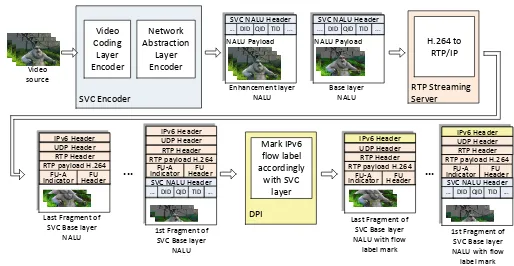
Fig. 1. Encapsulation of SVC video at different stages
Amendment 3 to MPEG-4 Part 10 (AVC) [10] and in Annex G of the ITU-T Recommendation H.264 [11].
SVC additions to MPEG-4 AVC/H.264 enable the partial multi-layered transmission and decoding of video bit streams hierarchically organized in the so-called SVC layers (or sub-streams). This allows their adaptation by including or excluding layers at the source, in-network, at the destination or in a cross-layer fashion to face the heterogeneity of devices, e.g., screen resolution, processing capabilities; and network conditions, such as bandwidth, jitter, errors, etc.
An SVC stream consists on a base layer of the lowest quality and bit rate which is H.264/AVC compliant and several enhancement SVC sub-streams. Scal-ability is provided by partially decoding an SVC stream which allows to increase the received quality as higher enhancement layers are completely received. It also allows to decrease it, in a graceful way, down to the base layer quality. Hence, the base layer transmission must be protected over the enhancement lay-ers, e.g., being sent over the best link or employing more robust error protection techniques.
As for H.264/AVC, SVC bit streams are encapsulated in Network Abstraction Layer Units (NALUs) which are designed for transmission in packet oriented networks. SVC extends the H.264/AVC by defining new types of NALUs and extending the standard H.264/AVC NALU header with the fields to identify the scalability layer carried by the payload of the SVC NALU. The above explanation regarding the encapsulation of the different SVC flows is shown with higher detail in Fig. 1.
There are different types of scalability dimensions for SVC video bit streams:
– Spatial scalabilityis provided by encoding layers with different image sizes (picture resolution). The use of this feature is identified by the field depen-dency id (DID) of the SVC NALU header.
– Signal-to-Noise Ratio (SNR) scalability is provided by encoding layers with different quantization parameters (QPs) which determine the video qual-ity, i.e., the higher the QP the lower the quality. Two types of encoding can be selected for this mode; i) Coarse-Grain Scalability (CGS) which allows per-layer adaptation and ii) Medium-Grain Scalability (MGS) which allows to progressively refine the quality by dropping certain NALUs. The use of this feature is identified by thequality id (QID) field.
Hence, an SVC layer is formed by SVC NALUs having the same (DID, TID, QID) in the SVC NALU header.
RTP payload format for SVC [12] extends the one for H.264/AVC and allows SVC streams to be transmitted over single or several RTP sessions: single-session transmission (SST) or multi-session transmission (MST).
Depending on the size of the NALUs and other constraints, an RTP stream-ing server can encapsulate each NALU in an RTP packet (Sstream-ingle NALU Packet), aggregate multiple NALUs in the payload of a unique RTP packet (Aggregation Packet) or fragment them into several RTP packets or Fragmentation Units (FUs) in which case only the first fragment contains the SVC header and there-fore the SVC layer information. This limitation, specially when using SST trans-mission mode, increases the complexity of the network mechanisms in charge of the adaptation of the SVC stream, as it does not allow for per-packet stateless in-spection of the stream, being Deep Packet Inin-spection (DPI) techniques required to keep the current SVC layer information state for FUs. For the experiments performed in this work, we take advantage of DPI in order to set the flow label field in the IPv6 header with a mark according to the SVC layer. In this way, at next stages of the transmission, the routers can exploit the flow label to route or redirect packets according to their policies (see Fig. 1).
5 IP Flow Mobility Management and SVC
Quality of Experience has become a hot topic while delivering media content over heterogeneous wireless access networks. The combination of cellular technology, by nature a centralized and managed wireless medium with guaranteed QoS, with WiFi, by nature an unmanaged and distributed technology, requires different ways of assessing the video quality perceived by the end user. QoE evaluation is a key tool and this article shows how QoE can be augmented by leveraging the multi access connectivity of mobile devices.
5.1 Architecture and key components
Fig. 2.PMIPv6 flow mobility operation
MN - LIF The Logical Interface (LIF) is commonly implemented as part of
the connection manager software of the MN, which is in charge of handling and automatically configuring the different network interfaces. Although the implementation of the LIF requires some changes on the client side, those are part of an already required terminal component (the connection manager), and does not have any impact on the IP stack, which remains standard. The LIF is a software entity that hides the real physical interface implementation to the host IP layer. Its use allows the MN to provide a single and permanent interface view to IP and higher layers, that can bind to this interface in order to establish any remote communication. Internally the logical interface is able to leverage several functionalities such as inter-technology handover, multi-homing or flow mobility, while presenting always the same IP address (or set of IP addresses) to higher layers. The LIF hides to the IP layer the physical interface used to actually send each packet, hence the movement of a flow from one physical interface to another is transparent to the IP and higher layers. Even more, it supports sequential attachment of interfaces as they come up, so the flow mobility features can be started in order to offload some interface or network (e.g., 3G offload) as soon as a new interface becomes active (e.g., a WiFi interface associates with an Access Point), without the higher layers being aware of it. In this way, the use of the LIF, sometimes referred to as Virtual Interface, enables the MN to suffer no drawbacks from the split of the SVC packet flow through different access technologies.
MAG - PMIPv6 extended for flow mobility As explained above,
prefix that has not been delegated by it to the MN. In [7] several cases showing the possible configurations for the combinations of prefixes and interfaces are de-tailed. The IETF is mainly focusing on two scenarios:i)the so-called “handover with full flow granularity”, which consists in the movement of a specific flow from one interface to another (e.g., a video-conference where the voice is going through a reliable interface such as 3G and the video through a high bandwidth link such as WiFi, but both flows are addressed to the same prefix), andii) the movement of a complete prefix and all the communications using it, to another interface, scenario often referred to as “partial handover”.
Both cases face the problem of requiring the target MAG to be aware of the prefixes through which the MN is receiving traffic. Flow mobility signaling takes place whenever the LMA decides to move a flow from one access to another. At the time of movement, either the prefix is already known at the target MAG or the LMA must advertise it to the MAG which is going to receive traffic addressed to this prefix. In the case the MAG already knows the target prefix, the LMA simply switches the flow to the target MAG, and no extra signaling is required. In the case signaling is required, the IETF is defining new messages to manage the notification to the MAG of the new flow/prefix to be forwarded.
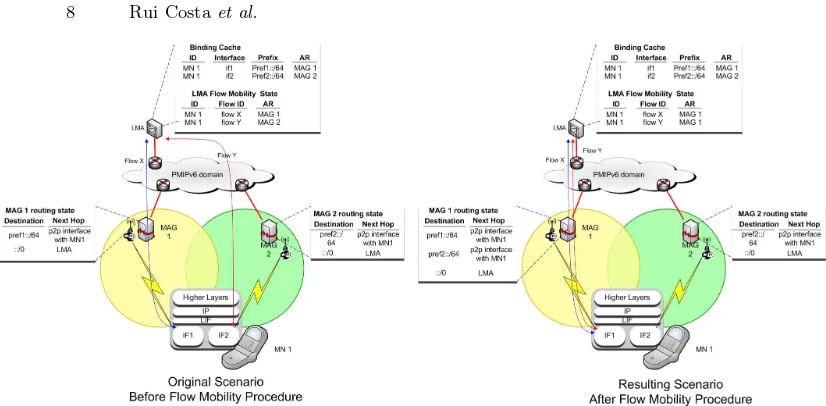
Fig. 2 shows an example of the initial and resulting routing state of the net-work upon a flow mobility procedure is completed. Let us suppose the following scenario: an MN (MN 1) is attached to the network through two interfacesif1, connected to MAG1, andif2, connected to MAG2 and each one receives a prefix,
pref1::/64 forif1andpref2::/64for if2respectively. The MN is receiving
two flows, Flow X and Y. Flow X is addressed towards pref1:lif(being lif the resulting EUI64 identifier of the Logical Interface) and is forwarded through MAG1, while Flow Y is addressed topref2:lifand is forwarded though MAG2. Following this configuration, the LMA has a conceptual data structure called the Flow Mobility Cache containing the mapping of flows and corresponding MAGs. This mapping can be based on any of the flow identifiers defined in [13].
At some point in time the LMA decides to move Flow Y from MAG2 to MAG1. The decision can be based on application profiles, or traffic type ori-ented policies triggered due to network congestion, for instance. In order to do so, the LMA needs to signal MAG1 that Flow Y is going to be forwarded through it. Using dedicated signaling, the LMA is able to install state in MAG1 regard-ing the identification of the flow and the identity of MN 1. Once this state is installed on MAG1, the LMA modifies the mapping stored in its Flow Mobility Cache, indicating that Flow Y is routed through MAG1 and starts forwarding the packets towards MAG1. The final state after flow mobility completion of the routing configuration on the network is also presented on Fig. 2.
This flow routing mechanism can be used to influence how an SVC encoded packet flow is routed. This means that marked packets with a certain flow label (i.e., containing the same video layer) will be routed according to the quality layer they contain, and therefore through a different technology if necessary.
LMA - FM The key addition is the intelligence in the Flow Manager to
policies. In particular the flow manager is capable of splitting a single video flow across two different wireless access technologies. By means of specific informa-tion contained in the IPv6 header (the flow label field) the flow manager can route the packets containing the different video layers on the most appropriate wireless medium. The key idea is that the Flow Manager receives information about traffic load, network congestion and can react accordingly. By leveraging on the complement of WLAN access it can therefore deliver different video qual-ity sub-streams on different wireless access media. By nature low qualqual-ity layers have low bandwidth requirements while high quality layers are more greedy in terms of bit rate. To this end, dynamic decision can be taken. If the MN has only cellular technology and the stream is badly played, the quality can be lowered (high quality layers dropped) to preserve customer satisfaction. In case the MN has both cellular and WLAN coverage (and the cellular network is overloaded) the LMA can send low quality layers on the cellular connections and route high quality layers over the WLAN connection. Thus a flow can be split across dif-ferent access technologies according to routing and policy rules, allowing the evaluation of the perceived feedback to be done by the network.
SVC server The SVC server transmits SVC encoded streams. In addition, it
marks the outgoing packets to embed in the IPv6 header the information related to the carried quality layer. This packet marking could also be performed by a network entity, like the LMA, so no direct interaction between the video service provider and the network video provider is required (in case they are not the same).
6 Experimental Setup
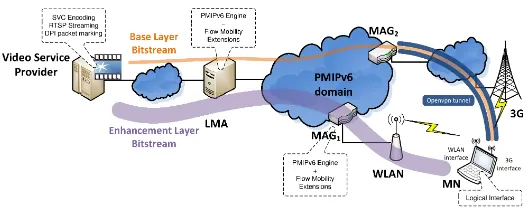
The benefits that can be obtained from the use of a combined SVC and flow mobility approach are shown through an experimental analysis, which setup is depicted in Fig. 3.
The testbed features an MN implementing the LIF over 3G (USB dongle) and WiFi interfaces . The 3G part relies on an in-house UMTS network while the WiFi link is provided by an IEEE 802.11b/g Access Point. Each access tech-nology is connected to a different MAG: WLAN is configured for direct IPv6 connectivity between MAG and MN while over the 3G access a VPN (Open-VPN3
) IPv6-in-IPv4 tunnel is built, due to the limited availability of IPv6 in 3G access. The MAGs implement the IP flow Mobility extensions developed for [5], while the LMA box includes flow mobility management software. The video server is based on the Live5554
library, which supports SVC streaming through RTSP encapsulation. Also, the video server runs a tool to mark the packets according to the explanation given in Section 4. As video client, the MPlayer5
3
http://www.openvpn.net/
4
http://www.live555.com
5
Fig. 3.Experimental setup
application was selected, since it supports the SVC codec through Open SVC Decoder6
library.
The video used for our tests is a two minutes-long scene taken from an animation movie7
with resolution 640x360 encoded with JSVM8
software, using SNR MGS mode with two layers: basic, with QP = 46 resulting in an average bit rate of 150 Kbps, and enhancement, with QP = 26 and rough average bit rate of 900 Kbps. The overall video stream is hence transmitted at more than 1 Mbps on average, and we argue these characteristics are typical for streaming good quality videos on hand-held devices.
Our experiment consists in streaming the SVC coded video, which in the remainder will be referred as SVC local, from the server outside the PMIPv6 domain to the MN, under three different conditions, which depend on the avail-ability of connectivity options for the MN:
– SVC 3G scenario: the MN is attached to the 3G MAG only, and both SVC
video sub-streams are delivered to the client, as no policy is defined at the flow manager;
– SVC 3G basescenario: the MN has only the 3G link active, but, according to
an operator’s decision (e.g., due to congestion), the flow manager at the LMA drops the flow related to the enhancement layer, based on the assumption that the 3G network cannot cope with a satisfactory delivery of both layers, or that it is consuming too many resources on the access;
– SVC 3G/WiFi scenario: the MN is connected to the network through the 3G
and WiFi links. The attachment to multiple MAGs is detected by the LMA and the FM, which installs routing rules to forward the low quality sub-stream via the 3G MAG, and the high quality layer through the WiFi MAG.
The system can automatically switch among any of the described scenarios, as the flow manager, Mplayer and the LIF run custom tools to react promptly to a change in the network conditions (which are simulated in our platform), producing the proper adjustments smoothly. From the user’s perspective, no
6
http://sourceforge.net/projects/opensvcdecoder/
7
http://www.bigbuckbunny.org/
8
Table 1.Video ratings summary
Video MOS 95% confidence interval SVC 3G 2.44 ±0.30
SVC 3G base 1.36 ±0.22 SVC 3G+WiFi 3.36 ±0.27
manual intervention is required, as MPlayer can seamlessly switch between SVC layers, by using an ad-hoc LIF-to-MPlayer API based on flow and interface information (it can be easily extended to allow sending commands to the NICs, e.g., to power up and/or to associate to an ESSID/APN).
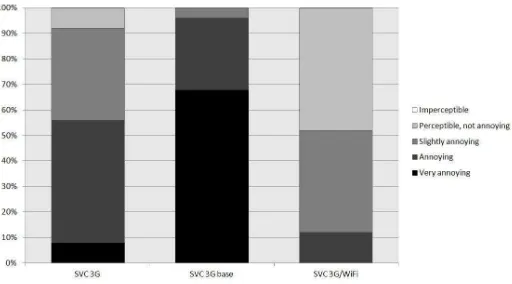
In order to assess the validity of our proposal, we conducted a Double Stim-ulus Impairment Scale (DSIS) test. Following ITU-R Rec. BT 500-11 for the subjective evaluation of video and audio quality, we showed to 25 users the 3 videos related to the corresponding test scenarios against SVC local, which is taken as reference. After watching the videos, the people involved in the test were asked to rate the degree of impairment with respect to the reference on the standard discrete five-level scale:Very annoying(mark 1),Annoying (2),slightly annoying (3),Perceptible, but not annoying (4) andImperceptible (5).
Fig. 4.Marks distribution for the video samples
The results obtained are summarized in Table 1, where the Mean Opinion Score (MOS) and the 95% confidence interval are shown. The complete distri-bution of the ratings collected for each video sample is depicted in Fig. 4.
The PMIP+Flow Mobility intelligence is now able to re-direct the video layers through both paths to the terminal, therefore restoring a video quality that is equal or better to what experienced with the 3G only. More, a key-aspect in this latter scenario, is that the resource consumption in the 3G network (the most critical for an operator) is kept identical as that in scenario 2, where the enhancement layer is dropped.
7 3GPP Considerations
The experimental platform depicted in Section 6 has been implemented using the IETF standard for network based mobility, namely PMIPv6. PMIPv6 has also being adopted by 3GPP9
as alternative to the GPRS Tunneling Protocol (GTP) protocol. In the 3GPP architecture, both protocols can be used to im-plement tunneling mechanisms between the Serving Gateway (S-GW) and the PDN Gateway (P-GW) to handle user mobility. The S-GW includes the MAG functionality while the P-GW implements the LMA functionality. We argue that the results presented for the PMIPv6 case hold also in the case of a GTP based network, being the terminal not impacted by any mobility signaling. In addi-tion, the mapping of the flow management functionality to the 3GPP architec-ture concerns the Policy Charging and Rules Function (PCRF), an already well established component in the 3GPP Evolved Packet Core. To summarize, the concepts demonstrated in this article nicely fit into the 3GPP architecture and the intelligence implemented to handle SVC based applications is added value for mobile service providers.
8 Conclusions
In this article we show the benefits of leveraging simultaneous wireless access technologies while receiving video content. In particular the use of cellular and WiFi networks combined with SVC based applications has been experimentally demonstrated. The vertical integration of these technologies allows mobile ser-vice providers to reduce the cost per bit while maximizing the perceived QoE by the end user. Starting from previous work on IP flow mobility, we extended the experimental framework for SVC based applications. A packet marking func-tion is proposed to intelligently mark SVC payloads and video aware rules are installed in the mobility anchors to reach mobile users on both cellular and WiFi networks. The experiments confirm that the proposed technology outper-forms current solutions achieving a better performance than current approaches. Finally, as next steps we plan to design and implement a better feedback mech-anism, relaying more information from the mobile device to the network so to more efficiently adapt the stream and therefore the perceived QoE. The impact of additional parameters, such as the range of access technologies, number of SVC layers, number and class of streaming users will be further explored.
9
Acknowledgment
The research leading to these results has received funding from the European Commission’s Seventh Framework Programme (FP7-ICT-2009-5) under grant agreement n. 258053 (MEDIEVAL project). Antonio de la Oliva has also received funding from the Spanish Government, MICINN, under research grant TIN2010-20136-C03.
References
1. T. Sutinen and H. Rivas, “Multi-interface Extension to a Scalable Video Streaming Architecture”,Journal of Communications, Vol 6, No 9 (2011), 700-710, December 2011
2. Y. Hsiao, J. Lee, J. Chen and Y. Chu, “H.264 video transmissions over wireless networks: Challenges and solutions”, Computer Communications, Volume 34, Issue 14, Pages 16611672, September 2011
3. B. Ciubotaru and G.-M. Muntean, “SASHAA quality-oriented handover algorithm for multimedia content delivery to mobile users”, IEEE Trans. Broadcast., vol. 55, no. 2, pp. 437450, June 2009
4. A. de la Oliva, C. J. Bernardos, M. Calderon, T. Melia and J. C. Zuniga, “IP Flow Mobility: Smart Traffic Offload for Future Wireless Networks”, IEEE Communica-tions Magazine, October 2011.
5. T. Melia, C. J. Bernardos, A. de la Oliva, F. Giust, M. Calderon, “IP Flow Mobility in PMIPv6 Based Networks: Solution Design and Experimental Evaluation”, Wire-less Personal Communications Journal, Springer, DOI 10.1007/s11277-011-0423-3, October 2011
6. S. Gundavelli et all, “Proxy Mobile IPv6”, RFC 5213 (Proposed Standard), Internet Engineering Task Force, August 2008
7. C. J. Bernardos, “Proxy Mobile IPv6 Extensions to Support Flow Mobility”, draft-bernardos-netext-pmipv6-flowmob-02, Internet Engineering Task Force, February 2011.
8. R. Braden, “Requirements for Internet Hosts - Communication Layers”, Internet Engineering Task Force, RFC 1122 (Standard), October 1989.
9. T. Melia and S. Gundavelli, “Logical Interface Support for multi-mode IP Hosts”, Work in Progress, draft-ietf-netext-logical-interface-support-01, Internet Engineer-ing Task Force, October 2010.
10. ISO/IEC, “Information technology – Coding of audio-visual objects – Part 10: Ad-vanced Video Coding”, 14496-10:2005
11. ITU-T Recommendation H.264, “Advanced video coding for generic audiovisual services”, November 2007
12. S. Wenger, Y.-K. Wang, T. Schierl and A. Eleftheriadis, “RTP Payload Format for Scalable Video Coding”, RFC 6190, Internet Engineering Task Force, May 2011 13. G. Tsirtsis, G. Giarreta, H. Soliman, and N. Montavont, “Traffic Selectors for