Overhearing Assisted Optimization of Address
Auto-Configuration in Position Aware VANETs
Marco Gramaglia, Ignacio Soto, Carlos J. Bernardos, Maria Calderon
Abstract—Vehicular networks allow vehicles to exchange
infor-mation that can be used to improve traffic efficiency and drivers’ safety. In addition to these new applications, Internet connectivity is also expected to be available in the cars of the near future, speeding up the global adoption of vehicular communication systems. One of the requirements for connecting vehicles to the Internet is their ability to auto-configure IP addresses. In this article, we propose an optimization to Geographically Scoped stateless Address Configuration (GeoSAC), which is an IP address auto-configuration mechanism for geographically aware location vehicles. The benefits of this optimization are two-fold: it can reduce the IP address configuration time, and it can be used to reduce the signaling overhead of GeoSAC. The optimization does not require any changes to the GeoSAC operation, being fully compatible with the original solution. We derive an analytical model for the probability of our optimization being effective in realistic scenarios and for the IP address configuration time. We also provide a thorough evaluation of the performance improvements of the optimization, including simulations with a realistic model for wireless technology, real vehicular traces, and experiments with a real prototype, which provide strong support for our analytical model.
Index Terms—VANETs, Geo-networking, IP address
auto-configuration, GeoSAC.
I. INTRODUCTION
V
EHICULAR communications are going to have an im-pact on the way we drive in the not-too-distant future. Driven by the goals of improving road safety and efficiency, governments, car manufacturers and telecommunication play-ers are working towards the definition of a communications ar-chitecture that enables vehicles to benefit from communication capabilities. Among the different candidate architectures that could be applied to tackle the problem of vehicular commu-nications, Vehicular Ad Hoc Networks (VANETs) have been adopted by the majority of the existing initiatives, due to their decentralized nature, which supports an unmanaged operation without infrastructure involvement. The primary advantage ofCopyright (c) 2011 IEEE. Personal use of this material is permitted. However, permission to use this material for any other purposes must be obtained from the IEEE by sending a request to [email protected]. Marco Gramaglia, Carlos J. Bernardos and Maria Calderon are with the Department of Telematics Engineering, Universidad Carlos III de Madrid, Avda. Universidad, 30, 28911 Leganes (Madrid), Spain (e-mail: [email protected],{cjbc, maria}@it.uc3m.es).
Marco Gramaglia is also with Institute IMDEA Networks, Avda. del Mar Mediterraneo, 22, 28918 Leganes (Madrid), Spain.
Ignacio Soto is with the Department of Telematics Engineering, Universidad Polit´ecnica de Madrid, Avda. Complutense, Ciudad Universitaria, 28040 Madrid, Spain (e-mail: [email protected]).
The research leading to the results presented in this paper has received fund-ing from the Spanish MICINN through the I-MOVING project (TEC2010-18907).
deploying this kind of self-organized network is that timely critical applications, such as life-safety applications, can be implemented by letting vehicles directly communicate to each other instead of relying on a centralized entity. Although safety related applications have been the main focus of research and standardization efforts so far, ensuring coexistence with other types of applications, specifically non-safety related ap-plications (e.g., infotainment or generic Internet apap-plications), has also been considered. Integrating the Internet Protocol (IP) into the system architecture not only enables vehicles to access classical and new Internet applications, but also takes advantage of all the operational experience with IP networks and the huge amount of implementations and resources that are available. This will help speed up the deployment of vehicular communication systems because the manufacturers and operators involved can save money by reusing existing resources, and users will see the additional benefit of the installation of a communication system in their cars (i.e., it would be not only safety oriented, but allow for Internet-based services).
The feasibility of Internet access from vehicles has been addressed in several research studies, assuming single-hop access in some cases [1] [2] and multi-hop access in others [3] [4] to the Internet; they have concluded that the use of IP-based applications over VANETs is viable. However, the provision of vehicles with Internet access by partially re-using the multi-hop VANET system architecture that is used for supporting safety applications is a problem that has not been yet extensively researched [5] [6] [7]. Note that we highlight the multi-hop VANET nature of the scenario because enabling Internet connectivity by using a single-hop access technology of wide-area coverage, such as 3G, does not pose any significant design challenge, although it has cost and performance drawbacks. Some functionalities will be required to bring IP into multi-hop vehicular networks: a) the capability of vehicles to auto-configure an IP address, b) IP mobility mechanisms suited for the multi-hop vehicular scenario, and
c) mechanisms for an efficient transmission and forwarding of
IP datagrams within the VANET.
Car-to-Car Communications Consortium1 (C2C-CC) and the
European Telecommunications Standards Institute Technical Committee Intelligent Transport Systems (ETSI TC ITS2).
The ETSI TC ITS system architecture, the basic operation of GeoSAC, and the motivations supporting the need for GeoSAC optimization are presented in Section II.
In this article, we propose an optimization mechanism for GeoSAC, based on nodes overhearing (when possible) information about the IP prefixes that they might use to configure an IP address in the future (due to the movement of the nodes). This method saves time that would otherwise be needed to reactively determine the above information. The overhearing assisted optimization mechanism and its proba-bility of being effectively used are described in Section III. We mathematically analyzed the optimization and compared it to the performance of the original GeoSAC solution in Section IV. The improvements in terms of address configu-ration time reduction and signaling saving, and their impact when combined with the use of an IP mobility solution were experimentally evaluated via simulations in different scenarios. Vehicular traces obtained from highways in Spain were also used to validate our analysis. Finally, we present in Section V the results of an experimental evaluation conducted with a real prototype in a testbed composed of 40 nodes. The obtained results show that our optimization mechanism is feasible and could be used to significantly improve the performance of GeoSAC. We conclude the article in Section VI.
II. BACKGROUND ANDRATIONALE
A. Related Work
The multi-hop nature of VANETs and their lack of a single multicast-capable link for signaling prevent current IPv6 address auto-configuration related protocol specifications from being used as-is in VANETs. This fact applies both to the IPv6 Stateless Address Auto-Configuration (SLAAC) [8] [9] and to its stateful counterpart DHCPv6 [10]. Besides, due to node mobility a vehicular network may get partitioned, or independent networks may merge, causing additional problems that need to be tackled [11].
There are several studies in the literature that propose to adapt DHCP mechanisms to work on VANET environments following distributed [12] or centralized [13] approaches. The Vehicular Address Configuration (VAC) protocol [12] uses a distributed DHCP service. It consists of a dynamic leader-based approach in which addresses are assigned by dynamically elected leaders running a DHCP server. Leaders coordinate with others within a certain distance (i.e., within the SCOPE parameter) to maintain updated information on currently assigned addresses and avoid the existence of du-plicates. By contrast, the Centralized Address Configuration (CAC) [13] employs a centralized DHCP server located in the infrastructure that can provide unique IP addresses to all vehicles in an urban area. In this case, access routers for the Internet relay configure messages between vehicles and the central DHCP server, which can ensure that vehicles will not
1http://www.car-to-car.org/ 2http://portal.etsi.org/its/its tor.asp
be configured with duplicate IP addresses. The main weakness of DHCP-based proposals is the time required to acquire or lease an IP address [1].
Enabling address auto-configuration by adapting the IPv6 Stateless Address Auto-Configuration (SLAAC) mechanisms to work in position-aware, multi-hop VANETs has also been researched [6] [7]. In Choi et al. [6], each vehicle obtains a different IPv6 prefix (by means of a Router Advertisement message) from the access router, and all the IP signaling messages are exchanged through a virtual point-to-point link set between the vehicle and the access router. In the case of GeoSAC [7], the concept of an IPv6 link is extended to a specific geographic area associated with a point of-attachment (e.g., an access router), and all the vehicles within the area share the same IPv6 prefix.
The main drawback of Choi et al.’s work is the need for a proactive mechanism to discover the access router to the Internet. This mechanism is needed both initially and after movements, but the paper does not tackle the issue of how mobility across multiple access routers is to be handled. As detailed in the next section, however, GeoSAC (thanks to the concept of an IPv6 link covering a specific geographic area associated with an access router) enables the standard IPv6 mechanisms of movement detection to be used as-is.
B. GeoSAC and the ETSI TC ITS system architecture
GeoSAC (Geographically Scoped stateless Address Config-uration) [7] is a mechanism for the application of an IPv6 au-tomatic address configuration technique to vehicular networks that is based on combining standardized IPv6 schemes with geographical routing functionalities. GeoSAC is defined in [7] for the VANET system architecture proposed by the C2C-CC. The ETSI TC ITS is defining a reference system [14] that is based on the C2C-CC recommendations. GeoSAC and the optimization proposed in this article work in both communication architectures because they are basically the same. The ETSI TC ITS is the technical committee that has received a standardization mandate from the European Commission for the development of short-range Intelligent Transportation Systems (ITS) communication protocols. We next describe the ETSI TC ITS reference system, and assume its use in the rest of this article.
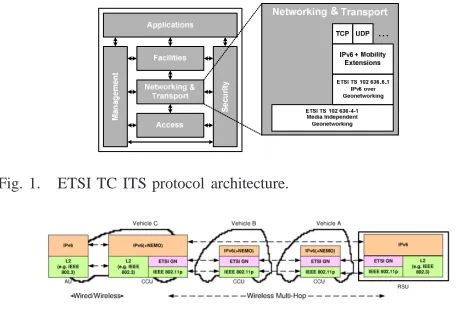
Fig. 1. ETSI TC ITS protocol architecture.
Fig. 2. GeoSAC forwarding within an area, and affected protocol layers.
are assumed to have a standard IPv6 protocol stack, whereas CCUs act as gateways for the in-vehicle network and are optionally enhanced with the Network Mobility Basic Support protocol [15].
The ETSI GeoNetworking (GN) protocol [16] plays the role of a network layer protocol in the ETSI TC ITS architecture, providing routing and addressing facilities in the upper layers. Given the nature of vehicular communications, a geographical-based routing and addressing approach has been adopted. An intermediate node forwards a packet to the direct neighbor that is the closest to the geographic position of the destination, an operation known as greedy forwarding. So, each node must be aware of i) the position of its direct neighbors and
ii) the position of the final destination. To this end, nodes
send periodic beacon messages informing neighboring nodes about their identifier, position and other relevant information. As for the position of the final destination, this information is provided by a location service. This functionality may be centralized (i.e., nodes updating their new locations on a location server) or distributed (e.g., the source node floods a message asking for the position of the destination node). Each node has one or more identifiers at the GN layer that are resolved to the position of the node by the location service.
GeoSAC [7] adapts the existing IPv6 Stateless Address Auto-Configuration (SLAAC) [9] [8] mechanisms to geo-graphic addressing and networking by extending the concept of an IPv6 link to a specific geographical area associated with a point-of-attachment. In GeoSAC, the ETSI GeoNetworking layer [16] plays the role of sub-IP layer (see Fig. 1), dealing with ad-hoc routing by using geographic location information, and presenting to the IPv6 layer a flat network topology. Consequently, the link seen by the IPv6 layer includes nodes that are not directly reachable but are portrayed as such by the sub-IP layer (see Fig. 3). This layer provides IPv6 with a multicast link that includes a non-overlapping partition of the VANET formed by all nodes within a certain geographical area [17]. The ETSI GN layer also avoids layers above to deal with the complexity given by using geographical information for routing and broadcasting. ETSI GN layer geo-broadcasting is used by GeoSAC in order to shape multicast/broadcast messages to a geographical area.
The RSU sends out standard IPv6 Router Advertisement
Fig. 3. ETSI TC ITS system architecture and GeoSAC area partitioning.
(RA) messages3 which reach the nodes currently located
within a well-defined area, and the nodes can then generate IPv6 addresses appending their network identifier (derived from the identifier used at the GN layer) to the received IPv6 prefix. RA multicasting is scoped geographically, so, at the GN layer, a vehicle only forwards an RA if the RSU that generated it is placed within the same GeoSAC area as the receiving node. We use the example shown in Fig. 3 to explain the way GeoSAC makes use of the ETSI GN layer to logically deliver packets between two nodes that, although communicating via multiple wireless hops, are logically attached to the same logical IP link. Suppose a device within Vehicle C wants to communicate with a node on the Internet. At the IP layer, Vehicle C and the RSU are directly connected (i.e., one hop distance), so Vehicle C uses the RSU as IP next-hop for the packets that it sends to the Internet. For that single-hop IP data forwarding to happen, Vehicle C must send the packets to Vehicle B, which forwards them to Vehicle A, which finally delivers them to the RSU. Note that this multi-hop forwarding is required because Vehicle C is not within the radio coverage (i.e., a single hop) of the RSU. If Network Mobility (NEMO) support is enabled, no changes are required in the operation of the mobility protocol, as the multi-hop nature of the vehicular network is hidden from the IP stack, due to the use of GeoSAC and the ETSI TC ITS GeoNetworking protocol. It is also worth mentioning that vehicles learn the geographic position of the RSUs from the RAs that they broadcast because this information is included in the GN protocol header of the frames.
The previous example shows that in a system architecture based on short range communication devices, the effective pro-visioning of Internet-based applications over multi-hop com-munication strongly depends on mobility. Single-hop vehicular Internet access based on WLAN has already been investigated in highway scenarios [18], for which it was concluded that the link between the CCU and the RSU is stable enough to allow for several types of applications.
3Note that the GeoSAC solution could be applied to multiple RSUs acting
C. Reducing the IP address auto-configuration time and sig-naling overhead
This section summarizes the main reasons why optimizing the mechanism used to provide nodes with an IPv6 address is important in the context of vehicular communications. The benefits from this optimization are two-fold: reducing the IP address configuration time and minimizing the signaling overhead caused by the solution.
Because the concept of an IPv6 link is associated with a specific geographical area, in GeoSAC, each vehicle must stop using its old IP address and configure a new one every time it changes areas. This reconfiguration involves a time during which the vehicle cannot communicate, lasting until a valid IP address is configured and becomes usable. We call this time configuration time Tconf, and it is formally defined as
the time elapsed from the moment a vehicle enters a new geographical area (thereby losing the connectivity to the old RSU) until the moment it starts using the newly configured global IPv6 address. Obviously, the shorter the time required to configure a new address, the better because the interruption time will be shorter. Unless additional mechanisms are in place, each time a vehicle changes its IP address, it must restart all existing communications. IP mobility solutions (e.g., Mobile IPv6 [19]) have been designed to enable IP address changing without breaking ongoing communications. In order to provide mobility support to the network formed by the CCU and the AUs, Network Mobility (NEMO) solutions have been defined [15] and further refined for the vehicular scenario [20]. The use of IP mobility protocols solves the problem of communication disruptions due to the change of IP address, but it does not avoid the interruption time caused each time the vehicle changes its IP address. Actually, this time is typically increased when IP mobility solutions are used because of the additional time required to complete the signaling with the mobility anchor point (e.g., the Home Agent in Mobile IPv6/NEMO). It should also be noted that due to the high mobility of nodes, it is even more important to reduce the overall interruption time (called handover latency) because handovers are more frequent than in other scenarios [21].
There is another metric worth improving: the signaling overhead. To configure a new address in GeoSAC, a vehicle waits to receive an unsolicited RA from the RSU of the new area; therefore, the configuration time is bound to the frequency with which the RSU of the area is sending RAs. In addition, due to the way the ETSI GN and GeoSAC abstract an IPv6 link (mapping it to a geographical area), each RA multicast by an RSU is actually flooded within the area managed by the RSU, which therefore occupies the wireless media for more time than does one single-frame transmission. Therefore, reducing the frequency of unsolicited RAs is even more important than in a non vehicular, single-hop wireless scenario.
Driven by these two goals, reducing the address configura-tion time and keeping the signaling overhead to a minimum (note that there is a trade-off here), we next propose an overhearing-assisted optimization mechanism for GeoSAC.
III. OVERHEARING-ASSISTEDOPTIMIZATION FOR
GEOSAC
In this section, we present an extension to the original GeoSAC that provides an important performance improvement and a signaling overhead reduction. An overview of the mech-anism is first provided, and then the probability of achieving seamless IP address reconfiguration is analytically modeled.
A. Solution overview
Our approach aims at reducing the IP address configuration time due to physical node movements that lead to a change of geographical area of the IPv6 link and ultimately of the IPv6 address. While the node is configuring a new IPv6 address (configuration time), the vehicle cannot communicate and has to defer its ongoing communications until a new and valid IP address is configured and becomes usable. Note that even if perfect juxtaposition of areas can be logically obtained in GeoSAC, in a practical scenario this separation does not really exist at the physical layer. Nodes within radio range of the forwarder of an RA located in an adjacent area also receive the RA. The original GeoSAC mechanism [7] mandates that this RA should be filtered out at the ETSI GN layer, to achieve perfect logical area division. However, nodes can benefit from
overhearing RAs generated at areas other than the one where
the receiving node is located. In this way, vehicles would be able to learn the IPv6 prefix used in a neighboring area before actually entering it, and they would be able to pre-compute the IPv6 address and default router configuration that should be used when located in that area (i.e., just after crossing the area border).
When a vehicle overhears RAs from multiple neighboring areas (e.g., cities, road intersections, etc.), it stores the over-heard RAs for some time. The vehicle learns the geographical area from which the RA was sent by using the destination information at the ETSI GN layer, which is set to the geo-graphical area by the RSU when multicasting RAs. By storing these RA-area pairs, the vehicle will be able to configure an IP address without waiting for an unsolicited RA if it later enters one of the areas about which it has knowledge.
This overhearing-assisted optimization allows shortening of the average IP address configuration time, in addition to a potential reduction of the required overhead. By enabling this optimization, GeoSAC improves its performance because nodes that successfully overhear an RA from an area where they later enter can start using their new addresses without waiting for a new RA, and with no extra overhead. The improvement obtained depends on the mobility conditions inside the VANET and does not limit the benefits achieved from using non overlapping areas that are described in [7].
RSU
D
target fwd
area n-1 area n
RSU
2
⩽R ⩽R ⩽R
multi-hop connectivity (mhc)
D fwd⩽R
R
Dmhc
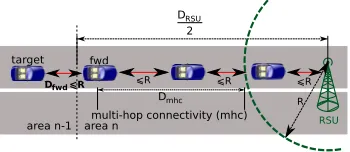
Fig. 4. Overhearing assisted optimization overview and terminology.
optimization is local to a vehicle, vehicles implementing this overhearing-assisted optimization will benefit from reduced IP address configuration time, without impacting in any way the performance or operation of other vehicles.
B. Overhearing probability
We first focus on analytically assessing how probable it is for a node to overhear an RA generated in a neighboring area. Let overhearing probability (Poh) be this probability. In this
section, we derive an analytical expression for Poh.
We assume that deploying vehicular networks without dead zones uncovered by an RSU is economically inefficient (at least for non-urban and not densely populated scenarios). As we have discussed in Section II-B, vehicles form a self-organized multi-hop network in the ETSI TC ITS architecture. This multi-hop network is used to forward (at the ETSI GN layer) the RAs sent by an RSU, which flood its associated geographical area and thereby extend the effective coverage area of the RSU.
We use the following terminology throughout the article (see Fig. 4). A vehicle that is located in the area n−1 and must be configured for the arean(i.e., an adjacent area) is called a
target. A forwarder (fwd) is a vehicle placed inside the arean that is also within the radio coverage of the target. LetDRSU
be the distance between two adjacent RSUs, R the wireless communication range,β the vehicular density, andvthe speed of the vehicles4. A target node successfully overhears an RA when the forwarder receives an RA and forwards it to the
target before it enters the area n. In order to be able to receive and forward an RA, the forwarder node should have connectivity with the RSU. Because this connectivity may involve multiple intermediate nodes (i.e., wireless hops), we call it multi-hop connectivity (mhc). Connectivity in ad-hoc networks has been thoroughly studied, but vehicular networks have special characteristics (in particular, the mobility patterns and range of speeds) that require specific analysis. Some studies have contributed to the characterization of connectivity in vehicular networks (for example, [22], [23], which focus on inter-vehicle connectivity), but in our paper, we analyze connectivity from the particular viewpoint of address auto-configuration, which requires characterizing the time needed until connectivity with an RSU (a fixed point in the road) is achieved.
4We consider the speed of all vehicles to be fixed and constant for the
sake of model simplicity. The simulation results we will present later prove that this simplification does not affect the validity of the conclusion of our analysis.
Given a forwarder node and the RSU, Pmhcf wd is the prob-ability of having multi-hop connectivity (that is, of having a chain of inter-connected vehicles between fwd and the RSU so that messages can be exchanged between them).
We next model the probability (Poh) of the target
over-hearing an RA originating at the area n. Poh, which can be
modeled by splitting the original problem into two comple-mentary sub-problems. Having mhc between the RSU and the forwarder node is a necessary condition for successfully overhearing an RA. Without mhc, no RA overhearing (oh) is possible; therefore, oh ⊂ mhc. From this condition, it is
straightforward to derive thatOH≡OH∩M HC:
Poh=P(OH) =P(OH∩M HC). (1)
By applying the conditional probability theorem in Eq. (1), we have:
Poh = P(OH∩M HC)
= P(OH|M HC)P(M HC)
= Poh|mhc Pmhcf wd, (2)
where Pmhcf wd represents the probability of mhc for the
forwarder. We first focus onPoh|mhc.
Let Trecv
nRA denote the time elapsed from the target vehicle
being at distanceR from an adjacent area border to the time it receives an RA sent by an RSU of that adjacent area. This time can be split in two parts. The first part (Tf wd)
represents the time elapsed until the forwarder vehicle leaves the area n−1, enters the next one and becomes ready to forward RAs to the target. The second part (Tunsol
RA ) is the time
elapsed until an RA from the RSU is received under this mhc assumption. We assume that the time between two consecutive RAs sent by an RSU (or an Access Router in the case when the RSU is working in bridge mode) follows a uniform distribution between a minimum value (MinRtrAdvInterval) and a maximum value (MaxRtrAdvInterval), which we refer to as Rm and RM, respectively [19]. By joining Tf wd and
Tunsol
RA , we can express TnRArecv as:
TnRArecv=Tf wd+TRAunsol. (3)
Assuming exponentially distributed distances between cars [24],Tf wd follows an exponential distribution with parameter
β; its probability density function (PDF) is given by:
fTf wd(t) =βve
−βvt, t≥0. (4)
Given that Tf wd and TRAunsol are independent, the PDF of
Trecv
nRA is given by:
fTrecv
nRA(t) =
fTf wd∗fTunsol
RA
(t)
=
2(1−βve(−βvt))
RM+Rm , 0≤t≤Rm,
2(βvRM−βvt+1−e−βv(t−Rm)−βv(RM−Rm)e−βvt) βv(R2
M−R2m) ,
Rm< t≤RM,
2e−βv(t−RM)−eβvRm−βv(RM−Rm) βv(R2
M−R2m) , t > RM.
Because an RA is overheard only if received by the vehicle before crossing the area border, and it takesR/v seconds for the vehicle to reach the border, the probability Poh|mhc of
overhearing an RA is given by:
Poh|mhc=
Z Rv
0
fTrecv
nRA(t)dt. (6)
Poh|mhc represents the probability of overhearing an RA,
given that there exists multi-hop connectivity between the RSU and the forwarder vehicle.
We next model Pmhcf wd, which depends on the distance between the RSU and the forwarder node, the radio coverage of the wireless communication technology and the vehicular density.
Given two nodes separated by a distance, D,Pmhc(D) is
the probability of having multi-hop connectivity between the two nodes. This probability depends on the distance between the two nodes (D), the radio coverage of the wireless commu-nication technology used (R) and the vehicular density (β). In order to have multi-hop connectivity between a forwarder node and the RSU, there should be a chain of connected vehicles (i.e., the distance between two consecutive vehicles must be less than or equal to R) between fwd and a vehicle within the direct (single hop) radio coverage of the RSU. If Dmhc
is the distance between these two nodes (see Fig. 4), then the probability of having multi-hop connectivity between the forwarder node and the RSU is given by Pmhc(Dmhc).
The distance between two consecutive vehicles that are part of a connected multi-hop chain of vehicles (i.e., one in which the inter-vehicle gap is smaller than R) follows a truncated exponential distribution [25]:
fte(d) =
( βe−βd
1−e−βR, 0< d < R,
0, otherwise. (7)
The length of a multi-hop connected chain ofn+ 1vehicles (Y) can be represented as the sum ofnindependent truncated exponential variables. The PDF of Y can be obtained by the method of characteristic functions [25]:
gY(y;n) = (βb) n
(n−1)!e −βy
k0
X
k=0
(−1)k
n k
(y−kR)n−1;
k0R < y <(k0+ 1)R, (8)
wherek0= 0,1,· · ·, n−1, andb= (1−e−βR).
Leta= (k0′+c)R, wherek0′ is an integer, and0≤c <1.
The cumulative distribution function (CDF) ofY evaluated at a isGY(a;n) =R
a
0 gY(y;n)dy:
GY(a;n) = 1 (1−e−βR)−n
k0
X
k=0
(−1)k
n k
e−βkR
Q[2(k0′−k+c)Rβ,2n]. (9)
where Q[u, w] =P χ2(w)< u
, andχ2(w) is a chi-square
variable with w degrees of freedom. Because the probability P(ihops)of having a connected chain ofihops is given by
(1−e−βR)i e−βR, the PDF and CDF of the length (L) of
a connected multi-hop chain of vehicles can be derived using the total probability theorem:
fL(l) = ∞
X
i=0
P(ihops)gY(l;i)
= ∞
X
i=0
(1−e−βR)ie−βRgY(l;i),
(10)
FL(l) =PL(L≤l)
=
Z l
0
fL(u)du= ∞
X
i=0
(1−e−βR)ie−βRGY(l;i).
(11)
If we consider the maximum possible value ofDmhc, which
is given by DRSU
2 −R, a pessimistic approximation ofP
f wd mhc
is given by:
Pmhcf wd=Pmhc(Dmhc)≥1−FL
D
RSU
2 −R
. (12)
The overhearing probabilityPohcan then be derived5 from
Eq. (2), using Eqs. (6) and (12):
Poh=Poh|mhc Pmhcf wd
≥
Z Rv
0
fTrecv
nRA(t)dt
1−FL
DRSU
2 −R
.
We next describe the experiments that we performed to validate our mathematical model. Using a Matlab-based sim-ulator6, we conducted a large amount of experiments under different traffic conditions. The simulator implements the model described in this section, namely, vehicles distributed on a one-dimensional road, traveling at a fixed and constant speed, with an exponential inter-vehicular distance and a maximum wireless radio coverage, assuming an ideal wireless technology (no loses nor collisions and infinite bandwidth). We argue that although the simulator used for these tests does not consider a real wireless model, it is sufficient to assess if our mathematical analysis correctly matches the overhearing success probability in the scenario we have used in the analysis. In Section IV-A, when we present our analysis for the configuration time, we use a more advanced simulator (OMNeT++), that does include a complete wireless model.
Because traffic conditions play a critical role in the efficacy of wireless multi-hop communications in a vehicular environ-ment, we studied several configurations in order to validate our model under different conditions. In order to limit the number of results presented in the article, we have selected the following four scenarios, which mostly cover a wide spectrum of the potential traffic scenarios:
• Urban road: high vehicular density (β= 80veh/km) and low speed (v= 50km/h).
5This approximation is also pessimistic because we only consider the first
opportunity to receive an unsolicited RA from the RSU, even though there may be more than one before crossing the border.
6The code of the simulator is available at http://fourier.networks.imdea.org/
0.2 0.4 0.6 0.8 1
0 2 4 6 8 10 12 14 16 18 20
Poh
TRA (Rm=0.75 TRA,RM=1.25 TRA)
sparse (analysis) highway (analysis) city beltway (analysis) urban (analysis) sparse (simulation) highway (simulation) city beltway (simulation) urban (simulation)
(a)DRSU= 1000m
0.2 0.4 0.6 0.8 1
0 2 4 6 8 10 12 14 16 18 20
Poh
TRA (Rm=0.75 TRA,RM=1.25 TRA)
sparse (analysis) highway (analysis) city beltway (analysis) urban (analysis) sparse (simulation) highway (simulation) city beltway (simulation) urban (simulation)
(b)DRSU= 1500m
Fig. 5. Overhearing probability,R= 150m.
• City beltway: moderate vehicular density (β = 50veh/km) and moderate speed (v= 80km/h). • Highway: low vehicular density (β = 35veh/km) and
high speed (v= 120km/h).
• Sparse: very low vehicular density (β = 10veh/km) and moderate speed (v = 100km/h). Examples of this scenario are city beltways and highways at night, or secondary roads.
For each of these scenarios, we conducted experiments using two different values of the wireless coverage radio R (150 and 300m) that cover possible IEEE 802.11-based tech-nologies. Figs. 5–6 show the analysis and simulation results for Poh versus different average intervals between Router
Advertisements for different deployment scenarios (defined by the distance between RSUs,DRSU). Note that different values
of DRSU are used depending on the value ofR because the
coverage radius of the wireless technology has an impact on the deployment. For small values ofR, it does not make any sense to deploy RSUs at long distances because the probability of having connectivity is low, and the number of hops is high (which has a negative impact on performance).
It can be noted from these results that our analytical model perfectly matches the results obtained via simulation7. From
these results, we can also observe that if a short range wireless
7Note that we have also performed simulations under several other traffic
conditions, and they supported the accuracy of our analytical model.
0.2 0.4 0.6 0.8 1
0 2 4 6 8 10 12 14 16 18 20
Poh
TRA (Rm=0.75 TRA,RM=1.25 TRA)
sparse (analysis) highway (analysis) city beltway (analysis) urban (analysis) sparse (simulation) highway (simulation) city beltway (simulation) urban (simulation)
(a)DRSU = 1500m
0.2 0.4 0.6 0.8 1
0 2 4 6 8 10 12 14 16 18 20
Poh
TRA (Rm=0.75 TRA,RM=1.25 TRA)
sparse (analysis) highway (analysis) city beltway (analysis) urban (analysis) sparse (simulation) highway (simulation) city beltway (simulation) urban (simulation)
(b)DRSU= 2000m
Fig. 6. Overhearing probability,R= 300m.
technology is used (R = 150m), high overhearing success probabilities can be achieved only if the RSUs are configured with short inter-RA values (TRA) and only for moderate
density scenarios (urban, city beltway and highway). For the case of R = 300m (i.e., for longer range wireless technolo-gies), the probability of overhearing an RA increases (being very close to 100%) without requiring too much resource-consuming TRA configuration settings. These results show
that our overhearing-assisted optimization is feasible and can effectively reduce the IP address configuration time in most of the practical scenarios. The results also show that for R= 300mthere is a high probability of overhearing an RA even in the sparse scenario. From this result, we can also observe the expected impact thatDRSU has onPoh, especially
with low vehicular densities.
IV. PERFORMANCEANALYSIS ANDEVALUATION
R
D
target
area n-1 area n
RSU 2
⩽R
no fwd in range
D >Rfwd
RSU R DRSU
2 - R
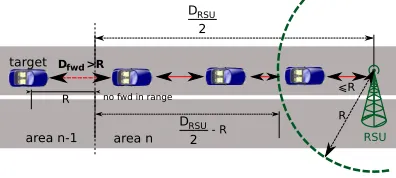
Fig. 7. No forwarder node within range of the target vehicle.
subsequent change of IP point of attachment and IP address), we also analyze the impact of the proposed optimization on overall performance when IP mobility is enabled.
A. IP address configuration time
The most obvious advantage of our overhearing optimiza-tion is the reducoptimiza-tion of the average IP address configuraoptimiza-tion time because nodes that successfully overhear a Router Ad-vertisement from a neighboring area are able to immediately configure an address if entering into that area afterwards. We define the GeoSAC IP address configuration time (Tconf) as
the time elapsed from when a vehicle crosses an area border till when it gets a valid IP address that can be used to send and receive packets while located in the new area. If our overhearing optimization is enabled, we call the configuration timeToh
conf. A node that overhears an RA from arean while
being at area n−1 and then enters into area n does not need to wait for any signaling before configuring and starting to use an IP address; therefore, Toh
conf = 0s in this case.
Depending on the deployment scenario and traffic conditions, it is not always possible for a node to successfully overhear an RA from an area that the node is about to enter. We performed a mathematical analysis that models Toh
conf. This
model allowed us to evaluate the gains obtained by using our optimization, focusing first on the IP address configuration time reduction compared to the case where plain (i.e., no optimization enabled) GeoSAC is used.
In order to make the analysis easier to follow, we have divided it into different parts, each of them corresponding to a different configuration scenario in which a node might be involved. This approach allows us to derive the average config-uration time of GeoSAC when our overhearing optimization is enabled. There are basically four possible situations that have to be considered:
(a) There exists a forwarder node (located in area n) in the wireless coverage of the target node (which is located in area n−1), there is multi-hop connectivity between the forwarder node and the RSU of arean, and the RSU sends an unsolicited RA while the target node has not yet crossed the area border (see Fig. 4). In this case (corresponding to overhearing success), the configuration time is 0s. (b) This case is identical to (a), but an RA from areanis not
received by the target node while still in arean−1. In this case, the configuration time is equal to the time elapsed from the target node crossing the area border until it gets an RA from the RSU. The average of this time (T¯wait RA)
is given by:
D
target fwd
area n-1 area n
RSU 2
⩽R
⩽R
no multi-hop connectivity >R D fwd⩽R
RSU R Lchain Dgap
Dfwd-RSU
Fig. 8. No multi-hop connectivity available between the target vehicle and the RSU.
¯
Twait RA=
R∞
R/vt
fF W D
Tf wd ∗fTunsol
RA
(t)dt
R∞
R/v
fF W D
Tf wd ∗fTunsol
RA
(t)dt − R
v,
(13)
wherefF W D
Tf wd is given by:
fTF W Df wd (t) = (
fTf wd(t) =βve−βvt, 0≤t≤R/v,
0, otherwise.
(14) (c) In this case, there is no forwarder node within radio range of the target node (see Fig. 7). The target node has to get direct (i.e., one hop) connectivity from the RSU first and then wait for the next unsolicited RA. The average configuration time (T¯no F W D) for this case is therefore
given by:
¯
Tno F W D=
DRSU/2−R
v + ¯T
unsol
RA . (15)
(d) In this case, there exists a forwarder node in wireless coverage of the target node at area n−1, but there is no multi-hop connectivity between the forwarder and the RSU of arean(see Fig. 8). The configuration time is the time required for the forwarder node to get connectivity to the RSU (as the forwarder node moves towards the RSU, the probability of having connectivity with the RSU increases) plus the time until an RA is sent. Here, we know that the length of the chain is shorter thanDRSU/2−R.
By finding the average length of a multi-hop chain, we can obtain the average size of the gap between the last vehicle of the chain and the RSU coverage area border (D¯gap in
Fig. 8). The final T¯conf for these cases is computed by
adding the average delay for getting an unsolicited RA (T¯unsol
RA ).
We must first calculate the average distance between the
target and forwarder. By definition, the forwarder is the
farthest vehicle that can relay an RA to the target because it is placed at most atRmeters away from it. Thus, for a given density and coverage radius, the forwarder is placed at D¯f wd. In order to calculate this value, we introduce
¯
LgY(y;k), the average length of a chain composed of a
¯
LgY(y;k)=
Z R
0
y gY(y;k)dy. (16)
The probability of a chain composed by k+ 1 vehicles being shorter thanRis(1−e−βR)ke−βRG
Y(R, k). From
this probability, we can calculate the average distance of the farthest vehicle withinR meters from the target (i.e., the forwarder):
¯
Df wd=
P∞
0 (1−e−βR)k e−βR GY(R, k) ¯LgY(y;k)
P∞
0 (1−e−βR)k e−βR GY(R, k)
.
(17) The average distance between the forwarder and the coverage area of the RSU is given by:
¯
Df wd−RSU =
DRSU
2 −R−D¯f wd. (18)
The average length of a chain of vehicles that is shorter thanD¯f wd−RSU is:
¯ Lchain=
P∞
0 (1−e
−βR)ke−βRGY( ¯Df wd
−RSU, k) ¯LgY(y;k) P∞
0 (1−e
−βR)ke−βRGY( ¯D
f wd−RSU, k) .
(19)
Therefore, the average gap length is given by:
¯
Dgap= ¯Df wd−RSU−L¯chain, (20)
and from this result, we can calculate the time required to configure an IP address. In this case:
¯
Tno MHC = ¯
Dgap
v + ¯T
unsol
RA (21)
In order to calculate the probability of each of the four identified situations occurring, we performed some probability calculations:
P(F W D)
P((OH|M HC)|F W D) +P((OH|M HC)|F W D) + P(F W D)
P((OH|M HC)|F W D) +P((OH|M HC)|F W D) = 1,
(22)
where P(F W D) is the probability of a forwarder node existing (i.e., being within R meters from the target node). Because P((OH|M HC)|F W D) = 0 (it is not possible to have overhearing success if there is no forwarder node) and P((OH|M HC)|F W D) = 1(if there is no forwarder node, it is impossible to overhear an RA), we can further expand Eq. (22) as follows:
P((OH|M HC)∩F W D) +P((OH|M HC)∩F W D) +P(F W D)
=P(OH|M HC) +P((OH|M HC)∩F W D) +P(F W D) =P(OH|M HC)P(M HC) +P((OH|M HC)∩F W D)P(M HC) +P(F W D)P(M HC)+
1−P(F W D)
P(M HC)+P(F W D)P(M HC)
=P(OH) +P((OH|M HC)∩F W D)P(M HC) +P(F W D)
P(M HC) +P(M HC)
+P(F W D)P(M HC) =P(OH) +P((OH|M HC)∩F W D)P(M HC)
+P(F W D) +P(F W D)P(M HC) = 1, (23)
in which we have also applied some properties of condi-tional probabilities. The goal of this analysis was to determine the probabilities of each of the four different situations that we identified previously. Using Eqs. (13)–(21) and Eq. (23), we can obtain an expression for the average IP address configu-ration time when the overhearing optimization is enabled:
¯
Tconfoh =P(OH) 0 +P((OH|M HC)∩F W D)P(M HC) ¯Twait RA
+P(F W D) ¯Tno F W D+P(F W D)P(M HC) ¯Tno M HC,
(24)
where:
P((OH|M HC)∩F W D) =
Z ∞
R/v
fTF W Df wd ∗fTunsol RA
(t)dt,
(25)
P(F W D) = 1−P(F W D) = 1−e−βR, (26)
and
P(M HC) =Pmhcf wd=Pmhc(Dmhc)≥1−FL
DRSU
2 −R
.
(27)
We next validated our mathematical analysis by means of simulation. In order to consider more realistic wireless conditions, we implemented our overhearing optimization for GeoSAC8 using OMNeT++ and the Mixim framework.
Mixim9 is a framework for a wireless ad hoc network for
the OMNeT++ simulator10. It provides the 802.11 MAC
layer and many physical layer models (including the widely accepted path-loss, shadowing and large and small-scale fading models [26] [27] [28]). The simulation scenario consists of a road segment where vehicles travel within a homogeneous flow. The vehicles’ starting positions are generated using an exponential distribution. The speed and density are defined by the type of scenario: urban, city beltway, highway and sparse; so the number of nodes involved in the simulation changes depending on the vehicular density. At the end of the road segment, nodes enter a GeoSAC area (DRSU meters long)
where an RSU is placed half-way (DRSU/2 from the area
border). The vehicles are equipped with a standard 802.11g MAC layer, with a bitrate of 6Mb/s. When the simulation starts, vehicles are first excluded from the results’ recollection because they were already located inside the GeoSAC area, but they are needed to build the multi-hop chain and to allow the subsequent vehicles to be configured. When a node receives the first Router Advertisement after crossing the area border, its configuration time is recorded. Each simulation is run 20 times using the same topology with a different seed, and for each parameter set, 50 different topologies are generated. The results are averaged on a population of at least1000×nCars values, wherenCarsdepends on the chosen vehicular density.
8The code of this simulator is available at http://fourier.networks.imdea.org/
people/∼marco gramaglia/sims/GeoSAC-sim/.
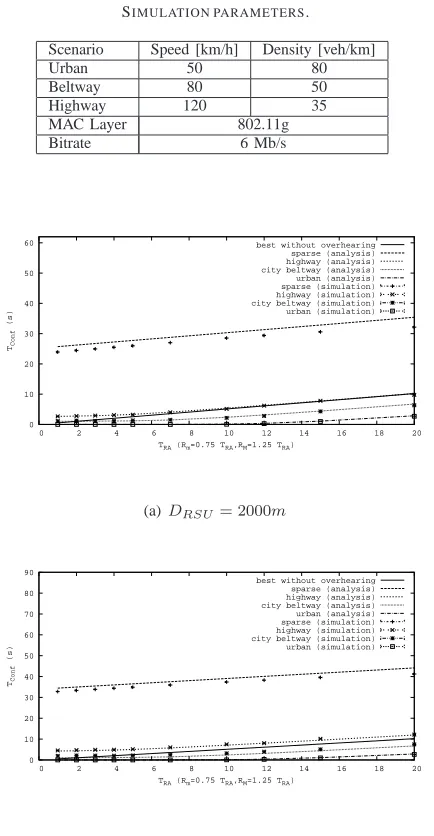
TABLE I SIMULATION PARAMETERS.
Scenario Speed [km/h] Density [veh/km]
Urban 50 80
Beltway 80 50
Highway 120 35
MAC Layer 802.11g
Bitrate 6 Mb/s
0 10 20 30 40 50 60
0 2 4 6 8 10 12 14 16 18 20
TConf
(s)
TRA (Rm=0.75 TRA,RM=1.25 TRA)
best without overhearing sparse (analysis) highway (analysis) city beltway (analysis) urban (analysis) sparse (simulation) highway (simulation) city beltway (simulation) urban (simulation)
(a)DRSU= 2000m
0 10 20 30 40 50 60 70 80 90
0 2 4 6 8 10 12 14 16 18 20
TConf
(s)
TRA (Rm=0.75 TRA,RM=1.25 TRA)
best without overhearing sparse (analysis) highway (analysis) city beltway (analysis) urban (analysis) sparse (simulation) highway (simulation) city beltway (simulation) urban (simulation)
(b)DRSU= 2500m
Fig. 9. IP address configuration time (analysis and OMNeT++ simulation results),R= 150m.
Because the road segment length is 15km, in the worst case, this value is approximately 150. The parameters used in the simulations are summarized in Table I.
Figs. 9–10 show the obtained results using the OMNeT++-based simulation. In this case, we used two different values ofR: i)R= 225m, the average coverage value between two wireless nodes in the OMNeT++ simulation, when configured as in our experiments (Fig. 10), and b) R = 150m, which is one of the values we used in the previous simulations that helped to better understand the performance of our optimiza-tion when the probability of having multi-hop connectivity is lower (Fig. 9). In addition to the simulation and analytical results, we also depict the best possible value for the IP address configuration time that plain GeoSAC could achieve [7]. This value, which corresponds to the optimistic, non-ideal assump-tion that there is always multi-hop connectivity between an unconfigured node and the RSU, is equal toT¯unsol
RA . The
0 10 20 30 40 50
0 2 4 6 8 10 12 14 16 18 20
TConf
(s)
TRA (Rm=0.75 TRA,RM=1.25 TRA)
best without overhearing sparse (analysis) highway (analysis) city beltway (analysis) urban (analysis) sparse (simulation) highway (simulation) city beltway (simulation) urban (simulation)
(a)DRSU = 2500m
0 10 20 30 40 50 60
0 2 4 6 8 10 12 14 16 18 20
TConf
(s)
TRA (Rm=0.75 TRA,RM=1.25 TRA)
best without overhearing sparse (analysis) highway (analysis) city beltway (analysis) urban (analysis) sparse (simulation) highway (simulation) city beltway (simulation) urban (simulation)
(b)DRSU= 3000m
Fig. 10. IP address configuration time (analysis and OMNeT++ simulation results),R= 225m.
lation results validate our mathematical analysis11. They show
that for the non-sparse scenarios and values of TRA between
1 and 20 seconds, the average IP address configuration time is always shorter than the best possible value that could be obtained with plain GeoSAC (i.e., without our optimization enabled). In addition, the improvement provided by overhear-ing optimization is quite large (average configuration time is close to zero for several values ofTRA). WithR= 150m, the
optimization does not provide any improvement in the sparse scenario. Note that the IP address configuration time displayed in Figs. 9–10 is sometimes larger for the sparse scenario than for plain GeoSAC under the best possible conditions. This is because the value for GeoSAC without overhearing is the one that would be achieved if there is always multi-hop connectivity between the vehicle and the RSU, which is far from true in sparse scenarios. In those scenarios, the IP address configuration time with and without our optimization enabled would be very similar. We also want to mention that the use case scenarios in which it makes sense to deploy an IP multi-hop network to connect vehicles to the Internet ranges from moderate to high vehicular density networks (with proper RSU placement). While providing a more effective support for sparse networks could be possible, that would introduce
11We also performed a large number of experiments using our Matlab-based
0.2 0.4 0.6 0.8 1
0 2 4 6 8 10 12 14 16 18 20
Poh
TRA (Rm=0.75 TRA,RM=1.25 TRA)
R=150m (analysis) R=225m (analysis) R=150m (simulation) R=225m (simulation)
(a) Overhearing probability
0 2 4 6 8 10
0 2 4 6 8 10 12 14 16 18 20
TConf
(s)
TRA (Rm=0.75 TRA,RM=1.25 TRA)
R=150m (analysis) R=225m (analysis) R=150m (simulation) R=225m (simulation)
(b) Overhearing-enabled GeoSAC configuration time
Fig. 11. Analysis and simulation with OMNeT++ and real vehicular traces.
a lot of complexity and computational costs, while bringing limited benefits, given the low connectivity level that vehicles experience in those scenarios.
Our last experiment to validate our analysis and the effec-tiveness of our overhearing optimization consisted of evaluat-ing the configuration time usevaluat-ing vehicular traces from a real road in Madrid, Spain. Using the OMNeT++ simulator, we assumed the position and speed of vehicles in a real road from traffic traces, evaluated the overhearing probability (Fig. 11(a)) and measured the GeoSAC configuration time. The traces were taken at the three-lane city beltway M40 in Madrid and accounted for the traffic from 8:30 to 9:00 a.m. (which can be considered as near to rush hour). The total number of samples was 2560. For each sample, we have a time-stamp and vehicle speed. We considered the measurement point to be the border between two geographical areas and assumed that each vehicle maintains the same speed while traversing the area. For our simulation environment, we fixed the distance between two RSUs at 2000m. Fig. 11(b) shows the results obtained from the simulation and our mathematical analysis (Eq. (24)). In our mathematical model, we used the vehicular density calculated from the traces (β = 54 veh/km) and the average speed (v = 95km/h). As can be observed from Fig. 11(b), the results using real vehicular traces confirm our previous findings, showing how overhearing optimization is able to significantly reduce the IP address configuration time. It is worth highlighting the influence ofTRAon the
perfor-mance gain provided by overhearing optimization. First, with relatively low values of TRA (up to 8 seconds), the average
configuration time is generally quite low (zero or close to zero) for all the scenarios. Second, increasingTRA gradually
impacts performance by increasing the average configuration time, without abrupt changes. This result basically means that the system can be configured to meet certain performance and signaling overhead requirements by setting up the correctTRA
values on the RSUs. Although shorter TRA values provide
better performance, there is an additional overhead cost that must be considered. The next section explores in further detail the trade-off between signaling overhead and configuration time.
B. Signaling savings
We have demonstrated in the previous subsection that en-abling our overhearing-assisted optimization greatly improves the GeoSAC performance in terms of IP address configuration time. However, our optimization can also, by sending unso-licited RAs less frequently, be used to reduce the signaling required to achieve a certain target configuration time.
From the simulations we have performed, we can obtain what the minimum Router Advertisements frequency required to achieve this target configuration time is, with and without our overhearing optimization enabled. In Table II, we provide some results (for R = 225m) to help evaluate the signaling savings that can be obtained. In the urban scenario, for example, a value of TRA = 15s is sufficient to obtain a
shorter configuration time than the one obtained by plain GeoSAC with TRA = 2s. For the city beltway and highway
scenarios, the results are similar. However, the difference in performance decreases as the vehicular density decreases, and the probability of overhearing success decreases. In the highway scenario, for example,TRA can be increased by up
to 10 seconds if the goal is to achieve a better performance than with plain GeoSAC andTRA= 2s.
C. Impact on the handover
GeoSAC was designed as a mechanism to enable vehicles in a self-configured VANET to obtain a valid IP address. Getting an IP address is just one of the functionalities needed to connect vehicles to the Internet. As we discussed in Section I, routing and mobility support are also important components. Routing within a VANET is independent of the IP addressing in the ETSI TC ITS system architecture; therefore, the per-formance of the IP address auto-configuration protocol does not have an impact on the routing functionality. However, that lack of impact is not the case for IP mobility management protocols, in which the speed of IP address acquisition has a direct impact on the overall performance of the mobility solution, and thus on the IP connectivity.
TABLE II
ADDRESS CONFIGURATION TIME(R= 225m).
DRSU(m) v(km/h) β(veh/km) T¯RA T¯conf T¯confoh Saving
2000 50 80
1 s 0.51 s 0 s 100 % 2 s 1.02 s 0 s 100 % 3 s 1.53 s 0 s 100 % 4 s 2.04 s 0 s 100 % 5 s 2.55 s 0 s 100 % 7 s 3.57 s 0 s 100 % 10 s 5.10 s 0.06 s 98.7 % 12 s 6.13 s 0.27 s 95.5 % 15 s 7.65 s 0.97 s 87.26 % 20 s 10.20 s 2.7 s 73.5 %
2000 80 40
1 s 0.51 s 0 s 100 % 2 s 1.02 s 0 s 100 % 3 s 1.53 s 0 s 100 % 4 s 2.04 s 0 s 100 % 5 s 2.55 s 0 s 100 % 7 s 3.57 s 0 s 100 % 10 s 5.10 s 0.13 s 97.44 % 12 s 6.13 s 0.39 s 93.53 % 15 s 7.65 s 1.17 s 84.56 % 20 s 10.20 s 3.04 s 70.18 %
2000 120 35
1 s 0.51 s 0 s 100 % 2 s 1.02 s 0 s 100 % 3 s 1.53 s 0 s 100 % 4 s 2.04 s 0.02 s 98.76 % 5 s 2.55 s 0.04 s 98.43 % 7 s 3.57 s 0.16 s 95.28 % 10 s 5.10 s 0.93 s 81.60 % 12 s 6.13 s 1.62 s 73.41 % 15 s 7.65 s 2.92 s 61.83 % 20 s 10.20 s 4.87 s 52.24 %
equipped with many devices with connectivity requirements. Every time a vehicle changes its IP point of attachment, the mobility protocol signals the movement to a central entity, called the Home Agent (HA), which keeps track of the current location of the mobile node. Every time the vehicle moves, there is an interruption time (called handover latency) during which the vehicle cannot send or receive packets until all the mobility operations are completed. This handover time can be expressed as:
Tho=TMD+Tconf+RT T(veh, HA), (28)
where TMD represents the time required by the vehicle
to detect that it has changed its point of attachment, Tconf
represents the time required to configure a valid IP address at its new location, and RT T(veh, HA) represents the round trip time between the vehicle and the corresponding HA. TMD = 0s because, as with GeoSAC, a change in its point
of attachment corresponds to a change of geographical area, which the vehicle can be easily detect by monitoring its GPS coordinates. RT T(veh, HA) depends on the distance between the vehicle and its HA, and it is typically on the order of milliseconds. Tconf is the main component in Eq. (28).
Therefore, reducing the address configuration time has a clear impact on the overall performance.
Table III shows the average GeoSAC handover delay (T¯ho),
with and without the overhearing optimization enabled for the city beltway scenario (with R = 225m) and the different components used in the calculation of this delay. Because the mobility signaling delay depends on the RTT between the vehicle and its mobility anchoring point (its HA), and because this delay depends on the location of these two entities, three
TABLE III
HANDOVER DELAY COMPARISON. CITY BELTWAY SCENARIO
(R= 225m).
RT T(veh, HA) TRA T¯conf T¯confOH T¯ho T¯hoOH Saving
5.37 ms
1 s 0.51 s 0.00 s 0.52 s 0.02 s 98.96 % 4 s 2.04 s 0.00 s 2.05 s 0.05 s 99.73 % 10 s 5.10 s 0.06 s 5.11 s 0.07 s 98.69 % 20 s 10.20 s 2.70 s 10.21 s 2.71 s 73.48 % 18.32 ms
1 s 0.51 s 0.00 s 0.53 s 0.02 s 96.53 % 4 s 2.04 s 0.00 s 2.06 s 0.02 s 99.11 % 10 s 5.10 s 0.06 s 5.12 s 0.08 s 98.44 % 20 s 10.20 s 2.70 s 10.22 s 2.72 s 73.39 % 138.79 ms
1 s 0.51 s 0.00 s 0.65 s 0.14 s 78.62 % 4 s 2.04 s 0.00 s 2.18 s 0.14 s 93.63 % 10 s 5.10 s 0.06 s 5.24 s 0.20 s 96.18 % 20 s 10.20 s 2.70 s 10.34 s 2.84 s 72.53 %
different values ofRT T(veh, HA)were used in this analysis, representing “local,” “regional” and “continental” delays (we used measurements taken from the PingER – Ping end-to-end reporting – project12). For each of these delay values, different
Router Advertisement intervals were used. The savings in the overall handover delay achieved by the use of the overhearing optimizations are more than 70% in the scenarios analyzed. In addition, the absolute handover latency values that are obtained when the overhearing optimization is enabled are small enough to even enable applications with certain latency constraints to be deployed in a vehicular network.
V. EXPERIMENTALRESULTS
In order to be able to conduct real experiments that allowed us to evaluate the performance of our overhearing-assisted optimization for GeoSAC, we developed a prototype of both GeoSAC and our proposed optimization. The prototype was implemented for Linux in user space. One of the main chal-lenges was to deploy an experimental set-up that allowed us to emulate a portion of a highway populated with vehicles. We used the Linksys WRT54GL v1.1 router as hardware for the vehicular communication box. This is a small and very popular home and office broadband router, equipped with a 200 MHz processor, an IEEE 802.11b/g WLAN interface, and an IEEE 802.3 Ethernet interface connected to a Virtual LAN (VLAN) capable 5-port switch. The firmware of the router can be replaced with an open source Linux-based firmware. We installed the OpenWRT13Backfire 10.03.1-rc4 distribution
with a Linux-2.4 kernel in the routers. This firmware gave us more flexibility in the use and configuration of the routers than the original firmware. A wired interface of each of the routers is used to perform several control and management plane operations, such as the global synchronization of the routers, the remote execution of tests, and the retrieval of the results for offline processing. A total of 40 routers were used for the tests. Additionally, we used a laptop as RSU and controlling node to monitor and manage all the routers of our deployment through the wired interfaces. The nodes calculated their geographical position with the help of time-frame messages broadcast by the controller node on the wired management network. The protocol was implemented as explained in section III-A.
0.2 0.4 0.6 0.8 1
0 2 4 6 8 10 12 14 16 18 20
Poh
TRA (Rm=0.75 TRA,RM=1.25 TRA)
highway analysis highway experimental
(a) Overhearing probability
0 1 2 3 4 5 6 7 8 9
0 2 4 6 8 10 12 14 16 18 20
Tconf
(s)
TRA (Rm=0.75 TRA,RM=1.25 TRA)
highway analysis highway experimental
(b) IP address configuration time
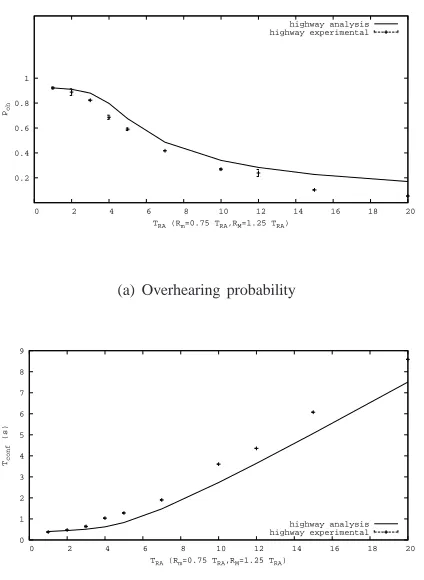
Fig. 12. Analysis and experimental results, highway scenario, DRSU = 1000m,R= 150m.
The testbed was physically deployed in a lab of our Com-puter Science (CS) building. Due to the fact that all the routers were within wireless radio connectivity range, iptables
software was used to selectively filter the packets that each router received and, in this way, be able to emulate any given physical topology. The controlling node computed a random topology (initial position and speed of each vehicle) at the beginning of each run and then remotely configured each Linksys router using iptablesso the routers emulated the topology and movement of the nodes during the test. On each run we collected the results (IP address configuration time and overhearing success) of all the vehicles that could potentially be configured with an overhearing success (i.e., the ones farther than R meters from the area border, the rest are used to populate the highway segment between the RSU and the unconfigured nodes) and processed them at the controlling node. Different inter-RA values were configured, and each test was composed of 300 iterations. We evaluated the highway scenario, with DRSU = 1000mandR= 150m.
The obtained results (displayed in Fig. 12) show that the experimental performance is quite close to the one predicted by our theoretical analysis. The difference between the experi-mental and theoretical results can be caused by the fact that the wireless media is more crowded in our lab environment than in a real highway, because all the nodes are placed together in the same room, and the presence of other interfering external
wireless networks. Nevertheless, it is worth highlighting that our model matches quite reasonably the experimental results obtained from our testbed, and this supports the feasibility of the implementation of our overhearing-assisted optimization in a real prototype.
VI. CONCLUSIONS
This article presents an overhearing-assisted optimization for GeoSAC, consisting of an address auto-configuration mechanism for vehicular networks. The optimization is based on vehicles overhearing Router Advertisements generated at neighboring geographical areas and allowing the vehicles to pre-compute valid IP addresses to be used at those areas in the event that they enter one of them. This optimization does not require changes to the operation protocol of the original GeoSAC, and it is fully compatible with nodes compliant to GeoSAC.
The article provides an analytical expression for the prob-ability of our optimization being used effectively in different realistic scenarios that consider values for vehicular density, coverage radius of the wireless technology, and distance be-tween attachment points deployed by the road infrastructure. We have also derived an expression for the IP address auto-configuration time when our optimization is enabled and have compared it with the time achieved by GeoSAC under optimal conditions. The analytical work has been validated by means of extensive simulation, including real wireless models and experiments incorporating vehicular traces from Spain. Addi-tionally, we have conducted an experimental evaluation using a real implementation of our solution in a testbed composed of 40 nodes.
Due to the properties of our optimization, we have shown in this article that it can be used not only to decrease the IP address configuration time but also to reduce the network signaling load (in terms of unsolicited Router Advertisements) required to achieve a certain target configuration time. Finally, we have also analyzed the benefits that our optimization provides when the vehicle uses an IP mobility protocol to enable transparent connectivity to the Internet despite changes in geographical areas.
ACKNOWLEDGEMENT
The authors would like to thank Gustavo de Veciana, Pablo Serrano and Jaume Barcel´o for their very useful revisions of previous versions of this article. We also thank the anonymous reviewers of this paper for their valuable comments.
REFERENCES
[1] V. Bychkovsky, B. Hull, A. Miu, H. Balakrishnan, and S. Madden, “A measurement study of vehicular Internet access using in situ wi-fi net-works,” in Proc. of the 12th ACM Conference on Mobile Computing and
Networking (MobiCom 2006). ACM MobiCom 2006 San Francisco, CA, USA, 2006.
[3] J. Marquez-Barja, C. Calafate, J.-C. Cano, and P. Manzoni, “Multi-Layer Performance Evaluation of a Content Delivery Framewirk for Urban Vehicular Networks,” in Proc. of IEEE International Conference
on Communications Workshops (ICC 2010). IEEE, 2010.
[4] K. Abrougui, A. Boukerche, and R. Pazzi, “Location-Aided Gateway Advertisement and Discovery Protocol for VANets,” IEEE Transactions
on Vehicular Technology, vol. 59, no. 8, pp. 3843–3858, 2010.
[5] R. Baldessari, A. Festag, W. Zhang, and L. Le, “A MANET-centric Solution for the Application of NEMO in VANET Using Geographic Routing,” in Proc of TridentCom, Innsbruck, Austria, March 2008. [6] J. Choi, Y. Khaled, M. Tsukada, and T. Ernst, “IPv6 support for VANET
with geographical routing,” in The 8th International Conference on
Intelligent Transport System Telecomunications (ITST 2008), October
2008.
[7] R. Baldessari, C. J. Bernardos, and M. Calderon, “GeoSAC - Scalable Address Autoconfiguration for VANET Using Geographic Networking Concepts,” in PIMRC 2008, Cannes (France), September 2008. [8] S. Thomson, T. Narten, and T. Jinmei, “IPv6 Stateless Address
Auto-configuration,” RFC 4862, September 2007.
[9] T. Narten, E. Nordmark, W. Simpson, and H. Soliman, “Neighbor Discovery for IP version 6 (IPv6),” RFC 4861, September 2007. [10] R. Droms, J. Bound, B. Volz, T. Lemon, C. Perkins, and M. Carney,
“Dynamic Host Configuration Protocol for IPv6 (DHCPv6),” RFC 3315, July 2003.
[11] D. Kim, H.-J. Jeong, C. K. Toh, and S. Oh, “Passive Duplicate Address-Detection Schemes for On-Demand Routing Protocols in Mobile Ad Hoc Networks,” IEEE Transactions on Vehicular Technology, vol. 58, no. 7, pp. 3558–3568, Sep. 2009.
[12] M. Fazio, C. Palazzi, S. Das, and M. Gerla, “Vehicular Address Config-uration,” in Proc. of the 1st IEEE Workshop on Automotive Networking
and Applications (AutoNet). GLOBECOM 2006 San Francisco, CA, USA, 2006.
[13] B. K. Mohandas and R. Liscano, “IP Address Configuration in VANET using Centralized DHCP,” in Proc. of the 33rd IEEE Local Computer
Networks Conference. IEEE, 2008.
[14] ETSI, “Intelligent Transport Systems (ITS); Vehicular Communications; GeoNetworking; Part 3: Network architecture,” ETSI TS 102 636-3 V1.1.1, March 2010.
[15] V. Devarapalli, R. Wakikawa, A. Petrescu, and P. Thubert, “Network Mobility (NEMO) Basic Support Protocol,” RFC 3963, January 2005. [16] ETSI, “Intelligent Transport Systems (ITS); Vehicular Communications;
Part 4: Geographical Addressing and Forwarding for Point-to-Point and Point-to-Multipoint Communications; Sub-part 1: Media-Independent Functionality,” ETSI TS 102 636-4-1 (work in progress), June 2010. [17] ——, “Intelligent Transport Systems (ITS); Vehicular Communications;
Part 6: Internet Integration; Sub-part 1: Transmission of IPv6 Pack-ets over GeoNetworking Protocols,” ETSI TS 102 636-6-1 (work in progress), June 2010.
[18] J. Ott and F. Kutscher, “The Drive-Thru Architecture: WLAN-based Internet Access on the Road,” in Proceedings VTC Fall, May 2004. [19] D. Johnson, C. Perkins, and J. Arkko, “Mobility Support in IPv6,” RFC
3775, June 2004.
[20] C. J. Bernardos, I. Soto, M. Calderon, F. Boavida, and A. Azcorra, “VARON: Vehicular Ad-hoc Route Optimisation for NEMO,” Computer
Communications, vol. 30, no. 8, pp. 1765 – 1784, June 2007.
[21] Q. Mussabbir, W. Yao, Z. Niu, and X. Fu, “Optimized FMIPv6 using IEEE 802.21 MIH services in vehicular networks,” IEEE Transactions
on Vehicular Technology, vol. 56, no. 6, pp. 3397–3407, 2007.
[22] N. Wisitpongphan, F. Bai, P. Mudalige, V. Sadekar, and O. Tonguz, “Routing in Sparse Vehicular Ad Hoc Wireless Networks,” IEEE Journal
on Selected Areas in Communications, vol. 25, no. 8, pp. 1538–1555,
October 2007.
[23] S. Yousefi, E. Altaian, and R. El-Azouzi, “Study of connectivity in vehicular ad hoc networks,” in Modeling and Optimization in Mobile,
Ad Hoc and Wireless Networks and Workshops, 2007. WiOpt 2007. 5th International Symposium on, Apr. 2007, pp. 1 –6.
[24] H. Reijmers and R. Prasad, “The influence of vehicle distribution models on packet success probability on a three lane motorway,” in 48th IEEE
Vehicular Technology Conference, 1998. VTC 98, vol. 3, 1998.
[25] L. Bain and D. Weeks, “A note on the truncated exponential distribu-tion,” The Annals of Mathematical Statistics, pp. 1366–1367, 1964. [26] A. K ¨opke, M. Swigulski, K. Wessel, D. Willkomm, P. T. K. Haneveld,
T. E. V. Parker, O. W. Visser, H. S. Lichte, and S. Valentin, “Simulating wireless and mobile networks in omnet++ the mixim vision,” in
Simu-tools ’08: Proceedings of the 1st international conference on Simulation tools and techniques for communications, networks and systems & workshops, 2008, pp. 1–8.
[27] J. K. Cavers, Mobile Channel Characteristics. Kluwer Academic Publishers, 2000.
[28] M. K. Simon and M.-S. Alouini, “Digital communications over fading channels (m.k. simon and m.s. alouini; 2005) [book review],” IEEE
Transactions on Information Theory, vol. 54, no. 7, pp. 3369–3370,
2008.
Marco Gramaglia received a BsC and a MsC in
Computer Science from the Polytechnic University of Turin (Politecnico di Torino) in 2006 and 2008 respectively, and a MsC in Telematics from the University Carlos III of Madrid (UC3M) in 2009. Currently he is a Research Assistant at Institute IMDEA Networks and a PhD candidate in Telemat-ics at University Carlos III of Madrid.
Ignacio Soto received a telecommunication
engi-neering degree in 1993, and a Ph.D. in telecom-munications in 2000, both from the University of Vigo, Spain. He was a research and teaching assis-tant in telematics engineering at the University of Valladolid from 1993 to 1999. In 1999 he joined University Carlos III of Madrid, where he was an associate professor since 2001 until 2010. In 2010, he joined Universidad Polit´ecnica de Madrid as associate professor. His research activities focus on mobility support in packet networks, heterogeneous wireless access networks, and automatic network management and operation.
Carlos J. Bernardos received a Telecommunication
Engineering degree in 2003, and a PhD in Telematics in 2006, both from the University Carlos III of Madrid (UC3M), where he worked as a research and teaching assistant from 2003 to 2008 and, since then, has worked as an Associate Professor. His Ph.D. thesis focused on route optimization for mobile networks in IPv6 heterogeneous environments. His current work focuses on vehicular networks and IP-based mobile communication protocols. He has published has published over 30 scientific papers in prestigious international journals and conferences, and he is also an active contributor to the Internet Engineering Task Force (IETF). He served as TPC chair of WEEDEV 2009 and as TPC co-chair of the Mobility track of NTMS 2011. He has also served as guest editor of IEEE Network.
Maria Calderon is an associate professor at the