Standardization of Optimal Level of Coconut Variants in
Chocolates Based on Consumer Acceptance
V. DiVyA
1*, D. BASkArAn
2and k.S.GnAnALAkSShmi
3,
m. ABDuL reiinCLuDe
3and m. ABDuL reiyAS
31Student (M.Tech), College of Food and Dairy Technology, TANUVAS, Chennai, India, 600 052. 2Dean, Faculty of Food Sciences, College of Food and Dairy Technology,
3 Assistant Professor, College of Food and Dairy Technology, TANUVAS, Chennai - 52,
TANUVAS, Chennai, India, 600 052. Corresponding author Email: [email protected]
http://dx.doi.org/10.12944/CRNFSJ.5.1.05 (Received: February 19, 2017; Accepted: March 22, 2017)
ABStrACt
A study was carried out to produce chocolates from coconut variants viz, coconut oil, coconut cream and coconut milk as a substitute for cocoa butter. The chocolate prepared with 40% cocoa butter was taken as control. The preliminary trials were conducted with different composition of ingredients for the optimization of the level of substitution of coconut variants. Cocoa butter substituted at the levels of 10 %, 20 % and 30 % by coconut oil, coconut cream and coconut milk respectively were optimized based on the consumer acceptance. The raw materials used in the fabrication of chocolate were subjected to analysed for Peroxide value (PV), Acid Value (AV) and Free Fatty Acid (FFA) content and were found to have desirable oxidative stability.
keywords: Cocoa Butter; Coconut Oil; Coconut Cream; Coconut Milk; Optimization: Consumer acceptance; oxidative stability
intrODuCtiOn
The chocolate industry in India is one of the major segments of the Indian confectionery, which is at the pace of increasing demand. Food retail industry and confectionery are the fastest growing sectors which would accelerate the growth of chocolates in the country. Dark chocolate which has only 9% market share at present is expected to be the fastest growing segment owing to the numerous health benefits and increasing awareness among Indian consumers. Dark chocolates are found to be rich in antioxidants such as flavonoids, epicatechin, catechin and procyanidins than in milk and other chocolates. The daily consumption of dark chocolate is believed to prevent or delay metabolic diseases, including cardiac disease1.
The popularity of chocolate appears to be mainly owing to its potential to arouse sensory perception and positive emotions2. Chocolate is perceived as
a comfort food which provides sense of goodness during depressive moods3. Cocoa butter is an
important ingredient for chocolate making and is used as the continuous phase in chocolate that support the non-fat ingredients4 and is responsible
for much of the snap, gloss, appearance, mouth feel and flavour release typical for chocolates. Due to the limited supply and the high demand, the price is high and can fluctuate in time depending on the crop yield4. Hence alternatives to cocoa butter
be classified into three groups: (1) Cocoa butter substitutes (2) Cocoa butter replacers and (3) Cocoa butter equivalents. The alternatives of cocoa butter developed so far could not meet the exact demand of cocoa butter. Hence it is necessary to conduct further research on this subject to discover the alternatives to cocoa butter fat that could be able to fulfil the demands of cocoa butter fat.
Coconut is one of the ancient food ingots in nature from the time immemorial, especially within Asian cuisine. Botanically, the coconut palm is a monocotyledon and belongs to the order Arecaceae, family Palmae and the species is known as Cocus nucifera Linn. It is promoted as a dietary supplement said to optimize health5. The supply and interest
in coconut consumption has increased during the last few years. It is from the flesh, coconut fat is extracted6. Coconut fat consists mainly about 90% of
saturated fatty acids. The major fatty acids present in coconut fat are lauric acid (12:0) with 46%, myristic acid (14:0) with 17% and palmitic acid (16:0) with 9%7 and is also totally devoid of trans-fatty acids
which are now thought to be more harmful than saturated fatty acids8.
The food processing sector has not paid due attention to diversification and value addition to coconut, coconut products and by products. The introduction of medicinal and organic ingredients in the manufacturing of chocolates will lead to a new trend and advancement in the traditional food disciples9. The present work has been proposed with
the main objective of producing low cost coconut substituted cocoa base chocolate prototypes without compromising on its sensory attributes with partial replacement of premium priced cocoa butter using coconut fats viz., coconut oil, coconut cream and coconut milk. This attempt would also favour the coconut farmers in regaining the remunerative prices for coconut due to rise in demand for coconut base material as well as chocolate novelties that are developed during the present research protocol.
mAteriALS AnD methODS Cocoa butter
Cocoa butter is the chief ingredient in chocolate making which contains 36-43% of unsaturated fat (29-43% is MUFA, 0-5% is PUFA).
Commercially available cocoa butter was used. Cocoa powder. Cocoa powder containing about 12% fat, 57% carbohydrates, 19.6% protein and 33.2% fibre obtained from commercially available brand in the market was used for the study. Cocoa powder was added at the level of 20% to the developed chocolates.
icing sugar
Commercially available good quality icing sugar was used. Standard inclusion level of 40% of icing sugar was maintained for developed chocolates.
Lecithin
Lecithin was used as the viscosity modulator in the preparation of chocolate. 0.5% of soy lecithin was added in each variety of chocolate.
Coconut variants
Cold pressed virgin coconut oil (Lauric acid - 53%, Palmitic acid - 8.5%, Oleic acid- 2.5%) obtained from private firm was used for the preparation of chocolates. Coconut cream (95% of coconut extract, fat - 29% of which 90% is saturated) and Coconut milk (85% of coconut extract, fat - 25% of which 75% is saturated) obtained from nearby market was used for the preparation of chocolates.
experimentAL DeSiGn
treatments
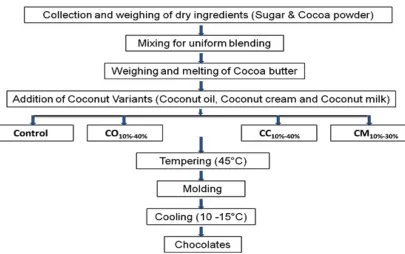
Control-• Chocolate was prepared with cocoa butter (40%).
CO
• 10%-40%-Chocolates were prepared by substituting cocoa butter (40%) with 10% to 40% of coconut oil.
CC
• 10%-40%-Chocolate was prepared by substituting cocoa butter (40%) with 10% to 40% of coconut cream.
Cm
• 10%-30%-Chocolate was prepared by substituting cocoa butter (40%) with 10% to 30% of coconut milk.
Analysis of oxidative stability
The Peroxide value (PV), Free Fatty Acid (FFA) content and Acid Value (AV) of cocoa butter (CB), coconut oil (CO), coconut cream (CC) and coconut milk (CM) employed in the production of chocolate were estimated by following the standard procedures of AOAC, 200010.
Sensory evaluation
The Hedonic Scale Test, developed in 1947 at the Quartermaster Food and Container Institute
for the Armed Forces, defines the psychological attitudes of “like” or “dislike” in a linear scale. In this type of sensory analysis the chocolate was assessed in 9 point scale. Numerical values ranging from 1 (dislike extremely) to 9 (like extremely) were calculated and mean values were used. This test is the most popular one for preference evaluation of food products.
Statistical analysis
The data obtained were analysed statistically by applying one way ANOVA in SPSS software (version 20.0) as per the standard procedure of Snedecor and Cochran, 1994.
reSuLtS AnD DiSCuSSiOnS
Analysis of Ingredients of chocolate for determination of oxidative stability
peroxide value
From Table-1 the Peroxide value of cocoa butter was estimated to contain higher limit of 1.09, which was found to be significantly differing from the
coconut variants utilized in the substitution of cocoa butter. Amongst the coconut variants, Peroxide Value was estimated to have markedly lesser value of 0.39 meq.O2/kg for coconut oil followed by coconut cream and coconut milk with 0.76 and 0.84 meq. O2/kg respectively. The study revealed that coconut variants were subjected to the minimal level of oxidative changes than the control cocoa butter used in the fabrication of chocolate, which has provided valid information on the suitability of the coconut variants for the substitution in the chocolate base. The results obtained were in agreement with the results of Clercq and Dewettinck (2012)11 who
studied the cocoa butter from various regions and the peroxide value was estimated to be in the range of 0.85 to 4.31meq.O2/ kg. The materials used for the current study was found to be highly stable in conformity with the findings observed by Moigradean (2012)12. that a product with peroxide value between
1 and 5, 5 and 10, and above 10 meq.O2/ kg were classified respectively as minimally oxidative, moderately oxidative and highly oxidative.
Free Fatty Acid content
In Table-1 , the fatty acid content of cocoa butter and coconut variants were found to be in the
range of 0.13 to 1.33%. The coconut oil used in the study had a very low value of free fatty acid content below 0.5% implying the fact that it has undergone very less oxidative changes. The free fatty acid content of coconut oil was well within the limits as prescribed in APCC13 (Asian and Pacific Coconut
Community, 2003) standards to be not more than 0.5% for virgin coconut oil. As per codex standards14
(2008) the free fatty acid content of cocoa butter should not exceed 1.75% and the present study showed significantly lower values than the maximum limits. The free fatty acid content of coconut oil used correlated with the study of Dayrit et al. (2007)15
which was in the range of 0.13% to 0.43%. Thus all the ingredients used had good oxidative stability and their oxidative values were within the prescribed standards.
Acid Value
From Table-1 the acid value was estimated to be high for cocoa butter which differed significantly (P d” 0.01) from the coconut variants utilized in the substitution of cocoa butter. Though cocoa butter had predominantly high acid value, the flavour defects were not appreciable in Taste panel evaluation. Among the coconut variants utilized for the study, table 1: estimation of peroxide Value (pV), Free Fatty Acid (FFA) and Acid
Value (AV) of Cocoa butter and Coconut variants for the determination of oxidative stability (mean ± Se)@
ingredients moisture pV FFA AV
% meq.peroxide/kg % mg kOh/g
Cocoa butter 1.00 1.09 ± 0.020d 1.03 ± 0.012d 2.04 ± 0.023d Coconut oil 1.00 0.39 ± 0.017a 0.13 ± 0.009a 0.26 ± 0.018a Coconut cream 65.00 0.76 ± 0.012b 0.33 ± 0.012b 0.66 ± 0.024b Coconut milk 72.50 0.84 ± 0.023c 0.43 ± 0.012c 0.84 ± 0.024c F value 157.04** 759.04** 1005.96**
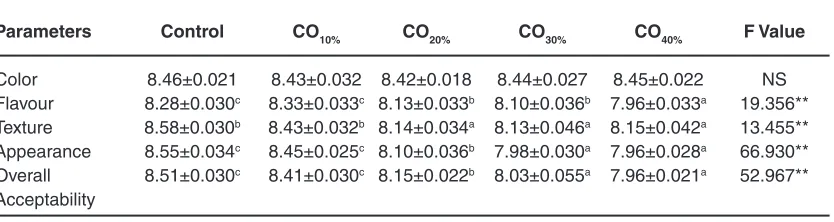
table 2: Optimisation of substitution level of coconut oil in chocolate base derived using taste panel (mean ± Se) @
parameters Control CO10% CO20% CO30% CO40% F Value
Color 8.46±0.021 8.43±0.032 8.42±0.018 8.44±0.027 8.45±0.022 NS Flavour 8.28±0.030c 8.33±0.033c 8.13±0.033b 8.10±0.036b 7.96±0.033a 19.356**
Texture 8.58±0.030b 8.43±0.032b 8.14±0.034a 8.13±0.046a 8.15±0.042a 13.455**
Appearance 8.55±0.034c 8.45±0.025c 8.10±0.036b 7.98±0.030a 7.96±0.028a 66.930**
Overall 8.51±0.030c 8.41±0.030c 8.15±0.022b 8.03±0.055a 7.96±0.021a 52.967**
coconut oil was found to have the lowest acid value followed by coconut cream and coconut milk. The high amount of acid value in coconut cream and coconut milk when compared to coconut oil can be attributed to the presence of moisture which had an impact on the oxidative stability of the sample. The lesser acid value of the coconut variants implies their suitability to produce highly stable final products. The results obtained were agreeable with the findings observed by Depypere et al. (2009)16 which was
between 1.54 and 3.05mg KOH/g. In the present study, the acid values of samples were between 0.26 and 2.04 mg KOH/g.
Optimisation of Coconut substitutes in Chocolate base. Optimisation of substitution level of coconut oil in chocolate base derived using taste panel
The sensory scores obtained for colour of chocolates substituted with different levels of coconut oil viz., 10%, 20%, 30% and 40% given in Table-2 were found to be similar to the control and there was no significant difference (P d” 0.01) between treatments in the study. The results were in concomitance to the study conducted by Melo et al. (2009)17 which reported that the sensory attributes
did not exhibit marked changes for the newer chocolate variants in the development of diabetic chocolates.
Optimisation of substitution level of coconut oil in chocolate base derived using taste panel. Table-2 indicates that the attributes of flavour, texture, appearance and overall acceptability were found to be highly significant (P d” 0.01) between the treatments of different levels of substitution with coconut oil viz., 10%, 20%, 30% and 40%. The
scores gave encouraging results that there was no significant difference within the treatments between the control and chocolate substituted with 10% coconut oil. The sensory scores for flavour of chocolate substituted with coconut oil at 10% showed higher values than even the control which was found to be highly acceptable among the taste panel. The scores for overall acceptability of chocolate substituted with coconut oil at 10% were in cognizance to the control and hence 10% coconut oil substitution level was optimized to be superior on all aspects of the parameters under consideration.
The results obtained in the present study were found to be in agreement with the studies conducted by El-kalyoubi (2011)18 which indicated
that the lower replacement rate of fat was close to control sample and increasing the ratio of fat replacer affected the rheological properties of chocolate. Optimisation of substitution level of coconut cream in chocolate base derived using taste panel
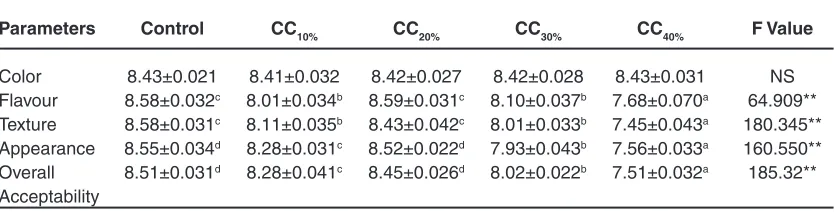
The sensory scores for colour of chocolates substituted with different levels of coconut cream viz., 10%, 20%, 30% and 40% from Table-3 indicated that there was no significant difference (P > 0.05) in the scores obtained between the control and treatments.
The sensory parameters of flavour, texture, appearance and overall acceptability given in Table-3 were found to be highly significant (P d” 0.01) between the treatments at the substitution levels viz., 10%, 20%, 30% and 40% with coconut cream and no significant difference was observed between the control and chocolate substituted with 20% coconut
table 3: Optimisation of substitution level of coconut cream in chocolate base derived using taste panel (mean ± Se) @
parameters Control CC10% CC20% CC30% CC40% F Value
Color 8.43±0.021 8.41±0.032 8.42±0.027 8.42±0.028 8.43±0.031 NS Flavour 8.58±0.032c 8.01±0.034b 8.59±0.031c 8.10±0.037b 7.68±0.070a 64.909**
Texture 8.58±0.031c 8.11±0.035b 8.43±0.042c 8.01±0.033b 7.45±0.043a 180.345**
Appearance 8.55±0.034d 8.28±0.031c 8.52±0.022d 7.93±0.043b 7.56±0.033a 160.550**
Overall 8.51±0.031d 8.28±0.041c 8.45±0.026d 8.02±0.022b 7.51±0.032a 185.32**
cream within the treatments. The sensory scores for flavour, appearance and overall acceptability of chocolate substituted with coconut cream at 20% level was found to be higher than at 10%, 30% and 40% levels and thus 20% substitution level of coconut cream was optimized which had highest acceptability.
The present findings were found to be in accordance with the research findings observed by Barnett (1978)19 that fat substituted at higher level
increased the viscosity of chocolate mix which made the demoulding of chocolate impossible.
Optimisation of substitution level of coconut milk in chocolate base derived using taste panel
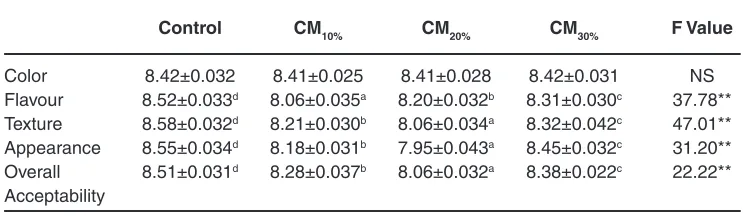
The sensory scores given in Table-4 obtained for the colour of the control and chocolates substituted with different levels of coconut milk viz., 10%, 20% and 30% showed that there existed no significant difference (P > 0.05) between treatments which revealed that the level of substitutions did not influence the colour of the chocolates. The attributes of flavour, texture, appearance and overall acceptability from Table-4 showed highly significant difference (P d” 0.01) between the control and the treatments at different substitution levels of coconut milk viz., 10%, 20% and 30%. The scores for these parameters revealed that chocolate made with the substitution of 30% coconut milk was found to
have scored the highest among the different levels of substitution and its scores were equivalent to the control with no significant difference. Hence, chocolate prepared with 30% level of substitution was selected and optimized. The findings by Olu et al. (2013)20 disclosed that coconut milk at 30%
substitution showed the peak acceptability which was in agreement to the present study. The results of the current study concurred with the findings recorded by Farooqui et al. (2014)21 who has studied
the changes in sensory parameters of chocolate prepared using coconut milk.
COnCLuSiOn
The coconut processing industry remains confined to only copra production, oil extraction and coir products. The present work would favour the coconut farmers in regaining the remunerative prices for coconut due to rise in demand for coconut base material as well as the developed chocolate novelties with different levels of substitution of cocoa butter with coconut oil (10%), coconut cream (20%) and coconut milk (30%).
ACknOwLeDGement
We kindly acknowledge the help rendered by College of Food and Dairy Technology and CAMPCO chocolate factory for carrying out the analysis.
table 4: Optimisation of substitution level of Coconut milk in chocolate base derived using taste panel (mean ± Se) @parameters
Control Cm10% Cm20% Cm30% F Value
Color 8.42±0.032 8.41±0.025 8.41±0.028 8.42±0.031 NS Flavour 8.52±0.033d 8.06±0.035a 8.20±0.032b 8.31±0.030c 37.78**
Texture 8.58±0.032d 8.21±0.030b 8.06±0.034a 8.32±0.042c 47.01**
Appearance 8.55±0.034d 8.18±0.031b 7.95±0.043a 8.45±0.032c 31.20**
Overall 8.51±0.031d 8.28±0.037b 8.06±0.032a 8.38±0.022c 22.22**
Acceptability
@- Average of six trials (Different superscripts in a row differ significantly) ** - Highly Significant (P ≤ 0.01)
NS- Non significant (P > 0.05)
reFerenCeS
1. Zomer E, Owen A, Magliano D. J, Liew D and Reid C. M. The effectiveness and cost effectiveness of dark chocolate consumption as prevention therapy in people at high risk of cardiovascular disease: best case scenario analysis using a Markov model. British Medical Journal: 344: 3657 (2012).
2.. Macht M and Dettmer, D. Everyday mood and emotions after eating a chocolate bar or an apple. Appetite: 46: 332–336: (2006). 3. Macdiarmid J. I and Hetherington M. M. 1995.
Mood modulation by food: an exploration of affect and cravings in ‘‘chocolate addicts’’. British Journal of Clinical Psychology:34 : 129–138: (1995).
4. Smith K.W. Cocoa butter and cocoa butter equivalents. In: Gunstone, F, editor. Structured and modified lipids. Bedfordshire, Unilever Research Colworth. p 401-422: (2001). 5. Paz D. C, Jimeno C, Sy R, Punzalan F. E and
Pena P. D. The effect of virgin coconut oil on lipid profile and fasting blood sugar: A phase I clinical trial. Phillippine Journal of Internal Medicine: 48(2) : 1-6: (2010).
6. Jonsson L, Marklinder I, Nydahl M and Nylander A. Department of Food Science. Sweden; p. 197: (2008).
7. Abrahamsson L, Andersson A, Becker W and Nilsson G. Department of Food, Nutrition and Dietetics. Sweden: p. 116. (2008).
8. Amarasiri W. A. and Dissanayake A. S. Coconut fats. The Ceylon medical journal: 51(2) : 47-51: (2006).
9. Shrestha T. Demand for dark chocolate to drive India’s chocolate industry: (2014). 10. AOAC. Official methods of analysis, 18th
Edition, Washington DC: (2000).
11. Clercq D. N. and Dewettinck K. Changing the functionality of cocoa butter. Agriculture and Food Sciences: XIV, 1 - 220: (2011). 12. Moigradean D, Mariana-Atenaand P,
Gogoasa I. 2012. Quality characteristics and oxidative stability of coconut oil during storage. Journal of Agroalimentary Processes and Technologies: 18(4) :272-276: (2012).
13. Dayrit F. M, Buenafe O. E. M, Chainani E. T, Vera I. M. S. D, Dimzon I. K. D, Gonzales E. G and Santos J. E. R. 2007. Standards for essential composition and quality factors of commercial virgin coconut oil and its differentiation from RBD coconut oil and copra oil. Philippine Journal of Science: 136(2) : 119-129: (2007).
14. Asian and Pacific Coconut Community (APCC). Standards for virgin coconut oil: (2003).
15. Codex Alimentarius Commission: Codex Standard for Named Vegetable Oils, Codex Stan 210. Joint FAO/WHO Food Standards Programme, Sept 2008.
16. F. Depypere N, de Clercq M, Segers B, Lewille and Dewettinck K. Triacylglycerol migration and bloom in filled chocolates: effects of low-temperature storage. European Journal of Lipid Science and Technology: 111(3) : 280-289: (2009).
17. Melo, L. L. M. M. D, Bolini H. M. A. and Efraim P. Sensory profile, acceptability, and their relationship for diabetic/reduced calorie chocolates. Food Quality and Preference: 20(2) : 138-143: (2009).
18. El-Kalyoubi M, Khallaf M. F, Abdelrashid A and Mostafa E. M. Quality characteristics of chocolate - Containing some fat replacer. Annals of Agricultural Sciences: 56(2) : 89-96: (2011).
19. Barnett C. D. Raw materials. In: The art and science of candy manufacturing. Books for Industry, Division of Magazines, Newyork, p 1: (1978).
20. Olu, M, Ogunmoyela O. A. B, Oluwajob S. O, Jimoh O, Adekoyeni O. O and Dania O. 2013. Effect of coconut milk substitution on the nutrient and sensory properties of malted and unmalted sorghum ogi. Academic Research International: 4(1): 372: (2013).