RESEARCH ARTICLE
VEHICLE TALKS TO IOT FOR BETTER DRIVING EXPERIENCE
1, *
Alanazi Yunus Ali, S.,
2Toshio Ito, and
3AlYami Hussain
1
Shibaura Institute of Technology, 307 Fukasaku, Minuma-ku, Saitama city 337-8570 Japan
2
Shibaura Institute of Technology, Nakano-ku Honmachi 6-19-8, Tokyo, 164-0012 Japan
3
Shibaura Institute of Technology
ARTICLE INFO
ABSTRACT
Internet of vehicles (IoV), or (V2X) vehicles to everything all this is a relatively new concept for all vehicles connected to the internet. In this paper, we propose solution of problems in traffic congestion. Road traffic congestion continues is a major problem in many developed countries and that will determine where traffic congestion at the time of rainfall, the position data based on GPS and sensors at vehicles. The sensors in the vehicles required to collect information to evaluate the congestion through cloud server via protocols like (CoAP, MQTT). In the beginning authors introduced the problems and then proposed a solution.
Copyright © 2018,Toshio Ito et al. This is an open access article distributed under the Creative Commons Attribution License, which permits unrestricted use, distribution, and reproduction in any medium, provided the original work is properly cited.
INTRODUCTION
Internet of Things (IoT) have many benefits and features nearly in technology. It creates a major change in the behavior of humanity daily lives. IoT able to save time and money and effort as well. And makes new opportunities for development, innovation, and knowledge. Also IoT able to Solve challenges facing smart cities by providing and collecting information. And when IoT technology intervene in the field of vehicles. It will create a new concept. The concept of Internet of Vehicles (IoV) is a future for smart transport. Smart sensors in the vehicle need to collect information in cloud server by using protocols such as (CoAP, MQTT). This requires robust sensors which are able to reliable of deliver information to the systems. such as (vehicle status, position, energy usage profile, driving profile). They interact with external systems (traffic control systems, parking management, electric vehicle charging). The idea in IoT can be assigned an IP address and provided with the ability to transfer data to a network. Vehicles fuel sensor capable of alerting the driver when the tank is empty and sensor of energy statue, the IoT protocols will allow monitoring and controlling remotely, over an existing network resulting in to improve accuracy, efficiency, and security.
*Corresponding author: Toshio Ito,
Shibaura Institute of Technology, 307 Fukasaku, Minuma-ku, Saitama city 337-8570 Japan.
In the past years, the new advantages inserted by the vehicles companies, the vehicles have become increasingly software driven and at the same time dependent. The auto industry has a longer and richer track record than any other sector by offering a series of improvements aimed at safer driving. Or Self-driving and avoid a collision. by studying how IoV can eliminate the needs to be in the close of a vehicle to perform diagnostics. By surveillance, all the aspects of the vehicles are easier to reveal any trouble in advance by sending all sensor readings to a certified center where service of the vehicles company will able to find and predict check failures of key systems integrated into the vehicle. In addition to the check part, this management system will help drivers to keep track of the yearly maintenance, programming service appointments or analyzing the fuel consumption and giving advice for a friendlier driving style. In a difficult position like an accident, such a system would be able to inform the emergency rescue service when the driver is helpless, finding the chances for the wounded to live by reducing the overall time of the rescue mission.
Problem Statement: The safety in the vehicle is the first main
issue. In order to ensure the safety of driver and passengers, it is of major importance all the information provided by the embedded sensor that is more reliable. Indeed, based on a large number of application to integrate data from information received from several sensors, especially in the application of localization vehicle The second problem is the traffic
ISSN: 0976-3376
Vol. 09, Issue, 10, pp.8743-8748, October,Asian Journal of Science and Technology 2018ASIAN JOURNAL OF
SCIENCE AND TECHNOLOGY
Article History:
Received 25th July, 2018
Received in revised form 20th August, 2018
Accepted 27th September, 2018
Published online 30th October, 2018
Key words:
IoV, V2I, V2X, GPS, CoAP, MQTT.
Citation: Toshio Ito, Alanazi Yunus Ali, S. and AlYami Hussain, 2018. “Vehicle Talks to IoT for Better Driving Experience”, Asian Journal of Science and
congestion at the time of rainfall. This will be a major threat to the driver of the risk of an accident. The safety of the road is the second main factor in order to ensure the safety of driver and passengers. Most of the vehicles have navigation connected with GPS that has alarm function provide the driver safety data included weather or traffic congestion. Mobile phone apps also have these functions. These methods could alleviate congestion and increase driving by providing this data to the drivers. However, in case of raining or snowing, the vehicle speed come slow the traffic congestion come over. This congestion has more effect on the safety than normal congestion caused by normal traffic or vehicles accidents. In case of congestion caused by rain or snow, drivers might have a high risk of vehicles accidents occurs, because in rain or snowfall case the risk of vehicle deviation in snow and lack of vision among drivers consider as drive safety challenge. To increase safety in case of congestion caused by rain or snow driver need to have data about weather and kind of traffic in narrow range.
This data in narrow range and exact congestion reason, could not be provided to the drivers through current mobile weather alarm and vehicle GPS which can only provide data in the wide range that might be insufficient to the driver. In case of autonomous vehicles, this data became more essential to have in the case to increase driver safety in case of unstable weather. In the near future vehicles are already driving themselves on roads in several cities in the world as like Californian, Texas, Arizona, and there will be no reliance on another device as like mobile to know the vehicle data or any data that is useful to the drivers. The total reliance on IoT technology will be in the vehicle for collecting data. The drivers Can be obtained a weather alarms easily via mobile app, however that data will not be accurate. Also, drivers like smartphone can know the area traffic congestion through GPS. But, in this system Accurate information about the rain level is shown and detection sub-module implements the rain level detection algorithm by reading real-time sensor information from the database, checking for wipers speeds in vehicle and then preparing data to make the needed IoV path way. In addition, vehicle should be able to organize themselves in order to avoid traffic congestion and to optimize drive energy usage. Vehicles from now are provided with a rapid and strong development in the field of vehicles, and will rely on themselves to provide data and make decision based on this data. This may be done in coordination and cooperation with the infrastructure of a smart city traffic congestion control and management system.
IoV (Internet of Vehicle): IoT is able to organize the vehicles
in order to avoid traffic congestion. and to improvement drive energy use. This may be done in coordination and cooperation with the infrastructure of a smart city’s traffic control and management system. more mutual communications between the vehicles and with the infrastructure able to making new methods to achieve traffic safety, then taking part to the reduction in the number of traffic accidents. The connection of internet to the vehicles it enables information sharing and collection of information on vehicles, infrastructure. Moreover, processing, computing, sharing and creating security path to the information on the information platforms. Based on this data, the system can effectively guide and supervise vehicles make a transport easier and safer.
Smart sensors in the vehicles and in Infrastructure produce very much information about the state of vehicles and roads. This information needs to collect provided by sensors and send it through protocols to a cloud server to be analyzed and sent it again in the form of realistic results to vehicles2.
Related Studies: Study of proposed about [Road Traffic
Congestion in the Developing World] Authors of [Vipin J, Alshlesh S, Lakshminarayanan S]3 illustrated in this study paper the goal is to design mechanisms to detect the state of traffic congestion in and around critical congestion areas and also design simple preventive mechanisms to prevent critical congestion areas from hitting congestion collapse algorithm based on the analysis of traffic images from live traffic, the image processing algorithm to estimate traffic density at a hot-spot by using CCTV camera feeds. There are several metrics that define traffic characteristics in this papers such as speed, flow, and density of a link. The detection mechanism is divided into two parts, a day time and a night time estimation methodology. Both mechanisms are different due to the high environmental differences, which results into two different image processing techniques. Apart from the environmental differences, vehicle's headlight and billboard illumination add considerable noise to the image making vehicle counting difficult.
The hardest part of the problem of determining the traffic congestion in the night time. Night time congestion detection is a harder problem because of multiple extraneous factors. Also, the absence of light eliminates typical vehicle feature estimation techniques. The next contender for vehicle identification becomes headlight counting, which suffers from light reflection and alternate light sources such as billboards and traffic signal lamps. In this case, light from multiple vehicles becomes difficult to distinguish and provide correct information in this system3. And about another proposed [Effect of Rain on Travel Demand and Traffic Accidents] Authors of [Edward Chung, Osamu Ohtani, Hiroshi Warita, Masao Kuwahara and H. Morita]4. Illustrated in this study the relationship between the weather and the performance of traffic, and the traffic road deteriorate with poor weather, and there is no detailed information to the driver, this study attempts to address to using mesoscale weather data and numbers of trips and accidents recoded on the Tokyo Metropolitan Expressway.
Fig1. Vehicle connected to the internet
Table 1. Selected routes and corresponding weather station for accidents analysis
Fig 2. Percentage of accidents occurred during rain
And presented for driver real information at the real time. This most important point to connect IoT in the vehicle.
Proposed Solution: In this proposal we propose and focus on a
solution problem of traffic congestion, when it is raining and the vehicle speed come slow the traffic congestion come over, and we can measure amount of rain by using the sensor to calculates the amount of falling rain on the windshield wipers the sensor using wipers movement speed and vehicle location. the windshield wiper is a device used to remove rain or snow from a windshield. A wiper usually consists of a metal arm, pivoting at one end with a long rubber blade attached to the other. The arm is powered by a motor, the blade swings back and forth over the windshield, and pushing water from the windshield. The driver can change the wipers speed depending on the rain amount on the windshield.
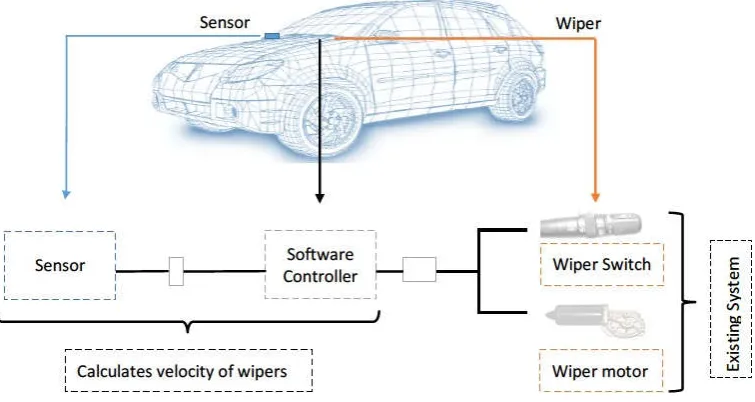
The wiper has a several continuous speeds and often two or more settings. Most vehicles use one or two of wipers arms. In wiper speed control levels there are three movements. The first is an INT-Intermittent wiper, second is LO-Low wiper speed, and third is HI-High wiper speed. whose selection made by the driver. And depending on the sensor of wiper speed can determine the amount of rainfall. That mean the rain amount will be calculated by the wipers speed. As shown in Figure 3.
System Configuration: This study based on IoT technology.
IoT must consist of three main elements which are device like sensor, and wiper. The reason of using network and cloud data server is to guide drivers and analyze sensor data by using optimization algorithms and giving drivers a safety route.
Fig 4. System Configuration
Technically, this system has the capability to provide maps based on gather the wipers sensor data and vehicle GPS for confirmation the route if there is a traffic jam or not. As well as, the data of level of rain can provide drivers another way by showing them IoV path that has less level of rain. This system works, to measure the velocity of wipers, we will rely on the reading sensor. To measure this speed, the sensor will be connected to the wiper switch cable with wiper moto. And another section to the sensor senses the output of the transmission, whereas the opposite side of the sensor is connected to wipers, which generates a voltage that is then transmitted to a Software controller, that calculates speed and shows it with real numbers.
The sensor will depend on the wipers speed part of a second, a wipers speed sensor generates a magnetic pulse in the form of a wave. when wipers moving at any speed, the sensor wipers will generate a frequency signal depending on the wipers speed directly proportional. Figure 4 shows the system. First collect important data from the vehicle. They contain the vehicle location and data sensors. And update the data by MQTT protocol to cloud server. The provisioning Module send information to Driver IoV sensor database. The Rain level detection sub-module implements the rain level detection algorithm by reading real-time sensor information from the database, checking for wipers speeds in vehicle and then preparing data to make the needed IoV path way. The IoV path way sub-module receives collision information from the collision detection sub-module, performs the path way adjustments and sends the updated path way to the IoV management module where it can be deployed to the IoV. The Rain alerting sub-module reports detected rain level and adjusted path way data to the driver management module, where it can then be displayed to the driver, as shown in Figure 5.
Data Acquisition and Recommended Route: After received a
location and data sensors from vehicles, and publish via MQTT protocol to cloud server. Drivers have another option which is receiving recommend route based on their location in the area, to avoid bad weather conditions. It means that the generated route can become in main roads and subsidiary roads, the numbers data and positioning data will be stored and analyzed on the cloud server. Then the data will be subscribing to the drivers. There will be an alert message generated via the Android application. The alert message generated is published to MQTT broker with a specific topic name, that route will be assigned as recommended safe route since the safe of the route has been confirmed by the administrator through analysis of data sensors and location.
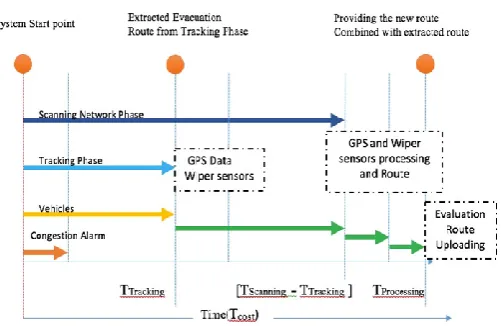
Timeline Evaluation: The Timeline of providing data
evaluates the system execution. The optimal time has to be in few minutes’ range. The following Equation and Figure 6 show the Timeline of providing the data in this system.
IoT PROTOCOL: In this propose will be using MQTT
because The MQTT protocol is a lightweight message queueing and transport protocol. Also, MQTT is suited for the transport of telemetry data sensor. MQTT is very lightweight and thus suited form M2M, WSN in the end IoT where sensor and actor nodes communicate with applications through the MQTT message broker. The protocol uses a publish and subscribe in disparity to HTTP with it is request and response model.
T Processing T Cost ={ T Tracking + [T Scanning - T Tracking ] + }
Fig. 6. Time-line of Providing the Data
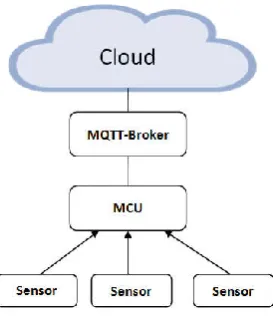
Publish and subscribe is sensor output and enables messages to be pushed to drivers. The important communication point is the MQTT broker, it is in charge of dispatch whole messages between the senders and right receivers. Every driver published a message to the broker, covers a subject into the message. The subject is the send information for the broker.
The most relevant MQTT parts for this proposal division of publisher and subscriber, and can be a feature in the points:
Use over time to communication model with message events.
Low overhead 2 bytes’ header from low network
bandwidth applications.
Publish / Subscribe Publisher and Subscriber model.
Separating data producer-publisher and data used
subscriber through subject’s message queues.
Fig 7. Driver Broker
The sensors in vehicles will be connected to MQTT broker, which work as a gateway to the MQTT broker, which build in the cloud. On the control center, it has an MQTT driver and receives the information. As shown in Figure 7.
Mosquitto mqtt driver: The MQTT driver is used
Fig. 8. Connected Vehicle driver
The future will make a powerful platform with many users, And the focus here will be on the communication vehicle to anything (V2X) with the cloud server, more precisely send diagnostic information by IoT protocols.
Conclusion
In this proposal illustrate a scenario for IoT connected vehicle by using MQTT Mosquitto broker to transfer data from sensors in the vehicle to cloud server to avoid the traffic congestion and to reduce the number and severity of accidents during rainy condition.
IoT integrated solution will provide correct information in order to avoid similar scenarios. And presented for driver real information at the real time. This most important point to connect IoT in the vehicle:
• IoV enhances the driving experience by sending
information to the cloud for more analysis.
• Protocols like MQTT is lightweight and send data of
the sensors effectively.
• Many IoT data means much information about the
driver and vehicle.
• Difficult driving conditions like driving in the rain need to analyze individually.
REFERENCES
Edward C., Osamu O., Hiroshi W., Masao K. and H. Morita
2005. Effect of rain on Travel Demand and traffic
Accidents.
Hideki K., Keiji F., Yasuhiro F. 1989. Automatic Wiper Controller Using Optical Rain Sensor.
Ovidiu V., Peter F. 2016. Internet of Things Connecting the
Physical, Digital and Virtual Worlds, River Publishers.
Ovidiu V., Peter F., 2014. Internet of Things from Research
and Innovation to Market Deployment, River Publishers.
Vipin J., Alshlesh S., Lakshminarayanan S. 2012. Road Traffic
congestion in the Developing World, New York University.