ISSN: 2149-214X
www.jeseh.net
The Evaluation of Conceptual Learning
and Epistemological Beliefs on Physics
Learning by Think-Pair-Share
Tolga Gok
Dokuz Eylul University
To cite this article:
Gok, T. (2018). The evaluation of conceptual learning and epistemological beliefs on
physics learning by think-pair-share.
Journal of Education in Science, Environment and
Health (JESEH), 4(1), 69-80. DOI:10.21891/jeseh.387489
This article may be used for research, teaching, and private study purposes.
Any substantial or systematic reproduction, redistribution, reselling, loan, sub-licensing,
systematic supply, or distribution in any form to anyone is expressly forbidden.
Authors alone are responsible for the contents of their articles. The journal owns the
copyright of the articles.
The Evaluation of Conceptual Learning and Epistemological Beliefs on
Physics Learning by Think-Pair-Share
Tolga Gok
Article Info
Abstract
Article History
Received: 08 June 2017
The purpose of the research was to investigate the effects of think pair share (TPS) instructional strategy on students' conceptual learning and epistemological beliefs on physics and physics learning. The research was conducted with two groups. One of the groups was the experimental group (EG) and the other group was the control group (CG). 35 students in the experimental group were instructed with think pair share instructional strategy while 36 students in the control group were instructed with conventional, teacher-centered teaching. Data were collected using "Mechanics Baseline Test (MBT)" which is used to monitor the conceptual learning of the students, "Colorado Learning about Science Survey (CLASS)" which is used to search for the epistemological beliefs on physics and physics learning of the students and students' opinions about think pair share instructional strategy. The results of the research revealed that think pair share instructional strategy had more positive effect on students’ conceptual learning and epistemological beliefs on physics learning than conventional teacher-centered teaching. The students in the experimental group also changed their perspective on conceptual learning and found the instructional strategy enjoyable. Besides, some suggestions based on the findings were presented at the end of research.
Accepted: 12 November 2017
Keywords
Conceptual learning Epistemological beliefs Physics education Think pair share
Introduction
Learning physics is quite difficult and a complex process thus many students do not generally like to learn the fundamental principles and concepts regarding physics course (Gok, 2015; Hake, 1998; Madsen, McKagan, & Sayre, 2015; Mazur, 1997). Students may learn the fundamental principles and concepts of the physics individually while instructor teaches the learning materials with the help of conventional, teacher centered teaching in the classroom but the usage of this teaching approach might not improve the learning physics of the students. Students may need to take an active role in learning physics. Therefore they should interact with their classmates, discuss the learning materials, and teach the fundamental principles and concepts of the physics each other.
Several studies (Caballero et al., 2012; Domert, Airey, Linder, & Kung, 2007; Hake, 1998; Hammer, 1994; Hammer, 1995; Lising & Elby, 2005; May & Etkina, 2002; Roth & Roychoudhury, 1994; Sharma, Ahluwalia, Sharma, 2013; Stathopoulou & Vosniadou, 2007) revealed that the conceptual development of the students have a strong relationship between cognitive understanding of the students and students' epistemological beliefs about physics and physics learning with the help of interactive engagement methods instead of conventional, teacher centered teaching. Thus many interactive engagement methods and effective instructional strategies based on active learning have been steadily developed by the researchers (Hake, 1998; Mazur, 1997; McDermott, 1993; Redish, 2003). One of the effective instructional strategies is think pair share (TPS). Think pair share instructional strategy is an active learning and teaching strategy. The theoretical framework of think-pair-share instructional strategy depends on Bandura's social cognitive theory. The cognitive theory explains the relationships between behaviors, personal factors, and environmental factors (Trent, 2013).
Kothiyal, Majumdar, Murthy, & Iyer (2013) also asserted that think pair share instructional strategy consists of several theoretical bases including interactive engagement, cooperative learning, and wait-time. Cooperative learning is the heart of many active learning strategies (Johnson, Johnson, & Smith, 1991). Cooperative learning provides students the opportunity to work together, it allows students to establish relationship between new information and existing knowledge, and it fosters the sense of responsibility of the students between pairs in order to fulfill targeted goals and objectives (Trent, 2013).
Think pair share instructional strategy like "peer instruction" (Mazur, 1997) is cooperative learning. Johnson & Johnson (1999) determined the five main components of cooperative learning. The first component is positive interdependence. This refers to a strong relationship between pairs for completing the groups' task. The second component is face-to-face promotive interaction. It shows that students encourage and motivate each other's learning by helping. The students explain and teach the learning materials each other. The third component is individual accountability. This means that the performance of each student is generally evaluated and the results are given to the group and/or the individual. The fourth component is interpersonal and small group skills. It indicates that students need to communicate with each other effectively. The small group skills refer to leadership, decision-making, trust-building, communication, and conflict-management skills. The last component is group processing. This means that students in groups and/or pairs need to determine targeted academic achievements and objectives. These components may also be valid for think pair share instructional strategy.
Think pair share instructional strategy provides students the opportunities to check their learning by means of formative assessment with their partners. It also may enable students to focus on concepts, to discuss around a concept or a quantitative and qualitative problem, to exchange the ideas and thoughts with each other of the students, to solve the problems, to promote higher-level thinking, to improve critical and analytical thinking skills during the discussion between pairs/partners, to be active throughout a class period, and to increase the attention (Cortright, Collins, & DiCarlo, 2005;Gok, 2015; Sampsel, 2013; Smith et al. 2009).
Think pair share instructional strategy is quite simple, flexible, and economical method. Preliminary works for the courses in the instructional strategy are generally easy and do not take a long time of the instructors. The instructional strategy can easily be conducted with the small groups or the large groups and used during any stage of teaching and learning in many disciplines (Allen & Tanner, 2002; Kothiyal et al. 2013; Prahl, 2017; Raba, 2017; Trent, 2013).
The application procedure of think-pair share instructional strategy consists of three steps. Students study on a question posed by the instructor, initially individually, secondly in pairs or groups and finally together with the entire class (Allen & Tanner, 2002; Kothiyal et al. 2013). The instructor does not directly present the knowledge to the class but instead the instructor guides and helps students with learning process as the students work cooperatively with their partners (Barkley, Cross, & Major, 2005; Johnson et al. 1991; Silberman, 1996). The instructor also evaluates the understanding of the students by listening and observing many groups during discussion and then the instructor interprets their responses before s/he explains an effective summative assessment to the class (Gok, 2013).
conventional, teacher centered teaching in the control group). The conceptual learning of the students and epistemological beliefs on physics and physic learning of the students were evaluated with two different instruments. The conceptual learning of the students was evaluated with Mechanics Baseline Test (MBT) and the epistemological beliefs on physics and physics learning of the students were evaluated with Colorado Learning about Science Survey (CLASS). Also the opinions of the students in the experimental group concerning the applied instructional strategy were collected with an essay. The research questions examined were:
1. Are there any difference between the experimental group and the control group students’ conceptual learning?
2. Are there any difference between the experimental group and the control group students' epistemological beliefs on physics and physics learning?
3. Does the teaching of think pair share instructional strategy change students' perspectives about conceptual learning and epistemological beliefs on physics and physics learning?
Method
A two group, pre-test and post-test, quasi-experimental design with a control group was conducted in the present study. Complete sections of an introductory calculus-based physics course were assigned to treatment and non-treatment conditions. In this section, firstly the participants of the research could be presented, secondly the applied instructional approaches could be explained and finally the data collection and data analysis of the research could be detailed as follows.
Participants
The study was performed at Dokuz Eylul University in Izmir, Turkey. The study sample consisted of 71 first-year students from two different sections of an introductory calculus-based physics course where the sections were randomly assigned to two groups. One of them was the experimental group (EG). This group consisted of 35 students. The other section was the control group (CG). This group comprised of 36 students. This course for science and engineering students covers vector displacement, uniform and accelerated motion, force, momentum, energy, rotating systems, oscillations, and an introduction to thermodynamics. The researcher examined the academic background of the students including the experimental group and the control group (by their GPA "Grade-Point Average" and University entrance scores), and the differences in these scores were not statistically significant.
Instructional Approaches
The research was conducted with two groups during nine weeks. The students in the experimental group were instructed with think pair share instructional strategy while the students in the control group were instructed with conventional, teacher-centered teaching. The students in the groups were taught by the same instructor. The main purpose of the course was to accustom the students with the scientific thinking skills which enhance their skills to examine, explore, analyze, and evaluate the principles of kinematics, Newton's Laws, energy conservation, impulse-momentum, and work. The application procedures of the think pair share instructional strategy and conventional, teacher-centered teaching were explained in detail as follows.
The procedures of the instructional strategy on a few sample activities before instruction were explained to the students in the EG. The procedure of think pair share instructional strategy in the experimental group could be listed as follows:
The instructor presented a concept test or problem after each short presentation (1-2 minutes). Concept tests and/or problems based on Bloom's Taxonomy should especially be simple and comprehensible. These concept tests and problems were generally multiple choice questions. It was significant to give the students enough time to identify the key points of the concept tests or problems and to think about the students' answer. Open-ended questions might be asked to the students during the activity at times. More complicated questions might be given extra 1 or 2 minutes the students to think about answers.
The students were given time to think about their solution concerning problems and concept tests silently. Then they recorded and wrote their answers individually (1-2 minutes).
The students freely discussed and compared their individual responses and thoughts with their neighbor "partner/pair" before selecting a final answer. The students could arbitrarily be asked to study in the groups of 2 or 3. Finally they came to a conclusion on response of the question after the discussion. Meantime, the instructor determined misunderstanding on concepts, followed their solution ways, and listened carefully the discussions by walking around the pairs and observing to the class (1-2 minutes).
The pairs' responses were voluntarily shared and discussed for finding a solution on the concept test or problem in the classroom. Then, the students revised their answers after the discussion. The instructor came across two circumstances for their answers as follows. a) If the majority of the answer was correct in the pairs, the instructor could summarize and examine the answer, if it was necessary, or this step could quickly be passed and moved on the other concept test or problem. b) If the majority of the answer was not correct, the students could discuss about the question with their partners under the instructor's guidance. Finally, the instructor provided a general feedback concerning correct answer. The students were allowed to record the final answer and solution (2-4 minutes).
Shortly, the instructor could give 10 minutes for each short presentation and s/he could give students the time between minimum 5 and maximum 10 minutes for each concept test and/or problem during the application of the instructional strategy. The application procedures may be changed to different disciplines and courses.
Conventional, Teacher-Centered Teaching
The same concept tests and problems were conducted to the control group students by means of conventional, teacher-centered teaching. The instructor performed the short presentations before each concept test or problem and the instructor asked the questions (concept tests and problems) to the control group students. They answered the questions in the classroom. Eventually, the instructor evaluated the students' responses. The instructor used the same amount of time as in the experimental group during learning and teaching.
Data Collection
The data of the research were collected with "Mechanics Baseline Test-MBT" and "Colorado Learning about Science Survey- CLASS" quantitatively. The data of the study was collected by pre-and post-test at the beginning and end of the research. Besides, the opinions of the voluntary students in the experimental group concerning think pair share instructional strategy were received qualitatively. These tools were thoroughly explained as follows.
Mechanics Baseline Test (MBT)
The MBT assessing students' understanding about classical mechanics (kinematics, general principles, specific forces, work, energy, and impulse-momentum) contained 26 five-option, multiple choice questions. The test was originally developed by Hestenes & Wells in 1992. The test was modified by conducting some statistical analysis (difficulty index, discrimination index etc.) by Cardamone, Abbott, Rayyan, Seaton, Pawl, & Pritchard (2012). The final test was consisted of 15 items concerning classical mechanics.
Colorado Learning about Science Survey (CLASS)
CLASS was developed to assess epistemological beliefs on physics and physics learning of students by Adams et al. 2006. The purpose of CLASS was to examine students' beliefs about physics and physics learning by using think pair share instructional strategies in the present study. The scale consists of 42 items with five-point Likert scale (i.e. "5=strongly agree", "4=agree", "3=neutral", "2= disagree", and "1=strongly disagree"). The scale was originally separated into eight factors according to statistical analysis results. These factors were named as "personal interest", "real world connection", "problem solving general", "problem solving confidence", "problem solving sophistication", "sense making/effort", "conceptual understanding", and "applied conceptual understanding". The analysis of validity and reliability of the scale were performed for Turkish version. First of all, the scale was translated into Turkish and then reviewed by Turkish language experts. Secondly, the final version for the pilot study was applied to 160 voluntary engineering students. Finally, the collected data was calculated statistically. "Exploratory Factor Analysis-EFA" using "Principal Component Analysis- PCA " with "Varimax Rotation- VR" was analyzed. Before starting the study, some items (4, 7, 9, 31, 33, and 41) were excluded in the scale. These items in the first version of the scale were not scored by Adams et al. 2006. The researcher removed indicated these items during the analysis. According to EFA, the exploration of the CLASS' validity revealed that "Bartlett's Test of Sphericity" was 1.333,43 (p<0.01), "Kaiser-Meyer-Olkin- KMO" value was 0.92 (KMO>0.60) and three factors were extracted with eigenvalues greater than 1.00. The sixteen items with "Factor Loadings" below 0.40 were excluded. Item loadings of selected 20 items ranged from 0.87 to 0.41. The factors accounted for 57% of total variance. 14 of these items have positive statements and 6 items have negative statements. Negative items were reversed while being coded.
These factors were named as PSG "problem solving general", CU "conceptual understanding" and SM/E "sense making/effort” by thinking the original scale. PSG consisted of seven positive items (e.g., "If I get stuck on a physics problem on my first try, I usually try to figure out a different way that works"). CU composed of two positive items and four negative items (e.g., "a significant problem in learning physics is being able to memorize all the information I need to know"). SM/E comprised five positive items and two negative items (e.g., "I am not satisfied until I understand why something works the way it does") although Adams et al. (2006) reported that PSG was eight items, SM/E was seven items, and CU was 6 items. The findings of both studies nearly adjusted on three factors including many items.
The Cronbach's alpha values of these factors were calculated as 0.79 for PSG, 0.79 for CU, and 0.74 for SM/E. The CLASS reliability was calculated to be 0.92. According to Hutcheson & Sofroniou (1999), these findings for an instrument showed that the calculated values were reasonable to use in low-risk study.
Qualitative Data Source
The students' opinion in the experimental group were documented by writing an anonymous essay on think pair share instructional strategy. Voluntary students (n=14) were asked to determine positive and negative aspects of the applied instructional strategy at the end of the application with the following question: "What do you think about the teaching of think pair share instructional strategy? Please state positive and negative aspects of think pair share instructional strategy." The students were given 10 minutes to write the essay.
Data Analysis
The students' responses to MBT and CLASS pre-test and post-test were calculated and analyzed. Descriptive statistics (M "means", and SD "standard deviations"), FG "Fractional Gain", and ANOVA "analysis of variance" for the collected data were calculated. Fractional gain equation developed by Hake (1998) was used to prevent the limitations in normal gain scores. Hake (1998) specially determined three gains. These gains are "high-gain" "medium-"high-gain" , and finally "low-"high-gain" .
The voluntary students' opinions in the experimental group (14 of 35) were read, coded and classified by the researcher as being positive or negative. The majority of the students (approximately 80%) had positive opinions while 20% of the students held a negative opinion. The positive opinions focused usually on verbs (e.g., think, understand, like, enjoy, enhance, improve etc.). The students' negative opinions were combined with adjectives (e.g., redundant, time-consuming, nonsense, etc.)
Results and Discussion
The two way repeated measures ANOVA was conducted to identify any significant differences between the EG and the CG mean results on the post-test of MBT. Table 1 shows that the results from 2x2 (groups “EG and CG” x tests “pre-test and post-test”) two way repeated measures ANOVA confirmed the performance differences of experimental and control groups.
Table 1. The results of ANOVA testing for differences between group' mean results
Repeated Measures ANOVA F df p
Group 200.16 1,69 0.000
Test 734.81 1,69 0.000
Test x Group 156.86 1,69 0.000
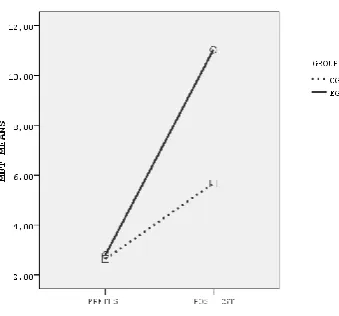
The main treatment effect and interaction (test x group) between EG and CG were calculated to be statistically significant in favor of EG. Besides, the fractional gains (learning gain) of the groups were calculated. The learning gain of EG was found to be gEG=0.67 “medium” and the learning gain of CG was calculated to be gCG=0.25 “low”. Figure 1 represents the interaction between the groups and the tests for MBT. The difference between the mean results of the students before the instruction revealed no statistically significant while the difference between the mean results of students after the instruction was found to be statistically significant in favor of the experimental group.
Figure1.The mean score differences between group mean results for MBT
Figure 2. Min-max scores of students on MBT
Table 2. The results of ANOVA testing for differences between groups' score
F df p
Group
CLASS 813.73 1,69 0.000
PSG 190.43 1,69 0.000
SM/E 643.20 1,69 0.000
CU 461.57 1,69 0.000
Test
CLASS 1456.26 1,69 0.000
PSG 351.14 1,69 0.000
SM/E 849.93 1,69 0.000
CU 599.14 1,69 0.000
Test x Group
CLASS 1353.41 1,69 0.000
PSG 347.45 1,69 0.000
SM/E 724.79 1,69 0.000
CU 566.85 1,69 0.000
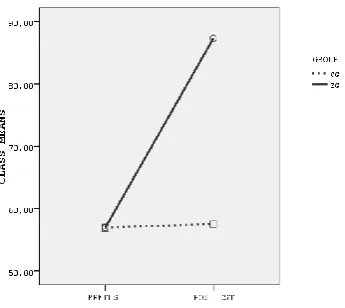
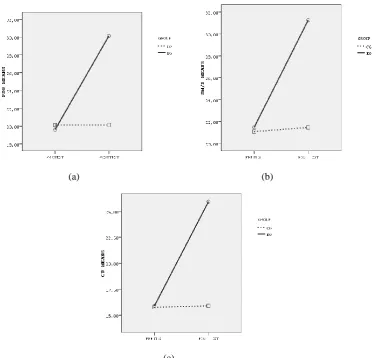
Table 2 shows the results of two way repeated measures ANOVA for the groups' CLASS score. The results were found to be statistically significant in favor of the experimental group. Figure 3 demonstrates the interaction between the groups and the sub-factors (PSG, SM/E and CU) of CLASS. The difference between the mean scores of the students before the instruction revealed no statistically significant while the difference between the mean scores of the students after the instruction was found to be statistically significant in favor of the experimental group.
Figure 3. The differences between group mean scores for CLASS
CU) revealed no statistically significant while the differences between the mean scores of the students after the instruction found to be statistically significant in favor of the experimental group.
(a) (b)
(c)
Figure 4. The mean score differences between group mean scores for (a) PSG, (b)SM/E, and (c) CU factors
The scores of the students in the control group were in the range of 52 and 64 while the scores of the students in the experimental group were in the range of 84 and 92 on the post-test. Figure 5 shows the minimum-maximum score distributions of the experimental and control groups on the post-test.
Students' Opinions about Think Pair Share Instructional Strategy
The general opinion of the students was collected with the student essays. Approximately 80% of the voluntary students represented their positive opinions about the teaching of think pair share instructional strategy as follows:
Think pair share instructional strategy was really useful to comprehend relationships between new information and existing knowledge.
They began to have interest in physics because they realized that they could understand fundamental concepts.
They liked cooperative working during the implementation. They participated the courses more when working in pairs/partners. They began to think creatively.
Think pair share instructional strategy enhanced self-confidence and responsibility of the students toward their own learning.
They fostered positive attitude toward conceptual learning.
The negative opinions of the students (20%) were listed as follows:
They could easily understand fundamental concepts. So, think pair share instructional strategy was time-consuming and unnecessary.
They did not like to study in a group.
They found the instructional strategy nonsense.
Conclusion
The present study revealed the positive effects of think pair share instructional strategy on students' conceptual learning about classical mechanics and the epistemological beliefs on physics and physics learning of the students relative to conventional, teacher centered teaching. The conceptual learning performance of the students instructed with think pair share instructional strategy was higher than the conceptual learning performance of the students instructed with conventional, teacher centered teaching. The factors affecting students performance during think pair share instructional strategy application could be summarized as follows: a) according to multiple-choice questions, the students meaningfully comprehended the fundamental principles and concepts of the subjects with the help of general feedback by the instructor, b) the students in the experimental group more participated in group discussion, c) they felt more comfortable when sharing their thoughts and ideas and they more communicated with pairs during discussions, d) think pair share instructional strategy proved to help the students in organizing the ideas and thoughts they had while working in the interactive classroom, e) the stress and embarrassment of the students in interactive learning environment diminished by cooperative working and finally f) the students took more responsibility toward their own learning between pairs. The researcher also observed that the students were more engaged in thinking, discussing and sharing in a group from in the beginning of the implementation to at the end of the implementation.
The epistemological beliefs on physics and physics learning of the students instructed with think pair share instructional strategy were more positive and higher than the epistemological beliefs on physics and physics learning of the students instructed with conventional, teacher centered teaching. The results in the literature (Adams et al. 2006; Crouch & Mazur, 2001; Gok, 2012; Kortemeyer, 2007; Lasry et al. 2016; Madsen et al. 2015; McDermott, 1991; Sharma et al. 2013; Stathopoulou & Vosniadou, 2007) supported the results of the research. These studies reported that peer instruction like think pair share instructional strategy was effective on epistemological beliefs on physics and physics learning of the students. The beliefs and attitudes of the students instructed with peer instruction was evaluated with the help of the some instruments (Maryland Physics Expectations-MPEX, Colorado Learning Attitudes about Science Survey-CLASS etc.). These studies revealed that the beliefs and attitudes of the students instructed with interactive engagement methods more enhanced than the beliefs and attitudes of the students instructed with conventional, teacher-centered teaching methods. The findings of examined studies supported the findings of the present study. Many studies revealed the positive correlations between the experience students' and inexperience students' epistemological beliefs and academic performances (Chu, Treagust, & Chandrasegaran, 2008; Domert et al. 2007; May & Etkina, 2002). When the results of the research were generally evaluated, it could be said that the students in the experimental group improved the view toward problem solving and conceptual understanding and began to make sense the learning materials based on fundamental principles/concepts. Besides the perception of the students having epistemological beliefs and attitudes on physics and physics learning changed with think pair share instructional strategy.
Recommendations
Some suggestions based on the findings of the results could be presented as follows:
There were a few challenges of think pair share instructional strategy in the application procedure. One of the challenges was to get the students to really be engaged during the discussion. The other drawback was the noise level during the discussion with each other of the students. Therefore some precautions on the mentioned challenges may be taken as follows: the instructor may walk around amongst pairs in the class during the activity and the instructor may encourage the students to focus on the concept tests and/or problems. Besides, the high digital technology called as "classroom response systems" for evaluating of the student results and managing time of the instructors may be effectively used in small and/or large groups.
References
Adams, W. K., Perkins, K. K., Podolefsky, N. S., Dubson, M., Finkelstein, N. D., & Wieman, C. E. (2006). A new instrument for measuring student beliefs about physics and leaning physics: The Colorado attitudes about science survey. Physical Review Special Topics-Physics Education Research, 2 (010101), 1-14.
Allen, D., & Tanner, K. (2002). Approaches in cell biology teaching. Cell Biology Education, 1, 3-5.
Barkley, E. F., Cross, P. K., & Mayor, C. H. (2005). Collaborative learning techniques: Handbook for college faculty. San Francisco: Jossey-Bass.
Caballero, M. D, Greco, E. F., Murray, E. R., Bujak, K. R., Marr, M. J., Catrambone, R., Kohlmyer, M. A., & Schatz, M. F. (2012). Comparing large lecture mechanics curricula using the Force Concept Inventory: A five thousand student study. American Journal of Physics, 80(7), 638-644.
Cardamone, C. N., Abbott, J. E., Rayyan, S., Seaton, D. T., Pawl, A., & Pritchard, D. E. (2012). Item response theory analysis of the mechanics baseline test. AIPConference Proceedings, 1413, 135-138.
Chu, H. E., Treagust, D. F., & Chandrasegaran, A. L. (2008). Naive students’ conceptual development and beliefs: The need for multiple analyses to determine what contributes to student success in a university introductory physics course. Research in Science Education, 38(1), 111-125.
Cortright, R. N., Collins, H. L., & DiCarlo, S. E. (2005). Peer instruction enhanced meaningful learning: Ability to solve novel problems. Advances in Physiology Education, 29, 107- 111.
Crouch, C. H., & Mazur, E. (2001). Peer instruction: Ten years of experience and results. American Journal of Physics, 69, 970-977.
Fagen, A. P., Crouch, C. H., & Mazur, E. (2002). Peer instruction: Results from a range of classroom. The Physics Teacher, 40, 206-209.
Fraenkel, J. R., & Wallen, N. E. (2009). How to design and evaluate research in education (7th ed). NY: McGraw-Hill.
Fraser, J. M., Timan, A. L., Miller, K., Dowd, J. E., Tucker, L., & Mazur, E. (2014). Teaching and physics education research: Bridging the gap. Reports on Progress in Physics, 77(3), 1-17.
Gok, T. (2012). The impact of peer instruction on college students' beliefs about physics and conceptual understanding of electricity and magnetism. International Journal of Science and Mathematics Education, 10, 417-436.
Gok, T. (2013). A comparison of students' performance, skill and confidence with peer instruction and formal education. Journal of Baltic Science Education, 12(6), 747-758.
Gok, T. (2014). Peer instruction in the physics classroom: Effects on gender difference performance, conceptual learning, and problem solving. Journal of Baltic Science Education, 13(6), 776-788. Gok, T. (2015). An investigation of students’ performance after peer instruction with stepwise problem-solving
strategies. International Journal of Science and Mathematics Education. 13(3), 561-582.
Hake, R. R. (1998). Interactive-engagement versus traditional methods: A six-thousand student survey of mechanics test data for introductory physics courses. American Journal of Physics, 66, 64–74.
Hammer, D. (1994). Epistemological beliefs in introductory physics. Cognition and Instruction, 12(2), 151-183. Hammer, D. (1995). Epistemological considerations in teaching introductory physics. Science Education, 79(4),
393-413.
Hestenes, D., & Wells, M. (1992). A mechanics baseline test. The Physics Teacher, 30, 159-166.
Hutcheson, G. D. & Sofroniou, N. (1999). The multivariate social science scientist: Statistics using generalized linear models. Thousand Oaks, CA: Sage.
Johnson. D. W., Johnson, R. T., & Smith, K. A. (1991). Active learning: Cooperative learning in the college classroom. Edina, MN: Interaction Book.
Johnson, D. W., & Johnson, R. T. (1999). Making cooperative learning work. Theory into Practice, 38(2), 73.
Kalman, C. S., Milner-Bolotin, M., & Antimirova, T. (2010). Comparison of the effectiveness of collaborative groups and peer instruction in a large introductory physics course for science majors. Canadian Journal of Physics, 88, 325–332.
Kortemeyer, G. (2007). Correlations between student and discussion behavior, attitudes, and learning. Physics Review Special Topics- Physics Education Research, 3(1), 1-8.
Kothiyal, A., Majumdar, R., Murthy, S., & Iyer, S. (2013). Effect of think-pair-share in a large CS1 class: 83% sustained engagement. Proceedings of the Ninth Annual International ACM Conference on International Computing Education Research. San Diego, CA: USA.
Kuo. E., & Wieman, C. E. (2016). Toward instructional design principles: Inducing Faraday’s law with contrasting cases. Physical Review Special Topics - Physics Education Research, 12(010128), 1-14. Lasry, N., Mazur, E., & Watkins, J. (2008). Peer instruction: From Harvard to the two-year college. American
Journal of Physics, 76(11), 1066-1069.
Lasry, N., Charles, E., & Whittaker, C. (2016). Effective variations of peer instruction: The effects of peer discussions, committing to an answer, and reaching a consensus. American Journal of Physics, 84(8), 639-645.
Lising, L., & Elby, A. (2005). The impact of epistemology on learning: A case study from introductory physics. American Journal of Physics, 73(4), 372-382.
Madsen, A., McKagan, S. B., & Sayre, E. C. (215). How physics instruction impacts students’ beliefs about learning physics: A meta-analysis of 24 studies. Physical Review Special Topics - Physics Education Research, 11(010115), 1-19.
May, D. B., & Etkina, E. (2002). College physics students' epistemological self-reflection and its relationship to conceptual learning. American Journal of Physics, 70(12), 1240-1258.
Mazur. E. (1997). Peer instruction: A user's manual. Upper Saddle River, NJ: Prentice Hall.
McDermott, L. C. (1991). Millikan Lecture 1990: What we teach and what is learned-Closing the gap. American Journal of Physics, 59(4), 301-315.
McDermott, L. C. (1993). Guest comment: How we teach and how students learn-A mismatch? American Journal of Physics, 61(4), 129-298.
McDermott, L. C. (2001). Oersted medal lecture 2001: Physics education research- The key to student learning. American Journal of Physics, 69 (11), 1127-1137.
Prahl, K. (2017). Best practices for the think-pair-share active-learning technique. The American Biology Teacher, 79(1), 3-8.
Raba, A. A. A. (2017). The influence of think-pair-share (TPS) on improving students’ oral communication skills in EFL classrooms. Creative Education, 8, 12-23.
Redish, E. F., & Saul, J. M., & Steinberg, R. N. (1998). Student expectations in introductory physics. American Journal of Physics, 66(3), 212-224.
Redish, E. F. (2003). Teaching physics with physics suite. Hoboken, NJ: John Wiley & Sons.
Roth, W. M., & Roychoudhury, A. (1994). Physics students’ epistemologies and views about knowing and learning. Journal of Research in Science Teaching, 31(1), 5-30.
Sampsel, A. (2013). Finding the effects of think-pair-share on student confidence and participation. Honors Project, 28.
Seung, E. (2013). The process of physics teaching assistants’ pedagogical content knowledge development.
International Journal of Science and Mathematics Education, 11, 1303-1326.
Sharma, S., Ahluwalia, P. K., & Sharma, S. K. (2013). Students’ epistemological beliefs, expectations, and learning physics: An international comparison. Physical Review Special Topics-Physics Education Research, 9(010117), 1-13.
Silberman, M. (1996). Active Learning: 101 strategies to teach any subject. Needham Heights, MA: Allyn & Bacon.
Smith, M. K., Wood, W. B., Adams, W. K., Wieman, C., Knight, J. K., Guild, N., & Su, T. T. (2009). Why peer discussion improves student performance on in-class concept questions. Science, 323, 122-24.
Stathopoulou, C., & Vosniadou, S. (2007). Exploring the relationship between physics-related epistemological beliefs and physics understanding. Contemporary Educational Psychology, 32, 281.
Suppapittayaporn, D., Emarat, N., & Arayathanitkul, K. (2010). The effectiveness of peer instruction and structures inquiry on conceptual understanding of force and motion: A case study from Thailand.
Research in Science & Technological Education, 28 (1), 63-79.
Trent, K. S. (2013). The effects of the peer instruction technique think-pair-share on students’ performance in chemistry. Unpublished master's thesis, Nicholls State University, Thibodaux, Louisiana.
Van Heuvelen, A. (1991). Learning to think like a physicist: A review of research-based instructional strategies. American Journal of Physics, 59(10), 891-897.
Author Information
Tolga Gok
Dokuz Eylul University
Torbali Technical Vocational School of Higher Education Izmir, Turkey