www.jeseh.net
Identifying the Factors Affecting Science
and Mathematics Achievement Using
Data Mining Methods
S. Ahmet KIRAY1, Bilge GOK2,A. Selman BOZKIR2 1
Necmettin Erbakan University 2Hacettepe University
To cite this article:
Kiray, S.A., Gok, B., & Bozkir, A.S. (2015).
Identifying the factors affecting science and
mathematics achievement using data mining methods.
Journal of Education in Science,
Environment and Health (JESEH), 1
(1), 28-48.
This article may be used for research, teaching, and private study purposes.
Any substantial or systematic reproduction, redistribution, reselling, loan, sub-licensing,
systematic supply, or distribution in any form to anyone is expressly forbidden.
Authors alone are responsible for the contents of their articles. The journal owns the
copyright of the articles.
Identifying the Factors Affecting Science and Mathematics Achievement
Using Data Mining Methods
S. Ahmet KIRAY1*, Bilge GOK2, A. Selman BOZKIR 1
Necmettin Erbakan University, 2Hacettepe University
Abstract
The purpose of this article is to identify the order of significance of the variables that affect science and mathematics achievement in middle school students. For this aim, the study deals with the relationship between science and math in terms of different angles using the perspectives of multiple causes-single effect and of multiple causes-multiple effects. Furthermore, the study examines and reveals how the reading skills, problem solving skills, cognitive and affective variables influence the math and science achievement. The data was collected from the results of Turkish students who participated in three international examinations; TIMSS 1999, PISA 2003 and PISA 2006. We analyzed the data using two data-mining methods (decision trees and clustering). The findings show that science or mathematics achievement is not influenced by the course-specific variable alone but also by other related variables. The following variables are the most important; the students’ reading and problem-solving skills affected both mathematics and science achievement; the mathematics achievement affected the science achievement; and the science achievement affected the mathematics achievement. It is also found that the affective variables have almost equally significant effects on the science and mathematics achievement.
Key words: Integrated science and mathematics; data mining; TIMSS; PISA
Introduction
The relationship between science and mathematics has been significant throughout the history of science (Kıray, 2012). Sometimes the work of a mathematician has been the basis of a great scientific invention, and scientific study has led to a new mathematical domain. Until the beginning of the 1700s, both subjects were combined under the heading of natural philosophy (Cahan, 2003) but as a result of the accumulation of knowledge over time, they became independent disciplines. However, since the fields of science and of mathematics are closely related thinking systems (McBride, 1991), an implicit relationship has always naturally existed between them (House, 1990; Berlin, 1991; Kurt & Pehlivan, 2013). “Science provides rich contexts and concrete phenomena demonstrating mathematical patterns and relationships. Mathematics provides the language and tools necessary for deeper analysis of science concepts and applications.” (Basista & Mathews, 2002). Therefore, in science and mathematics instruction, in order to achieve the goals of the science course, mathematics should be used, while similarly science topics should be employed in order to make the mathematics topics more concrete (Taşdemir & Taşdemir, 2008). This connection between science and mathematics is inevitably reflected in school curriculums. Courses based on science offered by most schools depend on mathematical skills (Basson, 2002). On the other hand, the mathematics course is supported by the science course in integrating knowledge with everyday experiences.
Science and mathematics courses are usually designed independently but there are many visible attempts to make connections between them in various countries, including in Turkey. This recent attempt is largely a result of the reactions to the achievement levels Turkish students in international examinations such as TIMSS and PISA, which lag behind the international averages. Such examinations provide the participating countries with the opportunity to compare themselves with other countries in terms of science, mathematics and reading scores (Aypay et al, 2007). The overall goal of TIMSS is to improve science and mathematics instruction in different countries by providing data on which instructional programs, instructional activities and school environments lead to higher levels of student achievement (Gonzalez & Miles, 2001). PISA examinations, on the other hand, are administered in order to measure the levels of reading, mathematics and science as well as problem-solving literacy (Shelley & Yildirim). This examination focuses not on the access levels of school curricula but on the knowledge and skills necessary for effective participation in social life (Berberoğlu & Kalender, 2005). At the
*
same time, PISA measures the levels of students in regard to use of the information and skills acquired in the school in the real-life situations (EARGED, 2005). International examinations deal with the scores of science, mathematics, reading and problem solving that are a part of the cognitive domain as well as with some basic characteristics related to achievement. As is widely known, the factors that have impacts on student achievement can be cognitive and/or affective. Research on this topic indicates that student achievement is related to affective characteristics (Oliver & Simpson, 1988; Güngör et al., 2007). Some of the affective characteristics are identified as; interest, self-concept/confidence, self-efficacy, belief, anxiety, self and motivation (Gömleksiz, 2003; Dede & Yaman, 2008).
As stated above, interest is one of the affective characteristics. It is commonly assumed that a prerequisite for learning is being interested in the subject to be learnt. Therefore, the higher the interest in the subject matter, the higher the level of learning achieved (Dewey, 1933; Hizarcı et al., 2005; Erten, 2008). Moreover, interest is known to affect both cognitive and affective processes (Yaman et al., 2008). Interest develops over time and influences the attitude of the individual. In order for a tendency to be a full attitude, the individual should exhibit it for a long period of time (Tavşancıl, 2006). One of the significant goals of science and mathematics education is to develop in students positive attitudes towards science and mathematics. The major reason for students having negative attitudes towards these two courses seems to be lack of interest and motivation (Bilgin, 2006). Both interest and motivation are significant factors in improving the concentration and achievement levels of students. Individuals’ interest, attitude, motivation and achievement as well as self-belief are in close interaction with one another.
Self-belief is significantly related to science and mathematics achievement (House, 2004). One aspect of self-belief is self-concept. Self-concept is about how one person perceives himself. “Academic self-concept and school performance strongly interact. When learning experiences are positive, self-concept is enhanced; when they’re negative, it suffers” (Eggen & Kauchak, 2001, p.100). On the other hand, self-concept is closely related to self-efficacy. High achievers feel self-efficacious and personally responsible for control of their academic learning process (Zimmerman et al., 1996; Girasoli & Hannafin, 2008). “Efficacy beliefs influence how people think, feel, motivate themselves and act” (Bandura, 1995). A person’s level of arousal, whether perceived positively as anticipation or negatively as anxiety, can influence his or her self-efficacy beliefs (Tschannen-Moran & McMaster, 2009). It is commonly argued that anxiety is a multi-dimensional construct (Bursal, 2008) and that it is related to negative attitude, avoidance, background, instructor behaviors, level of achievement, lack of confidence and negative school experiences (Bursal & Paznokas, 2006; Harper & Daane, 1998; Hembree, 1990; Sloan et al., 2002).
Chaos, Fuzzy Logic and Data Mining
Lorenz developed the idea of the butterfly effect as a result of computer-assisted weather forecast calculations in 1963. The idea, a metaphor for chaos theory, is that the flutter of a butterfly in China in March leads to changing the nature of a hurricane that will occur in the Atlantic Ocean in August (Gleick, 1987). Following this idea, scientists today deal with the reasons for the hurricane occurring in the Atlantic Ocean and mathematicians with the mathematical models accounting for the variables leading to the hurricane. Given that the variables leading to the hurricane interact with one another, it is quite clear that such a cause-effect relationship cannot be linear. Furthermore, such a relationship cannot be understood following double logic. “Fuzzy logic” developed by Zadeh (1965) is an alternative approach in that it suggests that almost none of the systems in real life are linear. A fuzzy set is the most basic element of fuzzy systems. A fuzzy set is one in which there are elements with varying levels of membership or of belonging. The membership value of the elements that do not belong to the set is 0 while the membership value of those elements that are full members of the set is 1. For those elements whose membership status is not clear, membership values ranging between 0 and 1 are assigned (Altaş, 1999). Advances in computer science have made it possible for the theory of the fuzzy set depending on fuzzy logic to be used commonly.
consists of a series of transformation steps, from data preprocessing to evaluation/interpretation of data mining results. The purpose of preprocessing is to transform the raw input data into an appropriate format for subsequent analysis. The stages involved in data preprocessing include fusing data from multiple sources, cleaning data to remove noise and duplicate observations, and selecting records and features that are relevant to the data mining task at hand (Tan et al., 2005). The KDD process is given below.
Figure 1. The KDD process (adapted from Mitra et al., 2002)
Aim of the Study
“Philosophically and theoretically, there is strong support for the integration of science and mathematics teaching and learning as a way to improve and enrich the science and mathematics learning experiences” (Berlin 1991). If teachers are aware of which variables affect students’ science and mathematics achievement, they may be able to tackle some of the causes of underachievement. Sometimes these effects can be seen with the linear models that emerge from positivist philosophy. However, human beings and their learning processes are very complex. Hermeneutic philosophers (suh as Kuhn) are opposed to linear thinking processes, arguing instead for chaos and fuzzy logic (Perla & Carifio, 2005). In regard to accounting for levels of achievement/underachievement in science and mathematics courses, Lorenz’s (1963) idea of the butterfly effect means that all variables, including those that have been regarded as irrelevant and those that have very minimal effects on student achievement, should be taken into consideration. If the flutter of a butterfly causes many events, or the reasons for the hurricane are various not single, then can the same reasoning be valid for educational situations? In this context, a student’s math anxiety may affect his science achievement, or the efficacy problems experienced by a student in regard to science may influence his mathematics achievement. Similarly, positive attitudes towards mathematics developed as early as the elementary education years may have an impact on later science achievement. In the same vein, high levels of motivation towards science may positively affect later mathematics achievement (Kıray, 2010).
1-When only the science achievement is considered as a predictable variable, what is the significance order of the variables having an impact on this achievement?
2-When only the mathematics achievement is considered as a predictable variable, what is the significance order of the variables having an impact on this achievement?
3-When both the science and mathematics achievement is considered as a predictable variable, what is the significance order of the variables having an impact on this achievement?
Method
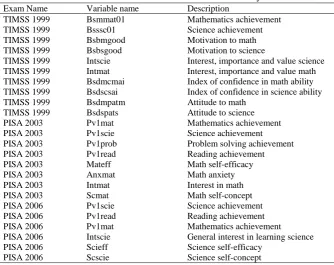
The data used for the study were collected from the TIMSS 1999, PISA 2003 and PISA 2006 examinations that were administered to Turkish students in the 15-year age group. The variables examined in the study are given in Table 1. The variables given in Table 1 are analyzed through the use of data mining methods.
Table 1. Variables examined in the whole study
Data Preparation and Applying Data Mining Methods
The understanding and the preparation stages are among the most important steps in the data mining applications (Delen et al., 2005). At the start of this study, three datasets which contain the data of TIMSS 1999 and PISA 2003/2006 exams were exported to SQL Server database from SPSS. At the same time, unnecessary variables in the dataset were excluded. The TIMSS 1999 data that we used in the analysis consisted of eight inputs and two predictable variables as well as 7163 records. These variables and their properties are listed in Table 2.
Table 2. Types and usage parameters of variables included in theTIMSS 1999 dataset
Variable Name Type Model 1 Usage Model 2 Usage Model 3 Usage
BSMMAT01 Numeric Predict Only Input Predict
BSSSCI01 Numeric Input Predict Only Predict
BSBMGOOD Discrete Input Input Input
BSBSGOOD Discrete Input Input Input
BSDMCMAI Discrete Input Input Input
BSDSCSAI Discrete Input Input Input
INTMAT Discrete Input Input Input
INTSCIE Discrete Input Input Input
BSDMPATM Discrete Input Input Input
BSDSPATS Discrete Input Input Input
Exam Name Variable name Description
TIMSS 1999 Bsmmat01 Mathematics achievement
TIMSS 1999 Bsssc01 Science achievement
TIMSS 1999 Bsbmgood Motivation to math
TIMSS 1999 Bsbsgood Motivation to science
TIMSS 1999 Intscie Interest, importance and value science
TIMSS 1999 Intmat Interest, importance and value math
TIMSS 1999 Bsdmcmai Index of confidence in math ability
TIMSS 1999 Bsdscsai Index of confidence in science ability
TIMSS 1999 Bsdmpatm Attitude to math
TIMSS 1999 Bsdspats Attitude to science
PISA 2003 Pv1mat Mathematics achievement
PISA 2003 Pv1scie Science achievement
PISA 2003 Pv1prob Problem solving achievement
PISA 2003 Pv1read Reading achievement
PISA 2003 Mateff Math self-efficacy
PISA 2003 Anxmat Math anxiety
PISA 2003 Intmat Interest in math
PISA 2003 Scmat Math self-concept
PISA 2006 Pv1scie Science achievement
PISA 2006 Pv1read Reading achievement
PISA 2006 Pv1mat Mathematics achievement
PISA 2006 Intscie General interest in learning science
PISA 2006 Scieff Science self-efficacy
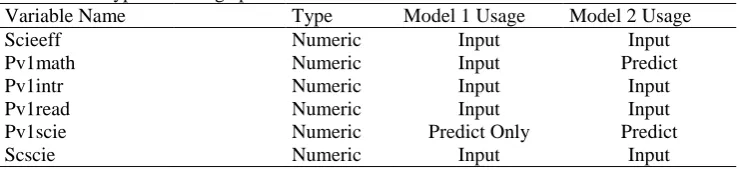
Likewise, the PISA 2003 dataset has six inputs, two predictable variables and 4855 records. Similarly, the PISA 2006 dataset has four inputs, two predictable variables and 4942 records. PISA 2003/2006 variables and their properties are given in Table 3 and Table 4 respectively.
Table 3. Types and usage parameters of variables included in thePISA 2003 dataset
Variable Name Type Model 1 Usage Model 2 Usage
Anxmat Numeric Input Input
Intmat Numeric Input Input
Matheff Numeric Input Input
Pv1math Numeric Predict Only Predict
Pv1prob Numeric Input Input
Pv1read Numeric Input Input
Pv1scie Numeric Input Predict
Scmat Numeric Input Input
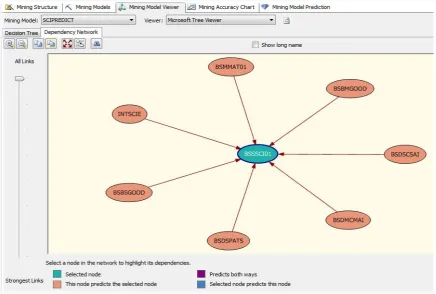
In order to carry out the research, Microsoft SQL Server 2008 Analysis Services software is chosen as the analyzing platform as it supports regression trees (the continuous variable version of decision trees). Since the goal of this data mining study is to develop models that can be used to discover the relationships of science and mathematics achievement, a decision tree, a well-known classification technique, and clustering, a descriptive data mining technique, were used simultaneously during the analysis. In addition, Microsoft SQL Server Analysis Services employs its own decision tree algorithm (Microsoft Decision Trees) and clustering algorithm (Microsoft Clustering). The Microsoft Decision Trees algorithm supports both discrete and continuous valued variables/attributes as the predictable variable. Another reason for selecting this algorithm and software is that these can build dependency network graphs which indicate the influences of independent variables on predictable variables. The dependency network graphs display the relationships among variables derived from the content of the decision tree model. Each node in the graph represents one variable, and each edge represents the relationship between two nodes (Tang & MacLennan, 2005).
Table 4. Types and usage parameters of variables included in thePISA 2006 dataset
Variable Name Type Model 1 Usage Model 2 Usage
Scieeff Numeric Input Input
Pv1math Numeric Input Predict
Pv1intr Numeric Input Input
Pv1read Numeric Input Input
Pv1scie Numeric Predict Only Predict
Scscie Numeric Input Input
The decision tree is a data mining approach that is often used for classification and prediction. Although different techniques, such as neutral network, can also be employed for classification purposes, decision tree methodology has the advantages of easy interpretation and understanding for decision makers to compare with their domain knowledge for validation and to justify their decisions (Chien & Chen, 2008). In addition, there are a few advantages of using decision trees over using other data mining algorithms, for example, decision trees are quick to build and easy to interpret and prediction based on decision trees is efficient (Tang & MacLennan, 2005). Hence, the decision tree models shown below are created for each dataset for the purpose of this study, and then the results were converted into tables.
Figure 2. Variables affecting the science achievement
On the other hand, the aim of clustering is to find groups of closely related observations so that observations that belong to the same cluster are more similar to each other than observations that belong to other clusters (Tan et al., 2005). Clustering is a useful technique for the discovery of some knowledge from a dataset. It is an exploratory method for helping to solve classification problems. Its use is appropriate when little or nothing is known about the category structure in a body of data. The objective of clustering is to sort a sample of cases under consideration into groups such that the degree of association is high between members of the same group and low between members of different groups (Chiu et al., 2009). Assigning cases to clusters is one of the most significant differentiators in clustering algorithms. The Microsoft Clustering algorithm serves two distinct techniques in clustering; K-means and expectation maximization (EM). In the K-means method, every case is assigned to one and exactly one cluster, whereas the EM method uses a probabilistic approach to assign clusters. Thus, a case does not have to be a member of a single cluster (soft clustering) as in the K-means approach (hard clustering) (Tang & MacLennan, 2005).
The data we used in both the decision trees and clustering studies is TIMSS 1999, PISA 2003 and PISA 2006 data from Turkey. In the clustering phases of study, we employed the EM algorithm. To gain natural clusters, we set the “Cluster_Count” parameter of the algorithm to “0”, meaning automatic and natural clustering. During the clustering phase, ten clusters were derived from the PISA 2003 and TIMSS 1999 datasets, and nine clusters from the PISA 2006 dataset.
Results
The variables used in the study are taken as predictable variables together either with only the science score or with only the mathematics (or math) score or with both scores based on the properties of the related exams and were then analyzed by means of both decision tree and clustering techniques. The results obtained are given below in chronological order of the examinations.
TIMSS 1999 Examination
Table 5 was completed using a dependency network together with a decision tree, and shows the most dominant variables as well as the most recessive ones. This order of significance is given in Table 5. With the science achievement score (Bsssci01) taken as the single predictable variable, the order of significance for the variables having an impact on it is given in Table 5. It can be seen that the most dominant variable on the science achievement score is the mathematics achievement score (Bsmmat01). Although the math interest (Intmat) and math attitude (Bsdmpatm) values are considered to be variables, they are empty in Table 5 and no effect of them on the science achievement score is observed.
Table 5. Order of significance for the variables affecting only science achievement score in TIMSS 1999
Predictable Variable Order of Predictors BSM- MAT01 BSS- SCI01 BSB-MGOOD BSB-SGOOD BSD- MCMAI BSD- SCSAI INT- MAT INT- SCIE BSD- MPATM BSD- SPATS
BSSSCI01 1 5 3 4 2 7 6
Predictable Variable: Mathematics (TIMSS 1999)
Table 6 was completed using a dependency network together with a decision tree, and shows the most dominant variables as well as the most recessive ones. This order of significance is given in Table 6. With the math achievement score taken as the single predictable variable, the order of significance for the variables having an impact on it is given in Table 6. Although science interest (Intscie), math attitude and science attitude (Bsdspats) values are considered to be variables, they are empty in Table 6 and no effect of them on the math achievement score is observed.
Table 6. Order of significance for the variables affecting only math achievement score in TIMSS 1999
Predictable Variable Order of Predictors BSM- MAT01 BSS- SCI01 BSB- MGOOD BSB- SGOOD BSD- MCMAI BSD- SCSAI INT- MAT INT- SCIE BSD- MPATM BSD- SPATS
BSMMAT01 1 3 4 2 5 6
Predictable Variables: Science and Mathematics (TIMSS 1999)
Table 7 was obtained using a dependency network together with a decision tree and shows the most dominant variables as well as the most recessive ones. This order of significance is also given in Table 7. When the science and math achievement scores are taken as the single predictable variables, the order of significance for the variables having an impact on them is given in Table 7. This table clearly indicates that the math achievement score is the dominant variable on the science achievement score. It is also seen that there is no empty column except for where both achievement scores overlap. When both achievement scores are regarded as predictable variables, all of the variables appear to be significant. In addition to the order of significance for variables extracted from dependency networks derived from the decision trees, the common characteristics of the students who participated in the exams are studied as well as the correlations among variables, which are analyzed via the clustering study. In the clustering study, the students are grouped considering the same input variables as in the decision tree analysis phase. The clusters of student characteristics can then be analyzed with the help of the “clustering profile viewer” of the Microsoft Analysis Services program (Figure 2).
Table 7. Order of significance for the variables affecting both science and math achievement score in TIMSS 1999 Predictable Variables Order of Predictors BSM- MAT01 BSS- SCI01 BSB- MGOOD BSB- SGOOD BSD- MCMAI BSD- SCSAI INT- MAT INT- SCIE BSD- MPATM BSD- SPATS
BSSSCI01 1 16 10 15 5 14 6 8 9
BSMMAT01 2 3 7 4 13 12 18 17 11
Figure 3. TIMSS 1999 clustering technique outcomes
PISA 2003 Examination
Predictable Variable: Mathematics (PISA 2003)
Table 8 was completed using a dependency network together with a decision tree and shows the most dominant variables as well as the most recessive ones. The math achievement score (Pv1math) is taken as the predictable variable in the model. The order of significance for the other variables affecting it is given in Table 8. The PISA 2003 examination focuses largely on the capability of students in regard to the mathematics course. Therefore, the exam includes only those cognitive and affective variables that are considered to be related to mathematics. In regard to the science course, only the achievement score is included but the other related variables are not covered. Table 8 indicates that the most dominant variable affecting the math achievement score is the math self-concept score, while the other variables included by the exam coverage as well as in the current study appear to be significant in accounting for the math achievement.
Table 8. Order of significance for the variables affecting math achievement score in PISA 2003
Predictable Variable Order of Predictors
Pv1prob Pv1math Pv1read Scmat Matheff Anxmat Pv1scie Intmat
Pv1math 2 3 1 6 4 5 7
Predictable Variables: Science and Mathematics (PISA 2003)
Table 9 was completed using a dependency network together with a decision tree and shows the most dominant variables as well as the most recessive ones. When both math and science achievement scores are taken as the predictable variables in the decision tree model, the order of significance for the other variables affecting them appears as given in Table 9. It is clearly shown that the most dominant variable on science achievement is the variable of problem-solving skill. It is also seen that there is no empty column except for where both achievement scores overlap in Table 9. When both math and science achievement scores are taken as the predictable variables, all variables included in the study appear to be significant in accounting for the achievement levels.
Table 9. Order of significance for the variables affecting math and science achievement in PISA 2003
Predictable Variable Order of Predictors
Pv1prob Pv1math Pv1read Scmat Matheff Anxmat Pv1scie Intmat
Pv1scie 1 2 3 13 6 11 14
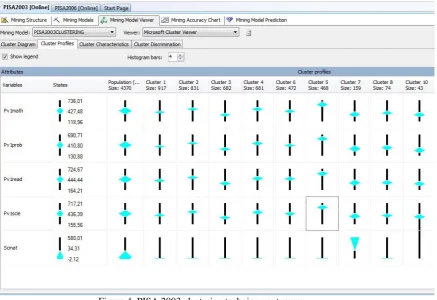
In addition to the order of significance for variables developed through dependency networks which are derived from the decision trees, using clustering technique we analyzed which variables have correlations. When natural sets of the students are analyzed, there appears no direct, linear correlation between math achievement/underachievement and science achievement/underachievement.
Figure 4. PISA 2003 clustering technique outcomes
The clustering study for the PISA 2003 examination data indicates that the level of achievement has the same trend in the highest achievement and lowest achievement sets both in math and science (see Fig. 4). The highest achievers in math appear to be the highest achievers in science also (Cluster 5). Similarly, other sets also show the achievement correlation between math and science. Additionally, the input variables of Pv1prob and Pv1read are also found to be parallel with the math and science achievement. Although other input variables are used in the dataset, these variables appear not to lead to significant differences from one set to another so that these inputs are excluded from the findings.
PISA 2006 Examination
Predictable Variable: Science (PISA 2006)
When science achievement (Pv1scie) is used as the predictable variable, the order of significance for the other variables affecting it appears as given in Table 10. The PISA 2006 examination focuses largely on the capability of the students in regard to the science course. Therefore, the examination includes only those cognitive and affective variables that are considered to be related to science. In regard to the math course, only the achievement score is included but the other related variables are not covered. It is clearly shown in Table 10 that the most dominant variable on the science achievement score is that of reading score. All of the other variables included by the exam coverage as well as in the current study also appear to be significant in accounting for the science achievement.
Table 10. Order of significance for the variables affecting science achievement in PISA 2006 Predictable Variable Order of Predictors
Pv1read Pv1math Scscie Scieeff Intmat
Predictable Variables: Science and Mathematics (PISA 2006)
Table 11 was completed using a dependency network together with a decision tree and shows the most dominant variables as well as the most recessive ones. In this study, both math and science scores are considered as predictable variables. The order of significance for the other variables affecting them is given in Table 11. Table 11 shows that the most dominant variable on the science achievement score is that of reading skill, whereas the variable of science interest is the least significant variable on the math achievement score. However, it is also seen that there is no empty column in Table 11 except for where both achievement scores overlap. When both math and science achievement scores are taken as the predictable variables, all variables included in the study appear to be significant in accounting for the achievement levels.
Table 11. Order of significance for the variables affecting math and science achievement in PISA 2006
Predictable Variable Order of Predictors
Pv1read Pv1math Scscie Scieeff Pv1scie Intscie
Pv1scie 1 2 3 4 9
Pv1math 5 7 6 8 10
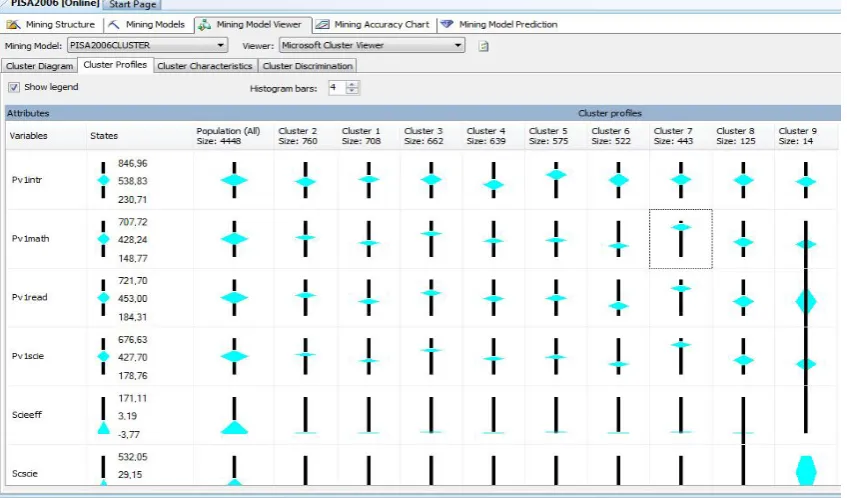
As in the studies already discussed, at this stage students are grouped and the correlation between achievement and underachievement levels of those in the same set is analyzed. The findings obtained from the PISA 2003 dataset are also found in the PISA 2006 dataset when analyzed in a clustering study (see Fig. 5). When the variables of reading skill (Pv1read), science achievement (Pv1scie) and math achievement (Pv1math) are taken into consideration, it appears that there is a significant correlation between them. Furthermore, achievement and underachievement in regard to mathematics, science and reading are parallel (see Cluster 7 at Fig. 5).
Figure 5. PISA 2006 clustering technique outcomes
Discussion
Correlation among Variables Related to Cognitive Domain and Skills Covered in the International Examinations
Correlation between Science Achievement and Math Achievement
is also successful in the other. These findings are consistent with those of the other studies, such as Wright and Corin (1999), Güleç and Alkış (2003), Wang (2005), Taşdemir and Taşdemir (2008) and Uzun, Bütüner and Yiğit (2010), suggesting that there is a strong, positive correlation between science achievement and math achievement. However, when the findings of the dependency network developed through the decision tree study are analyzed, it is found that the effect of the math achievement on the science achievement is higher than the effect of the science achievement on the math achievement. Nevertheless, one of the most dominant variables on the math achievement is the variable of science achievement, whereas one of the most dominant variables on the science achievement is the variable of math achievement. One of the potential reason for this finding seems to be the fact that a successful math student may also be successful in the science course since the latter is closely related to and depends on the math course. On the other hand, in regard to science achievement, some subfields in science (biology, earthscience etc.) may require more use of reading skills, interpretation and inference skills than the use of mathematical skills. Therefore, since these subfields in science have different structures, science achievement may have less significance in accounting for math achievement. In the same vein, Sloutsky, Kaminski, and Heckler (2004, 2005) and Kıray and Kaptan (2012) conclude that integrating and using abstract math concepts within concrete science topics increases student achievement. They also conclude that the transfer of abstract concepts into concrete concepts is much more effective than the transfer of concrete concepts into abstract concepts and that the transfer of abstract concepts into concrete concepts does not have any negative outcome. They also report that math achievement is much more effective in accounting for science achievement. In other words, science achievement is found to be less effective in explaining math achievement. One of the potential reasons for this finding is that, since mathematics has an abstract structural nature whereas the nature of science is largely concrete (Bassok & Holyoak, 1989), the transfer of abstract into concrete is much more influential than the transfer of concrete into abstract. Another possible reason is that mathematics is necessarily employed in the science course and therefore it affects the learning of mathematics. Recent science and mathematics programs used in Turkey and in other countries indicate the fact that many subfields of mathematics are extensively employed in the science course, particularly in physical sciences (Mehmetlioglu & Ozdem, 2014). The other relevant point is related to the development of math and science programs. Since math programs are usually developed based on the assumption that the content of the math course is learnt first, and then it is transferred into the science course, the math achievement is able to be much more influential in accounting for the science achievement.
Correlation between Science/Math Achievement and Reading Skills
The analyses of the PISA 2003 and PISA 2006 datasets clearly indicate that science/math achievement and reading skill are closely related. Clustering outcomes strongly suggest that this correlation is interactive, suggesting that if the reading score of a student is higher, then he or she will be successful in either of the courses, but if the reading score of a student is lower, then he or she will not be successful in either of the courses. On the other hand, when the findings of the dependency networks developed through decision tree studies are analyzed, it is found that the effects of the reading skills on science achievement are much more influential, in contrast to their effects on the math achievement. Thus, it is safe to argue that reading skill is the most significant predictor of science achievement. This finding is consistent with that of Ireland’s study (1987), which proposes that there is a high positive correlation between reading performance and science achievement.
These findings of the current study clearly suggest that reading skill is much more significant for science achievement in comparison with both math achievement and problem-solving skill. These findings seem to be consistent with the finding of Friend (1985), who argues that the reading score is much more influential in predicting science achievement than is the math achievement score.
learning all of the other subject matters and that these skills are dominant capabilities in two learning areas of the science program. The first step towards solving problems is to understand correctly the problem to be solved (Polya, 1945). Math items included in the PISA examinations, on the other hand, require the students to understand the problems correctly. Thus, reading skills may be strong predictors for math achievement. However, the problems in math items are not written as text so they depend more on problem-solving skills than reading ability. Therefore, although reading skills are also strong predictors of math achievement, reading skills are much stronger predictors of science achievement.
Correlation between Science/Math Achievement and Problem-Solving Skills
The findings obtained from the PISA 2003 examination dataset clearly indicate that both science and math achievement are closely related to problem-solving skills. Clustering outcomes further suggest that both math scores and science scores change depending on changes in the scores for problem-solving skills. In other words, a student with a higher score for problem-solving skills appears likely to be successful in both courses, whereas a student with a lower score for problem-solving skills appears likely to be an underachiever in both courses. This finding of the current study seems to be consistent with the findings of previous studies suggesting that such skills as problem-solving and reasoning are the common skills necessary for both science and mathematics (Berlin & White, 1994; Davison et al., 1995; Lederman & Niess, 1998; Kıray, 2010). On the other hand, the findings obtained from the dependency networks that are derived from decision tree study clearly indicate that the effect of problem-solving skill on science achievement is much more influential in comparison with its effects on math achievement. Therefore, although problem-solving skill is one of the most dominant predictors for mathematics achievement since it is among the basic skills for the mathematics course, it is also the strongest predictor for science achievement. This specific finding of the current study is consistent with that of Kıray’s study (2003), which found that those students who known the problem-solving steps developed by Polya in science course were much more successful in solving problems than those students who did not know these problem-solving steps. Math problems can be categorized as follows: ordinary problems that are commonly included in the math textbooks and that require the use of four basic math operations, and real-life problems that require the skills of organizing and classifying the data and the skill of recognizing the relationships and that express a real-life situation or a potential real-life event (Altun, 2008; Mataka, Cobern, Grunert, Mutambuki, & Akom, 2014). The PISA 2003 examination includes real-life based problems not ordinary math problems. Therefore, it asks the students to use related problem-solving skills for real-life problems. Such skills put emphasis on the skills of decision making when facing a complex real-life problem, as well as reasoning skills (EARGED, 2005). Given the nature of the Turkish science and technology programs, such item types seem to be more appropriate for eighth- and ninth-grade science contents. Thus, level of problem-solving skills appears to be a much more significant predictor for science achievement rather than for math achievement.
Correlation between Affective Variables Covered by the International Examinations and Science/Math Achievement
Self Concept
The findings of the dependency networks developed through decision tree studies in which math achievement is taken as the predictable variable suggest that the most significant affective predictor for math achievement is math self-concept (Scmat), whereas the effect of science self-concept (Scscie) on math achievement is less significant. This finding of the current study is consistent with that of Wang (2007), who analyzed the findings of the TIMSS 1995, 1999 and 2003 examinations and found that “there was a non-monotonic change in the reciprocal relationship between mathematic self-concept and mathematics achievement” and correspond with that of Manger and Eikeland (1998), and Barkatsas, Kasimatis and Gialamas (2009), who found that mathematics self-concept/confidence is an important variable accounting for mathematical achievement. The national report issued by EARGED (2003) states that students who believe that they are underachievers in the math course develop feelings of helplessness and increase in the level of such feelings causes decrease in the level of achievement. One of the reasons math self-concept is influential on achievement levels may be the students’ past experience which leads to their feelings of helplessness.
concept. The national report on the TIMSS 1999 examination also argues that both math and science self-concept\confidence variables seem to be the most influential factor in accounting for the achievement levels (EARGED, 2003). The findings of the current study also support this argument.
The findings of our study in regard to the TIMSS and PISA examinations suggest that the achievement level in any subject is most strongly influenced by the related self-concept, which is an affective variable. Additionally, self-concept in science and in mathematics, respectively, appear to be strong predictors of achievement both its own field and in the other one. However, the effect on the other is less in the three examinations in regard to the effect of the field’s own concept. The finding of the current study in regard to the effects of the math self-concept on science achievement and also the effects of the science self-self-concept on the math achievement is consistent with the argument of Marsh (1992) that self-concepts in different areas have impacts on the performance in different areas. Based on this finding, it is possible to argue that self-concept/confidence in one course affects not only the achievement level in that course but also affects the achievement level in other related courses.
Brookover, Thomas, and Peterson (1964) identified a positive correlation between self-concept and achievement in specific subject matter (cited in Labenne & Greene, 1969). “Although researchers find a moderate relationship between academic self-concept and achievement, the strongest correlations exist between specific academic self concepts and their corresponding subject matter areas” (Eggen & Kauchak, 2001, p.100). Although the findings of the dependency networks suggest that a specific self-concept is the most significant predictor for achievement in the related subject matter, the analysis of the clustering findings based on the association rule shows that the relationship between self-concept and science or math achievement is less significant than the relationship between reading and problem-solving skills and science or math achievement. This may be a result of the fact that self-confident students either in science or in mathematics encounter a different examination pattern in the international examination that is largely distinct from the nature of examinations administered in their schools. It may be argued further that although self-concept is a very significant predictor for achievement; it may be affected by changes in the positional and temporal conditions. Thus, students with higher self-concept scores may not be successful when the conditions are significantly changed or students with lower self-concept scores may be successful when the conditions are significantly changed.
Interest
Analysis of affective variables clearly indicates that among the affective variables, the one that has least effect on the achievement levels is the variable of interest. However, since one of the prerequisites for learning is interest in the subject matter, it may account for achievement in the related course. The finding of this study is consistent with the argument of Güngör, Eryılmaz, and Fakıoğlu (2007) that there is a positive relationship between interest and achievement. On the other hand, in the current study the variables of interest in mathematics and interest in science that refer to interest towards mathematics (Intmat) and interest towards science (Intscie), respectively, are excluded in the single cause-multiple effects relationship since they appear to have minimal effects on the achievement levels due to the specific nature of the program employed in the study.
The findings of the dependency networks related to the TIMSS 1999 and PISA 2006 examinations in which both science achievement and mathematics achievement are taken to be the predictable variable show that science interest is the least effective predictor for mathematics achievement. The findings of the dependency network related to the TIMSS 1999 and PISA 2003 examinations in which both science achievement and mathematics achievement are taken to be the predictable variable, on the other hand, display that mathematics interest is one of the less effective predictors for science achievement. Again this chaotic situation may be a result of the fact that when the findings are analyzed from the perspective of multiple causes-multiple effects depending on the fuzzy reasoning, those variables remain implicit because the interactions of variables seem to have influences on the achievement levels.
boring; math/science is important to everyone’s life; math/science is an easy subject; I would like a job that involved using math/science; etc.) indicates that if for some students math is an easy subject and they enjoy it, then the same positive attitudes are also reflected towards the math content covered in the science course and therefore their interest in math may have an impact on their science achievement, even though their level of math interest is low. Given that science activities are also used in the math course, the science interest may have effects on the math achievement too. Another reason could be that since in the math courses the instructional methods of the science courses are extensively used (inquiry, discovery, learning cycle etc.) and similarly, in the science courses, skills of the math courses are commonly employed (problem-solving, reasoning, modeling etc.), the interest in either of the courses may become a common interest in both. Interest is generally identified with intrinsic motivation. Given that interest is the key element of motivation (Dotterer et al., 2009), the effects of interest on achievement also point to the effects of motivation on achievement.
Motivation
The findings of the dependency network related to the TIMSS 1999 examination, in which the mathematics achievement is taken to be the predictable variable, suggest that the second most significant affective variable after the self-concept score in regard to math achievement is the score of the motivation towards math (Bsbmgood). This is followed by the score of the motivation towards science (Bsbsgood). The findings of the dependency network related to the TIMSS 1999 examination in which the science achievement is taken to be the predictable variable similarly indicates that the score of the motivation towards science, after the science self-concept, is the second most significant affective predictor for science achievement, followed by the scores for math self-concept and motivation towards math. The finding that motivation is one of the significant predictor for achievement is consistent with Hendrickson (1997) and Gardner and Tamir (1989), suggesting that student motivation increases the levels of achievement. As stated by Eggen and Kauchak (2001), individual needs are the basic elements in the cognitive theories of motivation. Most children younger than 15 years receive a general education without election of subjects in Turkey. Education at this level is not based on training for specific occupations. The analysis of subdimensions of the motivation category shows that the variable of motivation is consisted of mostly those items on the future expectations (to get the job I want; to get into the school I prefer, to please my parents, to please myself). For those students whose future expectations are closely related to the vocational use of science and math, intrinsic motivation towards these courses is probably higher. The need and desire to learn science and math may make these students more successful in these courses. On the other hand, for those students who do not perceive any need to learn science and math the motivation levels may be lower. Accordingly, their achievement levels in these courses may also be lower. Considering the perspective of the single effect-multiple causes, the reason for motivation being one of the significant predictors of achievement may be that it seems to reflect the future expectations of the students.
chaos theory. This may stem from the fact that the content of the science course is employed for reinforcement in making connections between the math course and everyday experiences. On the other hand, as stated by McBride and Silverman (1991), science activities that display mathematical concepts using examples appear to increase the motivation to learn math. Examples of everyday experiences are transferred into the math course to attract the students’ attention, to motivate them towards the course contents and to make the abstract mathematical contents more concrete for the students. However, in science instruction there are no such attempts since the science subject itself is a real-life topic. Given that the source of the motivation towards science is the everyday experiences of the students, the fact that the effects of the motivation towards science on the math achievement are higher than its effects on the science achievement seems to be reasonable. However, the clustering outcomes indicate that the motivation scores do not change depending on the change in the achievement scores. The outcomes of clustering are compatible with the findings of Zakaria and Nordin’s study (2008), indicating that there is low correlation between math achievement and motivation, and also with the conclusions of Oliver and Simpson (1988), and Akbaş and Kan (2007) who found that there is low correlation between motivation and science achievement. Therefore, it can be argued that motivation is the prior preparation stage for learning. Accordingly, higher or lower motivation alone cannot predict higher or lower levels of achievement for the course but higher motivation can be one of the most significant conditions that lead to higher levels of the achievement.
Efficacy
The findings of the dependency networks related to the PISA 2003 and 2006 point out that the variable of math efficacy (Mateff) score is significant in accounting for math achievement while the variable of science efficacy score (Scieff) is significant in accounting for science achievement. These findings are consistent with those of Demir and Kılıç’s study (2009) which deals with the PISA 2003 examination. Specifically, the authors argue that those students with higher math self-efficacy have higher levels of math achievement. On the other hand, Basista and Mathews (2002) state that inefficient learning of the contents of both math and science leads to lower levels of self-efficacy in these courses. This situation may be a result of the fact that those students who do not have sufficient knowledge and skills for problem-solving have lower levels of self-efficacy scores. When both science and math are regarded as the predictable variable for the PISA 2003 examination, it appears that the effects of math efficacy on science achievement are higher than its effects on math achievement. However, the findings obtained from the dependency network based on the PISA 2006 data for science achievement suggest that science self-efficacy is much more significant in accounting for the science achievement in contrast to in accounting for the math achievement. Math efficacy is much more significant than science self-efficacy in accounting for science achievement, while science self-efficacy is much less significant than math efficacy in accounting for math achievement. This may suggest that those students with higher levels of science achievement have higher levels of self-efficacy in regard to both science and mathematics. Although a similar pattern occurs for math achievement, it is not as strong as that observed for science achievement. One of the variables with lower effects on math achievement is science efficacy. The fact that, although math self-efficacy is one of the significant variables in accounting for science achievement, science self-self-efficacy is not very significant for explaining math achievement may reflect that the dependency of the science course on the math course is greater than the dependency of the math course on the science course. The math content used in the science course is an inevitable, integrated part of the science course according to Turkish science curriculum. As stated by Blanchette and Dunbar (2002) and Sousa (2006), the content of the math course may difficult to be transferred into the science course to solve problems for unsuccessful student, so they may feel low self-efficacy toward math. The transfer skill may be related to the sense of self-efficacy. Hence the students felt low self-efficacy to math may fail to math, they may not transfer to math content into the science course.
Anxiety
findings are consistent with the current finding that the anxiety score is a significant variable in accounting for the achievement. Furthermore, math anxiety has equally significant effects on science achievement as on math achievement. As stated Sousa (2006) and Kıray (2010) that since those students with math anxiety have negative feelings towards math, they may avoid meeting the requirements to learn math. Those students with math anxiety may experience difficulty in their science courses, since the science courses extensively include mathematical contents, leading to underachievement in the science examinations. On the other hand, Baloğlu (2001), states that math anxiety may occur not only due to cognitive factors but also due to the lack of self-concept and the lack of self-efficacy related to math. In the current study, these two affective variables are found to be influential on the achievement levels. Thus, it is safe to argue that those students with math anxiety as a result of their lack of math self-efficacy may avoid certain science contents that include intensive use of mathematical concepts.
Attitude
The TIMSS 1999 examination dataset suggests that attitude towards science (Bsdspats) appears to be the second last variable in accounting for science achievement. On the other hand, attitude towards math (Bsdmpatm) does not have any impact in accounting for science achievement, and attitude towards math and attitude towards science are not significant predictors for math achievement. However, when both science achievement and math achievement are taken as the predictable variables, the findings of the dependency network developed through the decision tree models appear to suggest that attitude towards math and attitude towards science have average effects in accounting for science achievement. On the other hand, attitude towards science in regard to accounting for math achievement again has an average effect while attitude towards math in this regard appears to be last in order of significance.
The findings of the study indicate that among the variables included in the analysis the variable of attitude is the one with the least significant effects. Serin (2004) and Papanastasiou and Zembylas (2004) concluded that there is low positive correlation between the attitude towards science and science achievement, while Caston (1986) concluded that it is not possible to argue that the attitude towards math is significantly correlated with math achievement. The findings of the current study support the argument that there is low correlation between attitudes towards a subject and achievement in the subject. However, it should be noted that those studies suggesting that there is no correlation between attitude and achievement often employ the perspective of single cause-single effect derived from positivist science philosophy. In fact, following such a perspective may inhibit the correlation between attitude and achievement. Thus, fuzzy logic and its derivative techniques are needed to uncover the potential correlation between math/science attitudes and math/science achievement.
suggested that the age of the participants is significant because they are at the beginning of attitude formation and the interaction of all the variables produces the effects of this pre-abstract operations period. It may be considered as evidence, at the same time, that the effects of attitude can be more clearly seen and the entity that is measured in such studies is the strong beliefs towards either science or math, or the maturing phase of attitudes. It may be interpreted as follows: when science and math courses are considered together, or when there is full integration between these two courses, the attitude variable becomes more important.
Conclusion and Recommendations
The results of the study indicate that science achievement and math achievement are affected not only by the variables belonging to the cognitive domain and related to the cognitive skills but also by the affective variables. Specifically, the study concludes that: 1- Achievement or underachievement in science and math courses affect each other; 2- The effect of the math achievement in accounting for the science achievement is much greater than that of the science achievement in accounting for the math achievement; 3- Science achievement and math achievement are both influenced by the skills of reading and of problem-solving; 4- The affective variables such as self-concept, interest, motivation, self-efficacy, anxiety, and attitude are all influential on science and math achievement; 5- Science achievement is affected by both affective variables related to the science course and the other affective variables related to the math course; 6- Math achievement is affected by both affective variables related to the math course and the other affective variables related to the science course; 7- The variables of the math/science achievement and of the skills of problem-solving and of reading interact one another.
We also found that there were very close relationships between math/science achievement and the skills of problem-solving and of reading. Therefore, these four variables should be taken into consideration immediately, rather than the other variables. The skills of reading and of problem-solving should be given importance in school programs since they are basic skills for each learning area. Given that such skills develop lifelong, they should not be regarded as the elements of a specific subject. Instead, they should be distributed to all areas of learning throughout the program and the development of these skills should be considered to be a major goal of any program.
The results of the study were obtained through the use of data mining techniques, providing the opportunity to employ chaos theory and fuzzy logic in regard to an educational research context. The study also indicates that, in the field of educational research, the determinist approach that is dominant in this line of research and that is based on the linear relationships is inefficient. It is all chaotic in that, when an individual come across a problem to be solved, he/she chooses those data that are available, analyzes and synthesizes them, interprets them, and develops a totally new body of information. New information recorded by the human brain may totally change the process due to the changes in the starting conditions. In this process of developing new information, all data interact with one another. Therefore, instead of using binary logic for science and mathematics, both courses should be approached by fuzzy logic. From this point of view, the study concludes as follows: 1- The skill of problem-solving, which traditionally has been considered to be a math skill, is much more influential in accounting for science achievement than it is in accounting for math achievement; 2- An affective variable, such as the math efficacy, that has been defined as belonging to the math area appears to be more significant in accounting for science achievement than it is in accounting for math achievement; 3- The motivation to learn science may have higher effects in accounting for math achievement in contrast to its effects in accounting for science achievement; 4- The variable of the math attitude appears to be ineffective when only the science or math achievement is taken into consideration, but it became a significant predictor for the achievement levels of both courses when both science achievement and math achievement are considered; 5- The significance of math anxiety is as evident in science achievement as it is in math achievement; 6- It is found that reading skills, which are not regarded as an integrated part of either science or math programs in the Turkish education system, is one of the most significant predictors for the achievement levels of these subject courses. This result suggests that Lorenz’s chaos theory and fuzzy logic are proper to deal with educational topics. Although each course is independent in subject matter, the lack of math efficacy and the negative attitude towards math that occurs in the math courses may also have significant effects on students’ underachievement in science courses, and such an interaction may not be predicted by the teachers. Similarly, the possibility of being underachiever for a student with poor problem-solving skills may be greater for the science course than for the math course.
developers and practitioners should consider these two subjects together, or integrate them, or develop strong connections between the courses focusing on the cognitive and affective characteristics and skills. If science teachers and math teachers are to improve students’ achievement levels and to reduce, if they cannot eliminate, reasons for underachievement, they should not focus only on their own courses. They should cooperate to realize these goals. Science instruction strategies (inquiry, discovery, learning cycle etc.) as well as math skills (problem-solving, reasoning, mathematical modeling, developing relationships etc.) should be regarded as an integrated part of teachers’ pre-service and in-service courses and should be taught to student-teachers as well as teachers in a full manner.
References
Akbaş, A., & Kan, A. (2007). Affective factors that influence chemistry achievement (motivation and anxiety) and the power of these factors to predict chemistry achievement-II. Journal of Turkish Science
Educatıon, 4(1), 9–18.
Alataş, B., & Akın, E. (2004). Veri madenciliğinde yeni yaklaşımlar. Paper presented at the YA-EM'2004 Congress, Adana.
Altaş, İ. H. (1999). Bulanık mantık: Bulanıklık kavramı (Fuzzy logic: concept of fuzzy logic). Enerji, Elektrik,
Elektromekanik-3e, 62, 80–85.
Altun, M. (2008). Matematik öğretimi (Teaching mathematics). Bursa: Alfa Basım Yayım Dağıtım.
Aypay, A., Erdoğan, E., & Sözer, M. A. (2007). Variation among schools on classroom practices in science based on TIMSS–1999 in Turkey. Journal of Research in Science Teaching, 44(10), 1417–1435. Baloğlu, M. (2001). Matematik korkusunu yenmek (To cope with math anxity). Educational Sciences: Theory
& Practice, 1(1), 59–76.
Bandura, A. (1995). Self-efficacy in changing societies. Cambridge: Cambridge University Press.
Barkatsas, A, Kasimatis, K., & Gialamas, V. (2009). Learning secondary mathematics with technology: Exploring the complex interrelationship between students’ attitudes, engagement, gender and achievement. Computers and Education, 52, 562–570.
Basista, B., & Mathews, S. (2002). Integrated science and mathematics professional development programs.
School Science and Mathematics, 102(7), 359–370.
Bassok, M., & Holyoak, K. J. (1989). Interdomain transfer between isomorphic topics in algebra and physics.
Learning, Memory, and Cognition, 15(1), 153–166.
Basson, I. (2002). Physics and mathematics as interrelated fields of thought development using acceleration as an example. International Journal of Mathematical Education in Science and Technology, 33(5), 679– 690.
Bekdemir, M. (2007). The causes of mathematics anxiety in elementary preservice teachers and proposals for decreasing mathematics anxiety. The example of faculty of Erzincan education. Erzincan Eğitim
Fakültesi Dergisi, 9(2), 131–144.
Belbase, S. (2013). Images, anxieties, and attitudes toward mathematics. International Journal of Education in
Mathematics, Science and Technology, 1(4), 230-237.
Berberoğlu, G., & Kalender, İ. (2005). Investigation of student achievement across years, school types and regions: The SSE and PISA analyses. Eğitim Bilimleri ve Uygulama, 4(7), 21–35.
Berlin, D.F. & White, A.L. (1994). The Berlin-White Integrated Science and Mathematics Model. School
Science and Mathematics, 94(1), 2–4.
Berlin, D. F. (1991). A bibliography of integrated science and mathematics teaching and learning literature.
School Science and Mathematics Association Topics for Teacher Series (No. 6). Bowling Green, OH: School Science and Mathematics Association.
Berry, M., & Linoff, G. (2000). Mastering data mining: The art and science of customer relationship
management.New York: John Wiley & Sons.
Bilgin, İ. (2006). The effects of hands-on activities incorporating a cooperative learning approach on eighth-grade students’ science process skills and attitudes toward science. Journal of Baltic Science
Education, 1(9), 27–37.
Blanchette, I., & Dunbar, K. (2002). Representational change and analogy: How analogical inferences alter target representations. Journal of Experimental Psychology: Learning, Memory, and Cognition, 28, 672–685.
Brookover, W. B., Thomas, S. & Peterson, A. (1964). Self-concept of ability and school performance. Sociology
of Education, 37, 271–278.