Intelligent SSD: A turbo for big data mining
Duck-Ho Bae1, Jin-Hyung Kim1, Yong-Yeon Jo1, Sang-Wook Kim2∗, Hyunok Oh3, and Chanik Park4
1 Dept. of Electronics and Computer Engineering, Hanyang University,
222, Wangsimni-ro, Seongdong-gu, Seoul, Republic of Korea
{dhbae,kjhfreedom,jyy0430}@agape.hanyang.ac.kr
2
Dept. of Computer and Software, Hanyang University, 222, Wangsimni-ro, Seongdong-gu, Seoul, Republic of Korea
∗Corresponding author
3 Dept. of Information Systems, Hanyang University
222, Wangsimni-ro, Seongdong-gu, Seoul, Republic of Korea [email protected]
4
S/W Development Team, Samsung Electronics Co., Ltd., 129, Samsung-ro, Yeongtong-gu, Suwon-si, Gyeonggi-do, Republic of Korea
Abstract. This paper introduces a new notion of the intelligent SSD and presents its potential benefits in terms of data mining applications. With intelligent SSDs, a large volume of data can be directly processed by CPU and DRAM inside intelli-gent SSDs, and the final result of a very small size needs to be transferred to the host CPU instead of all the data stored in intelligent SSDs. We first discuss design considerations of intelligent SSDs compared with the current SSD architecture. We then analyze the execution costs of data mining applications running on intelligent SSDs by formulating their cost models. Finally, we show the efficiency of perform-ing data minperform-ing on intelligent SSDs by comparperform-ing it with those of traditional ones through a series of simulations. Through the experimental results, we show that the intelligent SSDs provide significant improvement in performance over the host CPUs in processing data-intensive data mining applications.
Keywords:Intelligent SSD, big data mining, in-storage processing, active SSD.
1.
Introduction
Recently, due to the growing of Internet-related business, the avalanche of e-mails, the spread of smart devices, and the emergence of various social network services, the amount of data generated and accumulated is growing at a significantly increasing rate. Owing to the high I/O bandwidth and low access latency,solid state drives (SSDs)have been rapidly replacing hard disk drives (HDDs) for data storage [1,2]. SSD manufacturers such as Micron, Samsung, SanDisk, and Toshiba try to overcome the physical limitations of flash memory and to provide higher I/O bandwidth for faster data accesses.
internal I/O bandwidth thanks to multi-way and multi-channel interleaving [4]. Therefore, in SSD environment, overall I/O performance is bound to the I/O bandwidth of a host interface,which subsequently becomes a new performance bottleneck in data-intensive applications such as big data analysis [3]. As a result, although the internal I/O bandwidth in SSDs can easily scale up by increasing the numbers of ways and channels for more effective multi-way and multi-channel interleaving, enlarging the internal bandwidth of SSDs as such is currently meaningless due to the problem of the host interface bottleneck. In this paper, as a fundamental solution to the problem of the I/O performance bottle-neck in the host interface, we propose an approach calledintelligent SSD(iSSD) in which a large volume of data are directly processed by computing resources (cores) inside the iSSD and then only the final result of a very small size is transferred from the iSSD to the host instead of all the entire data stored in the iSSD. With this approach, the host inter-face becomes free from the I/O performance bottleneck when processing data-intensive applications even with the enlarged internal I/O bandwidth of the SSD. As a result, the iSSD enables the significant performance improvement in processing data-intensive ap-plications. Moreover, since the data is processed by the cores inside the iSSD that are so close to the location where it is stored, we can save both the resources and energy for data transfer between the host and the storage [4].
There have been several researches on processing data within storage devices, mainly focusing on HDDs [5,6]. Since HDDs have a limitation to the expansion of the internal I/O bandwidth due to their physical characteristics (i.e., very long times for seek and rotational latency), their approaches have not been practically adopted [4]. However, the SSD employs no mechanical mechanism and also provides high scalability of internal I/O bandwidth. Moreover,by adding a general-purpose core and memory to each channel
inside the SSD that has a multi-channel structure, we can process the datain parallel. This enables the iSSD to have inside computing power large enough to process data-intensive applications efficiently.
In this paper, we focus ondata miningas our primary applications of the iSSD. Data mining is a typical example of data-intensive applications and has the following charac-teristics: (1) It frequently accesses the stored data during its execution; (2) It conducts relatively simple operations repeatedly applied to the accessed data; and (3) the scalabil-ity of data parallelism in data mining fairly is high5[7,8]. Thus, the iSSD could be a good
solution to the problem of dealing with such big data mining applications.
In this paper, we first discuss design considerations of the iSSD compared to a current SSD architecture for processing data within the iSSD efficiently (in Section 3). With the iSSD, the bandwidth of the host interface is no longer the performance bottleneck of data-intensive applications. Therefore, we can provide the iSSD internal I/O bandwidth significantly higher than that of a current SSD by increasing the numbers of channels and ways inside the iSSD. Moreover, in order to fully exploit the internal I/O bandwidth and to avoid becoming a new performance bottleneck in in-storage processing, the iSSD should have sufficient inside processing power by adding a general-purpose processor to each channel.
We then propose strategies for executing data mining efficiently inside the iSSD (in Section 4.1). Our strategies are (1) to process all the data in parallel over all the channels
5Data parallelism is achieved when each processor performs the same task on different datasets
and (2) to use the flash memory cell as virtual memory for channel memory when an application needs more memory during its execution. This allows us to make up for the weakness of the iSSD (i.e, low computation power compared with the host side) and to reinforce the strength of the iSSD (i.e., high I/O internal bandwidth owing to the multi-channel structure).
We also formulate cost models of data mining applications (in Section 4.2) and then validate them (in Section 5.1). We show our cost models are quite accurate in terms of the correlation between the execution time in the real machine and the estimated execution time obtained from our cost models. We finally verify the potential of the iSSD by com-paring its performance with those of traditional ones through a series of simulations (in Sections 5.2 and 5.3). The results show that the iSSD achieves significant speed up by up to 83 times compared with the host CPU in data mining applications.
This paper is an extension of its preliminary version that has been presented as a short paper (4 pages) in ACM CIKM 2013 [9]6. New materials in this extended version are as follows. We present basic strategies to process the data efficiently in intelligent SSD (Section 4); in the experimental section, we verify the validity of our cost model for processing of data mining applications in intelligent SSD (Section 5.1); we show the performance of data mining applications according to different sizes of channel memory in intelligent SSD (Section 5.3).
The rest of this paper is organized as follows. Section 2 reviews related work for intelligent SSD. Section 3 reviews the architecture of current SSD and introduces the notion of intelligent SSD. Section 4 proposes our approach to data mining in intelligent SSD. Section 5 demonstrates and analyzes the results of experimental evaluation. Finally, Section 6 summarizes and concludes the paper.
2.
Related Work
The attempts to process data inside storage devices have continued from the end of 1970. A database machine, appeared in 1970s and 1980s, is special-purpose hardware for sim-ple but core database operations such as sort and join [8,10]. However, database machines have low price-efficiency due to the high cost of extra hardware and failed to be commer-cially successful [11].
In late 1990s, as the prices of processor and memory decrease, the low-cost general-purpose CPU and DRAM are equipped inside HDDs. Some researchers explored the con-cept of active (or intelligent) disks that execute database operators such as scan, selection, sorting, and join using CPU and DRAM inside HDDs [12,13,14]. Reference [12] focused on scan-based algorithms for nearest neighbor searches, frequent sets, finding and image edge detection. Reference [13] also focused on similar applications but assumed more
6
powerful in-storage processing and also higher memory capacity. Reference [14] also handled more general applications.
However, their approaches have not been practically adopted due to insignificant per-formance gain, the lack of data-intensive killer applications, and the limitations of storage interface. In particular, due to the physical limitations of HDDs, the low internal I/O band-width of HDDs became the main performance bottleneck in processing data inside the active disk. There is another research effort that re-explores the concept of active disk for unstructured data processing applications [16]. However, it also has not been practically adopted due to the same reasons.
Recently, in order to fully utilize the internal I/O bandwidth of the SSD, some studies to adopt the concept of active disk to the SSD have been done. References [4] and [17] tried to attachspecial-purpose hardwarefor scan operations in DBMSs to each channel in the SSD. Reference [3] ported some query processing components within real SSD devices. Reference [18] also ported map operations in the MapReduce framework in real SSD devices.
While these studies and our approach all focus on the SSD, their target applications and inside architecture assumed for the SSD are different. The operational mechanisms of efficient data mining applications are quite different from one another [19,20]. Thus, it is infeasible to employ special-purpose hardware for every data mining application inside the SSD as done in References [4] and [17]. Moreover, in order to perform data mining applications inside our iSSD, unlike the simple scan operations and map operations, the iSSD requires more processing power and memory capacity.
Nevertheless, the iSSD could be a very good solution for large-scaled data mining applications because data mining applications have the following data-intensive charac-teristics: (1) frequent accesses of data and repeated executions of simple operations and (2) high scalability of data parallelism. Furthermore, we note that current internal I/O bandwidth of the SSD is bound to that of the host interface even if the internal I/O band-width in SSDs can easily scale up. Therefore, we expect that exploiting the iSSD for data mining applications should be successful.
3.
Intelligent SSD
In this section, we review the architecture of the current SSD and then present design considerations and the potential benefits of the iSSD in terms of data mining.
3.1. Background: Architecture of an SSD
Figure 1 shows the overall architecture of an existing SSD with way and multi-channel interleaving [2]. Typically, the SSD contains 8∼32 channels. In each channel, there are (1) 8∼16NAND flash memory cellsfor storing data, (2) a flash memory con-troller(FMC) for managing all the flash memory cells in each channel, and (3)DRAM
for reading/writing data from/to flash memory cells [2]. All the channels are managed and controlled by firmware calledflash translation layer (FTL) [4]. Embedded CPUs (SSD cores) execute the FTL and DRAM saves FTL metadata (core memory) in the SSD.
N
SRAM
DRAM
FMC
FMC
FMC
FMC
Cell Cell Cell Cell
Cell Cell Cell Cell
Cell Cell Cell Cell
Cell Cell Cell Cell
SRAM SRAM SRAM SRAM
SSD core Host Interface
Fig. 1.Architecture of an SSD.
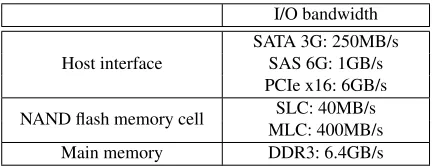
currently enlarging the internal bandwidth of SSDs is meaningless even though SSDs provide higher scalability of internal I/O bandwidth.
Table 1.I/O bandwidth of each part in SSDs
I/O bandwidth Host interface
SATA 3G: 250MB/s SAS 6G: 1GB/s PCIe x16: 6GB/s NAND flash memory cell SLC: 40MB/s
MLC: 400MB/s
Main memory DDR3: 6.4GB/s
Internal bandwidth of an SSD 8-way, 16-channel: 6.4GB/s
3.2. Intelligent SSD: A Proposal
In this section, we first discuss our design considerations of the intelligent SSD (iSSD) for efficient in-storage data processing7. Based on this, we then analyze the suitability of the iSSD in terms of data mining applications.
The iSSD should have the following structural characteristics. First, the iSSD should have internal I/O bandwidth higher than that of a current SSD. With the iSSD having in-storage processing power, the bandwidth of the host interface is not the performance bottleneck of data-intensive applications anymore. Therefore, by expanding the internal I/O bandwidth of the SSD, the iSSD will be able to access and to process a large volume of data more efficiently. As mentioned earlier, the internal I/O bandwidth in iSSDs can easily scale up by increasing the number of channels and the number of ways inside the iSSD [4].
Second, in order to fully exploit the internal I/O bandwidth, reasonable processing power needs to be equipped inside the iSSD; otherwise, it could become a new perfor-mance bottleneck of in-storage processing. We could add a cheap (while having
relatively-7
low performance) processor calledchannel coreand a small memory calledchannel mem-oryto each channel inside the iSSD. The advantages with this approach are as follows: (1) Data can be processed over all channel cores in parallel. The size of the data pro-cessed in a channel core is in inverse-proportion to the number of channels in the iSSD. Therefore, the cheap channel core and small channel memory sufficiently take advantage of the channel I/O bandwidth if we increase the number of channels inside the iSSD; (2) Adding a channel into the iSSD provides not only the expansion of the internal bandwidth but also the improvement of the inside processing power, thereby not burdening both the host interface and the host CPU; (3) A number of cheap channel cores are better than a single or a few high performance SSD cores inside an iSSD in thethermal aspect[21].
The processing power and memory size of each part in the iSSD assumed in this paper are as follows.
– Processing power: host CPU>>SSD core>channel core
– Memory size: host CPU>>SSD core>channel core
Data processing in the iSSD (1) requires a data access cost lower than data process-ing based on the host CPU and (2) can process data over all channel cores in parallel. Therefore, we expect that data mining applications having data-intensive characteristics can be performed efficiently in the iSSD. In Section 4, we discuss the strategies for data processing in the iSSD, and analyze the execution costs of data mining applications for predicting their performance in the iSSD.
4.
Data Mining in iSSD
In this section, we first propose three strategies for running data mining functions effi-ciently in the iSSD. Then, we formulate the cost models for estimating the performance of data processing in the iSSD (In-Storage Processing, ISP) with our strategies and that of traditional data processing based on the host CPU (In-Host Processing, IHP).
4.1. Strategies for running data mining functions in the iSSD
In this paper, we use the following three strategies for efficient in-storage processing of data mining functions in the iSSD.
– Strategy 1: Process data over all channel cores in parallel.A parallel paradigm is general and has also been employed in other frameworks such as MapReduce [17] using multiple nodes and GPGPU [25] using multiple cores. Our first strategy is to have the parallel paradigm realized inside the iSSD by giving an FMC core to each channel. Each channel core in the iSSD performs the same task on its own dataset. While the strategy itself is not novel, its application to SSD could be regarded novel and also makes ISP more efficient inside the iSSD via the parallelism. It is fairly beneficial to data-intensive applications including data mining and databases.
– Strategy 3: Conduct the global merge in SSD cores.Some data mining applications require global merge that aggregates multiple local results obtained independently from channel cores. The global merge adversely affects the performance in the ISP because it cannot be performed over channel cores in parallel. We assume to have global merge conducted in SSD cores since they directly communicate with every channel core and have computing power higher than channel cores.
4.2. Cost models of data mining applications
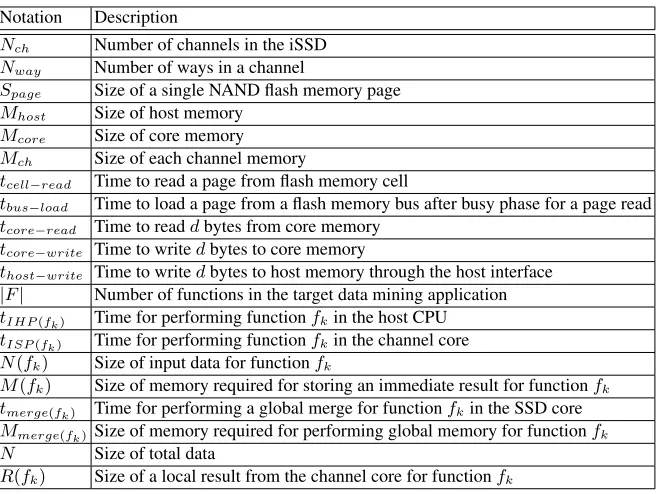
In this section, we analyze the execution costs of data mining applications. Table 2 sum-marizes the notations used throughout this paper. We note that there are no real-world iSSDs (no hardware and no firmware) provided yet by SSD manufacturers. This makes us unable to evaluate the effectiveness of the in-storage processing based on our iSSD in comparison with that of the traditional in-host processing. Thus, we instead formulate two cost models for the IHP and the ISP by estimating the performance of data mining applications in the host and iSSD, respectively. With the cost models, we can easily in-vestigate the performance change affected by parameter settings under different host and iSSD architectures.
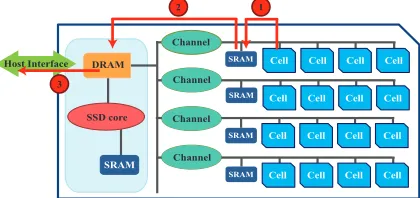
Figure 2 shows the steps of processing data stored in cells. The IHP requires three steps for data accesses: (1) from a cell to SRAM of a channel core, (2) from SRAM of a channel core to DRAM of a SSD core, and (3) from DRAM of a SSD core to main mem-ory in the host. The steps of transferring data processed in the host to cells are performed in the reverse order.
In contrast, the ISP requires only steps (1) and (2) during processing data stored in cells because it does not need to transfer data to the host. Also, we note step (2) is unlikely to occur frequently because SSD cores are mainly used for merging data obtained from channel cores that are in charge of processing data stored in their cells.
N
SRAM DRAM
Channel
Channel
Channel
Channel
Cell Cell Cell Cell
Cell Cell Cell Cell
Cell Cell Cell Cell
Cell Cell Cell Cell
SRAM SRAM SRAM SRAM
SSD core Host Interface
3
2 1
Fig. 2.Execution steps of processing data in cells.
Data access cost We begin by defining some preliminaries to describe the cost to transfer dbytes in each path, similar to the derivation in [4].
Table 2.Notations
Notation Description
Nch Number of channels in the iSSD Nway Number of ways in a channel
Spage Size of a single NAND flash memory page Mhost Size of host memory
Mcore Size of core memory Mch Size of each channel memory
tcell−read Time to read a page from flash memory cell
tbus−load Time to load a page from a flash memory bus after busy phase for a page read tcore−read Time to readdbytes from core memory
tcore−write Time to writedbytes to core memory
thost−write Time to writedbytes to host memory through the host interface |F| Number of functions in the target data mining application
tIHP(fk) Time for performing functionfkin the host CPU tISP(fk) Time for performing functionfkin the channel core N(fk) Size of input data for functionfk
M(fk) Size of memory required for storing an immediate result for functionfk tmerge(fk) Time for performing a global merge for functionfkin the SSD core Mmerge(fk) Size of memory required for performing global memory for functionfk N Size of total data
R(fk) Size of a local result from the channel core for functionfk
•Cell→channel:Equation 1 represents the cost to readdbytes from flash memory
cell to channel memory.
tcell→ch=⌈
d
Spage×Nway⌉ ×
tcell−read+⌈
d Spage⌉ ×
tbus load (1)
•Channel→core:For efficiency, data transfer between channel memory and core
memory employs the direct memory access (DMA) operationandthe pipeline strategy
[4]. Equation 2 represents the cost to readdbytes from channel memory to core memory.
tch→core=max(tcell→ch, tcore−write) (2)
•Core→host:Similar totch→core, the data transfer between core memory and host
memory also employs the DMA operation and the pipeline strategy. Equation 3 represents the cost to readdbytes from core memory to host memory.
The data access costs to transferdbytes in each path, derived from above preliminar-ies, with the IHP and the ISP are shown in Equations 4 and 5, respectively.
data access(IHP) =
|F|
∑
k=1
((tch→core/Nch+tcore→host)×N(fk)/d) (4)
data access(ISP) =
|F|
∑
k=1
(tcell→ch/Nch×N(fk)/d) (5)
As shown in Figure 2, the data transfer path of the ISP is shorter than that of the IHP. Moreover, in the ISP, data do not move through the host interface that is a new bottleneck in the iSSD. Consequently, the data access cost in the ISP is much smaller than that in the IHP.
Data processing cost The data processing costs of the target data mining application
in the IHP and in the ISP are formulated as shown in Equations 6 and 7. Note that tIHP−swap(fk)(tISP−swap(fk)) is the swap cost for functionfkin the IHP (in the ISP) as
shown in Equations 8 and 9. The data processing cost depends mainly on aCPU rateof the place where the function is performed. The processing power of each channel core is much lower than that of host CPU. However, the iSSD performs data mining applications on a number of channel cores in parallel. Therefore, the aggregated processing power from all the channel cores in the iSSD is enough to execute data-intensive applications efficiently.
data processing(IHP) =
|F|
∑
k=1
(tIHP(fk)+tIHP−swap(fk)) (6)
data processing(ISP) =
|F|
∑
k=1
(tISP(fk)/Nch+tISP−swap(fk)) (7)
The swap cost is influenced by (1) the memory size required for storing an immediate result for functionfk, (M(fk)), (2) the memory size of the place where the functionfkis
performed, and (3) the input data size for functionfk, (N(fk)). The swap cost is also
in-fluenced by the swapping strategy such as round robin and LRU. In this paper, we assume that LRU is used as a swapping strategy. However, since most data mining applications access the whole data sequentially during their execution [5,6,24], thebuffering effectdue to the LRU strategy would be insignificant.
tIHP−swap(fk)=⌈M(fk)/Mhost⌉ ×(tch→core/Nch+tcore→host)×N(fk)/d (8)
tISP−swap(fk)=⌈M(fk)/Mch⌉ ×tcell→ch/Nch×N(fk)/d (9)
adversely affects the performance in the ISP because it cannot be performed over multiple channel cores in parallel. The global merge cost in the ISP is shown in Equation 10.
merge(ISP) =
|F|
∑
k=1
(tmerge(fk)+ (tch→core/d×R(fk)×Nch)) (10)
The global merge cost is influenced by (1) the size of a local result from each channel core, (2) the number of channels in the iSSD, and (3) the complexity of the global merge: i.e., the global merge cost increases as the size of a local result, the number of channels, or the complexity of the global merge increases.
Total execution cost Equations 11 and 12 show the total execution costs of a data mining
application in the IHP and in the ISP, respectively.
total cost(IHP) = data access(IHP) + data processing(IHP) (11)
total cost(ISP) = data access(ISP) + data processing(ISP) + merge(ISP) (12)
With these equations, we can compare the performance of the ISP with that of the IHP. In Section 5, we first validate our cost models and then quantify the degree of the performance improvement in the ISP over the IHP by using the cost models.
5.
Performance Evaluation
5.1. Cost model validation
We first validate the proposed cost models by using three well-known data mining appli-cations ofk-means (for data clustering) [26], PageRank (for web page ranking) [27], and Apriori (for frequent pattern mining) [28]. Note that, Apriori requires theglobal mergeto aggregate all the local results, each of which is the local frequency of a candidate itemset obtained by each channel core, in order to get its global frequency [28].
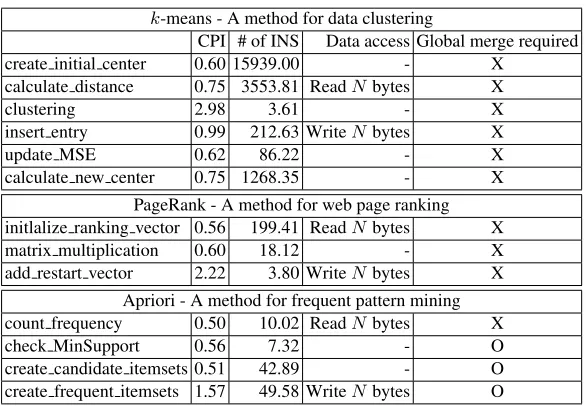
Table 3 shows the execution characteristics of the primitive functions in those data mining applications. To extractthe number of cycles per instruction(CPI) andthe number of instructions(#INS) in each function of the target data mining application, we executed the application with V-Tune8. The data and parameter settings to obtain the results are
shown in Table 4. As a result, we have a total of 27 cases obtained by varying the sizes of data and the parameter values of data mining applications.
We can estimate the total execution time of each data mining application in the IHP (ISP) to substitute the execution characteristics shown in Table 3 into Equation 11 (12). For the data access cost, we used the Samsung SSD datasheet9. To obtain the time for
performing each function in the data processing cost, we used Equation 13.
Function execution time = (CPI×#INS) / CPU rate (13)
8
http://software.intel.com/en-us/intel-vtune-amplifier-xe/
9
Table 3.Descriptions of data mining applications
k-means - A method for data clustering
CPI # of INS Data access Global merge required
create initial center 0.60 15939.00 - X
calculate distance 0.75 3553.81 ReadNbytes X
clustering 2.98 3.61 - X
insert entry 0.99 212.63 WriteNbytes X
update MSE 0.62 86.22 - X
calculate new center 0.75 1268.35 - X
PageRank - A method for web page ranking initlalize ranking vector 0.56 199.41 ReadNbytes X
matrix multiplication 0.60 18.12 - X
add restart vector 2.22 3.80 WriteNbytes X Apriori - A method for frequent pattern mining count frequency 0.50 10.02 ReadNbytes X
check MinSupport 0.56 7.32 - O
create candidate itemsets 0.51 42.89 - O create frequent itemsets 1.57 49.58 WriteNbytes O
Table 4.Data and parameter settings for our data mining applications
Algorithm Description for experiments k-means
The number of objects: 100,000∼700,000 (in step of 100,000) The number of dimensions per object: 8
The number of iterations for convergence: 30 PageRank
The number of nodes: 200,000∼1,000,000 (in step of 200,000) The number of edges: the number of nodes×the number of nodes The number of iterations for convergence: 10
Apriori
The number of transactions: 4,000∼12,000 (in step of 4,000) The threshold: 4∼16 (in step of 4)
The average number of items in each transaction: 8
To validate the accuracy of our cost models, we computed the Pearson Correlation Coefficient (PCC) between (1) the execution time of k-means, PageRank, and Apriori estimated by our IHP model and (2) the execution time obtained by executing them sep-arately in a real machine. We measured the total execution times in the same way as in Table 4.
Figure 3 shows the results. Thex-axis indicates the execution time in a real machine and they-axis does the execution time estimated by our model. A single point indicates the execution time results for each case. We observe they are correlated significantly as all the points are located closely on the graph ofy =x. The PCC between two values for 27 cases is shown to be 0.997, indicating that the proposed cost model is very accurate.
5.2. Experimental Setup
0.0 50.0 100.0 150.0 200.0 250.0
0.0 50.0 100.0 150.0 200.0 250.0
C
o
s
t
m
o
d
e
l
Real machine
k-means PageRank Apriori
Fig. 3.PCC between the real and estimated execution time.
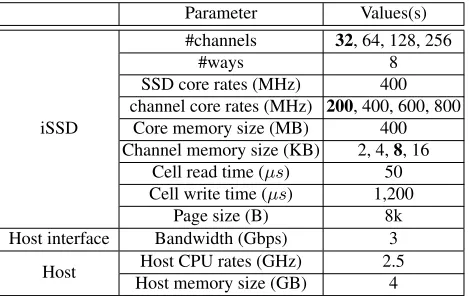
each parameter. While changing the values of one parameter, the other parameters are fixed to their pivot value. We used 1GB data obtained from MineBench [18].
Both of data mining applications and their data are stored in the iSSD. For processing, a data mining application is first loaded from the iSSD to memory in host and then is offloaded to memory on the iSSD. Inside the iSSD, the application performs its task by processing the data stored in channels. The time for offloading the application is a new one additionally required for ISP. However, a data mining application is normally quite small in size, compared with data. Specifically, the size of a data mining application is only several tens of kilobytes while that of data is typically several gigabytes as in the experimental section. Moreover, the data need to be loaded multiple times during data analysis while the application is offloaded only once. Therefore, we did not include the offload time, which is negligible in the total execution time.
Table 5.Parameter values for experiments
Parameter Values(s)
iSSD
#channels 32, 64, 128, 256
#ways 8
SSD core rates (MHz) 400 channel core rates (MHz) 200, 400, 600, 800
Core memory size (MB) 400 Channel memory size (KB) 2, 4,8, 16
Cell read time (µs) 50 Cell write time (µs) 1,200
Page size (B) 8k
Host interface Bandwidth (Gbps) 3 Host Host CPU rates (GHz) 2.5
5.3. Results and analyses
ISP with different iSSD settings In this experiment, we first changed the number of
channels in the iSSD as 32, 64, 128, and 256, respectively. Other parameters were set to pivot values shown in Table 5. As shown in Figure 4, the performance of the ISP in all cases dramatically increases as the number of channels increases. In particular, it increases almost linearly with the number of channels fork-means and PageRank which do not have the stage of the global merge in their execution. However, in the case of Apriori, the performance is improved much less, which is due to its global merge.
91.1 59.7 153.8 45.6 29.9 131.4 22.8 14.9 120.4
11.5 7.5
115.2 0 20 40 60 80 100 120 140 160 180
k-means PageRank Apriori
E x e c u ti o n t im e s (s )
32 64 128 256
Fig. 4.Performance of the ISP with different numbers of channels.
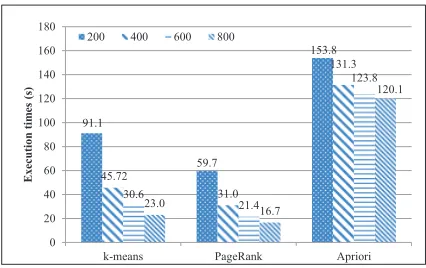
We also changed the channel core rates as 200MHz to 800MHz in step of 200MHz. Other parameters were also set to pivot values shown in Table 5. In Figure 5, we observe linear performance improvement with channel core rates ink-means and PageRank. This indicates that the internal processing power may become a new performance bottleneck of data mining applications which do not have the stage of global merge leading to (high parallelism) in the iSSD.
91.1 59.7 153.8 45.72 31.0 131.3 30.6 21.4 123.8 23.0 16.7 120.1 0 20 40 60 80 100 120 140 160 180
k-means PageRank Apriori
E x e c u ti o n t im e s (s )
200 400 600 800
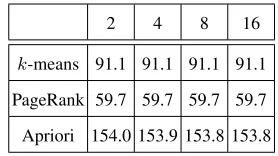
Then, we changed the channel memory size as 2KB, 4KB, 8KB, and 16KB, respec-tively. Table 6 indicates the performance result. The performance of the ISP is almost the same and is independent of the channel memory size. This result indicates thatk-means, PageRank, and Apriori require just a small memory to store an intermediate result dur-ing their execution, and the small channel memory is enough to hold all the intermediate result. Therefore, we can perform those data mining applications in the iSSD efficiently.
Table 6.Performance of the ISP with different channel memory sizes
2 4 8 16
k-means 91.1 91.1 91.1 91.1 PageRank 59.7 59.7 59.7 59.7 Apriori 154.0 153.9 153.8 153.8
Comparison of the ISP with the IHP For showing the potential benefits of the iSSD
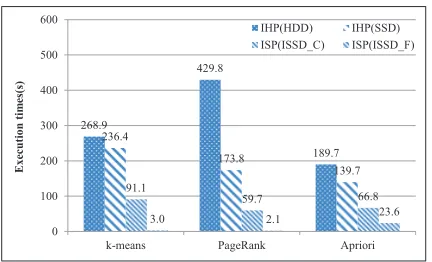
quantitatively, we compared the performance of the IHP and the ISP withk-means, PageR-ank, and Apriori. For the IHP, we deployed not only SSD but also HDD for examining performance change with different storage media. For the ISP, we considered two iSSD architectures: iSSD C (typical settings in the current SSD) with 32 channels and their CPUs of 200MHz and iSSD F (settings in thefutureiSSD) with 256 channels and their CPUs of 800MHz.
Figure 6 shows the results. The ISP in both iSSD architectures outperforms the IHP fork-means and PageRank that do not require a global merge stage. Even with the current settings (iSSD C), the ISP outperforms the IHP about 2∼3 times. With the future settings (iSSD F), the ISP dramatically improves the performance of the IHP up to 83 times.
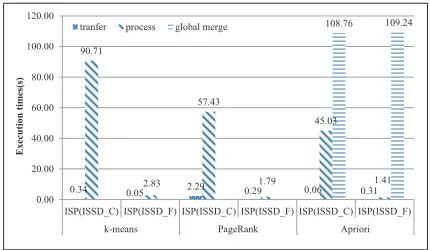
On the other hand, Apriori with a global merge shows opposite results. In Apriori, ISP(iSSD C) shows lower performance than the IHP(SSD), and ISP(iSSD F) also shows insignificant performance improvement over the IHP(SSD). This is because the SSD core that performs the global merge becomes a new performance bottleneck in the execution of data mining applications. Such findings are vividly illustrated in Figure 7.
Figure 7 shows the breakdown result of the ISP(iSSD C) and ISP(iSSD F). In this figure, transfer and process indicate the data transfer time between a channel and an SSD core and the data processing time on channels, respectively. In the ISP, the figure shows that the internal communication time is not significant. In particular, as the number of channels and channel core rates increase, the execution time on each channel core de-creases.
268.9 429.8 189.7 236.4 173.8 139.7 91.1 59.7 153.8
3.0 2.1
111.0 0 100 200 300 400 500 600
k-means PageRank Apriori
E x e c u ti o n t im e s(s ) IHP(HDD) IHP(SSD) ISP(iSSD_C) ISP(iSSD_F)
Fig. 6.Performance comparison of the ISP with the IHP.
global merge with the help from the host CPU which has much higher processing power than the SSD core.
0.34 0.05 2.29 0.29 0.06 0.31 90.71 2.83 57.43 1.79 45.03 1.41 108.76 109.24
0.00 20.00 40.00 60.00 80.00 100.00 120.00
ISP(ISSD_C) ISP(ISSD_F) ISP(ISSD_C) ISP(ISSD_F) ISP(ISSD_C) ISP(ISSD_F)
k-means PageRank Apriori
tranfer process global merge
E x e c u ti o n t im e s(s )
Fig. 7.Breakdown of the ISP cost.
We indeed measured the performance of Apriori to conduct the global merge in the host CPU (denoted as IHP+ISP). Figure 8 shows the results. The figure shows that the IHP+ISP outperforms the others about 3.3∼8 times. We think that this result gives us a future research direction to collaborate the iSSD with the host CPU in order to maximize the overall performance.
Correlation between the execution times obtained by the iSSD simulator and the cost
model In this section, we performed an experiment to show the correlation between the
execution times obtained by the iSSD simulator [29] and the cost model. We developed our iSSD simulator to verify our cost model on top of the gem 5 simulator. The gem 5 simulator [30] provides a virtual computing environment that makes it possible to run applications as in someones target system.
268.9
429.8
189.7 236.4
173.8
139.7 91.1
59.7 66.8
3.0 2.1 23.6
0 100 200 300 400 500 600
k-means PageRank Apriori
E
x
e
c
u
ti
o
n
t
im
e
s(
s)
IHP(HDD) IHP(SSD)
ISP(ISSD_C) ISP(ISSD_F)
Fig. 8.Performance of the IHP + ISP.
Thus, it is infeasible to evaluate the performance of ISP on the iSSD by using our iSSD simulator in the case of a large size of data. In contrast, a cost model predicts the execution time very quickly based on a simple formula, but could have a problem of producing inaccurate results.
Therefore, we verify our cost model to evaluate the performance of the iSSD by com-paring its results with those of our iSSD simulator. If the cost model shows reasonable coincidence with the simulator, we can use it to estimate quickly the execution time of data mining algorithms even with the large size of data. To compare the execution times, we used results shown in Table III of [29]. We computed the Pearson correlation coeffi-cient between the time by simulation and that by the cost model to show their coincidence. Table 7 shows the results, which indicate that the Pearson correlation appears to be very close to one in all the three data mining algorithms.
Table 7.Execution times with the iSSD simulator and the cost model
Algorithms PCC Apriori 0.9989 k-means 0.9997 PageRank 0.9998
6.
Conclusions
In this paper, we introduced the iSSD as a turbo for big data mining. The detailed contri-butions of this paper are summarized as follows.
(1) incurs a low data access cost compared with the conventional IHP and (2) handles data over all channel cores in parallel.
– Second, we proposed the strategies for the ISP. Our strategy is (1) to process data over all channel cores in parallel, (2) to use flash memory cell as virtual memory of channel memory, and (3) conduct the global merge in SSD cores since they efficiently communicate with every channel core and have performance higher than channel cores.
– Third, we formulated the execution cost models of data mining applications for pre-dicting their performance in the iSSD. In the ISP, the execution cost is composed of (1) a data access cost, (2) a data processing cost for accessed data, and (3) a global merge cost for aggregating all the local results in SSD cores.
– Finally, we validated our cost models and showed the potential of the ISP with data mining applications through a series of simulations. The results show that the ISP achieves dramatical speed up by up to 83 times compared with the current the IHP.
As future work, we plan to do research on a novel job scheduling algorithm where the iSSD and the host CPU collaborate with each other in order to maximize the overall per-formance. To the end, the job scheduling algorithm should be intelligent enough to know the characteristics of applications and hardware specifications such as the local result size, the global merge overhead, and the I/O bandwidth of a host interface. Also, we plan to do research on efficient ways to exploit a large number of iSSDs in super-computer environ-ment. For this, we are devising a data placement strategy that minimizes the dependency among data to be analyzed.
Acknowledgement.This research was supported by (1) Semiconductor Industry
Collab-orative Project between Hanyang University and Samsung Electronics Co. Ltd., (2) the National Research Foundation of Korea (NRF) grant funded by the Korea government (MSIP) (No. NRF-2014R1A2A1A10054151), (3) the ICT R&D program of MSIP/IITP (B0101-15-0266, Development of High Performance Visual Big-Data Discovery Platform for Large-Scale Realtime Data Analysis), and (4) the National Research Foundation of Korea (NRF) Grant funded by the Korean Government (MSIP) (No. 2015R1A5A7037751).
References
1. Bae, D., Chang, J., Kim, S.: An efficient method for record management in flash memory envi-ronment. Journal of Systems Architecture 58(6), 221-232 (2012)
2. Lee, S., Moon, B., Park, C.: Advances in flash memory SSD technology for enterprise database applications. In: Proceedings of the 2009 ACM SIGMOD International Conference on Manage-ment of Data. pp.863-870. ACM, New York, USA (2009)
3. Do, J., Kee, Y., Patel, J., Park, C., Park, K., DeWitt, D.: Query processing on smart SSDs: oppor-tunities and challenges. In: Proceedings of the 2013 ACM SIGMOD International Conference on Management of Data. pp. 1221-1230. ACM, New York, USA (2013)
4. Kim, S., Oh, H., Park, C., Cho, S., Lee, S.: Fast, energy efficient scan inside flash memory SSDs. In: Proceedings of the International Workshop on Accelerating Data Management Sys-tems. pp.36-43. (2011)
6. Zambreno, J., Ikylmaz, B., Memik, G., Choudhary, A.: Performance characterization of data mining applications using MineBench. In: Proceedings of 9th Workshop on Computer Architec-ture Evaluation using Commercial Workloads. Citeseer (2006).
7. Schuster, S., Nguyen, H., Ozkarahan, E., Smith, K.: RAP. 2-An associative processor for databases and its applications. IEEE Transactions Computers 100(6), 446-458 (1979)
8. Lewis, T.: Data parallel computing: An alternative for the 1990s. Computer 24(9), 110-111 (1991)
9. Bae, D., Kim, J., Kim, S., Oh, H., Park, C.: Intelligent SSD: a turbo for big data mining. In: Proceedings of the 2013 ACM International Conference on Information and Knowledge Man-agement. pp. 1573-1576. ACM, New York, USA (2013)
10. Su, S., Lipovski, G.: CASSM: A cellular system for very large data bases. In: Proceedings of the 1st International Conference on Very Large Data Bases. pp. 456-472. ACM, New York, USA (1975)
11. Boral, H., DeWitt, D.: Database machines: An idea whose time has passed?. In: Proceedings of International Workshop on Database Machines. (1983)
12. Riedel, E., Gibson, G., Faloutsos, C.: Active storage for large-scale data mining and multime-dia. In: Proceedings of the 24rd International Conference on Very Large Data Bases. pp. 62-73. Morgan Kaufmann, San Francisco, USA (1998)
13. Acharya, A., Uysal, M., Saltz, J.: Active disks: Programming model, algorithms and evaluation. In: Proceedings of the Eighth International Conference on Architectural Support for Program-ming Languages and Operating Systems. pp. 81-91. ACM, New York, USA (1998)
14. Keeton, K., Patterson, D. A., Hellerstein, J. M.: A case for intelligent disks (IDISKs). ACM SIGMOD Record 27(3), 42-52 (1998)
15. Kim, J., Bae, D., Kim, S., Oh, H., and Park, C.: An efficient data mining algorithm for intelli-gent SSD. In: Journal of KIISE 39(1), 178-179 (2012)
16. Smullen, C., Tarapore, S., Gurumurthi, S., Ranganathan, P., Uysal, M.: Active storage revisited: the case for power and performance benefits for unstructured data processing applications. In: Proceedings of the 5th conference on Computing Frontiers. pp. 293-304. ACM, New York, USA (2008)
17. Cho, S., Park, C., Oh, H., Kim, S., Y,i Y., Ganger, G.: Active disk meets flash: A case for intelligent SSDs. In: Proceedings of the 27th international ACM conference on International Conference on Supercomputing. pp. 91-102. ACM, New York, USA (2013)
18. Kang, Y., Kee, Y., Miller, E., Park, C.: Enabling cost-effective data processing with smart SSD. In: Proceedings of the 29th IEEE Symposium on Massive Storage Systems and Technologies. pp. 1-12. IEEE (2013)
19. Choudhary, A., Narayanan, R., Ikylmaz, B., Memik, G., Zambreno, J., Pisharath, J.: Optimiz-ing data minOptimiz-ing workloads usOptimiz-ing hardware accelerators. In: ProceedOptimiz-ings of the Workshop on Computer Architecture Evaluation using Commercial Workloads. Citeseer (2007)
20. Narayanan, R., Ozisikyilmaz, B., Zambreno, J., Memik, G., Choudhary, A.: Minebench: A benchmark suite for data mining workloads. In: Proceedings of 2006 IEEE International Sym-posium on Workload Characterization. pp. 182-188. IEEE (2006)
21. Reddi, V., Lee, B., Chilimbi, T., Vaid, K.: Web search using mobile cores: Quantifying and mitigating the price of efficiency. ACM SIGARCH Computer Architecture News 38(3), 314-325 (2010)
22. Du, D., He, D., Hong, C., Jeong, J., Kher, V., Kim, Y., Lu, Y., Raghuveer, A., Sharafkandi, S.: Experiences in building an object-based storage system based on the OSD T-10 standard. In: Proceedings of 23rd IEEE Conference on Mass Storage Systems and Technologies. IEEE (2006) 23. Mesnier, M., Ganger, G., Riedel, E.: Object-based storage. Communications Magazine 41(8),
84-90 (2003)
25. Jo, Y., Kim, S., and Bae, D.: Efficient Sparse matrix multiplication on GPU for large social network analysis. In Proceedings of International conference on Information and Knowledge Management. pp 1261-1270. ACM (2015)
26. MacQueen, J.: Some methods for classification and analysis of multivariate observations. In: Proceedings of the fifth Berkeley Symposium on Mathematical Statistics and Probability. pp. 281-297. University of California Press (1967)
27. Page, L., Brin, S., Motwani, R., Winograd, T.: The PageRank citation ranking: Bringing order to the web. Technical Report, Stanford InfoLab (1999)
28. Agraval, R., Srikant, R.: Fast algorithms for mining association rules in large data bases. In: Proceedings of 20th International Conference on Very Large Data Bases. pp. 487-499. Morgan Kaufmann, Santiago, Chile (1994)
29. Jo, Y., Chung, M., Kim, S., and Oh, Hyunok.: Data mining in intelligent SSD: simulation-based evaluation. In: Proceeding of Big Data and Smart Computing (BigComp). pp. 123-128. KIISE (2016)
30. Binkert, N., Beckmann, B., Black, G., Reinhardt, S., Saidi, A., Basu, A., Hestness, J., Hower, D., Krishna, T., and Sardashti, S. The gem5 simulator. In: ACM SIGARCH Computer Architec-ture News 39(2), 1-7 (2011)
Duck-Ho Baereceived the BS, MS, and PhD degrees in Electronics and Computer
En-gineering from Hanyang University, Seoul, Korea, in 2006, 2008, and 2013, respectively. Currently, he is a senior engineer at Samsung Electronics. His research interests include data mining, databases, and distributed systems.
Jin-Hyung Kimreceived the MS degree in Electronics and Computer Engineering from
Hanyang University, Seoul, Korea, in 2013. He is currently working as a system engineer in Hyundae Autoever.
Yong-Yeon Joreceived the MS degree in Electronics and Computer Engineering from
Hanyang University, Seoul, Korea, in 2013. He is currently a PhD candidate in Depart-ment of Computer and Software, Hanyang University. His research interests include graph processing, data mining, social network analysis, and high-performance computing with SSD and GPGPU.
Sang-Wook Kimreceived the BS degree in Computer Engineering from Seoul National
University, Seoul, Korea in 1989 and earned the MS and PhD degrees from Korea Ad-vanced Science and Technology (KAIST) at 1991 and 1994, respectively. He is Professor at Department of Computer Science and Engineering, Hanyang University. Professor Kim worked with Carnegie Mellon University and IBM Watson Research Center as a visiting scholar. He is an associate editor of Information Sciences. His research interests include data mining and databases.
Hyunok Ohreceived the BS, MS, and PhD degrees in Computer Engineering from Seoul
Chanik Parkreceived the B.S. and M.S. degrees in Computer Engineering and the Ph.D. degree in Electrical and Computer Engineering from Seoul National University, Seoul, Korea, in 1995, 1997, and 2002, respectively. He is currently a Vice President with Mem-ory Business at Samsung Electronics, Hwaseong, Korea. His research interests include storage architecture and high-performance and reliable solid-state drive-based NAND flash memories with the assistance of hardware/software codesign.