Security and Law
Security and Law
Volume 13 Number 1 Article 10
3-31-2018
Hierarchical Bloom Filter Trees for Approximate Matching
Hierarchical Bloom Filter Trees for Approximate Matching
David Lillis
University College Dublin, [email protected]
Frank Breitinger
Mark Scanlon
University College Dublin, [email protected]
Follow this and additional works at: https://commons.erau.edu/jdfsl
Part of the Computer Law Commons, and the Information Security Commons
Recommended Citation Recommended Citation
Lillis, David; Breitinger, Frank; and Scanlon, Mark (2018) "Hierarchical Bloom Filter Trees for Approximate Matching," Journal of Digital Forensics, Security and Law: Vol. 13 : No. 1 , Article 10.
DOI: https://doi.org/10.15394/jdfsl.2018.1489
Available at: https://commons.erau.edu/jdfsl/vol13/iss1/10
This Article is brought to you for free and open access by the Journals at Scholarly Commons. It has been
accepted for inclusion in Journal of Digital Forensics, Security and Law by an authorized administrator of Scholarly Commons. For more information, please
contact [email protected].
HIERARCHICAL BLOOM FILTER TREES
FOR APPROXIMATE MATCHING
David Lillis
Forensics and Security Research Group
School of Computer Science
University College Dublin
Frank Breitinger
Cyber Forensics Research
and Education Group
Tagliatela College of Engineering
University of New Haven
[email protected]
Mark Scanlon
Forensics and Security Research Group
School of Computer Science
University College Dublin
ABSTRACT
Bytewise approximate matching algorithms have in recent years shown significant promise in detecting files that are similar at the byte level. This is very useful for digital forensic investigators, who are regularly faced with the problem of searching through a seized device for pertinent data. A common scenario is where an investigator is in possession of a col-lection of “known-illegal” files (e.g. a colcol-lection of child abuse material) and wishes to find whether copies of these are stored on the seized device. Approximate matching addresses shortcomings in traditional hashing, which can only find identical files, by also being able to deal with cases of merged files, embedded files, partial files, or if a file has been changed in any way.
Most approximate matching algorithms work by comparing pairs of files, which is not a scalable approach when faced with large corpora. This paper demonstrates the effectiveness of using a “Hierarchical Bloom Filter Tree” (HBFT) data structure to reduce the running
time of collection-against-collection matching, with a specific focus on theMRSH-v2algorithm.
Three experiments are discussed, which explore the effects of different configurations of HBFTs. The proposed approach dramatically reduces the number of pairwise comparisons required, and demonstrates substantial speed gains, while maintaining effectiveness.
1.
INTRODUCTION
Current digital forensic process models are surprisingly arduous, inefficient, and expen-sive. Coupled with the sheer volume of digi-tal forensic investigations facing law enforce-ment agencies worldwide, this has resulted in significant evidence backlogs becoming com-monplace (Scanlon, 2016), frequently reach-ing 18-24 months (Casey et al., 2009) and exceeding 4 years in extreme cases (Lillis et al., 2016). The backlogs have grown due to a number of factors including the volume of cases requiring analysis, the number of de-vices per case, the volume of data on each device, and the limited availability of skilled experts (Quick & Choo, 2014). Automated techniques are in continuous development to aid investigators, but due to the sensitive na-ture of this work, the ultimate inferences and decisions will always be made by skilled hu-man experts (James & Gladyshev, 2015).
Perhaps the most common (and most time-consuming) task facing digital investi-gators involves examination of seized suspect devices to determine if pertinent evidence is contained therein. Often, this examina-tion requires significant manual, expert data processing and analysis during the acquisi-tion and analysis phases of an investigaacquisi-tion. A number of techniques have been created or are in development to expedite/automate parts of the typical digital forensic
pro-cess. These include triage (Rogers et al.,
2006), distributed processing (Roussev & Richard III, 2004), Digital Forensics as a Service (DFaaS) (van Baar et al., 2014), workflow management and automation (de Braekt et al., 2016; J. N. Gupta et al., 2016). While these techniques can help to
This paper is an extended version of Lillis et al. (2017), which was presented at the 9th EAI Inter-national Conference on Digital Forensics and Cyber Crime (ICDF2C), Prague, Czech Republic, 9-11 Oc-tober, 2017.
alleviate the backlog, the premise behind many of them involves evidence discovery based on exact matching of hash values (e.g., MD5, SHA1). Typically, this requires a set of hashes of known incriminating/pertinent content. The hash of each artefact from a suspect device is then compared against this set. This approach falls short against ba-sic counter-forenba-sic techniques (e.g., content editing, content embedding, data transfor-mation).
Approximate matching (also referred
to as “fuzzy hashing”) is one technique used to aid the discovery of these obfus-cated files (Breitinger, Guttman, et al., 2014). A number of algorithms have been
developed including ssdeep (Kornblum,
2006), sdhash (Roussev, 2010), and
MRSH-v2 (Breitinger & Baier, 2012). This
paper focuses specifically on MRSH-v2. This
algorithm operates by generating a “simi-larity digest” for each file, represented as Bloom filters (Bloom, 1970). An all-against-all pairwise comparison is then required to determine if files from a set of desired content is present in a corpus of unanalysed
digital material. Thus, MRSH-v2 does not
exhibit strong scalability for use with larger datasets.
This paper presents an improvement in the runtime efficiency of approximate match-ing techniques, primarily through the im-plementation of a Hierarchical Bloom Fil-ter Tree (HBFT). Additionally, it examines some of the tunable parameters of the al-gorithm to gauge their effect on the required running time. A number of experiments were conducted, using two different formulations of a HBFT, which indicated a substantial re-duction in the running time, in addition to which the final experiment achieved a 100% recall rate for identical files and also for files
that have a MRSH-v2similarity above a
rea-sonable threshold of 40%.
been conducted in the area of approximate
matching. The operation of MRSH-v2 is
dis-cussed in Section 3. HBFTs are introduced in Section 4. Section 5 presents the series of experiments designed to evaluate the effec-tiveness of the HBFT approach, and finally Section 6 concludes the paper and outlines directions for further work.
2.
BACKGROUND:
APPROXIMATE
MATCHING
Bytewise approximate matching for dig-ital forensics gained popularity in 2006 when Kornblum (2006) presented context-triggered piecewise hashing (CTPH)
includ-ing an implementation called ssdeep. It
was at that time referred to as “fuzzy
hashing.” Later, this term converted to
“similarity hashing” (most likely due to
sdhash which stands for “similarity digest
hash” (Roussev, 2010)). In 2014, the
National Institute of Standards and Tech-nology (NIST) developed Special Publica-tion 800-168, which outlines the definiPublica-tion and technology for these kinds of algo-rithms (Breitinger, Guttman, et al., 2014).
In addition to the prominent aforemen-tioned implementations, there are several
others. MinHash (Broder, 1997) and
SimHash(Sadowski & Levin, 2007) are ideas on how to detect/identify small changes (up to several bytes), but were not designed to compare hard disk images with each other. Oliver et al. (2013) presented an algorithm
named TLSH, which is premised on
local-ity sensitivlocal-ity hashing (LSH). There are sig-nificantly more algorithms, but to explain all of them would be beyond the scope of this paper; a good summary is provided by Harichandran et al. (2016).
While these algorithms have great capa-bilities, they suffer one significant drawback,
which we call the “database lookup prob-lem.” In comparison to traditional hash val-ues which can be sorted and have a lookup
complexity of O(1) (hashmap) or O(log(n))
(binary tree; wherenis the number of entries
in the database), looking up a similarity di-gest usually requires an all-against-all
com-parison (O(n2)) to identify all matches. To
overcome this drawback, Breitinger, Baier, and White (2014) presented a new idea that overcomes the lookup complexity (it is
ap-proximately O(1)) but at the cost of
inac-curacy. More specifically, the method allows item vs. set queries, resulting in the answer either being “yes, the queried item is in the set” or “no, it is not”; one cannot say against which item it matches.
As a means of addressing these drawbacks, Breitinger, Rathgeb, and Baier (2014) pre-sented a further article where they offered a theoretical solution to the lookup problem, based on a tree of Bloom filters. However, an implementation (and thus a validation) has not been conducted to date. We refer to this as a Hierarchical Bloom Filter Tree (HBFT). The focus of the present work is the empirical evaluation of this approach, so as to demonstrate its effectiveness and to in-vestigate some practical factors that affect its performance.
3.
THE
MRSH-V2
ALGORITHM
The work in this paper is intended to
im-prove upon the performance of theMRSH-v2
algorithm. Therefore, it is important to
firstly outline its operation in informal terms, which will aid the discussion later. A more detailed, formal description of the algorithm can be found in the paper by Breitinger and Baier (2012). The primary
goal of MRSH-v2 is to compress any byte
can be compared with each other, which will result in a similarity score. Each similarity digest is a collection of Bloom filters (Bloom, 1970).
To create the similarity digest, MRSH-v2
splits an input into chunks (also known as “subhashes”) of approximately 160 bytes.
These chunks are hashed using FNV (a fast
non-cryptographic hash function), which is used to set 5 bits of the Bloom filter. To di-vide the input into chunks, it uses a window of 7 bytes, which slides through the input
byte-by-byte. The content of the window
is processed and whenever it hits a certain value (based on a modulus operation), the end of a chunk is identified. Thus, the ac-tual size of each chunk varies. Each Bloom filter has a specific capacity. Once this has been reached, any further chunks are in-serted into a new Bloom filter that is ap-pended to the digest. Approximate match-ing occurs by comparmatch-ing similarity digests
against one another. To compare two file
sets, an all-against-all pairwise comparison is required.
One way to improve upon the all-against-all comparison is to use the file-against-set strategy outlined by Breitinger, Baier, and White (2014). An alternative strategy that has not yet been fully evaluated is to use a hierarchical Bloom filter tree (HBFT), as suggested by Breitinger, Rathgeb, and Baier (2014). This approach is intended to achieve speed benefits over a pairwise comparison while supporting the identification of specific matching files. The primary contribution of this paper is to investigate the factors that affect the runtime performance of this latter approach, compared to the pairwise compar-isons required by the original algorithm.
4.
HIERARCHICAL
BLOOM FILTER TREES
(HBFT)
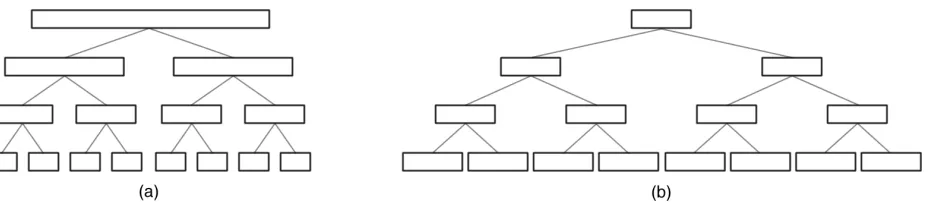
In a Hierarchical Bloom Filter Tree (HBFT), the root node of the tree is a Bloom filter that represents the entire collection. A key feature of a Bloom filter is that it can say only whether an item is probably contained in it, or definitely not contained in it. Thus it is possible to give false positive results, but not false negatives. The rate of false posi-tives depends on the size of the Bloom filter and the number of items it contains. When searching for a file, if a match is found at the root of the tree, its child nodes can then be searched. Although this structure is inspired by a classic binary search tree, a match at a particular node in a HBFT does not indi-cate whether the search should continue in the left or right subtree. Instead, both child nodes need to be searched, with the search path ending when a leaf node is reached or a node does not match.
Two forms of tree layout are shown in Fig-ure 1: one uses Bloom filters of different sizes (referred to as a “variable-width” HBFT), whereas the other uses a single fixed size for
each Bloom filter. For the variable-width
tree, each level in the tree is allocated an equal amount of memory. Thus each Bloom filter occupies half the memory of its parent, and also represents a file set that is half the size of its parent. The expected false posi-tive rates will be approximately equal at all levels in the tree. In contrast, a fixed-width tree uses the same size for every Bloom filter. Thus each level of the tree occupies twice the space of the level above.
Figure 1. Hierarchical Bloom Filter Tree (HBFT) structure using (a) variable-width and (b) fixed-width Bloom filters.
as for the single Bloom filter approach out-lined by Breitinger, Baier, and White (2014), which is also very similar to the approach
taken by the classic MRSH-v2algorithm
out-lined in Section 3. The key difference is that instead of creating a similarity digest of po-tentially multiple small Bloom filters for an individual file, each subhash is used to set 5 bits of the larger Bloom filter within a tree node that usually relates to multiple files.
Depending on the design of the tree, a leaf node may represent multiple files. Thus a search that reaches a leaf node will still re-quire a pairwise comparison with each file in
this subset, using MRSH-v2. However, given
that most searches will reach only a subset of the root nodes, the number of pairwise comparisons required for each file is greatly reduced.
The process to check if a file matches a Bloom filter node is similar to the process
of inserting a file into the tree. However,
instead of inserting each hash into the node, its subhashes are instead checked against the Bloom filter to see if they are contained in it. If a specific number of consecutive hashes are contained in the node, this is considered to be a match. The number of consecutive hashes is configurable as a parameter named
min run. The first experiment in this paper (discussed in Section 5.2.1) explores the ef-fects of altering this value.
In constructing a HBFT, memory con-straints will have a strong influence on the
design of the tree. In practical situations, a typical workstation is unlikely (at present) to have access to over 16GiB of main mem-ory. Thus trade-offs in the design of the tree are likely. Larger Bloom filters have lower false positive rates (assuming the quantity of data is constant), but lead to shallower trees (thus potentially increasing the num-ber of pairwise comparisons required).
Of the two proposed designs for a HBFT, each has its own theoretical advantages. One aim of the ensuing experiments is to identify if any of these has more influence in practice. Some considerations worthy of note include:
• Calculating the union of two Bloom
fil-ters of equal size is trivially performed using a bitwise-OR operation. Thus a fixed-width HBFT can be constructed in a bottom-up manner, whereby each file needs only be inserted into a leaf Bloom filter. Once all files have been processed, these leaves can be recur-sively merged to create the parent nodes. In contrast, a variable-width tree design requires each file to be inserted separately into an appropriate node at every level in the tree.
• Another consequence of the above
ob-servation is that if the HBFT is to be distributed over multiple computational nodes, this has consequences for the quantity of data that must be shared between nodes when building the tree.
Instead of sending the hashes of all files throughout the system, Bloom filters can be shared and locally merged where necessary. This is outside of the scope of this paper, but is discussed as future work in Section 6.
• The memory required at each level of a
fixed-width tree increases exponentially. This means that for an equal amount of available memory, a fixed-width tree must necessarily either be built to be shallower than the variable-width tree, or make use of smaller Bloom filters to-wards the top of the tree. The latter ap-proach results in a higher false-positive rate in this part of the tree, which will likely lead to deeper searches for files that are not matched with anything in the corpus. If the size of the leaf nodes is equal, then the overall false positive rate of the two trees will be equivalent.
For both types of tree, larger Bloom fil-ters result in lower false positive rates at the expense of a shallower tree (since memory
is limited). In a shallower tree, each leaf
node represents a larger subset of the cor-pus, which may require a greater number of pairwise comparisons for each search.
5.
EXPERIMENTS
As part of this work, a number of experi-ments were conducted to examine the factors that affect the performance of the HBFT structure. In each case, a HBFT was used to model the contents of a dataset. Files from another dataset were then searched for in the tree, and the results reported. Because the speed of execution is of paramount
impor-tance, and because the originalMRSH-v2
im-plementation was written in C, the HBFT implementation used for these experiments
was also written in that language. The
source code has been made available under
the Apache 2.0 licence1.
The workstation used for the experiments contains a quad-core Intel Core i7 2.67GHz processor, 12GiB of RAM and uses a solid state drive for storage. The operating sys-tem is Ubuntu Linux 16.04 LTS. The pri-mary constraint this system imposes on the design of experiments is that of the mem-ory that is available for storing the HBFTs. For all experiments, the maximum amount of memory made available for the HBFT was 10GiB. The size of the individual Bloom fil-ters within the trees then depended on the number of nodes in the tree (which in turn depends on the number of leaf nodes).
For each experiment, the number of leaf
nodes (n) is specified in advance, from which
the total number of nodes can be com-puted (since this is a complete binary tree).
Given the upper total memory limit (u, in
bytes), and that the size of each Bloom fil-ter (in bytes) should be a power of two (per Breitinger, Baier, and White (2014)), it is possible to calculate the maximum pos-sible size of each Bloom filter.
For a variable-width tree, all levels in the tree are allocated the same amount of mem-ory. Therefore the size of the root Bloom
filter in bytes (r) is given by:
r= 2blog2(u/(log2(n)+1))c (1) The size of the other nodes in bytes is then r
2d where d is the depth of the node in the
tree (i.e. the size of a Bloom filter is half the size of its parent).
For a HBFT with fixed-sized Bloom filters, all nodes have size equal to that of the root
node. Here, r is given by:
r= 2blog2(u/(2n−1))c (2)
The ultimate goal of the experiments is to demonstrate that the HBFT approach can
1Available at
improve the running time of an investigation over the all-against-all comparison approach of MRSH-v2 without suffering a degradation in effectiveness. It achieves this by narrow-ing the search space so that each file that is searched for need only be compared against a subset of the dataset.
Using a HBFT, the final outcome will be a set of similarity scores. This score is
cal-culated by using MRSH-v2 to compare the
search file with all files contained in any leaves that are reached during the search. Therefore, the HBFT approach will not
iden-tify a file as being similar ifMRSH-v2does not
also do so.
In these experiments, the similarity scores
generated by MRSH-v2 are considered to be
ground truth. Evaluating the degree to
which this agrees with the opinion of a hu-man judge, or how it compares with other al-gorithms, is outside the scope of this paper. The primary difference between the outputs is that the HBFT may fail to identify files that MRSH-v2 considers to be similar (i.e. false negatives) due to an appropriate leaf node not being reached.
Therefore the primary metric used, aside from running time, is recall: the proportion of known-similar (or known-identical) files for which the HBFT search reaches the ap-propriate leaf node.
5.1
Datasets
Two datasets were used as the basis for the experiments conducted in this paper:
• The t5 dataset (Roussev, 2011) is
fre-quently used for approximate matching
experimentation. It consists of 4,457
files (approximately 1.8 GiB) taken
from US government websites. It
in-cludes plain text files, HTML pages, PDFs, Microsoft Office documents and image files.
• The win7dataset is a fresh installation
of a Windows 7 operating system, with default options selected during installa-tion. It consists of 48,384 files (exclud-ing symbolic links and zero-byte files) and occupies approximately 10GiB.
The first two experiments use one or both of these datasets directly. The final exper-iment includes some modifications, as out-lined in Section 5.2.3.
5.2
Experiment Overview
The following sections present three exper-iments that were conducted to evaluate the HBFT approach. Section 5.2.1 compares the
t5 dataset with itself. This is intended to
find whether the HBFT approach is effec-tive in finding identical files, and to investi-gate the effect of varying certain parameters when designing and searching a HBFT. It also aims to demonstrate the extent to which the number of pairwise comparisons required can be reduced by using this technique.
Section 5.2.2 uses disjoint corpora of
dif-ferent sizes (t5 and win7). In a typical
in-vestigation, there may be a large difference between the size of the collection of search
files and a seized hard disk. This
experi-ment aims to investigate whether it is prefer-able to use the tree to model the smaller or the larger corpus. Additionally, it examines the performance characteristics of fixed and variable width HBFTs.
Finally, Section 5.2.3 uses overlapping cor-pora where a number of files have been planted on the disk image. These files are identical to, or similar to, files in the search corpus. This experiment demonstrates that using a HBFT is substantially faster than the pairwise approach.
5.2.1 Experiment 1: t5 vs. t5
For the initial experiment, the HBFT was
constructed to represent the t5 corpus. All
Thus every file searched for is also located in the tree and should be found. Conducting an all-against-all pairwise comparison using
MRSH-v2required a total of 19,864,849 com-parisons, which took 319 seconds.
To construct the tree, the smallest num-ber of leaf nodes was 32. Following this, the number of leaf nodes was doubled each time (maintaining a balanced tree). The excep-tion was that after the experiment with 2,048 leaf nodes, 4,457 leaf nodes were used for the final run, thereby representing a single file from the corpus in each leaf.
The aims of this experiment were:
1. Evaluate the effectiveness of the HBFT approach for exact matching (i.e. find-ing identical files) usfind-ing recall.
2. Identify an appropriate value for
MRSH-v2’smin run parameter.
3. Investigate the relationship between the size of the tree and the time taken to build and search the tree.
4. Investigate the relationship between the size of the tree and the number of pair-wise comparisons that are required to calculate a similarity score.
When running the experiment, it became apparent that the first two aims are linked.
Table 1 shows the recall associated with
three values of min run: 4, 6 and 8. Using
a min run value of 4 resulted in full recall.
However, increasing min run to 6 or 8
re-sulted in a small number of files being
omit-ted. Whenmin runis set to 8, three files are
not found in the tree. This indicates the dan-gers inherent in requiring longer matching
runs. The files in question are000462.text,
001774.html, 003225.html. These files are 6.5 KiB, 6.6 KiB and 4.5 KiB in size re-spectively. Although each chunk is approxi-mately 160 bytes, this is variable depending
on the file content. While these are
rela-tively small files, they are not the smallest in the corpus. This shows that even when the file is large enough to contain 8 chunks
of the average size, amin runrequirement of
8 successive matches may still not be
possi-ble. Similarly, using 6 as the min run value
results in two files being missed. The type of HBFT used did not alter these results.
Table 1. Effect of min run on recall: identi-cal files.
min run Recall
4 100%
6 99.96%
8 99.93%
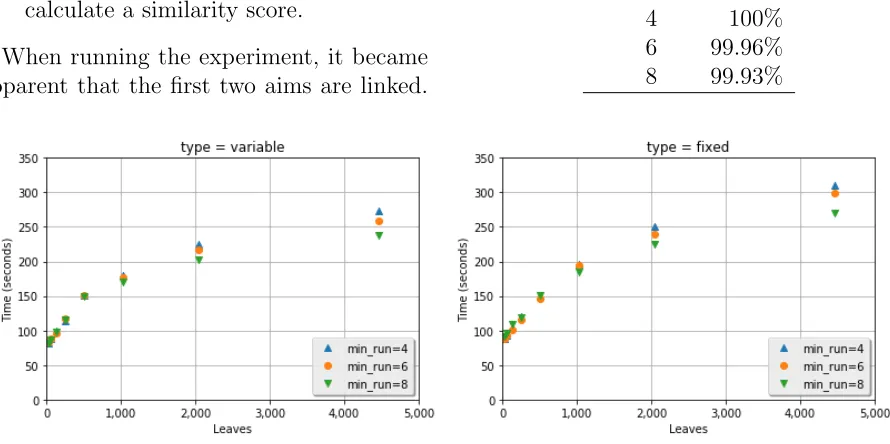
Figure 2. Effect of varying number of leaf nodes on time taken: t5 vs. t5
"'
i:, 350
300
250
§ 200
~ ';; 150 E i= 100 so 0 t
-•
't'0 1.000
type = variable
•
•
1' !•
rrin_run=4 I•
riin_run=6 1' rrin_run=B2,000 3,000 4,000 5,000
Leaves "' i:, 350 300 250
§ 200
~ ';; 150 E i= 100 so 0
'
-.
~
0 1.000
type= fixed
•
-1'i
-•
rrin_run=41•
rrin_run=61' nin_run=B
2,000 3,000 4,000 5,000
It should be acknowledged that if the aim is solely to identify identical files, then exist-ing hash-based techniques will take less time and yield more reliable results. Intuitively, however, a system that is intended to find similar files should also find identical files. While the chunk size of 160 bytes will always fail to match very small files, it is desirable to find matches when file sizes are larger.
Figure 2 shows the time taken to build the tree and search for all files. As the number of leaf nodes in the tree increases, so too does the time taken to search the tree. Higher
val-ues of min runuse slightly less time, due to
the fact that it is more difficult for a search to descend to a lower level when more matches are required to do so. However, as the recall for these higher values is lower, 4 was used as the min run value for further experiments.
The times shown here relate only to build-ing the tree and searchbuild-ing for files within it, and do not include the time for the pair-wise comparisons at the leaves. Therefore, although using 32 leaf nodes results in the shortest search time (due to the shallower tree), it would require a most comparisons,
as each leaf node represents 1
32 of the entire
corpus. As an illustration, using a
variable-width tree with 32 leaf nodes and min run
value of 4 requires 8,538,193 pairwise com-parisons after searching the tree. A similar tree with 4,457 leaves requires 617,860
com-parisons.
One issue that is important to note is that the time required to perform a full pairwise
comparison is 319 seconds. However, for
the largest trees, the times for building and searching the tree are 274 and 309 seconds for a variable and fixed HBFT respectively. Thus, for a relatively small collection such as this, the use of the tree is unlikely to provide benefits in terms of overall running time.
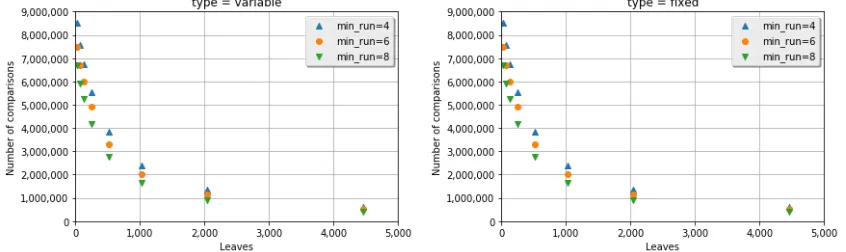
Figure 3 plots the number of leaf nodes against the total number of comparisons
re-quired to complete the investigation. As
the size of corpora increases, so does the number of pairwise comparisons required by
MRSH-v2. Thus reducing this search space is the primary function of the tree. Larger trees tend to result in a smaller number of
comparisons. For the largest trees (with
4,457 leaves), the min run value does not
have a material effect on the number of com-parisons required, regardless of whether the tree is variable-width or fixed-width. This implies that although searches tend to reach deeper into the tree (hence the longer run-ning time), they do not reach substantially more leaves.
From this experiment, it can be concluded
that using a min run value of 4 is
desir-able in order to find exact matches. This causes the time taken to search to be slightly longer, while having a negligible impact on
Figure 3. Effect of varying number of leaf nodes on number of comparisons: t5 vs. t5
type = variable
9,000,000 ~ - - - ' - i - - - ~ - - ~ •
8,000,000 •
~ 7,000,000 •
L
.A rnin_run=4
j
•
rrin_run=6• rrin_run=B
·
i
6.000,000-[ 5.000,000 ,~"~ ."'- - - < - - - - + - - - - + - - - + - - - -- l
O 4,000,000 s-~" ~ .. - - - < - - - - + - - - - + - - - + - - - --1
w
~ 3,000,000 z 2,000,000
•
T ,--• 1,000,000
O + - - - - ~ - - - - + - - - ~ - - - - t - - - < 0 1,000 2,000 3,000 4,000 5,000
Leaves
type= fixed
9,000,000 ~ - - - . ' ~ - - - ~ - - ~ a,000,000 +:- - - < L - - - - + - - - - + - - - 11 • mn_run=4
•
j
•
rrin _run=6~ 7,000,000 • • rrin _run=B
·
i
6.000,000-[ 5.000,000 ,~"~ ."'- - - < - - - - + - - - - + - - - + - - - -- l
O 4,000,000 s-~" ~ .. - - - < - - - - + - - - - + - - - + - - - --1
w
~ 3,000,000 z 2,000,000
•
T ,-
--
t-1,000,000
O + - - - - ~ - - - - + - - - ~ - - - - t - - - < • 0 1,000 2,000 3,000 4,000 5,000
the number of pairwise comparisons required afterwards. Fixed-width and variable-width HBFTs exhibit similar characteristics for a corpus of this size
5.2.2 Experiment 2: t5 vs. win7 and win7 vs. t5
The second experiment was designed to op-erate with larger dataset sizes. In this
ex-periment, t5 was used as a proxy for a set
of known-illegal files, and win7 was used to
represent a seized disk.
The aims of this experiment were:
1. Investigate whether the HBFT should represent the smaller or larger corpus.
2. Contrast the performance of variable-width and fixed-variable-width trees.
3. Measure the effect on overall running time of using a HBFT.
In pursuit of the first objective, the ex-periment was first run by building a tree to
represent t5 and then searching for the files
contained inwin7. The number of leaf nodes
in this tree was varied in the same way as in Experiment 1. Then this was repeated by
inserting win7 into a tree and searching for
the files from t5. Again the number of leaf
nodes was doubled every time, with the ex-ception that the largest tree contained one leaf node for every file in the collection (i.e. 48,384 leaves). This procedure was followed for both forms of tree.
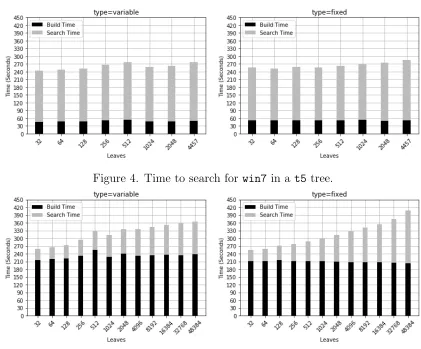
The time taken to build and search the trees are shown in Figures 4 and 5. Figure 4 shows the results when the tree represents
t5, with the time subdivided into the time
spent building the tree and the time spent
searching for all the files from win7. The
total time is relatively consistent for both
types of tree. This is unsurprising in the
context of disjoint corpora. Most files will not match, so many searches will end at the root node, or at an otherwise shallow depth.
Figure 5 shows results when the tree
mod-els win7. With only 32 leaf nodes, it is
no-table that all four experimental runs take approximately the same total time, regard-less of the type of tree or the dataset that is chosen for the tree to represent. Due to its
size, the build times for the win7 trees are
substantially longer than for t5. The search
time exhibits a generally upward trend as the number of leaf nodes increases: a trend that is far more pronounced for the fixed-width tree.
This is a consequence of the hardware con-straints associated with the setup of the ex-periment. Because memory footprint is con-strained, a tree with 48,384 leaf nodes will contain Bloom filters that are much smaller
than for trees with fewer nodes. For the
variable-width tree representing win7,
al-though its leaf nodes are 8KiB in size, its root node is 512MiB. In the correspond-ing fixed-width tree, the Bloom filters are all 64KiB. The false positive rate associated with Bloom filters is much higher for smaller
Bloom filters. Thus even where two
cor-pora have no files in common, searches int he fixed-width tree will descend deeper due to false positives higher in the tree, hence in-creasing the search time. This is likely to be even more pronounced in corpora that have a substantial number of similar files. There-fore, the fixed-width tree in its current de-sign is unlikely to successfully scale to very large corpora.
Overall, the total time taken is less when the tree represents the smaller dataset. As with the first experiment, the total num-ber of pairwise comparisons decreases as the number of leaves increases. Table 2 shows the total number of comparisons that are re-quired when using the largest number of leaf nodes (i.e. 4,457 when the tree represents
t5 and 48,384 when win7 is stored in the
mod-Figure 4. Time to search for win7 in a t5 tree.
Figure 5. Time to search for t5 in a win7 tree.
els t5. This, combined with the lower build
and search time suggest that the preferred approach should be to use the smaller cor-pus to construct the HBFT.
Table 2. Number of pairwise comparisons
required for largest trees: t5 vs. win7
Tree Search Fixed Variable
t5 win7 98,260 98,260
win7 t5 193,924 101,386
Memory is an additional consideration. Using a HBFT to model the larger dataset requires the similarity hashes of all its files to be cached at the leaves. This requires more memory than for the smaller collection, thus reducing the amount of memory available to
store the HBFT itself.
Following these observations, the experi-ment was repeated once more. A
variable-width tree was used, which modelledt5with
4,457 leaves. All files from win7 were then
searched for. The total running time, includ-ing pairwise comparisons, was 1,094 seconds. In comparison, the time taken to perform
a full pairwise comparison using MRSH-v2 is
2,858 seconds.
5.2.3 Experiment 3: Planted evidence
The final experiment involved overlapping datasets, constructed as follows:
• A set of simulated “known-illegal” files:
4,000 files fromt5.
450 type=variable 450 type=fixed
' '
420
~
-
Build Time 420~
-
Build Time390
~-
Search Time 390~-
Search Time360 360
330 330
vi 300 vi 300
'g 270 'g 270
~ 240 ~ 240
!!].210 !!]. 210
~ 180 ~ 180
i= 150 i= 150
120 120
90 90
60 60
30 30
0 0
'Y <J- v'o {?'° ,,,...,,.,,, ~
-$) ,f>,J, ~
"'"
'Y <J- v'o {?'° ,,,...,,.,,, -$) ~ ,f>,J, ~"'"
Leaves Leaves
450 type=variable 450 type=fixed
420
~
-
Build Time 420~
-
Build Time390
7-
Search Time 3907-
Search Time360 360 f - -
f--330 330
vi 300 - - - - f - - f - - f - - f-- ,;;;-300 - - f - - f - - f - -
f--'g 270 'g 270
~ 240 ~ 240
!!]. 210 !!]. 210
~ 180 ~ 180
i= 150 i= 150
120 120
90 90
60 60
30 I- 30
I-0 0
y <J- v'o {?'° ,,,...,,.,,, -$) ~ ~ i,.'b ~o,'° :!:'"' ?,'I{' ""''b ?,~ y <J- v'o {?'° ,,,...,,.,,, ~ i,.'b ~o,'° :!:'"' ?,'I{' ""''b ?,~ 'b --.."' 'Y ~ -$) ~ 'b --.."' 'Y ~
• A simulated seized hard disk: the win7
image, plus 140 files fromt5, as follows:
– 100 files that are contained within
the 4,000 “illegal” files.
– 40 files that themselves are not
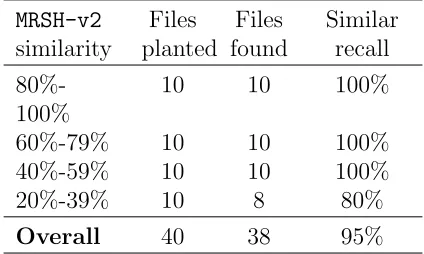
contained within the “illegal” files, but that have a high similarity with files in the corpus, according toMRSH-v2. 10 of these files have a similarity of 80% or higher, 10 have a similarity between 60% and 79% (inclusive), 10 have a similarity be-tween 40% and 59% (inclusive) and 10 have a similarity between 20% and 39% (inclusive).
The aims of this third experiment were:
1. Evaluate the time taken to
per-form a full search, compared with
the all-against-all pairwise approach of
MRSH-v2.
2. Evaluate the success of the approach in finding the 100 “illegal” files that are included verbatim in the hard disk im-age, and the 40 files from the image that are similar to “illegal” files, according to
MRSH-v2.
For the first aim, the primary metric is the time taken for the entire process to run, comprising the time to build the tree, the time to search the tree and the time required to conduct the pairwise comparisons at the leaves. In evaluating the latter aim, recall is used. Here, “recall” refers to the percentage of the 100 identical files that are successfully identified, and “similar recall” refers to the percentage of the 40 similar files that are suc-cessfully found. A file is considered to have been found if the search for the file it is sim-ilar or identical to reaches the leaf node that contains it, yielding a pairwise comparison.
The total running time for MRSH-v2 was
2,592 seconds. The running times of the
HBFT approach are shown in Figure 6. Fol-lowing the insights gained in the previous experiment, the smaller collection of 4,000 “illegal” files was used to construct the tree and then searches were conducted for all of the files in the larger corpus. The “Search Time” includes the time spent searching the tree and the time to perform the compar-isons at the leaves.
As expected, for both types of tree the maximum number of leaf nodes resulted in the fastest run time. This configuration also yielded the maximum reduction in the num-ber of pairwise comparisons required, with-out substantially adding to the time required to build and search the tree. The remain-der of this analysis focuses on this scenario, where the tree has 4,000 leaf nodes.
Using a variable-width tree took 1,182 sec-onds (a 54% reduction in the time required for an all-against-all pairwise comparison). The fixed-width tree took 1,207 seconds (a
53% reduction). This illustrates that in
terms of run-time, the HBFT approach offers substantial speed gains over pairwise com-parison. Due to the lack of scalability of the pairwise approach, this difference is likely to be even more pronounced for larger datasets.
Table 3. Similar recall for Planted Evidence experiment.
MRSH-v2 Files Files Similar
similarity planted found recall
80%-100%
10 10 100%
60%-79% 10 10 100%
40%-59% 10 10 100%
20%-39% 10 8 80%
Overall 40 38 95%
suc-Figure 6. Time to search for planted evidence (including pairwise comparisons).
cessfully found in both tree types. The sim-ilar recall is shown in Table 3 and is the same for both types of tree. All files with a MRSH-v2similarity of 40% or greater with a file in the “illegal” set were successfully identified. Two files with a lower similarity (25% and 26%) were not found. This yields an overall similar recall score of 95% for all 40 files.
This is an encouraging result, indicating that the HBFT approach is extremely effec-tive at finding files that are similar above a reasonable threshold of 40% and exhibits full recall for identical files. Thus it can be con-cluded that the HBFT data structure is a viable alternative to all-against-all compar-isons in terms of effectiveness, while achiev-ing substantial speed gains.
6.
CONCLUSIONS
AND FUTURE WORK
This paper aimed to investigate the effec-tiveness of using a Hierarchical Bloom Fil-ter Tree (HBFT) data structure to improve upon the all-against-all pairwise comparisonapproach used by MRSH-v2. A number of
experiments were conducted with the aim of improving the speed of the process. Ad-ditionally, it was important that files that should be found were not omitted (i.e. that
recall is maintained).
The first experiment found that while HBFTs with more leaf nodes take longer to build and search, they reduce the number of pairwise comparisons required by the great-est degree. It also sugggreat-ested the use of a
min runvalue of 4, as higher values resulted in imperfect recall for identical files.
The results of the second experiment in-dicated that when using corpora of differ-ent sizes, it is preferable to build the tree to model the smaller collection and then search for the files that are contained the larger
cor-pus. For larger trees, it was additionally
noted that the fixed-width HBFT did not scale as well as its variable-width counter-part. This is due to the small size of the Bloom filters used in the tree as the number of nodes increases.
For the final experiment, a Windows 7 im-age was augmented by the addition of a num-ber of files that were identical to those be-ing searched for, and a further group that were similar. The HBFT approach yielded a recall level of 100% for the identical files and of 95% for the similar files, when using
mrsh-v2as ground truth. On examining the two files that were not found, it was noted that these had a relatively low similarity to the search files (25% and 26% respectively), with all files with a higher similarity score
type=variable type=fixed
3000
-
Build Time 3000-
Build Time-
Search Time-
Search Time2500 2500
i 2000 i 2000
C: C:
0 0
.., ..,
'" ~ 1500
~ 1500
'" '"
E E
I" 1000 I" 1000
500 500
0 0
,t,,"' <,'-"\, ~
~ ,fi i,.'b ~ i:,C> ,t,,"' <,'-"\, ~ ~ ,fi i,.'b ~ i:,C>
being identified successfully. The run time for this experiment was substantially quicker than an all-against-all comparison: a 54% time reduction for a variable-width tree and a 53% reduction for a fixed-width tree.
These experiments lead to the conclusion that the HBFT approach is a highly promis-ing technique. Due the poor scalability of the traditional all-against-all approach, it can be inferred that this performance im-provement will be even more pronounced as datasets become larger.
Given the promising results of the experi-ments presented in this paper, further work is planned. A number of avenues for future work are apparent:
• Cuckoo filters have been identified as
a promising replacement for Bloom fil-ters for approximate matching pur-poses (V. Gupta & Breitinger, 2015). It is possible that these could be incor-porate into a similar hierarchical tree structure to produce further improve-ments.
• Currently, when building the tree, files
are allocated to leaf nodes in a round-robin fashion. For trees with multiple files represented at each leaf, it may be possible that a more optimised alloca-tion mechanism could be used for this (e.g. to allocate similar files to the same leaf node).
• The current model also uses balanced
trees, with the result that all success-ful searches reach the same depth in the tree. Further investigation may reveal circumstances where an unbalanced tree is preferable so as to shorten some more common searches.
• Parallelisation and distribution are
highly likely to yield further perfor-mance improvements, and this should be investigated.
• Fixed-width HBFTs do not scale to the
same extent as variable trees, due to the high false positive rates that are associated with the small Bloom fil-ters that result from using large trees with many nodes. Although the exper-iments presented in this paper indicate that variable-width HBFTs are prefer-able, there may be circumstances where fixed-width trees may be useful, due to their theoretical advantages noted in Section 4.
• While these experiments have used
MRSH-v2 as the algorithm for calculat-ing the similarities at the leaf nodes, other algorithms should be considered
also (e.g. sdhash).
REFERENCES
Bloom, B. H. (1970). Space/Time Trade-offs in Hash Coding with Allowable Errors.
Communications of the ACM, 13(7),
422–426.
Breitinger, F., & Baier, H. (2012). Similarity Preserving Hashing: Eligible Proper-ties and a New Algorithm MRSH-v2. In International conference on digital
forensics and cyber crime (pp. 167–
182). Springer.
Breitinger, F., Baier, H., & White, D.
(2014). On the Database Lookup
Problem of Approximate Matching. Digital Investigation, 11, S1–S9. doi: 10.1016/j.diin.2014.03.001
Breitinger, F., Guttman, B., McCarrin, M., Roussev, V., & White, D. (2014). Ap-proximate Matching: Definition and
Terminology. NIST Special
Publica-tion, 800, 168.
Breitinger, F., Rathgeb, C., & Baier, H.
(2014, sep). An Efficient Similarity
Journal of Digital Forensics, Security and Law,9(2), 155–166.
Broder, A. Z. (1997). On the Resemblance
and Containment of Documents. In
Compression and complexity of se-quences 1997. proceedings (pp. 21–29). doi: 10.1109/SEQUEN.1997.666900 Casey, E., Ferraro, M., & Nguyen, L. (2009).
Investigation Delayed is Justice De-nied: Proposals for Expediting Foren-sic Examinations of Digital Evidence. Journal of forensic sciences, 54(6), 1353–1364.
de Braekt, R. I., Le-Khac, N. A., Farina, J., Scanlon, M., & Kechadi, T. (2016, April). Increasing Digital Investigator Availability Through Efficient Work-flow Management and Automation. In 4th international symposium on digital forensic and security (isdfs)(p. 68-73). doi: 10.1109/ISDFS.2016.7473520 Gupta, J. N., Kalaimannan, E., & Yoo,
S.-M. (2016). A Heuristic for Maximiz-ing Investigation Effectiveness of Digi-tal Forensic Cases Involving Multiple
Investigators. Computers &
Opera-tions Research, 69, 1–9. doi: 10.1016/ j.cor.2015.11.003
Gupta, V., & Breitinger, F. (2015). How cuckoo filter can improve existing
ap-proximate matching techniques. In
J. James & F. Breitinger (Eds.),
Digi-tal forensics and cyber crime (Vol. 157, p. 39-52). Springer International Pub-lishing. doi: 10.1007/978-3-319-25512 -5 4
Harichandran, V. S., Breitinger, F., & Bag-gili, I. (2016). Bytewise Approximate Matching: The Good, The Bad, and
The Unknown. The Journal of Digital
Forensics, Security and Law: JDFSL,
11(2), 59.
James, J. I., & Gladyshev, P. (2015). Au-tomated Inference of Past Action
In-stances in Digital Investigations.
In-ternational Journal of Information Se-curity, 14(3), 249–261. doi: 10.1007/ s10207-014-0249-6
Kornblum, J. (2006). Identifying Identical Files Using Context Triggered
Piece-wise Hashing. Digital investigation,
3, 91–97. doi: 10.1016/j.diin.2006.06
.015
Lillis, D., Becker, B., O’Sullivan, T., & Scan-lon, M. (2016). Current Challenges and Future Research Areas for Digital
Forensic Investigation. In11th ADFSL
Conference on Digital Forensics,
Se-curity and Law (CDFSL 2016).
Day-tona Beach, FL, USA: ADFSL. doi: 10.13140/RG.2.2.34898.76489
Lillis, D., Breitinger, F., & Scanlon, M.
(2017). Expediting MRSH-v2
Ap-proximate Matching with Hierarchical
Bloom Filter Trees. In 9th EAI
Inter-national Conference on Digital Foren-sics and Cyber Crime (ICDF2C 2017). Prague, Czech Republic.
Oliver, J., Cheng, C., & Chen, Y. (2013). TLSH–A Locality Sensitive Hash. In Fourth Cybercrime and Trustworthy Computing Workshop (CTC), 2013 (pp. 7–13). doi: 10.1109/CTC.2013.9 Quick, D., & Choo, K.-K. R. (2014).
Im-pacts of Increasing Volume of Digital Forensic Data: A Survey and Future
Research Challenges. Digital
Investi-gation, 11(4), 273–294. doi: 10.1016/ j.diin.2014.09.002
Rogers, M. K., Goldman, J., Mislan, R.,
Wedge, T., & Debrota, S. (2006).
Computer Forensics Field Triage
Pro-cess Model. Journal of Digital
Foren-sics, Security and Law,1(2), 19–38.
Roussev, V. (2010). Data Fingerprinting
with Similarity Digests. InIFIP
Inter-national Conference on Digital
Foren-sics (pp. 207–226). Springer. doi:
10.1007/978-3-642-15506-2 15
Foren-sic Similarity Hashes. Digital Investi-gation, 8, S34–S41.
Roussev, V., & Richard III, G. G. (2004). Breaking the Performance Wall: The Case for Distributed Digital
Foren-sics. In Proceedings of the 2004
Digital Forensics Research Workshop (Vol. 94).
Sadowski, C., & Levin, G. (2007). Simhash:
Hash-based Similarity Detection. Cite-seer.
Scanlon, M. (2016, 08). Battling the Digital Forensic Backlog through Data
Dedu-plication. In Proceedings of the 6th
IEEE International Conference on In-novative Computing Technologies
(IN-TECH 2016). Dublin, Ireland: IEEE.
van Baar, R., van Beek, H., & van Eijk, E. (2014). Digital Forensics as a Service:
A Game Changer. Digital