Indexing Ordered Trees for (Nonlinear) Tree
Pattern Matching by Pushdown Automata
Jan Tr ´avn´ıˇcek, Jan Janouˇsek, and Borivoj Melichar Faculty of Information Technology
Czech Technical University in Prague Th ´akurova 9, 160 00 Prague 6, Czech Republic {Jan.Travnicek, Jan.Janousek, melichar}@fit.cvut.cz
Abstract. Trees are one of the fundamental data structures used in Com-puter Science. We present a new kind of acyclic pushdown automata, the tree pattern pushdown automaton and the nonlinear tree pattern push-down automaton, constructed for an ordered tree. These automata accept all tree patterns and nonlinear tree patterns, respectively, which match the tree and represent a full index of the tree for such patterns. Given a tree withnnodes, the numbers of these distinct tree patterns and nonlinear tree patterns can be at most2n−1+nand at most(2 +v)n−1+ 2, respec-tively, wherevis the maximal number of nonlinear variables allowed in nonlinear tree patterns. The total sizes of nondeterministic versions of the two pushdown automata areO(n) andO(n2
), respectively. We discuss the time complexities and show timings of our implementations using the bit-parallelism technique. The timings show that for a given tree the run-ning time is linear to the size of the input pattern.
Keywords: Tree pattern matching, nonlinear tree pattern matching, index-ing trees, pushdown automata
1.
Introduction
Trees are one of the fundamental data structures used in Computer Science. Finding occurrences of tree patterns in trees is an important problem with many applications such as compiler code selection, interpretation of nonprocedural languages, implementation of rewriting systems, or various tree finding and tree replacement systems. Tree patterns are trees in which leaves can be la-belled also by a special linear variableS, which serves as a placeholder for any subtree. Nonlinear tree patterns can further contain leaves labelled by specific nonlinear variables, where each of nonlinear variables represents a specific subtree. Nonlinear tree pattern matching is used especially in the implementa-tion of term rewriting systems, in which the terms can be represented as tree structures with nonlinear variables.
tree of size n, such tree pattern matcher typically perform the search phase in time linear inn[15, 6, 12, 24]. This approach is suitable for cases when one wants look for occurrences of a given pattern in input subject structures. The second basic approach is represented by the use of an indexing data struc-ture constructed for the subject in which we search. In other words, the sub-ject is preprocessed. Examples of such indexing structures are suffix or factor automata [9, 10, 22, 25] in the area of string processing or subtree pushdown automaton [18], which represents a complete index of an ordered tree for sub-trees. This approach is suitable especially for cases when one wants look for occurrences of different input patterns in a given subject structure.
The theory of formal tree languages have been extensively studied and de-veloped since the 1960s and its main models of computation are various kinds of tree automata [14, 6, 8]. However, trees can also be represented as strings, for example in their prefix (also called preorder) or postfix (also called pos-torder) notation. A linear notation of a tree can be obtained by the corresponding traversing of the tree. Moreover, every sequential algorithm on a tree traverses nodes of the tree in a sequential order and so follows a linear notation of the tree. [20] proves that the deterministic pushdown automaton (PDA) is an appro-priate model of computation for labelled ordered trees in linear notation and that the trees in postfix notation acceptable by deterministic PDA form a proper su-perclass of the class of regular tree languages [14], which are accepted by finite tree automata. Recently, pushdown automata gain a popularity in solving prac-tical problems of processing trees, for example in processing XML documents [13].
In this paper we present a new kind of acyclic pushdown automata for an ordered tree. The tree pattern pushdown automaton and the nonlinear tree
tern pushdown automaton represent a complete index of the tree for tree
pat-terns and nonlinear tree patpat-terns, respectively, and accept all tree patpat-terns and nonlinear tree patterns, respectively, which match the tree. Given a tree withn
nodes, the numbers of distinct tree patterns and nonlinear tree patterns which match the tree can be at most2n−1+nand at most(2 +v)n−1+ 2, respectively, wherevis the maximal number of distinct nonlinear variables allowed in nonlin-ear tree patterns. We describe the construction of nondeterministic (nonlinnonlin-ear) tree pattern pushdown automata and discuss their time and space complexi-ties. We are not aware of any other existing pushdown automaton which would represent such an index. The presented nondeterministic pushdown automata are input–driven and therefore can be determinised.
bit-parallel technique and show their timings. The timings show that the running time is for a given tree linear to the size of the input (nonlinear) tree patterns, which is a result similar to the result described in [23].
We note that the presented PDAs have only one pushdown symbol and therefore can be easily transformed to counter automata, which are a weaker and simpler model of computation than the PDA. We present the automata in this paper as PDAs because the PDA is a more fundamental and more widely-used model of computation than the counter automaton.
Since our pushdown automata accept finite languages, which correspond to finite sets of various connected subgraphs of the tree, a finite automaton could also be used instead of a pushdown automaton. However, such finite automaton would have significantly more states than the PDA, in which the underlying tree structure is efficiently processed by the pushdown store.
Early presentations of the tree pattern pushdown automaton and the non-linear tree pattern pushdown automaton can be found in [21, 19] and [26], re-spectively. This paper can be considered as an extended version of these pub-lications.
The paper is organised as follows. The second section discusses related works of existing (nonlinear) tree pattern matching algorithms. The third section contains basic definitions. The fourth section is devoted to indexing trees for tree pattern matching by pushdown automata. The fifth section describes indexing trees for nonlinear tree pattern matching by pushdown automata. Section 6 deals with nonlinear tree pattern matching for more than one nonlinear variable in nonlinear tree patterns. The seventh section describes our implementations and show experimental results. The last section is a conclusion.
2.
Related Works
Some algorithms for (nonlinear) tree pattern matching are known. All of them use the approach which is represented by the preprocessing of the (nonlinear) tree pattern. For tree pattern matching algorithms see [15, 6, 12].
Nonlinear tree pattern matching algorithm described in [24] reads the Euler linear notation of both a subject tree and a nonlinear tree pattern. Euler notation is a tree linear notation, which contains a node each time it is visited during the preorder traversing of the tree. This means that every node appears exactly
1 +arity(node)-times in Euler notation. Our method presented in this paper uses a standard tree prefix notation, which contains every node just once.
3.
Basic notions
We define notions on trees similarly as they are defined in [2, 14, 15].
3.1. Alphabet
An alphabet is a finite nonempty set of symbols. A ranked alphabet is a fi-nite nonempty set of symbols each of which has a unique nonnegative arity (or rank). Given a ranked alphabetA, the arity of a symbola ∈ Ais denoted
Arity(a). The set of symbols of arity p is denoted by Ap. Elements of arity
0,1,2, . . . , pare respectively called nullary (constants), unary, binary,. . .,p-ary symbols. We assume thatA contains at least one constant. In the examples we use numbers at the end of identifiers for a short declaration of symbols with arity. For instance,a2is a short declaration of a binary symbola.
3.2. Tree, tree pattern, nonlinear tree pattern
Based on concepts from graph theory (see [2]), a tree over an alphabetAcan be defined as follows:
An graph Gis a pair(N, R), whereN is a set of nodes andR is a set of edges such that each element ofR is of the form(f, g), wheref, g ∈ N. This element will indicate that, for node f, there is an edge between node f and nodeg.
A directed graphGis a graph, where each element ofR of the form(f, g)
indicates that, there is an edge leaving nodef and entering nodeg. This edge is ordered from f to g. An undirected graph G is a graph in which no such ordering of edges is given.
A sequence of nodes(f0, f1, . . . , fn),n≥1, is a path of lengthnfrom node f0 to nodefn if there is an edge which leaves node fi−1 and enters node fi
for1 ≤ i≤ n. A labelling of an ordered graphG= (N, R)is a mapping ofN
into a set of labels. In the examples we useaf for a short declaration of nodef
labelled by symbola.
A directed graph is connected if there exists a path fromfu to fv for each
pair of nodes (fu,fv),u6=v, of the graph.
A cycle is a path(f0, f1, . . . , fn)in whichf0=fn.
Given a nodef of a directed graph, its out-degree is the number of distinct pairs (f, g) ∈ R, where g ∈ N. By analogy, the in-degree of node f is the number of distinct pairs(g, f)∈R, whereg∈N.
A tree is a connected graph without any cycle. In this paper we assume that the tree has at least one node. Any node of a tree can be selected as a root of the tree. A tree with a root is called rooted tree.
A tree can be directed. A rooted and directed treetis an acyclic connected directed grapht= (N, R)with a special noder∈N, called the root, such that (1)rhas in-degree0, (2) all other nodes ofthave in-degree 1, (3) there is just one path from the rootrto everyf ∈N, wheref 6=r.
A labelled, (rooted, directed) tree is a tree having the following property: (4) every nodef ∈N is labelled by a symbola∈ A, whereAis an alphabet.
A ranked, (labelled, rooted, directed) tree is a tree labelled by symbols from a ranked alphabet and out-degree of a nodef labelled by symbola∈ Aequals toArity(a). Nodes labelled by nullary symbols (constants) are leaves.
An ordered, (ranked, labelled, rooted, directed) tree is a tree where direct descendants af1, af2, . . . , af n of a node af having an Arity(af) = n are
or-dered.
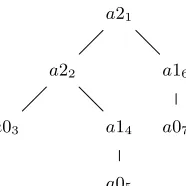
Example 1. Consider a ranked alphabetA={a2, a1, a0}. Consider an ordered,
ranked, labelled, rooted, and directed treet1 = ({a21, a22, a03, a14, a05, a16,
a07}, R1)overA, whereR1is a set of the following ordered pairs:
R1={(a21, a22),(a21, a16),(a22, a03),(a22, a14),(a14, a05),(a16, a07)}. Treet1in prefix notation ispref(t1) =a2a2a0a1a0a1a0.
Trees can be represented graphically, and treet1is illustrated in Figure 1.
a05
a03 a14 a07
a22 a16
a21
Fig. 1. Treet1from Example 1
A subtree of a treet = (N, R)is any treet′ = (N′, R′)such that: (1)N′ is
nonempty and contained inN, (2)R′=A′×A′∩R, and (3) No node ofA\A′
is a descendant of a node inA′.
The height of a treet, denoted by Height(t), is defined as the length of the longest path leading from the root oftto a leaf oft.
To define a tree pattern, we use a special nullary symbolS, not in alpha-betA,Arity(S) = 0, which is a variable and serves as a placeholder for any subtree. A tree pattern is defined as a labelled ordered tree over an alphabet A ∪ {S}. We will assume that the tree pattern contains at least one node la-belled by a symbol fromA. A tree pattern containing at least one symbolSwill be called a tree template.
A tree patternpwithk≥0occurrences of the symbolSmatches a subject
treetat nodenif there exist subtreest1, t2, . . . , tk(not necessarily the same) of
the treetsuch that the treep′, obtained frompby substituting the subtreet ifor
thei-th occurrence ofS inp,i = 1,2, . . . , k, is equal to the subtree oft rooted atn.
specific subtrees. Every occurrence of a symbolXin a nonlinear tree pattern is matched with the same subtree. A nonlinear tree pattern has to contain at least one symbol fromA. A nonlinear tree pattern which contains at least two equal nonlinear variables will be called a nonlinear tree template.
A nonlinear tree patternnpwith k ≥2occurrences of a nonlinear variable
X matches a subject treetat nodenif there exists a subtreetX of the treet
and subtreest1, t2, . . . , tm(not necessarily the same) of the treetsuch that the
treenp′, obtained fromnpby substituting the subtreet
X for thei-th,1≤i≤k,
occurrences ofXinnp, and by substituting the subtreetifor thei-th occurrence
ofSinp,i= 1,2, . . . , m, is equal to the subtree oftrooted atn.
Example 2. Consider a treet1 = ({a21, a22, a03, a14, a05, a16, a07}, R1)from Example 1, which is illustrated in Figure 1.
Consider a tree patternp1overA, p1 = ({a21, a02, a13, a04}, Rp1). Tree pat-ternp1in prefix notation ospref(p1) =a2a0a1a0.
Rp1={((a21, a02),(a21, a13)),((a13, a04))}
Consider a tree patternp2overA ∪ {S}, p2= ({a21, S2, a13, S4}, Rp2). Tree patternp2 in prefix notation ispref(p2) = a2 S a1 S. Note that symbolS can occur in a nonlinear tree pattern and it serves as a linear variable.
Rp2={(a21, S2),(a21, a13),(a13, S4)}
Consider a nonlinear tree patternp3 overA ∪ {S, X}, p3 = ({a21, X2, a13,
X4}, Rp3). Nonlinear tree patternp3in prefix notation ispref(p3) =a2X a1X.
Rp3={(a21, X2),(a21, a13),(a13, X4)}
Tree patterns p1,p2 andp3 are illustrated in Figure 2. Tree patternp1 has one occurrence in treet1 – it matches at node2oft1. Tree patternp2has two occurrences in treet1– it matches at nodes1and2oft1. Nonlinear tree pattern
p3has one occurrence in treet1– it matches at node2oft1.
a04
a02 a13
a21
S4
S2 a13
a21
X4
X2 a13
a21
3.3. Language, finite and pushdown automata
We define notions from the theory of string languages similarly as they are defined in [2, 16].
A language over an alphabetAis a set of strings overA. SymbolA∗denotes
the set of all strings overAincluding the empty string, denoted by ε. SetA+ is defined asA+ = A∗\ {ε}. Similarly, for stringx∈ A∗, symbolxm, m ≥0,
denotes them-fold concatenation ofxwithx0 = ε. Setx∗ is defined asx∗ =
{xm:m≥0},x+={xm:m≥1}andx∗=x+∪ {ε}.
A nondeterministic pushdown automaton (nondeterministic PDA) is a seven-tupleM = (Q,A, G, δ, q0, Z0, F), whereQis a finite set of states,Ais an input
alphabet,Gis a pushdown store alphabet,δis a mapping fromQ×(A∪{ε})×G
into a set of finite subsets of Q×G∗,q0 ∈ Qis an initial state, Z0 ∈ Gis the
initial pushdown store symbol, andF⊆Qis the set of final (accepting) states. Triple (q, w, x) ∈ Q× A∗×G∗ denotes the configuration of a pushdown
automaton. We will write the top of the pushdown storexon its left hand side. The initial configuration of a pushdown automaton is a triple(q0, w, Z0)for the input stringw ∈ A∗. The relation ⊢
M⊂ (Q× A∗×G∗)×(Q× A∗×G∗)is a
transition of a pushdown automatonM. It holds that(q, aw, αβ)⊢M (p, w, γβ)if
(p, γ)∈δ(q, a, α). Thek-th power, transitive closure, and transitive and reflexive closure of the relation⊢M is denoted⊢kM,⊢
+
M,⊢∗M, respectively.
A pushdown automaton is input–driven if each of its pushdown operations is determined only by the input symbol.
A languageLaccepted by a pushdown automatonM is defined in two distinct ways:
1. Accepting by final state:L(M) ={x: (q0, x, Z0)⊢∗M (q, ε, γ)∧x∈ A∗∧γ∈ G∗∧q∈F}.
2. Accepting by empty pushdown store:Lε(M) ={x: (q0, x, Z0)⊢∗M (q, ε, ε)∧ x∈ A∗∧q∈Q}.
If the pushdown automaton accepts the language by empty pushdown store, then the setF of final states is the empty set.
Unreachable states are states p ∈ Q from automaton M = (Q, A, G, δ, q0, Z0, F) which are not reachable from the initial state because there is no sequence of transitions from the initial state to that particular statep. Formally, there are no transitions that allow(q0, kw, Z0)⊢+M (p, w, γ).
Unnecessary states are statesp∈Qfrom automatonM = (Q,A, G, δ, q0,
Z0, F)which are not connected to any final statef∈Fif automaton accepts by final states, or not connected to any state, whereγ∈G∗may beε, if automaton
accepts by empty pushdown store.
Pushdown automaton M = (Q,A, G, δ, q0, Z0, F) is acyclic if it does not contain transitions(q, x1, γ1)⊢+M (q, x2, γ2), wherexx2=x1,x6=εandq∈Q.
3.4. String suffix and factor automata
String suffix and factor automata are finite automata that were introduced in
22, 25]. Given a strings∈ A∗, the suffix and factor automaton constructed for
the string saccepts all suffixes and substrings, respectively, of the string sin time linear to the length of the input suffix and the input substring, respectively, and not depending on the length of the strings. In [9, 10, 25], suffix and factor automata are defined as such minimal deterministic finite automata. In [23, 22], their basic nondeterministic versions are also presented. In some literature, the deterministic suffix automaton is also called the directed acyclic word graph
(DAWG).
Example 3. Given a stringpref(t1) =a2a2a0a1a0a1a0, which is the prefix
notation of tree t1 from Example 1, the corresponding nondeterministic suffix automaton isF Mnsuf(pref(t1)) = ({0,1,2,3,4,5,6,7},A, δn,0,{7}), where its
transition diagram is illustrated in Figure 3. For the construction of the nonde-terministic suffix automaton, see [22].
0 a2 1 a2 2 a0 3 a1 4 a0 5 a1 6 a0 7
a2 a0 a1
a0 a1 a0
Fig. 3. Transition diagram of the nondeterministic string suffix automaton
F Mnsuf(pref(t1)) for prefix notation pref(t1) = a2 a2 a0 a1 a0 a1 a0 of tree t1 from Example 1
4.
Indexing trees for tree pattern matching
In this section, algorithms and theorems regarding tree pattern PDAs for trees in prefix notation are given, and the tree pattern PDAs and their construction are demonstrated on an example. A tree pattern can be either a subtree or a tree template, which contains at least one special nullary symbolSrepresenting a subtree. Tree pattern PDAs are an extension of subtree PDAs, introduced in [18]. A subtree PDA is analogous to the string suffix automaton and it accepts a linear notation of all subtrees of a given tree. The pushdown operations are used to process the tree structure. New states and transitions, which are used for processing the special nullary symbolsS in tree templates, are additionally present in the tree pattern PDA. The pushdown operations are the same.
Definition 1. Lettandpref(t)be a tree and its prefix notation, respectively. A
tree pattern pushdown automaton forpref(t)accepts all tree patterns in prefix
Given a subject tree, first we construct a so-called deterministic treetop PDA for this tree in prefix notation, which accepts all tree patterns that match the subject tree and contain the root of the subject tree. The deterministic treetop PDA is defined by the following definition. States and transitions of the treetop pushdown automaton are computed by Algorithm 1. Finally, the correctness Algorithm 1 is proved by Theorem 1.
Definition 2. Lett, randpref(t)be a tree, its root and its prefix notation,
re-spectively. A treetop pushdown automatonMpt(t) = (0,1,2, ..., n, A∪S, S, δ,0, S,
∅)forpref(t)accepts all tree patterns in prefix notation which have the rootr
and match the treet.
The construction of the treetop PDA is described by the following algorithm. The treetop PDA is deterministic.
Algorithm 1 Construction of a treetop PDA for a treetin prefix notationpref(t).
Input: A treetover a ranked alphabetA; prefix notationpref(t) =a1a2. . . an,
n≥1.
Output: Treetop PDAMpt(t) = ({0,1,2, . . . , n},A ∪ {S},{S}, δ,0, S,∅).
Method:
1. For each statei, where1≤i≤n, create a new transition
δ(i−1, ai, S) = (i, SArity(ai)), whereS0=ε.
2. Create a setsrms ={i : 1≤i ≤n, δ(i−1, a, S) = (i, ε), a ∈ A0}. The
abbreviation srms stands for Subtree Right Most States.
3. For each statei, wherei=n−1, n−2, . . . ,1,δ(i, a, S) = (i+ 1, Sp),a∈ A p,
create a new transitionδ(i, S, S) = (l, ε)such that(i, xy, S)⊢+
Mp(t) (l, y, ε) as follows:
Ifp= 0, create a new transitionδ(i, S, S) = (i+ 1, ε).
Otherwise, ifp≥1, create a new transitionδ(i, S, S) = (l, ε), wherelis the
p-th smallest integer such that l ∈ srms and l > i. Remove all j, where
j∈srms, andi < j < l, fromsrms. ⊓⊔
The treetop PDA is similar to the prefix string finite automaton. Moreover, there exists additional transitions reading symbol S, which represents a subtree, and these transitions skip over parts which are subtrees of the tree in prefix notation. The automaton uses the pushdown store for computing a checksum so that the input would be a valid prefix notation of a tree.
The construction of treetop PDA by Algorithm 1 is illustrated in the following example.
Example 4. Consider treet1 in prefix notationpref(t1) =a2a2a0a1a0a1a0
δ1(0, a2, S) = (1, SS)
δ1(1, a2, S) = (2, SS) δ1(1, S, S) = (5, ε)
δ1(2, a0, S) = (3, ε) δ3(2, S, S) = (3, ε)
δ1(3, a1, S) = (4, S) δ1(3, S, S) = (5, ε)
δ1(4, a0, S) = (5, ε) δ1(4, S, S) = (5, ε)
δ1(5, a1, S) = (6, S) δ1(5, S, S) = (6, ε)
δ1(6, a0, S) = (7, ε) δ1(6, S, S) = (7, ε)
The transition diagram of deterministic treetop PDAMpt(t1)is illustrated in Figure 4. In this figure for each transition ruleδ(p, a, α) = (q, β)fromδthe edge leading from statepto stateqis labelled by the triple of the forma|α7→β.
Deterministic treetop PDAMpt(t1)has been constructed by Algorithm 1 as follows. We can see that the initial setsrms={3,5,7}. Then, new transitions, which read symbol S, are created in the following order: δ4(6, S, S) = (7, ε),
δ4(5, S, S) = (7, ε),δ4(4, S, S) = (5, ε),δ4(3, S, S) = (5, ε),δ4(2, S, S) = (3, ε),
andδ4(1, S, S) = (5, ε). ⊓⊔
0 1 2 3 4 5 6 7
a2|S7→SS a2|S7→SS a0|S7→ε a1|S7→S a0|S7→ε a1|S7→S a0|S7→ε
S|S7→ε S|S7→ε S|S7→ε
S|S7→ε S|S7→ε
S|S7→ε
Fig. 4. Transition diagram of deterministic treetop pushdown automatonMpt(t1)for tree in prefix notationpref(t1) =a2a2a0a1a0a1a0from Example 4
Theorem 1. Given a treetand its prefix notationpref(t), the PDAMpt(t)
con-structed by Algorithm 1 is a treetop PDA forpref(t).
Proof. Letrbe the root oft. The PDAMpt(t)is a simple extension of the PDA,
which is constructed by step 1 and accepts the treetin prefix notation. It holds for new transitions added by step 3, which read the special nullary symbol S, thatδ(q1, S, S) = (q2, ε)if and only if(q1, w, S)⊢+Mpt(t)(q2, ε, ε)andq1is not the initial state0. This means that the new added transitions readingScorrespond just to subtrees not containing the rootr. Thus, the PDAMpt(t)accepts all tree
Algorithm 2 Construction of a nondeterministic tree pattern PDA for a treetin prefix notationpref(t).
Input: A treetover a ranked alphabetA; prefix notationpref(t) =a1a2. . . an,
n≥1.
Output: Nondeterministic tree pattern PDAMnpt(t) = ({0,1,2, . . . , n},A ∪ {S},
{S}, δ,0, S,∅). Method:
1. CreateMnpt(t)asMpt(t)by Algorithm 1.
2. For each statei, where2≤i≤n, create a new transition
δ(0, ai, S) = (i, SArity(ai)), whereS0=ε. ⊓⊔
The tree pattern PDA is similar to the string factor finite automaton. Its con-struction is based on the treetop PDA and the extension is that the tree pattern accepted by the automaton can be matched on any node of the tree. For this reason, additional transitions are created.
Example 5. Consider treet1 in prefix notationpref(t1) =a2a2a0a1a0a1a0
from Example 1, which is illustrated in Figure 1. The nondeterministic tree pat-tern PDA accepting all tree patpat-terns matching tree t1, which has been con-structed by Algorithm 2, is nondeterministic PDA
Mnpt(t1) = ({0,1,2,3,4,5,6,7},A,{S}, δ2,0, S,∅)), where mapping δ2 is a set of the following transitions:
δ2(0, a2, S) = (1, SS)
δ2(1, a2, S) = (2, SS) δ2(1, S, S) = (5, ε) δ2(0, a2, S) = (2, SS)
δ2(2, a0, S) = (3, ε) δ3(2, S, S) = (3, ε) δ2(0, a0, S) = (3, ε)
δ2(3, a1, S) = (4, S) δ2(3, S, S) = (5, ε) δ2(0, a1, S) = (4, S)
δ2(4, a0, S) = (5, ε) δ2(4, S, S) = (5, ε) δ2(0, a0, S) = (5, ε)
δ2(5, a1, S) = (6, S) δ2(5, S, S) = (6, ε) δ2(0, a1, S) = (6, S)
δ2(6, a0, S) = (7, ε) δ2(6, S, S) = (7, ε) δ2(0, a0, S) = (7, ε)
The transition diagram of nondeterministic tree pattern PDAMnpt(t1)is illus-trated in Figure 5. Again, in this figure for each transition ruleδ(p, a, α) = (q, β)
from δthe edge leading from statepto state q is labelled by the triple of the
forma|α7→β. ⊓⊔
In the following theorem we prove the correctness of the constructed tree pattern PDA.
Theorem 2. Given a tree t and its prefix notation pref(t), the PDA Mnpt(t)
constructed by Algorithm 2 is a tree pattern PDA forpref(t).
Proof. The PDAMnpt(t)is a simple extension of the PDAMpt(t), which is
con-structed by Algorithm 1 and accepts all tree patterns in prefix notation which contain the rootrof the treetand match the treetby empty pushdown store. The PDAMnpt(t)contains new added transitions of the formδ(0, ai, S) =
0 1 2 3 4 5 6 7 a2|S7→SS a2|S7→SS a0|S7→ε a1|S7→S a0|S7→ε a1|S7→S a0|S7→ε
a2|S7→SS a0|S7→ε a1|S7→S
a0|S7→ε a1|S7→S a0|S7→ε
S|S7→ε S|S7→ε S|S7→ε
S|S7→ε S|S7→ε
S|S7→ε
Fig. 5. Transition diagram of nondeterministic tree pattern pushdown automatonMnpt
(t1)from Example 5 for tree in prefix notationpref(t1) =a2a2a0a1a0a1a0
symbol of a tree pattern to be accepted can be any node of the treet. Thus, the PDA Mnpt(t)accepts all tree patterns in prefix notation which match the tree
t. ⊓⊔
Lemma 1. Given a tree t with n nodes, the number of distinct tree patterns
which match the treetcan be at most2n−1+n.
Proof. First, subtrees of any subtree of the treet can be replaced by the
spe-cial nullary symbolS and the tree template resulting from such a replacement is a tree pattern which matches the tree. Given a tree withnnodes, the maxi-mal number of subsets of subtrees that can be replaced by the special nullary symbolSoccurs for the case of a treet2whose structure is given by the prefix notationpref(t2) =a(n−1)a10a20. . . an−10, wheren≥2. Such a tree is illus-trated in Figure 6. In this tree, each of the nullary symbolsa10, a20, . . . , an−10 can be replaced by nullary symbolS, and therefore we can create2n−1distinct tree templates which are tree patterns matching the treet2.
a(n−1)1
a102 a203 . . . an−10n
pref(t2) =a(n−1)a10a20. . . an−10
Fig. 6. A treet2with2n− 1
Second, the treetitself and all its subtrees not containing the root are tree patterns which match the tree, which givesnother distinct tree patterns (pro-vided all the subtrees are unique).
Thus, the total number of distinct tree patterns matching the treetcan be at
most2n−1+n. ⊓⊔
Lemma 2. The number of states of a nondeterministic tree pattern pushdown
automatonMntpism+ 1, wheremis the number of nodes of a subject tree.
Proof. There is one state for each symbol in pref(t)plus and the initial state.
Thus, the number of states ism+ 1. ⊓⊔
Lemma 3. The number of transitions of a nondeterministic tree pattern
push-down automatonMntpis3m−2, wheremis the number of nodes of a subject
tree.
Proof. There is one transition for each symbol inpref(t), which forms the
“back-bone” of the automaton. There are exactlym−1transitions from the initial state to every other state. Finally, there is one transition for symbolSleading from ev-ery state except the initial state. Thus, the number of states is then3m−2. ⊓⊔
5.
Indexing trees for nonlinear tree pattern matching
Definition 3. Lett and pref(t)be a tree and its prefix notation, respectively.
A nonlinear tree pattern pushdown automaton forpref(t)accepts all nonlinear
tree patterns in prefix notation which have at most one nonlinear variable and
match the treet.
5.1. Basic nonlinear tree pattern pushdown automaton
In our indexing pushdown automata for nonlinear tree pattern matching we con-struct new parts called tails, which represent parts of the pushdown automaton after reading nonlinear variables.
Definition 4. Given a tree pattern pushdown automaton M = (Q,A, G, δ, q0,
Z0, F)and a stateqt∈Q, thetail(M, qt) = (Qt,A, G, δt, qt, S, F).Qt=QrQus,
Qusis a set of unreachable states fromqt,δt=δrδus,δusare transitions leading
from or to stateqn ∈Qus.
Example 6. Consider a tree pattern pushdown automaton Mnpt(t1) from
Ex-ample 5, which is an index of treet1from Example 1. The tail of automaton with initial stateqt= 3istail(Mnpt(t1),3) = (Q,A ∪ {S},{S}, δ,3, S,∅)constructed from tree pattern pushdown automaton shown in Figure 5. The corresponding
transition diagram is illustrated in Figure 7. ⊓⊔
3 4 5 6 7 a1|S7→S a0|S7→ε a1|S7→S a0|S7→ε
S|S7→ε S|S7→ε
S|S7→ε S|S7→ε
Fig. 7. Tail of tree pattern pushdown automatontail(Mnpt(t1),3)from Example 6
Definition 5. Given a tree pattern pushdown automaton Mnpt(t) = (Q,A, G,
δ, q0, Z0, F) and a state q ∈ Q, the subtree skipped by transition sst(q) =
b1b2. . . bm, whereb1, b2, . . . , bm∈ A, is given by a labelled pathb1, b2, . . . , bmin the PDAMnpt(t)between statesqandqt, where(qt, ε)∈δ(q, S, S).
Informally, sst(q) is the prefix notation of the subtree which is skipped by transitionS leading from the stateq.sst(q)is used in Algorithm 3 to determine which subtree of the subject tree was ”assigned” to a particular automaton tail.
Example 7. Consider a tree pattern pushdown automaton Mnpt(t1) from
Ex-ample 5, which is an index of treet1from Example 1. The subtree skipped by
transitionsst(1) =a2a0a1a0. ⊓⊔
The construction of basic nonlinear tree pattern PDA consists of two algo-rithms. Algorithm 3 constructs tails from the original tree pattern pushdown au-tomaton. Algorithm 4 recursively connects these created tails to the pushdown automaton being created.
Algorithm 3 Recursive construction of tail of nondeterministic basic nonlinear
tree pattern automaton.
Input: Tail of nondeterministic tree pattern pushdown automatonMtnpt, string
representing subtree skipped by transitionx=sst(q).
Output: Recursively created tailnta(Mtnpt, x).
Method:
1. For each transition(qt, ε)∈δ(q, S, S)in automatonMtnptwheresst(q) =x
do:
1.1. CreateMtmp=nta(tail(Mtnpt, qt), x)using Algorithm 3.
1.2. Add new stateqidtoMtnptwhereqidis copy of stateqt.
1.3. Add new transition(qid, ε)∈δ(q, X, S)toMtnpt.
1.4. AddMtmptoMtnptand merge initial state ofMtmp withqid.
2. nta(Mtnpt, x)isMtnpt.
Algorithm 4 Construction of nondeterministic basic nonlinear tree pattern
push-down automaton.
Input: Nondeterministic tree pattern pushdown automatonMnpt(t).
Output: Nondeterministic basic nonlinear tree pattern pushdown automaton Mb(t).
Method:
1.1. CreateMtmp=nta(tail(Mnpt(t), qt), sst(q))using Algorithm 3.
1.2. Add new stateqidtoMnpt(t)whereqid is copy of stateqt.
1.3. Add new transition(qid, ε)∈δ(q, X, S)toMnpt(t).
1.4. AddMtmptoMnpt(t)and merge initial state ofMtmpwithqid.
2. Mb(t)isMnpt(t).
The nonlinear tree pattern PDA is similar to the tree pattern PDA. The dif-ference between Algorithm 3 and Algorithm 4 is that Algorithm 3 calls itself only when processing transition for symbolSleading from stateq, wheresst(q)
equals its subtree parameter. On the other hand, Algorithm 4 calls Algorithm 3 for each transition for symbolS.
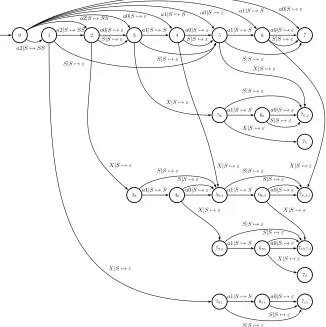
Example 8. Given a stringpref(t1) = a2 a2a0 a1 a0 a1 a0, which is a prefix
notation of tree t1 from Example 1, the corresponding nondeterministic basic nonlinear tree pattern pushdown automaton is
Mb(t1) = (Q,A ∪ {S, X},{S}, δ,0, S,∅), where its transition diagram is
illus-trated in Figure 8. ⊓⊔
5.2. Nonlinear tree pattern pushdown automaton
Some states of the pushdown automaton constructed by Algorithm 4 can be merged so that states in nondeterministic nonlinear tree pattern pushdown au-tomaton Mnntp for a subject tree t Mnntp(t) = ({0, 1, 2, . . . , n, x1, . . . , n1,
y2, . . . , n2, . . . , zm, . . . , nm},A ∪ {S, X},{S}, δ,0, S,∅)would still track both
assigned subtree and the same number of nonlinear variables read from the pattern. Merged states are those from tails with the same assigned subtree and the same number of nonlinear variables read.
Definition 6. LetMb(t) = (Q,A ∪ {S, X},{S}, δ, q0, S,∅)be a basic
nondeter-ministic nonlinear tree pattern PDA constructed by Algorithm 4. Let x be the longest string over alphabet A, where (q, x, α) ⊢∗
M b (qf, ε, β). The tree node state label tnsl(q)is definedtnsl(q) =|pref(t)| − |x|.
Algorithm 5 Algorithm for counting thetnsl.
Input: Nondeterministic basic nonlinear tree pattern pushdown automaton Mb(t)and stateqfor which thetnslis counted.
Output: Number representingtnsl.
Variables: Temporary numbern, Stateinitial.
Method:
1. n= 0.initialis the starting state ofMb(t).
2. Do:
2.1. If exists transition(q, Sarity(a))∈δ(qprev, a, S)wherea∈ Aand qpref 6=initialdo:
2.1.1. n=n+ 1,q=qprev.
0 1 2 3 4 5 6 7
a2|S7→SS
a2|S7→SS a0|S7→ε a1|S7→S a0|S7→ε a1|S7→S a0|S7→ε a2|S7→SS a0|S7→ε a1|S7→S
a0|S7→ε a1|S7→S a0|S7→ε
S|S7→ε S|S7→ε S|S7→ε
S|S7→ε S|S7→ε
S|S7→ε 71
X|S7→ε
72 X|S7→ε
56 66 76
a1|S7→S a0|S7→ε
S|S7→ε S|S7→ε X|S7→ε
75
X|S7→ε
54 64 74
a1|S7→S a0|S7→ε
S|S7→ε S|S7→ε X|S7→ε
73
X|S7→ε
38 48 58 68 78
a1|S7→S a0|S7→ε a1|S7→S a0|S7→ε
S|S7→ε S|S7→ε
S|S7→ε S|S7→ε
X|S7→ε
77
X|S7→ε
510 610 710
a1|S7→S a0|S7→ε
S|S7→ε S|S7→ε X|S7→ε
79
X|S7→ε
511 611 711
a1|S7→S a0|S7→ε
S|S7→ε S|S7→ε X|S7→ε
2.2. If exists transition (q, ε) ∈ δ(qprev, X, S)whereX is nonlinear variable
do:
2.2.1. n=n+|sst(qprev)|,q=qprev.
2.2.2. Goto step [2.]. 2.4. Outputn+ 1.
Example 9. Given a basic nondeterministic nonlinear tree pattern pushdown
automaton isMb(t1) = (Q,A ∪ {S, X},{S}, δ,0, S,∅), its transition diagram is shown in Figure 8.
Then,tnsl(3) = 3,tnsl(54) = 5,tnsl(711) = 7,tnsl(79) = 7. ⊓⊔
Definition 7. Given a basic nondeterministic nonlinear tree pattern pushdown
automatonMb(t) = (Q,A ∪ {S, X},{S}, δ,0, S,∅)created by Algorithm 4, the
number of nonlinear variable transitionsnnv(q, X)is the number of transitions
reading nonlinear variable X on the path from the initial state q0 to state q, whereqandq0∈Q.
Algorithm 6 Algorithm for counting thennv.
Input: Basic nondeterministic nonlinear tree pattern pushdown automaton Mb(t)and stateqfor which thetnslis counted.
Output: Number representingnnv.
Variables: Temporary numbern, Stateinitial.
Method:
1. n= 0.initialis the starting state ofMb(t).
2. Do:
2.1. If exists transition(q, Sarity(a))∈δ(q
prev, a, S)wherea∈ Aand qpref 6=initialdo:
2.1.1. q=qprev.
2.1.2. Goto with step [2.].
2.2. If exists transition (q, ε) ∈ δ(qprev, X, S)whereX is nonlinear variable
do:
2.2.1. n=n+ 1,q=qprev.
2.2.2. Goto with step [2.]. 2.3 Outputn.
Definition 8. Given a nondeterministic basic nonlinear tree pattern pushdown
automatonMb(t)created by Algorithm 4, the mergeable states
ms(Mb(t)) is a collection of pairs (key, value), where key is a triplet (sst(q), nnv(u, X),tnsl(u)) andvalueis a set of states.ms(Mb(t))stores sets of states
with the same number of transitions reading nonlinear variableX nnv(q, X)and subtree skipped by transitionsst(q).
ms(Mb(t)) ={(sst(qx), nnv(sa1, X), tnsl(sa1)),{sa1, sa2, . . .}),
(sst(qy), nnv(sb1, X), tnsl(sb2)),{sb1, sb2, . . .}), . . .}, where the first states1from each set is the main state. State v is sst(v)denoting state for state s1 given by (v, Xω, Sγ) ⊢ (s1, ω, γ), where ω = (A ∪ {S, X})∗. All states from that set are given by following: {∀s: nnv(s, X) = nnv(s1, X)andsst(v) = sst(u)and
Each set from the collection of sets of mergeable statesms(Mb(t))defines
states from nondeterministic basic nonlinear tree pattern pushdown automaton
Mb(t)that can be merged and the resulting automaton is called
nondetermin-istic nonlinear tree pattern pushdown automatonMnntp(t). All states from each
set defines the start of a merging process so that states that are reachable by the same sequence of transitions are also merged.
Example 10. Given a string pref(t1) = a2 a2 a0 a1 a0 a1 a0, which is the
prefix notation of tree t1 from Example 1. The corresponding nondetermin-istic basic nonlinear tree pattern pushdown automaton is Mb(t1) = (Q,A ∪ {S, X},{S}, δ,0, S,∅), where its transition diagram and states are illustrated in
Figure 8.
All states that occur in one of the set in the collectionms(Mb(t1))are target states from all transitions for a symbol X and the transitions for a symbol S
which shares the source state.
ms(Mb(t1)) ={((a0,1,5),{54,58}),((a0,1,7),{71,74,78}),
((a0,2,7),{73,77,710}),((a1a0,1,7),{72,76})}.
Algorithm 7 Construction of the nondeterministic nonlinear tree pattern
push-down automaton.
Input: Nondeterministic basic nonlinear tree pattern pushdown automaton Mb(t).
Output: Nondeterministic nonlinear tree pattern pushdown automaton Mnntp(t).
Variables: Collection of sets of statesms(Mb(t)).
Method:
1. For all transitions(u1, ε)∈δ(q, X, S)do:
1.1. If the collection ms(Mb(t)) does not contain a set on a key (sst(q), nnv(u1, X),tnsl(u1)) create that set as an empty set.
1.2. Addu1to the collectionms(Mb(t))to the set on the key
(sst(q),nnv(u1, X),tnsl(u1)).
2. For all transitions(u2, ε)∈δ(q, S, S), where exists a transition
(u1, ε)∈δ(q, X, S)do:
2.1. Ifnnv(u2, X) 6= 0and the collectionms(Mb(t))does not contain a set
on a key (sst(q),nnv(u2, X),tnsl(u2)) create that set as an empty set. 2.2. Addu2to the collectionms(Mb(t))to the set on the key
(sst(q),nnv(u2, X),tnsl(u2)).
3. For each set in the collectionms(Mb(t))do:
3.1. Merge all states in this set, along with all states that follows-up.
Example 11. Given a stringpref(t1) =a2a2a0a1a0a1a0, which is the prefix
notation of treet1 from Example 1, the corresponding nondeterministic nonlin-ear tree pattern pushdown automaton is
0 1 2 3 4 5 6 7
a2|S7→SS
a2|S7→SS a0|S7→ε a1|S7→S a0|S7→ε a1|S7→S a0|S7→ε a2|S7→SS a0|S7→ε a1|S7→S a0|S7→ε
a1|S7→S a0|S7→ε
S|S7→ε S|S7→ε S|S7→ε
S|S7→ε S|S7→ε
S|S7→ε
38 48 58,4 68,4 78,4,1
a1|S7→S a0|S7→ε a1|S7→S a0|S7→ε
S|S7→ε S|S7→ε
S|S7→ε S|S7→ε
510 610 710,7,3
a1|S7→S a0|S7→ε S|S7→ε S|S7→ε
79
56 66 76,2
a1|S7→S a0|S7→ε
S|S7→ε S|S7→ε
75
511 611 711
a1|S7→S a0|S7→ε
S|S7→ε
S|S7→ε
X|S7→ε X|S7→ε X|S7→ε
X|S7→ε
X|S7→ε
X|S7→ε
X|S7→ε
X|S7→ε X|S7→ε
X|S7→ε
Fig. 9. Nondeterministic nonlinear tree pattern pushdown automatonMnntp(t1)from
The nondeterministic nonlinear tree pattern pushdown automaton can be even minimalised by omitting the nnv(q, X)part of the key value pairs of the collectionms(Mb(t)). The resulting automaton would represent an index of the
subject tree for nonlinear tree pattern matching but would not be able to say how many nonlinear variables has been read during processing the nonlinear tree pattern.
5.3. Time and Space Complexity Analysis
Lemma 4. Time complexity of accepting the nonlinear tree template by
au-tomaton created by Algorithm 7 isO(PKki), whereKis the set of all prefixes
exceptε, andkiis the number of distinct sequences of transitions in automaton
Mnntp(t)forki∈Kwhich ends in a state of automatonMnntp.
Proof. Automata have to try all possible sequences of transitions according to
tree template which occur in the nondeterministic nonlinear tree pattern au-tomaton. Sequences of symbols of these transitions form a prefix of tree tem-plate. Prefix of the size of one symbol from tree template is handled by exactly
nsteps, wherenis the number of all possible sequences of transitions in the automaton for that prefix. Prefix of the size of two symbols is handled byn+m
steps, where m is the number of all possible sequences of transitions in the automaton for that prefix. Note that handling two symbols prefix requires two transitions to be processed, however the first transition is already accounted by prefix of size of one symbol.
Exact time complexity is then the sum of all possible sequences of tran-sitions in the automaton for all prefixes of nonlinear tree template, which is
O(PSrsi). ⊓⊔
Lemma 5. The number of states of nondeterministic nonlinear tree pattern
pushdown automatonMnntp(t)created by Algorithm 7 is
O(n(Psi=0ri)) =O(n2), wherenis the number of nodes of a subject tree and
Ps
i=0ri, where s is the number of distinct subtrees, and ri is the number of
repetitions of each subtree.
Proof. Each occurrence of each unique subtree in tree increments the
num-ber of automaton tails, that were created for this subtree. The exact numnum-ber of tails created for particular subtree is thenri, whereriis the number of
repeti-tions of that subtree. Then the total number of tails for one nonlinear variable in automaton is the number of tails created for each unique subtree of indexed tree which isPsi=0ri. The total number of tails does not count original
automa-ton. The exact number of states of the automaton for one nonlinear variable is O(n(Psi=0ri+ 1))=O(n(Psi=0ri)). ⊓⊔ Lemma 6. The number of transitions of nondeterministic nonlinear tree pattern
pushdown automatonMnntp(t)created by Algorithm 7 is
O(n2+n+Pis=0(r2i+ri
2 )) =O(n
2), wherenis the number of nodes of a subject
tree,sis the number of distinct subtrees andri is the number of repetitions of
Proof. For all tails for one nonlinear variable, there are transitions reading
sym-bolXbetween these tails. There is one transition heading to the last tail. There are two transitions heading to the previous tail, and so on. The number of tran-sitions reading symbolX isPsi=0(r2i+ri
2 ).
Using Lemma 5 the number of transitions for symbolS is12n2and the num-ber of transitions for symbola∈ Ais 12n2+n.
The number of transitions then isO(Psi=0(ri2+ri
2 ) +n
2+n). ⊓⊔
Lemma 7. Given a tree t with n nodes, the number of distinct nonlinear tree
patterns which match the treetcan be at most3n−1+ 2.
Proof. First, subtrees of any subtree of the treet can be replaced by the
spe-cial nullary symbolS and the tree template resulting from such a replacement is a tree pattern which matches the tree. Second, subtrees of any subtree of the tree t can be replaced by the special nullary symbol X and the nonlin-ear tree template resulting from such replacement is a nonlinnonlin-ear tree pattern which matches the tree. Given a tree with n nodes, the maximal number of subsets of subtrees that can be replaced by the special nullary symbol S,X
occurs for the case of a treet3whose structure is given by the prefix notation
pref(t3) = a(n−1)a10 a20. . . an−10, wheren ≥ 2. Such a tree is illustrated in Figure 6. In this tree, each of the nullary symbolsa10, a20, . . . , an−10can be replaced by nullary symbolS or X, and therefore we can create3n−1distinct tree templates which are tree patterns matching the treet3.
Third, the tree t itself and all its subtrees not containing the root are tree patterns which match the tree. Subtrees of the treetmust be the same so that the nonlinear tree pattern matched the tree in the first place. These gives 2
other distinct tree patterns.
Thus, the total number of distinct tree patterns matching the treetcan be at
most3n−1+ 2. ⊓⊔
6.
Processing more nonlinear variables in nonlinear tree
patterns
Indexing for nonlinear tree pattern matching with more than one nonlinear vari-able can be done by a pushdown automaton created as a pushdown automaton for the intersection of languages. Automaton for two nonlinear variables would be constructed on the basis of two automata – each of them for one nonlinear variable. The disadvantage of this approach would be increasing space com-plexity.
Another approach is represented by a nondeterministic nonlinear tree pat-tern pushdown automatonMnntp(t)for one nonlinear variable that can be used
Example 12. Consider a ranked alphabetA = {a4, a3, a2, a1, a0}. Consider a nonlinear tree templatep4overA ∪ {S, Y, Z}p4= ({a41, X2, X3, Y4, Y5}, Rp4) overA, whereRp4is a set of the following ordered pairs:
Rp4={(a41, X2),(a41, X3),(a41, Y4),(a41, Y5)}. Nonlinear tree templatep4is illustrated in Figure 10.
a41
Z2 Z3 Y4 Y5
Fig. 10. Nonlinear tree templatep4from Example 12
Nonlinear tree templatep4 can be decomposed to nonlinear tree templates for one nonlinear variable. These nonlinear tree templates will be over alphabet
A ∪ {S, X}and are illustrated in Figure 11. ⊓⊔
a41
X2 X3 S4 S5
a41
S2 S3 X4 X5
Fig. 11. Decomposition of nonlinear tree templatep4from Example 12
In the beginning the algorithm decomposes a given nonlinear tree template to nonlinear tree templates of one nonlinear variable. Then, the accepting se-quences of transitions are computed using nondeterministic nonlinear tree pat-tern pushdown automatonMnntp(t)and each decomposed nonlinear tree
pat-tern. These accepting sequences of transitions can be used for filtering real occurrences out of the original tree template for more nonlinear variables.
Algorithm 8 Algorithm of nonlinear tree pattern matching with more nonlinear
variables using nondeterministic nonlinear tree pattern pushdown automaton
Mnntp(t)
Input: Nondeterministic nonlinear tree pattern pushdown automaton
Mnntp(t). Nonlinear tree pattern with more variables p, set vars of variables
used in the templatep.
1. Collection of nonlinear templates for one variablepois an empty collection. 2. For each variablevarinvarsdo:
2.1. pdis a clone of nonlinear tree templatep.
2.2. Change a symbol in leaf nodes to nullary symbolS, where node label
l∈(vars\var).
2.3. Change a symbol in leaf nodes to nullary symbol of nonlinear variable
X, where node labell=var. 2.4. Addpdtopo.
3. SetOcccontains{0,1, . . . , n}wherenis the size of the treet. 4. For each nonlinear tree templatepdinpodo:
4.1. Determine accepting sequences of transitionstsof tree templatetusing
Mnntp(t).
4.2. Compute a setOccpd as set oftnsl(q), whereqis a target state of the
first transition from allts.
4.2. Remove all items inOccwhich are not inOccpd.
5. OutputOcc.
6.1. Time and Space Complexity Analysis
Lemma 8. Time complexity of accepting the nonlinear tree template for more nonlinear variables by nondeterministic nonlinear tree pattern pushdown
au-tomaton isO(v×m+Prun(pd) +POccpd), wherev is the number of
non-linear variables,mis the size of the nonlinear template,run(pd)is the time of
locating all accepting transition sequences of each of decomposed templates
pdin automatonMnntp(t)andOccpd is the size of occurrences of decomposed
templatepd.
Proof. The nonlinear tree template needs to be decomposed to nonlinear tree
templates for one nonlinear variable. This takesv×mtime.
Occurrences of each nonlinear tree template from decomposed nonlinear tree templatepare computed in timePrun(pd).
Composition of partial occurrencesOccpd to Occ can be done in POccpd
time. ⊓⊔
Lemma 9. Given a tree t with n nodes, the number of distinct nonlinear tree
patterns (with more nonlinear variables) which match the treetcan be at most
(2 +v)n−1+ 2.
Proof. First, subtrees of any subtree of the treetcan be replaced by the special
nullary symbolS and the tree template resulting from such a replacement is a tree pattern which matches the tree. Second, subtrees of any subtree of the tree
tcan be replaced by the special nullary symbols of variables and the nonlinear tree template resulting from such replacement is a nonlinear tree pattern which matches the tree. Given a tree withnnodes, the maximal number of subsets of subtrees that can be replaced by the special nullary symbols of variables occurs for the case of a treet3whose structure is given by the prefix notation
in Figure 6. In this tree, each of the nullary symbolsa10, a20, . . . , an−10can be replaced by nullary symbol of variables and therefore we can create(2 +v)n−1 distinct tree templates which are tree patterns matching the treet3.
Third, the tree t itself and all its subtrees not containing the root are tree patterns which match the tree. Subtrees of the treetmust be the same so that the nonlinear tree pattern matched the tree in the first place. These gives 2
other distinct tree patterns.
Thus, the total number of distinct tree patterns matching the treetcan be at
most(2 +v)n−1+ 2. ⊓⊔
7.
Some empirical results
We have implemented the nondeterministic tree pattern pushdown automaton and the nonlinear tree pattern pushdown automaton using the bit-parallelism technique, which was introduced in [27]. For our implementations of transitions reading symbols from A we use the same approach as it is used in the im-plementation of nondeterministic string suffix automata in [23]. The transitions reading the special variable nullary symbols must be treated in a special way. When processing these nullary symbols the algorithm takes indexes of each one in configuration bit vector of the bit–parallelism simulation and recompute these indexes according to transitions reading variable symbols in the simulated automaton. A unique id of subtree is stored for each location in the bit vector so that the matching of nonlinear tree patterns is possible.
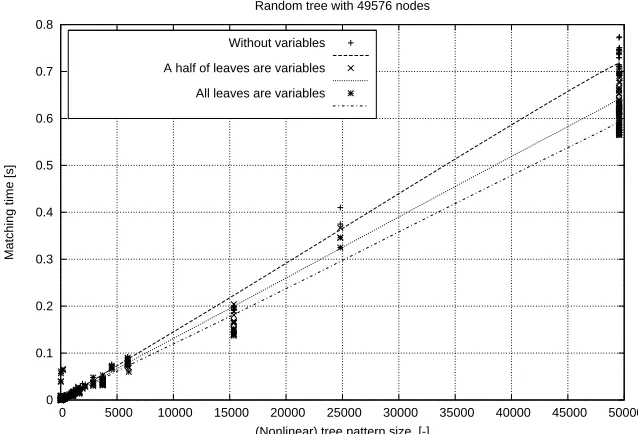
Our implementations were written in Java programming language; all tim-ings were conducted on a 2 GHz Intel Core i7 with 8 GB of RAM running Open-SUSE GNU/Linux version 12.1 and Java 1.6.0. In Figures 12, 13, and 14, it is shown that the running time for a given tree is linear with the size of the input (nonlinear) tree pattern. In Figures 15, 16, and 17, it is shown that the running time for binary trees is also linear in general but for very small input patterns there is a slowdown caused by recomputing the configuration vector of bit–parallelism for nullary variable symbols.
8.
Conclusion
We have presented the tree pattern pushdown automaton and the nonlinear tree pattern pushdown automaton, a new kind of pushdown automata which represent a complete index of a given ordered tree for tree patterns and non-linear tree patterns, respectively. We have discussed the time and space com-plexities and have shown timings of our implementations using the bit-parallel technique. The timings are similar to those for the existing bit-parallel imple-mentation of nondeterministic string suffix automata.
0 0.1 0.2 0.3 0.4 0.5 0.6 0.7 0.8
0 5000 10000 15000 20000 25000 30000 35000 40000 45000 50000
Matching time [s]
(Nonlinear) tree pattern size [-] Random tree with 49576 nodes
Without variables
A half of leaves are variables
All leaves are variables
Fig. 12. Random tree with 49576 nodes
0 0.5 1 1.5 2 2.5 3 3.5
0 20000 40000 60000 80000 100000 120000
Matching time [s]
(Nonlinear) tree pattern size [-] Random tree with 107732 nodes
Without variables
A half of leaves are variables
All leaves are variables
0 1 2 3 4 5 6
0 20000 40000 60000 80000 100000 120000 140000 160000
Matching time [s]
(Nonlinear) tree pattern size [-] Random tree with 146074 nodes
Without variables
A half of leaves are variables
All leaves are variables
Fig. 14. Random tree with 146074 nodes
0 0.05 0.1 0.15 0.2 0.25 0.3 0.35 0.4 0.45
0 5000 10000 15000 20000 25000 30000 35000
Matching time [s]
(Nonlinear) tree pattern size [-] Full binary tree with 32767 nodes
Without variables
A half of leaves are variables
All leaves are variables
0 0.2 0.4 0.6 0.8 1 1.2 1.4 1.6
0 10000 20000 30000 40000 50000 60000 70000
Matching time [s]
(Nonlinear) tree pattern size [-] Full binary tree with 65535 nodes
Without variables
A half of leaves are variables
All leaves are variables
Fig. 16. Full binary tree tree with 65535 nodes
0 0.5 1 1.5 2 2.5 3
0 10000 20000 30000 40000 50000 60000 70000
Matching time [s]
(Nonlinear) tree pattern size [-] Full binary tree with 131071 nodes
Without variables
A half of leaves are variables
All leaves are variables
References
1. Aho, Alfred V.; Margaret J. Corasick: Efficient string matching: An aid to bibliographic search. In: Communications of the ACM, 18 (6), pp. 333340, 1975.
2. Alfred V. Aho and Jeffrey D. Ullman. The theory of parsing, translation, and compil-ing. Prentice-Hall Englewood Cliffs, N.J., 1972.
3. Arbology www pages, Available at: http://www.arbology.org, June 2012.
4. Blumer, A., Blumer, J., Haussler, D., Ehrenfeucht, A., Chen, M. T., Seiferas, J. I., 1985. The smallest automaton recognizing the subwords of a text. Theor. Comput. Sci. 40, 31–55.
5. Christou, M., Crochemore, M., et al., 2011. Computing All Subtree Repeats in Or-dered Ranked Trees. In String Processing and Information Retrieval, Vol. 7024, pp. 338-343.
6. L.G.W.A. Cleophas: Tree Algorithms: Two Taxonomies and a Toolkit. PhD Thesis, Department of Mathematics and Computer Science, Eindhoven University of Tech-nology, Eindhoven, April 2008.
7. Crochemore, M., 1986. Transducers and repetitions. Theor. Comput. Sci. 45 (1), 63–86.
8. H. Comon, M. Dauchet, R. Gilleron, C. L ¨oding, F. Jacquemard, D. Lugiez, S. Ti-son, and M. Tommasi. Tree automata techniques and applications. Available on: http://www.grappa.univ-lille3.fr/tata, 2007. release October, 12th 2007.
9. Crochemore, M., Hancart, C., 1997. Automata for matching patterns. In: Rozenberg, G., Salomaa, A. (Eds.), Handbook of Formal Languages. Vol. 2 Linear Modeling: Background and Application. Springer–Verlag, Berlin, Ch. 9, pp. 399–462.
10. Crochemore, M., Rytter, W., 1994. Jewels of Stringology. World Scientific, New Jer-sey.
11. Domenico Cantone, Simone Faro and Emanuele Giaquinta: A Compact Represen-tation of Nondeterministic (Suffix) Automata for the Bit-Parallel Approach, In: CPM 2010, LNCS 6129, Springer, Berlin, 2010.
12. Toms Flouri, Jan Janousek, Borivoj Melichar, Costas S. Iliopoulos, Solon P. Pissis: Tree Template Matching in Ranked Ordered Trees by Pushdown Automata. In: CIAA 2011, LNCS 6807, Springer, Berlin, pp. 273-281, 2011.
13. Olivier Gauwin, Joachim Niehren: Streamable Fragments of Forward XPath. In: CIAA 2011, LNCS 6807, Springer, Berlin, pp. 3-15, 2011.
14. F Gecseg and M. Steinby. Tree languages. In G. Rozenberg and A. Salomaa, edi-tors, Handbook of Formal Languages, volume 3 Beyond Words. Handbook of For-mal Languages, pages 1–68. Springer–Verlag, Berlin, 1997.
15. Christoph M. Hoffmann and Michael J. O’Donnell. Pattern matching in trees. J. ACM, 29(1):68–95, 1982.
16. Hopcroft, J. E., Motwani, R., Ullman, J. D., 2001. Introduction to automata theory, languages, and computation, 2nd Edition. Addison-Wesley, Boston.
17. J. W. Klop. Term Rewriting Systems, Handbook of Logic in Computer Science, 1992. 18. Janousek, J. String Suffix Automata and Subtree Pushdown Automata. In: Proceed-ings of the Prague Stringology Conference 2009, pp. 160–172, Czech Technical University in Prague, Prague, 2009.
19. Janousek, J.: Arbology: Algorithms on Trees and Pushdown Automata. Habilitation thesis, TU FIT, Brno, 2010.
21. Melichar, B. Arbology: Trees and pushdown automata. In: LATA 2010 (LNCS 6031), invited paper, pp. 32-49, Springer, 2010.
22. Melichar, B., Holub, J., Polcar, J., 2005. Text searching algorithms. Available at: http://stringology.org/athens/, release November 2005.
23. Gonzalo Navarro, Mathieu Raffinot: A Bit-Parallel Approach to Suffix Automata: Fast Extended String Matching. In: CPM, LNCS 1448, Springer, Berlin, pp. 14-33, 1998. 24. R. Ramesh, I. V. Ramakrishnan. Nonlinear Pattern Matching in Trees, Journal of the
Association for Computing Machinery, Vol 39, No 2, April 1992.
25. Smyth, B., 2003. Computing Patterns in Strings. Addison-Wesley-Pearson Educa-tion Limited, Essex, England.
26. Travnicek, J. , Janousek, J., Melichar, B. Nonlinear Tree Pattern Pushdown Au-tomata. InProceedings of the FEDCSIS 2011, IEEE Computer Society Press, pp. 871-878, 2011.
27. R. Baeza-Yates and G. H. Gonnet. A new approach to text searching. In: Commun. ACM, 35(10), pp. 7482, 1992.
Jan Tr ´avn´ıˇcek has been a PhD student at the Department of Theoretical
Com-puter Science, Czech Technical University in Prague, Faculty of Information Technology. His research interests are focused on algorithms on trees (Arbol-ogy).
Jan Janou ˇsek has been an associate professor at the Department of
Theoret-ical Computer Science, Czech TechnTheoret-ical University in Prague, Faculty of Infor-mation Technology. His research interests include algorithms on trees (Arbol-ogy), parsing algorithms, compiler construction, attribute grammars and formal languages and automata theory.
Borivoj Melichar has been a full professor at the Department of Theoretical
Computer Science, Czech Technical University in Prague, Faculty of Informa-tion Technology. His research interests include algorithms on strings (Stringol-ogy), algorithms on trees (Arbol(Stringol-ogy), parsing algorithms and compiler construc-tion.