Long Distance Face Recognition for Enhanced
Performance of Internet of Things Service Interface
Hae-Min Moon1 and Sung Bum Pan2
1 Dept. of Information and Communication Engineering, Chosun University,
375 Seoseok-dong, Dong-gu, Gwangju, Republic of Korea [email protected]
2 Dept. of Electronics Engineering, Chosun University,
375 Seoseok-dong, Dong-gu, Gwangju, Republic of Korea [email protected]
Abstract. As many objects in the human ambient environment are intellectualized and networked, research on IoT technology have increased to improve the quality of human life. This paper suggests an LDA-based long distance face recognition algorithm to enhance the intelligent IoT interface. While the existing face recognition algorithm uses single distance image as training images, the proposed algorithm uses face images at distance extracted from 1m to 5m as training images. In the proposed LDA-based long distance face recognition algorithm, the bilinear interpolation is used to normalize the size of the face image and a Euclidean Distance measure is used for the similarity measure. As a result, the proposed face recognition algorithm is improved in its performance by 6.1% at short distance and 31.0% at long distance, so it is expected to be applicable for USN’s robot and surveillance security systems.
Keywords: IoT, USN, surveillance, long distance face recognition.
1.
Introduction
mobile robot in a Ubiquitous Sensor Network (USN) or in a Smart Home environment recognizes family members and acts. Also the intelligent surveillance system continues to monitor the surveillance status and the acquired information may be provided to humans anytime and anywhere through network services. These technologies are implemented using actual IoT service interface and the IoT service interface plays the role of sensing, process/extracting/handling, storage, judgment, situational awareness, recognition, security, and human awareness of information [3], [4].
The purpose of this paper is to enhance the IoT service interface for uses human awareness by enhancing face recognition used in mobile robots and intelligent surveillance systems. Face recognition has a relatively lower recognition rate than fingerprint and iris recognition but because faces can be recognized from non-contact/non-cooperative environments and long distances, research studies on long distance human recognition using the face are currently underway [5], [6], [7]. Generally, the face recognition method is highly dependent on the quality of images obtained from the image sensor, so face recognition performance excels in short distance versus long distance. However, since the existing Linear Discriminant Analysis (LDA)-based face recognition technology works in short distance environment, if mobile robot or intelligent surveillance system of USN are applied literally to mobile robot or intelligent surveillance system, satisfactory service can’t be expected. In order to provide seamless IoT service, it is necessary to have long distance face recognition technology that can recognize the target from various distances as well as at a short distance.
Therefore, this paper proposes a long distance face recognition algorithm that is applicable to mobile robots and intelligent surveillance systems. While the existing face recognition algorithm uses single distance image as training images, the proposed algorithm uses face images extracted from 1m to 5m as user training images. For face images at a distance of 1m to 5m, the size of face images extracted by distance is different, so it is normalized to the same size of face images using bilinear interpolation. In addition, Euclidean Distance measure is used for similarity measure. As a result, the face recognition rate of existing LDA-based face recognition was 85.8% in short distance and 44.0% in long distance, but the proposed face recognition method showed improved performance of 6.1% and 31.0%, respectively, for 91.9% in short distance and 75.0% in long distance. This paper is organized as follows. Section 2 introduces the concept of IoT service, face recognition technique and interpolation. Section 3 describes the proposed long distance face recognition algorithm and Section 4 analyzes the experiment results. Finally, Section 5 concludes the paper.
2.
Background and Related Work
2.1. Concept of Internet of Things for Service Interface
various ambient objects are participating in the internet [8], [9], [10]. The definition of IoT can be generally divided into: Internet-based definition, Semantic- based definition and object-based definition. Firstly, the internet-based IoT definition is focused on network construction to therefore be able to connect with any objects, anywhere, and anyone such as the International Telecommunication Union (ITU) [11], [12]. Currently, the world is changing such that internet-based IoT is connecting a number of surrounding objects including mobile internet, Radio Frequency Identification (RFID), and sensor network and the objects are communicating with each other autonomously [13]. Secondly, the semantic-based definition is approaching IoT from the point of view of how to express, store, search and systemize many objects that will be included in IoT and the information which is produced from these objects [14], [15], [16]. Lastly, the RFID international standard organization, Global Standard 1 (GS1)/ Electronic Product Code (EPC) global defined IoT for the first time based on objects having the sole identifier-EPC. This made it possible to have object recognition and global location tracking by attaching a RFID tag with EPC to objects by reading these codes in real time through RFID readers installed all over the world and by storing and managing that information in IoT infrastructure distributed system [17]. Based on this, it is possible to: monitor and manage object information, which is part of IoT in real time and have various IoT services through a standardized interface. Recently, advances moving beyond simple identification studies are underway to provide various and intelligent IoT services through the development of an advanced interface including situation recognition and human recognition [3], [18], [19].
2.2. Algorithms of Face Recognition
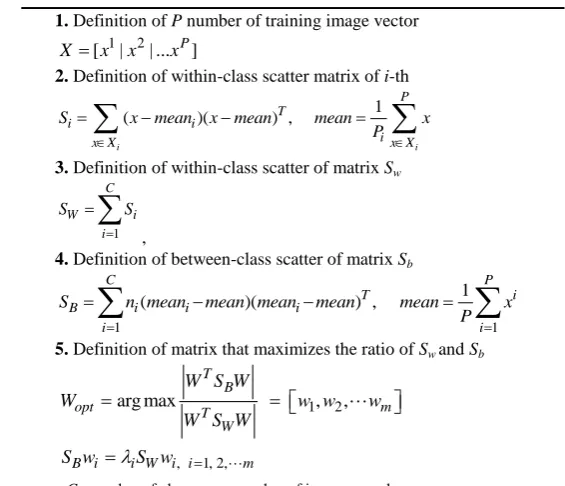
Face recognition technology is examined in various studies ranging from still image-based face recognition in a controlled environment to video image-image-based face recognition from a crowded environment [20], [21], [22]. In this paper, we utilized LDA, which uses a feature extraction method using basis vector. In order to express two-dimensional face images, face shape and texture information are vectorized. For face shape information, physiographic features like the distance and ratio of face elements such as eye, nose and mouth are used. Texture information is expressed as brightness information itself in the face area. By arraying the brightness value of two dimensional face images in order, features are extracted by expressing one-dimensional vector. The feature extraction process in face recognition is to find the base vector for linear transition. LDA is to find the basis vector which reduces the scatter within the class and increases the distance between averages of each class [23], [24]. LDA use face images as a feature vector for face recognition by reflecting the face images to the basis vector.
Table 1. Training process of LDA technique
1. Definition of P number of training image vector
1 2 [ | | ... ]
P
X x x x
2. Definition of within-class scatter matrix of i-th 1 ( )( ) , i i P T i i i
x X x X
S x mean x mean mean x
P
3. Definition of within-class scatter of matrix Sw
1 C W i i S S
,4. Definition of between-class scatter of matrix Sb
1 1
1
( )( ) ,
C P
T i
B i i i
i i
S n mean mean mean mean mean x
P
5. Definition of matrix that maximizes the ratio of Sw and Sb
1 2
, 1, 2,
arg max , ,
T B
opt T m
W
B i i W i i m W S W
W w w w
W S W
S w S w
- C : number of classes, ni : number of images per class
Table 2. Recognition process of LDA technique
1. Definition of P number of recognition image vector
1 2 [ | | ... P]
Y y y y
2. Difference of each image vector and average image vector
1 1 ,
P
i i i
i
y y mean mean y
P
3. Definition of feature vector for recognition image using Wopt
i i opt
y W y
2.3. Interpolations for Image Normalization
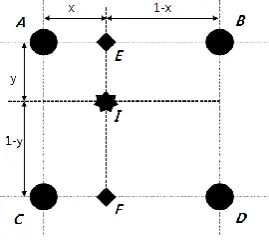
proportional to the distance from each of the adjacent pixels. Figure 1 shows the bilinear interpolation using one-dimensional linear interpolation. To find the interpolated pixel I, bilinear interpolation is performed using the values of the adjacent four pixels (A, B, C and D). The bilinear interpolation provides a better image than nearest neighbor interpolation but it increases the computational complexity and the edge parts are not as smooth.
Fig. 1. Bilinear interpolation
Interpolation using a higher-order polynomial equation defines the function of weighted value and is a method to calculate the pixel values by adding all the values of neighboring pixel values of original images multiplied by weighted values. The representative method using a higher-order polynomial equation and includes cubic convolution interpolation [26]. Figure 2 shows the process of performing the two-dimensional cubic convolution interpolation using one-two-dimensional cubic convolution interpolation. Bicubic convolution interpolation produces new interpolated pixels using 16 pixels of original images. After four rounds of cubic convolution interpolation in the vertical direction as shown in Figure 2(a), four interpolated pixels (P0, P1, P2 and P3) are produced. Using the newly produced four interpolated pixels, when the cubic convolution interpolation is performed once horizontally, the final interpolated pixel I is produced as shown in Figure 2(b). Bicubic convolution interpolation refers to more pixels than bilinear interpolation so its image quality is good but it requires more computational complexity
(a) Vertical interpolation (b) Horizontal interpolation
3.
Proposed Long Distance Face Recognition System
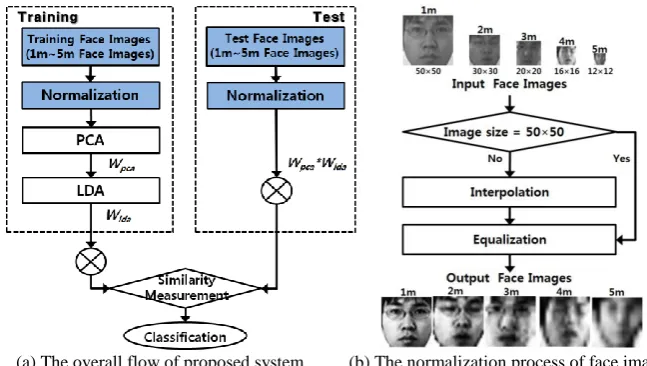
Figure 3 is the flowchart of the proposed LDA-based long distance face recognition. Figure 3(a) shows the overall flow and Figure 3(b) presents the normalization process of face images being entered. The overall flow of the face recognition algorithm is the same as in existing face recognition algorithm. However, it has a difference in that the proposed algorithm uses face images at a distance of 1m to 5m as training images and adds a normalization process for face images based on distance.
(a) The overall flow of proposed system (b) The normalization process of face images
Fig. 3. Long distance face recognition flowchart using LDA
The training process using face images from a distance is as follows. If face images at a distance of 1m to 5m are entered, the average face vector of the normalized face image is calculated through a normalization process. After calculating the difference of average face vectors in each face image, then find the covariance matrix. After finding the eigenvector and eigenvalue from the determined covariance matrix, finally Wpca is generated. Wpca generated through PCA is optimized by LDA again. To find Wlda which is the data that the ratio of between-class scatter and within-class scatter in LDA is maximal. The test process of using face images from 1m to 5m distances is as follows. When the face image from 1m to 5m distances is entered, it is normalized through a normalization process. From the normalized face images, feature vectors are extracted through a difference of average face image vector and Wlda projection. Finally, after comparing the feature vectors in the test area and the training areas, the face image that has the most similar value is classified.
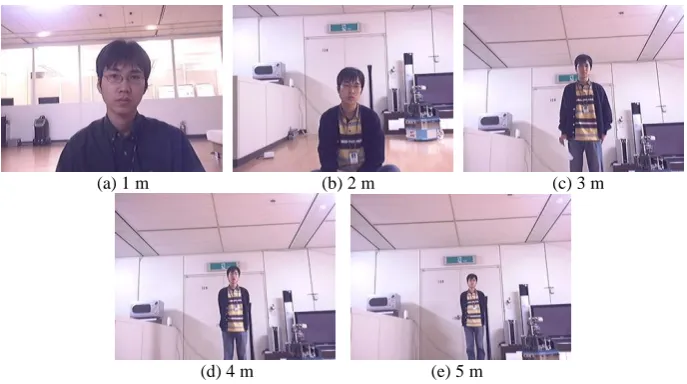
to 5m. The sizes of extracted face images are 50×50, 30×30, 20×20, 16×16 and 12×12 from 1m to 5m, respectively. The face images extracted by distance are normalized by four kinds of interpolation as shown in Figure 5.
(a) 1 m (b) 2 m (c) 3 m
(d) 4 m (e) 5 m
Fig. 4. Examples of original images at increasing distances
(a) 1m (b) 2m (c) 3m (d) 4m (e) 5m
Fig. 5. Examples of extracted face image at increasing distances
4.
Experiment Result
Table 3. ETRI face database
Total persons : 10
Environment of obtained face images - various lighting change
- 1m~5m distance change - face position change
Face image size
- 1m : 50×50 2m : 30×30 3m : 20×20 4m : 16×16 5m : 12×12
The number of total obtained face images : 5000 images
Obtained face images per a person : 500 images
Table 4. Face recognition experiment according training images
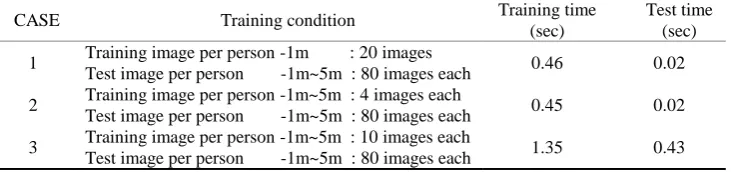
CASE Training condition Training time (sec)
Test time (sec)
1 Training image per person -1m : 20 images
Test image per person -1m~5m : 80 images each 0.46 0.02
2 Training image per person -1m~5m : 4 images each
Test image per person -1m~5m : 80 images each 0.45 0.02
3 Training image per person -1m~5m : 10 images each
Test image per person -1m~5m : 80 images each 1.35 0.43
4.1. Face Recognition Rate Changes according to Interpolations
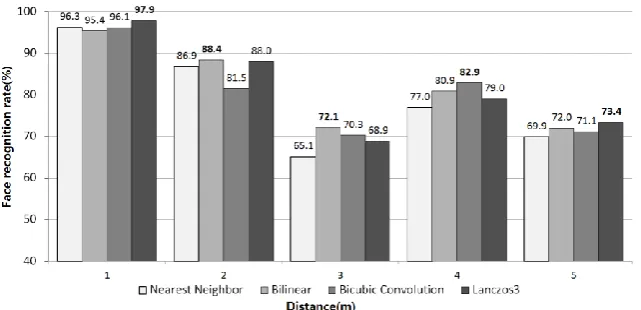
This experiment was carried out using Table 4 in order to find appropriate interpolations for the proposed algorithm. LDA was used as the face recognition method and Euclidean Distance was used for similarity measure. For normalization of the face image size by distance of 1m to 5m, the nearest neighbor, bilinear, bicubic convolution and Lanczos3 interpolations were used [28].
for test images, each of 80 face images by 1m to 5m distances was used. As a result, when bilinear interpolation was used the face recognition was 93.8%, which showed the best face recognition performance. In long distance, the face recognition performance was excellent for 78.54% when nearest neighbor interpolation was used.
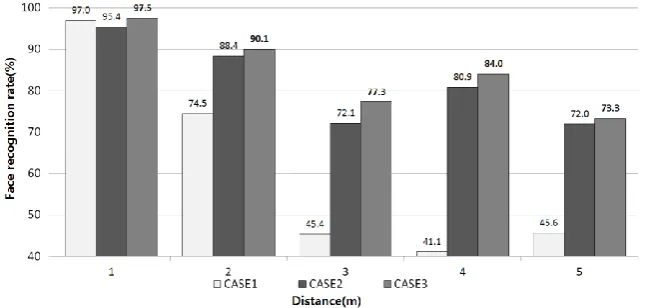
As a result, when the short distance face image is used as training, it is better to use Lanczos3 at the image normalization method in LDA-based face recognition. However, when using the face images at 1m to 5m distances as training, the face recognition performance was the best using the bilinear interpolation. When comparing CASE 1 and CASE 2 results, it was confirmed that it had better performance when using face images at 1m to 5 m distances than that of short distances. In addition, according to CASE 2 and CASE 3 results, as the number of training images per person increased, the recognition performance was improved. CASE 3 has better performance than CASE 2 but 50 pages of the training images per person are not used for general face recognition, so in this paper, the CASE 2 condition was considered.
Fig. 6. Face recognition rate of CASE 1 according to interpolations
Fig. 8. Face recognition rate of CASE 3 according to interpolations
Fig. 9. Face recognition rate according to training images
4.2. Face Recognition Rate Change according to the Configuration of Training Images
75.0%. Consequentially, when the same number of training images was used, the face recognition rate was improved if multi-distance face images were used rather than single distance face images.
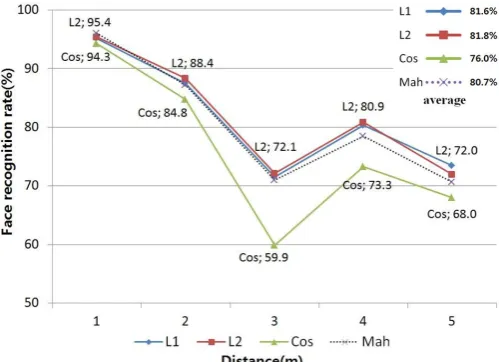
Fig. 10. LDA-based face recognition rate according to similarity measure
4.3. Face Recognition Rate Change according to Similarity Measure
Through this experiment, when the face images at 1m to 5m distances were used, the similarity measure that is appropriate to long distance face recognition is proposed. The configuration of training images were like in CASE 2 and LDA was used for the face recognizer. Bilinear interpolation was used as image normalization method. For similarity measure, Manhattan Distance (L1), Euclidean Distance (L2), Cosine Similarity (Cos), and Mahalanobis Distance (Mah) distance scale method were used [29]. Figure 10 shows the face recognition rate of LDA-based face recognition according to similarity measure. As a result, L2 was used for short distance and it showed the best performance at 91.9%. In long distance, L1 and L2 showed similar performance at 75.1% and 75%, respectively. The overall average face recognition rate of 1m to 5m were 81.6%, 81.8%, 76.0% and 80.7% respectively when using L1, L2, Cos and Mah and the recognition rate of L2 was the best. Consequently, in LDA-based long distance face recognition when multi-distance images were used as training, the face recognition performance was the best when the Euclidean Distance (L2) similarity measure was used.
5.
Conclusion
This paper proposes a long distance face recognition algorithm, which is applicable as an USN or MSM service-based technology. Face recognition, which has used the existing single distance face images as training images, has the disadvantage of lower recognition rate as the distance between the surveillance camera and the user increases. In this paper, an LDA-based long distance face recognition algorithm appropriate to the environment of the surveillance camera is proposed. Face images at distance were used in a proposed face recognition algorithm and the low resolution images at distance were normalized using a bilinear interpolation. For the similarity measure, Euclidean Distance measure method was used. A major result of this experiment showed that the proposed face recognition algorithm had improved face recognition rate for 6.1% in short distance and for 31.0% in long distance compared to the LDA-based face recognition using existing short distance face images.
In future, the proposed algorithm will be developed into a structure that is able to use minimization and low power processing of the proposed algorithm suitable for an object communication service environment. Additionally, technologies that can protect personal information effectively used in human recognition received on a mobile robot or terminal device will be developed.
Acknowledgments.This research was supported by a Basic Science Research Program through the National Research Foundation of Korea (NRF) funded by the Ministry of Education, Science and Technology (2011-0023147)
References
1. Strategy, I.T.U., Unit, P.: ITU Internet Reports 2005: The Internet of Things, International Telecommunication Union, Geneva. (2005)
2. Gonzalez-Miranda, S., Alcarria, R., Robles, T., Morales, A., Gonzalez, I., Montcada, E: An IoT-leveraged Information System for Future Shopping Environments. IT Convergence Practice, Vol. 1, No. 3, 49–65. (2013)
3. Sundmaeker, H., Guillemin, P., Friess, P., Woelfflé, S.: Vision and Challenges for Realising the Internet of Things. CERP-IoT–Cluster of European Research Projects on the Internet of Things, 1–230. (2010)
4. Perera, C., Zaslavsky, A., Christen, P., Georgakopoulos, D.: Context Aware Computing for the Internet of Things: a survey. IEEE Communications Surveys & Tutorials, Vol. 16, No. 1, 414–455. (2014)
5. Moon, H.M., Pan, S.B.: A New Human Identification Method for Intelligent Video Surveillance System. In Proceedings of 19th International Conference on Computer Communication and Networks, Zurich, Switzerland, 1–6. (2010)
6. Tsai, H.C., Wang, W.C., Wang, J.C., Wang, J.F.: Long Distance Person Identification using Height Measurement and Face Recognition. In Proceedings of 2009 IEEE Region 10 Conference, Singapore, 1–4. (2009)
7. Yao, Y., Abidi, B., Kalka, N.D., Schmid, N., Abidi, M.: High Magnification and Long Distance Face Recognition: Database Acquisition, Evaluation, and Enhancement. In Proceeding of 2006 Biometrics Symposium: Special Session on Research at the Biometric Consortium Conference, Baltimore, Maryland, 1–6. (2006)
9. Gershenfeld, N., Krikorian, R., Cohen, D.: The Internet of Things. Scientific American, Vol. 291. No. 4, 76–81. (2004)
10. Ashton, K.: That ‘Internet of things’ Thing, RFID Journal, Vol. 22, 1–6. (2009) 11. ITU.: http://www.itu.int/en/ITU-T/techwatch/Pages/internetofthings.aspx 12. IPSO.: http://ipso-alliance.org/about
13. Weinstein, R.: RFID: A Technical Overview and Its Application to the Enterprise. IT Professional, Vol. 7, No. 3, 27–33. (2005)
14. Toma, I., Simperl, E., Hench, G.: A Joint Roadmap for Semantic Technologies and the Internet of Things. In Proceeding of 3rd STI Roadmapping Workshop, Helsinki, Greece. (2009)
15. Katasonov, A., Kaykova, O., Khriyenko, O., Nikitin, S., Terziyan, V.: Smart Semantic Middleware for the Internet of Things. In Proceedings of the Fifth International Conference on Informatics in Control, Automation and Robotics, Robotics and Automation, Madeira, Portugal. (2008)
16. Song, Z., Cárdenas, A.A., Masuoka, R.: Semantic Middleware for The Internet of Things. Internet of Things, 1–8. (2010)
17. San Jose, J.I., de Dios, J.J., Zangroniz, R., Pastor, J.M.,: WebServices Integration on An RFID-based Tracking System for Urban Transportation Monitoring. IT Convergence Practice, Vol. 1, No. 4, 1–23. (2013)
18. Miorandi, D., Sicari, S., Pellegrini, F.D., Chlamtachm, I.: Internet of Things: Vision, Applications and Research Challenges. Ad Hoc Networks, Vol. 10, No. 7, 1497–1516. (2012)
19. Domingo, M.C.: An Overview of the Internet of Things for People with Disabilities. Journal of Network and Computer Applications, Vol. 35, No. 2, 584–596. (2012)
20. Wiskott, L., Fellous, J.M., Kr¨uger, N., von der Malsburg, C.: Face Recognition by Elastic Bunch Graph Matching. IEEE Transactions on Pattern Analysis and Machine Intelligence, Vol. 19, No. 7, 775–779. (1997)
21. Chellappa, R., Wilson, C.L., Sirohey, S.: Human and Machine Recognition of Faces: A Survey. Proceedings of IEEE, Vol. 83, No. 5, 705–741. (1995)
22. Zhao, W., Chellappa, R., Phillips, P.J., Rosenfeld, A.: Face Recognition: a Literature Survey. ACM Computing Surveys, Vol. 35, 399–458. (2003)
23. Turk, M., Pentland, A.: Eigenfaces for Recognition. Journal of Cognitive Neuroscience, Vol. 3, No. 1, 71–86. (1991)
24. Belhumeur, P., Hespanha, J., Kriegman, D.: Eigenfaces vs. Fisherfaces: Recognition using Class Specific Linear Projection. IEEE Transactions on Pattern Analysis and Machine Intelligence, Vol. 19, No. 7, 771–720. (1999)
25. Parker, J.A. , Kenyon, R.V., Troxel, D.E.: Comparison of Interpolating Methods for Image Resampling. IEEE Transactions on Medical Imaging, Vol. 2, No. 1, 31–39. (1983)
26. Keys, R.G.: Cubic Convolution Interpolation for Digital Image Processing. IEEE Transactions on Acoustic, Speech, and Signal Processing, Vol. asp-29, No. 6, 1153–1160. (1981)
27. Kim, D.H., Lee, J.Y., Yoon, H.S., Cha, E.Y., A Non-Cooperative User Authentication System in Robot Environments. IEEE Transactions on Consumer Electronics, Vol. 53, No.2, 804–810. (2007)
28. Duchon, C.E.: Lanczos Filtering in One and Two Dimensions. Journal of Applied Meteorology, Vol. 18, No. 8, 1076–1022. (1979)
Hae-Min Moon received the B.S. degree in Control, Instrumentation, and Robot Engineering in 2009 from Chosun University, Gwangju, Korea. He received the M.S. degrees in Information and Communication Engineering in 2010 from Chosun University, Gwangju, Korea. He is currently working toward the Ph.D. degree. His research interests include image interpolation, video surveillance, and video compression.
Sung Bum Pan is the corresponding author of this paper. He received the B.S., M.S., and Ph.D. degrees in Electronics Engineering from Sogang University, Korea, in 1991, 1995, and 1999, respectively. He was a team leader at Biometric Technology Research Team of ETRI from 1999 to 2005. He is now professor at Chosun University. His current research interests are biometrics, security, and VLSI architectures for real-time image processing.