An Efficient Wormhole Attack Detection Method in
Wireless Sensor Networks
Guowei Wu1, Xiaojie Chen1, Lin Yao1, Youngjun Lee2, and Kangbin Yim2
1 School of Software, Dalian University of Technology, Dalian, 116620 China
[email protected], [email protected], yaolin [email protected] 2
Dept. of Information Security Engineering, Soonchunhyang University, Asan, 336-745 Korea
[email protected], [email protected]
Abstract. Wireless sensor networks are now widely used in many areas, such as military, environmental, health and commercial applications. In these environments, security issues are extremely important since a successful attack can cause great damage, even threatening human life. However, due to the open nature of wireless communication, WSNs are liable to be threatened by various attacks, especially de-structive wormhole attack, in which the network topology is completely destroyed. Existing some solutions to detect wormhole attacks require special hardware or strict synchronized clocks or long processing time. Moreover, some solutions can-not even locate the wormhole. In this paper, a wormhole attack detection method is proposed based on the transmission range that exploits the local neighborhood information check without using extra hardware or clock synchronizations. Exten-sive simulations are conducted under different mobility models. Simulation results indicate that the proposed method can detect wormhole attacks effectively and effi-ciently in WSNs.
Keywords:wormhole attacks, wireless sensor network, local neighborhood, net-work topology.
1.
Introduction
Wireless sensor networks (WSNs) consist of a large number of low-cost and resource constraint sensor nodes to perform distributed sensing tasks. Sensor nodes in WSNs col-laborate with each other to transmit messages in a multi-hop manner. WSNs are used for various tasks such as surveillance, widespread environmental sampling, security, and health monitoring [23][2]. WSNs are characterized by their infrastructure-less nature, ease of deployment and independence to any pre-existing architecture [24]. Since the open na-ture of wireless communication, WSNs are prone to be attacked in various ways, such as Denial of Service (DOS) attack, the wormhole attack, the Sybil attack, selective forward-ing attack, etc. [22].
a low-latency link, namely wormhole link. A low latency can be realized through a net-work cable, other kind of wired link technology or just a long-range out-of-band wireless transmission [20]. Once the wormhole link is established, the adversary eavesdrops on packets at one end of the link, tunnels them through the wormhole link and replays the packets at the other end of the link. This makes the sensor nodes around the two ends of the wormhole link seem like neighbor nodes as though they are multi-hops away from each other actually.
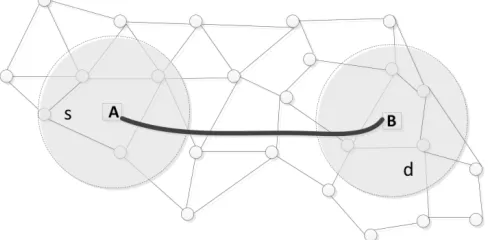
Fig. 1.The Minimum Key Set Route
An example of wormhole attack is given in Fig.1. Node A and B are two malicious nodes placed by the adversary connected via a network cable. So node A and B are the two end points of the wormhole link. Node A receives packets, tunnels them through the wormhole link and replays the packets at node B and vice versa. As a result, nodes in the neighborhood of node A will assume that all nodes in the neighborhood of node B are their neighbors and vice versa. For example, source node s can take a one-hop path to send packets to destination nodedvia the wormhole link instead of a multi-hop path.
2.
Related Works
Wormhole attack is very destructive since the neighborhood information is confused. Any routing protocol relying on network topology information can’t work normally. Periodic protocols like Secure Efficient Ad hoc Distance vector routing protocol (SEAD) [6] will malfunction because the routing table information is different from the real network topol-ogy due to the wormhole. On-demand protocols like Dynamic Source Routing protocol (DSR) [11] will have false route establishment because the route quest and route reply message in the route discovery stage will contain the wormhole link. So all the routes established by these network routing protocols are attracted to the wormhole and the ad-versary can launch further attack like selective forwarding attack, black hole attack and etc. What is worse, the wormhole attack is easily deployed to some extent. The adver-sary has no need to compromise any node in the network and don’t need to deal with the cryptographic keys. The integrity, authenticity and confidentiality are still reserved in the existence of wormhole. All the adversary has to do is to place two malicious nodes in good positions in the network and make them receive and send packets.
Because of the reason, the detection of wormhole attack has become an essential is-sue and various methods have been proposed to detect the wormhole. In [7], Hu et al. introduce the general mechanism of packet leashes to detect wormhole attacks. Two types of leashes are used: geographic leashes and temporal leashes. A leash is any information that is added to a packet designed to restrict the packet’s maximum allowed transmission distance. However, to form a leash, each node must know its own location and have syn-chronized clocks. In [8], the End-to-end Detection of Wormhole Attack (EDWA) is pro-posed in wireless ad-hoc networks. The source node estimates the minimum hop count to the destination and compares the hop count value received from the reply packet to detect the wormhole. Obviously, each node should measure its geographical location through a GPS. There are some solutions based on the discovery and maintenance of node neighbor-hood. For instance, LITEWORP [12] uses secure two-hop neighbor discovery and local monitoring of control traffic to detect nodes involved in the wormhole attack. It provides a countermeasure technique that isolates the malicious nodes from the network thereby removing their ability to cause future damage. MobiWorp [13] is further proposed to com-plement LITEWORP by introducing some location-aware mobile nodes.
informa-tion and reconstructs the neighborhood sub-graph by Multi-Dimensional Scaling (MDS). Potential wormhole nodes are detected by validating the legality of the reconstruction. Then, a refinement process is introduced to filter the suspect nodes and to remove false positives. In the paper [21], wormhole attack detection is proposed based on Round-Trip Time (RTT) between successive nodes and congestion detection mechanism. If the RTT between two successive nodes is higher than the threshold value, a wormhole attack is suspected. If a wormhole is suspected, node’s transitory buffer is probed to determine whether the long delay between the nodes is due to wormhole or not, as delays can be caused due to congestion or by queuing delays.
3.
Proposed wormhole detection method
Detecting wormholes in WSNs is essential since they can make the routing protocols malfunction. In this paper, a highly efficient wormhole detection method named TRM is developed, which uses the local neighborhood information to calculate the transmission range.
3.1. Network model
In order to prepare for the discussion of the wormhole detection, the network model is presented first. In the network model, a WSN with N sensor nodes is considered, which can be denoted by a directed graphG = (V, E). In this graph,V is the set of vertices indicating the sensor nodes and E is the set of direct edges indicating the wireless links in the graph. The graph takes a Unit Disk Graph (UDG) [17] as its connectivity model. In UDG, each node is modeled as a disk of unit radius in the plane, which indicates the trans-mission range of a single node. Each node is a neighbor of all nodes located in its disk. Nodes are randomly distributed in the specified area. Two types of nodes are considered in the network: normal nodes and malicious nodes placed by the adversary. Malicious nodes differ from normal nodes in their transmission range, power and calculation capability.
3.2. Adversary model
As described in Section 1, one end of the wormhole eavesdrops on packets, tunnels them through the wormhole and replays them at the other end of the wormhole. The adversary can place many pairs of malicious nodes to deploy wormholes across the whole network. The adversary’s goal is to attract as more routes through the wormhole link as possible. And as long as the wormholes are placed carefully, the majority of the network routes can be attracted to the wormhole link. To introduce our wormhole detection method, some assumptions must be made first. These three assumptions following lay a foundation for our wormhole detection method.
2. There is some time t when the wormhole is absent, so the sensor nodes have enough time to establish their neighbors.
3. The wormhole is closed [25]. The wormhole attacks are divided into three groups (closed, half open, and open) according to the format of the tunnel and attacker’s capability. In this paper, we focus on the closed wormhole attack.
3.3. Principle and analysis
In order to explain our wormhole detection method, its principle analysis is presented first. In the network, each node pair can establish a link because their distance is less than or equal to the transmission ranger. For any nodem, the neighbor set ofmis denoted byN(m). For example, if a nodeBcan receive packets from nodeAwith one hop, node Bis a neighbor of nodeAand meetsB∈N(A). The principle is to check the neighbor topology by using the geometric relationship of nodes’ locations under the constraint of the communication range of the two involved sensor nodes.
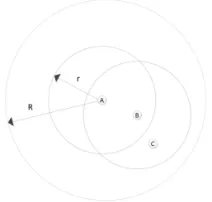
Fig. 2.Neighbor Nodes without Wormhole
The principle is illustrated in Fig.2 by studying the geometric relationship among nodes in the network without wormholes. NodeAandB are two neighbor nodes to be checked. NodeCmeetsC∈N(B)butC ̸∈N(A). The transmission range of nodeA, B andCisr. When nodeA adjusts its transmission range toR = 2rin Fig.2, all the neighbors of nodeCbecome neighbors of nodeA. So it meets thatC∈N(A)andN(B) ⊆N(A).
The geometric relationship among nodes in the network under wormhole attack is totally different as shown in Fig.3. Node Aand B are two neighbor nodes which are connected via the wormhole link. NodeCandDboth meet thatC,D∈N(B). NodeA, BandDare mutually neighbors due to the wormhole link as described in Section 1.
Fig. 3.Neighbor Nodes with Wormhole
nodeA, one of nodeB’s neighbors is still not a neighbor of nodeA. So it meets thatD∈ N(A)andC̸∈N(A). As a result, not all the neighbors of nodeBturn into neighbors of nodeA, which meets thatN(B)̸⊂N(A). And this can be used to check whether there exists a wormhole between two sensor nodes.
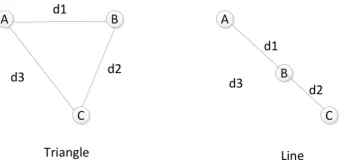
Fig. 4.Neighbor Nodes with Wormhole
Then we make some calculations to prove that the above principle is feasible. As shown in Fig.4, the distance betweenAandBis denoted byd1; the distance betweenB andCis denoted byd2, the distance betweenAandCis denoted byd3. There are two cases of node-relative position: triangle and line. According to the neighbor relationship described above and their transmission ranger, it is obvious thatd1 ≤ randd2 ≤ r. In the triangle case, it can be seen thatd3 < d1 +d2 ≤ 2r. In the line case, it can be seen thatd3 = d1 +d2 ≤ 2r. So we can getd3 ≤ 2r. Since the radius of node A is R = 2r, node Cis within nodeA’s transmission range. And it meets thatd3 ≤2rfor ∀C ∈ N(B). Therefore, we can get the formulaN(B) ⊆N(A). When the network is under the wormhole attack, the actual distance of the two neighbor nodesAandBmay be very far away. It may meet thatd3>2rfor∀C∈N(B). NodeCis still not a neighbor of nodeAafter expanding its radius to2r. But due to the wormhole, some node likeD in Fig.3 may still be a neighbor of nodeA, which means thatC ̸∈N(A),∃C∈ N(B). Therefore, we can getN(B)̸⊂N(A). Now we can get the conclusion that:
2. When there is no wormhole and the transmission range of nodeA isR, all nodes C∈N(B)meetC∈N(A).
3.4. Detection procedure
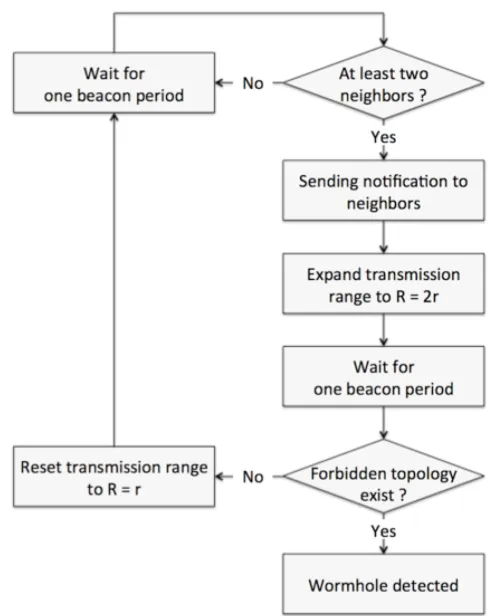
Based on the principle of detecting wormholes, detailed detection procedure will be pre-sented in this section. Two neighbor nodes such as node A andB are to be checked which has its neighbor listN(A)andN(B)separately. The neighbor list information can be exchanged between neighbors through periodic beacon messages. After nodesA andB exchange the neighbor list information, the detection procedure will begin. Node A notifies all its neighbors inN(A)through its beacon messages that will increase its transmission radius. The neighbor nodes receiving this notification will not change their transmission radius in the next beacon time. Then nodeAincreases its transmission range to2rand updates its neighbor listN(A). Finally, nodeAcomparesN(A)andN(B):
1. If the neighbor listsN(A)andN(B)satisfyN(B)⊆N(A), then there is no worm-hole link between nodeAandB.
2. If the neighbor listsN(A)andN(B)satisfyN(B)̸⊂N(A), then there is a worm-hole link between nodeAandB.
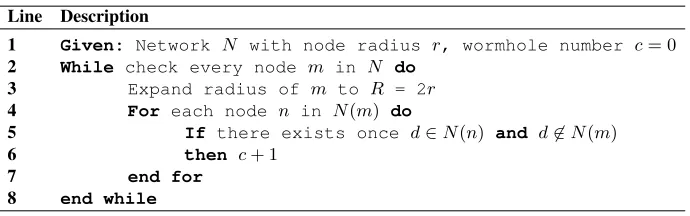
network can eliminate the bad effects of wormholes. The description of the algorithm is shown in Table 1.
Fig. 5.Wormhole Detection Process
3.5. Complexity and feasibility analysis
num-Table 1.Transmission Range based Method to Detect Wormholes
Line Description
1 Given: Network N with node radius r, wormhole number c= 0
2 While check every node m in N do
3 Expand radius of m to R = 2r
4 For each node n in N(m) do
5 If there exists once d∈N(n) and d̸∈N(m)
6 then c+ 1
7 end for
8 end while
ber of nodes is limited such asnand the number of its neighbors isc, the time complexity of TRM isO(cn), i.e.,O(n).
The space complexity is defined as the storage space. In the TRM, the space com-plexity is influenced by the number of nodes in the network. According to our algorithm, except the neighbor list, no extra data structures are required to store in TRM. Suppose there is a wormhole between nodeAand nodeB. Because only neighbor information is stored, the space complexity is obviouslyO(1). When all thennodes in the network are checked, the space complexity isO(n). The feasibility of the algorithm is that every node must have its neighbor nodes. Supposennodes are distributed in a square region with the side lengthdand the transmission radiusr. According to TRM algorithm, the number of nodes in each row is√nlying on a line of length d. The distance between two neigh-bor nodes is √nd
−1. Every node can communicate with each other as long as the distance between neighbor nodes is less than the node’s transmission radius. So it should be met
d
√n−1 ≤r, which is easy to implement. However, there may be some particularly isolated nodes, which doesn’t make sense for the wormhole attacker. In summary, the feasibility of the proposed algorithm has been verified.
4.
Simulation analysis
In order to verify the performance of our wormhole detection method, various experi-ments have been carried out. In the simulated system scenario, the wireless sensor net-work consists of 100 sensor nodes. First, we show the great damage of wormhole attack to the network. Among the entire nodes, ten source nodes and ten destination nodes are se-lected randomly. Then routes are established between those source and destination nodes. The routes are set up using the basic Shortest Path Algorithm for simplicity. Then it can be seen in the simulation as shown in Fig.5 that the routes are badly corrupted due to the existence of wormhole. The routes are broken since the routes cross the wormhole end points. In this way, the traffic can be attracted to the wormhole link and the adversary can mount further attack like sinkhole attack or just eavesdrop on the information:
Fig. 6.The Broken Routes Percent by Wormholes
In Fig.7, the wormhole detection rate is calculated as the number of wormholes in-creases from 2 to 40. The detection rate is also compared under different system scenario in which the networks with the same number of wormholes have different node densities. Network distribution area 5x5 corresponds to the greatest node density. And the node density decreases as the network distribution area increases to10x10,20x20, and30x30. It can be seen from Fig.6 that the bigger the node density, the higher the detection rate. The detection rate is perfectly 100% when the side length of the network is square since it’s easy to detect wormholes when a node has many neighbors. A node’s detection failure can be complemented by another neighbor node. The detection rate is not 100% because some neighbor nodes around the wormhole can’t detect the wormhole link. The detec-tion may fail because the node has nearly no neighbor to check the local neighborhood information using our method. This situation, which is of low probability in practical ap-plication, happens in very spare network or some isolated sensor nodes. Moreover, there is no worth for the adversary to attack such isolated sensor nodes because little traffic will be caused to use by the attack.
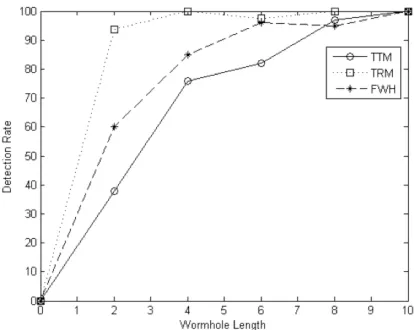
To compare the performance of TRM with other wormhole detection method, two other kinds of detection methods are simulated in the experiments. The Transmission Time based Mechanism (TTM) [13] detects wormhole attacks during the route setup pro-cedure by computing transmission time between every two successive nodes along the established path. The Four Way Handshaking algorithm (FWH) [18] uses a simple four-way handshaking messages to exchange. It can be seen from Fig.8 when the wormhole length is smaller than 10, our method can achieve the highest detection rate. When the wormhole length is 2, the transmission time of two neighbor nodes created by wormhole link is not too long to be detected. The FWH algorithm is also affected by the time. Our TRM has nothing to do with the time and detect the wormholes according to the geomet-ric relationship of nodes as described in section 3. So our TRM can have high detection rate all the time in different network scenarios.
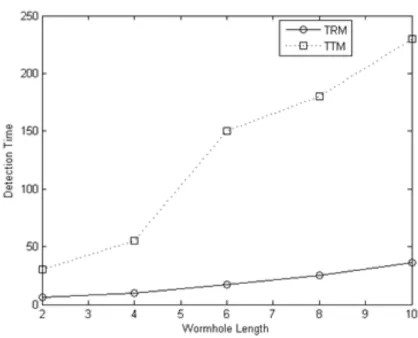
Fig. 9.Detection Time Comparison
In Fig.9, the detection time of TRM and TTM algorithm is compared. The actual average transmission time between one-hop nodes is ten milliseconds. However in TTM, the RTT between two nodes connected through the wormhole link is calculated since the two endpoints of wormholes are far away. In TTM, the detection result is obtained through calculating transmission time. So the detection time is longer when the wormholes are far away. It can be seen in Fig.9 that the detection time increases greatly as the length between wormholes increases. In TRM, however, the wormholes are detected by checking the false neighbor topology. The wormholes can be found out by calculating the geometrical relationship between nodes. In this way, the computation is of low complexity and more quick. At the same time, since the node’s neighbor list has nothing to do with the length of wormholes, the wormhole length doesn’t affect the detection time. So the detection time doesn’t increase greatly as the length of wormhole increases.
5.
Conclusions
Wormhole attack in WSNs has been drawing more and more attention since it can disrupt normal network routing protocols. However, in previous work of wormhole detection, most of them need either extra hardware or clock synchronizations and suffer from high complexity. In this paper, an efficient wormhole detection method is proposed, which is based only on local neighborhood information. Through judging the node’s position, we can determine whether the node is in the local network topology affected by the wormhole link.
In the detection procedure, the neighborhood information of each node is updated and exchanged periodically between neighbors along with the increment of the transmission range. A local topology that has a wormhole link finally reports a mismatch of the neigh-borhood information between nodes. According to the analysis, the algorithm givesO(n) for both of the time complexity and the space complexity.
sen-sor network with 100 sensen-sor nodes and deployed up to 40 wormholes in it with different density. In case of a denser network with more wormholes, the detection rate was getting higher. In the performance comparison with other detection methods, the proposed TRM gave much bigger detection rate for wormholes with shorter lengths.
In the future, the proposed algorithm is required to enhance the performance for coarse networks and consider the separated nodes as well as optimizing the procedure even for dense networks. Performance of the proposed TRM algorithm also should be evaluated for various network conditions such as the case that the network has frequent link breaks between nodes as a common problem in a practical environment.
Acknowledgments.This research was sponsored in part by the Fundamental Research Funds for the Central Universities (No. DUT13JS10). This work was also supported in part by the Soonchun-hyang University Research Fund.
References
1. Agrawal, S., Jain, S., Sharma, S.: A survey of routing attacks and security measures in mobile ad-hoc networks. Journal of Computing 03(01), 41–48 (2011)
2. Akyildiz, W., Sankarasubramaniam, Y., Cayirci, E.: Wireless sensor networks: a survey. Com-puter Networks 38(04), 393–422 (2002)
3. Ban, X., Sarkar, R., Gao, J.: Local connectivity tests to identify wormholes in wireless net-works. In: Proceedings of the 12th ACM International Symposium on Mobile Ad Hoc Net-working and Computing. pp. 65–78 (2011)
4. Dong, D., Li, M., Liu, Y., Liao, X.: Wormcircle: connectivity-based wormhole detection in wireless ad hoc and sensor networks. In: Proceedings of the 15th International Conference on Parallel and Distributed Systems. pp. 72–79 (2009)
5. Hu, Y.: Wormhole attacks in wireless networks. IEEE Journal on Selected Areas in Communi-cations 24(02), 370–380 (2006)
6. Hu, Y., Johnson, D., Perrig, A.: Secure efficient distance vector routing for mobile wireless ad hoc networks. Ad Hoc Networks 01(01), 175–192 (2003)
7. Hu, Y., Perrig, A., Johnson, D.: Packet leashes: A defense against wormhole attacks in wire-less networks. In: Proceedings of 22nd Annual Joint Conference of the IEEE Computer and Communications. pp. 1976–1986 (2003)
8. Hu, Y., Perrig, A., Johnson, D.: An end-to-end detection of wormhole attack in wireless ad-hoc networks. In: Proceedings of 31st Annual International Computer Software and Applications Conference. pp. 39–48 (2007)
9. Jhaveri, R., Patel, D., Jatin, D., Parmar, D., Shah, B.: Manet routing protocols and wormhole attack against aodv. International Journal of Computer Science and Network Security 10(04), 12–18 (2010)
10. Jhaveri, R., Patel, S., Jinwala, D.: Dos attacks in mobile ad hoc networks: A survey. In: Pro-ceedings of Advanced Computing & Communication Technologies. pp. 535–541 (2012) 11. Johnson, D., Maltz, D., Broch, J.: Dsr: The dynamic source routing protocol for multi-hop
wire-less ad hoc networks. In: Perkins, C. (ed.) Ad Hoc Networks, pp. 139–172. Addison-Wesley Longman Publishing Co., Inc. Boston, MA, USA (2001)
12. Khalil, I., Bagchi, S., Shroff, N.: Liteworp: a lightweight countermeasure for the wormhole attack in multihop wireless networks. In: Proceedings of the International Conference on De-pendable Systems and Networks. pp. 612–621 (2005)
14. Lazos, L., Poovendran, R., Meadows, C., C., S., L., C.: Preventing wormhole attacks on wire-less ad hoc networks: a graph theoretic approach. In: Proceedings of the IEEE Wirewire-less Com-munications and Networking Conference, Broadband Wirelss for the MassesReady for Take-off. pp. 1193–1199 (2005)
15. Lu, X., Dong, D., Liao, X.: Mds-detection using local topology in wireless sensor networks. International Journal of Distributed Sensor Networks 2012, 1–9 (2012)
16. Maheshwari, R., Gao, J., Das, S.: Detecting wormhole attacks in wireless networks using con-nectivity information. In: Proceedings of the 26th IEEE International Conference on Computer Communications. pp. 107–115 (2007)
17. Maheshwari, R., Gao, J., Das, S.: Detecting wormhole attacks in wireless networks using con-nectivity information. In: Proceedings of 26th IEEE International Conference on Computer Communications. pp. 107–115 (2007)
18. Nat-Abdesselam, F., Bensaou, B., Yoo, J.: Detecting and avoiding wormhole attacks in op-timized link state routing protocol. In: Proceedings of IEEE Wireless Communications and Networking Conference. pp. 3117–3122 (2007)
19. Patel, K., Manoranjitham, T.: Detection of wormhole attack in wireless sensor network. Inter-national Journal of Engineering Research & Technology 02(05), 366–369 (2013)
20. Poovendran, R., Lazos, L.: A graph theoretic framework for preventing the wormhole attack in wireless ad hoc networks. Wireless Networks 13(01), 27–59 (2007)
21. Sebastian, M., Kumar, A.: A novel solution for discriminating wormhole attacks in manets from congested traffic using rtt and transitory buffer. I. J. Computer Network and Information Security 05(08), 28–38 (2013)
22. Sharma, K., Ghose, M.: Wireless sensor networks: an overview on its security threats. IJCA, Special Issue on Mobile Ad-hoc Networks pp. 42–45 (2010)
23. Sohrabi, K., Gao, J., Ailawadhi, V., Pottie, G.: Protocols for self-organization of a wireless sensor network. IEEE Personal Communications 07(05), 16–27 (2000)
24. Triki, B., Rekhis, S., Boudriga, A.: A novel secure and multipath routing algorithm in wireless sensor networks. In: Proceedings of 2010 International Conference on Data Communication Networking. pp. 1–10 (2010)
25. Wang, W., Bhargava, B., Lu, Y., Wu, X.: Defending against wormhole attacks in mobile ad hoc networks. Wireless Communications and Mobile Computing 06(04), 483–503 (2006)
Guowei Wureceived B.E. and Ph.D. degrees from Harbin Engineering University, China, in 1996 and 2003, respectively. He was a Research Fellow at INSA of Lyon, France, from September 2008 to March 2010. He has been an Associate Professor in School of Soft-ware, Dalian University of Technology (DUT), China, since 2003. Dr. WU has authored three books and over 20 scientific papers. His research interests include embedded real-time system, cyber-physical systems (CPS), and wireless sensor networks.
Xiaojie Chenreceived B.E. and Master degrees from Dalian University of Technology, China, in 2010 and 2013, respectively. He is an engineer in China Unicom. His research interests include embedded real-time system, cyber-physical systems (CPS), and wireless sensor networks.
Technology (DUT), China, since 2004. She has co-authored one book and over ten scien-tific papers. Her research interests include pervasive computing, cyber-physical systems (CPS), and wireless sensor networks.
Youngjun Lee received B.E. degree from Dept. of Information Security Engineering, Soonchunhyang University, Korea, in 2013. He is currently pursuing his Master degree. His research interests include malware analysis, secure hardware design, and CPS security and testing.
Kangbin Yimreceived his B.S., M.S., and Ph.D. from Ajou University, Korea in 1992, 1994 and 2001, respectively. He is currently a Full Professor in the Department of Infor-mation Security Engineering and the founding director of the R&BD Center for Security and Safety Industries (SSI) in Soonchunhyang University. He has served as the executive board member of Korea Institute of Information Security and Cryptology, Korean Society for Internet Information and The Institute of Electronics Engineers of Korea. He also has served as editor of the journals such as JIT, MIS, IJCM, JCPS, JISIS and JoWUA. His research interests include vulnerability assessment, malware analysis, embedded systems security, and software-hardware co-design and evaluation. Related to these topics, he has worked on more than fifty research projects and published more than a hundred research papers.