Doctoral Dissertations Theses, Dissertations, Capstones and Projects
2017
A Quantitative Analysis of a Critical Pedagogy in
Catholic Secondary School Religious Studies
Teachers in the San Francisco Bay Area
Alex Porter Macmillan
University of San Francisco, [email protected]
Follow this and additional works at:https://repository.usfca.edu/diss
Part of theEducational Leadership Commons,Regional Sociology Commons, and theReligion Commons
This Dissertation is brought to you for free and open access by the Theses, Dissertations, Capstones and Projects at USF Scholarship: a digital repository @ Gleeson Library | Geschke Center. It has been accepted for inclusion in Doctoral Dissertations by an authorized administrator of USF Scholarship: a digital repository @ Gleeson Library | Geschke Center. For more information, please [email protected].
Recommended Citation
Porter Macmillan, Alex, "A Quantitative Analysis of a Critical Pedagogy in Catholic Secondary School Religious Studies Teachers in
the San Francisco Bay Area" (2017).Doctoral Dissertations. 339.
A QUANTITATIVE ANALYSIS OF A CRITICAL PEDAGOGY IN CATHOLIC SECONDARY SCHOOL RELIGIOUS STUDIES TEACHERS IN THE
SAN FRANCISCO BAY AREA
A Dissertation Presented to
The Faculty of the School of Education Department of Leadership Studies Catholic Educational Leadership Program
In Partial Fulfillment of the Requirements for the Degree
Doctor of Education
by
Alex Porter Macmillan San Francisco
ii
THE UNIVERSITY OF SAN FRANCISCO Dissertation Abstract
A Quantitative Analysis of a Critical Pedagogy in Catholic Secondary School Religious Studies Teachers in the San Francisco Bay Area
Scholarship has indicated that Catholic, secondary school religion teachers in the United States are often not adequately prepared pedagogically and theologically (Aldana, 2015; Ramey, 2014; Schroeder, 2013; Cook and Hudson, 2006; Cook, 2001, 2000; Lund 1997). Rossiter (2011, 2010, 2007) and Crawford and Rossiter (2006) described aspects of a pedagogy that can be summarized as “Critical Interpretation and Evaluation of Cul-ture” (Rossiter, 2011), where a number of different criteria and examples are described that can serve as a relevant pedagogy for religious education.
In a researcher designed, online, cross-sectional survey, 18 questions from rele-vant literature using both binary “yes / no” questions and Likert scales measured the fre-quency and importance of pedagogical practices related to how to help students interpret and evaluate culture. From November 9, 2016 to February 1, 2017, 119 Catholic second-ary school religion teachers participated from three different Roman Catholic Dioceses: Oakland (n = 24); San Francisco (n = 45); and San Jose (n = 50) and included select de-mographic information.
iii
the Faculty of the School of Education in partial fulfillment of the requirements for the degree of Doctor of Education. The content and research methodologies presented in this work represent the work of the candidate alone.
Alex Porter Macmillan April 25, 2017
Candidate Date
Dissertation Committee:
Ursula Aldana April 25, 2017
Chairperson
Michael Duffy April 25, 2017
Walter Gmelch April 25, 2017
v
DEDICATION
We have come to know and to believe in the love God has for us. God is love, and whoever remains in love remains in God and God in him.
- 1 John 4:16
This dissertation is dedicated to my wife,
Michele Margaret Porter Macmillan
and my daughter,
Michaela Maura Porter Macmillan.
God is shown in our family by their great love, joy, and laughter.
The great medieval theologian, Thomas Aquinas, famously stated about God: “Everything I have written seems to me as straw in comparison with what I have seen.”
vi
“If the only prayer you ever say in your entire life is ‘thank you’, that would suffice.”
- Meiser Eckhart. The Roman Catholic tradition understands that all education, and especially
religious education, first and foremost occurs in the family. Parents are considered the primary educators of their children. So, for all of my religious education that has taken place in schools, I have to begin with my deepest gratitude for my family.
This program would have been impossible without my wife, Michele Porter Macmillan, whose support and encouragement have been the foundation of the entire process both of this dissertation and the Institute of Catholic Educational Leadership (ICEL) program. Michele has been the best support, cheerleader, dialogue partner, and co-parent I could have ever asked for. I am indebted to her beyond what I can express here.
As I started the program in 2012, the greatest gift and joy of my life during this time has been my daughter, Michaela Maura Porter Macmillan, born on February 14th, 2016. I hope some day I can communicate how much she has meant to me and how grateful I have been for her during this time in my life. Her presence has become the center of the work related to this dissertation.
vii can say.
I would like to thank the Society of Jesus for the education and training that I have received from Boston College, the Jesuit School of Theology at Berkeley, and the University of San Francisco. I will continue to be indebted to the Jesuits for the
spirituality, formation, and education that they have provided me.
Additionally, I want to express gratitude for Bishop O’Dowd High School, which provided both financial and emotional support for the first two years of this program. I am exceedingly grateful for Dr. Steve Phelps who encouraged and supported me throughout my time in the ICEL program. I would not have considered USF had it not been for Dr. Phelps’ mentorship. I am also indebted to Dr. Colette Roche and Dr. Diana Murray for their wisdom and encouragement.
I am also grateful for St. Ignatius College Preparatory’s support for the last three years of this program. I am especially appreciative of the wisdom and guidance of Dr. Justin Christensen, Dr. Don Gamble, and Dr. Kevin Quattrain, all who had been through ICEL before me and were tremendously helpful in the process of writing.
In addition to the many faculty and staff of Bishop O’Dowd and St. Ignatius who have shown me support, I would like to acknowledge the approximately 2500 students I have taught in religious education. Beyond any institution, it is each and every one of these students that has given me a vocation. Thank you to all of my students.
viii your help and guidance.
The faculty at the University of San Francisco have been extraordinary. I would especially like to thank: Fr. Steve Katsouros, S.J., Dr. James Everett, Enrico Hernandez, and Dr. Benjamin Baab. Each of them helped immensely in the formation. I would also like to thank Dr. Graham Rossiter from Australian Catholic University for his
correspondence in the formation and encouragement in the early parts of developing an instrument using his research. A special, sincere, and heartfelt thanks goes to Dr. Doreen Jones, my advisor for three years of this program. I will always be reminded of the sacred joy of teaching by her example.
I truly enjoyed the conversations and support of my dissertation committee, Dr. Michael Duffy and Dr. Walt Gmelch. The mentorship and friendship that Dr. Duffy has shown me over the last 15 years has been invaluable, and the joy and enthusiasm of Dr. Gmelch made this process fun, engaging, and important.
Finally, I cannot express enough gratitude or appreciation for my dissertation chair, Dr. Ursula Aldana. Dr. Aldana has been an incredible support through every step of the dissertation process and I cannot convey fully here my admiration and respect for her. She is both an incredible guide and inspiration for me as a Catholic educator. I hope that I can emulate her character and her commitment in my work in Catholic education.
ix
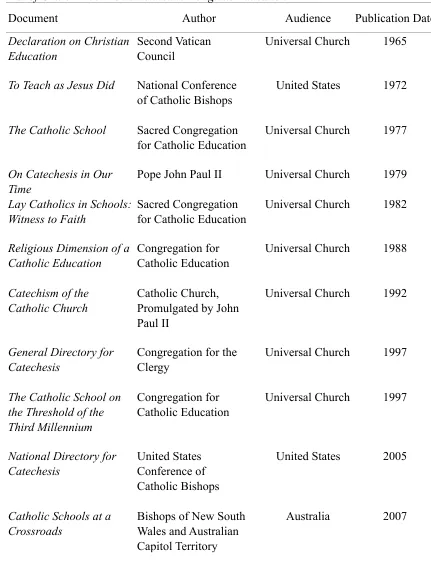
1. List of Church Documents Related to Religious Education………..……37 2. Habel and Moore’s Types Compared to Smart’s Phenomena and Traditional
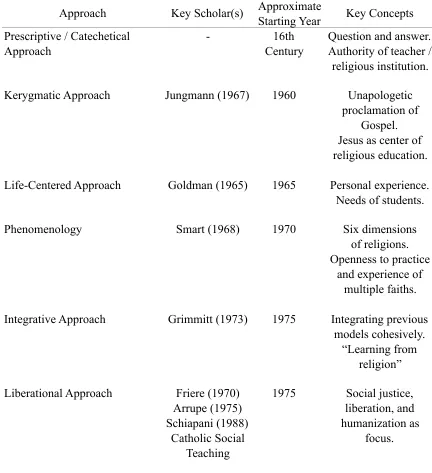
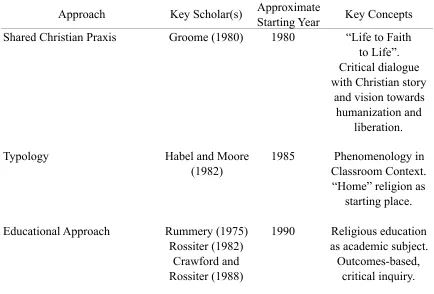
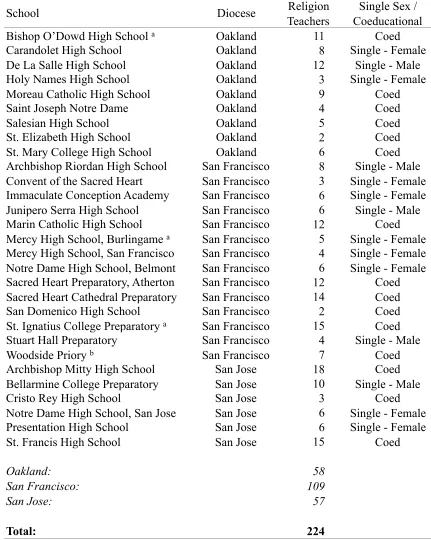
Disciplines in Christian Seminaries (Habel and Moore, 1982)……….……56 3. Summary of Approaches to Secondary School Religious Education Since Second Vatican Council………..………..…….……85 4. Religious Studies Teachers in Bay Area Catholic High Schools by Diocese and
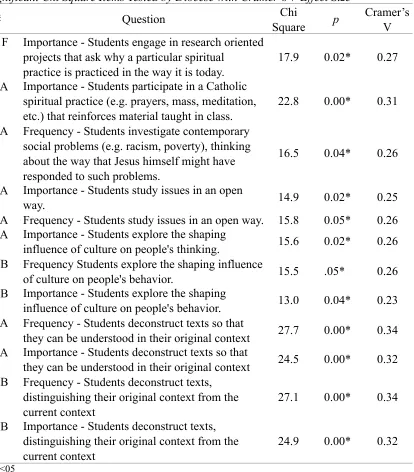
Coeducational Status…….………..……….111 5. Survey Respondents by Diocese Compared to Overall Population..….…….….120 6. Significant Chi Square Items Tested by Diocese with Cramer’s V Effect
Size...121
x
20. Significant Items for Major/Minor in Theology - Importance……….146 21. T-Test Based on Advanced Degree in Theology or Equivalent……...….…147 22. Significant Items for Advanced Degree in Theology / Equivalent-Frequency…148
23. Significant Items for Advanced Degree in Theology / Equivalent-Importance..148
24. Means for Frequency Items by Diocese and Advanced Degree in Theology or Equivalent.……….…..149
25. T-Test: Years of Teaching Experience: 0-10 Years vs. 11+ Years…….………151
26. Significant Items: T-Test for Teaching Experience - Frequency…..……...……153
27. Significant Items: T-Test for Teaching Experience - Importance…………...…154
28. ANOVA Years of Teaching Experience………..………155
29. T-Test, Degree in Education vs. No Degree in Education.………..………157
30. Significant Items for Degree or Certificate in Education - Frequency…………158
31. Significant Items for Degree or Certificate in Education - Importance…..……159
32. Means for Frequency Items by Diocese and Degree or Certification in
Education……….160
33. Means for Importance Items by Diocese and Degree or Certification in
SIGNATURE PAGE ………..……… iv
DEDICATION ………..……….…… v
ACKNOWLEDGEMENTS………..………..……… vi
LIST OF TABLES……….……….…… ix
LIST OF FIGURES………..……….…….………… xi
CHAPTER I: THE RESEARCH PROBLEM……… 1
Statement of the Problem………..……….……… 1
Background and Need ………..……… 3
Purpose of the Study …………..…….………..… 7
Research Questions ……..….………..….. 8
Theoretical Framework ………..……….……….. 9
Limitations and Delimitations ………..….……….…………..…… 11
Significance ……….…..…..….………..……..……… 13
CHAPTER II: REVIEW OF LITERATURE……….…….… 14
Restatement of the Problem……….…………..……… 14
Overview……….…..……..………..………. 16
Ecclesial Documents on Teaching of Religious Education…….….………. 17
Scholarship on The Development of Approaches to Religious Education… 39 The Catechetical Approach: The Prescriptive Model…….………… 39
The Kerygmatic Approach: Jesus at the Center……….….……….… 42
The Personal Approach: Life-Centered Models……..………. 44
The Phenomenological Approach: Teaching How………… 47
The Typological Approach: Practical Phenomenology……… 53
The Integrative Approach: Experience and Phenomenology….…… 57
The “Life to Faith to Life” Approach: Shared Christian Praxis..….… 62
The Liberation Approach: Social Justice as Focus……..…….……… 70
The Educational Approach: Critical Thinking in Religious Education………..…… 76
Expanding the Educational Approach: “Critical Interpretation and Evaluation of Culture”……….….. 89
Influence of Graham Rossiter and Marissa Crawford..….….. 89
Introduction to Critical Interpretation and Evaluation of Culture………..……… 90
The Critical and Evaluative Nature of Religious Education.… 90
Critical Interpretation and Evaluation of Culture………. 100
Summary……….………..……. 106
CHAPTER III: METHODOLOGY……..…………..……….………….…. 108
Restatement of the Purpose of the Study……….…..……… 108
Research Design ……….…..………..………..…… 108
Setting………..….………..…….….…….………… 108
Population……….………..………..…. 110
Instrumentation……….…..……….…………..….….……….. 110
Validity………..……….………..……. 112
Data Collection and Procedures……….……… 113
Ethical Considerations………..………. 115
Data Analysis Plan………..……….………. 116
CHAPTER IV: RESULTS……..………..………….. 118
Restatement of the Purpose of the Study……….………..……… 118
Research Questions……….….….………….……… 118
Demographics………..……….……….… 119
Research Question 1………..……….……….….. 124
Research Question 2………..……….……….….. 143
Research Question 3…..……….……….….. 144
Research Question 4………..……….……….….. 150
Research Question 5……….………….……….….…..………… 154
CHAPTER V: CONCLUSIONS, IMPLICATIONS, AND RECOMMENDATIONS…………..……….…………. 163
Summary of the Study……….……..……… 163
Research Question 1………….……….……….……….….. 165
Research Question 2……..……….……….….. 167
Research Question 3………..……….……….….. 168
Research Question 4……..…….……….…………..….………….….. 169
Research Question 5……….…………..……….….…. 170
Conclusions and Implications……….………….………..……… 172
Research Question 1……….………..……….. 172
Research Question 2…….……….……….……….. 179
Research Question 3………….……….……….……….. 181
Research Question 4……….………..……….. 183
Research Question 5……..……….……….. 183
Additional Findings……….……….….……….….. 185
Recommendations……….…….…….………….…….. 188
REFERENCES……….…..……….……….…………..……… 192
APPENDICES……….…..……….………..…………..……… 201
Appendix A: Survey………..……….…………..…………. 202
Appendix B: Survey Item Composition………..……….….….……… 219
Appendix C: Validity Panel……….……….…. 238
Appendix D: Letter to Validity Panel..….……….…….… 241
Appendix E: Permission from Superintendents of Catholic Dioceses…..… 245
Appendix F: IRBHS Permission to Conduct Survey……….……… 248
Appendix G: IRBHS Permission to Take Field Notes…….……….…….… 250
Appendix H: Sample E-mail for Permission from Principals…..………….. 252
CHAPTER I
THE RESEARCH PROBLEM
Statement of the Problem
In 1988, The Roman Catholic Church’s Congregation for Catholic Education, in
its document The Religious Dimension of Education in a Catholic School, articulated the
importance of religion teachers in Catholic schools by stating:
The religion teacher is the key, the vital component, if the educational goals of the
[Catholic] school are to be achieved (#96)…In Catholic schools today, these
teachers tend more and more to be lay people, and they should have the
opportunity of receiving the specific experiential knowledge of the mystery of
Christ and of the Church that priests and Religious automatically acquire in the
course of their formation (#97).
While the vitality of the role of the religion teacher in Catholic education is clearly stated,
Lund (1997) noted that secondary school religion teachers often have multifaceted and
undefined roles as “missionaries, theological thinkers / reflectors, cultivators, catalysts,
[and] mentors” (p. 49). Following this lack of definition in the role of a secondary school
religion teacher, Cook (2001), in surveying religion teachers to articulate their primary
role as educator, found 45% of respondents indicated “religious instruction” while 55%
indicated “catechesis”. In this same study, Cook (2001) noted that only 41% of religion
teachers held an advanced degree in theology, religious studies, or religious education.
theology, religious studies, or religious education; only 16.1% had a minor, both
substantially lower than their counterparts in other subjects - english, math, science, or
social studies - in both private and public education (Cook 2001).
Cook and Hudson (2006) observed: “Catholic Church documents provide little
guidance for identifying and/or fully describing a knowledge and skill set for religion
teachers...religion teachers cannot even agree on what the goals of the Catholic high
school religion program should be” (p. 9). Cook and Hudson’s (2006) work suggests that
there has been little consensus among religion teachers and religion departments in the
United States on what the nature of religious education in Catholic secondary schools
should be, let alone consensus on an approach that adequately addresses the spiritual
needs of adolescents in the 21st century.
After evaluating the spirituality and identity of today’s youth and the current state
of Catholic schools in Australia, Crawford and Rossiter (2006) summarized the spiritual
crisis of today’s youth as follows:
The perceived relevance of Catholic theology and religious education in these
times remains in crisis as far as many youth and adults are concerned. They will
quietly ignore the Catholic faith tradition – and its religious education – unless
they sense that something serious is being said about issues in contemporary
personal, social, and political life...If the presentation of theology and spirituality
does not engage sufficiently in the real spiritual and moral issues that people
experience, then they will get used to the expectation that their faith tradition
be expected to resolve the problem, it can endeavour to make the study of religion
a more life-enhancing experience for students. And this requires an approach – in
content, language and pedagogy – that is in tune with young people’s spirituality;
in short, a religious education that is concerned with reasons for living (p. 407,
emphasis in original).
The approach referred to here is described by Crawford and Rossiter (2006) and
discussed in depth by Rossiter (2011), where he refers to it as “critical interpretation and
evaluation of culture” (p. 5). Rossiter (2011) argues that this is the best approach to
address the spiritual needs of teenagers today and thus is the most appropriate method of
instruction for Catholic secondary religious education. While this approach has
significantly influenced religious education in Australia (Finn 2009), there has been no
investigation of the degree to which this method is being implemented by religion
teachers in Catholic secondary schools in the United States. The lack of literature in the
United States in reference to religious education is already problematic; the reference to
Rossiter’s work on the method and purpose of religious education is notably absent.
Background and Need
Cook (2001) noted that only 47% of religion teachers in Catholic secondary
schools in the United States had any kind of teaching certification, compared to 67% of
all Catholic secondary school teachers in the United States. He goes on to explain that
only two states have teaching certification programs in religion; those that have received
some type of credential in religious education typically receive this education from their
that, although teachers often have theological training, they rarely have any type of
pedagogical training. In describing the various methods of religious education in the
United States, Lovat (1989) only makes reference to Groome’s (1980) method of Shared
Christian Praxis. The dialogue around best practices in religious education in Australia
and the United Kingdom (Crawford and Rossiter, 2006; Buchanan, 2005; Lovat, 1989)
has largely been absent in American literature. For example, one of the few articles
published by an American scholar engaging in this international dialogue (Groome, 2002)
was published in an Irish journal. Moran (1989), an American scholar, explicitly
describes American authors’ lack of interest in international scholarship, arguing that
religious education scholars in the United States tend to ignore international resources
(“One has only to check the footnotes and bibliographies of books on religious
education” p. 88). Moran (1989) specifically mentions Australia as fertile ground for
scholarship on religious education: “With its connections to Asia, Europe, and North
America, there is probably no place better suited than Australia to work out a
comprehensive meaning of religious education.” (p. 227).
The Congregation for Catholic Education (1988) has clearly stated the importance
of the preparation of religion teachers: “In this area, especially, an unprepared [religion]
teacher can do a great deal of harm. Everything possible must be done to ensure that
Catholic schools have adequately trained religion teachers; it is a vital necessity and a
legitimate expectation” (#97). Yet only a minority of religion teachers in the United
States have pedagogical training in the form of certification and an even smaller minority
(2015) explored a specific example of the damage that can be done by religion teachers
when a lack of contextual, cultural, pedagogical, and theological preparation is present
among religion teachers. She highlighted how a secondary school designed for
low-income students failed to account for the context and relevancy that religion classes
might play in its students lives largely as a result of a lack of training and experience.
Cook and Hudson (2006) describe the desire for religion teachers to be taken
more seriously as an academic discipline. One of the problems noted in this study was the
lack of status for religion teachers in the sight of both their colleagues and those outside
the school. This research suggested that religious education needed to be taken more
seriously at the secondary level, in accordance with the high place afforded the discipline
in Church documents. Lund (1997), Cook (2001; 2000), Cook and Hudson (2006),
Schroeder (2013), and Ramey (2014) all point to the lack of training for religion teachers,
simultaneously noting the importance of such training. In order to determine what
pedagogical approach teachers are using, an appropriate pedagogical framework for
religious instruction has been used in this study to measure the extent to which religion
teachers are utilizing current best practices.
Rossiter (1982) initially argued for the separation for religious education into two
distinct pedagogical approaches: catechesis and religious instruction. He argued that
catechesis, or faith formation, should take place in the Catholic parish. On the other hand,
religious instruction, or an academic approach to religion as a cultural phenomenon,
should take place within the Catholic school. Groome (2002) described this approach as
Rossiter (2011; 2010) expanded on the vision of religious instruction. Rossiter
(2010) summarized the research regarding the changes in religion and society over the
last half-century in 21 different sociological constructs (religiosity; churched /
unchurched; secularization; privatization of religion; social reality of religion; world
views; social reality; cultural postmodernity; individualism / individualization; pluralism;
relativism; traditionalism; ideology; inter-cultural communication;
de-institutionalization; meaning and purpose; identity; wellbeing; resilience; character; and
virtues). Summarizing these findings, he writes:
[I]t is proposed that the starting point for a more relevant religious education is to
accept that a relatively secular spirituality is normal for most young people. If this
was taken into account more seriously in Catholic religious education documents,
it could help change the focus from trying to eliminate and replace contemporary
spirituality towards trying to diagnose and address its needs constructively –
responding to the opportunity to enhance young people’s spirituality whether it is
religious or not (Rossiter, 2010, p. 12).
Based on the changes in contemporary society, previous methods of religious instruction
are considered increasingly irrelevant. A prescriptive approach (as described in Lovat,
1989), involved direct question-and-answer class sessions: “‘Which is the true
church?’…’The true Church is the Holy Catholic Church’” (Lovat, 1989, p. 5). A teacher
in this circumstance would pose questions and students would either respond correctly or
be corrected by the teacher. Memorization was valued (Buchanan 2003). Students
increasingly irrelevant (Rossiter 2010; Crawford and Rossiter 2006; 1988).
Rossiter (2011) suggests that the appropriate approach for contemporary religious
education in Catholic secondary schools is what he calls “critical interpretation and
evaluation of culture” (p. 5). This method and purpose for religious education is proposed
to address the concerns raised by Rossiter's (2010) previous work. He provides a
framework for this method that religion teachers can utilize to meaningfully speak to
today’s youth and address the concerns of religious instruction in the Catholic Church.
This study adds to the current research on Catholic secondary school religious education
in the United States, in that it determined the extent to which this framework was being
used by a relevant sample of religion teachers in Catholic secondary schools. Given
Cook’s (2001) concerns of the lack of proper preparation of religion teachers in the
United States, this study gives an indication of the degree to which these teachers are
implementing best practices.
Purpose of the Study
The purpose of this study is to examine to what extent religious studies teachers in
Catholic secondary schools in the Dioceses of Oakland, San Francisco,and San Jose
perceive that they utilize a critical pedagogy in their teaching that could help their
students learn how to interpret and evaluate how culture might have a shaping influence
on people's thinking and values; this means developing 'critical thinking' about culture (a
pedagogy explained in Rossiter, 2011). The research questions utilized Cook’s (2001)
demographic categories to delineate relevant information about religious studies teachers
Research Questions
The research questions include:
1. To what extent religious studies teachers in Catholic secondary schools in the
Dioceses of Oakland, San Francisco, and San Jose perceive that they utilize a
critical pedagogy in their teaching that could help their students learn how to
interpret and evaluate how culture might have a shaping influence on people's
thinking and values -- E.g developing critical thinking. (A pedagogy explained
in Rossiter, 2011)?
2. Is there any statistical relationship between the reported use of such a critical
pedagogy and teachers' undergraduate professional development in religious
studies -- for example an undergraduate major or minor in theology or
religious studies.
3. Is there any statistical relationship between the reported use of such a critical
pedagogy and teachers graduate professional development -- an advanced
degree in theology, religious studies or religious education.
4. Is there any statistical relationship between the reported use of such a critical
pedagogy and teaching experience?
5. Is there any statistical relationship between the reported use of such a critical
pedagogy and pedagogical training through the completion of coursework in
Theoretical Framework
This study explored religious education through the lens of Crawford and Rossiter
(2006) and Rossiter (2010, 2011) for its theoretical framework. Crawford and Rossiter
(2006) described the goal of religious education as “critical interpretation [and
evaluation] of culture” (p. 404). Drawing the resources of the Catholic Church and
theological, psychological, and sociological research, Crawford and Rossiter describe this
practice of religious education in terms of relevance and the “search of meaning and
identity” (p. 401). In the tradition of Roman Catholicism, the Congregation for Catholic
Education (1999) describes a current crisis in meaning:
On the threshold of the third millennium education faces new challenges which
are the result of a new socio-political and cultural context. First and foremost, we
have a crisis of values which, in highly developed societies in particular, assumes
the form, often exalted by the media, of subjectivism, moral relativism and
nihilism. The extreme pluralism pervading contemporary society leads to
behaviour patterns which are at times so opposed to one another as to undermine
any idea of community identity. Rapid structural changes, profound technical
innovations and the globalization of the economy affect human life more and
more throughout the world. Rather than prospects of development for all, we
witness the widening of the gap between rich and poor, as well as massive
migration from underdeveloped to highly-developed countries. The phenomena of
multiculturalism and an increasingly multi-ethnic and multi-religious society is at
Crawford and Rossiter (2006) point to the concerns about identity, meaning, and
spirituality as issues that can be addressed by religious education. Rossiter (2010)
believes that these constructs can be addressed by “cultural meanings”, defined as:
Cultural meanings are often a blend of social, cultural, religious, spiritual and
political ideas that are in turn meshed with feelings and values that reinforce the
ideas. People draw on and interact with these cultural meanings when forming
their own personal ideas about life (p. 4-5).
Critical interpretation and evaluation of culture assumes the direct relationship between
cultural and religious constructs, using culture as a lens through which to address the
secularization of today’s youth (Crawford and Rossiter, 2006).
Religious education in the context of an increasingly secularized culture depends
on exploring religion as a cultural artifact rather than an assumed faith. Rossiter (2011)
argues that faith development takes place through a rigorous academic exploration of
religious topics rather than an overly simplistic didactic method. For example, Crawford
and Rossiter (1985) propose an open, inquiry-based approach to the Catholic devotional
practice of praying the rosary. In this proposal, students research the history of the rosary,
interview practitioners of the rosary, compare the rosary to prayer practices in other
religious traditions, and explain what might be lost if the practice fell out of favor. This
approach, exploring culture through a critical, evaluative lens, exemplifies what an
academic approach to religious education looks like. Rossiter (2011) notes:
• exploration of the shaping influence of culture on people’s thinking and
behaviour; appraisal of healthy and unhealthy effects;
• investigation of a range of contemporary social issues;
• identification of the influences on decisions and events;
• uncovering the historical, ideological and political forces at work, identifying
who stands to gain or lose;
• deconstructing the components of writings so that they can be understood
within their original contexts; this will inform potential meanings in different
contexts;
• searching for the underlying economic and commercial interests that affect a
situation; highlighting justice and environmental issues;
• calling ideologies to account (p. 63).
In this system, the approach to religious education as critical interpretation and evaluation
of culture enhances the faith practice of practitioners through their exploration of topics
related to their faith while also serving an educational role for more secularized students.
Its lens is therefore appropriate for the variety of Catholic schools across the United Staes
generally and the Bay Area specifically.
Limitations and Delimitations
This study limits itself to secondary school teachers in the dioceses of San
Francisco, San Jose, and Oakland due to researcher convenience. Catholic secondary
school teachers are studied due to their specialty in the subject area (most religion
unlike their primary school counterparts).
The participants of this study are limited to Catholic secondary school religion
teachers in the San Francisco Bay Area. Due to this study being limited to a specific
region of the United States, it is difficult generalize the results to other regions of the
country that may have different cultural and religious backgrounds from the San
Francisco Bay Area. While there are useful patterns that may be of interest to other
regions of the country, it should not be assumed that the results can be applied
universally. Catholic secondary school principals also delineated whether or not the
participants were able to participate in the survey.
The San Francisco Bay Area is also distinct from other regions in the country due
to the presence of the Graduate Theological Union (GTU) in Berkeley, CA, which has
historically housed three Catholic graduate theology schools (The Jesuit School of
Theology, The Franciscan School of Theology, and the Dominican School of Philosophy
and Theology). The researcher is an alumnus of the Jesuit School of Theology and is
anecdotally familiar with religious studies educators in the area both through the GTU
and by working in the field. The researcher’s perception is that Catholic secondary
schools’ religious studies departments have benefitted tremendously from the presence of
the GTU. The degree to which the results of this study are transferable nationally will be
limited, as there may be a larger number of teachers with graduate degrees than in other
regions. As the presence of a graduate degree in theology will be one of the variables
measured in this study, the results are compared to national trends in theological
Due to the limiting nature of survey research, survey fatigue played a factor in
some of the results. The instrument was researcher developed for this study.
Researcher bias is a relatively strong factor in this study. As a religious studies
teacher in a Catholic secondary school in the archdiocese of San Francisco, the researcher
is professionally and personally familiar with many of the participants in this research.
Significance
This study adds to a limited body of research of religious education in the United
States in general and religious education in Catholic secondary schools specifically. Little
research exists exploring the practice and method of Catholic secondary school religion
teachers in the United States. Almost no research exists in the United States on the
method and practice of religious education (Ramey 2014), so the current study adds to
relatively little literature in the field.
This study also introduced the approach of Crawford and Rossiter (2006) and
Rossiter (2011, 2010) to many practitioners in the United States. The research of these
scholars is curiously absent from the literature on religious education in the United States,
particularly in those scholars that have directly responded to Rossiter’s work (Groome
CHAPTER II
REVIEW OF LITERATURE
Restatement of the Problem
In 1988, The Roman Catholic Church’s Congregation for Catholic Education
(CCE), in its document The Religious Dimension of Education in a Catholic School,
articulated the importance of religion teachers in Catholic schools by stating:
The religion teacher is the key, the vital component, if the educational goals of the
[Catholic] school are to be achieved (#96)...In Catholic schools today, these
teachers tend more and more to be lay people, and they should have the
opportunity of receiving the specific experiential knowledge of the mystery of
Christ and of the Church that priests and Religious automatically acquire in the
course of their formation (#97).
While the vitality of the role of the religion teacher in Catholic education is clearly stated,
Lund (1997) noted that secondary school religion teachers often have multifaceted and
undefined roles as “missionaries, theological thinkers / reflectors, cultivators, catalysts,
[and] mentors” (p. 49). Following this lack of definition in the role of a secondary school
religion teacher, Cook (2001), in surveying religion teachers to articulate their primary
role as educator, found 45% of respondents indicated “religious instruction” while 55%
indicated “catechesis”. In this same study, Cook (2001) noted that only 41% of religion
teachers hold an advanced degree in theology, religious studies, or religious education.
Additionally, only 26.2% of participants reported having an undergraduate major in
substantially lower than their counterparts in other subjects - english, math, science, or
social studies - in both private and public education (Cook, 2001). Cook and Hudson
(2006) observed: “Catholic Church documents provide little guidance for identifying and/
or fully describing a knowledge and skill set for religion teachers...religion
teachers cannot even agree on what the goals of the Catholic high school religion
program should be” (p. 9). Cook and Hudson’s (2006) work suggests that there is little
consensus among religion teachers and religion departments in the United States on what
the nature of religious education in Catholic secondary schools should be, let alone any
consensus on an approach that adequately addresses the spiritual needs of adolescents in
the 21st century.
After evaluating the spirituality and identity of today’s youth and the current state
of Catholic schools in Australia, Crawford and Rossiter (2006) summarize the spiritual
crisis of today’s youth as follows:
The perceived relevance of Catholic theology and religious education in these
times remains in crisis as far as many youth and adults are concerned. They will
quietly ignore the Catholic faith tradition – and its religious education – unless
they sense that something serious is being said about issues in contemporary
personal, social, and political life...If the presentation of theology and spirituality
does not engage sufficiently in the real spiritual and moral issues that people
experience, then they will get used to the expectation that their faith tradition
remains only marginally relevant to their lives. While religious education cannot
a more life-enhancing experience for students. And this requires an approach – in
content, language and pedagogy – that is in tune with young people’s spirituality;
in short, a religious education that is concerned with reasons for living (p. 407,
emphasis in original).
The approach referred to here is described by Crawford and Rossiter (2006) and
discussed in depth by Rossiter (2011), where he refers to it as “critical interpretation and
evaluation of culture” (p. 5). Rossiter (2011) argues that this is the best approach to
address the spiritual needs of teenagers today and thus is the most appropriate method of
instruction for Catholic secondary religious education. While this approach has
significantly influenced religious education in Australia (Finn, 2009), there has been no
investigation of the degree to which this method is being implemented by religion
teachers in Catholic secondary schools in the United States. The lack of literature in the
United States in reference to religious education is already problematic; the reference to
Rossiter’s work on the method and purpose of religious education is notably absent.
Overview
This literature review will explore the development of religious education since
the Second Vatican Council (Vatican II) until the present day with specific reference to
the role of the religion teacher. As this literature review will reveal, Vatican II stands as
the starting place for the modern understanding of religious education (Lovat, 1989). Two
movements of religious education will be traced.
First, documents written for the Roman Catholic Church generally and for the
education. These documents, written by both national and global Roman Catholic
authorities, serve as guidelines for understanding the role of religion teachers in Catholic
schools with specific reference to Catholic schools.
Second, an overview of research and literature from scholars of religious
education will discuss the various approaches to religious education in secondary schools
since the Second Vatican Council. Special reference will be made to international
research, since the theoretical framework in this dissertation is taken from scholars in the
Australian context that largely draw on sources from the United Kingdom (Rossiter,
2011; Rossiter, 2010; Crawford and Rossiter, 2006).
Ecclesial Documents on Teaching of Religious Education
In 1962, Pope John XXIII called an ecumenical council of the Catholic Church,
the second such council to be held in Vatican City. Vatican II addressed many of the
challenges the Roman Catholic community faces in the modern world. One of the
purposes of this council was to define and expand on the mission of Catholic education.
The Declaration on Christian Education, ratified at this council, speaks specifically to the
issue of teachers:
Let teachers recognize that the Catholic school depends upon them almost entirely
for the accomplishment of its goals and programs. They should therefore be very
carefully prepared so that both in secular and religious knowledge they are
equipped with suitable qualifications and also with a pedagogical skill that is in
In Catholic schools, the Church calls her teachers to be educated both religiously and
secularly, as well as with pedagogical skill. In this document, Vatican II sets the precedent
for understanding Catholic education until the present day.
In 1972, the National Conference of Catholic Bishops (NCCB) released To Teach
as Jesus Did, a pastoral letter instructing members of the Roman Catholic community on
best practices in regards to religious education. The letter notes its connection with The
Declaration on Christian Education as it is written regarding “…the background of the
Second Vatican Council’s Declaration on Christian Education which requested national
hierarchies to issue detailed statements on the educational ministry considered in the
context of the Church and society in their own countries” (NCCB, #2).
To Teach as Jesus Did focuses on a threefold mission of Catholic education,
which it states is “an integrated ministry embracing three interlocking dimensions: the
message revealed by God (didache) which the Church proclaims; fellowship in the life of
the Holy Spirit (koinonia); service to the Christian community and the entire human
community (diakonia)” (#14). These three dynamics - message, community, and service -
serve as the basis of the Catholic school.
The work of the religion teacher and courses in religious education in a Catholic
school are located within in the context of message, though certainly relate to community
and service as well. In its understanding of how teachers in Catholic schools should
function, To Teach as Jesus Did explains:
This integration of religious truth and values with the rest of life is brought about
the presence of teachers who express an integrated approach to learning and living
in their private and professional lives (#104).
Here, the critical role of the teacher, particularly the religion teacher, is shown to be
central to the mission of the Catholic school. The passing down of the faith is centrally
located in teachers of Catholic schools. In addition to their training in best practices in the
field, the presence and affect of the teacher is centrally important to the mission of
Catholic schools.
Five years later in 1977, the Vatican’s Sacred Congregation for Catholic
Education published The Catholic School to further develop the ideas present in The
Declaration on Christian Education. The importance and critical role of the religion
teacher is clear:
Without entering into the whole problem of teaching religion in schools, it must
be emphasised that, while such teaching is not merely confined to "religious
classes" within the school curriculum, it must, nevertheless, also be imparted
explicitly and in a systematic manner to prevent a distortion in the child's mind
between general and religious culture. The fundamental difference between
religious and other forms of education is that its aim is not simply intellectual
assent to religious truths but also a total commitment of one's whole being to the
Person of Christ (#50).
For The Catholic School, one of the key roles of the religion teacher is their role in both
the academic exercise of religion as well as the affective dimension of education. In this
intellectual and emotional aspects of learning. Later, the document iterates the essential
need for the training of Religious Studies educators:
The Catholic school must be alert at all times to developments in the fields of
child psychology, pedagogy and particularly catechetics, and should especially
keep abreast of directives from competent ecclesiastical authorities. The school
must do everything in its power to aid the Church to fulfill its catechetical mission
and so must have the best possible qualified teachers of religion (#52).
By this understanding, a religion teacher should be qualified in both the pedagogy and
content of their discipline. This responsibility to hire and train religion teachers rests with
the Catholic school in supporting the catechetical mission of the Church.
Pope John Paul II (1979), in his apostolic exhortation On Catechesis in our time,
describes the particular vitality and importance of religious education in Catholic schools:
“The special character of the Catholic school, the underlying reason for it, the reason why
Catholic parents should prefer it, is precisely the quality of the religious instruction
integrated into the education of the pupils” (#69). Here, the critical importance and nature
of religious instruction is shown to be central to the mission of the Catholic school by the
pope. The language unequivocally articulates that religion courses are the underlying
reason for Catholic education. Of particular note is the reference to parents in
demonstrating support of the mission of Catholic schools precisely by religion classes.
When referring to catechists, who train others in faith, John Paul II explains:
Catechists for their part must have the wisdom to pick from the field of
and their teaching, drawing, like the theologians, from the true sources, in the
light of the magisterium (#61).
Here, the pontiff is calling for those training others in faith to benefit from theological
research. This point will be picked up three years later in discussing lay teachers of
religion.
In 1982, the Sacred Congregation for Catholic Education articulated the role of
lay teachers in particular in its document Lay Catholics in Schools: Witness to Faith. The
document describes the context of Catholic schools that still exists today:
Lay Catholics, both men and women, who devote their lives to teaching in
primary and secondary schools, have become more and more vitally important in
recent years. Whether we look at schools in general, or Catholic schools in
particular, the importance is deserved. For it is the lay teachers, and indeed all lay
persons, believers or not, who will substantially determine whether or not a school
realizes its aims and accomplishes its objectives. (#1)
Committed, well-educated, lay Catholics now represent the majority of faculty, staff, and
administrators throughout Catholic education following the upheaval of religious life in
the 1960’s. Acknowledging this central role of lay teachers, the document has specific
advice regarding religion teachers, referencing John Paul II’s (1979) earlier exhortation:
In their teaching, therefore, taking into account the nature of the group being
taught, teachers of religion (and also catechists) ‘should take advantage of every
opportunity to profit from the fruits of theological research, which can shed light
The language used here develops John Paul II’s in two important ways: first, it references
religion teachers in Catholic schools in addition to catechists; second, the calling to study
theology is clearer for religion teachers. As priests often have training in theology as part
of their formation, the explicit necessity to call laity to theological training demonstrates
how religion teachers should be prepared for their work.
The Catholic Congregation for Education’s (1988) document The Religious
Dimension of Education in a Catholic School discussed the central role of the religion
teacher in more detail than any document since the Second Vatican Council. The
language regarding religion teachers is unambiguous:
The religion teacher is the key, the vital component, if the educational goals of the
school are to be achieved. But the effectiveness of religious instruction is closely
tied to the personal witness given by the teacher; this witness is what brings the
content of the lessons to life. Teachers of religion, therefore, must be men and
women endowed with many gifts, both natural and supernatural, who are also
capable of giving witness to these gifts; they must have a thorough cultural,
professional, and pedagogical training, and they must be capable of genuine
dialogue.
Most of all, students should be able to recognize authentic human qualities in their
teachers. They are teachers of the faith; however, like Christ, they must also be
teachers of what it means to be human. This includes culture, but it also includes
judgment, patience in listening to others and prudence in the way they respond,
and, finally, availability for personal meetings and conversations with the
students. A teacher who has a clear vision of the Christian milieu and lives in
accord with it will be able to help young people develop a similar vision, and will
give them the inspiration they need to put it into practice.
In this area, especially, an unprepared teacher can do a great deal of harm.
Everything possible must be done to ensure that Catholic schools have adequately
trained religion teachers; it is a vital necessity and a legitimate expectation. In
Catholic schools today, these teachers tend more and more to be lay people, and
they should have the opportunity of receiving the specific experiential knowledge
of the mystery of Christ and of the Church that priests and Religious
automatically acquire in the course of their formation. We need to look to the
future and promote the establishment of formation centres for these teachers;
ecclesiastical universities and faculties should do what they can to develop
appropriate programs so that the teachers of tomorrow will be able to carry out
their task with the competence and efficacy that is expected of them (CCE, 1988,
#96-97).
Several components are worth discussion from the quoted text.
First, it is clearly outlined that religion teachers have the proper training as a
“vital necessity and a legitimate expectation” (#97). Universities and faculties are called
United States shows that the opposite is true for Americans. Only two states (Wisconsin
and Nebraska) have certification programs for religion teachers and standards for religion
teachers vary widely from diocese to diocese. This shows a significant gap between
theory and practice.
Second, the clear description of how a lack of preparation can do a “great deal of
harm” (#97) reinforces the role of the religion teacher in the Catholic school, not only in
positive language as a witness to faith, but in the negative language in questions about the
damage that can be done to students. Cook’s (2003) research would therefore raise
concerns about the possibility of harm done to students by unprepared religion teachers.
Third, the criteria of “cultural, professional, and pedagogical training, and they
must be capable of genuine dialogue” (#96) is significantly lacking in the United States.
Lund (1997) notes that teaching religion is perhaps the most complicated job in
education, explaining that teachers need to “know about history, politics, psychology, art,
music, science, biology, ethics, philosophy, literature, pop culture and current events
[while also] know the Bible and have a solid understanding of the two-thousand year
development of Catholic doctrine” (p. 50). Cook’s (2003) research suggests that only
one-fourth of religion teachers have a state certification in their field, while three-fourths
of teachers of other subjects have a state certification in their field. Ramey (2014)
articulates that religion teachers do not typically receive pedagogical training of any kind.
This reflects not only the need for training for religion teachers, but also the diversity of
Fourth, as the document states “the effectiveness of religious instruction is closely
tied to the personal witness given by the teacher” (#96). Religion teachers do not only
need pedagogical, theological, professional, and cultural training, but also require
formation. Though little research exists to explore how religion teachers are being
formed, Cook’s (2003) concerns that a significant number of religion teachers lack an
undergraduate major or minor in theology or religious studies, lack of advanced degree,
lack pedagogical training, and lack experience teaching religion raise questions about the
formation taking place in religion teachers.
The Religious Dimension of Education in a Catholic School also discusses the
complexity of methodology in teaching religion in Catholic schools. The document
underscores the distinction between two general categories of religious education:
There is a close connection, and at the same time a clear distinction, between
religious instruction and catechesis, or the handing on of the Gospel message. The
close connection makes it possible for a school to remain a school and still
integrate culture with the message of Christianity. The distinction comes from the
fact that, unlike religious instruction, catechesis presupposes that the hearer is
receiving the Christian message as a salvific reality. Moreover, catechesis takes
place within a community living out its faith at a level of space and time not
available to a school: a whole lifetime (#68).
The Church acknowledges here the distinct purposes of religious instruction and
catechesis. It outlines the necessary conditions for catechesis to take place in that the
important to note that catechesis is simply defined as “the handing on of the Gospel
message” (#68). Religious instruction is not as well defined but described in contrast to
catechesis in the following terms:
The aim of the school however, is knowledge. While it uses the same elements of
the Gospel message, it tries to convey a sense of the nature of Christianity, and of
how Christians are trying to live their lives. It is evident, of course, that religious
instruction cannot help but strengthen the faith of a believing student, just as
catechesis cannot help but increase one's knowledge of the Christian message
(#70).
Here, knowledge appears to be the end of religious instruction in the forms of the nature
of Christianity and how Christians are trying to live their lives. Religious instruction does
not necessarily lead to conversion, but can enhance the spirituality of the student.
This complexity of catechesis and religious instruction is taken up later in the
document, when it discusses the role of evangelization:
We have already referred to the fact that, in many parts of the world, the student
body in a Catholic school includes increasing numbers of young people from
different faiths and different ideological backgrounds. In these situations it is
essential to clarify the relationship between religious development and cultural
growth. It is a question which must not be ignored, and dealing with it is the
In these situations, however, evangelization is not easy - it may not even be
possible. We should look to pre-evangelization: to the development of a religious
sense of life. In order to do this, the process of formation must constantly raise
questions about the "how" and the "why" and the "what" and then point out and
deepen the positive results of this investigation (#108).
In Catholic schools that include people of different faiths and backgrounds, the document
argues that religious instruction should take the form of evangelization when possible and
pre-evangelization where evangelization is not possible. Pre-evangelization is simply
described as “the development of a religious sense of life” (#108), concerned in particular
with the “how…why…and what” (#108) of religion.
The Congregation for Catholic Education (1988) demonstrates the nuances in
attempting to define what should be taught in religion courses in Catholic schools. The
method and approach of religious education depends greatly on the context within one is
teaching, specifically whether the community is Christian and has already accepted the
Gospel. Further, even in a specifically Christian context, elements of religious education
should include both catechesis and religious instruction while maintaining a clear
distinction between each construct.
Additionally, the call to each Christian member of the educational community to
“clarify the relationship between religious development and cultural growth” (CCE,
#108) expresses the need to properly understand religion and its relationship to culture.
A Catholic secondary school will give special attention to the "challenges" that
human culture poses for faith. Students will be helped to attain that synthesis of
faith and culture which is necessary for faith to be mature. But a mature faith is
also able to recognize and reject cultural counter-values which threaten human
dignity and are therefore contrary to the Gospel. No one should think that all of
the problems of religion and of faith will be completely solved by academic
studies; nevertheless, we are convinced that a school is a privileged place for
finding adequate ways to deal with these problems…[O]ne of the
characteristics of a Catholic school is that it interpret and give order to human
culture in the light of faith (CCE, 1988, #52).
Here, the teaching of religion is further nuanced not only by the different modes of
religious education, but by the complex interplay between faith and culture. The school is
identified as the privileged place for finding ways to synthesize faith and culture. This
point is made with particular reference to the role of the religion teacher who is able
[T]o assist in clarifying religious questions that come up in other classes.
Conversely, they may wish to invite one of their colleagues to attend a religion
class, in order to have the help of an expert when dealing with some specific
issue. Whenever this happens, students will be favourably impressed by the
cooperative spirit among the teachers: the one purpose all of them have in mind is
This is one example of how religion teachers are called on to support the ongoing
dialogue between faith and culture. They should explicitly address the realties of culture
and explore the ways in which faith can both support and critique culture.
CCE’s (1988) The Religious Dimension of Education in a Catholic School also
gives guidelines for further development of religious education:
It is not easy to develop a course syllabus for religious instruction classes which
will present the Christian faith systematically and in a way suited to the young
people of today.
The Second Extraordinary General Assembly of the Synod of Bishops in 1985
suggested that a new catechism be developed for the universal Church, and the
Holy Father immediately created a commission to begin the preparatory work on
this project. When the catechism becomes available, adaptations will be necessary
in order to develop course outlines that conform to the requirements of education
authorities and respond to the concrete situations that depend on local
circumstances of time and place (#73).
The document anticipates a new catechism that would eventually become the Catechism
of the Catholic Church (United States Conference of Catholic Bishops, 1994) and
adaptations for a course outline which takes form in Doctrinal Elements of a Curriculum
Framework for the Development of Catechetical Materials for Young People of High
School Age (United States Conference of Catholic Bishops, 2008; hereafter, Framework)
In 1997, The Congregation for the Clergy (CC) released General Directory for
Catechesis as a guideline for methods and procedures of the teaching of religion. In its
efforts to maintain a dialogue between faith and culture, the document seeks to: “arrive at
a balance between two principle requirements: on the one hand the contextualization of
catechesis in evangelization; on the other the appropriation of the content of the faith as
presented” (#7). As one of the guiding principles of the document, the particular cultural
context of any given school should be accounted for without sacrificing an authentic
representation of the Christian faith.
The Congregation for the Clergy (1997) addresses the role of catechesis and
religious instruction in schools. In its discussion of religious instruction, the document
articulates a deeper understanding of religious education and culture:
What confers on religious instruction in schools its proper evangelizing character
is the fact that it is called to penetrate a particular area of culture and to relate with
other areas of knowledge. As an original form of the ministry of the word, it
makes present the Gospel in a personal process of cultural, systematic and critical
assimilation (#73).
Religious instruction is called to both “penetrate a particular area of culture” while also
relating “with other areas of knowledge”. It should both inform culture and relate to the
broader areas of culture. Later, it is argued that religious instruction should
[K]eep in touch with the other elements of the student's knowledge and education;
learning, and the harmonization of their culture will be achieved in the light of
faith (#73).
What students learn in other subjects should be informed by their understanding of the
Gospel in their religion classes. Culture can thus be “harmonized” with the “light of
faith”. To achieve this integration and dialogue of faith and culture, it is argued that
religious instruction
[A]ppear as a scholastic discipline with the same systematic demands and the
same rigour as other disciplines. It must present the Christian message and the
Christian event with the same seriousness and the same depth with which other
disciplines present their knowledge (#73).
This sense of academic rigor is critical to the success of religious education. In order for
students to take the Christian message seriously, it must demonstrate the same level of
depth as other subjects.
The particular approach of religious instruction will vary by each student, and the
context of each particular student is discussed specifically in the General Directory for
Catechesis. For the believing student, religious instruction supports and deepens their
experience of faith. For the searching student, religious instruction gives students the
opportunity to ask questions and what the response the Church is to their questions, in
addition to an exploration of their own choice regarding faith. For students who do not
believe, religious instruction takes on an evangelizing character and gives students the
tools to make a decision in regards to faith (CC, 1997). Critical to the continued
student is an essential component of religious education. The approach of religious
education is dependent on the student.
The Congregation for the Clergy (1997) also made explicit the proper setting for
religious instruction and catechesis: “Christian education in the family, catechesis and
religious instruction in schools are, each in its own way, closely interrelated with the
service of Christian education of children, adolescents, and young people” (#76). The
parish and the family are seen as the place for catechesis and the school is seen as the
place for religious instruction. While religious instruction can occasionally take place in
the parish and catechesis can take place in schools, the school should generally be the
appropriate locus for religious instruction.
The Congregation for Catholic Education released The Catholic School on the
Threshold of the Third Millennium in 1997. This document is notable for two reasons: 1)
It identifies the school as a place simultaneously for formation and teaching, that is, both
for the handing on of faith and for the accumulation of knowledge; and 2) That the two
tasks of formation and teaching are seen as the joint responsibilities of all adults in the
community, not specifically religion teachers. No specific reference to religion teachers
are made in the document.
The United States Conference of Catholic Bishops (2005; In 2001, the National
Conference of Catholic Bishops, NCCB, was reorganized into the United States
Conference of Catholic Bishops, USCCB hereafter. Each organization released the
official church documents for the United States during their respective times and function
States Roman Catholic bishops cooperatively author these documents) released the
National Directory for Catechesis as a companion to the General Directory for
Catechesis for the specific context of the United States. The USCCB addresses religious
instruction in Catholic schools:
The Catholic school should have a clearly defined religion curriculum with
specific goals and objectives that are in harmony with the parish catechetical plan
and with the diocesan catechetical priorities. The principal and teachers should
ensure that a part of each day is dedicated to religious instruction. It should be
clear to the whole school community of parents, faculty, and staff, students and
parishioners that the teaching of the truths of the faith occupies a high priority
within the school (p. 263).
Unlike The Religious Dimension of the Catholic School or General Directory for
Catechesis, religious instruction and catechesis are conflated here. This confusion
between catechesis and religious instruction is deepened when describing the role of
religion teachers:
Religion teachers in Catholic schools have the same responsibilities and perform
many of the same functions of parish catechists. Therefore, they should be
practicing Catholics with a thorough knowledge of the Christian message and the
ability to communicate completely, faithfully, and enthusiastically; they should