California State University, San Bernardino California State University, San Bernardino
CSUSB ScholarWorks
CSUSB ScholarWorks
Theses Digitization Project John M. Pfau Library
2000
Constructible circles on the unit sphere
Constructible circles on the unit sphere
Blaga Slavcheva Pauley
Follow this and additional works at: https://scholarworks.lib.csusb.edu/etd-project
Part of the Geometry and Topology Commons
Recommended Citation Recommended Citation
Pauley, Blaga Slavcheva, "Constructible circles on the unit sphere" (2000). Theses Digitization Project. 1675.
https://scholarworks.lib.csusb.edu/etd-project/1675
CONSTRUCTIBLE CIRCLES ON THE UNIT SPHERE
A Project
Presented to the
Faculty of
California State University,
San Bernardino
In Partial Fulfillment
of the Requirements for the Degree
Master of Arts
in
Mathematics
by
Blaga Slavcheva Pauley
CONSTRUCTIBLE CIRCLES ON THE UNIT SPHERE
A Project
Presented to the
Faculty of
California State University,
San Bernardino
by
Blaga Slavcheva Pauley
December 2000
d by App
Jo ar air
Robert Stein, Committee Member
enxiang Wang, Conmittee Member
Charles Stanton, Acting Chair
Department of Mathematics
<
■^/i/oo
Date
Terry Hallett,
Graduate Coordinator
ABSTRACT
In this paper we show how to give an intrinsic
definition of a constructible circle on the sphere. The classical definition of constructible circle in the plane,
using straight edge and compass is there by translated in
terms of so called Lenart tools. The process by which we
achieve our goal involves concepts from the algebra of
Hermitian matrices, complex variables, and Stereographic
projection. However, the discussion is entirely elementary
throughout and hopefully can serve as a guide for teachers
ACKNOWLEDGMENTS
I want to express my gratitude to my incredible
mentors, Dr. John Sarli and Dr. Susan Addington. Dr. Robert
Stein filled my days with-humor and hidden pictures. I will
always treasure his genuine acceptance of who I am, and his
contagious love for the history of mathematics. To be
honest, I never intended to test the limits of Dr. Hasan's
patience in the classroom. It was a case of both student
and teacher being equally passionate about the subject. I
am grateful to Dr. Williams and Dr. Hallet for the
emotional support through my first clash with a "difficult
student." I honor all of my beloved teachers in the last
four incredible years - Dr. Griffing. Dr. Freiling, Dr.
Joel Stein, Dr. Stanton, Dr. Rinne, Dr. Wang, and Dr.
Fejzic. I am grateful to Dr. Davida Fishman for providing
her warm friendship and good advice> when I needed it. My
love goes to Paula, Nancy and Heather- the Three: Graces of::
the Department; to my best friend Steven; and to the rest
of my colleagues- the extraordinary graduate students of
Class 2000. Above all, I honor and admire the people who
lovingly and patiently, let me realize all of my dreams- my
iii
TABLE OF CONTENTS
ABSTRACT...
.
.
ACKNOWLEDGMENTS
LIST OF FIGURES,.
.
v
•.
....
-Vi^
I. INTRODUCTION.
.'v.
^
.• • •
; v, v.. : 1
II. CIRCLES OF.;APQLLONlUS •
•...
...
.
- .
.> .. j
^ 4.:
III. HERMITIAN REPR:ESENTATI0N UF
IN THE EUCLIDEAN PLANE...
.
.
CIRCLBS^^^ ^
25
IV. STEREOGRAPHIC PROJECTIQN ONTO THE UNIT SPHERE...
... 34
V. TNTRINSIC DEFINITION OF ;
A CONSTRUCTIBLE CIRCLE ON THE UNIT SPHERE.. . . . .;... . 57
LIST OF FIGURES
Figure 2.1...
Figure 2.2...
12
Figure 2.6... •
Figure 2.11 . • •
Figure 4.7
Figure 2.3
14
Figure 2.4.
14
Figure 2.5..
15
Figure 2.7...
18
Figure 2.8...
.
.
....
.
.
22
Figure 2.9
• • • . • • • • . • ... 22
Figure 2.10..
^. i. ..
23
Figure 4.1...
45
Figure 4.2
46
Figure 4.3...
. 48
Figure 4.4
.
.
52
Figure 4.5...
52
Figure 4.6...
53
Figure 5.1
•
62
I.INTRODUCTION
One of the oldest games in mathematics is geometric
construction. As specified by Plato, the tools of the game
are the ruler (straight edge) and the compass. Points,
lines, and circles on the plane, constructed by these tools
only, are called "ruler and compass" points, lines, and
circles, or simply "constructible" points, lines, and
circles.
In the Cartesian plane, a constructible point is a
point which is the last of a finite sequence
ob
points such that each point is in{(0,0), (l,0) or is obtained
|
in one of three ways: (i) as an intersection of two lines,
each of which passes through two points that appear earlier
in the sequence; (ii) as an intersection of a line and a
circle, where the line passes through two points that
appear earlier in the sequence and the circle passes
through an earlier point, having another earlier point as a
center; and (iii) as an intersection of two circles, each
of which passes through an earlier point in the sequence
and has ah earlier point as a center.
A constructible line is a line that passes through
A constructihle circle is a circle through a
constructible point and having another constructihle point
as a center, or equivalently, a circle with a constructible
point as a center and having a constructible radius.
A number X is a constructible number if (x, 0) is a constructible point. [1]
With the definitions above, we have an Euclidean
notion for the constructible circles and constructible
lines. Yet, on the surface, the definitions of
constructible lines and circles appear to be different. A
common definition can be found through stereographic
projection of the constructible circles in the plane onto
the unit sphere.
The main idea in this paper is the intrinsic .
characterization of the constructible circles on the unit
sphere.
In Section II the circles of Apollonius will be
defined in the realm of the Euclidean plane as the
hyperbolic pencil of circles. The definition will be
derived in the context of two other pencils of circles, in
particular, the elliptic.and the parabolic pencils of
In Section III, a new representation of circles on
the plane will be introduced, namely the Hermitian matrix
representation of circles on the plane.
In Section IV, the tool of the sterepgraphic
projection will be defined and used to transmit the pencils
of circles on the Euclidean plane onto the unit sphere.
Finally, in Section V, the intrinsic definition of the
II.CIRGLES QF APOLLONIUS
We will Genter our disGussion on tlie anoient problem of
Apollonius, but before we give that problem, we will set out a
few definitions.
{2.1} DEFINITION:
Reflection (7^ in line rn is an involutory
transformation that interohanges the half planes of m .
Refleotion (7^ fixes point P, if and pnlY if P; is on m .
RefleGtion cr^ fixes line / pointwise if and only if / = m ,
Refleotion <7^ fixes line 7 if and only if l = m or /J_m. [6]
(2.2) DEFINITION:
Given a Girole with oenter O and radius ^, the
inverse of any point P 5^0 is P'& OP, whose distanoe from O
satisfies the equation OPxOP'= .[A]
It follows from the definition 2.2 that the inverse of
'P'is7p. :.V''
:
■
■
:
Inversion has two very important properties. It is an
involutory and a oonformal transformation. The later is a
transformation, whioh preserves angles.
Inversion oan be seen as a "refleotion" in a oirole
analogy allows us to define a straight line as a circle of
infinite radius. From that point of view, any circle
inverts into a circle.
The transformation defined above as inversion was
characterized in 1828 by Jacob Steiner (1796-1863), a
mathematician from Switzerland, who has been regarded as
the greatest synthetic geometer since Euclid. Remarkably,
Jacob Steiner did not publish his ideas on inversive
geometry and William Thompson Lord Kelvin (1824-1907)
discovered them independently through physics. The ideas of
inversive geometry found their applications in problems in
electrostatics.
To familiarize ourselves with inversion we may follow
a simple example. We will discover what kind of curve is
the inversion of the rectangular (or "equilateral")
hyperbola in the unit circle.
(2.3) DEFINITION:
/
X
.
1 H
Let z= ix,y)e C3 z= x+iy . The inversion of z is —=--^
z \z\
(2.4) DEFINITION:
A hyperbole is the set of all points on the plane, the
difference of whose distances from two fixed points is a
between the fixed points. When centered at the origin, the
equations of the hyperbola are:
2 2,
1. -^=1 if foci are on the x-axis. When a = b =l
a'
then the unit hyperbola with foci on the x-axis is
=1 . 2 2
2. ^
y X;-=l if foci are on the y-axis. When a = Z> =l
a &then the unit hyperbola with foci on the y-axis is
[7]
Our investigation will take place on the complex
plane, with points of the form (x,}')=z such that z=x+iy.
The inversion of zis defined by = . Then the points on the z
inversion of the unit hyperbola in the unit circle are of
1 the form
x-iy
1 1 x+iy X y . ^ i
It follows that -=-——X ^= y+ ' which
x^iy . x+iy x +y x +y
corresponds to the points on the complex plane of the form
r \
■ ■ X ■ y
'x^ + y^
unit hyperbola with foci on the x-axis is of the form
form if
x^—y^=\. What curve do the points
x'-y'=1?
Now,
X
2 / \
=1 is a curve of order 4. Let's
V J
translate it into polar coordinates. (Recall that the
conversion from rectangular to polar coordinates is defined
by the equations x>rcos0 and y = rsin0.)
2 ,
f \ / \
X dV
[x^+/J
=1V -^ )
r
2
cos
2
Q sin^ 6
=1
4
r T
cos^G-■sin^ B = r
COS 26
= rV-
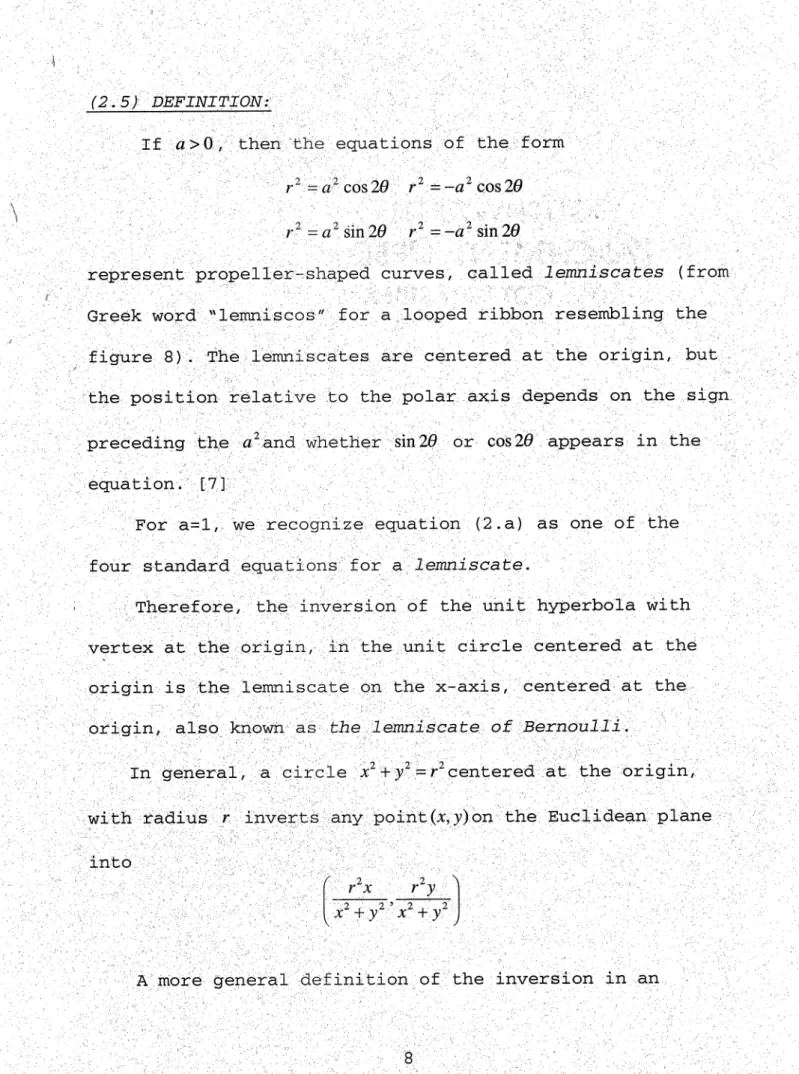
(2.a)(2.5) DEFINITION:
If a>0, then the equations of the form
f- -a'cos20 r' =-a'cos20
r^=a^sin20 r^=-a^ sin 20
represent propeller-shaped curves, called lemniseates (froih
Greek word "lemniscos" for a looped ribbon resembling the
figure 8). The lemniscates are centered at the origin, but
the position relative to the polar axis depends on the sign
preceding the
and whether sin 20 or cos20 appears in the ;;
equation. [7]
For a=l, we recognize equation (2.a) as qrie of the
four standard equations for a lemniscate.
Therefore, the inversion of the unit hyperbola with
vertex at the origin, in the unit circle centered at thd
origin is the lemniscate on the x-axis, centered at the
origin, also known as the lemniscate of Bernoulli.
In general, a circle centered at the origin,
with radius r inverts any point(x,^)on the Euclidean plane
into
^ r^x
r^y ^
x^ + y^'x^+ y'^
V J
arbitrairi^ cirGle on the complex plane is given
(2:6) THE0BiM: ■■t;'
' An inversion in a circle C of radius r, centered at
may
complex plane by the ;
•transformatdon.
■ ■ "■■ ■' ■ "" "
^(z)—
where (zeC—{c}) '
(2ib)
As another example of inversion, we will derive the
formulae for inversion of an arbitrary circle in the unit
circle centered at (1,0) . Without loss of generality, we
may assume a= 1 and radius p =1. The point circle then is
at (1,0) d > dv'-, . t;
c = fl +Z?/ = 1+Q" = 1
^ - c = (r +iy)-1= (r -1)+
/,d- ■ ^-c = (x-l)-/3;
■ ./t-dr;~;1=^
td' ;. ■';d't' :: -;;V/-d- ■: vd'
In the context of the hyperbolic and elliptic pencils
(to be defined below) , the inversion in a unit circle
centered at (1,0) will be
which after rationalizing the denominator simplifies to
(x-1)'+(x-l)+y'^
y
I
Therefore, the image of any point {x,y) on a circle in
the elliptic or hyperbolic pencils will be a point on the
complex plane defined as
{x-if +(x-l)+y
-
y
^
2 . ,.2(r-lf + y-
'(x-l)^ +y
The general equation of an arbitrary circle in the
elliptic pencil is
x^ + -2ky-\= Q
(2.c)
Therefore, the inversion of an arbitrary circle
through the unit circle centered at (1/0) would be
^2 ^2 , /
(-v-2X :-X+J
+ -2k =1
(x-if + y^ j i(x-y +
■ y(x-if^
yX +y -2ky
= 1
-2x+l
which yields to
2 , ,.2
2x — 2ky =\
{2.6.)
Similarly, the general equation of an arbitrary circle
in the hyperbolic pencil is
+2ky-\=0 (2.e]
2 „ . _2 X
X -x+y y
+ +2k =1
y
X +y +2ky
= 1
x^.+ y^ -2x+l
which yields to
X +y +2ky — x +y —2x+\
2x-\-2ky=\
(2.f)We will now give an elementary definition of pencil of
circles. Any single circle in the Euclidean plane may
belong to any of three distinct pencils. Any two circles on
the Euclidean planes define a particular pencil of circles.
(2.7) DEFINITION:
A collection of circles determined by two distinct
circles is called a pencil of circles. Two distinct circles
may relate in three ways only:
b) they may be tangent to each other (parabolic
pencil); and
c) they may fail to intersect (hyperbolic pencil of
circles.)
(2.8) DEFINITION:
An elliptic (intersecting) pencil of circles consists
of all the circles passing through two fixed points. The
elliptic pencil of circles has no point circles. There is a
unique line circle through and .
/\
P, =(-a
We may take the line circle through Pj and Pjas the
X—axis of our coordinate system. The line circle defined by
all the centers of the circles in the pencil passing
through the -fixed points
aijd
, is the'!: perpendicular
bisector of PiPj . We take it as the j'-oxw of the
coordinate: system we need to work with. Therefore, the
center of an arbitrary circle in the pencil would have the
coordinate of the form (0,i). Since the ordinate is the
perpendicular bisector, the fixed points P, and P2 will be
equidistant from the origin and the cobrdinates for Pj and
P2 should be of the form (-a,O) and (a,0), respectively.
(Note that in this context, the y-cais appears to be the
line of reflection for the fixed points Pj and P2.)
(2.9) DEFINITION:
The parabolic (tangent) pencil contains all the
circles sharing the point of tangency but also whose
centers lay on the line determined by the centers of the
two original circles. The pencil has exactly one ireal point
circle, situated at the only common point of all the
■. , :Pigure 2y3' ■
Let P be an arbitrary poirit on a vertical line /. Draw
all the circles with centers on I passing through the point
P. We will easily reason that the '■^unique line circle"
through P will be a straight line, perpendicular to I,
therefore a horizontal line m , such that /om =P.If weassign / and m as y- and x-axes respectively, now we have
a rectangular coordinate system we can work with,
> ■ A,. ^
P
\/
Figure 2.5
Witliout loss of "generality, the lines / : and m Gould
interchange roles. If mis seen as the line formed by the
points, which are the centers of circles passing through
the point P, then the line I would be the yunique line
circle." In this case the parabolic penci1 of circles will
be on the x-cixis of our rectangular coordinate system.
The proof of the orthogonality of the set of all
circles with their centers on the y-axis and the set of all circles with their centers on the x-axis will occur in
Section III, after the Hermitian matrix representation of
the pencils of circles is introduced.
j
An important distinction between parabolic and
elliptic pencils of circles that a parabolic pencil is
determined by a unique point only, while an elliptic pencil
of circles is determined by both, the points and Pj,
important observation is that there exists a minimal radius
for the circles in a parabolic pencil, which is exactly
diPi.P,)
an
Given that P^=(-a,0), P^={afl), and the center of
arbitrary circle O =(0,^), we may find the general
expression for the radii of the circles in the elliptic
pencil.
{x-hf +{y-ky'=
{x-Of+{y-kf=p'
+(y-kf =p^
(2.g)
=P
/N
O io,k)
<-P, (a,0)
Figure 2.6
AlsQ, using the Distance Formula, we may express the
radius of an arbitrary
^{0-af+{k-0f =p
■\la^ +k^ = p
Gbmbining both results we have the equation
+{y-ky' = ■\la^ +k^
+{y-ky =a^+k^
(2.h)
The third case in the definition of pencil of circles
is really the starting point of our discussion. How does
one determine a collection of circles by two
nonintersecting circles? A rather surprising answer of; this
question will bring us back to an ancient Greek problem,
stated by Apollonius of Perga (c 260-190 BC) .
Now we will introduce the construction of the circle
of Apollonius as a way of completing the classification of
pencils of circles.(2.10) THEOREM: .
The locus of a point P whose distances from two fixed
^P=liP^P is a circle.
^2 A
A Figure 2.7
A
PROOF: Assuming p I let P be any point for which
A'P = pAP. (Refer to Figure 2.7 on the previous page.) Let
the internal bisector of ZAPA' meet with AA' at point A,.
Let the external bisector of ZAPA' meet AA' at point A,.
Construct E and F on AP such that AE is parallel to A^P
and A'Fis parallel to A^P, which makes it perpendicular
to A^P . Now FP = PA'= PE , then it follows that
AA, AP AP
, ,
AA, AP AP
= = and also ■ = = —-.
A,A PE PA:
A'A, FP PA
The points A, and A, divide the segment AA' in the
ratio 1:p and moreover, their location is independent of
the position of the point P. Since ZAiPA, is a right angle,
P lies on the circle with diameter A,A,.
points dividing the line segment AA' in the ratio l:fi. Let
the point P be any point on the circle with diameter .
Then:
AP AAi
1_AA2_AP
PE~ A^A~ ii~ A A^~ FP
Thus FP =PE, and P, which is the midpoint of EE, is
the circumcenter of the right triangle ZFlAF . It follows
that PA'=PE and
AP _AP 1
PA~ PE~ yL
The most important discovery is that A' is an
inversion of A through the circle of Apollonius A^A2P .
Let's investigate the relations between the lengths of the
line segments formed by the points A, A', Aj, Aj, and the
center of the circle O.
Let Ai0= A20-P the radius of the circle A^A^P
Observe that
AAi = AO-p
A,A'^p-A'0
AA2 = p + AO
Now we may derive the proportions
- v-AO,.- f) _
p — A'O A|A A A2 p + A'O
Next, we solve the proportion :
AO-p p + AX}
p - AO p + A'O
(aO^ p)(/0+A'o)-(p--A
(4o)(a0)-p'= -^Iao)^
.': V'
'v'','
■^' '
The result defines A as the inversion of the point Athrough the circle of Apollonius A^A^P . [4]
Remarks : ■ - .v ■ ■'V.
V • When p = 1 , the locus would be a straight line,
the perpendicular bisector of AA' , that is the line that
reflects A into A . Recall that in this context, a
straight line is a circle with infinite radius.
• When the locus is a circle that inverts A
into A. (Apollonius of Perga)
way inversion is understood constructively.
Let P be a point in the complete plane. (We include
the point at infinity.) Let f*'be .the Inverse image of P in
circle C.
• If Fis outside of C, to construct P':
A. Construct the two tangent lines of C through P .
B. Draw a line through the points of tangency Tjand
T2 on the circle.
C. Draw the line OP . (Recall, O is the center of the
circle.)
D. Define P'= TJ'2 ^OP
• If Fis inside of C, to construct F':
A. Extend OP in the. plane.
B. Construct the line perpendicular to OP through F
C. Call the points of intersection of the circle and
the line from step B Fjand T2.
D. Draw a tangent line of C through FjOr Fj.
E. F'is the intersection of the tangent line and OF
F. F'=FiF2^0F
In general
P
F
Figure 2.8
These circles are named after the Greek geometer
Apollonius of Perga, c. 255-170 BC, whose only surviving
work is seven out of eight books of a treatise on CONICS,
and is also known for improving Aristotle's approximation
of TT .
(2.11) DEFINITION:
Furthermore, the pencil of all the circles of
Apollonius through two fixed points forms the hyperbolic
(nonintersecting) pencil of circles.
A
o
F,=(-a;0) ^ =(«.0)
Figure 2.9
circles, two different point circles, and, so called
"imaginary circles", which will be defined in the following
section. No two circles of a given hyperbolic pencil
intersect. The investigation of this pencil will continue
in Section III. There we will obtain a new, standard
representation of all the circles and pencils of circles in
the Euclidean plane.
In summary, let P and P' be inverse points in the
circle C with origin O . Then:
The pencil of lines through point P' will invert to
the elliptic (intersecting) pencil of circles through the
given points O and P , including the line OPP'.
The system of concentric circles with center P', which
are orthogonal to the lines through point P', will invert
to the hyperbolic (nonintersecting) pencil of circles.
These circles will not share a point and they will be
orthogonal to the elliptic (intersecting) pencil.
In the special case when the center of the circle C
coincides with point P , all the circles that touch a fixed
line at a fixed point 0= P form the parabolic (tangent)
pencil of circles, that will invert, in a circle with
center O, to all the lines parallel to the given line.
1
U i {
\ V
1 1 , 1 I
\ X, / ~ SH 'V /
z
A yv
\
/
1 / ^
3
Ill.HERMITIAN REPRESENTATION OF CIRCLES IN THE
EUCLIDEAN PLANE
All points z-x^-yi of the complex plane, which are of
a distance p from a fixed point 7= aH-/Siform a circle which
has a characteristic equation of the form
{x-af +(y-PY =p^
If we rewrite the LHS of this equation as
\z-Yf =fe-y)(t-r) another form of the circle is obtained, in
particular
zz-Yz-yz+YY- =0
The more general equation
c[z,z)= Azz+Bz+Cz+D =0,
(3.a)
where Aand D are real and 5and C are complex conjugate
numbers, represents the same circle, if
B=-Ay ,
C^-Ay =B, D =a(77-P^) (3.b)
The matrix with entries A, B , B, and D is therefore
a Hermitian matrix
^A B^
C = (3.C)
(3.1) DEFINITION:
Over the complex numbers, a matrix that is equal to
its own conjugate transpose is called a Hermitian matrix.
The name of such matrix is after the French
mathematician Charles Hermite (1822-1901), who worked with
Joseph Liouville and Carl Jacobi, and is best known for his
proof that e is a transcendental number.
As an example, we use Hermitian matrices to represent
the parabolic pencil in which the y —axis is the line I
formed by the points- centers of the circles in the pencil
(See Figure 2.4).
The origins of the circles are points of the form
(0,A:) and consequently the radii of , the circles in the
pencil will be p=k . Therefore a general equation of a
circle in this pencil of circles would be an equation of
the form
(r-O)^ +{y-ky =
with the circles above the x-axistor k>Q and the circles
below the x-axistor k<0.
Let A =l. Then since C =-Ay = B, with 7=0+jA:, it
follows that B =-ik. Consequently the conjugate of B must
D=a(77-P^) will give D =li^k)(^ik)-k^)=-i^k^ —k^ =k^ —k^ =0.
The Hermitian matrix representing the pencil of circles on
Figure 3.1.1 will be of the form
IV:
(3.d) -ik 0
Similarly, the Hermitian matrices representing the
peihcil of circles whose centers lay on the x—axis (see
Figure 2.5) will be of the form
(3.e)
^2
h 0
We want now to calculate the inner product.
(3.:2) DEFINITION:
^ are orthogonal if the inner product of
their Hermitian matrices equals Oi The inner product is
defined as the trace of the inner product of the first
matrix and the adjoin of the second matrix, that is
N
_
_
Va BAfD,
(A
(A B,
=
'r B, dAt, A,
B, A 5, £)t
In this case:
^1 h'^
1 ik
= (l)(o)+{lXo)--iM-(-rM) = -ihk+ihk = 0
-ik 0 h 0
(3.f)
for Hermitian matrices the inner product is a real number. The value of the inner product, 0 indicates that these two
pencils of circles are orthogonal to each other (see Figure
2.3).
What are the entries of the Hermitian matrices
corresponding to the elliptic pencil of circles? We will
investigate two separate cases in answering this question:
Case 1: Find the Hermitian matrix corresponding to the unique line circle;
Case 2: Find the Hermitian matrices corresponding to the rest of the circles in the elliptic pencil.
Now:
Case 1: The unique straight-line circle in the elliptic
pencil is assigned as the abscissa in the rectangular
coordinate system. Therefore the equation of the
straight-line circle is ^=0. Also, in the context of this paper,
for a straight-line circle the entry A in the Hermitian
matrix
'A
B D
V J
circle 4zz+fiz+5z+I)-0:, for A =0 will reduce to
B{x-iy)+B{x+iy)+D =0
iB+^+i{B-^^-D=0
In order to get y =0 we restrict B = —B, which gives a
pure imaginary (see footnote 1) Ai witli Av>0 and As i? . We
may divide by A , so the Hermitian matrix takes values
0 ±i
+ i D : V
To find the value for D, which will give the desired
equation ^=0, we proceed as
±i(i+i)y +D =0
. . +2iy +D =0 ■
Therefore, v =0 when D =0. Now the Hermitian matrix
for the line circle in the elliptic pencil is complete as
■
■
'
■
^0 '
-i::
(3.g)
c,=
-i 0
Case 2: For the rest of the circles in the elliptic pencil,
assume A =1 . The center of any arbitrary circle is (0,k) or
Y =ki. Then B=-yB=ki, B=-ki, and D = yy-p'=k'-(«'+k^)=-a'.
1 For B =a+jj8 and B =a-iP, B-B ={a+ip)-{a-10)= 2j8 i= for A =ip,a pure imaginary
The Herrriitian matrix is of a form
1 ki
(3.h)
—ki -a^ , . /
with a determinant del =-A' -a . As expected, the determinate
will always be a negative number.
Observe that, when the distance between the given
points, jF^ and
is 0, :then
=
beGOmes a single given
point and the elliptic pencil of circles will be the
parabolic pencil of circles (see Figure 2.9).
(3.3) DEFINITION:
The locus of a point P whose distances from two given
points Pj and Pj are in a constant ratio
, so that
P2P =/iPjP is the circle of Apollonius. ^ Furthermore, the
pencil of all the circles of determined by two
given points forms the hyperbolic pencil of circles.
In a situation where the points Pj and P, have already
defined an elliptic pencil, any set of circles through P,
and Pj is orthogonal to any circle of Apollonius for P, and
P2
our coordinate system. Let the coordinates of point P be
(x,y) and let find the general equation of a circle of
Apollonius, corresponding to any value of jU , in this case
an arbitrary parameter.
Now, P2P = liI\P and by the Distance formula:
■^{x-aY + y^ =IJ.'J{x+ay +y^
{x-aY + y" = [(r +a)" + y"J
Q =li^\x+ aY + y^\-{x-aY
0 = fi^x^ +2^^ax + jJL^a^ +H^y^ -x^ + 2ax-a^ - y^
0 = x^{fi^ -l)+2ax(u^ +l)+a^(u^ -l)+
-l)
0 =
-l\x^ +a^ + y^)+2ax{fi^ +l)
0= x^+a'+y' + ^Y''^}lx
(m -l)
. 2a(Ai'+l) Afl+lT 2
— u +■
R-lf
fl(|U^ +l)
^+"7^—r
+(y-o)^
R-i?
(^ -i)
^
a{p,^ +\^
+(}'-0)^
(3.i)
u"-1
W'-I)
V ^ /
The resulting equation is an equation of a circle with
its center
a(u^ +l)
Y = ,0 (3.3)
FR
with radius
2a/i ^
(3.k) P =
^ -1 y
Indeed, we expected the centers of the circles in thq
pencil to be on the horizontal axis.
Let's determine the correspondihg Hermitian
Let A =1. Then from C=-Aj= B /
witAi
, it1^'
follows that
s=-t^=-b
Knowing that D=a(77-p^), we will derive
+l)X ( ^ ^
D =1
(m'-l)
m'-i
+l)^ -(2ap)^
(l-p')f
-b1+
+r~2<3(p)
a^{fi^+2ap+l)(p^-2ap+1)^
MT
"
((p+iXp -1))^
(l-p^)'
^a^ipL^ -l)^
g'=D
The Hermitian matrices representing the hyperbolic
pencil of circles are;
g(l+ p^)
(3.1) Ch =
/
IV.STEREOGRAPfilC PEOjECTION ONT^^ TINIT SPEERE
So far we have been developing the inverse geometry of
the plane. As: it tutrisiout,: the eomplete^^^
is aiv
limited field for deyeloping the gepmetry Of.circles
;
because the position of one of itS: points, the point et
infinity, is in fact 1sglated. ;{Ths Completion of the:plarie
with a point at infinity was crucial for the inversion of
the whole plane onto itself to be a one-one
The idea in this paper is to translate and possibly ;
classify the constructible points of the Euclidean plane
onto the sphere. We chose to explore the geometry of
circles and a conformal one-one mapping called the
Stereographic projection. In order to achieve our main goal
in studying constructible circles on the sphere, we will
define a mapping from the extended plane onto the sphere
with the following properties:
a) It is a topological mapping of the completed plane
onto the sphere, which makes these two surfaces
topologically equivalent. (A topological mapping is a
mapping that is continuous and has a continuous inverse.)
The stereographic projection maps from the plane onto the
imaginary circles to imaginary circles.
bj it is a conformal mapping, which means that it
preserves angles. The significance of the latter is that
the imsLges of orthogonal circles on the plan©/ under the
^
stereographic projection, are orthogonal circles on the
sphere.
Now we are ready to give a precise analytic definition
of pencil of circles in terms of Hermitian coordinates'
representation.
(4.1) DEFINITION:
A pencil of circles is a subspace of the yectbf space
of Hermitian matrices. The collection of Hermitian matrices
is a 4-diinensional vector space, which means that we can
form real linear combinations. Thus, a pencil determined by
two circles is a vector space of dimension 2.
As an application of this Hermitian structure we will
show two problems:
• The orthogonality of Elliptic and
Hyperbolic pencils of circles; and
• Inversions through the unique circle with
the smallest radius in the elliptic circle.
product of their Hermitian matrices equals 0.
The Hermitian matrices representing the hyperbolic
pehcil
d
(3.j) and radii (3.k) with
an' arbitrary :parain^te:r: ■ .
ci(ju^ +1)
(4.a)
a(jLr +l)
a
The Hermitian matrices for the elliptic pencil of
citcles iexcluding the- line circle)! ate:Of the form
^ 1 ki^
(4.b)
— hi -a^
Caieulating the infier product as defined in Definition
3.2; to
a{u^ +l)
ki ^
"W
2.
-ki -a
a V" ■ ■ ■"■
l(- )+l{a^)- (-ki]
kai {jJL^ +1) kai {u^ +1)_ n
-a^ +(2^
Hence, we may state the following theorem:
(4.2) THEOREM:
The Elliptic and the Hyperbolic pencils of circles are
mutually orthogonal.
The proof that the two parabolic pencil of circles with the centers of the circles respectively on the
X-axis and y-axis are orthogonal is similar.
Pencils have interesting properties with respect to inversion. The elliptic pencil of circles has a unique
circle with smallest radius. For the purpose of this paper, we may assume, without loss of generality, that the radius
of this circle is 1, that is (a,0) in this exercise will be
(1.0)
Previously, we derived the general form of the point of inversion through the unit circle, centered at the origin, that is
' ^ y
9 7' 2 2
Also, we introduced the general equation for a circle
(3.a)
P,=(a,0)=(1,0)
c(z,z)= Azz+^+Bz+D=0
The Hermitian matrix for an arbitrary circle in the
elliptic pencil was derived as:
f 1 ki
- ki -a'
and the Hermitian matrix for the unit circle as the unique
circle with the smallest radius in the elliptic pencil is
consequently:
^1 0^
(4.C) Ce =
0 -i
since a = l and k = Q, where k is the distance between the
origin and the center of the arbitrary circle in the
elliptic pencil.
To find the inversion for k^O:
+ y^ + ki{x+iy)-ki(x-iy)-1=0
r + y + kix-ky-kix-ky-I=0
xi + V" ~2M'~ 1 — 0 (4.d)
(The latter is the general equation of an arbitrary circle
\2 \
+, -Ik M-0
H- y'^
X
- + -
■2ky-{x-^
x^ + };^
x^^y^
I- 2ky - .V" - ;v' = 0
: ■ V,x-' +y^
-1-0 (4.e)The opposite sign in the (4 .d) and (4 . e)
show that the inversion of an circle in the
elliptic pencil through the unique circle with the smallest
radius is a circle on the other side of the line circle. In
fact, setwise, an inversion through the unique circle with
the smallest radius is equivalent to a reflection through
the line circle. Note, the equivalency is up to the same
set of points. The reflection through the line circle is a
linear transformation, while the inversion through a circle
is not a linear transformation.
We conclude that the elliptic pencil is invariant
under inversion through the unique circle with the smallest
radius.
There is a couple of ways one can set the spatial
employ the stereographic projection. In this paper we will
work with the Euclidean plane intersecting the sphere
through the "equator" and we will define the South pole, S,
of the sphere as the image of the point of infinity of the
completed plane. The South pole will be the center of the
projection.
One may visually imagine the ma,pping as a nay of light (a straight line) and the source of this light being at the "hole" of the South pole of the sphere. Thus, any straight line would intersect at a Single point both surfaces, the plane and the sphere. For our purposes, we will call the point on the complex plane z =m +?v the pre-image and the
point on the sphere z* - t of the mapping.
Let's recall that the circles on the sphere are the
sets of the points of intersection of a plane with the
unit sphere. The general equation of a plane is
au+bv'+cw'=d
(4.f)
In the special case of d=0, the plane will be passing through the origin of the sphere and the set of points of intersection would form a great circle on the sphere.
Our next Step is to establish the equations of the
Generally, let (li,?7i,Ci) and
arbitrary points
in space, represented by the position vectors r, and ^2'
respectively. Then, the vector represents any point on the
line determined by these two points r
where A is a real parameter, that is
i)=(l-A)t|,+A>),
[31
Applying the relation above to the two points of
interest to us, the South pole S =(0,0-1) of the unit sphere
and an arbitrary point on the competed plane Z=(m,v,0),
the image on the sphere Z* =(M',v',w')will have the co
ordinates:
m'=^(1 —A)0+Am ;
v'=(l—A)0+Av
w'=(1-AX-1)+0
Simplified,
m'= Am; v'= Av; and h''= A —1 (4.g)
To find the value of A , we will substitute the
expressions of (5.b) into the equation of the unit sphere
u'^ +v'^ +w'^ =1 as follows:
Solving for vl yielids the equation
. 2 _ 2_ '
+v^ +1 1+zz
Thus, the coordinates of Z* =
w')will be given by
, • /
2z
, 1-ZZ
// • N
M + jv = = and w — (4.i)
. 1+ZZ . 1+zz, \
Explicitly,
Z* =(u\v\w)=—^{2u,2v,l-zi\
(4.j)
1+zz^
/
In the other direction, to find Z on the plane for a
given Z* on the sphere, similarly:
u — (1 —A)0+Am
V — (l — A)0+AV
0-(1-AX-1)+Aw'
simplified,
u = Xu } v = Xv ,- and
0= A-l+zlvv'^^l+ AG+ w') {4.k)
Hence, X= —h_ and consequently
1+ w'
Z=^
(4.1)
1+ w
Trivially, the unit circle on the Euclidean plane will
contain all the points z=u + vi, such that Z = Z* . In other
the stereographic projection. Also, the unit circle on the
Euclidean plane is a great circle on the unit sphere.
The Hermitian matrix for the unit circle is
fi .oV
0 -1
V • 7
Our goal now is to find the equations of the
stereographic projection, which would map the Hermitian
matrix representations of the points on the plane to the
ordered triples, (m',v',w') representations of the points on
the sphere. The Hermitian matrix for a generalized circle
on the plane is
B D \
with coefficients from the equation of a circle presented at the beginning of this paper
Azz+ Bz+Bz+D = 0.
A plane may be defined by an equation au'+bv'+cw'= d,
where:
• when d=0, it is an equation of a plane through
the center of the sphere;
• when d^O, it is an equation of a plane
Another way to define a plane is by its normal vector
(MVv'iw') with the r^^
of u'^ +v'^
= 1 and
/ , /•
U + V I
z =
l+ w'
Therefore,
Azz+ Bz.+ Bz+ D =0
/ / , /•\/ / /•\ / / /•\
,( M + V ; Y a —V i * U + V I ^
+ J +S +D =0
l+ w A l+w l+w' 1+w'
/2 , '2■ \ / / /•\
U + V I '^u'+ v'i^ -=4 u -V
+ B
+5 :
•,
+D =0::1+ w'. l+w
Since u +v =!- u'
[— w')+5(m
'
+ v'i)+B(u':— i''/)+£)(l+ w')=0:
Distributing and combining like terms to
u — B+B;
v=i(B-B)^iv'=B-B
w'= D-A ;
and d = D +A {4.m)
In aM'+&v'+cw'= , d shows the "height of the cut
where the plane and the sphere intersect. In the. Hermitien
matrix, Z> is such bhat ID =^p^, where p is the radius of'
the circle. Any circle centered at the origin of the
a;-.'
(4.n)
We already characterized a hyperbolic as;
■'follows.: ' . _
A hyperbolic pencil of circles consists of real
circles, imaginary circles, and two different point
•pircleS.-..:;;.'..;;- ' 'v;'
Two circles of a hyperbolic pencil cannot have a
common point (see Figure 2.9) . However, this is the general
case of circles of Apollonius.
We may also work with the so-called standard
hyperbolic pencil (also referred to as hyperbolic pencil in
standard position) , which is a special case of the
collection of the Apollonius circles on the completed
plane. In this case, only one of the two point circles is
finite and the other one is the point circle at infinity.
It is the collection of concentric circles with a common
center at the origin.
The images of this pencil on the sphere, under the
stereographic projection, will be circles- sets of points
of intersection of "stack" of planes, all parallel to the
u,v- plane. The axis of this parallel plane pencil is the
line of infinity.
We now want to find the axis corresponding to an
arbitrary Apollonius pencil of circles. In order to do this
we will observe the images of the two point circles of the
hyperbolic pencil onto the sphere.
/ \/
Apparently, there are
/
tangent planes to
/X / \\\
the sphere, whose
/ f" /
m\
line of intersection
/ I 1"
" y \
is an line exterior
\J
y \ \
to the sphere, and
/
'^1
this line is the axis
\ of the pencil of
planes. Figure 4.2
Let Pi=-ai+/&i and
be the two point circles
of the hyperbolic pencil of circles with two distinct
Hermitian matrix representations of and F^ respectively:
(1
bA r 1^2'
::;:itnd''^
, where F^ =
=-a^ +ibj
Bi D2
\
m'
\ ^ Jdeterminants of the Hermitian matrices above must equal 0.
Therefore, the restriction on the entries is such that
=
=0 or D =\Bf, and in order for the two points
to be distinct, iDj
•'
representations
could be written in a form
1 B, \ B,
Bi \B,?
and Bi IBoIfor the points and Fj, respectively.
Now, let B-^=ay +i\ and 52 =^2+^'^2- Then B+B = 2a;
B-^=2ib; and \Bf ±1= +b^ ±l. Substituting these, values in
(5.g), we have the equations of the images of the two
distinct point circles on the sphere as follows:
2aiM'-2&iv'+|Fj|^
= +1
2a2M'—2Z)2v'+
—l)w^'=
52 +1Note that the plane equations show that the planes
will tangent or exterior to the unit sphere. ,
The points on the line where the two tangent planes
containing the images intersect are orthogonal to both
i j k
n — 2^1 -2b^
-1
2a2 —2/^2 IBtI" ~1
d-2|-fciffi2l'^l)+^>2|5i1'-i| 1+2^151^
Let P,=-a,+ ib^ and ,Pj — -c^ +1&2 .: Since,
it follows that
p* P*
. 1 ■'^Z'
L
2 d 2 Vi
2
:+
-
^
+
j(l+ (^2 "^^2 /
4a,a2 +4/2,/22 + (l -af -/zf )(l-a^ ~^^2) _
; (1+ af
j^+h2 -I- ^1) ■ '
:
Figure 4.3
are
Pj* and: Pican be: viOwed as uhit vectors, siiioe they
i^=COS0
a
CL COS0 = 1 — Of
=>a(l+cos0)=l
=4>a =
1+ COS0-:
Nbtic© that the
result will be undefined in the
case : where cos0 =-1. This is a special case and we will
explain it later in this section. We will continue our
reasoning assuming that cos0 i=- -1
■ Combining the last two results yields:
1 +4rt,i/,+4hJ?2 +(i-
-l>i j(l-al-hi)
The positional vector
Or
f =((^,r;,C)/ that is
g
—(cZj +rj2)(l+
)(li"^22 t )
1+4ajii2 +4&J&2 t(l~ ~
^2 ~^z)
ri
ih +^2)(l+
)(l+^2 +^2)
1+4fljfl2 +4&jZ?2 "t" ^1 — Q,^ ~
~ci^ ~ b^ ^
„ _ (2-af -^2
-^>2 )(l+af +^>i^)(l+a2 +^2)
1+4^1(^6(2 +4&J&2 +(1~
~*^2
The point represented by the positional vector
r=(^,»7,C)
is a point on the axis of the pencil of planes..
The directional vector is
d 2[—Zjj^6(2 +^2 ~ ^2 t ^1)] i
+2[a2{a^ +bf -1)-aj[a^ +&2 ~l)] j+4(a2^i-a^b2) k
(4.r)
With the location of a point in 3-D and a directional
vector, we now can precisely describe a line in 3-D, in
particular the axis of a pencil of planes.
Let Pi=(—5-,0) and P2-(j,0). Then aj=t; b^=0; a2=-y;
above, we have
r ={^,ri,C)=(0,0,j) and
d =0i+fj+0k =fj
A circle on the sphere is obtained by the intersection
of the sphere with the plane. In fact,, even planes that do
not intersect with the sphere determine "imaginary"
circles.
We will finish with few technical results regarding
the stereographic image of pencils of circles. The three
types of pencils correspond to 3 situations in 3
dimensional pencil of planes (where pencil of planes will
be defined as all the planes that contain the line, called
axis of the pencil):
A. Elliptic pencil Of circles will be determined
by a pencil of planes, whose axis is a line secant
to the sphere. All the circles will be with a non
zero radius. The points of intersection will be the
stereographic projection of the two given points the
one that determines the pencil of circles in the
Axis of the pencil
of planes
Figure 4.4 V
B. A pencil of planes, whose axis is a line
tangent to the sphere, will determine the parabolic
pencil of cirCleS::.^^ ^
the unique point
circle of the pencil of circles in the plane will
occur at the point of tangency.
/
\<-Point of tangency^the image
of the unique point^
\i
circle in the plane,
Figure 4.5
C. Hyperbolic (Apollonian) pencil of circles will
be determined by a pencil of planes, whose axis is a
Figure 4.6
I. The two planes tangent to the sphere will
deterinine, under Stereographic projectipn, the images
of. the two point circles in the plahey:
II. All the planes intersecting the sphere will
determine the images of the circles with non-zero
radii, or the real circles in the pencil;
III. All the planes that do not intersect the
sphere will determine the images of the circles with a
"negative radii" or, so called the imaginary circles
in the pencil.
Mow does one, in general, determine the planes in a
pencil which produce ima.ginary circles. We may further
elaborate on this using the last concrete example in this
section. ForP, (-|,0) and P, =(t,0), the positional vector
r =(0,0,4) located a point on the axis of the pencil of
planes and the direGtional vector was cl =|-j .
Therefore, + +^3^ ~T^3' where n =(wivWijWs)/ d:= I- j , and
n•d =0 must be a plane in the pencil. Since, d = U =(0,|,0),
niO+ njI+^sO =0 , which forces nj-^. The conclusion is that ;
any vector of the form n =(wj,0,n3) is a possible normal
vector- of this' pencil, and a.ny planes of the form
njX+n3Z =|-n3 for arbitrarY values for n,. are planes of this
pencil. Back to the concrete case for
=(—y,0) and P,~("i'^) >
using the equations on page 31, we get the images
/!'=■, ] , :
I U'
(MU) and
P2= :^^
1+ a, + Wo
Thus, planes of the form ±yx + fz = -^ or ±8x + 6z = 9 are
planes in the pencil. '
It would be even nicer to be able to determine the
planes in the Apollonian pencil producing imaginary
Figure 4.7
n- r iV-i n.
<cos 0, 2 "'"'^3 +rt.
where the direction of the inequality follows the fact that
cosine is a decreasing function. In this particular case, 6
is the angle between Pi* =(-jAf) and
fAf)/ and can be
easily computed as
j_ cos e=p*-p* 25
Therefore,
In conclusion, all the planes satisfying the relationship
^3 3
Although not in this paper, an interesting problem
could be posed for the cases where the images of the unit
sphere are antipodal points. The tangent planes determining
the point circles on the sphere therefore will be parallel
to each other, and the axis will be the line at infinity.
V,INTRINSIC DEFINITION OF A CONSTRUCTIBLE CIRCLE ON THE
UNIT SPHERE
: Let'^ on the surface of the sphere and ; ;;
adjust to the "laws of nature" working on it. On the
sphere, as on the plane, circles have radii, diameters, and
chords. The difference is that on the sphere all these are
chords of great circles. (Great circles are intersections
of the sphere with planes going through its center.) Every
circle has exactly two centers- antipodal points on the
sphere. Like on the plane, a radius of a circle is one half
of its diameter, but unlike of the lengths of radii and
diameters on the plane, here, on the sphere, distances are
measured in degrees. For some, translation in radian
nveasurements could be more familiar.
The planar straightedge and the planar compass have
their counterparts on the sphere. The spherical compass can
only draw circles on the sphere with radius measures no
longer than 90". If a radius greater than 90" is given, the
circle is drawn from the opposite center with radius egual
to the supplementary angle.
In the last section of this paper, we will define the
interested how one can define a circle on the sphere as
constructible, using only measurements which can be
gathered on the sphere alone, regardless of the preimages
in the Euclidean plane. For example, seeing a circle as the intersection of the sphere with a phane in the space, one
may calculate the normal and the position vectors
determining the plane by taking measurements along the
sphere. We will call the normal and the given position
vectors that determine the plane, a set of data of the plane. Also, angle measurements on the sphere are
equivalent to distances. Angles on the sphere can be
measured by Lenart's compass, and these are, of course,
intrinsic measurements.
In order to achieve this goal, we will start with a
non-intrinsic definition of the constructible circles
on the sphere.
(5.1) DEFINITION:
A circle on the sphere is constructible if and only if
its stereographic projection is constructible on the
completed plane.
Our motivation,behind this definition is twofold:
quadratic rational processes (see Definition 5.2). Thus a
point z in the completed plane is construetible if and
Only if its image, under stereographic projection z* has
consructible coordinates.
• The construction of the circle on the
sphere by Lenart instruments is consistent with this
definition. We will show this at the end of this section.
(5.2) DEFINITION:
Any calculation from given numbers, involving
squaring, square roots, arid the four basic operations of a
number field, is a quadratic rational process.
: As an example of a non-intrinsic property we will show
that the center of a circle in the plane does not, in
general, project to the cup point of the stereographic
image of the circle.
Given a circle in the plane defined by |z —c|= r, we
compute z*- C'-^-cosB , where (z*- G*) is the ordinary dot
product of vectors in 3-D and so 0 is the angle between
them. ■ 1- ■ '' l' ,
: ■ Now,
(z-c3(z'-c)::=^ ''
=»^|zp+|cp-,(cz H-cz)-
'
|z|" +jc|^ -2(RczRec+Imzimc)= rl
z|^:+14?-^.^^;= 2(Re'zRe.c+ImzImc)
. ;(5,.a);
From (4.g) we have the formula for the spherical
images of the points on the plane under stereographic
projection.
: Therefore:
z*= 12Rcz,2Im z,l- z
0.:;
and ■
C*=
^(2Rcc,2fm c-,1- c
Then
■i
^(4RezRec + 4ImzImc,(l-|zp)^-lcp))
(l+|c| |l+|d J
i:
1 ( I j2 I 12 I |21 12
, Y ^ ^ V |4RetRec + 4ImzImc -i-1--[zl -\c\ -t- |z| p|
I
czRec +ImzImc)+l-|zl' -jcj' +|z|'|c|
,, r |2 V. |2Substituting the result (5.a) in, we get
^-^^(2tisicr-.^Ki-izr-icr.mzr)
^-^^^.NNicr.|zrkr-2r^)
2r'
=l-f TV (5.b)
(i+H'Ii+tf)
The later is a representation of the spherical
distance between the image C* of the center of the planar
circle and the image Z* of a point on that circle. Since
(5.b) is not a constant expression, C* does not necessarily
coincide with the cup point- the center of the spherical
circle.
We do not want to leave the plane pre-images of the
spherical circles before we put a little bit more thought
into the constructible circles there. Let's say we have a
constructible circle in the Euclidean plane. Then
points. The diametrical opposite point of
, say P3, must
also be a constructible point. Then P2, the intersection of
PjPj and its perpendicular bisector, would be a
constructible point as well. More generally, from Figure
5.1, it is easy to see that ZPjOPj / .^PiOP^, Z.P2OP2 are
Constructible angles, and each of the P^ has coordinates
(cos0,sin0) for the appropriate 0, which are constructible
entries. We may always translate any constructible circle
on the plane, so its center is the origin of the coordinate
system, moving through a constructible angle away from a
constructible angle. Even if we must scale the circle to
get the unit circle, centered at the origin, it will
involve multiplication of a constructible distance, which
is also constructible.
P
P, P
. It:^ a:qonstructible
circle, defined as such by a constructilile point as a
center and at least one constructible poirtt in the set of
its points, has at least three constructible points in the
■■set-'of ■its points., How may one use this observation for defining a
constructible circle on the sphere intrinsically? In other
words, how does one define a circle on the sphere as
constructible, not knowing what is its preimage on the
Let I\ ,
, and P/ be the images on the sphere of P, ,
P^, and P3, respectively. Although they are in different
places on the spherical circle now, they are still
constructible points . Then, P^P. and
are constructible
yectors./- ';.y;
(5.6) DEFINITION:
A vector is constructible if its coordinates are ■
constructible.
NOTE: If a given vector is constructible, then its
associated unit vector is also constructible, since
division be the length of the vector is a quadratic
If are constructible:
• Their difference is a constructible distance;
• Their cross product, since it involves
• multiplication and addition only, is
constructible;
• Normalizing their cross product to unit
length-the vector, normal to length-the plane, determined by length-the vectors
P1P2 and P1P3 , involves division by a constructible length.
Figure 5.2
A circle on the sphere is constructible if and only if
its cup point and its radius are constructible. and C*are
constructible and all P* are equidistant from the cup C*.
This distance on the sphere has the angle representation of
T-»*
(5.7) main theorem.- :
: A circle is construetibia if and only if it is determined by a plane with constructible data. (5.8) COROLLARY: : ' t■ ■ ' ■'V t;
A circle is constructible by Lenart tools if the cup
point is constructible and the radius of the circle (angle,
arc) is constructible.
(5.9) LEMMA:
A circle on the sphere is constructible only if its
Hermitian matrix representation has constructible entries.
(The lemma is conditional only, because the matrix can
determine "imaginary" Circles, , which we will clear up at
the end of this section. )
PROOF: As we have seen in Section III, the entries of the
Hermitian matrix. A, B, and D, have been obtained by
quadratic rational processes only. Their entries are
constructible if the radii of the represented circles
are constructible. The data determining the plane (Section
IV) , in particular the positional vector r (4.q) and the
normal vector ri (4.p) , involved only quadratic rational
processes.
to a construetibie circle, provided that it has a
bormai■
vector with construetible coordinates, and at least oneconstruetible point on the circle, q V.
! . i
A circle on the sphere is defined as an intersection
of the sphere and a pi^he- We will use:the Hermitianm
to find the plane whose intersection with the sphere is the
circle in question. Any plane in 3-D is determined by:
its normal vector n ; and
:
• a known position vector f, which picks up a
point on the plane.
Thus, a constructible circle on the sphere corresponds
to a Hermitian matrix with constructible entries. On the
other hand, we know that some Hermitian matrices correspond
to affine planes that are exterior to the unit sphere. This
motivates the following definition: I'
(5.10) EXTENDED DEFINITION
; OF CONSTRUCTIBLE CIRCLE ON THE SPHERE:
: A circle on the sphere (real or imaginary) is ■ ■
constructible provided that the plane corresponding to its
Hermitian matrix has constructible data.
What are these "imaginary" circles?
geometry, even though we canhot construct them with Lenart
tools. However, the space of Hermitian matrices has a rich
geometry of its own where imaginary circles can be given a
natural representation. This subject is beyond the scope of
REFERENCES
ti] Martin, George; :<Seometric ConstiructiQns.-;199p Springer
■
Verlag New \York-:inc-.' , -^V.
■
■
I
■ ■
'
■
[2]" Borowski; E.'
; Bgrwein
Har^^er Collins
Dictionsry of: Mathematics " •
[3]- Schwerdtfeger, Hans;: Geometry of
:Coriiplex Numbers 1979
Dover'Publication inct.
,
V
,jt
; •
[4] ^Coxeter
H. S. M.; Introduction to Geometry.j John Wiley
Sons,
■;lnc',; '' ■"
^ ' -j ■ \
'
15 ] ■ Boyer, Carl B.; A Histpry of Mathematics. jLiin Wi1ey &
/Sons,yinc:.':;
■ ' |v
[6] Martin, George; Transformation Geometry. 198|2
Springer-Verlag New York Inc.
V[7] :{Hi Thatb
4*^^ edition,)
[8] Lenart, Istvan; Non-Euclidean Adventures odi the Lenart