s Z
RESEARCH ARTICLE
MEASURING AND MANAGING PERFORMANCE IN SECONDARY SCHOOL IN MAURITIUS
*Bhaugeerutty Vinod Sharma
Hospital Road, Centre De Flacq, Mauritius
ARTICLE INFO ABSTRACT
During the years school performance management has become an important issue in many countries. As performance measurement plays an important role in the management of secondary school. This document shows an understanding of how schools measure its performance, report it and use it for improvement purposes. In this way, performance management includes these elements, namely measurement that is a collection of information on organization performance, secondly incorporation that is reporting of organizational performance information to organizational stakeholders, and finally use, the utilization of organizational performance information for decision making. One of our main goals is to analyze the performance management practices of schools, in the relation to the above elements.
INTRODUCTION
The Ministry of Education in Mauritius in collaboration with policy makers, is using performance management as a measurement tool to raise student achievement and improve educator performance. This document looks at some of the assumptions that underpin the current approach to performance management and measurement. It considers issues about the reliability of these measurements, the appropriateness of using targets and indicators to measure and manage the performance of students and schools, and the likely impact on students and educators. Policy makers are using performance management as a key instrument to improve the education system so as to raise educator’s achievement and increase accountability as it enables schools to assess the progress in achieving predetermined outputs rather than just focusing on costs and activities. Performance management in its current form, however, has origins in anxiety about underperformance in education in an increasingly competitive global economic environment.The development of appropriate techniques of performance measurement in education raises a number of questions that deserve being researched (Mayston, 2003). One important property that any model of performance measurement should have, and that should be considered, is the
*Corresponding author: Bhaugeerutty Vinod Sharma,
Hospital Road, Centre De Flacq, Mauritius.
need to adequately account for the differences in resources and in the characteristics of the students that each school faces. The utilization of aggregate exam results, not adjusted for these differences, will unduly favour schools that receive students from more privileged socioeconomic backgrounds.
The Principles of Performance Management
Performance management is a means of auditing and managing system-wide activity. Schools are encouraged to raise their levels of performance, and manage their staff and students more tightly to achieve better outputs and outcomes. Its assumptions are that performance levels can be raised so that evaluation on both an individual and comparative basis will promote improvement. Performance management uses indicators such as student test scores to rank students, schools and counties and to generate Performance Targets that are then used to manage performance. When identifying desirable outputs or outcomes, it is critical to start with service objectives and think about what are the intended benefits and beneficiaries, for example, objectives include better schools, provision for missing facilities, allocation of additional funds, improved access to education, better IT services, to achieve quality education etc. One of our main goals is to analyze the performance management practices of educators in relation to the above indicators and understand how schools measure its Article History:
Received 19th July, 2017
Received in revised form 10th August, 2017
Accepted 21th September, 2017
Published online 30th October, 2017
www.ijramr.com
International Journal of Recent Advances in Multidisciplinary Research
Vol. 04, Issue 10, pp.2841-2860, October, 2017
Keywords:
Supervising Officer – SO Key Result Areas – KRA Key Performance Indicators – KPI Heads of Section – HOS Performance Agreement – PA
Performance Management System – PMS Key Strategic Factors – KSF
performance, report it and use it for improvement purposes (Bouckaert and Halligan, 2008).
Role and Responsibilities of Key Stakeholders
The Supervising Officer of Ministries/Departments (SO): The SO identifies the Key Result Areas (KRAs) in line with its strategic plan and the priorities that the Ministry/Department should deliver to its customers. It is responsible for the development and adoption of the strategic priorities of the Ministry/Department through the annual plans.The SO is responsible for ensuring that each section/unit of the department is assigned Key Performance Indicators (KPIs) drawn out of the department’s strategic and annual business plans. The SO appoints the Monitoring Committee and the Moderating Committee in consultation with senior management, employee representatives and Head of Personnel Section. It ensures the implementation of the PMS at the Ministry/Department.The SO appoints the Appeal Panel in cases of appeal.
Heads of Section/Unit (HOS)
The HOS are responsible for the achievement of objectives of their respective sections or units. They ensure that all members of staff have valid and up-to-date job descriptions and that all Appraisers discuss and agree upon a Performance Agreement (PA) with every appraisee under their supervision.
Appraisers
The Appraiser ensures that the development of a PA is fully explained to all appraisees under their supervision. They will then develop a PA jointly with each Appraisee.The Appraiser will clarify for Appraisees the objectives of the section/unit, the customers of the unit, the Appraisee’s job description, the Appraisee’s customers, agreed KRAs and competencies, Performance Standards and the actual rating on appraisal. They will also assist Appraisees to identify and incorporate training needs into their PAs.The Appraiser will also ensure that all forms are completed properly, accurately and in a timely manner.
Appraisees
All Appraisees of the Ministry/Department are responsible for clarifying with their immediate supervisors the dates and process for developing and submitting their Pasfor developing a draft PA, based on the required objectives, KRAs and other aspects of their job that have been previously clarified by the Appraiser. The Appraisee is responsible for presenting the draft PA to the Appraiser for joint development of the final PA.
To achieve this, the Appraisee must ensure the following:
Participate in performance planning at team and individual levels.
Enter into performance agreement with his/her Appraiser.
Execute tasks to achieve KRAs and competencies criteria.
Keep personal records of successful achievements of outputs, as well as shortfalls, to facilitate meaningful communication/feedback when required.
Seek support and guidance, if necessary.
Be available and prepared for performance feedback and performance appraisal interview discussions.
Communicate career, developmental and recognition aspirations to his/her supervisor/team leader.
Identify customers, both fellow Appraisees in the department as well as others outside the department, establish their service requirements and obtain customer feedback on service provided.
Take responsibility for own work plan and participate in the Performance Appraisal discussion.
Importance of setting indicators
The use of indicators of performance as a way to measure progress towards achieving desired outputs and improving performance in education is now widespread across schools. Though it is in place since 2008, it differs in significant ways from school to school, for example, providing data on examination success rates and school environment. In some cases, the absolute number and percentage are relevant and useful information for the indicator. Indicators can measure quantitative (raw data, comparable numbers) as well as qualitative (opinions, values, yes/no) information and can be used to serve as benchmarks, comparing results across time, or across different population groups, localities, types of schools, gender and etc. Kenny (2001, p.176) developed a performance measurement framework, “Strategic Factors” that identifies key school stakeholders (namelyeducators in this study) and their expectations (Key Strategic Factors, (KSF)) from the management as well as the performance indicators that reflect the status of each KSF. Kenny (2001, p.176) has applied the „Strategic Factors” approach to a number of commercial as well as governmental organisations. Kenny (2001), and Wisniewski, et al. (2004) have applied the stakeholder concept to measure performance of noncommercial organisations. So the policy-makers have to collect data on the functioning of education systems, and need to draw on these data to monitor systems, identify trends and promote change. From literature review, it is seen that policy-makers in the UK have experience performance management as a mechanism for putting pressure on educators which has deviated educators from a perceived overemphasis on the teaching process to a stronger focus on attainment outcomes, together with a desire to increase the accountability of the teaching profession, and so increase value for money.
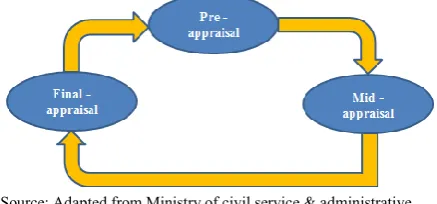
The Performance Management Cycle
Source: Adapted from Ministry of civil service & administrative reforms (March 2013)
Figure 1. Performance Appraisal Process at Individual level
The performance management cycle can be grouped into three phases comprising the following steps:
Pre-appraisal stage
In pre-appraisal stage, the school appoints a convener/appraiser to take charge of the development or improvement of the educator performance management system. It is essential to conduct a situational analysis of the school. The appraiser discusses and records priorities and an objective with each of the educators in his/her team and discuss how progress will be monitored through a two way communication between appraiser and appraisee. It is important for the appraisee to select the Key Performance Indicators (KPIs) or Competencies. So the appraisee fills in the section on Personal Data and that of Performance Agreement & Identification of Competencies of the Performance Appraisal Form (PAF), Appendix A. appendix B gives an understanding of the PAF. The appraisee and the appraiser discuss the work plan for the period which consists of the job’s KRAs/Key tasks and the Performance Standards. The workplan also provides for the identification of the competencies required for the effective performance of the job.
Mid-appraisal is the managing performance stage
The mid-appraisal period is the time during which the appraisee performs assigned work responsibilities namely to observe, document and monitor performance. If an appraisee’s Key Tasks change during the course of a mid-appraisal period, the changes should be noted on the Performance Appraisal Form. Any new Key Tasks should be added to the form with the corresponding date. Any Key Tasks that are no longer being performed should be highlighted and a date added as to when the Key Task was no longer performed by the Appraisee. Any modification to the Performance Appraisal Form should be initialed by the Appraiser and Appraisee.A three-month period is the minimal period of time to evaluate an employee for a reliable evaluation. The Appraiser should use good judgment of timing when modifying, adding or deleting Key Tasks. During this stage, an informal communication and feedback usually takes place between the Appraiser and Appraisee. The appraiser conducts a formal interview with the appraisee to review and record progress made on the performance agreement. The purpose of the review is to motivate and reveal to the appraisee areas that need improvement and if, required, to modify the PA. During this stage, the appraiser fixes the mid-term appraisal meeting and informs the appraisee well in advance (preferably 2 weeks before). The appraisee fills in sections 3.1 and 3.2 and submits the original PAF to appraiser. During the mid-term meeting,
the appraiser and appraisee discuss on progress achieved on Performance Agreement (PA) and fill in sections 3.3 and 3.4 of PAF. It identifies the weaknesses and is then monitored in order to help the employee to improve.
Final Appraisal is the Reviewing Performance stage.
At the end of the one year cycle, the appraiser reviews, evaluates and documents the performance of the appraisee during the appraisal period. The Appraiser considers the appraisee’s performance of KRA/Key Tasks while reviewing documentation and seeking input from other appropriate sources, as the case may be. Then the performance is to be compared to what was listed during the pre-appraisal. The KRA/Key Tasks are rated based on the performance level as discussed in the pre-appraisal phase. The appraisee fills in sections 4.1 and 4.2 and submits the original PAF to Appraiser. The final appraisal interview is designed to give the appraisee specific performance information with regard to good performance and to provide any pertinent suggestions for improvement. During the final appraisal session, the appraiser and the appraisee discuss achievements of PA and fill in sections 4.3, 4.4, 5 and 6 of PAF.
The Appraiser prepares thoroughly for the appraisal session and has the form and factual information ready to present at the proper time during the appraisal feedback session. The Appraiser must be ready to respond to any questions regarding the reasons for the ratings. Action plans are developed for deficient areas. This action plan may be developed by the Appraiser with the Appraisee during the final appraisal session. An action plan identifies the following factors:
The improvement required and the time frame for same.
The explanation of expected results or work conduct.
A follow-up date at the end of the set time-frame to discuss progress.
Any assistance that will be provided by the Appraiser.
This type of communication and documentation allows opportunity for an appraisee to adhere to the expected results for the post during the next appraisal year. An action plan can be used anytime during the year to help correct performance, but is also beneficial at final appraisal. It is extremely important to allow sufficient time for the employee to ask questions and discuss any performance topic. If during the final appraisal an appraisee is not satisfied with the ratings/remarks given by the appraiser, he/she can make a request for appeal to the Supervising Officer through the Appraiser within 5 working days of performance appraisal meeting by filling in the Appeal Form (Appendix E). The Appraiser submits the request for Appeal to the Supervising Officer together with his/her comments within 1 week of receiving the request. A copy of the request is forwarded to the Monitoring/ Moderating Committee.The Supervising Officer sets up an Appeal Panel within one week to investigate into cases of appeal.
A Distinctive Approach in Mauritius to Performance Management
local and school-based elements of evaluation and combine quantitative and qualitative data to arrive at indicators of quality. For example, extra-curricular activities, school involvement, examination performance might be combined with data on educators’ or parents’ views to construct the indicators of quality.
So the Performance Management System is as follows:
Step1: Conduct a Situational Analysis of the Schools
When initiating a performance management system for education, it is useful to collect authenticated and reliable data so that the school can conduct a general situational analysis. The objective is for each school to define its basic needs and priorities for the future. The situationalanalysis enables the school to focus on its gaps, and better understand existing challenges andopportunities for improvement. Undertaking a situational analysis will also help the schools identifyfactors that cause poor performance (step 3) and quickly develop a school action plan (step 7).
Step2: Select the Key Performance Indicators (KPIs)
When initiating performance management within the school or department, there needs to be a consensus or determination on which KPIs will be used to rank and select the low performing schools. Section of the KPIs should be finalized after stakeholder consultation to determine the priority indicators for the schools.
Step3: Use Performance Management Tools
Once the KPIs are selected, refer to Appendix D,the appraisers should address each individual KRA/Key task in terms of the requirement, with emphasis on the outputs and their measures and the actual achievement against these outputs. It is essential to read the descriptive statements associated with each of the five levels of performance as set out at Appendix C. The number associated with the statement that best describes the achievement of the job holder is chosen. The number associated with the statement is the score that is assigned to the KRA for overall appraisal score calculations. The procedure for scoring competencies is similar to that for scoring KRAs/Key Tasks. Only those competencies selected for the inclusion in the PA are assessed. However, a minimum quantum of competencies that best fit the requirements of the job is chosen (at least10 competencies for the Professional, Technical and Administrative Groups and 5 for the Workmen’s Group). The standard rating scale for competencies is at Annex D. The overall performance rating is the combination of the average KRA score and the average competencies score. KRAs are weighted at 70% and competencies at 30% of the overall score.
Overall Performance rating:
Average score for KRAs X 0.7+ Average score for competencies X 0.3
Step 4: Develop Action Plans (DAPs) for improving performance
Each educator receives a copy of the PAF and the rating appraiser maintains the appraisee PAF until completion of the
final appraisal phase. The PMS monitoring and review stages enable the early identification and resolution of poor performance. Some of the options open to the Appraiser for overcoming poor performance are:
Personal counselling.
On-the-job coaching.
Training.
Redefining the PA.
Work environment audits to establish whether there are other factors affecting performance.
Should the employee not respond to such initiatives, action may be taken according to existing rules and regulations
After the final appraisal phase, the original PAF is forwarded to the Personnel Section. A copy is kept by the rating appraiser and the appraisee.
Step5: Implement and Monitor Action Plans
Implement the action plans by assigning responsibility and allocating proper resources identified in theaction plan through participatory approaches. Pay careful attention to the development of need basedbut comprehensive action plans particularly with respect to target setting, and the roles and responsibilities of all participants. Effective monitoring of Action Plans is key to improving the performance of the schools through planning and allocating resources, and demonstrating results (being accountable to key stakeholders). Use the Rating Tool to allocate score and if the desired targets have not been met, identify problems and take corrective measures for improvement. Although monitoring is the systematic collection, analysis, and use of information and is an ongoing process, information on the KPIs could be collected after completion of one academic session of the students. Monitoring the action plan can help identify high performance, highlight areas for career development, and identify training needs for all teaching staff
Step 6: Report Annually and Take Actions for Improvements
The ongoing monitoring as well as the annual update of the action plan should be shared with all stakeholders. The phases of the PM cycle should be conducted in a participative and transparent manner. All signatures on the PAF are mandatory. The signature of the Appraisee acknowledges the fact that the appraisal has been discussed but does not necessarily denote agreement. The Appraiser maintains the original PAF to use in completing the employee performance appraisal. Moderation of the outcomes of the appraisal system may result in assessment scores being altered. The Appraisee should be informed accordingly. An evaluation exercise should be carried out at the end of the PMS Cycle to determine the effectiveness of the system. This should be done by the Head of Section in consultation with the Monitoring/Moderating Committee.
Emphasis on Quantitative Indicators
policy-makers will focus on the Priority Areas whereprogress can most readily be quantified (example, Achievement and Attainment) and place less emphasison those Priority Areas such as Values and Citizenship,or Inclusion and Equality where progress is moredifficult to assess and measure. It is likely that quantifiable indicators will assumegreater importance and significance for the public andfor policy-makers because they appear to be reliableand straightforward. They can be easily translated intotargets, and progress towards them represented as‘trends’. Yet their reliability is open to question, andtheir straightforwardness may cover their inadequacyin describing real world complexity. Even within theAchievement and Attainment Priority Area, thestatistical information from which attainment targetsfor schools is derived and open to the criticism that it does not accurately estimate the schools’ contribution to student progress after taking account of differences in intake example, it does not give an accurate picture of ‘value added’. The Ministry of Education in Mauritius does not yet have appropriate measures that enable the sources of inequalities in attainment to be identified and targeted. Possible techniques do exist but are not yet in widespread use. Meanwhile, reliance on inadequate statistical models and measurements may encourage policy-makers and politicians to simplify complex problems and relationships while appearing to be guided by ‘hard’ evidence. The growth of the idea of ‘evidence-based’ policy may contribute to reliance on superficially robust indicators.
Monitoring Action Plan
Monitoring is the systematic collection and analysis of information to enable participants to determinewhether key activities are being carried out as planned and achieving desired results. Human and financialresources are usually considered as the basic inputs necessary for carrying out plans. However, the availabilityof these inputs is not sufficient to ensure that activities will be carried out as planned. Monitoring providesfeedback to the management, which can be used to improve operational plans and to take corrective action. All schools keep records and notes, and discuss what they are doing. This becomes monitoring wheninformation is collected routinely and systematically against a plan. The information might be about activitiesundertaken, service quality or access, user satisfaction, or about external factors affecting the organization orservice delivery. Monitoring information is collected at specific times: daily, monthly, term-wise or annually,depending on the type of indicator being monitored. It is necessary to combine and analyze this informationso that it can help schools that provide services answer questions such as:
How well are we doing?
Are we doing the right things?
What difference are we making?
Monitoring the implementation of the action plan helps to identify gaps between planned and actual timelines and assistthe management in exploring alternatives in getting the plan back on schedule. If the target(s) are beingachieved, the appraiser and the appraisee revise their action plans and set higher targets. Else schools need to identify reasonscausing delays in implementation of activities and take corrective actions.
The Impact of Performance Management on Educators and Students
Reliance on target setting and monitoring as a key element of the management of educators also raisesconcerns about the possible distorting effects of targetson relationships between educators and managers, andon educators’ definitions of their core tasks. Educators,heads and their employers all feel under pressure todemonstrate good performance. This may have positiveeffects, but it may also reduce trust, inhibit discussionof difficulty and diminish honest self-evaluation at alllevels in the system. Because it is necessary todemonstrate constant improvement, educators, as well as students, may experience unproductive stress that inhibitstheir learning and development. Some evidence from recent study of educators inEurope and Australia suggests that the performance management approach has had a number of negative consequences for some students and educators, example, educators in Portugal, Spain, Finland, Swedenand both Scotland and England reported that they hadless time to devote to assisting students with difficulties asthey had to concentrate on those students whoseimproved performance would count towardsachievement of targets. Educators made the relatedpoint that students at risk of failure and social exclusionwere both more excluded and more aware of theirexclusion than previously. Educators in all the systemsnoted that the demands of reporting andrecording performance, and of managing processes ofaccountability, had serious impacts on their time andenergy (Lindblad and Popkewitz 2001). It is interestingto note that there are concerns about educator recruitment and retention throughout the developedeconomies. These concerns may well be connected tothe demands made on educators’ time by performance management systems. An investigationof strategies for recruiting and retaining effective educators notes that over-prescription of curriculum and assessment may have negative effects for educators’ ‘engagement and job satisfaction’ (OECD 2002).
Conclusion
educators have changed. The aim would be to continue to refine and develop the appraisal practice.
REFERENCES
Bouckaert, G., Halligan, J. 2008. Managing Performance: International Comparisons, New York: Routledge
http://civilservice.govmu.org/English/Documents/pms%20secr etariat/understanding%20PIF%20and%20PIP.pdf
http://www.minedu.govt.nz/NZEducation/EducationPolicies/Sc hools/SchoolOperations/EmploymentConditionsAndEvalua tion/PerformanceManagementSystems/PMS
Kenny, G. 2001. Strategic factors: Develop and measure winning strategy. President Press, Mosman, New South Wales, Australia
Lindblad, S. and Popkewitz, T. 2001. EducationGovernance
and Social Integration and Exclusion in Europe (Final
report of the EGSIE Project), Uppsala: Uppsala University Press.
Mayston, D.J. 2003. “Measuring and Managing Educational Performance”, Journal of the Operational Research
Society, 54 (7), 679-691
OECD, 2002. The Recruitment and Retention of Teachers, Paris: OECD.
Wisniewski, M. & Stewart D. 2004. Performance measurement for stakeholders: The case of Scottish local authorities. The
International Journal of Public Sector Management, 17(3),
(summarise briefly your achievements against the concrete evidence of performance wherever possible. Explain performance gaps of KRAs/ Key Tasks and suggest steps to be taken to address them)
MID- TERM END-OF-YEAR
Achievements/Performance Gaps Remarks/Remedial Steps Achievements/Performance Gaps Remarks/Remedial Steps
………... ..………. .………
………..
………... ..………. .………
………..
………... ..………. .………
………..
………... ..………. .………
………..
………... ..………. .………
………..
………... ..………. .………
………..
………... ..………. .………
………..
………... ..………. .………
………..
………... ..………. .………
………..
………... ..………. .………
………..
………... ..………. .………
………..
………... ..………. .………
………..
………... ..………. .………
………..
………... ..………. .………
………..
………... ..………. .………
………..
………... ..………. .………
………..
………... ..………. .………
………..
………... ..………. .………
………..
………... ..………. .………
………..
………... ..………. .………
………..
………... ..………. .………
………..
Appraisee’s Signature & Date:……… Appraisee’s Signature & Date:………..………
Appendix B
Understanding the PAF: The purpose of the PAF is to document the facts, events and circumstances of an officer’s appraisal process. This process involves the defining of performance expectations and the appraisal of the officer based on these expectations.
The PAF comprises seven sections as outlined below:
Section I – Personal Data
This section relates to personal data and is filled in by the officer being appraised.
Section 2 – The Performance Agreement and Identification of Competencies
In this section the Key Result Areas, Key Tasks of the Appraisee and the Performance Standards together with the competencies required to perform the tasks effectively are listed after deliberations between the Appraiser and the Appraisee.
Section 3.1, 3.2, 4.1, 4.2 – Mid-Term Appraisal and End of year Appraisal
These sections are completed by the Appraisee if he/she is willing to provide input regarding his/her performance in the performance appraisal exercise.
Section 3.3 and 4.3 – Assessment of KRAs/Key Tasks
These sections are completed by the Appraiser in the presence of the Appraisee at mid-term and end of year appraisal period.
Rating 2 Needs improvement
Performance and results achieved frequently to not meet the standards and expectations of the job requirements and objectives.
Rating 3 Good
Performance and results achieved generally meet the standards and expectations of the job requirements and objectives.
Rating 4 Very Good
Performance and results achieved often exceed the standards and expectations of the job requirements and objectives.
Rating 5 Outstanding
Performance and results achieved always exceed the standards and expectations of the job requirements and objectives.
SECTION 6 OF PAF – OVERALL PERFORMANCE
Combined Average rating
Rating 1 Unsatisfactory 1 and under 2 Rating 2 Needs improvement2 and under 3 Rating 3 Good 3 and under 4
Rating 4 Very Good 4 and under 5 Rating 5 Outstanding5
Note:Overall Performance is derived from the combination of average ratings for Key Result Areas and Competencies.
Appendix D
List of Competencies
A Competency is defined as an element of knowledge, skill or attribute that is directly related to effective performance in a job.
Ability to Work in a Team
Rating 1 Unsatisfactory
Rating 2 Needs improvement
Able to demonstrate a level of co-operation with immediate colleagues but needs assistance in communicating and relating to others.
Rating 3 Good
Generally gets on well with colleagues. Communicates well as part of a team and works to achieve team objectives. Requires normal level of supervision and guidance.
Rating 4 Very Good
Often demonstrates good motivation and communication skills, is able to produce better than expected results for team. Requires minimal guidance or counseling.
Rating 5 Outstanding
Always demonstrates exceptional abilities to work as member of a team and high level of cooperation communication skills to achieve team and individual targets. Motivates other team members to achieve better results. Little or no guidance ever required.
Analytical Skills
Rating 1 Unsatisfactory
Experiences great difficulty in analyzing cases. Unable and unwilling to make quality work related decisions. Demonstrates a lack of ability to develop and analyze alternative courses of action.
Rating 2 Needs improvement
Experiences some difficulty in analyzing cases in a competent way. Shows some willingness to make quality work related decisions. Demonstrates some ability to develop and analyze alternative courses of action.
Rating 3 Good
Generally analyses cases in a competent way. Shows willingness to make quality work related decisions. Able to develop and analyze alternative courses of action.
Rating 4 Very Good
Able to analyze cases in a very competent way. Regularly makes quality work related decisions based on sound judgment and occasionally exceeds normal expectation to develop and analyze alternative courses of action.
Rating 5 Outstanding
Constantly demonstrates exceptional knowledge and skills to analyze cases. Always makes quality work related decisions based on sound judgment. Often exceeds normal expectation to develop and analyze alternative courses of action.
Attendance and Punctuality
Rating 1 Unsatisfactory
Makes no attempt to attend duty on time. Fails to ensure that work responsibilities are covered when absent. Unwilling or unable to begin work on time.
Rating 2 Needs improvement
Needs to be reminded to attend duty on time. Sometimes ensures that work responsibilities are covered when absent. Occasionally begins work on time.
Rating 3 Good
Regularly attends duty on time. Manages his/her time effectively. Ensures that work responsibilities are covered when absent.
Rating 4 Very Good
Attends duty on time and demonstrates good time management skills. Ensures that work is completed before proceeding on leave and work responsibilities are covered when absent without being reminded. Always begins work on time.
Rating 5 Outstanding
Change Management
Rating 1 Unsatisfactory
Unable to maintain effectiveness when experiencing major changes in the work environment. Fails to show willingness to adapt to job or organizational changes. Demonstrates no effort to adjust to work within new work structures, processes, requirements or cultures.
Rating 2 Needs improvement
Demonstrates some ability to maintain effectiveness when experiencing major changes in the work environment. Shows some willingness to adapt to job or organizational changes. Makes some effort to adjust to work within new work structures, processes, requirements or cultures.
Rating 3 Good
Able to maintain effectiveness when experiencing major changes in the work environment. Willing to adapt to job or organizational changes. Makes effort to adjust to work within new work structures, processes, requirements or cultures and to facilitate the change process.
Rating 4 Very Good
Above average ability to maintain effectiveness when experiencing major changes in the work environment. Adapts to job or organizational changes. Eager to adjust to work within new work structures, processes, requirements or cultures and to facilitate the change process.
Rating 5 Outstanding
Demonstrates exceptional ability to maintain effectiveness when experiencing major changes in the work environment. Adapts to job or organizational changes very quickly and constantly facilitates the change process. Constantly adjusts to work within new work structures, processes, requirements or cultures.
Coaching and Counselling
Rating 1 Unsatisfactory
Unwilling and unable to coach subordinates.
Rating 2 Needs improvement
Indifferent to development needs of subordinates.
Rating 3 Good
Able to demonstrate ability to help develop the full potential of subordinates. Able to encourage, nurture and give appropriate feedback. Able to demonstrate empathy in his/her dealings with his/her staff.
Rating 4 Very Good
Very good ability to help develop the full potential of subordinates. Often encourages, nurtures and gives appropriate feedback. Often demonstrates empathy in his/her dealings with his/her staff.
Rating 5 Outstanding
Demonstrate exceptional ability to help develop the full potential of subordinates. Always encourages, nurtures and gives appropriate feedback. Always demonstrates empathy in his/her dealings with his/her staff.
Communication Skills
Rating 1 Unsatisfactory
Demonstrates a lack of ability to express facts in a clear, concise and logical way.
Rating 2 Needs improvement
Demonstrates some ability to express facts and ideas orally or in writing in a clear and logical manner. Often requires guidance and editing.
Rating 3 Good
Organises and expresses facts and ideas orally or in writing in a clear and logical manner. Needs normal guidance and editing.
Rating 4 Very Good
Above average ability to organize and express facts in a clear, concise and logical way and to give constructive feedback.
Rating 5 Outstanding
Customer Focus
Rating 1 Unsatisfactory
Makes no effort to ensure the provision of prompt and efficient service to internal and external customers. Demonstrates little attention to listen and respond to customer requests and problems. Shows no commitment to increase customer satisfaction.
Rating 2 Needs improvement
Demonstrates some willingness to ensure the provision of prompt and efficient service to internal and external customers. Able to show attention to listen and respond to customer needs and problems. Shows some commitment to increase customer satisfaction.
Rating 3 Good
Expresses willingness to ensure the provision of prompt and efficient service to internal and external customers. Listens and responds to customer needs and problems. Is committed to increase customer satisfaction.
Rating 4 Very Good
Regularly demonstrates willingness to ensure the provision of prompt and efficient service to internal and external customers. Listens and responds eagerly to customer needs and problems. Demonstrates high level of commitment to increase customer satisfaction.
Rating 5 Outstanding
Consistently exceeds normal expectations to ensure the provision of prompt and efficient service to internal and external customers. Demonstrates an exceptional ability to listen and respond to customer needs and problems. Maintains very high standards of commitment to increase customer satisfaction.
Decisiveness
Rating 1 Unsatisfactory
Fails to show ability to make decisions, judgements and commitments. Fails to make decisions within the time limits required by the situations. Makes no attempt to make good and sound decisions.
Rating 2 Needs improvement
Demonstrates little ability to make decisions, judgements and commitments. Occasionally makes decisions within the time limits required by the situations. Makes some attempt to make good and sound decisions.
Rating 3 Good
Demonstrates ability to make decisions, judgements and commitments. Often makes decisions within the time limits required by the situations. Most decisions are good and sound.
Rating 4 Very Good
Demonstrates very good ability to make decisions, judgements and commitments. Makes decisions within the time limits required by the situations. All decisions are good and sound.
Rating 5 Outstanding
Demonstrates exceptional ability to make decisions, judgements and commitments. Always makes decisions before the time limits required by the situations. All decisions are sound and good beyond expectations.
Ethical Conduct
Rating 1 Unsatisfactory
Fails to take care not to jeopardize the reputation of the Organisation. Demonstrates lack of commitment in terms of honesty, loyalty and integrity. Unwilling or unable to act consistently with the core values of the organisation and to be equitable and ethical in the treatment of others.
Rating 2 Needs improvement
Sometimes takes care not to jeopardize the reputation of the Organisation. Demonstrates some commitment in terms of honesty, loyalty and integrity. Willing to act consistently with the core values of the organisation and to be equitable and ethical in the treatment of others but not too often.
Rating 3 Good
Often takes care not to jeopardize the reputation of the Organisation. Shows commitment in terms of honesty, loyalty and integrity. Acts consistently with the core values of the organisation and is equitable and ethical in the treatment of others in most cases.
Rating 4 Very Good
Always takes care not to jeopardize the reputation of the Organisation. Shows high level of commitment in terms of honesty, loyalty and integrity exceeding expectations sometimes. Always upholds to the core values of the organisation and is always equitable and ethical in the treatment of others.
Rating 5 Outstanding
Always takes utmost care not to jeopardize the reputation of the Organisation. Shows a very high level of commitment in terms of honesty, loyalty and integrity always exceeding expectations. Goes out of his /her way to be equitable and ethical in the treatment of others. Goes out of his/her way to uphold the core values of the organisation.
Focus on Results
Rating 1 Unsatisfactory
Unwilling or unable to achieve targeted results. Refuses to accept responsibility for own actions. Requires very high level of supervision.
Rating 2 Needs improvement
Seldom takes time to organize work so as to achieve goals. Demonstrates some ability to set goals that are aligned with unit objectives. Requires close supervision.
Rating 3 Good
Able to achieve targeted results. Demonstrates ability to set goals in alignment with unit objectives. Accomplishes agreed upon workload under normal level of supervision.
Rating 4 Very Good
Eagerly achieves targeted results. Shows very good ability to set goals in alignment with unit and organisational objectives. Demonstrates ability to consistently identify and solve problems. Little guidance/counseling required.
Rating 5 Outstanding
Demonstrates exceptional ability to achieve targeted results. Constantly sets goals in alignment with unit and organisational objectives. Accepts responsibility very competently for own actions. Normally no guidance/counseling required.
Initiative and Creativity
Rating 1 Unsatisfactory
Demonstrates little or no initiative and creativity at work, seeking out repetitive or routine work. Consequently requires very high level of supervision and instruction. Lack of creativity is detrimental to the workgroup/component.
Rating 2 Needs improvement
Performance of routine work satisfactory. Occasionally shows initiative and creativity, but not at expected level.
Rating 3 Good
Works out own programmes/approaches to overcome problems and competently performs to expectations where general principles are not adequate to determine procedure or decisions to be taken. Requires normal level of supervision and counseling.
Rating 4 Very Good
Shows high level of initiative and creative work, even in absence of guiding principles and precedents. Only limited guidance or counseling required. Volunteers for additional responsibilities.
Rating 5 Outstanding
Constantly shows a high level of initiative and creativity. Always seeks out additional responsibilities. Normally no guidance or counseling necessary.
Leadership
Rating 1 Unsatisfactory
Makes no attempt to motivate or control subordinates. Lack of leadership is having detrimental effects on the workgroup.
Rating 2 Needs improvement
Motivation and control of subordinates is deficient and there is room for improvement and personal development.
Rating 3 Good
Rating 4 Very Good
Often inspires work group to develop and promote a shared vision of organisation’s goals and objectives at all levels. Demonstrates leadership qualities of above normal acceptable level. Workgroup produces good to superior standard of work in terms of quality, quantity and timeliness.
Rating 5 Outstanding
Always inspires workgroup to develop and promote a shared vision of organisation’s goals and objectives at all levels. Constantly maintains very high standards and manages to overcome problems of motivation and control with minimum guidance or counseling from above.
Planning
Rating 1 Unsatisfactory
Generally inadequate which results in wasteful expenditure in terms of energy, time, human resources, equipment and finances. Lacks ability to scope length and difficulty of work. No clear breakdown of the process steps. Development of work-plans weak.
Rating 2 Needs improvement
Some aspects of work result in fruitless expenditure. Very little contingency arrangements. Shows little ability to scope length and difficulty of work. No clear breakdown of the process steps. Development of work-plans weak.
Rating 3 Good
Demonstrates ability effectively and efficiently. Demonstrates the ability to scope length and difficulty of work. Clear breakdown of the process steps. Well thought out work-plans.
Rating 4 Very Good
Demonstrates ability to consistently be effective and efficient, and considers relevant information critically and thoroughly. Demonstrates the ability to scope length and difficulty of work well. Well thought out process steps. Well thought out work-plans.
Rating 5 Outstanding
Demonstrates an exceptional ability to scope length and difficulty of work. Clear sequencing of events/activities/process steps. Work-plans exceptionally well thought through and expressed. Achieves results on time and with required quality.
Problem Solving Skills
Rating 1 Unsatisfactory
Makes no attempt to identify problems and relevant issues. Fails to break problem into components. Unwilling or unable to see relationships and alternative solutions. Demonstrates an inability to arrive at sound conclusion through a logical process. Abnormal amount of supervision and guidance is required.
Rating 2 Needs improvement
Attempts to identify problems and relevant issues. Makes some efforts to break problem into components. Try to see relationships and alternative solutions. Experiences some difficulty to arrive at sound conclusion through a logical process. Often requires close supervision and guidance.
Rating 3 Good
Able to identify problems and relevant issues. Able to break problem into components. Sees relationships and alternative solutions. Experiences little difficulty to arrive at sound conclusion through a logical process. Requires normal level of supervision and guidance.
Rating 4 Very Good
Very good ability to identify problems and relevant issues. Breaks problem into components. Demonstrates ability to see relationships and alternative solutions well. No difficulty to arrive at sound conclusion through a logical process. Only minimal supervision and guidance required.
Rating 5 Outstanding
Demonstrates exceptional ability to identify problems and relevant issues. Effective time management when breaking problem into components in a clear and logical manner. Demonstrates outstanding ability to see relationships and alternative solutions. Constantly arrives at sound conclusion through a logical process. Normally no supervision or guidance necessary.
Reliability
Rating 1 Unsatisfactory
Fails to execute functions as instructed and within agreed upon time frames.
Rating 2 Needs improvement
Needs to be reminded of responsibilities continually. Usually make excuses.
Rating 3 Good
Shows commitment to work. Is seldom required to report progress about task.
Rating 4 Very Good
Takes on additional work eagerly and can be trusted to deliver.
Rating 5 Outstanding
Always exceeds normal expectations. Handles greater responsibility independently.
Responsibility
Rating 1 Unsatisfactory
Declines all responsibility for own areas of work and that of subordinates, seriously impairing the work of workgroup/ component. Requires abnormal amount of supervision/instruction.
Rating 2 Needs improvement
Either needs assistance in the form of training/counseling, or cannot cope with the full range of responsibilities involved in the job, even though some training and/or counseling have been provided. Still room for improvement.
Rating 3 Good
Constantly accepts responsibility in a competent manner for own areas of work and those of subordinates. Can be relied upon to accept responsibility in respect of other employees in their absence when requested to do so. Normal level of supervision and counseling required.
Rating 4 Very Good
Occasionally exceeds normal expectations, accepts responsibility very competently for own areas of work, those of subordinates and of other employees in their absence. Only minimal guidance or counseling required.
Rating 5 Outstanding
Often exceeds all normal expectations and accepts responsibility very competently for own areas of work. Conduct may only be described as exceptional, the employee displaying outstanding qualities far exceeding the requirements of the job. Normally no guidance or counseling required.
Strategic Thinking
Rating 1 Unsatisfactory
Unwilling or unable to set overall strategic direction and priorities. Experiences great difficulty to organize and achieve organizational objectives. Fails to provide the enabling requirements for the achievement of organizational objectives. Fails to ensure that strategic plan is transformed into specific targets.
Rating 2 Needs improvement
Shows some willingness to set overall strategic direction and priorities. Experiences some difficulty to organize and achieve organizational objectives. Provides to some extent the enabling requirements for the achievement of organizational objectives. Demonstrates some ability to ensure that strategic plan is transformed into specific targets.
Rating 3 Good
Shows willingness to set overall strategic direction and priorities. Experiences very little difficulty to organize and achieve organizational objectives. Provides the enabling requirements for the achievement of organizational objectives. Demonstrates ability to ensure that strategic plan is transformed into specific targets.
Rating 4 Very Good
Regularly sets overall strategic direction and priorities. Able to organize and achieve organizational objectives. Above average ability to provide the enabling requirements for the achievement of organizational objectives. Occasionally exceeds normal expectation to ensure that strategic plan is transformed into specific targets.
Rating 5 Outstanding
Technical Knowledge and Skills
Rating 1 Unsatisfactory
Fails to show willingness or lacks ability to apply technical/professional knowledge and skills. Abnormal amount of supervision is required. Performance of workgroup/component is being adversely affected.
Rating 2 Needs improvement
Requires close supervision and constant guidance in order to properly apply technical/professional knowledge and skills to task in hand.
Rating 3 Good
Demonstrates ability to apply technical/professional knowledge and skills to immediate work situation. Normal level of supervision and guidance necessary.
Rating 4 Very Good
Shows very good technical/professional knowledge and skills in immediate work area and wider work environment. Little guidance/ counseling required.
Rating 5 Outstanding
Consistently demonstrates exceptional technical/professional knowledge and skills in connection with immediate work areas and those of wider work environment. Normally no counseling or guidance necessary.
Versatility
Rating 1 Unsatisfactory
Unable and unwilling to manage multiple tasks. Unwilling to change.
Rating 2 Needs improvement
Demonstrates little ability to manage multiple tasks. Indifferent to change.
Rating 3 Good
Demonstrates ability to manage multiple tasks competently and shows an open and positive attitude to change and brings appropriate changes to processes and systems.
Rating 4 Very Good
Demonstrates very good ability to manage multiple tasks competently and shows an open and positive attitude to change and often brings appropriate changes to processes and systems.
Rating 5 Outstanding
Demonstrates exceptional ability to manage multiple tasks competently. Always shows an open and positive attitude to change and very enthusiastic to bring appropriate changes to processes and systems.
OTHERS
As regards other competencies, it may be worked out in collaboration with the PMS Coordinator at the Steering Committee and then finally submitted to the Central Monitoring Committee .