11
THE SOCIAL BENEFITS OF MIGRANT WORKERS IN BASIC EU MOVING
Carina-Elena STEGĂROIU
The University “Constantin Brâncuşi” of Târgu Jiu Mail: [email protected]
Constanţa ENEA
The University “Constantin Brâncuşi” of Târgu Jiu Mail: [email protected]
Valentin STEGĂROIU
The University “Titu Maiorescu” of Bucharest Mail: [email protected]
ABSTRACT:
In this article we intend to analyze social solidarity in pension systems, the background and policy reforms on pensions in the EU, in terms of migrant workers and focuses on how social benefits are established for such social categories. In the analysis of the setting and payment of benefits, we found that necessary, creation of a single European payment of benefits for migrant workers.
Key words:Social policy, social model, European Social Model, Quality of life
JEL Codes: F02, F15, F53, F59, H55, O11, O52. REL Codes: 3D, 10C, 20F.
INTRDUCTION:
EU supports the diversity of pension systems of member states if these states share a common set of principles and goals. This policy took the form of principles such as unity in diversity, subsidiary and open method of coordination [5, p. 10; 4, pp. XX-XXII; 7, p. 22)
In the field of pension policy, the European Council established in December 2001, at a meeting in Laeken, eleven common objectives can be subsumed under the following three general objectives: adequacy, financial sustainability and modernization of pension systems [5, p. 6]. The first general objective, adequacy of pension systems, is strongly based on social solidarity and means objectives: preventing social exclusion, to maintain living standards after retirement and solidarity. Arguments for social security systems are not only challenges to the public pension system in a particular Member State (MS) by increasing the dependency ratio of retirees relative to active people, but also higher return on investment and positive economic effects of pension funds [3]. Against these economic arguments are lower investment returns of pension funds related to public pension systems in Eastern Europe [6], Nicholas Barr [1, 2].
Moreover, Joseph Stiglitz and Peter Orszag [8] talk about the myths of pension funds that solve the problem of aging population, early retirement, weak political influence and economic development.
12
- Pension which corresponds to the amount of pension calculated and provided by a given institution, regardless than the periods of insurance completed under the laws;
- Theoretical or EU pension - pension amount is calculated according to the legislation applied by the institution of MS, taking into account periods of insurance or residence completed by the worker in the MS to whose legislation the person concerned was subject;
- Proportional or pro rata pension is equal to the theoretical pension, to which pro rata coefficient determined by the periods of insurance or residence which do not overlap, made prior to the contingency under the legislation applied by the Community institution shall calculate and performance in relation to the total duration of periods of insurance or residence completed before the contingency in all MS to whose legislation the worker was exposed to.
To better understand this principle, offer an analysis of a situation which may exist at a time. Thus, consider three EU MS: A, B and C. Under those principles, at the time N, state A shall be entitled to certain social security benefit (pension age) based on residence, state B grants this benefit based on place of employment, and state C only carrying on a business. At the time of the state A will be given risk allowance applicant to reside on its territory, state B will provide the applicant as employed in the territory of competence, while State C will pay only if the person concerned pursued an economic activity within or timing risk.
For providing these benefits, each state has its own policy that may require some period of training required, which can vary, for example, 15 years residence, 10 years of employment or five years of economic activity. Even more, for providing different benefits that formula funding and how that may differ from state to state.
A major shortcoming of the principle of territoriality is the immigrant traveling time, in case of long journeys it may lose some rights to social security that can he obtained at home. Thus, in our example of all three countries, migrant workers may not be recognized by the national legislation of the time the risk is or period of residence or the employment or the economic activity previously completed. Territoriality principle would make the law of A is not a pension of a person not residing on its territory and state law B to not give this right to the person who was committed outside its territory. In the EU these functions have been clarified by the adoption of Regulation (EEC) no. 1408/71 on social security schemes employed, independent workers and their families moving within the Community.
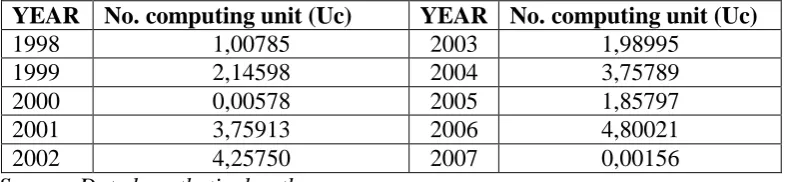
In exemplifying the principle of territoriality as defined and legislated by Regulation 1408/71, assume that a citizen who has worked partly in the state A, where he was residing, working under a legally binding contract and since 1998 he established residence in the state B (Romania), which undertakes the date of 01.08.1998. In February 2007, calls for a disability pension, based on medical documents issued in this respect. In this situation, state B must give the performance required under its legislation, but taking into account the period confirmed the state A to assume that was 10 years.
13 Table no. 1
Situation contributory
YEAR No. computing unit (Uc) YEAR No. computing unit (Uc)
1998 1,00785 2003 1,98995
1999 2,14598 2004 3,75789
2000 0,00578 2005 1,85797
2001 3,75913 2006 4,80021
2002 4,25750 2007 0,00156
Source: Date hypothetical author
To calculate this type of benefit, taking into account the age of the applicant taken on risk occurrence and the duration necessary to grant compensation, calculating the potential placement (SP) which in our case is the difference between the complete (SC) contribution and actual employment record (SCR) before enrollment in the degree of disability. So:
SP = SC – SCR (1)
All state law B (Romania), provides that disability benefit may be granted if the risk occurrence on the person concerned has completed at least half of the contribution period required (SCN):
SP1 = SC – SCN (2)
Assuming that the person is aged 43 years and having contributed to the request made by law (on enrollment in the degree of disability) of 12 years, (1) and (2) are formulas, given that the SC is provided by the law B 35 years, and the SCN of the benefit is 20 years:
SP = 35 – 12 = 23 years
SP1 = 35 -
2 1
20 = 25 years
Average score used for the periods completed in State B is calculated as the annual arithmetic mean of the scores achieved as follows:
na Rt
Rm
(3)Rm - Average score achieved Rt - Annual score achieved
na - Number of years of contribution, so:
10
85797 , 1 75789 , 3 98995 , 1 25750 , 4 75913 , 3 00578 , 0 14598 , 2 00785 ,
1
Rm
35838 , 2 10
58282 , 23 10
00156 , 0 80021 ,
4
Uc
Calculation of benefits
14
stage for a disability pension year degree score of 0.75 Vpp (potential value).
In these conditions, state pension should be calculated using the following formula:
Vpp SC
SP Rm Rm
PN
1
(4)
Becomes: PN
0,56024 275UM35 60838 , 19 35
12 35 75 , 0 35838 ,
2
(Monetary units)
Where: Rm1 - annual score for disability degree for potential internship
Community pension calculation shall be given aggregation contributory periods in both countries. Regulation no. 1408/71 provides that in such cases the institution performing the calculation, determine the amount of pension as periods of insurance or residence were completed under its legislation, which is called the theoretical pension (Pt) [9, art. 46, § 2a].
SC
SP Rm Rm
naSt Rt
Pt
A 1 (5)Where: naStA - number of years contributing to the state A.
In our analysis are taken as analysis, security type B, characterized in that the amount of disability pension calculation taking into account the length of insurance.
Transposing the formula initial data, this becomes:
35
25 , 17 79190 , 11 58382 , 23 35
23 75 , 0 35838 , 2 5 58382 , 23 Pt
50359 , 1 35
62572 , 52
Uc
Pension pro rata (Ppr) is calculated from theoretical pension to which a coefficient determined by the
periods of insurance and non-overlapping, made prior to the contingency coefficient and is called pro rata.
Vpp SC SC
SC Pt
Ppr
B A
B
(6)
Where: SCA - Employment record made in the state A;
B
SC - Length of contribution period in state B, resulting in:
275
12 5
12 50359 ,
1
Ppr UM 1,06136 275
17 12 50359 ,
1
UM = 292 UM
15 Calculation of benefits for older
The rights of an employee benefits for old age that has undergone, during the period of wage legislation two or more MS operation that involves making, taking into account all legislation that has undergone employed when the request it’s his right.
For the calculation of benefits for old age, in economy resolution procedure for organization of the exchanges between institutions of different countries must be a permanent coordination in the manner of the calculation and granting of the right event at which institution shall [9, art. 36], an institution that addresses the person requesting his place of residence and documents required to draw up procedures for establishing entitlement benefits are provided by the institution where the person requesting addresses to his place of residence and documents required to draw up procedures for establishing entitlement benefits are provided by the investigating institution to other institutions in the MS where the applicant has worked, what are called institutions concerned.
If a right to benefits is open to considering only the periods of insurance or residence completed under the legislation administered by one or more of these institutions, and the amount of benefit corresponding to this period can be established without delay, this amount is communicated to the institution instrumentation in conjunction with periods of insurance or residence.
In their justification, propose analyzing a hypothetical case establishing a right to provide social insurance for old age pension for an applicant during the active life and has worked in three MS, each with its own method of calculation allowance. Given the open method of coordination required by EU regulations, calculation of the benefit in question must be achieved by applying the double calculation [9, art. 49]. For this suppose that the person is born on 01.01.1950, making active during the following stages of contribution: the state A period a of 25 years in state B a period of 10 years, and in state C (Romania) for five years, with an average annual score of 2 points, which has its home, placing the institution coordinating and handling the request for pension rights, on reaching the age of 65 years, once that the state B does not qualify for the retirement pension.
Applying the principle of rule double calculation calculate to the national pension and retirement community. Since the problem shows that the home state pension which cannot be calculated since the applicant does not qualify for the right retirement pension as legislation, this law provides for a minimum period of 15 years.
To calculate Community pension rule applies tabulation of double counting periods is performed as follows:
I. Is excluded from the state B
- Calculate theoretical pension for old age:
C A A C
lv
SC Rm SC Rm
Pt (7)
Where: RmA - Average annual score achieved in state A
C
Rm - Average annual score achieved in state C
C
16
71429 , 1 3535
lv
Pt Uc
- Calculate retirement pension pro rata
28571 , 0 30 5 71429 ,
1
C A C lv lv SC SC Pt
Ppr (8)
Which fact in will be given to the applicant.
II. In performing the standard age required for retirement benefit granted in state B, a recalculation must be done following the same steps as the rights in section I, as follows:
- Theoretical calculation of pension
C C B C A C lv SC Rm SC Rm SC Rm Pt
2,2857135 20 50 10 35 2 10 2 25 2 2 2 2 2
Uc (9)
- Pensionable pro rata
0,32608
35 5 28571 ,
2
B C A C lv lv SC SC Pt
Ppr Uc (10)
In the latter case, given the Community pension payment period completed pro rata valuing and State (B) which was valued for I.
Starting from the basic principle - a pro rata basis (characteristic method of social security coordination system defined by Regulation no. 1408/71, which applies in the social field in Romania is used as such) - in terms of providing benefits for nature pensions to be granted to those persons who have paid employment in the EU MS, which, as was discussed above, special rules are calculated by comparing the national pension pro rata is found, at least in terms of e service, a difference between contributory periods for which contributions were paid and the coordination in the system of calculation and the final benefit by opting for the most favorable.
According to a universal principle available to get what you paid, the method of calculation, establishment and coordination of EU social security covered by Community regulations, is not it clear that each State to submit the final calculation in which the institution of instrumentation, the score achieved, the individual migrant, during the active life, or the state pension which ought by taking the necessary calculation of the opening right in the state entering the relationship, the stages performed in other states so they help each other and not as provided in existing Community legislation, which applies to placements made for pensionable theoretical points made in the State of residence, pension to be taken into account in determining pension pro rata or community, including consideration of periods of unemployment abroad.
17
insured risk. Compared to the above, if it reaches a common guideline, the coordination shift to a single model for calculating and determining benefits proposed to amend the Community pension formula, the formula (8) becomes:
C C C B B B A A A lv SCn SC Rm SCn SC Rm SCn SC Rm
Pt (11)
Formulas to data from (11), suppose that we have the following data: Table no. 2
Scoring average annual number of years contributing STATE Scoring average
annual Rt
Number of years contributing SC
Stage of use as necessary to obtain a
benefit SCn
A 3,5 25 35
B 3,8 10 40
C (Romania)
2,0 5 35
TOTAL 9,3 40 X
Source: Date hypothetical author
If you calculate the pension community by excluding the period of state B, we obtain:
78571 , 2 28571 , 0 5 , 2 35 10 35 5 , 87 35 5 0 , 2 35 25 5 , 3 lv
Pt Uc
And pension pro rata becomes: 0,464285
30 5 78571 ,
2
lv
Ppr Uc
Adding to the standard age and made corresponding period in State B provides a recalculation of rights, resulting in the following amount of benefit:
73571 , 3 28571 , 0 95 , 0 5 , 2 35 10 40 38 35 5 , 87 35 5 2 40 10 8 , 3 35 25 5 , 3 lv Pt
0,46696 40
5 73571 ,
3
lv
Ppr
If disability pension, as if its aim to take account of annual score achieved in each of the Member States required calculate to the benefit, with a score performed annually for 5 years contributing value of 2.5 units, get:
B B B A A A inv SCn SP Rn SC Rn SCn SC RmPt 1 (12)
And we have:
0,357141,1666835 83382 , 40 35 5 , 12 35 23 75 , 0 58382 , 23 35 5 5 , 2 inv Pt
1,52382 Uc
18
requested that our opinion is in additional income and as close to real stages right recipient requested that our opinion is in additional income and as close to real stages highlights the contribution made during the period assets held under a legal framework in several MS, and of course respecting is just the basic principle of social insurance system.
In terms of individual taxpayers by simplifying our proposal materializes determination procedure, in that each MS shall transfer to the final state, although the new work was in another state, the state would not be required to determine the benefit of the migrant worker worked for the period, but only units of value which, according to the laws, the stage of determining appropriate social security entitlements. From another standpoint, analyzing budget effort, it is determined that transferring unit value not only financial support, the State where the migrant worker has worked, would achieve a surplus and a deficit in the final state, it alone part of the total worker was collected by the end the right to social security. Another drawback is still the lack of a single monetary standard, which would be to collect contributions migrant workers, and on the occurrence of the insured, it can use them in any state in the community to intervene without the phenomenon of "benefit double".
As noted above, our proposal to amend the law establishing the calculation of social security of migrant workers is it fair to benefit the entire contributory period, regardless of the currency in which they were paid and the institution has collected. Currently, all the MS is in the process of restructuring and relocation reconsidered the whole social security system and especially the pension, which is the most difficult segment of social protection with direct implications on beneficiaries and the especially on those beneficiaries type PAYG systems, each focusing MS system to adapt to the needs and characteristics determined by the Single Market which are active players.
Community Insurance Fund for migrant workers to be distinct from other state social security funds and not be influenced by any decision of the State in which the migrant worker wage legal activity and targeting them with insurance against accidents and illness, disability, medical benefits that could benefit and old age pensions. Should be exempted from granting benefits as unemployment insurance, which in our opinion, they should continue to be provided within the State where he worked worker and by residence and minimum contribution required by law under which the country is on risk occurrence.
Depending on where the occurrence of risk that was created this unique community fund social security and benefits, providing the institution must send it to grant such rights based methodologies and establishing rights, agreed. An exception to this rule are those periods must worked in the receiving State Community worked prior periods, in which case, these periods are to be used only within its own system, and for overlapping periods, from Community to is optional contributory period to be taken in calculating the right called for an increase of benefit to it, as I proposed increase calculated using the formula (11).
Conclusions
The current Community provisions on social security must really be fully modified, both in structure and content, because they are necessary in order to replace social security systems are the characteristics of MS and different from state to state, with one European generally valid throughout the Community, as a necessity because of this you should follow the coordination mechanism and not an adaptation of legislation harmonization, to ensure that the characteristics of national systems in order to avoid loss of security rights social workers moving within the Community.
19
that can be granted in accordance with national legislation, the calculation of their contributions to be paid for their support, with the right to free movement of persons.
Bibliography
[1] Barr, N., The Economics of Welfare State, London, Weidenfeld and Nicolson, 1987.
[2] Barr, N., The Welfare State as a Piggy Bank. Information, Risk, Uncertainty, and the Ro le of the State, Oxford, Oxford University Press, 2001.
[3] Davis, E. P., Pension Founds. Retirement-Income Security and Capital Markets. An International Perspective, Oxford, Clarendon Press, 1997.
[4] Espig-Andersen, G, Gallie, D., Hemerijck, A and Myles, J., Why We Need a New Welfare State, Oxford, Oxford University Press, 2002.
[5] European Commission, Adequate and sustainable pensions. Joint Report by the Commision and the Council, 2003.
[6] Fultz, E., Pension reform in the EU accesion countries: challenges, achievements and pitfalls, in „International Social Security Review”, Vol. 57, Nr. 2, 2004.
[7] Schmögnerová, B., The European Social Model: Reconstruction or Deconstruction? A View from a Newcomer, Bonn, Friedrich Elbert Foundation, 2005.
[8] Stiglitz, J. E., Oszag, P. R., Rethinking Pension reform: Ten Myths About Social Security System, presented at conference New Ideas About Old Age Security organized by the World Bank in September to Washington, D.C, 1999.
[9]****** Regulation (EEC) no. 1408 to 1471 of 14 July 1971 on social security schemes for employees and members of their families moving within the Community, published in Official Journal no. L 149 of July 5, 1971.