ISSN (Online): 2320-9364, ISSN (Print): 2320-9356
www.ijres.org Volume 7 Issue 1 Ser. II ǁ 2019 ǁ PP. 07-13
Finance the Activities of Small and Medium-Sized Enterprises in
Times of Crisis
Anatoliy Suprun
1, Maria Sadovenko
2, Natalia Suprun
31Ph.D., Assocsate Professor, Kryvyi Rih Economic Institute of Kyiv National Economic University named after
Vadym Hetman, Kryvyi Rih, Ukraine
2Ph.D., Assocsate Professor, Kryvyi Rih Economic Institute of Kyiv National Economic University named after
Vadym Hetman, Kryvyi Rih, Ukraine
3Ph.D., Senior Lecturer, Kryvyi Rih National University, Kryvyi Rih, Ukraine
Corresponding Author: Anatoliy Suprun
ABSTRACT. :
Small and medium – sized business is the key to a balanced development of economy, formation of the middle class of society. In times of crisis, small and medium business acts as a stabilizer of the economic system, it solved the issues of employment and economic security of the state in many areas. An important issue is the financing of the activities of small and medium-sized businesses during the crisis. In a stable economic situation, such enterprises are financed mainly by own and borrowed funds. In this case, bank loans are affordable due to low rates and moderate requirements for collateral in developed countries. In many cases, small business loans are issued without collateral. Another thing when it comes to financing small and medium-sized businesses in a systemic economic crisis. Negative factors lead to a significant increase in the value of bank loans and make them unavailable to many businesses. The aggregated financial and economic indicators of activity of enterprises of small and medium – sized business are analyzed. According to the results of the research, the directions of provision of enterprises with financial resources in the short and medium term are determined.KEYWORDS: bank credit, equity, financial results, gross domestic product (GDP), interest rates, shadow economy, small and medium-sized enterprises (SMEs).
JEL code: G01, G30, L26, M21
--- --- Date of Submission: 26-04-2019 Date of acceptance:06-04-2019 ---
---I.
INTRODUCTION
At present Ukraine is experiencing the most tragic moment of its history since its independence. Direct military aggression, annexation of territories and political instability brought severe economic consequences.
World experience and business practice show that the most important feature of a market economy is the existence and interaction of many large, medium - sized and small enterprises, their optimal ratio. The most dynamic element of the ever changing structure of the national economy is the small and medium - sized business.
Ukraine has approximately the same share of small and medium enterprises as in other countries of the world or the European Union (EU). But the effectiveness of their activities differs significantly.
Following the onset of the crisis in 2014, substantial problems in the activity of small and medium-sized businesses fully manifested in 2015-2016.
The purpose of the study is to develop proposals for financing activities of enterprises in conditions of crisis, by combining traditional and new methods of attracting to the process of the informal sector of the economy. The study applies comparative-historical and systematic methods in the study of the development of enterprises of small and medium – sized business and their functioning in the Ukrainian economy, factors affecting the provision of financial resources.
II.
RESEARCH RESULTS
Ukraine’s losses in the early 1990s were comparable to the economic losses of Ukraine after the Second World War.
Certain sprouts of stability appeared in 1994-1997. Hyperinflation has been stopped and the economy has gradually begun to grow by choosing the market’s features. Instead of a temporary monetary unit in 1996, a constant monetary unit, the hryvnia, was introduced. But in 1998 the world crisis began and the economy again suffered significant losses. The result was a fall in gross domestic product (GDP) and the devaluation of the national currency almost doubled. The consequences of this crisis were overcome by the beginning of the 200s.
The best economic situation was observed in Ukraine from 2000 to 2008. The nominal and real GDP also grew. Inflation rates were moderate (in 2002 there was even a deflation of 0.2%). [National Bank of Ukraine, 2018]. Prices for Ukrainian exports grew. The exchange rate was stable. Foreign direct investment came into the country, and it concerned both real and financial sectors. Small and medium-sized businesses quickly evolved as facilitated by the introduction of a simplified taxation system. Fixed agricultural tax and loyal world prices have contributed to the rapid growth of agriculture.
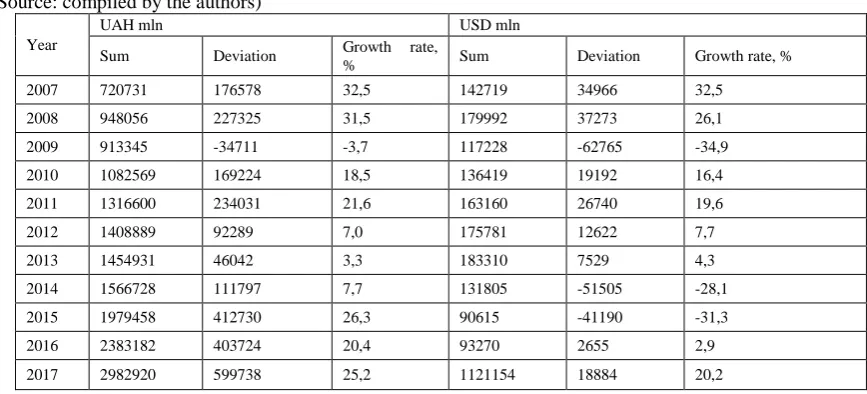
But all the positive trend was lost at the end of 2008, when Ukraine together with the world has entered a phase of new economic crisis (in the Western theoretical publications it was called the Great financial crisis). In many aspects Ukraine has not overcome the consequences of the crisis and up to 2013, while GDP in 2013 (in dollar terms) exceeded the GDP of 2008. Dynamics of GDP in Ukraine for 2007-2017 years is presented in table 1. [State Statistics Committee of Ukraine, 2018; the World Bank, 2018].
The GDP indicator is quite controversial in terms of reflecting the real economic situation. For example, today’s increase in utility costs leads to an increase in GDP. A significant factor in GDP growth, which is measured in hryvnias, is the devaluation of the national currency in 2008-2009 and in 2014-2015. Nominal GDP in Ukraine over the past 6 years has increased, which is primarily due to an increase in the average price level. This fact is confirmed by the fall of real GDP from UAH 1079346 million in 2010 up to 996236 million UAH in 2016 in 2010 prices.
Table 1Analysis of the nominal GDP of Ukraine from 2007 to 2017 (Source: compiled by the authors)
Year
UAH mln USD mln
Sum Deviation Growth rate,
% Sum Deviation Growth rate, %
2007 720731 176578 32,5 142719 34966 32,5
2008 948056 227325 31,5 179992 37273 26,1
2009 913345 -34711 -3,7 117228 -62765 -34,9
2010 1082569 169224 18,5 136419 19192 16,4
2011 1316600 234031 21,6 163160 26740 19,6
2012 1408889 92289 7,0 175781 12622 7,7
2013 1454931 46042 3,3 183310 7529 4,3
2014 1566728 111797 7,7 131805 -51505 -28,1
2015 1979458 412730 26,3 90615 -41190 -31,3
2016 2383182 403724 20,4 93270 2655 2,9
2017 2982920 599738 25,2 1121154 18884 20,2
Significant losses in the real GDP of the country are due to the fact that in the uncontrolled territories there are still a lot of heavy industry productions, which made a significant contribution to the GDP and significant foreign exchange earnings. The economic benefits derived from the conclusion of a free trade agreement with the EU zone did not compensate for the economic losses associated with the events of 2014.
The picture of real economic losses in the period from 2007 to 2017 is traced by the best GDP denominated in US dollars. Before the big financial crisis in 2008, GDP totaled USD 179992 million. Exceeding this figure the country could only in 2013 – UAN 183310 thousand (it should be remembered that the US dollar's purchasing power in the world has been decreasing during this time). After the 2014 events, there was a real economic catastrophe. In 2014, GDP decrease in dollar terms amounted to USD 51505 million (-28.1%) and in 2015 USD 4119 million (-31.3%). GDP in USD in 2015 was only 49.4% of GDP in 2013. Such losses can be compared with the loss or the economy in 90 years, or losses during the Second World War.
in 2019 both presidential and parliamentary elections will take place, and the political situation in the country is extremely tense;
the economy remains largely raw materials, and the situation in commodity markets is very uncertain. The stability of the course of the national currency depends to a large extent on raw material exports;
for 2019 there is a peak of payments on external borrowings. In the adopted state budget, about 40% of GDP is directed to debt repayments.
At the end of 2015, there were 1973000 small and medium-sized enterprises (compared to 1932000 in the previous year) in Ukraine, of which 1.63 million entrepreneurs and 343000 legal entities-entrepreneurs.
In the structure of enterprises, the ratio of large, medium and small enterprises has changed somewhat. As before, 0.1% of all enterprises are represented by large enterprises. But the share of medium-sized enterprises has decreased from 4.7% to 4.4%. In accordance with 95.2% to 95.5%, the share of small enterprises has increased, of which almost 83% have the status of micro-enterprises. Consequently, reducing the number of medium-sized businesses that provide the highest levels of employment, productivity, and productivity is one of the most important issues. And this is a problem for the most part of the financial plan. If small businesses and micro-enterprises can work at their own expense with occasional involvement of bank loans, then the inaccessibility of a loan for medium-sized enterprises is a problematic issue. Small and medium business enterprises make a significant contribution to employment of the population.
Fig.1 The number of employed workers of subjects of large, medium and small entrepreneurship of Ukraine in 2013-2017, thsd. persons
(Source: compiled by the authors)
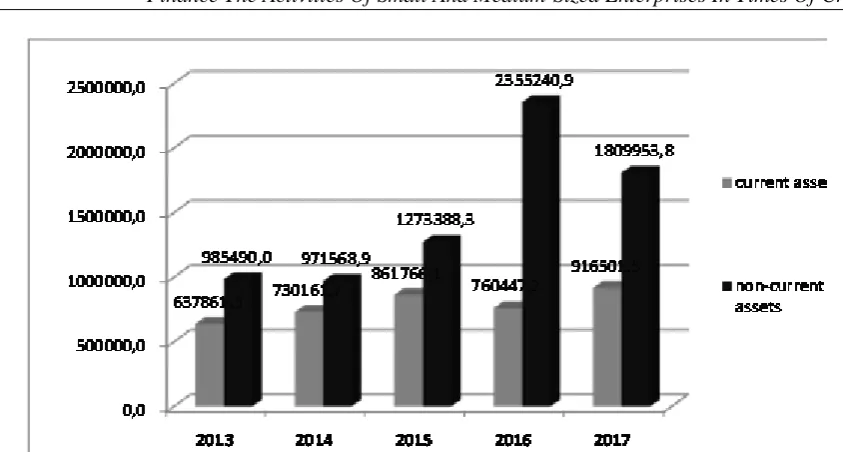
Fig.2 Dynamics of non-current and current assets of small business enterprises in 2013-2017, UAH mln (Source: compiled by the authors)
According to this diagram one can state that in addition to the depreciation of fixed assets there is another significant financial problem. In 2016-2017 there was a significant decrease in the share of working capital in assets. Thus, in 2016, compared with 2015, the amount of current assets of enterprises decreased by UAH 101318.9 million, or by 11.7%. And this despite the fact that inflation this year was very high - 12.4% (according to independent experts it was even higher). This decrease is due to two factors:
decrease in business activity in the country starting from 2014;
due to the growth of interest rates, loans to replenish working capital of small businesses became less accessible.
Consequently, the growth rate of the value of working capital was higher than the rate of inflation, indicating certain stabilization processes.
By type of economic activity, the volume of sold products (goods, services) of small and medium-sized enterprises was divided as follows: 45% - trade, repair of motor vehicles, 26% - industry, 10% - agriculture, forestry and fisheries, 4,5% - transport , warehousing, postal services, 4% - construction, 2% - information, telecommunications, 2% - scientific and technical activities, 0.3% - health care, social assistance, the lowest indicator of volumes of sales of works (services) in the field of education - 0.1%, Arts and Sports - up to 0.1%. Figure 3 shows the dynamics of equity capital of small enterprises. [State Statistics Committee of Ukraine, 2018].
Financial speaking, financial and economic stability of small businesses has always been low, as current sources of financing significantly outperformed current liabilities. In general, financing is more on a commodity than a bank loan. In developed countries where lending rates range from 2-3%, most companies prefer to use borrowed funds. A number of countries (e.g. Sweden, Japan, Switzerland) use zero or negative interest rates to stimulate small business development.
The unavailability of bank loans, especially long-term and medium-term, significantly reduces the possibilities for technical re-equipment and expanded development of small and medium-sized businesses.
The systemic crisis in the segment began before 2014. Thus, after the growth of financial results in 2012 compared to 2011, by UAH 16651.2 billion, or by 53.6%, in 2013 there was a deep recession. The financial result of the activity of small enterprises decreased by UAH 39351.9 thousand, or by 82.4%. But for most economic parameters, 2013 was the last year of stability in Ukraine prior to the beginning of the 2014 events and socio-economic losses at all levels observed in subsequent years (see Fig.4).
Based on the economic situation in 2013, two quite probable assumptions can be made:
the government, led by the previous president, was not interested in the development of small business. The course was aimed at forming a totalitarian administrative and economic system in Ukraine with signs of formal democracy, and small business has always been the main opponent of regimes of this type and the foundation of civil society;
the business community is clearly responsive to negative manifestations and bad predictions and involves shadowing (withdraw capital, optimize taxation due to artificially inflated costs, etc.).
Fig.4Financial result before taxation of small businesses in 2010-2017, UAH mln (Source: compiled by the authors)
The dynamics of the net financial result significantly differs from the dynamics of the financial result of the pre-tax period:
in 2010-2013, small businesses before tax had a positive financial result. However, in the given period, enterprises had a total net loss;
in 2014-2015, with a loss before taxation, small and medium-sized enterprises all paid the profit tax anyway. On the whole, this accelerated the reduction of working capital in the system through taxation;
in 2016-2017, having a positive financial result before taxation, enterprises had a net loss of UAH 32206.8 million and UAH 20971.9 million in accordance.
Thus, the period of the study of the formation of financial results of small business enterprises is 8 years and in one year there was not received a pure positive financial result in the system. There is a clear tendency to reduce losses in 2014-2017, but it is equally a question - how can a system have such a long time working with a negative net financial result. In this context, several conclusions can be drawn:
Taking into account the above figures for the income tax, it can be argued that the system of small entrepreneurship during the years of functioning in Ukraine received some immunity. The economic system (in this case, the small business system) can not work all the time without profits and paying taxes. From this follows the absolutely unambiguous conclusion - most of the small business is in the shadow and taxes are not paid in full.
Significant growth of the index in 2014-2017 certainly has an inflationary base. In order to assert this, compare the growth rate of net profit with the consumer price index (see Table 2).
Table 2Comparison of the growth rate of net profit of small enterprises with the level of inflation (Source: compiled by the authors)
Year Consumer price index, % Profit growth rate, %
2012 99,8 108,5
2013 100,5 101,3
2014 124,9 126,5
2015 143,3 197,6
2016 112,4 111,1
2017 113,7 108,7
According to the data, one can see that the most favorable ratio was in 2012-2015, when the growth rate of net profit exceeded the level of inflation. Enterprises successfully raised their prices together with the general increase in prices in the country and received a small real increase. In 2016, the resource of anti-crisis measures was exhausted. The level of inflation has risen above the profit growth.
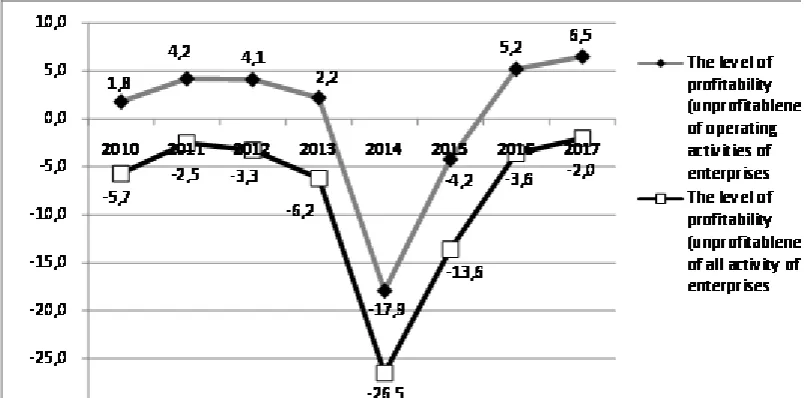
Fig.5The level of profitability of the operating and all activities of small business enterprises in 2010-2017, % (Source: compiled by the authors)
It can be seen that throughout the period, the profitability is calculated on all activities of enterprises, is negative. According to operational indicators, negative values were in 2014-2015, and positive indicators had rather low values. Significantly, in the crisis years 2016 and 2017, the profitability was higher than profitability indicators in the pre-crisis period.
Thus, the current situation allows us to predict the very slow growth of small and medium-sized businesses. The acceleration of growth can only increase the availability of funding from various sources.
III.
CONCLUSIONS
The conducted research allowed to form a number of conclusions:
www.ijres.org 13 | Page
]
the size of bank interest rates for business financing is practically inaccessible from the point of strategic financing (the purchase of equipment, technology, franchises, know-how. It is almost impossible to create business from the ground up at the expense of a bank loan. In the country, educational programs for the development of business-plans and receiving funding for them;the activity of microenterprises and small enterprises in the conditions of the crisis of 2014-2018 years showed a high level of adaptability of economic entities. By 2016, the average level of their profitability exceeded inflation in the country;
in addition to the general financial and economic problems, a large number of loss-making enterprises points to manipulation of taxation. Particularly inclined to overestimate the costs of enterprises that are in the general system of taxation;
despite the fact that the number of small and medium-sized enterprises in relation to the total mass of business entities meets world standards, the share of such enterprises in the formation of GDP of the country is far behind. The main reasons are low productivity of enterprises due to weak technological base and high level of shadow economy;
the statistics of small and medium-sized enterprises, the results of their activities, the provision of financial resources, the identification of the share of the shadow economy in the composition of small and medium-sized businesses is unsatisfactory and needs to be improved;
Access to financing of small and medium-sized businesses is today the basic problem that can be solved with the participation of the state, commercial banks and international partners.
REFERENCES
[1]. Official site of the National Bank of Ukraine. Retrieved January 3, 2019 from https://bank.gov.ua
[2]. Official site of the State Statistics Committee of Ukraine. Retrieved January 5, 2019 from http://www.ukrstat.gov.ua [3]. Official site of the World Bank in Ukraine. Retrieved January 5, 2019 from https://www.worldbank.org/uk/country/ukraine