ISSN (Online): 2320-9364, ISSN (Print): 2320-9356
www.ijres.org Volume 3 Issue 7 ǁ July 2015 ǁ PP.15-21
Less Conservative Consensus of Multi-agent Systems with
Generalized Lipschitz Nonlinear Dynamics
Jian Li
1, Zhiyang Wu
1, Fang Song
1,21.Laboratory of Intelligent Control and Robotics, Shanghai University of Engineering Science, Shanghai, 201620, P. R. China
2. State Key Laboratory of Robotics and System, Harbin Institute of Technology, Harbin, 150001, P. R. China
Abstract :
This paper addresses the problem of consensus of multi-agent systems with general Lipschitz nonlinear dynamics. The goal of this note was to introduce a design approach. We take advantage of the structure of the part of the non-linearity and inequality scaling technology. The advantage of the developed approach was that it was significantly less conservative than other previously published results for Lipschitz systems. A numerical example was presented to show the superiority of this letter.Keywords- Consensus, Less Conservative Condition, Lipschitz Nonlinear Dynamics, Multi-agent Systems
I.
Introduction
Recently, consensus for a group of agents has became an important problem in the area of cooperative control of multi-agent systems and has been widely investigated by numerous researchers, due to its potential applications in such broad areas as satellite formation flying, sensor networks, and cooperative surveillance[1,2]. In [3] a distributed observer-type consensus protocol based on relative output measurements was proposed. In [4], a general framework of the consensus problems for networks of dynamic agents with fixed or switching topologies and communication time delays was established. Relative-state distributed consensus protocols was established in [5]. A distributed algorithm was proposed in [6] to achieve consensus in finite time. However the provided synthesis conditions which infeasible for systems with big Lipschitz constants restrict all these approaches, such as [6],[7],[8]. Then in [18] the authors introduced a generalized version of the Lipschitz condition which includes some structural knowledge of the system non-linearity.
This paper considers the problem of consensus of multi-agent systems with general Lipschitz nonlinear dynamics under a fixed topology. Consensus of multi-agent systems with general linear dynamics was researched in [3],[5],[14],[15],[19]. Especially, different static and dynamic consensus protocols are established in [3],[5],[14] which is difficult to tackle and implement by each agent in distributed fashion. Then, we design a distributed consensus protocol for the relative states and an adaptive law for adjusting the coupling weights between neighboring agents which were first proposed in [6]. One contribution of this paper is to extend the result of [3],[5],[6],[14],[20] to a generalized Lipschitz nonlinear system which includes the classical Lipschitz system as a special case. The goal of this note was to introduce a design approach. We take advantage of the structure of the part of the non-linearity and inequality scaling technology. The advantage of the developed approach was that it was significantly less conservative than other previously published results for Lipschitz systems.
The rest of this paper was organized as follows. Some useful preliminaries results were reviewed in Section 2. The consensus problems of multi-agent systems with generalized Lipschitz non-linear dynamics using distributed adaptive protocols were investigated in Section 3. Extensions to Lipschitz non-linearity dynamics were studied in Section 4. In Section 5, we use a simulative example to illustrate the applications of our consensus algorithm. Section 6 concludes the paper.
II.
Preliminaries
A. Graph theory notions Let n n
R
be the set ofn n
real matrices, n nC be the set of n n complex matrices. Denote by
1
( PR
1
) a column vector with all entries equal to one. The superscriptT
means transpose for real matrices.IP represents the identity matrix of dimensionP
. For any matrices, if not explicitly stated, wereassumed to have compatible dimensions. Diag (A1,...,An) represents a block-diagonal matrix with
matrices
A
andB. For a vectorx
, let
x
denote its 2-norm. An undirected graph G( , )
,where 1{v ,...,vN}
was the set of nodes(i
.e ,agents),and
was the set of edges(i
.e, communication links).An edge( ,
v v
i j)(
i
j
)
means that agentsv
i and vj can obtain information from eachother. A path between distinct nodes
v
i andv
l was a sequence of edges of the form ( ,v vk k1),ki,...,l1. An undirected graph was connected if there exists a path between every pair of distinct nodes, otherwise was disconnected. A directed graphG
was a pair ( , )
, where { ,...,v1 vN} was a non-empty finite set of notesand
was the set of edges. For an edge( . )
v v
i j , nodev
i was called the parent node ,nodev
j wasthe child node,
v v
i.
j were adjacent. A directed graph contains a directed spanning tree if there exists a node called the root, which has no parent node, such that the node has a directed path to every other node in the graph. A directed graph was strongly connected if there was a directed path from every node to every other node. A directed graph has a directed spanning tree if it was strongly connected , but not vice versa.The adjacency matrix [ ] N N i j
A a R associated with the directed graph
G
was defined by aii0,ai j1 if ( , )v vj i
anda
i j
0
otherwise. Adjacency matrixA
associated with the undirected graph was definedby
a
ii
0,
a
ji
a
i j
1
if ( , )v vj i
and ajiai j 0 otherwise. Laplacian matrix[
]
N N ijL
L
R
was defined asL
ii
j ia
ijandL
ij
a i
ij,
j
.B. Lemmas:
Lemma 1[8,9]: Zero was an eigenvalue of
L
with 1 as a right eigenvector and all non-zero eigenvalues have positive real parts .Furthermore ,zero was a simple eigenvalue ofL
if and only if the graphG
has a directed spanning tree .Lemma2[17]: For any vectors
a b
,
R
nand scalar
0
,we have 12
a b
T
a a
T
b b
T .III.
Consensus of multi-agent systems with generalized Lipschitz non-linear dynamics
.
Consider a group of
N
identical agents with generalized Lipschitz nonlinearity dynamics. The dynamics of thei
-th agent were described by
x
i
A x
i i
Df Hx
(
i)
Bu
ii
1 , . . . ,
N
(1)where
x
i
R
n was the state,u
i
R
p was the control input, andA B D H
, , ,
were constant matrices with compatible dimensions, and nonlinear function Df Hx( i) was assumed to satisfy the following general form Lipschitz condition which was defined in [18] as follows
f Wf
T
x Rx
T
(2)where the
W
andR
were positive definite symmetric matrices .f
f Hx
(
i)
f Hx
(
j),
x
x
ix
j. It can be seen that any non-linear functionDf Hx
(
)
was a Lipschitz function with
max( ) /
R
min(
W
)
which called Lipschitz constant. Any Lipschitz non-function Df Hx( ) can satisfy condition (2) withW
I R
,
2I
. (2) can also be rewritten as a generalized form
K f
W
K x
R
,
K
W、K
R were two positive definite matrices.,
W R
K W K R.
The communication topology among the agents was represented by an undirected graph
G
( , )
, where {1,..., }N was the set of nodes(
i
.e ,agents), and
was the set of edges(i
.e, communication links). An edge( ,
v v
i j)(
i
j
)
means that agentsv
i andv
j can obtain information from each other. A path between distinct nodesv
1 andv
l was a sequence of edges of the form( ,
v v
k k1),
k
1,...,
l
1
. An undirected graph was connected if there exists a path between every pair of distinct nodes , otherwise was disconnected.A variety of static and dynamic consensus protocols have been proposed to reach consensus for agents with dynamics given by (1) e.g, in [1]–[5]. For instance, a dynamic consensus protocol based on the relative states between neighboring agents was given in [6] as follows
(3)
1
(
)
N
i i j i j i j j
u
F
c a
x
x
(
)
T(
)
ij i j i j i j i j
where
a
i jwas (i j
,
)-th entry of the adjacency matrixA
associated withG
,k
ij
k
ji were positive constants,c
i j denotes the time-varying coupling weight between agentsv
i andv
j with(0)
(0)
i j i j
c
c
,and p nFR and n n
R
were the feedback gain matrices.
Theorem 1 :Solve the LMI :
(4)
to get a matrix P0 and a scalar
0
.Then the N agent described by (1) reach global consensus under the protocol (3) with F B PT 1 and P BB P1 T 1 for any connected communication graph G.Proof: As argued in the Section 2 ,it follows that ci j( )t cj i( ),t t 0. Using (3) for (1),we obtain the closed-loop network dynamics as
c
ij
k a
i j i j(
x
i
x
j)
T
(
x
ix
j)
i1,...,N (5) Letting and e[e1T,...,eNT T] ,we get [( (1/ )11 ) ]T
N n
e I N I x.We can see that
e
satisfies the following dynamics:
c
ij
k a e
i j i j(
i
e
j)
T
(
e
ie
j)
i1,...,N (6)where cij cij
and
was a positive constant. Consider the Lyapunov function candidate(7) the time derivative of
V
along the trajectory of (8) as follows:
(8) According to the equivalent form of Lipschitz condition (2) and Lemma 2 we obtain
(9) . . 1 1
1 1 1,
2
N N N
i j i j T
i i
i i j j i i j
c c V e P e
k
1 1 0T T T T
AP PA DW D BB PH
HP R
1 ( ) ( ) Ni i i i j i j i j
j
x Ax Df Hx BF c a x x
1 1 1 ( ) ( ) ( ) ( ) N Ni i i i ij i j i j
j j
e Ae Df Hx Df Hx c a BF e e
N
. . 1
1
1 1 1,
2
N N N
i j i j T
i i
i i j j i i j
c c V e P e
k
1 1 1 1
1 1 1 1 1
1
2 2 2 [ ( ) ( ) ( ) ( )]
N N N N N
T T T T
i i ij i j i i i i j
i i j i j
e P Ae L e P BB P e e P D f Hx f Hx f Hx f Hx N
1 11 1 2 2
1 1 1
2
[ (
)
(
)]
2
[ (
)
(
)]
1
[ (
)
(
)]
[ (
)
(
)]
T T
i i i i i i
T T T
i i i i i i
e P D f Hx
f Hx
e P DW W
f Hx
f Hx
e P DW D P e
f Hx
f Hx
W f Hx
f Hx
1 1 1 1
T T T T
i i i i
e P DW D P e e H RHe
1 1 1
1
[
] ,
0
T T T
i i
e
P DW D P
H RH e
As 1
0
N T i ie
, then(10) Set up ˆ 1
i i
e P e , and ˆ [ T,..., T T]
i N
e e e , based on (9)and(10)we can draw from (8)that
(11)
Set up N N
UR be the unitary matrix satisfying (0, 2,..., )
T
N
U LU diag ,set up
1 ˆ
[ T,..., T T] ( T )
N U IN e
, then
1
[(1 /
T
N
)
P
1]
e
0
,from (11)we have
(12)
We choose sufficiently big
so that2
i
,
i
2,...,
N
, then(13)
We get inequality (4) from (14) by using the Schur complement Lemma[12]. we know that
S
( )
0.
1
0
V
, soV t
1( )
and everyc
ij were bounded. And from (5) we know thatc
ij was monotonically increasing, soc
ij converge to finite value andc
ij as well. By using LaSalle-Yoshizawa Theorem [13] weget limtS( ) 0,so
lim
t
i
0,
i
2,...,
N
,10. In conclusion,lim
t, ( )
e t
0
. so, we achievethe proof .
Remark 1: Equation (2) was a generic form Lipschitz condition. Any Lipschitz non-function f Hx( ) can satwasfy equation (2) with WI R,
2I which was first define in [18] includes some structural knowledge of the system non-linearity for observer design. Then, it was used to consensus of multi-agent systems with non-linear dynamicsDeduction to Lipschitz non-linearity dynamics
This subsection considers the consensus problem of the agents in (1) under the adaptive protocol (3). The communication topology among the agents was represented by an undirected graph. The nonlinear function
( i)
Df Hx was assumed to satisfy the Lipschitz condition with a Lipschitz constant
0
, i.e. (14)Theorem 2 :Solve the LMI :
(15)
To get a matrix
P
0
and a scalar
0
.Then the N agent described by (1) reach global consensus under the protocol (3) with T 1F B P and 1 T 1 P BB P
given as in Theorem 1 for any connected communication graph
G
.The proof of Theorem 1can be shown by following similar steps in proving Theorem 2 Remark 2:Theorem 2 tends Theorem 1 to the case with Lipschitz non-linear dynamics. When2 ,
W I R I , Theorem 1will reduce to Theorem 2.Theorem 2 shows that the agents in (1) under the adaptive protocol (3) can also get consensus with the nonlinear function satisfying the Lipschitz condition.
1 2
1
[ 2 ] ( )
N
T T T T T
i i i
i
AP PA DW D PH RHP BB S
1 1ˆiT[ N ( T T T ) 2 T]ˆi
e I AP PA
DW D PH RHP
L BB e
1 1 11
[ (
)
(
)]
0
N N
T
i i j
i j
e P
f Hx
f Hx
N
( ) ( ) ( )f Hx f Hy
H xy
0
T T T T
AP
PA
DD
BB
PH
HP
I
1 1 1[ ( ) 2 ]
T T T T T
N
V I AP PA DW D PH RHP BB
1 2 1
[ 2 ] ( )
N
T T T T T
i i i
i
AP PA DW D PH RHP BB S
1 1 2T T T T
AP PA
DW D PH RHP
BB
1
1
0
T T T T
AP
PA
DW D
PH RHP
BB
,
nx y
R
IV.
Numerical comparisons and simulation examples
In order to evaluate our design methodology, we present in this Section a numerical example to validate the effectiveness of the theoretical results. In fact, we show through this example that our approach was the best method that takes into account the structure of the nonlinearity in detail.
Consider a network of single-link manipulators with revolute joints actuated by a DC motor. The dynamics of the i-th manipulator was described by (3) with
[0
21.6
0
0]
TB
[0
0
0
0.333]
TD
[0
0 1 0]
H
3
(
i)
[0
0
0
0.333sin(
i)]
TDf Hx
x
Clearly,
f Hx
(
i)
satisfies (4) with a Lipschitz constant
0.333
, solving the LMI (9) by using the LMI toolbox of Matlab gives the feasible solution as
Fig 1 .Communication topology.
Fig 1 .Communication topology.
1
2
3
4
i i i
i i
x
x
x
x
x
0
1
0
0
48.6
1.25
48.6
0
0
0
0
10
1.95
0
1.95
0
A
3239
500
2579
6459
500
77
398
998
2579
398
2054
5144
6459
998
5144
12881
[ 56.68
8.767
45.15
113.1]
F
0.8088,
0.3634
Xi1
Xi3
Fig 2. States of the eight manipulators under (3)
Fig 3 . Coupling weights ci j.
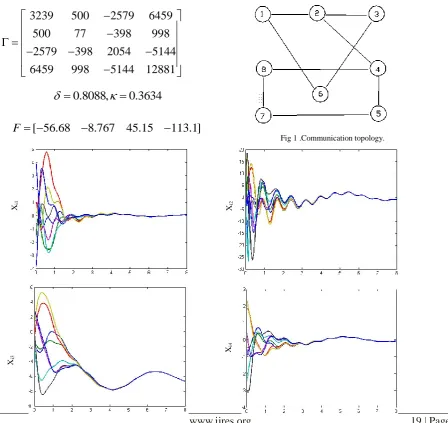
In order to illustrate Theorem 2 ,we let the communication graph
G
as in fig 1.G
was connected and undirected. There were eight manipulators. In other words, i j, 1,...,8 in (1) ,k
ij
k
ji
1
,c
ij(0)
c
ji(0)
.The coupling weighs were as Fg 2 . They converge to steady values. The states of the manipulators which satisfies (3) were as Fg 3. They also get consensus.
Table1 .Comparwason of maximum Lipschitz constant for various LMI design techniques
Method LMI(14)of L. Zhongkui(2013) LMI(21)
max
0.34 610
We focus our study on the conservation of the states LMI approach. The comparison between different LMI conditions in Table 1 shows that our approach is significantly less conservative than other previously published results for Lipschitz systems.
V.
Conclusions
We have studied the adaptive consensus problem of multi-agent systems with generalized Lipschitz nonlinear dynamics. A less conservative adaptive consensus condition has been proposed by carefully considering the structure information of nonlinearities and using a sharp inequality to deal with the generalized Lipschitz condition. It can significantly reduce the conservatism in some existing adaptive consensus results for Lipschitz nonlinear system,which is verified through a numerical example.
VI.
Acknowledgement
This work was partly supported by the State Key Laboratory of Robotics and System (HIT) under Grant SKLRS-2014-MS-10, the Jiangsu Provincial Key Laboratory of Advanced Robotics Fund Projects under Grant JAR201401, and the Foundation of Shanghai University of Engineering Science under Grant nhky-2015-06, 14KY0130 and 15KY0117.
References
[1] R Olfati-Saber, J Fax, R Murray. Consensus and Cooperation networked multi-agent systems. Proc. IEEE. Vol 95, no 1, pp 215–233, 2007.
[2] W Ren, R Beard, E Atkins. Information consensus in multi-vehicle cooperative control. IEEE Control Syst. Mag . vol 27, no 2, pp 71–82, 2007.
[3] S Tuna. LQR-Based Coupling Gain for Synchronization of Linear Systems. 2008[Online]. Available :http:/ /arxiv.org / abc/ 0801.3390.
[4] S Tuna. Conditions for synchronizability in arrays of coupled linear systems. IEEE Trans Autom. Vol 54, no 10, pp 726–737, 2008. [5] L Scardovi , R Sepulchre. Synchronization in networks of identical linear systems. Automatica. Vol 45, no 11, pp 2557–2562, 2009. [6] L Zhongkui . Consensus of Multi-Agent Systems With General Linear and Lipschitz Nonlinear Dynamics Using Distributed Adaptive
Protocols. Automatica. Vol 58,no 7.
[7] L Zhongkui .Global H
consensus of Multi-Agent Systems With Lipschitz Nonlinear dynamics. IET Control /Theory Appl. vol.6,no 13, pp 2041-2048,2012.[8] R Olfati-Saber, R Murray. Consensus problems in networks of agents with switching topology and time-delays. IEEE Trans, Autom.Control. vol 49,no 9, pp 1520–1533, 2014.
Control. Vol 50, no 5, pp. 655–661, 2005.
[10] W Yu, G Chen, M Cao, J Kurths . Second-order consensus for multi-agent systems with directed topologies and nonlinear dynamics. IEEE Trans.,Syst, Man, Cybern, B Cybern. Vol 40, no 3,pp. 881–891, 2010.
[11] Z Qu. Cooperative control of dynamical systems: applications to autonomous vehicles. Spinger-Verlag, London, UK. 2009.
[12] S Boyd, L Ghaoui, E Feron, V Balakrwashnan. Linear matrix inequalities in system and control theory. SIAM, Philadelphia, PA.2014. [13] M Krstić, I Kanellakopoulos, P Kokotovic. Nonlinear and Adaptive Control Design. New York Wiley, 2013.
[14] Z Li, Z Duan, G Chen, L Huang. Consensus of multi agent systems and synchronization of complex networks: A unified viewpoint . IEEE Trans.,Circuits Syst .,I:Reg.,Papers,. Vol 57, no 1, pp. 213–224,2010.
[15] J Seo, H Shim, J Back. Consensus of high-order linear systems using dynamic output feedback compensator: Low gain approach. Automatica . vol 45, no. 11, pp. 2659–2664, 2009.
[16] J Cortés. Distributed algorithms for reaching consensus on general functions. Automatica. Vol 4,2013.
[17] H Ju,O Kwonb. Novel stability criterion of time delay systems with nonlinear uncertainties. Sciencedirect, Applied Mathematics Letters . vol 18 ,pp 683–688, 2014
[18] M Ekramian, S Hosseinnia. Observer design for non-linear systems based on a generalized Lipschitz condition. Control Theory AppL, IET. vol.5,no 16,pp 1813-1818, 2010.
[19] S Tuna. Conditions for synchronizability in arrays of coupled linear systems . IEEE Trans. Autom. Control. Vol 54, no 10, pp 2416–2420, 2009.