Smart Grid – A Brief Overview of the Emerging
Framework
Ms. Rakhi R Nair Mr. Sankaran Nampoothiri K
UG Student Assistant Professor & Head of Dept. Department of Electrical & Electronics Engineering Department of Electrical & Electronics Engineering
Sree Buddha College of Engineering, Elavumthitta Pathanamthtta, Kerala India
Sree Buddha College of Engineering, Elavumthitta Pathanamthtta, Kerala India
Abstract
All over the world, electrical power systems are encountering radical change stimulated by the urgent need to decarbonize electricity supply, to swap aging resources and to make effective application of swiftly evolving information and communication technologies. All of these goals converge toward one direction: ‘Smart Grid’ Smart grid technology aims to reconstruct current grid into sophisticated, digitally enhanced power system where the use of modern communications and control technologies allow greater robustness, efficiency and flexibility than traditional power grid. Basically, the vision of Smart Grid is to provide much better visibility to lower-voltage networks as well as to permit the involvement of consumers in the function of the power system, mostly through Smart meters and Smart Homes. This paper deals with present trends and some future expectations, consumer participation and discusses the barriers for the implementation of the smart grid. The paper focuses on some fundamental challenges facing the utilization of electricity today and for years to come.
Keywords: Electrical Power System, Smart Grid, Smart Meters, Smart Homes
________________________________________________________________________________________________________
I. INTRODUCTION
The grid refers to the electric grid, a network of transmission lines, substations, transformers and more that deliver electricity from the power plant to your home or business. It’s what we plug into when we flip on our light switch or power up our computer. Our current electric grid was built in the 1890s and improved upon as technology advanced through each decade. Today, it consists of more than 9,200 electric generating units with more than 1 million megawatts of generating capacity connected to more than 300,000 miles of transmission lines. Although the electric grid is considered an engineering marvel, we are stretching its patchwork nature to its capacity. To move forward, we need a new kind of electric grid, one that is built from the bottom up to handle the groundswell of digital and computerized equipment and technology dependent on it-and one that can automate and manage the increasing complexity and needs of electricity in the 21st Century.
In this paper, we discussed about such a new kind of grid that is smart grid. A smart grid delivers electricity from suppliers to consumers using two-way digital technology to control appliances at consumers' homes to save energy, reduce cost and increase reliability and transparency. It is capable of assessing its health in real-time, predicting its behaviour, anticipatory behaviour, adaptation to new environments, handling distributed resources, stochastic demand, and optimal response to the smart appliances. It is a tool that allows electric utilities to focus on evolving true business drivers by enabling cost containment, end-to-end power delivery control, and a more secure infrastructure.[1]
Today’s electricity infrastructure is complex. So electricity efficiency is less than perfect and continues to deteriorate in a world demanding digital quality power. Several new trends are already shaping changes in the electricity infrastructure including the expansion of the existing grid with microgrids and megagrids, and new apparatus exploring new materials and concepts ranging from superconductivity and nano materials to highly flexible control and energy storage.
New smart devices and technologies developed provide benefit to the power network only when all work together. To ensure that the individual sensing, communications and computing equipment installed over the coming years will be able to be integrated with other system, come together to form a single machine, the power needs an overall architecture that is a common method and tools for planning and designing these smart system and a complete suite of standards.
A smart grid delivers electricity from suppliers to consumers using two-way digital technology to control appliances at consumers' homes to save energy, reduce cost and increase reliability and transparency. It is capable of assessing its health in real-time, predicting its behaviour, anticipatory behaviour, adaptation to new environments, handling distributed resources, stochastic demand, and optimal response to the smart appliances. It is a tool that allows electric utilities to focus on evolving true business drivers by enabling cost containment, end-to-end power delivery control, and a more secure infrastructure.
randomness of loads and market participants in real time, while creating more complex interaction behaviour with intelligent devices, communication protocols, standard and smart algorithms to achieve complex interaction.
II. TRADITIONAL ELECTRIC GRID
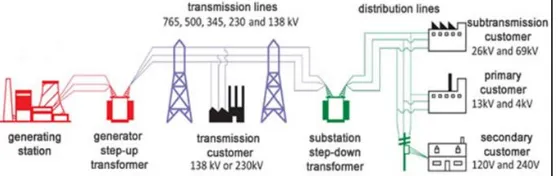
Today, electric power distribution is made possible by the power distribution grid, a system of transmission mediums that allow electricity to be transferred at different voltages from the point of generation to our homes. This system came to be as a result of industrialization and meeting the electricity needs of a growing population in the United States. In the early 1870s and 1880s, Direct Current (DC) systems were popular. Because it operated with a uniform voltage from generation to use, DC systems were integrated only in factories and small downtown urban centers which had favorable economies of scale. Sadly, this left 95% of residents in the United States without electricity.
Generation by multiple sources became possible at sites distant from that of the final user. A windmill, for example, could generate power by spinning a turbine. That power’s voltage would be “stepped-up” to travel a long distance to its final user, and then “stepped-down” to a more appropriate 120V for a household lamp. Multiple generators could then be connected over a large area, reducing generation costs and enhancing economies of scale. The sad part is, the history essentially stops there. The last major development in our grid was around the turn of the 20th century.[2]
The rapid industrialization of the United States meant the grid would become a crucial part of our nation’s infrastructure. We continued to develop and refine it, though it remains today largely the same as it was then: a technology developed in the late 19th century. This presents a problem today. Operationally the conventional electrical grid starts at power generating systems such as power stations that generate 3 phase alternating current (AC) electricity. The 3 phase AC current is passed through a transmission substation that uses transformers to step up (increase) the voltage from thousands of volts to hundreds of thousands of volts. Increasing the voltage allows for efficient transmission of electricity over long distances. After being converted to high voltage, the 3 phase electricity is sent over long distance transmission lines through three lines, one for each phase. Before it can be distributed to end users, the electricity must pass through a power substation that steps down (decreases) the voltage with transformers so that it can be distributed to communities and used in homes and businesses at the correct voltage.
A 3 phase current is used because electricity is generated in a sine wave that has peaks and trough, meaning that power strength for a single phase fluctuates between weaker and stronger moments. By generating three phases and offsetting them by 120 degrees, the moment of peak power is evenly distributed between the three phases, allowing for more consistent peak power output. Having consistent peak power output is important mainly for industrial purposes, e.g., industrial 3 phase motors. Alternating current is used because it is easier to change voltages with it than with DC, and a very high voltage is fundamental to long distance electrical transmission because it reduces energy loss by lowering resistance in the wires.
III. PROBLEMS WITH THE EXISTING GRID
Generation technology and grid infrastructure have remained relatively constant over the last century. The sector has been structured largely around fossil-fuel generation, large hydroelectric plants, and centralized grid systems. This is true both globally and in the case of the countries assessed in this report. According to the International Energy Agency, four key sources of electricity have dominated generation over the last 40 years: coal, natural gas, large hydro, and nuclear. By 2012, these four sources together accounted for about 90 percent of electricity generation in the world.
The structure of the traditional electricity system can be characterized as a network, with a unidirectional flow of electricity from a few centralized generators to millions of consumers. Electricity is transported over large distances through high voltage transmission and lower-voltage distribution lines from generators to load centers. Under this structure, the key objective of policymakers, regulators, and utilities is to ensure access to electricity for all consumers whenever and wherever they need it, in the most reliable and cost effective manner possible. Safety and efficiency of the grid is also a key concern. For these services, under the traditional electric utility business model, utilities earn a guaranteed rate of return on generation, infrastructure, and other investments in the grid and its operation, which is collected through charges on consumer electricity sales. In many developing countries, state utilities are simply mandated to operate regardless of financial viability, and receive public subsidies to make up revenue shortfalls. The traditional sector described here is representative of many developing countries, including the four examined in this report. However, the traditional fuel mix and structure have started to change in recent decades and are doing so at an increasingly rapid pace. Structural changes include various forms of utility restructuring, deregulation and liberalization in wholesale and retail markets.
Presently, the grid is facing a multitude of challenges that can be outlined in four categories. First there are infrastructural problems due to the fact that the system is outdated and unfit to deal with increasing demand. As a result, network congestions are occurring much more frequently because it does not have the ability to react to such issues in a timely fashion. Ultimately such imbalances can lead to blackouts which are extremely costly for utilities especially since they spread rapidly due to the lack of communication between the grid and its control centers. A second flaw is the need for more information and transparency for customers to make optimal decisions relative to the market, so as to reduce their consumption during the most expensive peak hours. Finally, a third problem is the inflexibility of the current grid, which can’t support the development of renewable energies or other forms of technologies that would make it more sustainable. In particular, the fact that renewable sources such as wind and solar are intermittent poses a significant problem for a grid that does not disseminate information to control centers rapidly.
It is inevitable that an electrical grid built on such a huge scale in a patchwork manner over 100 years will have reliability issues.28,29 Several cascading failures during the past 40 years spotlighted the need to understand the complex phenomena associated with power network systems and the development of emergency controls and restoration. In addition to mechanical failures, overloading a line can create power supply instabilities such as phase or voltage fluctuations. For an ac power grid to remain stable, the frequency and phase of all power generation units must remain synchronous within narrow limits. A generator that drops 2Hz below 60Hz will rapidly build up enough heat in its bearings to destroy itself, so circuit breakers trip a generator out of the system when the frequency varies too much. However, much smaller frequency changes can indicate instability in the grid
Bi-directional current flow is the biggest hardware problem. Current power lines and transformers cannot handle current flowing backwards through the system as would occur if houses send power back into the network. These problems are compounded by the lack of grid monitoring equipment. With these variability problems, utilities would need to know about power flow at all points of the grid to have the control needed. Sensors are needed at the substation, transformer, and household levels. All of these problems are addressed by the smart grid through improved communications technology, with numerous benefits for both the supply and demand sides of the electricity market.[3]
IV. SMART GRID
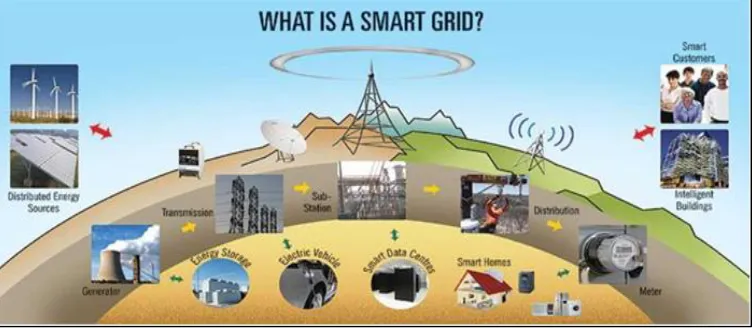
Smart Grid is a concept and vision that captures a range of advanced information, sensing, communications, control and energy technologies, together result in a system that can intelligently integrate all actions of connected users. A Smart Grid delivers electricity from supplier to consumers using two- way digital technology to control appliances at consumers homes to save energy, reduce cost and increase reliability and transparency. It overlay the electricity distribution grid with an information & net metering system. Power travels from the power plant to our house through an amazing system called the power distribution grid. Such a modernized electricity networks is being promoted by many governments as a way of addressing energy independences, global warming and emergency resilience issues. Smart meters may be part of smart grid, but alone do not constitute a smart grid. A smart grid includes an intelligent monitoring system that keeps track of all electricity flowing.
A smart grid uses sensing, embedded processing and digital communications to enable the electricity grid to be observable (able to be measured and visualized), controllable (able to manipulated and optimized), automated (able to adapt and self-heal), fully integrated. From the mentioned definitions, the Smart Grid can be described as the transparent, seamless, and instantaneous two-way delivery of energy information, enabling the electricity industry to better manage energy delivery and transmission and empowering consumers to have more control over energy decisions.
A Smart Grid incorporates the benefits of advanced communications and information technologies to deliver real-time information and enable the near-instantaneous balance of supply and demand on the electrical grid. One significant difference between today’s grid and the Smart Grid is two-way exchange of information between the consumer and the grid. For example, under the Smart Grid concept, a smart thermostat might receive a signal about electricity prices and respond to higher demand (and higher prices) on the grid by adjusting temperatures, saving the consumer money while maintaining comfort.
A smart grid includes an intelligent monitoring system that keeps track of all electricity flowing in the system. It also incorporates the use of superconductive transmission lines for less power loss, as well as the capability of the integrating renewable electricity such as solar and wind. When power is least expensive the user can allow the smart grid to turn on selected home appliances such as washing machines or factory processes that can run at arbitrary hours. At peak times it could turn off selected appliances to reduce demand.[1]
The utilities get the ability to communicate with and control end user hardware, from industrial- scale air conditioner to residential water heaters. They use that to better balance supply and demand, in part by dropping demand during peak usage hours. Taking advantages of information technology to increase the efficiency of the grid, the delivery system, and the use of electricity at the same time is itself a smart move. Simply put, a smart grid combined with smart meters enables both electrical utilities and consumer to be much more efficient.
A smart grid not only moves electricity more efficiently in geographic terms, it also enables electricity use to be shifted overtime-for example, from period of peak demand to those of off-peak demand. Achieving this goals means working with consumers who have smart meters to see exactly how much electricity is being used at any particular time. This facilitates two-way communication between utility and consumer. So they can cooperate in reducing peak demand in a two-way that it is advantageous to both. And it allow to the use of two way metering so that customer who have a rooftop solar electric panel or their own windmill can sell surplus electricity back to the utility.
Benefits
The US Department of Energy’s (DOE’s) National Energy Technology Laboratory (NETL) states that the “Modern Grid” will have certain benefits for consumers, business, utilities and the Nation.
Self-Healing: A smart grid automatically detects and responds to routine problems and quickly recovers if they occur, minimizing downtime and financial loss. It incorporates an engineering design that enables problems to be isolated, analyzed, and restored with little or no human interaction. It performs continuous predictive analysis to detect existing and future problems and initiate corrective actions. It will react quickly to electricity losses and optimize restoration exercises. Resists Attack: A smart grid has security built-in from the ground up.
Motivates and Includes the Consumer: A smart grid gives all consumers – industrial, commercial and residential – visibility into real time pricing, and affords them the opportunity to choose the volume of consumption and price the best suits their needs. The smart grid consumer is informed, modifying the way they use and purchase electricity. They have choices, incentives, and disincentives to modify their purchasing patterns and behaviour. These choices help drive new technologies and markets.
Provides Power Quality for 21st Century Needs: A smart grid provides power free of sags, spikes, disturbances and interruptions. It is suitable for use by the data centres, computers, electronics and robotic manufacturing that will power our future economy.
Accommodates all Generation and Storage Options: A smart grid enables “plug-and-play” interconnection to multiple and distributed sources of power and storage. It supports large, centralized power plants as well as Distributed Energy Resources (DER). DER may include system aggregators with an array of generation systems.
Enables Markets: By providing consistently dependable coast-to-coast operation, a smart grid supports energy markets that encourage both investment and innovation. The Smart Grid enables a market system that provides cost-benefit tradeoffs to consumers by creating opportunities to bid for competing services. As much as possible, regulators, aggregators and operators, and consumers can modify the rules of business to create opportunity against market conditions. Innovative products and services create market penetration opportunities and consumers with choices and clever tools for managing their electricity costs and usage.
Optimizes Assets and Operates Efficiently: A smart grid enables us to build less new infrastructure, transmit more power through existing systems, and thereby spend less to operate and maintain the grid. It applies current technologies to ensure the best use of assets. Assets operate and integrate well with other assets to maximize operational efficiency and reduce costs. Routine maintenance and self-health regulating abilities allow assets to operate longer with less human interaction. Operate Resiliently against Attack and Natural Disaster. The Smart Grid resists attacks on both the physical infrastructure
(substations, poles, transformers, etc.) and the cyber-structure (markets, systems, software, communications). Sensors, cameras, automated switches, and intelligence are built into the infrastructure to observe, react, and alert when threats are recognized within the system. The system is resilient and incorporates self healing technologies to resist and react to natural disasters. Constant monitoring and self-testing are conducted against the system to mitigate malware and hackers.
Challenges
Major change usually entails substantial challenges, and the smart grid is no exception. DOE’s National Energy Technology Laboratory report, a systems view of the modern grid lists the following as major barriers to achieving smart grids.
Government Support: The industry may not have the financial capacity to fund new technologies without the aid of government programs to provide incentives to invest. The utility industry is capital-intensive, with $800 billion in assets, but it has undergone hard times in the market place and some utilities have impaired financial ratings.
Compatible Equipment: Some older equipment must be replaced as it cannot be retrofitted to be compatible with smart grid technologies. This may present a problem for utilities and regulators since keeping equipment beyond its depreciated life minimizes the capital cost to consumers. Early retirement of equipment may become an issue.
Speed of Technology Development: The solar shingle, the basement fuel cell, and the chimney wind generator were predicted 50 years ago as an integral part of the home of the future. This modest historical progress will need to accelerate. Policy and Regulation: Utility commissions frequently take a parochial view of new construction projects. A critical circuit
tie crossing state boundaries has historically met significant resistance. The state financing the project may not always be the one benefiting most from it. Unless an attractive return on smart grid investments is encouraged, utilities will remain reluctant to invest in new technologies.
Co-operation: The challenge 3,000 diverse utilities will be the co-operation needed to install critical circuit ties and freely exchange information to implement smart grid concepts.
Skills and knowledge: As the utilities will move towards Smart Grid, there will be a demand for a new skill sets to bridge the gap and to have to develop new skills in analytics, data management and decision support. To address this issue, a cadre of engineers and managers will need to be trained to manage the transition. This transition will require investment of both time and money from both government and private players to support education programs that will help in building managers and engineers for tomorrow. To bring such a change utilities have to think hard about how they can manage the transition in order to avoid over burdening of staff with change.[1]
V. CONSUMER PARTICIPATION
The Smart Grid offers many opportunities for consumers to save energy and for utilities to operate the grid in a more efficient, effective, and reliable way. But some features enabled by the Smart Grid also involve some sacrifice on the part of consumers, such as holding off on running your dishwasher until later in the evening.
A smart consumer will ask, "What's in it for me?" And the answer is: money. Specifically, participating in these programs will earn consumers extra savings on their energy bills. And for people who generate their own power, it can even result in something they never thought they would see: their utility could mail a check to them.
Many utilities already offer their customers ways to save extra money on their utility bills. For people with central air conditioning systems, for instance, some utilities will place a remote-control switch on the air conditioner to cycle the air conditioner on and off during times of peak power demand. In return, customers receive a credit on their electrical bill.
The Smart Grid will allow programs like these to operate in more sophisticated ways, resulting in greater energy savings with less inconvenience to businesses and homeowners. Some examples include time-of-use pricing, net metering, and compensation programs for plug-in electric vehicles (PEVs). [5-7]
Time of Use Program
One of the most important ways we can get involved with the Smart Grid is to take advantage of time-of-use programs when they become available in our area. Throughout the day, the demand for energy changes: it’s usually lowest in the middle of the night and highest from about noon to 9 p.m., but it can vary according to weather patterns and what’s happening during that time. Power plants and utilities have to work harder to meet the needs of electric consumers when the demand is highest.
During peak energy usage, utilities sometimes have to bring less-efficient and often more-polluting power generation facilities on line or purchase power from neighbouring utilities at a higher cost. In the worst cases, utilities may have to institute rolling blackouts or reduce the voltage of the system, an approach called a "brownout.”Time-of-use rates encourage us to use energy when the demand is low by giving us a lower price for electricity during those times. Distributing the demand more evenly ensures that a steady and reliable stream of electricity is available for everyone.
Home energy management systems will help us to make the most of time-of-use pricing. Accessed with a home computer or hand-held mobile device, we will be able to see when prices are highest, which appliances use the most electricity, and even—at some point down the line—be alerted when prices go up, so we can remotely turn off unnecessary appliances until demand lowers and prices go back down.
Net Metering
For people that generate their own power at home—using a rooftop solar power system, for instance—net metering is an option already available in many states. In general, net metering involves the use of a meter that can record power flows back into the grid as a credit. Some mechanical meters will literally spin backwards, although today most utilities are using digital meters for net metering.
have the option of carrying over credits into the next year or receiving a check for their excess power generation. That's right, your utility can pay you for power.
The Smart Grid will enable enhancements to these net metering programs. For instance, a utility might pay more for customer-generated power during times of peak power demand, while paying less for off-peak power. Like time-of-use pricing, such a pricing structure will encourage home generators to minimize their energy use during times of peak demand so they can maximize the amount of power fed onto the grid.
Net metering can be measured over the month or year. Annualized net metering provides a more accurate measurement because it takes into account your changing energy usage and production over the four seasons.
The most obvious benefit of net metering is to consumers. If we install net metering in our home, we can reduce the amount of money we spend each year on energy. We can even make money if we produce more than we consume and our utility company pays us for that excess energy at the retail rate. Here are a few other benefits of net metering
The system is easy and inexpensive. It enables people to get real value for the energy they produce, without having to install a second meter or an expensive battery storage system.
It allows homeowners and businesses to produce energy, which takes some of the pressure off the grid, especially during periods of peak consumption.
Each home can potentially power two or three other homes. If enough homes in a neighbourhood use renewable energy and net metering, the neighbourhood could potentially become self-reliant.
It encourages consumers to play an active role in alternative energy production, which both protects the environment and helps preserve natural energy resources.
Homes that use net metering tend to be more aware of, and therefore more conscientious about their energy consumption. It saves utility companies money on meter installation, reading and billing costs.
Financial Incentives
The Smart Grid will open up countless new ways for us and our utility to interact on energy. Many of these new capabilities will offer energy savings to us, but some may also include minor sacrifices or inconveniences, and for those, utilities are likely to offer financial incentives to encourage us to participate.
For instance, smart appliances could offer countless subtle ways for utilities to shift electrical demand to off-peak hours. Our dishwasher could defer running until later in the evening, or our refrigerator could defer its defrost cycle. Our air conditioner could slightly extend its cycle time to help lower our power demand during peak hours. Unneeded lights or electrical devices could even power off.
For any such program, our utility will probably offer some financial incentive for our participation. The result could be a double savings for us: a direct energy savings on our electricity bill and the extra benefit of earning an incentive payment from our utility.
One future area of potential financial incentives involves the use of plug-in electric vehicles (PEVs) as sources of stored energy for the utility. If we own a PEV, our utility might pay an incentive for occasionally drawing power from our battery pack. Because extra cycling of our battery pack could shorten its useful life (at least in today's battery packs), our utility could provide us with extra compensation to help account for the slight degradation in the useful service life of our batteries.
Overall, the Smart Grid will open the door to many new possibilities for utilities and their customers to reach agreements on ways to save energy. The financial incentives available could encourage a wide range of new consumer options. We may be willing to pay a bit extra for a smart appliance, for instance, if it can also become a new source of revenue for us. And utility incentives could also encourage us to install a home generation system, such as a small wind turbine or solar power system. [8][9][10]
VI. CONCLUSION
With the increasing world population, thereby increasing demand, and depleting resources they need to be smart and efficient in our energy usage has become an imperative. Implementation of Smart Grid concept would go a long way in solving many of the present energy issues and problems. The whole network needs to be upgraded to meet the requirements i.e. at transmission as well as distribution level. Researches are going on to find the optimal solution and new technology to make all the desired characteristics possible. Implementation of smart grid concept would go long way in solving many of the present energy issues and problems. Several future grid developments are expected such as:
Increased use of renewable variable generation
Active involvement of customers in all aspects of electricity generation Proliferation of interoperability standards facilitating new developments
VII. FUTURE EXPANSION
Smart grid will consist of millions of pieces and parts - controls, computers and new technologies and equipment. Initially there is requirement of huge financial demands and regulations. It will take some times for all technologies to be perfected, equipment’s installed and systems tested before it comes fully on line. Once mature, the smart grid will likely bring the same kind of transformation that the internet has already brought to the way we live, work, play and learn.
REFERENCES
[1] Mladen Kezunovic, James D. McCalley and Thomas J. Overbye, Smart Grids and Beyond: Achieving the Full Potential of Electricity Systems, Vol. 100, May 13th, 2012
[2] PSerc, Challenges in integrating renewable technologies into an electric power system, Power Syst. Eng. Res. Cntr. Rep. 10-27, 2010. [3] NETL, Smart Grid Principal Characteristics Enables New Products, Services, and Markets, DOE/NETL-2010/1401, Feb. 2010.
[4] J. D. McDonald, Substation automation, IED integration and availability of information, IEEE Power Energy Mag.,vol. 1, no. 2, pp. 22–31, Mar./Apr. 2003.
[5] EPRI, Estimating the costs and benefits of smart grid: A preliminary estimate of the investment requirements and the resultant benefits of a fully functioning smart grid,Tech. Rep., Mar. 2011.
[6] M. Begovic, D. Novosel, D. Karlsson, C. Henville, and G. Michel, Wide-area protection and emergency control, Proc. IEEE, vol. 93, no. 5, pp. 876–891, May 2005.
[7] S. H. Horowitz, A. G. Phadke, and J. S. Thorpe, Adaptive transmission system relaying, IEEE Trans. Power Delivery, vol. 3, no. 4, pp. 1436–1445, Oct. 1988
[8] Y. Dong, V. Aravinthan, M. Kezunovic, and W. Jewell, Integration of asset and outage management tasks for distribution systems,in Proc. Power Energy Soc. Gen. Meeting, pp. 1–9, Jul. 26–30, 2009
[9] B. Roberts, Capturing grid power, IEEE Power Energy Mag., vol. 7, no. 4, pp. 32–41,Jul./Aug. 2009