INTERPLAY OF SOLUBILITY AND DISSOLUTION IN
DOSAGE FORM DEVELOPEMNT
Dr. Ajay Semalty
Faculty of Pharmacy, Department of Pharmaceutical Sciences, H.N.B Garhwal (Central) University, Srinagar (Garhwal)-Uttarakhand, INDIA
Date Received: 5TH Jan 2014
Date of Accepted: 8st Jan 2014
Date Published: 11th Jan 2014
Abstract:
For the drug formulation and drug delivery poor solubility and the dissolution of drugs are the major challenges. The drugs which have the water solubility less than the 10 mg/ml (over the pH range of 1 to 7 at 37 ºC) show the potential bioavailability problems. The bioavailability of the drugs (which show the solubility or dissolution rate limited absorption) may be improved by improving their aqueous solubility. Moreover, the various formulations need water solubility of the drug as a prerequisite. The article discussed the basic concept related to solubility and dissolution, their importance in biopharmaceutical classification of drugs along with their significance in pharmaceutical drug delivery.
Keywords: BCS, IVIVC, Solubility, theory of dissolution. Bioavailability Introduction
The oral route of drug administration is the most convenient, cost effective and popular approach of drug delivery. Upon the oral ingestion of a drug it must be dissolved in the gastrointestinal (GI) fluid followed by the permeation across the biomembranes which lead to its availability to systemic circulation. The aqueous solubility is needed for the good dissolution (in gastrointestinal fluid) while the oil solubility (n octanol solubility in case of the GI membranes) is needed for the permeation of drug across the GI membranes followed by systemic uptake of the drug. Therefore, the solubility of a drug is one of the most critical factors in developing a drug into a dosage form or delivery system. The aqueous solubility governs the amount of compound that will dissolve and hence the amount available for absorption. Therefore, a fair solubility in
gastro intestinal medium is an indispensable property for good bioavailability of orally administered drugs. As the dissolution of drug is directly dependent on the aqueous solubility of the drug, the dissolution and solubility are considered to be the two most important properties which play an important role in formulation development of the drugs [1, 2].
use of salt forms, complexation etc. have been investigated for resolving solubility issue in pharmaceutical product development. Each of these techniques has its own merits and some demerits [3-10]. The present article reviews the basic concept related to solubility and dissolution and their significance in pharmaceutical drug delivery.
BIOPHARMACEUTICAL CLASSIFICATION
SYSTEM
The Biopharmaceutical Classification System (BCS) is a scientific framework for classifying drug substances based on their aqueous solubility and intestinal permeability.
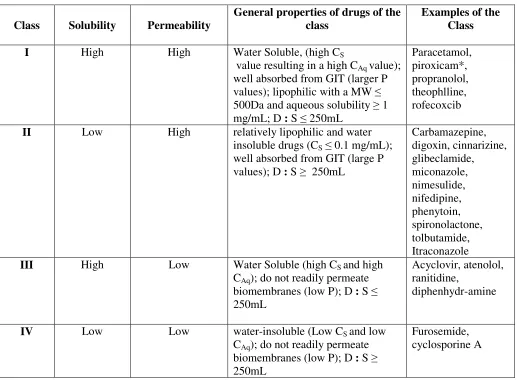
As shown in figure 1, three fundamental factors including dissolution, solubility and intestinal permeability govern the rate and extent of drug absorption from solid oral dosage forms. The Biopharmaceutical Classification System (BCS) (which was proposed by Amidon et al. in 1995) classifies drugs into four different groups, depending on their solubility and permeability (Table1) [11-16]. BCS is a drug development tool that allows estimation of the contribution of three fundamental factors including dissolution, solubility and intestinal permeability, which govern the rate and extent of drug absorption from solid oral dosage forms. Drug dissolution is the process by which the drug is released, dissolved and becomes ready for absorption. Permeability is referred to the ability of the drug molecule to permeate through a membrane in to the systemic circulation. The intention of the system (BCS) was to set up a theoretical basis for correlating the in vitro dissolution profiles with in vivo bioavailability of drugs. BCS is also a fundamental guideline for determining the conditions under which in vitro in vivo correlations (IVIVCs) are expected.
It is also used as a tool for developing the in-vitro dissolution specification. The BCS can be employed as a tool to develop a strategy for improving the bioavailability of new chemical entities. Additionally, the system provides information about whether a compound’s bioavailability (BA) is solubility or permeability limited [3]. With this framework, when certain criteria are met, the BCS can be used as a drug development tool to help sponsors justify requests for biowaivers.
2.1 Solubility
The solubility of a drug in the BCS is based on the highest dose strength in an Immediate release (IR) product. When a drug shows a dose: solubility ratio of 250 ml or lower of aqueous media at 37 °C over a pH range of 1.2–6.8, it can be classified as “highly soluble. (The pH has been decreased from 7.5 in the FDA guidance to 6.8 (in WHO Expert Committee on Specifications for Pharmaceutical Preparations, 40th Report, 2006), which reflects the need to dissolve the drug before it reaches the mid-jejunum to ensure absorption from the gastrointestinal tract. The volume estimate of 250 mL is derived from typical bioequivalence study protocols that prescribe the administration of a drug product to fasting human volunteers with a glass of water [3].
2.2 Permeability
The permeability classification is based directly on the extent of intestinal absorption of a drug
substance in humans or indirectly on the
measurement of the rate of mass transfer across the human intestinal membrane. A drug is classified as highly permeable if the fraction absorbed is > 85 % (from solution). In WHO revisions to the criteria for BCS classification, the permeability criterion was relaxed from 90% in the FDA guidance (40th Report, 2006) to 85%, which shifted some BCS class III drugs to class I drugs e.g. paracetamol, acetylsalicylic acid, allopurinol, lamivudine and promethazine.
Figure 1
Formulated Drug
Solubilized Drug
Absorbed Drug
Kd Kp
kd = dissolution rate; which is a function of solubility (including food), drug product quality attributes.
kp = permeability rate; which is a major function of API molecular structure and shows minor
Table 1. Biopharmaceutical classification system of drugs
Class Solubility Permeability
General properties of drugs of the class
Examples of the Class
I High High Water Soluble, (high CS
value resulting in a high CAq value); well absorbed from GIT (larger P values); lipophilic with a MW ≤ 500Da and aqueous solubility ≥ 1 mg/mL; D : S ≤ 250mL
Paracetamol, piroxicam*, propranolol, theophlline, rofecoxcib
II Low High relatively lipophilic and water
insoluble drugs (CS ≤ 0.1 mg/mL); well absorbed from GIT (large P values); D : S ≥ 250mL
Carbamazepine, digoxin, cinnarizine, glibeclamide, miconazole, nimesulide, nifedipine, phenytoin, spironolactone, tolbutamide, Itraconazole
III High Low Water Soluble (high CS and high
CAq); do not readily permeate biomembranes (low P); D : S ≤ 250mL
Acyclovir, atenolol, ranitidine,
diphenhydr-amine
IV Low Low water-insoluble (Low CS and low
CAq); do not readily permeate biomembranes (low P); D : S ≥ 250mL
Furosemide, cyclosporine A
* piroxicam is practically insoluble in water but is a potent drug with low enough D : S ratio to be classified as a class I drug. Cs is saturation solubility of the drug in the aqueous fluid; CAq is the drug concentration in the aqueous exterior immediately adjacent to the mucosal surface; P is permeability coefficient of the drug through the lipophilic mucosa; D:S is dose to solubility ratio.
2.3 Dissolution
An IR drug product is characterized as a rapid dissolving when no less than 85% of the labeled amount of the drug substance dissolves within 30 minutes using USP Apparatus I at 100 rpm or USP Apparatus II at 50 rpm in a volume of 900 mL or less of each of the following media:
• 0.1N HCl or Simulated Gastric Fluid USP
without enzymes
• pH 4.5 buffer
• pH 6.8 buffer or Simulated Intestinal Fluid
USP without enzymes
The BCS guidance document (August 2000)
recommends that sponsors may request biowaivers for highly soluble and highly permeable drug substances (Class I) in IR solid oral-dosage forms that exhibit rapid in vitro dissolution, provided the following conditions are met:
• the drug must be stable in the gastrointestinal tract
• the drug must not have a narrow therapeutic index
• the product is designed not to be absorbed in the oral cavity.
2.4 Benefits and applications of BCS
Thus for BCS Class I drug substances, demonstration of rapid in vitro dissolution using the recommended test methods would provide sufficient assurance of rapid in vivo dissolution, thereby ensuring human in vivo bioequivalence. The potential benefit from this FDA guidance is not only lowering expenditures associated with bioavailability / bioequivalence studies but more critically expediting the development of new chemical entities for the marketplace, entities that will ultimately be of benefit to the health of the public.
In general, NSAIDs have oral bioavailability of about or >90% in humans (that is a large P value in equation 2). In spite of good bioavailability, many acidic NSAIDs (pKa about 4.5), such as indomethacin, ketoprofen, naproxen, and tiaprofenic acid are clas- sified as class II drugs based on their solubility at pH 1.0, but they would be classified as class I drugs based on their solubility at pH >5 (i.e. pH in duodenum) [17]. The BCS is based on a simple absorption model, in which the intestine is a cylindrical tube where absorption occurs; particles are spheres of the same size; there are no reactions (i.e., there is no metabolism) in the intestine; solubility is independent of the particle size and the intestinal pH gradient; and no aggregation occurs. Amidon et al. have demonstrated that the key parameters controlling drug absorption are three dimensionless numbers: an Absorption Number, An; a Dissolution Number, Dn; and a Dose Number, Do; representing the fundamental processes of membrane permeation, drug dissolution and dose, respectively:
2.4.1 Absorption Number (An)
The Absorption Number (An) is the ratio of the
Mean Residence Time (Tres) to the Mean
Absorption Time (Tabs) and is calculated by
equation 1.
An = Tres / Tabs (1)
Or
An = (Peff/ R). Tres
Where Tres is the mean residence time (~180 min),
Peff is the effective permeability, and R is the radius
of the intestinal segment.
2.4.2 Dissolution Number (Dn)
The Dissolution Number (Dn) is the ratio of Tres to
Mean Dissolution Time (Tdiss) and could be
estimated using equation 2.
Dn = Tres / Tdiss (2)
Tdiss is the time required for a drug particle to
dissolve.
2.4.3 Dose Number (Do)
The Dose Number (Do) is calculated using equation 3.
Do = (Mo/Vo)/ Cs (3)
where M0is the dose of drug administered, V0 is the
initial gastric volume (~250 ml), Cs is the saturation solubility,
Class I compounds such as metoprolol exhibit a high absorption (An) and a high Dissolution (Dn) number. The rate-limiting step to drug absorption is drug dissolution or gastric emptying rate if dissolution is very rapid. Class II drugs such as phenytoin has a high absorption number, An, but a low dissolution number, Dn. In vivo drug dissolution for Class II drugs is, therefore, a rate limiting factor in drug absorption (except at very high dose number, Do) and consequently absorption is usually slower than Class I and takes place over a longer period of time. Class III drugs, such as cimetidine, are rapidly dissolving and permeability is the rate controlling step in drug absorption. Class IV drugs are low solubility and low permeability drugs. This class of drugs exhibit significant problems for effective oral delivery. It is anticipated that inappropriate formulation of drugs fall in class IV, as in the case of class II drugs, could have an additional negative influence on both the rate and extent of drug absorption.
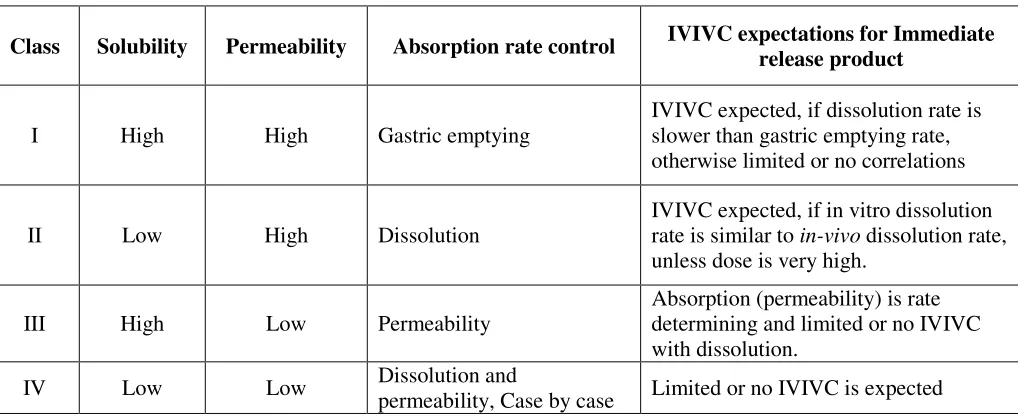
theoretical basis for correlating the in vitro dissolution profiles with in vivo bioavailability of drugs. BCS is also a fundamental guideline for determining the conditions under which IVIVCs are expected (Table 2).
However, it has been argued that these definitions of ‘highly permeable’ and ‘highly soluble’ are too conservative [18], in particular, the solubility restrictions of permeable acidic drugs, like some nonsteroidal antiinflammatory drugs (NSAIDs), which fail the minimum solubility requirements at pH below their pKa values but fulfill the requirements at pH > 5 (i.e. at pH in duodenum) [17].
3. SOLUBILITY
About 40 % of the drug candidates identified via combinatorial screening programmes are poorly water soluble. Poor solubility can hinder or even prevent drug development, yet, the volume and level of poorly water soluble compounds is dramatically increasing, leaving gaps in development pipeline. Currently, only 8 % of new drug candidate have both high solubility and permeability.
An understanding of the solubility behavior of a drug candidate can be regarded as one of the most important aspects of preformulation testing for poorly soluble compounds. For parenteral formulations, which are usually needed for preclinical and early clinical studies, the drug must be soluble in a pharmaceutically acceptable vehicle. For oral formulations, the drug must have an adequate solubility and dissolution rate to achieve suitable bioavailability. However, determining solubility of these poorly soluble compounds and identifying solubilizing systems are not easy tasks. Special care must be taken and often special techniques must be applied to obtain reliable results [19].
For a drug to be called “soluble,” the Food and Drug Administration (FDA) biopharmaceutical classification system (BCS) requires that the human dose of drug be soluble in 250 mL throughout the gastrointestinal (GI) pH range of 1–7.5. For drugs with moderate permeability, when the projected doses are about 1 mg/kg, the effects of different solubility of drugs can be roughly estimated as in Table 3.
Table 2 IVIVC expectationsfor immediate release products based on BCS
Class Solubility Permeability Absorption rate control IVIVC expectations for Immediate release product
I High High Gastric emptying
IVIVC expected, if dissolution rate is slower than gastric emptying rate, otherwise limited or no correlations
II Low High Dissolution
IVIVC expected, if in vitro dissolution rate is similar to in-vivo dissolution rate, unless dose is very high.
III High Low Permeability
Absorption (permeability) is rate determining and limited or no IVIVC with dissolution.
IV Low Low Dissolution and
TABLE 3 Solubility data interpretation
Solubility (µg/mL) Classification Comments
≤ 20 Low Will have solubility problems 20-65 Moderate May have solubility problems
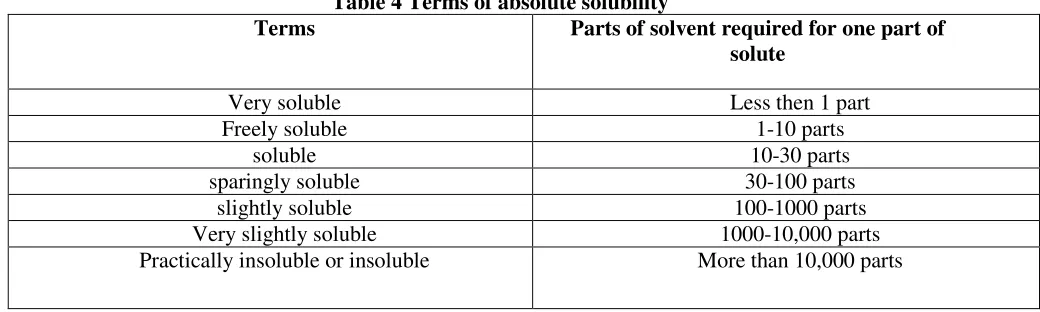
≥ 65 High No solubility problem Indian Pharmacopeia provides the solubility criteria and terminology as given in Table 4.
Table 4 Terms of absolute solubility
Terms Parts of solvent required for one part of
solute
Very soluble Less then 1 part Freely soluble 1-10 parts
soluble 10-30 parts
sparingly soluble 30-100 parts slightly soluble 100-1000 parts Very slightly soluble 1000-10,000 parts Practically insoluble or insoluble More than 10,000 parts
3.1Definition of Solubility
Solubility of a substance is the molarity of that substance (counting its entire solution species) in a solution that is at chemical equilibrium with an excess of the undissolved substance. This implies that there must also be a uniform temperature throughout the system, because solubility is typically temperature dependent. It is also greatly affected by pH and solubility of salt form [19].
3.2 Methods of Determination of Solubility [19]
The determination of solubility for insoluble compounds may be very challenging and time consuming. Recognizing the advantages and limitations of various methods and choosing the proper method(s) or combination of methods for the specific preformulation requirement is essential to ensure the quality of the data.
3.2.1 Equilibrium Method
The equilibrium solubility of the drug candidate is obtained by equilibrating an excess of material in a vial with the solvent. The vial is shaken or stirred at constant temperature and the amount of drug is determined periodically by analysis of the supernatant fluid. In general, several samples
should be assayed at different time intervals to determine if equilibrium has been achieved. When results from two successive samples are identical, equilibrium has most likely been reached. The residual solid from the solubility study should be checked to see if there are any crystal form changes. For very insoluble compounds, the methods have many limitations. First of all, the analytical method may not be sensitive enough to quantitate the solubility. Second, the extremely low dissolution rate resulting from the low solubility may lead to difficulty in reaching equilibrium, leading to large errors in solubility results.
There are several possible ways to improve the saturation rate. One reason for the delay in the attainment of equilibrium is the decrease in effective surface area during the dissolution process. This can be overcome by using a substantial excess of solid in the solubility sample [20]. Another approach for enhancing the dissolution rate is the addition of a water-immiscible solvent in which the organic solute is more soluble, thereby increasing the effective surface area available for dissolution.
3.2.2 Intrinsic Dissolution Rate Method
intrinsic dissolution rate measurements are selected. The rotating-disk method is the most useful and most widely used technique for measuring intrinsic dissolution rates. The theoretical considerations and experimental details of this method will be considered later in this chapter in the discussion dealing with dissolution.
The intrinsic dissolution rate method is most useful where the equilibrium method cannot be used. For example, when one wishes to examine the influence of crystal habit, solvates and hydrates, polymorphism, and crystal defects on apparent solubility, the intrinsic dissolution rate method will usually avoid the crystal transitions likely to occur in equilibrium methods.
3.2.3 Non-equilibrium Method
The methods that do not contain steps to ensure the establishment of equilibrium can be considered nonequilibrium methods. In the past few years, several methods commonly used for solubility measurements in the early discovery setting have been reported [21-23]. These methods typically begin with dimethylsulfoxide (DMSO) solutions or with amorphous material. Turbidity and ultraviolet detection are commonly used because they easily can be designed into high-throughput instrumentation. The usefulness of the solubility data from these nonequilibrium methods is often questionable. In this method, setting the right criteria to eliminate poorly soluble compounds may be challenging.
3.2.4 Estimation from the Partition Coefficients
For extremely insoluble compounds, the direct measurement of solubility may be impractical and unreliable. One possible way to obtain solubility information in these cases is through estimation from the partition coefficient [20]. Typically, these very water-insoluble compounds are sufficiently soluble in a water-immiscible organic solvent to allow direct measurement. Once the solubility in some selected organic solvents is known, the solubility in water can be calculated from the directly measured or, more usually, the estimated partition coefficients. On the basis of assumptions of the group contribution approach [24], the partition coefficient for a molecule can be predicted
from the partition characteristics of its constituent parts by assuming that they are additive.
4. DISSOLUTION
Dissolution is defined as the process by which a known amount of drug substance goes into solution per unit of time under standardized conditions [3]. The extent to which the dissolution proceeds under a given set of experimental condition is referred to as the solubility of the solute in the solvent. Thus, the solubility of substance is the amount of it that passes into solution when equilibrium is established between the solution and excess (undissolved) substance. The solution that is obtained under these conditions is said to be saturated.
On point to emphasize at this stage is that the rate of solution (dissolution) and amount which can be dissolved (solubility) are not the same and are not necessarily related, although in practice high drug solubility is usually associated with a high dissolution rate.
4.1Goals of Dissolution Testing
The primary goal of dissolution testing is to be used as a qualitative tool to provide measurements of the bioavailability, batch-to-batch consistency and to signal potential problems with in vivo bioavailability.
The bioavailability and bioequivalence data obtained as a result of dissolution testing can be used to guide the development process toward product optimization, as well to ensure continuing product quality and performance of the manufacturing process. In addition dissolution is a requirement for regulatory approval for product marketing and is a vital component of the overall quality control program.
4.2 Need of Dissolution Testing • To help assure lot-to-lot uniformity
USP requirement applies even if there is no correlation with in vivo data because it is a very discriminating and useful control over manufacturing variables.
• To guide formulation development
• To help establish stability/expiration dates • To demonstrate to FDA that products after
• When correlated with in vivo data, dissolution may be used instead of human biostudies.
• Used without in vivo correlation for minor
changes.
4.3 Basic Concept of Dissolution
The dissolution of a solid substance can be described in two steps. In the first step the molecules are released from the surface to the surrounding dissolution media. This creates a saturated layer, called the stagnant layer, adjacent to the solid surface. Thereafter, the drug diffuses into the bulk of the solvent from regions of high drug concentration to regions of low drug concentration. The rate of drug dissolution at a specific time can be described with the Modified Noyes-Whitney’s equation
= . .
ℎ . s −
where dx/dt is the dissolution rate, A is the surface area of the particle available for dissolution, D is the diffusion rate constant, K is the oil water partition coefficient, h is the thickness of the stagnant layer surrounding the particle, Cs is the saturation solubility of the drug, Xd is the amount dissolved of drug at time t and V is the volume of the dissolution media.
The dissolution rate is influenced both by the physicochemical properties of the substance and by the prevailing physiological conditions in the GI tract, which varies between the fasted and fed state as well as within and between subjects. Formulation strategies intended to alter these properties have been employed to increase the dissolution rate of low soluble drugs. These include micronisation, nano-suspensions, lipid-formulations, microemulsions, and the use of complexing agents such as cyclodextrins.
4.4 Basic Theories of Dissolution (Dissolution Models)
Dissolution of a solute is a multistep process involving heterogeneous reactions/interactions between the phases of the solute, solute-solvent, solvent-solute-solvent, and at the solute-solvent interface. As one of the most commonly known mass transfer rate processes, the component heterogeneous reactions may broadly be
categorized into (i) diffusion or convective transport of the solute from the interface to the bulk phase; and (ii) the rate of solute liberation and transport from and across the interfacial boundaries (Fig. 2).
Various theories have been developed to define the dissolution process. Diffusion layer model, surface renewal theory, and limited solvation theory are the three of the pioneering theories in the field. Major theories of dissolution are as followed In the diffusion layer theory, the simplest model used to describe dissolution makes use of a single crystal in a nonreactive environment. The initial step in solution of the solid (solute or crystal) at the interface is usually very rapid and results in the formation of a saturated stagnant layer around the particle. This is contrasted by the second diffusion step that is slow and becomes the rate-limiting step in the dissolution process. In particular, the Noyes-Whitney equation [dc/dt = K (cs - ct); where dc/dt: drug dissolution rate; K: first-order dissolution constant; cs: equilibrium drug concentration; ct: drug concentration at time t ] illustrates that one of the main factors determining the rate of dissolution is drug solubility. From this it is understood that in vivo the dissolution process may become the rate-limiting step if the rate of solution is much slower than the rate of absorption. This may be the case when the drug in question has a very low solubility at both gastric and intestinal pH.
The surface renewal theory assumes equilibrium at the solute-solution interface is attained and that the rate limiting step in the dissolution process is mass transport. The model is thought of as being continually exposed to fresh dissolution medium. The agitating medium consists of numerous eddies or packets into which the solute diffuses and is carried to the bulk medium. Due to the turbulence at the surface of the solute, there is no boundary layer and therefore no stagnant film layer. In other words the surface is continually being replaced with fresh medium.
crystal must be considered since each face of the crystal may have a different interfacial barrier. Hence each surface may provide a different contribution to the dissolution process.
4.5 Official Dissolution Test Apparatus
In U.S. Pharmacopeia (USP), seven dissolution test apparatus are mentioned, while Indian Pharmacopoeia (IP) provides only two apparatus.
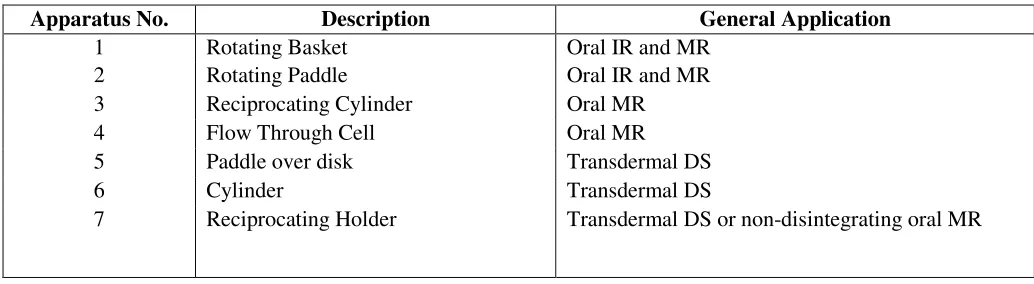
Various dissolution test apparatus official in USP are given in table 5. The most commonly employed dissolution test methods are (1) the basket method (Apparatus 1) and (2) the paddle method (Apparatus 2). The basket and the paddle methods are simple, robust, well standardized, and used worldwide. These methods are flexible enough to allow dissolution testing for a variety of drug products.
For this reason, the official in vitro dissolution methods described in USP, Apparatus 1 and Apparatus 2 should be used unless shown to be unsatisfactory. The in vitro dissolution procedures, such as the reciprocating cylinder (Apparatus 3) and a flow-through cell system (Apparatus 4) described in the USP may be considered if needed. Dissolution methodologies and apparatus described in the USP can generally be used either with manual sampling or with automated procedures
Fig. 2 Schematic diagram of the dissolution process
Table 5. USPofficial dissolution test apparatus
*IR = Immediate release, MR = Modified Release, DS= Delivery System
Apparatus No. Description General Application
1 Rotating Basket Oral IR and MR 2 Rotating Paddle Oral IR and MR 3 Reciprocating Cylinder Oral MR 4 Flow Through Cell Oral MR 5 Paddle over disk Transdermal DS 6 Cylinder Transdermal DS
For this reason, the official in vitro dissolution methods described in USP, Apparatus 1 and Apparatus 2 should be used unless shown to be unsatisfactory. The in vitro dissolution procedures, such as the reciprocating cylinder (Apparatus 3) and a flow-through cell system (Apparatus 4) described in the USP may be considered if needed. Dissolution methodologies and apparatus described in the USP can generally be used either with manual sampling or with automated procedures.
4.6 Unofficial/Unconventional dissolution test apparatuses
These methodologies or other alternatives/modifications should be considered on the basis of their proven superiority for a particular product. Because of the diversity of biological and formulation variables and the evolving nature of understanding in this area, different experimental modifications may need to be carried out to obtain a suitable in vivo correlation with in vitro release data. Therefore, apart from official test apparatuses, various scientists have developed different kinds of dissolution test apparatus, which have been classified as natural convection and forced convection models, on the basis of mode of agitation of dissolution medium [3].
4.7 Comparing and presenting and comparing the dissolution profiles
Drug dissolution from solid dosage forms has been described by kinetic models in which the dissolved amount of drug (Q) is a function of the test time, t or Q 5f(t). Some analytical definitions of the Q(t) function are commonly used, such as zero order, first order, Hixson–Crowell, Weibull, Higuchi, Baker–Lonsdale, Korsmeyer–Peppas and Hopfenberg models. Other release parameters, such as dissolution time (t ), assay time (t ), dissolution efficacy (ED), difference factor ( f ), x% x min 1 similarity factor ( f ) and Rescigno index ( j and j) can be used to characterize drug dissolution / release profiles [25].
After determining the order of release, the drug release mechanism can be determined by models like Higuchi, Peppas etc. According to the Higuchi Model the linear relationship between the drug release and the square root of time indicate the drug
release by matrix diffusion process. On the other hand the Korsmeyer-Peppas model is generally used to analyze the release of pharmaceutical polymeric dosage forms, when the release mechanism is not well known or when more than one type of release phenomena could be involved. In this model, if the diffusion is the main drug release mechanism, a graphic representing the drug amount released, in the referred conditions, versus the square root of time should show a straight line. Under some experimental situations the release mechanism deviates from the Fick equation, following an anomalous behaviour (non-Fickian). In these cases a generic equation can be used: Mt/
M∞= at
n
, where a is a constant incorporating structural and geometric characteristics of the drug dosage form, n is the release exponent, indicative of the drug release mechanism, and the function of t is Mt/ M∞ (fractional release of drug). In this model
the n value is used to characterize the different release mechanisms, concluding for values for a slab, of n = 0.5 for Fick diffusion and higher values of n, between 0.5 and 1.0, or n=1.0, for mass transfer following a non-Fickian model.
A simple model independent approach for dissolution profile comparison uses a difference factor (f1) and a similarity factor 1 (f2) to compare
dissolution profiles. The difference factor (f1)
calculates the percent (%) difference between the two curves at each time point and is a measurement of the relative error between the two curves. US FDA recommends that the f2 test be used to
compare profiles from the different strengths of the product. The similarity factor (f2) is a logarithmic
reciprocal square root transformation of the sum of squared error and is a measurement of the similarity in the percent (%) dissolution between the two curves (of reference and the test). An f2 value
(similarity factor) > 50 indicates a sufficiently similar dissolution profile such that further in vivo studies are not needed. The similarity factor f2 is to be computed using the equation [3, 25].
5. CONCLUSIONS
and dissolution. The process of bioequivalence study for preparing the generic copy of the reference drugs (which might of getting out of the patent protection), the role of establishing the dissolution correlation is always the most important and vital deed. The article reviewed the basic concept related to solubility and dissolution, their importance in biopharmaceutical classification of drugs and their significance in pharmaceutical drug delivery.
As per the available literature it was evident that the bioavailability of the drugs (which show the solubility or dissolution rate limited absorption) may be improved by improving their aqueous solubility. And this holds true specifically for BCS class II drugs (and class IV drugs in some cases).
References
1. Vilarnovo BP, Lopez IP, Lopez ME, Pardo PS, Estrada E, Juan J, Labandeira T. Improvement of water solubility of sulfamethizole through its complexation with β and HP-β-CD characterization of the interaction in solution and in solid state. Eur J Pharm Sci 2001;13:325-331.
2. Ozkan Y, Atay T, Dikmen N, Isimer A, Hassan Y, Enein A. Improvement of water solubility and in vitro dissolution rate of gliclazide by complexation with β- cyclodextrins. Pharm Acta Hel 2000;74:365-370.
3. Semalty A, Semalty M, Rawat MSM. Essentials of Pharmaceutical Technology. Hyderabad: Pharma Med Press; 2011. pp. 4-5. . 4. Moneghini M, Kikig I, Perissutti B,
Franceschinis E, Corteri A. Characterization of nimesulide-β-cyclodextrin system prepared by supercritical fluid impregnation. Eur J Pharm Bioparm 2004;58:637-644.
5. Pralhad T, Kumar R. Study of freez-dried quercetin- cyclodextrin binary system by DSC, FTIR, X-ray diffraction and SEM analysis. J Pharm Biomed Ana. 2004;34:333-339.
6. Babu RJ, Pandit JK. Effect of cyclodextrin on the complexation and transdermal delivery of bupranolol through rat skin. Int J Pharm 2004;271:155-165.
7. Rawat S, Jain SK. Solubility enhancement of celecoxib using β- cyclodextrin inclusion complexes. Eur J Pharm Biopharm 2004;51:263-267.
8. Sajeesh S, Sharma CP. Cyclodextrin – insulin complex encapsulated polymethacrylic acid based nanoparticles for oral insulin delivery. Int J Pharm 2006;325:147-154.
9. Chen X, Chen R, Guo Z, Li C. The preparation and stability of the inclusion complex of astaxanthin with β-CD. Food Chem 2007;101:1580-1584.
10. Semalty A, Semalty M, Singh D, Rawat MSM. Preparation and characterization of phospholipid complexes of naringenin for effective drug delivery. J Incl Phenom Macrocycl Chem 2010;67:253-60.
11. Amidon GL, Lennern H, Shah VP. A theoretical basis for a biopharmaceutic drug classification: the correlation of in vitro drug product dissolution and in vivo bioavailability. Pharm Res 1995; 12:413-20
12. Dressman J, Butler J, Hempenstall J. The BCS: where do we go from here? Pharm Tech North Am 2001; 25 (7):68-76.
13. Horter D, Dressman JB. Influence of physicochemical properties on dissolution of drugs in the gastrointestinal tract. Adv Drug Deliv Rev 2001; 46:75-87
14. US FDA, Center for Drug Evaluation and Research: The biopharmaceutics classification system (BCS) guidance [online]. Available
from URL:
www.fda.gov/cder/OPS/BSC_guidance.htm 15. Magnusdottir A, Masson M, Loftsson T.
Cyclodextrin in drug delivery. Expert Opin Drug Deliv 2005;2:335-351. 16. Loftsson T, Brewster ME, Masson M.
Role of Cyclodextrins in improving oral drug delivery. Am J Drug Deliv 2004;2(4): 261-275
17. Yu LX, Amidon GL, Polli JE. Biopharmaceutics classification system: the scientific basis for biowaiver extensions. Pharm Res 2002; 19: 921-5
18. Yazdanian M, Briggs K, Jankovsky C. The ‘high solubility’ definition of current FDA guidance on biopharmaceutical classification system may be too strict for acidic drugs. Pharm Res 2004; 21: 293-9
20. Higuchi T, Shih FL, Kimura T and Rytting JH. Solubility determination of barely aqueous soluble organic solids. J Pharm Sci 1979;68:1267–1272.
21. Curatolo WJ. Screening Studies for Transport Properties. Proceeding for 38th Annual International Industrial Pharmaceutical Research and Development Conference, Merrimac, WI 1996.
22. Lipinski CA, Lombardo F, Dominy BW and Feeney PJ. Experimental and Computational approaches to estimate solubility and permeability in drug discovery and development settings. Adv Drug Delivery Rev 1997;23:3–25.
23. Pan L, Ho Q, Tsutsui K, Takahashi L. Comparison of chromatographic and spectroscopic methods used to rank compounds for aqueous solubility. J Pharm Sci 2001; 90:521–529.