e
-ISSN: 2278-067X,
p
-ISSN: 2278-800X, www.ijerd.com
Volume 6, Issue 11 (April 2013), PP. 31-35
An Energy Efficient and Load Aware Routing Scheme in
Multi Sink Wireless Sensor Networks
Samiran Gupta
1, Bappaditya Das
21Pursuing M Tech (CSE) from Dr. B. C Roy Engineering College, Fuljhore, Jemua Road, Durgapur, West Bengal, India.
2
Assistant Professor , Department of Computer Science & Engineering of Dr. B. C. Roy Engineering College, Fuljhore, Jemua Road, Durgapur, West Bengal, India.
Abstract:- Now a days Wireless sensor networks is a revolutionary technology. Now it is widely used in many Indoor and outdoor areas. Due to limited power supply it is very difficult to run it for a long period of time. To run it for a long interval we need an optimum energy and load balancing option such that using this we can minimize the wastage of power consumption. Basically the main power is wasted by transceiver to find an appropriate route for data transmission, So that the sense data can reach to a sink for further processing. In this regards the routing is very vital issue. Normally, using single sink network sense data is routed to the sink using shortest path routing approach, due to this the node near to the sink are quickly exhausted as a result network get down. Over here we are implement a new routing algorithm using multi sink platform with few most important constraints like energy, load and hop count to select an appropriate route or path to enhance the lifetime of Wireless sensor networks.
Keywords:- Optimum path, current traffic, multi-sink, static, wireless sensor networks.
I.
INTRODUCTION
We are the witness of recent advancement with wireless sensor networks (WSNs) in many areas of our daily life. Nowadays, there are numerous applications for sensor networks and newer applications are still to come. A WSNs consists of a huge number of spatially distributed low cost, low power sensor nodes [1] spread in a specific area to collect information concerning the environment like temperature, sound, pressure, pollution etc. Among the main features of such networks are that they do not have any fixed infrastructures and they basically are used without any fixed stations without any wired connections to exchange information and to manage the networks. So actually they work with cooperation of each other. Every sensor node has a specific radio range and hence, in order to send the information to a specific destination, it needs to locate an appropriate neighbour nodes and to communicate with them so the information is finally routed to the destination
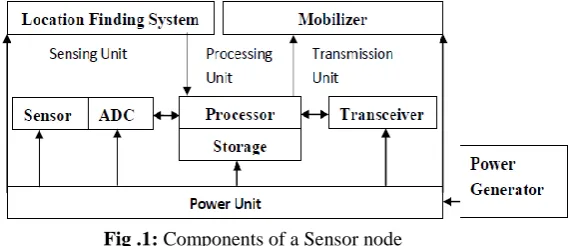
Fig .1: Components of a Sensor node
Figure 1.Shows the schematic diagram of components of a sensor node which contains few units like sensing, processing transmission, mobilizes, position finding system and power unit. The main functions of sensor nodes are sensing, processing and communication.
WSNs systems, restricted power supply for nodes make them difficult to maintain its operations for a extensive period of time. Energy consumption for the nodes, therefore, becomes an essential issue that needs to be balanced.
At present, many routing protocols have been planned for WSNs, and most of them are planned for the static nodes, i.e., they assume that both the sensor nodes and the sink have a fixed locations. while geographic routing makes the routing decision at each node by different constrains of wireless networks[9] .
In traditional single sink base approach all the sensor nodes send their data towards to sink, as result the nodes near to sink get used regularly and the energy consumption is more. Therefore there is a very high chance for network partitioning [2]. Over here we proposed a new energy and load aware routing algorithm with multi sink architecture to find the optimum route from the source node to sink using few fare most criteria like energy, load and hop count. The multi sink network is used to avoid the breakdown of whole network due to the failure of any node in single sink architecture.
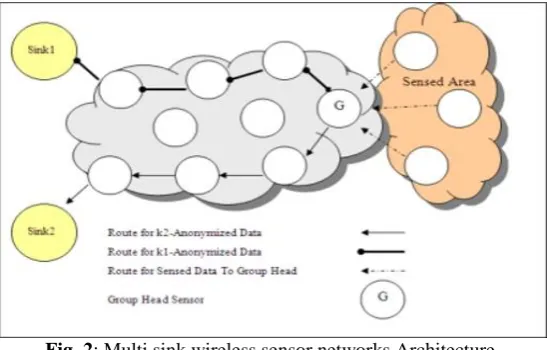
Fig. 2: Multi sink wireless sensor networks Architecture.
Figure 2 shows architecture of multi sink wireless sensor network. In this regards route choice for an instance is the main challenge in multi sink wireless networks. So, we can say that data routing is play a vital role in WSNs. The design of routing protocols in WSNs is influenced by many challenging factors like, Node deployment, scalability, network dynamics, connectivity, data aggregation, node/link heterogeneity, coverage, transmission, media [4] etc
In rest of the paper is organized as follows, in section II we discuss the previous works, in section III we introduce our main proposed work, section IV contain conclusion and then references.
II.
PREVIOUS
WORK
In traditional optimal path routing schemes over WSNs, each node selects specific nodes to transmit data according to some criteria in order to maximize network lifetime. Many routing protocols have been proposed for WSNs, classic flooding [4],[5] is an old technique that can also be used for routing in sensor networks where , when a sensor node detects an incident, it broadcasts the message to other neighbour sensor nodes within its radio transmission range, generally known as one hop. After this all the receiving nodes broadcast the message to all of their neighbour nodes within one hop, except the node from which they obtain the message. This method is re cursively performed until the message reaches the sink node Therefore, a good routing method in WSNs involves finding the optimal transmission path form the sender through relay nodes to the destination in order to prolong the network lifetime. The minimum energy routing problem has been discussed in [6],[7],[8]. The minimum total energy routing approaches in these papers are to reduce the total consumed energy. But, if all the traffic is routed through the minimum energy path to the destination, the nodes along the path will foil out of batteries fast rending other nodes useless due to the network partition even if they do have available energy. In maximum network lifetime, routing problem has been includes in [3].
wireless network. In this technique each node receives a packet must agree on their identities and choose one forwarder. Multi-path On-demand Routing protocol [13] uses hop-by-hop reliability layer for routing and data delivery in a wireless ad-hoc networks. Every node makes local decision about forwarding of data packets.
III.
PROPOSED
WORK
Our propose work based on the following assumptions.
1. At the beginning of network deployment all sensor nodes contain same amount of initial energy level with n number of neighbours and m number of sinks means m number of independent paths from source to sink. 2. At a random moment each nodes queue contains certain amount of pending traffic measure as current load
of the node.
3. The sensor node batteries are neither replicable nor remotely rechargeable.
4. We consider a GPS Beacon enabled system to find the position of every sensor nodes and sink location.
Now, the cost of the path Pi is defined as follows,
Cost Pi = Cost ( d(Source, N1i) )+ Cost ( d(N1i, N2i) ) +……..+ Cost ( d(NKi, Sink) ).
Where, Cost d (j,k) is measured as the energy consumption occurs to transfer data from node j to node k using the following formula.
COST (d(j,k))=id(j,k)α +
.Where i is the power distribution parameter of transmission circuit,
is the total energy consumption for sampling, computation and receiving of sensor node. α is a power dissipation exponent its value varies according to the environment and d(j,k) is the distance between two sensor node j and k.Considering only the residual energy and Cost the number of times the Intermediate node can successfully transfer the data to its neighbour ,termed as Energy level [14] to the direction of sink for path i, can be find out using the formula,
A. Energy Level Path wise
i
p
s
=min(
1
( ,
/ Cost d
i
Source source N
E
,.
E
N1i/ Cost d
(N1i,N2i
,………
( ,sin )
/ Cost d
ki ki
N N k
E
).If the intermediate node of ith path is assigned with load Lji then considering only the load of each intermediate node, the no of times the node can transfer the data to its neighbour along the direction of propagation is measure as Load level consideration with respect of energy level of the node.
Similarly we consider the load level for whole path i as,
B. Load level Path Wise
i
p
L
=min (1i
/ L
1N i
E
,2i
/ L
2N i
E
…/ L
Ki
N ki
E
).Over here for load consideration we leave the source node and consider the load of intermediates, because for each path load level is same for the source node.
C. Hop Count
Now our next consideration is hop count. In networking, the hop count represents the total number of devices a given piece of data (packet) passes through. In wireless sensor networks each intermediate sensor node treated as a single hop count. Hence we represent the total hop count from source to sink for a path using (Hi) where i is 1 to m for m number of paths.
Now we try to calculate and assign reliability factor for each path using those three measures like, Energy
level(
i
p
S
),Load level(i
p
L
) and Hop count(H
i) for the path i.Reliability factor path wise
So, for path i=1 to m .
i i p p i i
S
L
R
H
Wherei
p
i
p
L
Stands for Load Level of Path i.i
H
Stands for Hop count of Path i.After calculating the entire Reliability factor we chose the maximum one for our selection of best path among them.
R
max(
R
i...m)
So, with the high data traffic the load of the corresponding node will increase and after passing the whole traffic the load will decrease. So according to our approach depending on varying load in the network with different time the optimum path has also changed. It is a very vital issue or important to choose an optimal path from source to destination.
Now, If any how we get two or more same Ri factor for different paths then we consider the load level of
different Sink
sink
/ L
sinN k k
E
of different paths and chose the path whose load level of sink is minimum. Over here we assume a random load in each node to prove that it is also a main key issue for the selection of path from source to sink in WSNs.Algorithm: Consider the network for n number of nodes and m number of sinks such that each nodes have initially same energy level with different traffic load and distance.
Step 1: Initialize the Network
Step 2: Interest received by a sensor node(S).
Step 3: For every path i=1 to m Evaluate Energy level [
i
p
S
], Load level [i
p
L
]and Hop count [H
i] . End forStep 4: For every path from i=1 to m
Calculate Ri =
_
_
_
Energy level Load level
Hop count
End for
Step 5: Select max Ri as optimum
Stop
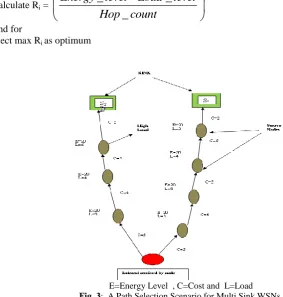
E=Energy Level , C=Cost and L=Load
Fig. 3: A Path Selection Scenario for Multi Sink WSNs.
So we can say that the Energy level for the path with S1 sink is=
min(
20
5
,
20
4
,
20
3
,
20
5
,
20
2
)
=4(As we see the cost from incident node and its immediate neighbour is 5 then with their respective neighbour is 4, 3, 5 and 2 toward to sink S1)
Similarly Load level for path with S1 is=
min(
20
,
20
,
20
,
20
)
3
4
4
3
=5(As we see the current load starting from immediate neighbour of incident node is 3 then with its respective neighbours 4, 4 and 3 toward to sink S1)
Similarly,
For next path with sink S2 Energy level is=4 and load level is=3. Hop count for S1=5 and S2=4.
Now Reliability for S1=4 and for S2=3.
Clearly the S1 is largest, so the path with sink (S1) is selected for routing in this regards with our approch.
IV.
CONCLUSION
So, form the above output we can say that the path with sink S1 is optimum from S2 according to our algorithm, because in normal sense path with sink S2 is looking optimum but due to overload of a node in the path of S2 it is not reliable and there is a chance for network partitioning. Now we can say that over here we providing a reliable load and energy aware routing path selection approach in Multi sink wireless sensor networks, using that technology we have overcome the problems of single sink based sensor networks and tried efficiently utilization of energy resource for the sensors. Using different scenario with different parameters e.g. energy, hop count and traffic load we chose different path to efficiently utilize the resources and it also help us to prolong the lifetime of the sensor networks. In our future work we will implement this algorithm with different platform in multi sink network to prove its better efficiency.
REFERENCES
[1]. S. Tilak, Nael B. Abu-Ghazaleh, and W. Heinzelman. “A Taxonomy of Wireless Micro-Sensor Network Models. Mobile Computing and Communication Review”,, Volume6, Number2, April 2002. [2]. D. Estrin, L. Girod, G. Pottie, and M. Srivastava, “Instrumenting the world with wireless sensor
networks”., In International Conference on Acoustics, Speech, and Signal Processing (ICASSP 2001), Salt Lake City, Utah, May 2001.
[3]. Y. M. Lu and V. W. S. Wong, “An energy-efficient multipath routing protocol for wireless sensor networks,” in Proc. IEEE 64th Vehicular Technol. Conf, pp. 1–5, Sep. 2006.
[4]. Jamal N. Al-Karaki Ahmed and E. Kamal, “Routing Techniques in Wireless sensor networks”, A Survey Dept. of Electrical and Computer Engineering Iowa State University, Ames, Iowa 50011. [5]. I. F. Akyildiz, S. Weilian, Y. Sankarasubramaniam, and E. Cayirci, “A survey on sensor networks”,
IEEE Communications Magazine, vol. 40, no. 8, pp. 102-114, 2002.
[6]. M. Ettus, “System capacity, latency, and power consumption in multihop-routed SS-CDMA wireless networks”, Proc. of Radio and Wireless Conference, pp.55- 58, Aug. 1998.
[7]. N. Sadagopan, B. Krishnamachari and A. Helmy, “The acquire mechanism for efficient querying in sensor networks”, Proc. of the SNPA‟03, pp.149-155, 2003.
[8]. S. Singh, M. Woo and C.S. Raghavendra, “Power-aware routing in mobile Ad Hoc networks”, Proc of the MobiCom‟98, pp. 181-190, 1998.
[9]. X. Hong, M. Gerla, R. Bagrodia, J.K Taek, P. Estabrook and P. Guangy, “The Mars sensor network: efficient, power aware communication”, Proc. of IEEE MILCOM, pp. 418-422, Oct. 2001.
[10]. X. Hong, M. Gerla, W. Hanbiao and L. Clare, “Load balanced, energy-aware communications for Mars sensor networks”, Proc. of Aerospace Conference, vol 3, pp.1109-1115, 2002.
[11]. Ganesan D., Govindan R., Shenker S., and Estrin D.(2002), „Highly resilient, energy-efficient multi-path routing in wireless sensor networks”, In Mobile Computing and Communications Review (MC2R) Vol 1, No. 2 .
[12]. Sanjit Biswas, Robert Morris (2004), “Opportunistic Routing in Multi-Hop Wireless Networks”, ACM SIGCOMM
[13]. Edoardo Biagioni and Shu Hui Chen (2004), “A Reliability Layer for Ad-Hoc Wireless Sensor Network Routing”, In Proceedings of the 37th
Hawaii International Conference on System Sciences. 2004.