Empirical Study on the Correlation between the
Internal Control and Enterprise Value
– Based on the Information System
Hongming Chen
School of Economic and Management, Changsha University of Science and Technology, Changsha, China [email protected]
Yanan Shi
School of Economic and Management, Changsha University of Science and Technology, Changsha, China [email protected]
Abstract—Internal control has been becoming a hot topic in
the modern enterprise management, and the internal control’s effectiveness is the important guarantee for enterprise to realize its goal. The article made regression analysis on the experience data of 200 manufacturing listed companies in 2009 based on the theoretical analysis of the correlation between the internal control and enterprise value. Then, the article gets the relevant relations between the value of the enterprise and internal control from the quantitative. Finally, this article combines internal control and information technology, suggesting how internal control to play a positive role in achieve company's goal and improving enterprise value.
Index Terms—Internal Control, Enterprise Value,
Information System, Empirical Study
I. INTRODUCTION
With the development of capital markets, the mobility of capital enhances, enterprise merger, venture investment and other property transactions have become increasingly active, which makes the assessment of corporate value as a key point in capital markets, so the study of corporate value has great significance for the promotion of the market's health. The internal control as an important part of modern economy management activities closely linked corporate value. Therefore, the study of the influence of internal control to corporate value has very important theoretical and practical significance
As the issue of < The basic norms of internal control> and< The concrete norms of internal control>, Internal control becomes a critical control point in corporate governance .However, close tie exists between internal control and the ultimate goal of enterprise operation - the maximization of enterprise value ,in which field, many scholars have made some achievements. Cha (2009) thought a reasonable corporate governance structure is the guarantee of, internal control system and the implementation of the maximization of enterprise value must have a sound foundation of internal control system. Cheng (2007) held that the implementation of the
maximization of enterprise value is the ultimate goal of internal control. Lin (2008) put forward that the level of internal control will affect the enterprise value on the basis of analysis of 300 listed companies’ experience data.
Based on the research of other scholars, the article analyses which and how factors of internal control influencing enterprise value according to the data from manufacturing.
II. THE RELATIVITY OF THEORY BETWEEN INTERNAL CONTROL AND ENTERPRISE VALUE
A. The related theory of theinternal control
The COSO points that the internal control is implemented under the influence of board of directors, managers, and other employees, with the purpose of ensuring the reliability of financial report ,the effectiveness and efficiency of management and the observance of current regulations. It considers that internal control framework is mainly composed of control environment, risk assessment, control activities, supervision, information and communication.
(1) Control environment
The control environment is the foundation of the five elements in the internal control framework. Its designation and operation not only affect the enterprise’ overall activity, but the other four elements. Therefore control environment directly affects the effect of implementation of internal control framework and the modern enterprises should establish a suitable internal control environment.
and supervises the system. 2) The manager’s management style and management idea. The manager’s management style and management idea influence the way of managing of the enterprises, especially the manager individual glamour and the ability to make decision .Managers control the enterprise mainly by designing the organization and management mechanism, authorizing and designing the system. 3) Organization structure. Organization structure including organization structure settings, responsibilities allocation, what position of the person in the organization is and what power and responsibility he have. Organization structure is the grantee for the enterprise to achieve overall goal and enterprises should plan, execute, control and supervise based on the structure of the organization.
(2) Risk assessment.
Risk assessment system is divided into three steps: risk identification, risk analysis and evaluation, risk control and report. 1) Risk identification. It asks the enterprise to judge and analyze risks, including its nature, types, and reasons of the occurrence, etc. 2) Risk analysis and evaluation. Risk analysis and evaluation needs quantitative analysis of digital information collected by mathematical method in order to make the risk management based on scientific basis. The result of risk analysis and risk evaluation is the probability of occurrence and size of the risk so as to provide a dependable basis for decision-making. 3) Risk control and report. As to risk analysis and assessment, management should consider how to control risk. The method of controlling risk usually is to transfer risk, adverse risk and disperse risk, etc.
(3) Control activities
Control activities are to make management instructions designed could be effective implementation of various policies and procedures. Control activities can help enterprises to ensure that it has already took measures to reduce a loss according to realization the goal of the enterprise.
From the point of daily business activities, control activities including: 1) Authorized management. It refers to that the manager decentralize powers his subordinate to make them have the right to address the problem and make a choice and share corresponding responsibility. 2) Duties. This refers to defined the authority and responsibility according to the principle of combining functions of department and its characteristic. 3) Business process and operation procedures. Business process is the procedure of all the business. An operation procedure is to say how to operate of every matter in detail.
(4) Supervision
Supervision and used to evaluate the quality of enterprise internal control performance by tracking and monitoring the internal control frame and operational status and take the necessary actions to ensure that internal control can operate effectively.
Supervision can be divided into continuous monitoring and individual assessment. Continuous monitoring activities usually are that the management department and each staff at various levels inspect, analyze and evaluate
the effectiveness and efficiency of production and operating activities of their respective during execution of the internal control system. It is a kind of self control mode. The higher the level is, the less individual evaluation need. Individual assessment is to evaluate the internal control system regularly and is usually done by the relatively independent internal audit department.
(5) Information and communication
Enterprise management activities can be divided into the plan, organization, coordination, reports, etc. When managers exercise these functions, messages are always the most basic support, namely, all the enterprise business activities are inseparable from information. Therefore, the information function is the basis of management activities and the level of information processing ability is one of the most important symbols of the level of management. And this information must be delivered timely to those who fulfill its responsibility and other responsible ones in some form. Completing the information transmission is communication and it can translate the abstract goal and plans into language that encourage employees.
B. The related theory of enterprise value
Enterprise value has become one of the core concepts in the learning of modern finance, as well as one of the most important targets to management authorities. Enterprise value is the value of complex asset of the enterprise. Enterprise value reflects not only the status of past and present, but the future development of the enterprise on the basis of the profitability and development potential of past and present. Enterprise value displays an ability of its production efficiency, profitability, growth through the combination of enterprise internal various resources.
According to the microeconomic, value refers to the present valve of future cash flow of assets. Therefore, the enterprise value is the present valve of the enterprise’s future cash flow of assets. Gordon proposed the financial appraisal method, which can be expressed as:
V=
∑
=
+
n
i
t t
r
CF
1
(
1
)
(1)V represents enterprise value, n is asset returns period, CFt points the cash flows of, t stage, r is the risk discount rate of cash flows. The equation (1) calculates the value of enterprise, the greater the V is, the bigger the enterprise value is.
C. The related theory of the correlation of enterprise value and the internal control
In the model, the enterprise value is affected by a number of factors which exist certain relations with the internal control, namely enterprise internal control affects the enterprise value to a certain extent.
decisions on investments, management, financing activities in internal control system influence the cash flows’ direction. Secondly, the quantity of cash flows generally should be matched with the enterprises ‘characteristic, the macro environment of market, etc. The internal control is formulated on the consideration of all the micro and macro conditions, therefore, internal control will affect the cash flow and the effectiveness of internal control can make the cash inflows and outflows achieve a equilibrium state. Finally, cash flows can be affected by the enterprises’ organization structure, post design and its authority, cash payment program, and the design of internal control in post settings, the authorization all can affect cash flows.
(2) The influence of internal control on discount rate The discount rate is a comprehensive ratio, which considers all risks about the cash flows, the rate of investors expected return as well as the time value and it has closely connection with risk evaluation. The assessment of risks is a very important factor in the internal control and is helpful for the management take measures to reduce losses brought by the risks. Risk assessment has a significant impact on investment intention and investment decision and enterprise's investment decision may affect risk coefficient as well as discount rate.
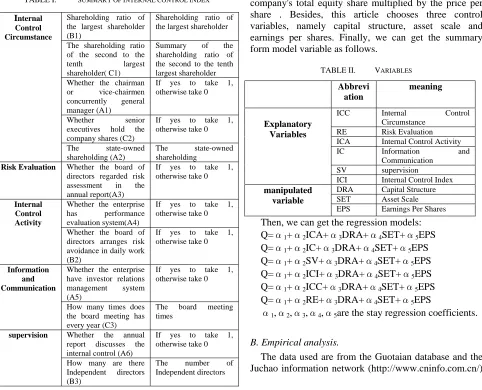
TABLE I. SUMMARY OF INTERNAL CONTROL INDEX
III. EMPIRICAL RESEARCH ON CORRELATION OF INTERNAL CONTROL AND ENTERPRISE VALUE
A.The construction of the indicator system
The article selects some indexes to measure the effectiveness of internal control according to the interpretation of five factors of internal control.
For the weight of each index, the first level of index weight for 5, the second is 3, the third is 2, which has been studied by Lin (2007) . So, we can get the formulations as follows:
ICC=5*((A1+ A2) +3*B1 +2*(C1+ C2) RE=5* A3
ICA=5* A4+3* B2 IC=5* A5+2 *C3 SB=5* A6+3 *B3
ICI=5*(A1+ A2+ A3+ A4+ A5+ A6) +3*( B1+ B2+ B3) +2*( C1+ C2+ C3)
In the current Tobin Q value is international generally used to measure the enterprise value, which can be expressed like this:
Tobin Q =the market value of shares/ the asset of replacement cost
In fact, the listed companies' replacement cost are difficult to be obtained, we commonly use the book value of total assets at the end of the year to replace replacement cost and replace the enterprise value by the company's total equity share multiplied by the price per share . Besides, this article chooses three control variables, namely capital structure, asset scale and earnings per shares. Finally, we can get the summary form model variable as follows.
TABLE II. VARIABLES
Abbrevi ation
meaning
Explanatory Variables
ICC Internal Control
Circumstance
RE Risk Evaluation ICA Internal Control Activity
IC Information and Communication
SV supervision ICI Internal Control Index
manipulated variable
DRA Capital Structure SET Asset Scale EPS Earnings Per Shares
Then, we can get the regression models: Q=α1+α2ICA+α3DRA+α4SET+α5EPS
Q=α1+α2IC+α3DRA+α4SET+α5EPS
Q=α1+α2SV+α3DRA+α4SET+α5EPS
Q=α1+α2ICI+α3DRA+α4SET+α5EPS
Q=α1+α2ICC+α3DRA+α4SET+α5EPS
Q=α1+α2RE+α3DRA+α4SET+α5EPS
α1,α2,α3,α4,α5are the stay regression coefficients.
B. Empirical analysis.
The data used are from the Guotaian database and the Juchao information network (http://www.cninfo.com.cn/)
Internal Control Circumstance
Shareholding ratio of the largest shareholder (B1)
Shareholding ratio of the largest shareholder
The shareholding ratio of the second to the
tenth largest shareholder( C1)
Summary of the shareholding ratio of the second to the tenth largest shareholder Whether the chairman
or vice-chairmen concurrently general manager (A1)
If yes to take 1, otherwise take 0
Whether senior executives hold the company shares (C2)
If yes to take 1, otherwise take 0
The state-owned shareholding (A2)
The state-owned shareholding
Risk Evaluation Whether the board of directors regarded risk assessment in the annual report(A3)
If yes to take 1, otherwise take 0
Internal Control Activity
Whether the enterprise has performance evaluation system(A4)
If yes to take 1, otherwise take 0
Whether the board of directors arranges risk avoidance in daily work (B2)
If yes to take 1, otherwise take 0
Information and Communication
Whether the enterprise have investor relations management system (A5)
If yes to take 1, otherwise take 0
How many times does the board meeting has every year (C3)
The board meeting times
supervision Whether the annual report discusses the internal control (A6)
If yes to take 1, otherwise take 0
How many are there Independent directors (B3)
and the numerical data of manufacturing listed companies. This article analyzes those data with SPSS software. The results are as follows:
a) Model fitting degree analysis
TABLE III. FITTING DEGREE ANALYSIS OF EQUITATION①
Model R Square
Adjusted R Square
Std. Error of the Estimate
Durbin -Watson
1 0.643 0.498 0.444 0.8653
a. Predictors (Constant) , ICC, DRA, IND, SET b. Dependent Variable: Q
TABLE IV. FITTING DEGREE ANALYSIS OF EQUITATION②
a. Predictors (Constant) , RE, DRA, IND, SET b. Dependent Variable: Q
TABLE V. FITTING DEGREE ANALYSIS OF EQUITATION③
Model R Square
Adjusted R Square
Std. Error of the Estimate
Durbin -Watson
3 0.998 0.442 0.527 0.7689
a. Predictors (Constant) , ICA, DRA, IND, SET b. Dependent Variable: Q
TABLE VI. FITTING DEGREE ANALYSIS OF EQUITATION④
Model R Square
Adjusted R Square
Std. Error of the Estimate
Durbin -Watson
4 0.768 0.662 0.453 0.87987
a. Predictors (Constant) , IC, DRA, IND, SET b. Dependent Variable: Q
TABLE VII. FITTING DEGREE ANALYSIS OF EQUITATION⑤
Model R Square
Adjusted R Square
Std. Error of the Estimate
Durbin -Watson
5 0.787 0.449 0.509 0.8112
a. Predictors (Constant) ,SV,DRA,IND,SET b. Dependent Variable: Q
TABLE VIII. FITTING DEGREE ANALYSIS OF EQUITATION⑥
Model R Square
Adjusted R Square
Std. Error of the Estimate
Durbin -Watson
6 0.543 0.987 0.521 0.8736
a. Predictors(Constant) ,ICI,DRA,IND,SET b. Dependent Variable: Q
From the analysis, we can see that the variance of fitting degree of each equation is quit small, which is to say that the actual observation is near to the regression straight line and it’s highly precise to do actual and forecast analysis according to regression equations. In addition, ruling coefficient R2 is close to 1, which tall us that the fitting degree is quite high and fitting effect is very well.
b) Variance analysis
TABLE IX. THE ANOVAS TABLE OF EQUATION ①(ANOVA)
Model Sum of
Squares
df Mean Square
F Sig.
1 Regression 228.764 4 100.342 32.314 0.000
Residual 265.735 196 1.294
Total 46.432 200
a. Predictors(Constant) , ICC, DRA, IND, SET b. Dependent Variable: Q
TABLE X. THE ANOVAS TABLE OF EQUATION②(ANOVA)
Model Sum of
Squares
df Mean Square
F Sig.
2 Regression 339.276 4 90.234 33.876 0.000
Residual 341.632 196 1.257
Total 1317.934 200
a. Predictors(Constant) , RE, DRA, IND, SET b. Dependent Variable: Q
TABLE XI. THE ANOVAS TABLE OF EQUATION③(ANOVA)
Model Sum of
Squares
df Mean Square
F Sig.
3 Regression 334.764 4 87.973 38.873 0.000
Residual 342.987 196 1.832
Total 1245.585 200
a. Predictors (Constant) , ICA, DRA, IND, SET b. Dependent Variable:Q
TABLE XII. THE ANOVAS TABLE OF EQUATION④(ANOVA)
Model Sum of
Squares
df Mean Square
F Sig.
4 Regression 339.287 4 76.322 43.097 0.000
Residual 372.187 196 1.634
Total 1379.173 200
a. Predictors (Constant) , IC, DRA, IND, SET b. Dependent Variable: Q
TABLE XIII. THE ANOVAS TABLE OF EQUATION⑤(ANOVA)
Model Sum of
Squares
df Mean Square
F Sig.
5 Regression 227.394 4 62.871 38.138 0.000
Residual 249.291 196 1.263
Total 1146.842 200
a. Predictors (Constant) , SV, DRA, IND, SET b. Dependent Variable: Q
TABLE XIV. THE ANOVAS TABLE OF EQUATION⑥(ANOVA)
Model Sum of
Squares
df Mean Square
F Sig.
6 Regression 376.291 4 76.291 53.192 0.000
Residual 238.193 196 1.092
Total 1379.836 200
a. Predictors (Constant) , ICI, DRA, IND, SET b. Dependent Variable: Q
In the variance analysis tables, P=0.000<
α
=0.01, which indicates that the fitting degree is quite well. c. Regression analysisModel R Square
Adjusted R Square
Std. Error of the Estimate
Durbin -Watson
TABLE XV. EQUATION 1 REGRESSION RESULTS
Model Unstandardized Coefficients
Standardized
Coefficients t Sig.
B Std.
Error Beta 1 (Constant) DRA SET EPS ICC 12.452 -1.635 -1.872 0.682 -0.729 2.871 1.893 0.201 0.729 0.381 -1.245 -0.481 0.191 -0.491 5.871 -1.419 -1.139 0.729 -0.342 0.000 0.41 0.003 0.416 0.204
a. Dependent Variable: Q
TABLE XVI. EQUATION2REGRESSION RESULTS
Model Unstandardized Coefficients
Standardized
Coefficients t Sig. B Std. Error Beta 1 (Constant) DRA SET EPS RE 13.981 -2.421 -0. 563 0.661 0.291 1.123 2.981 0.168 0.342 0.732 -0.423 -0.214 0.336 0.731 4.981 -1.312 -3.368 0.831 0.794 0.000 0.215 0.000 0.231 0.382
a. Dependent Variable: Q
TABLE XVII. EQUATION3REGRESSION RESULTS
Model Unstandardized Coefficients
Standardized
Coefficients t Sig. B Std. Error Beta 1 (Constant) DRA SET EPS ICA 11.832 -1.135 -0.213 0.398 0.173 1.278 1.872 0.113 0.532 0.215 -0.331 -0.698 0.351 0.101 4.982 -1.421 -3.092 0.891 0.342 0.000 0.434 0.000 0.391 0.617
a.Dependent Variable: Q
TABLE XVIII. EQUATION4REGRESSION RESULTS
Model Unstandardized Coefficients
Standardized
Coefficients t Sig. B Std. Error Beta 1 (Constant) DRA SET EPS IC 12.652 -2.554 -0.701 0.845 -0.159 2.561 1.615 0.678 0.423 0.182 -0.251 -0.142 0.271 -0.189 4.176 -1.441 -2.651 0.559 -1.138 0.000 0.161 0.000 0.116 0.481
a.Dependent Variable: Q
TABLE XIX. EQUATION⑤REGRESSION RESULTS
Model Unstandardized Coefficients
Standardized
Coefficients t Sig. B Std. Error Beta 1 (Constant) DRA SET EPS SV 13.651 -1.987 -0.745 0.491 0.384 2.116 1.001 0.261 0.664 0.071 -0.162 -0.798 0.167 0.021 4.788 -1.981 -0.462 0.661 0.098 0.000 0.519 0.000 0.341 0.614
a. Dependent Variable: Q
TABLE XX. EQUATION5REGRESSION RESULTS
Model Unstandardized Coefficients
Standardized
Coefficients t Sig. B Std. Error Beta 1 (Constant) DRA SET EPS ICI 12.265 -1.651 -0.479 0.671 0.351 1.154 1.721 0.661 0.153 0.087 -0.178 -0.774 0.192 0.061 6.092 -2.981 -2.652 0.650 0.761 0.000 0.1191 0.000 0.731 0.983
a. Dependent Variable: Q We can get:
Q=12.452 - 0.729ICC - 1.635DRA -
1.872SET+0.685EPS
Q=13.918+0.291RE - 2.421DRA -
0.563SET+0.661EPS
Q=11.832+0.0173ICA - 1.135DRA -
0.213SET+0.398EPS
Q=12.652 - 0.159IC - 2.554DRA -
0.701SET+0.845EPS
Q=13.651+0.384SV - 1.987DRA -
0.745SET+0.491EPS
Q=12.265+0.351ICI - 1.651DRA -
0.479SET+0.671EPS
(1) The enterprise value and internal control index, risk evaluation, internal control activities, supervision are positively correlated.
The higher the Internal control index is, the higher the enterprises' internal control efficiency is. Perfect internal control ensures the enterprises’ efficient operation and the value of the firm will be higher. In the risk evaluation, timely, accurate evaluation of the risk can make the management of enterprise identifying risks in a timely manner, and take measures to reduce the loss and maximize enterprise value. In the enterprise internal control activities, rational division and coordination with each other can improve the efficiency and effect of enterprise management, which can promote enterprise value. In supervision, identifying weak management link and taking remedial measures will help the enterprise management perfect control system, eventually increase the value of the firm.
(2) Enterprise value, information and communication and control environment are negatively correlated.
such equity structure affects managers’ reasonable authorization, which makes subordinate cannot have access for reasonably right and cannot practice ideas into reality and will affect the enterprise value.
(3) Enterprise value and earnings per share are positively correlated.
Earnings per share is a comprehensive index to reflect a company’s profitability. The higher the earnings per share is, the better profitability is. This will increase the confidence of investor and lead more excellent resources into the enterprise, so as to enhance the enterprise value. At the same time, because of the profitability is strong, the retained earnings will be relatively higher. When increasing capital by retained earnings, it will reduce the cost of capital, the value of the firm will be increased.
(4) Enterprise value and asset scale, capital structure are negatively correlated.
Under certain conditions, the enterprise asset scale’s growth will form scale economy, but it needs to meet certain conditions. However, in the normal course of business, the expansion of the scale will often make management level can't satisfy the needs of the business activities of enterprises, at which time, the expansion of the assets scale of enterprise cannot increase the value of the firm. In the analysis of the enterprise's capital structure, though financing in debt will bring the company financial leverage benefits, the large-scale liabilities affects enterprise's investors, creditors, suppliers stakeholder negatively. Excessive liabilities increases financial risk, which will reduce the confidence of the investors, can make the creditor worry about their capital’s safety, can make the suppliers formula tighter credit policy, which will affect the enterprise value of ascension.
IV. CONCLUSIONS
According to the data analysis results, we can give some suggestions to perfect the internal control and promote enterprise value.
A. Based on the J2EE standards, building B/S structure in the information system
a) Establishing effective information and communication Full, timely, accurate information and communication is the basis of internal control to be implemented effectively. Staff in each levels need information to identify, evaluate and deal with risk. An enterprise should minimize the organizational level based on the reasonable organizational structure to accelerate the flow of information between levels to enhance the action efficiency. A healthy enterprise can keep an open communication system for a long time. The leaders should communicate with employees on policy and the task to help the employees understand organizational goal clearly; employees should focus on enterprise's development change, put forward constructive suggestions to achieve common organizational goals. On the basis of establishing organization structure, reasonably division of responsibilities and power distribution is in need. This is the software elements of internal control system to operate.
Building B/S structure in the information system will realize the free networking that is accordance with the teamwork concept advocated in the modern enterprise management. This type of system realize information exchange and sharing among the internal departments and every post, which reduce the levels and time of information flow and ensure the effectiveness of information, strengthen the internal information communication. Meanwhile, it can make staff feedback related problem to superior leadership and the management solve and find timely to make up the insufficient of internal control and make it service the enterprise's operation and management better.
b) To strengthen enterprise control activities and supervision
With the purpose of strengthening the enterprise internal control and preventing relevant personnel of engaging in malpractices for personal gain behavior, highly authority centralized forms of organizational structure is ubiquitous in the modern enterprise management. Such type of organizational structure reduces the cost of the supervision and curbs the compliance behavior in certain extent, but highly centralized organization brought a lot of drawbacks, such as low efficiency of management and short of execution, managers’ limited energy and single thinking mode and so on. So, the enterprise should do authorized management and understand the difference between general authorization and specific authorization. Meanwhile, enterprises should establish necessary examination system to ensure the quality of work after authorizing, including a series of beforehand and afterwards auditing and special audit in order to discover and solve problems timely.
B. Build risk control rule library based on Business Rules Management (BRM)
Enterprise should judge and analyze risk appearing in the management process according to the development strategy and business goal and take actions. Besides, the enterprise should set up special risk management departments or equipped with professional personnel. Firstly, enterprise should set up a perfect risk identification system to identify potential risks, including types of risk, reasons of risk producing and possible effects of risk to the enterprise management.
Secondly, on the basis of the quantitative analysis to the collected data, adopt appropriate method to evaluate risk. The basic method includes MPY value estimation and VAR evaluation.
Thirdly, management should take corresponding control and countermeasures after analyzing and assessing the risk. The enterprise should differentiate risks types, such as business risk, financial risk.
Finally, the enterprise should establish the risk warning system which is to find financial problems and problems existing in the management process, analyze the reasons, and took this as management decision support by the analyzing enterprise’s financial statements and other related materials.
In a business entity ,there are all kinds of risk control rules and the rules are scattered in every respects of enterprise in unstructured storage style which makes the business logic has not been used and managed effectively leading that good experience cannot be accumulated and poor experience cannot be summarized and improved. Even if enterprises has used computer system, all the business processing logical has always been seen as a process written into the program code. When some demand and business rule changes, you must modify the original code which brings high modify and maintenance costs. Therefore it needs establish the risk control rule library of solutions with the default of general risk control management rules of various industry and management system data collection interface and provide a visual maintenance, automatic operation, automatic report completed mechanism. Then business personnel can use jargon not professional programming language when writing rules which greatly reduces the workload of developers and programming errors, as well as enables developers to pay more attention to the system itself.
In risk control mode, all the staff needs to be involved in risk and internal control survey and take corresponding responsibility for the defect improvement, managers at every levels and every departments can understand the risk state and defect to be improved of each key point of control. The Platform also achieved the transformation from WEB1.0 to WEB2.0 and change afterwards risk management into advance risk warning and management.
C. Adopt WEBSERVICE and realize seamless integration of man-hour management system and the enterprise OA system
For any enterprise, human resources are the most important asset and strengthening human resources
management, improving human resources utilization is the necessary premise for the enterprise to create more value. Improving human quality, enhancing human resource efficiency has become the tackle key problem if the company tends to be bigger and stronger. Facing with the fierce market competition, how to manage professionals’ working hours effectively and control project cost also become critical factors in getting project profits and making enterprise successful. When experiencing multiple projects, how to determine comparably profitability project influences the enterprise‘s decision- making in the development strategy.
In the modern enterprise management, office automation system (OA) has been widely adopted with which employees can do attendance, registration some simple information and sharing part of information. But the existing OA system can not help the managers control enterprise cost and supervise management activities. The phenomenon often appears that some personnel idle but others overdraw their time and energy and when the OA indicates that someone is free during certain period, however, in fact, he has been assigned another project. This is not good for formulating rational incentive system to encourage employees. How to scheduling staff reasonably and improving human resources utilization is the key link to realize the project cost control and supervise.
Based on the above reasons, the enterprise should introduce or independent research and develop a set of man-hours management system according to its actual need, which will help arrange relevant personnel reasonable and control project cost as well as supervise corporate activities. The man-hours management system can be issued by WEBSERVICE to realize the seamless integration with OA system, sharing the information of department, staff, roles, institutions, project and man-hour. With this system, enterprise can complete the project plan and work assignment, records of personnel working, project quality evaluation, project profit distribution; it can also get the quantitative management effect by computing actual working hours , average working hours, historical man-hour automatically and reveal the most excellent employees, project, departments and customers, which helps improve further human resources utilization, project management level ,improving project service level and customer satisfaction. What is important is that the system enables the company to perfect the internal control, promotion enterprise value and enhance its core competitive advantages.
REFERENCES
[1] YuanMin, Attention on internal control and report in audit [J], journal of finance and economics, 2008(3) : 82-89Zhang
[3] ZhengDanfeng, LiuChaoma, Chinese, Study on the relations between family listed companies ownership structure and enterprise value [J], journal of zhejiang university of technology, 2010 (4) : 672-678
[4] LouMingJuan, Lei Jun, Internal control research management based on value chain [J]. journal of value engineering, 2008 (4) : 68-69
[5] GuoYongQing, Xia Dawei.Internal control integrated research based on corporate governance [J]. journal of commercial economy and management, 2009 (7) : 5 to 11 [6] Xianzhi, Management and corporate finance innovation
based on the value,Accounting Research, 2008(8) : 32-39 [7] Chan Jinqiu,Zhang Qiusheng, Zhuang Jian, Empirical
research on the internal control and enterprise value relations under strategic management of enterprises, Auditing Research, 2009(1) : 76-80
[8] Wu Yibing, The correlation of internal control auditing, enterprise value and the cost of capital, Economy Management,2009(9) : 64-69
[9] Lin Zhongga, Zheng Jun, Wang Shuzhen, Internal control and enterprise value, Finance research, 2007(4) : 132-143J. Clerk Maxwell, A Treatise on Electricity and Magnetism, 3rd ed., vol. 2. Oxford: Clarendon, 1892, pp.68-73
[10]COSO: InternalControl-Integrated Framework. 1992, Edition, 1994
[11]David M.Willis, Susan S. Lightle, 2000, Management reports on internal controls. Journal of Accountancy [12]Gleason, Matur, Mathur. New Development and
Techniques in Structural Equational Modeling. Mahwah: wrence Erlbaum Associates, 2000
[13]Berger Patti, 2005, The determinants of weaknesses in internal control over financial reporting. Working Paper. New York University, 2005
[14]Friedman M,The Social Responsibility of Business is to Increase its Profit[J]. New York Times Magazine, 2003, 8(13) : 122-126.
[15]Aupperle. How Companies to Social Demands[J]. Harvard Business Review, 2003, V01.5 1, p88-98
[16]Heinze, David. Financial correlates of a social involvement measure[J], Business and Economic Review,2006, 2: 48-5 1.
[17]Sturdivant, Ginter. Corporate social responsiveness: Management attitudes and economic performance [J]. California Management Review, 2007, 4: 43-47
[18]Comell & Shapiro. Corporate Stakeholders and Corporate Finance [J]. Financial Management, 2007, (Spring) [19]Sandra A. Wad dock & Samuel B. Graves. Green Paper:
Promoting a European Framework for Corporate Social Responsibility, 2006
[20]Jensen, Meckling. Theory of the Firm: Managerial Behavior, Agency Cost and Ownership Structure, 2005 (03)
[21]Stulz, the role of majority shareholders in publicly held corporations, 2008 (20)
[22]Morek R, Shleifer A, Vishny R w. Management ownership and market valuation: an empirical analysis [J]. Journal of Financial Economies, 2008(20) : 293-315
[23]Demsetz, Villalonga, the Structure of Corporate Ownership: Causes and Consequences, 2001 (11)
[24]Dunn. On the Convergence of Projected Gradient Process to Singular Critical Points, 2002 (56)
[25]Doyle. J, Ge. W, Mcvay. S. The determinants of weaknesses in internal control over financial reporting. Working Paper. New York University, 2006
HongmingChen is a professor in the School of Economics and Management, Changsha University of Science and Technology, Changsha city, P.R. China. He received BS, MSc, PhD in Information System and Management from Hunan University.
His major research interests include accounting information system, business administration. His papers appeared in many journals and International Conferences, such as Accounting Research, International Forum on Computer Science-Technology and Applications, IFCSTA. Professor Chen had written several books, for instance Computer accounting theory and application (Hunan science and technology Press) , Visual FoxPro 6.0 Design and accounting computerization model(Hainan Publishing house) .
Professor Chen is the member of Accounting Society of China, and the trustee of Accounting Society of Hunan Province and Accounting Society of Changsha city. Application (Hunan science and technology Press) , Visual FoxPro 6.0 Design and accounting computerization model(Hainan Publishing house) .
Professor Chen is the member of Accounting Society of China, and the trustee of Accounting Society of Hunan Province and Accounting Society of Changsha city.