e-ISSN: 2278-067X, p-ISSN: 2278-800X, www.ijerd.com
Volume 8, Issue 6 (September 2013), PP.17-22
Bit Error Rate Reduction Using SLM in Reception of FRFD in
OFDM Systems
Sruthi A
1, Nithin S S
2,
Parameshachari B D
3,Muruganatham C
4,H S
DivakaraMurthy
5and S B Ershad
61
M.Tech Student, 2,4,6Assistant Professor, 3Associate Professor, 5Dean and HOD,
1,2,3,4,5,6Department of ECE, Nehru College of Engineering and Research Centre, Pampady, Thiruvilawamala,
Kerala India, 3(Research Scholar, Dept. of ECE, Jain University, Bangalore, Karnataka, India)
Abstract:- DVB-T2 or DVB-NGH, are last and future generation wireless communication standards, for digital video broadcasting. They are using multiple-input multiple-output (MIMO) system in order to fully exploit the combine diversity and spatial multiplexing channel capacity. For this purpose Full-rate full-diversity (FRFD) space-time codes (STC) are used, but they presents high complexity and bit error rate in detection of received signals while using the list fixed complexity sphere decoding algorithm. Here a method is developed by using selective mapping (SLM) technique in order to further reduce the bit error rate in the reception of FRFD space frequency block codes (SFBC) in bit interleaved coded modulation (BICM) OFDM systems.
Keyword:- Selective mapping technique, MIMO systems, space frequency block codes, Orthogonal frequency division multiplexing.
I.
INTRODUCTION
Orthogonal Frequency Division Multiplexing is an FDM modulation technique for transmitting large amounts of digital data over a radio wave. OFDM works by splitting the radio signal into multiple smaller sub-signals that are then transmitted simultaneously at different frequencies to the receiver. Space-time coding is one of the main methods in order to exploit the capacity of multiple-input multiple-output (MIMO) channels [1].STC uses both time and spatial domains for coding data symbols. When this STC combined with OFDM it performs space frequency block coding (SFBC). This technique can been incorporated in last and new generation terrestrial and mobile digital video broadcasting standards.
By using the low density parity check (LDPC) encoder symbols are converted into codewords. Then by SFBC block codes are formed, translated to the time domain and transmitted through several transmit antennas. This transmission scheme is usually combined with bit-interleaved coded modulation (BICM) giving good diversity results in a wireless communication link [2]. In order to achieve the full MIMO diversity-multiplexing frontier [3], the proposals for the future generations of terrestrial, portable and mobile digital video broadcasting standards, such as DVB-NGH, focus on the combination of both diversity and spatial multiplexing [4], [5] through full-rate full-diversity (FRFD) codes [6].
In the reception of FRFD codes detection of the signals will be difficult. In order to reduce the complexity of detection of received signals and bit error rate list fixed complexity sphere decoding (LFSD) algorithm is developed replacing the list sphere decoding (LSD) algorithm.It performs a search over only a fixed number of possible transmitted signals, generated by a small subset of all possible signals located around the received signal vector. Here selective mapping technique along with this SFBC is developed in order to further reduce the BER.
The paper is organized as follows: Section 2 discusses the brief overview of related work. Section 3 describes the proposed method. Section 4 shows experimental results. Finally in Section 5 the conclusion and future scope is described.
II.
RELATED
WORKS
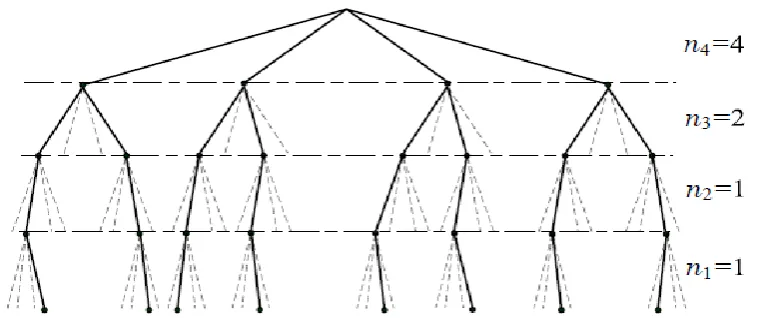
Fig 1. Fixed-complexity tree search of a QPSK-modulated signal using a tree configuration vector of n = [1, 1, 2, 4].
The main idea behind the Fixed Sphere Decoder is to perform a search over only a fixed number of possible transmitted signals, generated by a small subset of all possible signals located around the received signal vector. This ensures that the detector complexity is fixed over time, a major advantage for hardward implementation. In order for such a search to operate efficiently, a key point is to order the antennas in such a way that most of the points considered relate to transmit antennas with the poorest signal-to-noise (SNR) conditions. Antennas with higher SNR conditions are much more likely to be detected correctly, based only on the received signal. Figure 1 shows a hypothetical subset S in 4 transmit antenna, 4 receive antenna system with 4-QAM constellations used at each transmit antenna. The number of points considered per level (i.e. transmit antenna) is = (1,1,2,4). In each level, the ni closest points to the received signal are considered as components of the subset S. LFSD is studied well.
In order to limit the complexity and to facilitate the computation of soft detected symbols, a complexity tree-search style algorithm was proposed in [7] for spatial multiplexing schemes, coined list fixed-complexity sphere decoder (LFSD). The main feature of the LFSD is that, instead of constraining the search to those nodes whose accumulated Euclidean distances are within a certain radius from the received signal, the search is performed in an unconstrained fashion. The tree search is defined instead by a tree configuration vector which determines the number of child nodes to be considered at each level. Therefore, the tree is traversed level by level regardless of the sphere constraints. Once the bottom of the tree is reached, the detector retrieves a list of Ncand candidate symbol vectors.
III.
PROPOSED
METHOD
A. Detection using LFSD
Here fixed complexity algorithm is used. This is the existing system where bit error rate and complexity will be less. The basic structure of the LDPC-coded bit interleaved OFDM system is shown in Figure 2.
The bit stream is coded, interleaved and mapped onto a complex constellation. Next, a vector of Q symbols s is coded into space and frequency forming the codeword X, which is transformed into the time domain by an inverse fast Fourier transform (IFFT) block and transmitted after the addition of a cyclic prefix. At the receiver side, the prefix is removed, a fast Fourier transform (FFT) is carried out and the resulting signal Y of dimensions N × T can be represented mathematically as
Y = HX + Z
where Hdenotes the N ×M complex channel matrix, X is any M×T codeword matrix composed by a linear combination of Q data symbols and Z represents the N × T zero-mean additive white Gaussian noise (AWGN) matrix whose complex coefficients fulfil CN( 0, 2σ²), being σ² the noise variance per real component. The design of the codeword X will provide full rate when Q = MT, being T the frequency depth of the codeword. By taking the elements column-wise from matrices X, Y and Z, above equation can be vectorized as
y = ĤGs + z
Where y, s and z are column vectors. The matrix Ĥ is the equivalent NT ×MT MIMO channel. The matrix G is the generator matrix for the SFBC such that x = Gs, where s corresponds to the symbol column
vector .
B. Selective mapping
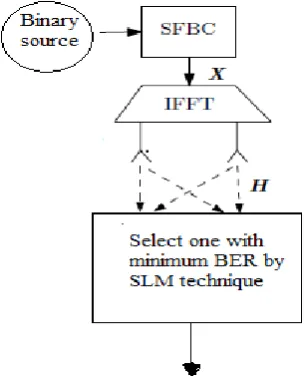
In selective mapping sequences are generated my multiplying independent phase sequences with the original data and the sequence. Then the lowest noise sequence is chosen for the transmission. In this proposed system input are randomly generated and they will be bpsk modulated by space frequency block coding, block codes are produced. It will be converted from frequency domain to time domain by using inverse fast fourier transform (IFFT) and cyclic prefix will be added. Then by using SLM signal with minimum BER is selected for the transmission, as shown in the figure 3. Peak and Mean power will be calculated to find the signal to noise ratio of the signal.
Selective mapping method (SLM) is a kind of phase rotation methods. Phase-rotated data of the lowest BER will be selected to transmit. Data stream after serial to parallel conversion as ᵀ. Then phase-rotated data can be written as
ᵀ
Each can be written as:
After passing through IFFT
Output data of the lowest BER is selected for transmission. SLM method effectively reduces BER without any signal distortion.SLM technique is shown in the figure 4. By this technique BER can be reduced compared to the original signal.
IV.
EXPERIMENTAL
RESULTS
A. Performance comparison between the original signal and proposed system
The performance of the overall system has been assessed by means of the bit error rate (BER) after the SLM. The DVB-T2 parameters used in the simulations are: 16- QAM modulation, 80 carriers as IFFT size and 1/4 of guard interval. The simulations have been carried out over a Rayleigh channel commonly used as the simulation environment for terrestrial digital television systems [8].
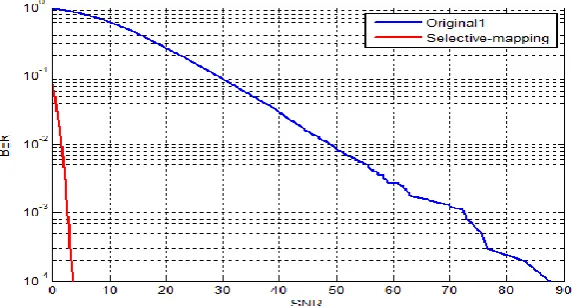
Fig 5. Comparison between original signal and signal with SLM
Figure 5 shows the comparison between original signal and signal with SLM. Here by using total carriers and guard interval the cyclic prefix to be added in the IFFT are calculated. And the input symbols are generated randomly by using the total carriers. Here mainly the power is considered. The peak and mean power are calculated from the signal power of the symbol. Then SNR is calculated by taking the ratio of the peak power and mean power.
Then the minimum value of original signal calculated and the output is obtained. Then bit error rate and signal to noise ratio are compared. In the output bit error rate and signal to noise ratio of proposed system is compared with the original one. And then can be concluded that the bit error is reduced by using the selective mapping technique in the proposed one than the original one from the output graph.
V.
CONCLUSIONS
ACKNOWLEDGEMENT
The work described in this paper is supported by Adv.Dr.P.Krishnadas,Managing Trustee&Dr.P Krishnakumar, CEO & Secretary, Nehru Group of Institutions, Tamil Nadu, Kerala-India. Authors are grateful to Prof. Dr. P.N. Ramachandran, Principal and Dr.N K Shakthivel, Vice- Principal, Nehru College of Engineering and Research Centre, Pampady, Thiruvilawamala, Kerala, India, for providing us the opportunity to undertake this project.
REFERENCES
[1]. V. Tarokh, H. Jafarkhani, and A. Calderbank, “Space-time block codes from orthogonal designs,” IEEE Trans. Inf. Theory, vol. 45, no. 5, pp. 1456–1467, 1999.
[2]. Lee, A. M. Chan, and C.-E. W. Sundberg, “Space-time bit-interleaved coded modulation for OFDM systems,” IEEE Trans. Signal Process., vol. 52, no. 3, pp. 820–825, Mar. 2004.
[3]. H. Yao and G. W. Wornell, “Achieving the the full MIMO diversity multiplexing frontier with rotation based space-time codes,” in 2003 Allerton Conf. Commun., Control Comput.
[4]. Y. Nasser, J. Helard, and M. Crussière, “System level evaluation of innovative coded MIMO- OFDM systems for broadcasting digital TV,” International J. Digital Multimedia Broadcasting, vol. 2008, pp. 1–12, 2008.
[5]. Sobron, M. Mendicute, and J. Altuna, “Full-rate full-diversity space frequency block coding for digital TV broadcasting,” in 2010 Proc. EUSIPCO, pp. 1514–1518.
[6]. X. Ma and G. B. Giannakis, “Full-diversity full-rate complex-field space-time coding,” IEEE Trans. Signal Process., vol. 51, no. 11, pp. 2917–2930, 2003
[7]. L. Barbero, “Rapid prototyping of a fixed-complexity sphere decoder and its application to iterative decoding of turbo-MIMO systems,” Ph.D. dissertation, University of Edinburgh, 2006.
[8]. COST207,”Digital land mobile radio communications (final report)” Commission of the European Communities, Directorate General Telecommunications, Information Industries and Innovation, Tech. Rep.,1989.
AUTHORS
Sruthi A received B.Tech degree in Electronics and Communication Engineering from Jyothi Engineering College, affiliated to University of Calicut, Kerala. Presently she is pursuing her M.Tech in Applied Electronics and Communication Systems from Nehru College of Engineering and Research Centre, Pampady, Kerala, affiliated to University of Calicut.
Nithin.S.S working as Assistant Professor in the Department of Electronics and Communication Engineering at Nehru College of Engineering and Research Centre, Pampady, Thiruvilawamala, Kerala, India, affiliated to University of Calicut. He received B.E degree in Electronics & Communication Engineering from Narayanaguru College of Engineering, Kanyakumari Dist,chennai,India affiliated to Anna University and M.E in Communication Systems from PET Engineering College,Vallioor,Tamil Nadu,India affiliated to Anna University.
Muruganantham.C working as a Assistant Professor in the Department of Electronics and Communication Engineering at Nehru College of Engineering and Research Centre,kerala,India. He obtained B.E in ECE from Madurai Kamaraj University,Tamilnadu and M.E in Applied Electronics from Anna University,Tamilnadu. Worked as Assistant Professor-II in SEEE of SASTRA University. Worked as Lecturer in Electrical & Computer Engg Department of Ethiopian Universities. Published papers in national/international conferences. He is member of ISTE. His areas of interest are High Speed VLSI Networks, Signal Processing.
Divakara Murthy H S has multi faceted experience in Research, Industry and Academic fields, He is working as a Dean and HOD in the Department of Electronics and Communication Engineering at Nehru College of Engineering and Research Centre, Pampady, Thiruvilawamala, Kerala, India, affiliated to University of Calicut and also served as a Principal at JSS Academy of Technical Education, Mauritius for two years. Involved in Administrative & Academic activities in development of infrastructure facilities marketing, mounting new courses and strategic planning. He worked at RGV telecom Ltd Bangalore as Deputy Vice president,for providing optical communication for Indian Railways for nealy two years and also worked nearly 27 years in Telecom in Industry at senior level in various capacities in Telecom Projects and Planning, Production and Marketing. During my intial career involved in Design and development of Instrumentation at NAL Bangalore. He obtained his B.E in Electronics and Communication Engineering from Siddaganga Institute of Technology, Tumkur from University of Mysore and MSc(Engg)in communication system from PSG Institute of technology, Coimbatore , from University of Madras. Divakara Murthy area of interest and research include Micro and Pico Satellite communication, Optical Communication and Wireless communication, GSM and WiMAX technology. He is a Member of ISTE, IETE
S B Ershad is Assistant Professor in Department of Electronics and Communication Engineering at Nehru College of Engineering and Research Centre, Pampady, Thiruvilawamala, Kerala, India, affiliated to University of Calicut. He obtained his M.Tech in VLSI DESIGN from Amrita School of Engineering, Amrutapuri Campus Kollam. He is a Associate member of Institution of Engineers India. His area of interests are Advanced Digital Design, Verilog RTL Simulation & Synthesis (Modelsim) and Advanced VLSI Fabrication