An Approach Recognition of Human Iris Patterns
using Pattern Matching
Bhupesh Kumar Sahu Shipra Rathore
M. Tech Student Assistant Professor
Department of Computer Science & Engineering Department of Computer Science & Engineering Kalinga University, Naya Raipur (C.G) Kalinga University, Naya Raipur (C.G)
Abstract
A biometric framework gives programmed distinguishing proof of an individual in light of an exceptional component or trademark controlled by the person. Iris acknowledgment is viewed as the most dependable and precise biometric recognizable proof framework accessible. Most business iris acknowledgment frameworks use licensed calculations created by Daugman, and these calculations can deliver immaculate acknowledgment rates. The work exhibited in this postulation included building up an iris acknowledgment framework so as to confirm both the uniqueness of the human iris furthermore its execution as a biometric. For deciding the acknowledgment execution of the framework two databases of digitized greyscale eye pictures will be utilized. The iris acknowledgment framework comprises of a programmed division framework that depends on the Hough change, and can limit the roundabout iris and student locale, blocking eyelids and eyelashes, and reflections. The separated iris area was then standardized into a rectangular piece with steady measurements to represent imaging conflicting.
Keywords: Biometric, iris recognition, neural network
________________________________________________________________________________________________________
I. INTRODUCTION
Iris acknowledgment may not be on of the far reaching advances utilized for validation however it has one of the most reduced mistake rates when contrasted with other biometric innovations. Irises examples are individual and don't change with age. It is likewise a reality that the iris examples of the left and right eyes inside the same individual are not quite the same as each other. The composition of the iris is comprised of a complex sinewy and flexible tissue now and again alluded to as the trabecular meshwork. This fine detail of this lattice like structure is built up preceding birth and stays in place for the duration of the life of the person.
Iris example is of a fairly consistent polar geometry making it simple to build up a co-ordinate framework for highlight acknowledgment. A point to be thought about is the way that the surface of the iris is portable since the student extends and contracts. The obvious segment of the iris contrasts taking into account ethnic cause and hereditary legacy; in people with dull eyes the imperative inquiry is the means by which effectively the limits amongst understudy and iris might be identified[1].
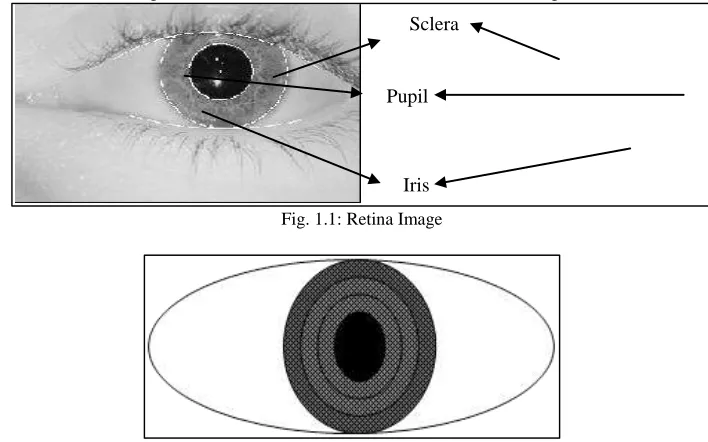
The initial step would be to catch the picture of the iris utilizing a CCD (Charge Coupled Device) camera. After the picture has been caught we utilize a roundabout edge indicator to recognize and find the limit between the white bit of the eye (Sclera) and the iris and continue further to recognize the limit between the iris and the student [Figure 1].
Fig. 1.1: Retina Image
Fig. 1.2: Iris Image Sclera
After this we characterize round shapes of expanding range with the goal that we have zones of examination [Figur2], which continue as before independent of student resizing movement. Parts of the iris that are covered up by the eyelids/eyelashes, or adulterated by reflections from glasses are distinguished and veiled out so the encoding of the iris is not affected. One must notice that the understudy is not generally key to the iris. Since the steady development of the iris different pictures are caught quickly till a true blue picture is affirmed. The client can watch this procedure by means of a reflected picture of the eye present in the CCD camera, which serves as a guide for the client to center and balance out the image[2].
Presently we dissect the zones of investigation [Figure 2] and recognize highlight inside these zones, for this reason we utilize 2D Gabor channels which fundamentally give data about introduction and spatial recurrence of particulars inside the picture areas. Integro-differential administrators of the structure given underneath do these recognition operations,
Where shape reconciliation is parameterized for size and area arranges r, x0, y0 at a size of investigation set by G (r) is performed over picture information I(x,y). At that point a direction framework is characterized which maps the tissue, this direction framework is pseudo polar and remunerates naturally for the extending of the iris tissue as the student widens. The nitty gritty example is encoded into a 256-byte code by demodulating it with 2D Gabor wavelets, which speak to the surface by phasors in the mind boggling plane. For every component of the iris design the phasor point is mapped to its particular quadrant where it lies.
Dr. John Daugman built up the iris-examining calculation, which is generally utilized these days. The astonishing reality is that the whole procedure of picture catching, zoning, examination and iris code creation is commonly finished in under a second. The present executions of the iris checking approach incorporate some measure of client communication with a specific end goal to legitimately catch the picture; however it is fundamentally a non-contact approach. It is found that the iris filtering approach functions admirably with exhibition and contact lens clients.
A choice made by a biometric framework is for the most part a "bona fide" or "fraud" choice, which can be spoken to utilizing two factual disseminations, certifiable dispersion and sham appropriation. For every kind of choice there will be two conceivable results i.e., genuine/false. All things considered there are four results, recorded beneath
1) a certifiable individual is acknowledged 2) a certifiable individual is rejected 3) an sham is rejected
4) an sham is acknowledged
Results 1 and 3 are right through 2 and 4 are mistaken. Presently we can characterize the execution criteria for this framework. So we characterize the False (sham) Acceptance Rate (FAR) and false (real) Rejection Rate (FRR). So as to give a more dependable appraisal of the framework we can characterize some more criteria, the first is the Reliable Operating Curve (ROC) and’d’. A ROC gives execution results (FAR and FRR) for the framework at different working focuses; "d" gives the separation between the veritable circulation and sham appropriation. As it was "d" measures how all around isolated the two conveyances are, since acknowledgment mistakes are brought on by their overlap [3].
On the off chance that their methods are 1 and 2 and their standard deviations are 1 and 2, then "d" is characterized as
222,743 comparisons of different iris patterns yielded a mean value 1 =0.089 and
1 =0.042
340 comparisons of sane iris pairs yielded a mean value of 2 =0.456 and 2 =0.018
The estimation of d is observed to be 11.36 for iris acknowledgment, which is much higher than that reported for some other biometric framework.
Till now we have secured the hypothetical parts of the innovation behind iris acknowledgment, now we proceed onward to see a pragmatic usage. We have taken the usage model case of National Instruments (NIDAYS), Italy.
II. REVIEW OF LITERATURE
Iris acknowledgment is the procedure of perceiving a man by investigating the irregular examples of the iris. The computerized technique for iris acknowledgment is generally youthful, existing as an issue just since 1994.
The iris is a muscle inside the eye which directs the span of the student, and it controls the measure of light which enters the eye. It is the hued part of the eye with shading in light of the measure of melatonin color inside the muscle
Max(r, x
0, y
0) G
(r) *
r, x0,y0I(x,y)
r 2r
ds
d = 1 - 2
Iris Recognition: What Is Beyond Bit Fragility?
The idea of delicacy of a few bits in the iris codes respects solely their inside class variety, i.e., the likelihood that they take diverse qualities in formats registered from various pictures of the same iris. This paper broadens that idea, by seeing that a comparative wonder happens for the between-classes examinations, i.e., a few bits have higher likelihood than others of accepting a prevalent quality, which was watched for close infrared and (in a more obvious manner) for noticeable wavelength information. In like manner, we propose another measure (bit discriminability) that considers both the inside class and between-classes variability's, and has roots in the Fisher discriminant. In view of the bit discriminability, we analyze the value of the distinctive locales of the iris for biometric acknowledgment, concerning multispectral information and to various channels parameterizations [4, 5]. At last, we measure the measure of data lost in codes quantization, which offers knowledge to further research on iris coordinating methodologies that consider both stage and size. But expanding the computational weight of acknowledgment, such sort of systems will reliably enhance execution, especially in low quality data [10].
THE iris is without a doubt among the most prominent qualities in the biometrics writing. This is a point that goes back to 1893, when Bertillon recommended to utilize the iris in anthropometric distinguishing proof. At that point, in 1951, it was affirmed that "the surface of the iris is so particular among various people that it could be utilized as mean of distinguishing proof"
[11], and, in 1993, Daugman proposed the pioneer computerized iris acknowledgment calculation, that was therefore improved [8]. As of now, the iris characteristic is the subject of concentrated exploration endeavors, being probably the most significant condensed by Bowyer et al. [5]. The majority of the past works that contemplated the viability of the iris as a biometric quality moved in the levels of false dismissals and in the idea of bit delicacy, watching uneven levels of inside class variety among bits, i.e., the probabilities that bits "wind up a 0 for some pictures of the iris and a 1 for different pictures of the same iris" are uneven, as firstly formalized by Bolle et al
This paper presented the idea of bit discriminability, for iris acknowledgment purposes. As a supplement to the beforehand proposed idea of bit delicacy, we saw that not just bits have diverse probabilities of flipping their qualities among tests of an iris, additionally the likelihood of watching concurring piece values for various irises fluctuates in a measurably critical manner. Despite the fact that this marvel was watched both for NIR and VW information, it is a great deal more apparent for the last wavelength, which ought to be because of the corneal reflections that are dictated by the surrounding light and show up (ordinarily) in the same positions of the irises in an information set. In view of the proposed idea of bit discriminability, we analyzed the viability of every district of the iris for biometric acknowledgment, concerning multi-otherworldly information and to two generally utilized sorts of channels (Gabor and MLDFs). Our principle decisions were: Iris Anatomy:
1) there is a poor connection between's the measure of data in iris patches and their convenience for biometric acknowledgment. This gives space for future examination regarding novel iris highlight encoding/coordinating calculations, especially for NIR information, where the most astounding measures of neighborhood data were watched. Be that as it may, note that by changing over the VW information to grayscale we dismissed a generous measure of the data in this sort of pictures. In the extent of shading data, there is apparent space for further investigation, as the adequacy of various shading spaces, or of various direct/non-straight procedures to intertwining shading channels;
2) the base parts of the iris are less inclined to be impeded by eyelids than the upper parts. Shadows are more continuous in the upper parts, especially when brightening from above is utilized. Nonetheless, take note of that business iris frameworks don't utilize enlightenment from above[6];
3) there is an immediate connection between's the span of the channels and the discriminability of the subsequent bits. This turns the center spiral groups of the iris as the most vital, as they are those where the biggest channels can be utilized there without surpassing the iris limits;
4) there is no proof that either the transient/nasal sides of the iris ought to be favored over the other. In any case, if there should arise an occurrence of enlightenment from the side, shadows by the nose are liable to show up in the iris, which may likewise diminish execution; • Filters: 1) MLDFs give preferable execution over Gabor portions because of their capacity of misusing non-nearby examples.
This property is especially fascinating for tissues with intertwining strands, for example, the human iris; 2) there is a solid understanding between the best iris areas got for MLDF and Gabor channels, recommending that the decision for the best locales to perform iris acknowledgment is generally autonomous of the sort of channels utilized; • Data Spectrum and Discriminating Information:
1) Both in NIR and VW information, the sign size conveys important separating data, which ought to be especially helpful for hard obtaining situations;
2) NIR information gives more separating data than VW information, especially in the pupillary groups;
3) the bit discriminability in VW information seems to spread in a more uneven manner than in NIR information. This point ought to be subject of further research, as we can't decide wether this was because of the apparently more out of control obtaining setups of the VW information sets than of the NIR sets utilized as a part of this paper..
Iris Image Classification Based on Hierarchical Visual Codebook
characterize an iris picture to an application particular classification, e.g. iris liveness discovery (grouping of bona fide and fake iris pictures), race characterization (e.g. grouping of iris pictures of Asian and non-Asian subjects), coarse-to-fine iris distinguishing proof (order of all iris pictures in the focal database into various classes). This paper proposes a general structure for iris picture characterization in light of composition investigation. A novel surface example representation technique called Hierarchical Visual Codebook (HVC) is proposed to encode the composition primitives of iris images [14].
The proposed HVC technique is a mix of two existing Bag-of-Words models, specifically Vocabulary Tree (VT), and Locality-compelled Linear Coding (LLC). The HVC embraces a coarse-to-fine visual coding technique and takes points of interest of both VT and LLC for exact and meager representation of iris composition. Broad exploratory results exhibit that the proposed iris picture grouping strategy accomplishes best in class execution for iris liveness discovery, race order, and coarse-to-fine iris recognizable proof. A complete fake iris picture database reenacting four sorts of iris farce assaults is produced as the benchmark for exploration of iris livens location.
IRIS acknowledgment has turned into a hot examination subject driven by its wide applications in national ID card, fringe control, managing an account, and so on. Iris is a ring-molded area of human eye with rich composition data under close infrared enlightenment. Iris composition is viewed as an epigenetic biometric example and stable amid life so that iris acknowledgment gives a greatly dependable strategy to individual verification [15].Iris acknowledgment means to relegate a one of a kind personality mark to every iris picture taking into account programmed preprocessing, highlight examination and highlight coordinating. Best in class iris acknowledgment strategies incorporate Gabor stage demodulation [1], ordinal measures [2], and so forth.
Iris picture arrangement intends to gathering iris pictures into various classes as indicated by their application related traits (e.g. liveness, ethnicity, surface class) instead of their personality data. Since iris picture grouping is a fundamentally diverse issue to iris picture acknowledgment as far as definition, difficulties, center issues, and applications, particular iris picture examination and example arrangement methodologies are required for iris picture order. Iris picture arrangement is a vital examination point however it is not all around tended to in the writing. Besides, the current exploration endeavors are isolated in particular application issues of iris picture classification[8].
In this paper, iris picture grouping is firstly planned as a nonexclusive issue in iris biometrics. Such a plan is gainful to bind together the exploration endeavors in iris liveness location, race characterization, coarse iris picture arrangement for productive recognizable proof, and so forth. Besides, it is conceivable to build up a nonexclusive iris picture characterization module in an iris acknowledgment framework for an assortment of uses. So that the computational expense of highlight extraction and coordinating for numerous iris picture characterization undertakings can be incredibly diminished.
Ordinal Feature Selection for Iris and Palmprint Recognition
Ordinal measures have been exhibited as a successful element representation model for iris and palmprint acknowledgment. Be that as it may, ordinal measures are a general idea of picture investigation and various variations with various parameter settings, for example, area, scale, introduction, et cetera, can be determined to develop a colossal component space. This paper proposes a novel streamlining plan for ordinal element determination with fruitful applications to both iris and palm print recognition[15]. The target capacity of the proposed highlight determination strategy has two sections, i.e., misclassification blunder of intra and interclass coordinating examples and weighted sparsity of ordinal element descriptors. Hence, the element determination expects to accomplish a precise and meager representation of ordinal measures. Also, the enhancement subjects to various straight disparity limitations, which require that all intra and interclass coordinating sets are very much isolated with an extensive edge. Ordinal element choice is figured as a straight programming (LP) issue so that an answer can be proficiently gotten even on an extensive scale highlights pool and preparing database. Broad test results exhibit that the proposed LP definition is beneficial over existing component choice techniques, for example, mRMR, ReliefF, Boosting, and Lasso for biometric acknowledgment, reporting stateof-the-workmanship precision on CASIA and PolyU databases.
IRIS and palm print surface examples are exact biometric modalities with effective applications for individual distinguishing proof. The achievement of a surface biometric acknowledgment framework vigorously relies on upon its component investigation model, against which biometric pictures are encoded, looked at and perceived by a PC. It is alluring to build up a component investigation technique which is in a perfect world both segregating and hearty for iris and palm print biometrics. On one hand, the biometric elements ought to have enough separating energy to recognize interclass tests. Then again, intra-class varieties of biometric examples in uncontrolled conditions, for example, enlightenment changes, twisting, impediments, posture/view changes, and so on.
Should be minimized through powerful component analysis[16]. Consequently it is a testing issue to accomplish a decent harmony between class uniqueness and intra-class vigor.
III. PROBLEM IDENTIFICATION
Problem Identification
The iris is an inside organ of the eye - maybe the main inward organ of the body that is routinely unmistakable from outside and its examples are resolvable with great camcorders from separations of up to around a meter. The iris is situated behind the cornea of the eye, and behind the watery cleverness, yet before the lens.
There is no hereditary determination of the point by point iris composition, as located perusers can affirm just by looking at the nitty gritty surface in their left and right eyes (which are, obviously, hereditarily indistinguishable). Aside from the periodic appearance of spots or other pigmentation changes brought on by some eye drop medicines for glaucoma, there is no confirmation for any change of iris example over a man's life.
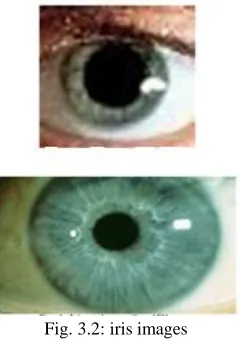
As showed by the going with close-up iris photo, iris designs have a high level of arbitrariness in their structure. This is the thing that makes them extraordinary. Each biometric relies on arbitrary variety amongst various persons in the picked estimations, keeping in mind the end goal to ensure that a specific example is one of a kind to only one individual and in this manner can serve as a dependable programmed identifier of them.
Solution of The Problem
Before acknowledgment of the iris happens, the iris must be found utilizing point of interest components. These historic point highlights and the state of the iris take into consideration imaging, highlight confinement, and extraction. To accomplish the area of the iris, sifting is being utilized, or all the more decisively the Gabor channel.
The Gabor channel, as concentrated on in the addresses is a straight channel utilized for edge location as a part of a picture. The Gabor channel sections and isolates the iris into vectors, and these vectors contain the data about the spatial recurrence in a picture, and the position in a picture.
IV. PROPOSED METHODOLOGY
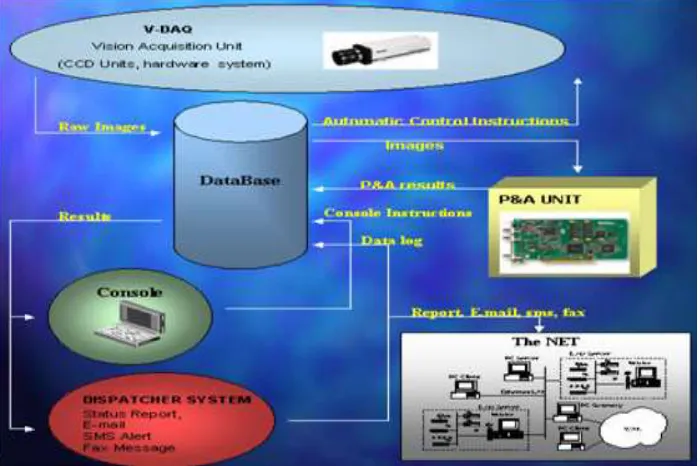
The equipment comprises of a standard PC with the Microsoft Windows as OS, the NI 1411 securing board, and an analogic shading single chip CCD camera. The framework engineering is organized as appeared in figure.
At the point when finding the iris there are two potential choices. The product could require theuser to choose focuses on the picture, which is both dependable and genuinely exact, be that as it may it is likewise tedious and unlikely for any certifiable application. The other alternative is for the product to auto-distinguish the iris inside the picture. This procedure is computationally unpredictable and presents a wellspring of blunder because of the innate complexities of PC vision.
Be that as it may, as the product will then require less client connection it is a noteworthy stride towards delivering a framework which is reasonable for genuine arrangement, and in this way turned into a need for developing the system determination.
The product is fueled by Labview and Labview RT. "The picture examination is acknowledged with IMAQ and the information investigation utilize the SIGNAL PROCESSING TOOLSET by NI. A private library was created for the acknowledgment in view of wavelet examination, neural system and hereditary calculations."
Fig. 3.2: iris images
The picture securing unit is in charge of the picture procurement and pre-decrease, for example, geometrical adjustment and photometric arrangement.
The console is utilized to control the framework. It likewise permits the enlistment of new individuals and clients.
The crude pictures are incidentally put away in the DataBase Unit (Figs. 3 and 4). It is connected to the framework by SQL TOOLKIT form 2 by NI.
Then, every picture is given to the Process and Analysis Unit (P&A Unit) for the acknowledgment. This is the most critical unit that I need to discuss, the calculation of iris investigation. It comprises of four procedures gave by four subunits: 1) "The first subunit parts the shaded picture in the RGB casings and tests the morphology of the eyes in the genuine
space."
2) "The second subunit changes the picture into a 3D picture, where the third measurement compares to an alternate weight of the eye as for a settled direction outline and concerning some trademark parameters in iridology."
3) "The third subunit changes the picture in the recurrence area, where a wavelet examination is done."
4) "The last subunit changes the picture into a multidimensional article, where the measurements of the space are connected with some chief parameters of the iris and understudy; then the calculation executes the last investigation to perceive a man by utilizing a hereditary pipeline."
After the investigation the information is transported back to the Database, which is connected with a Dispatcher Information framework. This unit naturally manufactures a status report about approving the right individuals, individuals stream, entryways and access to the structures, et cetera. Specifically, measurements, plots of information and occasions are created and put away by the module. In the event of an extraordinary occasion, similar to a ready, this unit can naturally achieve administrators and police with email and SMS (Short Message System) administration.
As per an examination of biometric advancements iris acknowledgment positions "high" in Universality, Uniqueness, Permanence, Performance and Circumvention yet positions medium in Collectability, low in Acceptability.
V. EXPECTED RESULTS
The last model is an utilitarian iris identification application, which furnishes the client with visual prompts and input furthermore some supplementary data about the stacked picture for troubleshooting purposes. The last item can read shading picture change over it to greyscale picture and will endeavor to consequently best fit parameters for the area of the understudy, iris and eyelids with thought for mainstream highlights and cushioning for eyelash obstruction. The whole auto-location process takes a matter of milliseconds.
VI. CONCLUSION AND SCOPE OF FURTHER WORK
The last model is an utilitarian iris discovery application, which gives the client visual prompts and input furthermore some supplementary data about the stacked picture for investigating purposes.
The last item can read in a 8-bit filed, greyscale picture and will endeavor to consequently best fit parameters for the area of the student, iris and eyelids with thought for mainstream highlights and cushioning for eyelash obstruction. The whole auto-recognition process takes a matter of milliseconds. The client may decide to physically enter focuses to indicate these areas; if the client does, he or she will get fitting visual input signs for repositioning components in a way instinctive to any easygoing PC client.
The iris code is put away in a nearby, new line delimited content database if interesting or the model reports that the code has as of now been situated in the database and an effective match discourse is given.
REFERENCES
[1] Chedekel, M.R. (1995) Photophysics and photochemistry of melanin. In: Melanin: Its Role in Human Photoprotection. Valdenmar: Overland Park, 11-23. [2] Z. Sun and T. Tan, "Ordinal measures for iris acknowledgment," IEEE Trans. Design Anal. Mach. Intell., vol. 31, no. 12, pp. 2211–2226, Dec. 2009. [3] Z. Sun and T. Tan, "Ordinal measures for iris acknowledgment," IEEE Trans. Design Anal. Mach. Intell., vol. 31, no. 12, pp. 2211–2226, Dec. 2009 [4] Z. Sun, T. Tan, Y. Wang, and S. Z. Li, "Ordinal palmprint representation for individual ID," in Proc. Conf. Comput. Vis. Design Recognit. (CVPR), vol. 1.
2005, pp. 279–284.
[5] Belhumeur, P.N., Hespanha, J.P., and Kriegman, D.J. (1997) Eigenfaces versus Fisherfaces: Recognition utilizing class-specic straight projection. Trans. Pat. Butt-centric. Mach. Intell. 19(7): 711-720.
[6] Daugman, John (January 2004). "How iris acknowledgment functions" (PDF). IEEE Transactions on Circuits and Systems for Video Technology 14 (1): 21–30. doi:10.1109/TCSVT.2003.818350. http://www.cl.cam.ac.uk/clients/jgd1000/irisrecog.pdf.
[7] J. Daugman, "High certainty visual acknowledgment of persons by a test of measurable autonomy," IEEE Trans. Design Anal. Mach. Intell., vol. 15, no. 11, pp. 1148–1160, Nov. 1993.
[8] "Precise and Fast Iris Segmentation"- International Journal of Engineering Science and Technology Vol. 2(6), 2010, 1492-1499 BY G. ANNAPOORANI, R. KRISHNAMOORTHI, P. GIFTY JEYA
[9] Berggren, L. (1985) Iridology: A basic survey. Acta Ophthalmologica 63(1): 1-8.
[10] Daugman, John (2003). "The significance of being arbitrary: measurable standards of iris acknowledgment" (PDF). Design Recognition 36 (2): 279–291. doi:10.1016/S0031-3203(02)00030-4. http://www.cl.cam.ac.uk/~jgd1000/patrec.pdf.
[11] Iris Recognition: What Is Beyond Bit Fragility? ,IEEE TRANSACTIONS ON INFORMATION FORENSICS AND SECURITY, VOL. 10, NO. 2, FEBRUARY 2015, Hugo Proença, Senior Member, IEEE
[12] K. Hollingsworth, K. W. Bowyer, and P. J. Flynn, "All iris code bits are not made equivalent," in Proc. first IEEE Int. Conf. Biometrics, Theory, Appl., Syst. (BTAS), Sep. 2007, pp. 1–6.
[13] K. P. Hollingsworth, K. W. Bowyer, and P. J. Flynn, "The best bits in an iris code," IEEE Trans. Design Anal. Mach. Intell., vol. 31, no. 6, pp. 964–973, Jun. 2009.
[14] Iris Image Classification Based on Hierarchical Visual Codebook Zhenan Sun, Member, IEEE, Hui Zhang, Member, IEEE, Tieniu Tan, Fellow, IEEE, and Jianyu Wang, IEEE TRANSACTIONS ON PATTERN ANALYSIS AND MACHINE INTELLIGENCE, VOL. 36, NO. 6, JUNE 2014
[15] Ordinal Feature Selection for Iris and Palm print Recognition Zhenan Sun, Member, IEEE, Libin Wang, and Tieniu Tan, Fellow, IEEE , IEEE TRANSACTIONS ON IMAGE PROCESSING, VOL. 23, NO. 9, SEPTEMBER 2014
[16] S. Z. Li, R. Chu, S. Liao, and L. Zhang, "Light invariant face acknowledgment utilizing close infrared pictures," IEEE Trans. Design Anal. Mach. Intell., vol. 29, no. 4, pp. 627–639, Apr. 2007.
[17] A. Destrero, C. De Mol, F. Odone, and A. Verri, "A sparsity-implementing strategy for learning face highlights," IEEE Trans. Picture Process., vol. 18, no. 1, pp. 188–201, Jan. 2009.
[18] Deep Representations for Iris, Face, and Fingerprint Spoofing Detection , IEEE TRANSACTIONS ON INFORMATION FORENSICS AND SECURITY, VOL. 10, NO. 4, APRIL 2015 David Menotti, Member, IEEE, Giovani Chiachia, Allan Pinto, Student Member, IEEE, William Robson Schwartz, Member, IEEE, Helio Pedrini, Member, IEEE, Alexandre Xavier Falcão, Member, IEEE, and Anderson Rocha, Member, IEEE.
[19] Y. LeCun, L. Bottou, Y. Bengio, and P. Haffner, "Inclination based learning connected to archive acknowledgment," Proc. IEEE, vol. 86, no. 11, pp. 2278– 2324, Nov. 1998.
[20] Impact of Quality-Based Fusion Techniques for Video-Based Iris Recognition at a Distance, Nadia Othman and Bernadette Dorizzi ,IEEE TRANSACTIONS ON INFORMATION FORENSICS AND SECURITY, VOL. 10, NO. 8, AUGUST 2015.
[21] Z. Wei, T. Tan, Z. Sun, and J. Cui, "Vigorous and quick evaluation of iris picture quality," in Proc. Int. Conf. Biometrics (ICB), 2006, pp. 464–471. [22] Video Presentation Attack Detection in Visible Spectrum Iris Recognition Using Magnified Phase Information, Kiran B. Raja, R. Raghavendra, and
Christoph Busc, IEEE TRANSACTIONS ON INFORMATION FORENSICS AND SECURITY, VOL. 10, NO. 10, OCTOBER 2015
[23] N. Wadhwa, M. Rubinstein, F. Durand, and W. T. Freeman, "Phasebased video movement preparing," ACM Trans. Diagram., vol. 32, no. 4, p. 80, 2013. [24] Iris Authentication in Handheld Devices – Considerations for Constraint-Free Acquisition, Shejin Thavalengal, Student Member, IEEE, Petronel Bigioi,
Senior Member, IEEE, and Peter Corcoran, Fellow, IEEE ,S. Thavalengal et al.: Iris Authentication in Handheld Devices – Considerations for Constraint-Free Acquisition 245 Contributed Paper Manuscript got 03/31/15 Current variant distributed 06/29/15 Electronic adaptation distributed 06/29/15. 0098 3063/15/$20.00 © 2015 IEEE
[25] J. Daugman, "New strategies in iris acknowledgment," IEEE Trans. Syst. Man. Cybern. B. Cybern., vol. 37, no. 5, pp. 1167–75, Oct. 2007.
[26] Review of Iris Recognition: A developing Biometrics Identification Technology, Nivedita S. Sarode, A. M. Patil,International Journal of Innovative Science and Modern Engineering (IJISME) ISSN: 2319-6386, Volume-2 Issue-10, September 2014.
[27] M.Suganthy, P. Rama moorthy, R. Krishna moorthy, "Powerful Iris Recognition For Security Enhancement", International Journal of Engineering Research and Applications (IJERA), Vol. 2, Issue 2, pp.1016-1019, 2012.
[28] Improving Iris Recognition Performance Using Segmentation, Quality Enhancement, Match Score Fusion, and Indexing Mayank Vatsa, Student Member, IEEE, Richa Singh, Student Member, IEEE, and Afzel Noore, Member, IEEE, IEEE TRANSACTIONS ON SYSTEMS, MAN, AND CYBERNETICS— PART B: CYBERNETICS.
[29] R. Singh, M. Vatsa, and A. Noore, "Enhancing check accuracyby blend of privately upgraded biometric pictures and deformable model," Signal Process., vol. 87, no. 11, pp. 2746–2764, Nov. 2007.
[30] Robust Detection of Textured Contact Lenses in Iris Recognition Using BSIF JAMES S. DOYLE, JR., (Student Member, IEEE), AND KEVIN W. BOWYER, (Fellow, IEEE) Department of Computer Science and Engineering, University of Notre Dame, Notre Dame, IN 46556, USA, Received July 6, 2015, acknowledged August 14, 2015, date of distribution September 14, 2015, date of current adaptation October 5, 2015. Computerized Object Identifier 10.1109/ACCESS.2015.2477470
[31] N. B. Puhan, S. Natarajan, and A. S. Hegde, ``Iris liveness identification for semi-straightforward contact lens spoo_ng,'' in Advances in Digital Image Prcessing and Information Technology. Berlin, Germany: Springer-Verlag, 2011, pp. 249_256.