ISSN (Online): 2320-9364, ISSN (Print): 2320-9356
www.ijres.org Volume 5 Issue 5 ǁ May. 2017 ǁ PP. 06-14
Image Super-Resolution Reconstruction Based On
Multi-Dictionary Learning
ShiMin
1, ZhuFeng
1, YI Qing-Ming
11School Of Information Science And Technology, Jinan University, Guangzhou, Guangdong 510632, China)
ABSTRACT:
In order to overcome the problems that the single dictionary cannot be adapted to variety types of images and the reconstruction quality couldn’t meet the application, we propose a novel Multi-Dictionary Learning algorithm for feature classification. The algorithm uses the orientation information of the low resolution image to guide the image patches in the database to classify, and designs the classification dictionary which can effectively express the reconstructed image patches. Considering the nonlocal similarity of the image, we construct the combined nonlocal mean value(C-NLM) regularizer, and take the steering kernel regression(SKR) to formulate a local regularization ,and establish a unified reconstruction framework. Extensive experiments on single image validate that the proposed method, compared with several other state-of-the-art learning based algorithms, achieves improvement in image quality and provides more details.Keywords:
directional feature; multi-dictionary learning; combined nonlocal mean value(C-NLM); steering kernel regression(SKR)I.
INTRODUCTION
The aim of image super-resolution(SR) is to construct a high-resolution (HR) from one or more low-resolution (LR) images and additional information such as exemplar images or statistical priors using software techniques. Because it is easy to implement and it takes lower cost performance, the image super-resolution technique has been widely applied to surveillance, medical imaging,remote sensing, and so on. In recent years, the super-resolution algorithms based on sparse representation have become one of the hot issues in current research [1,2].Yang et al.[3,4] first introduced sparse coding theory to estimate high-frequency details from an over-complete dictionary. The approach performs well in recovering some high frequency information. But it often produces noticeable blurring artifacts along the edges.For the same assumption, Zeyde et al.[5] proposed a more efficient image super-resolution algorithm based on K-SVD dictionary learning.All of the above algorithms used a universal and over-complete dictionary to represent various image structures. However, sparse decomposition over a highly redundant dictionary is potentially unstable and tends to generate visual artifacts.To address the aforementioned problem in single dictionary, a large number of SR methods introduced the idea of classification to produce more compelling SR results.Yin et al.[6] proposed a sparse representation of texture constraints, which divides the image into different texture regions, and trains multiple texture dictionaries.Dong et al.[7] proposed an image super-resolution method combining sparse coding and regularized learning models into a unified SR framework. The methods can recover many high-frequency details, but it has the high computation complexity and slow convergence.
propose a novel SR method based on Multi-Dictionary Learning algorithm for feature classification. Firstly, we adopt the curvelet transform to estimate the sixteen direction feature image in which all patches are clustered in several groups. Then each patch satisfying a certain condition in the database is classified into one of these groups with supervision of the clustering results, and Principal Component Analysis (PCA) is used to learn corresponding compact dictionaries for different groups by which we can obtain more accurate representation of subspaces of these patches. Moreover, considering spatial and directional information of patches, we construct the combined nonlocal mean value(C-NLM) regularization term, which is very helpful in preserving edge sharpness.
Single Image SR Model
So far, a variety of models have been proposed for SR recovery, and the most widely used observation model relating X and Y can be generally expressed as
v
Y
SHX
(1)WhereXand
Y
are the HR and LR images, respectively,S
andHdenote a down-sampling operator and a blurring filter respectively, and v represents Gaussian noise.From the observation model, we know that the low quality observation imageY
is typically generated by blurring, down-sampling and noising. However, the objective of SR reconstruction is to solve the inverse problem of estimating the underlying HR imageXfrom the LR imageY
.That is to solve the following least squares problem:
22
arg min
E
( )
X
X
Y
SHX
X
(2)Where
E
( )
X
represents the regularization term constructed from a prior knowledge, and
is a regularization parameter. To obtain the additional information of image, this paper integrates the HR reconstruction term, local and non-local regularization terms, and example-based hallucination term into the unified SR framework like Eq. (2). Mathematically, it is defined as
22 12 3
(
)
arg min
(
)
(
)
sparse
nonlocal local
E
E
E
X
Y
SHX
X
X
X
X
(3)
Where 2
2
Y
SHX
is the reconstruction term to ensure that the reconstructed HR image should beconsistent with the LR input via back-projection. The second term
E
sparse( )
X
is the sparse hallucinationregularization term, which requires that the estimated HR image has a sparse representation over a
multi-dictionary learnt from the LR itself and the database image. The third term
E
nonlocal( )
X
is the non-localFeature classification dictionary-based hallucination 2.1 Curvelet-Based Direction Extraction
Curvelet transform is an efficient representation for preserving edges since it has very high directional sensitivity and is highly anisotropic [8]. Therefore, in this paper, we apply the curvelet transform to extract directional features which are then used for classified dictionary learning and weight estimation. Considering different sizes of X andY, we firstly apply bicubic interpolation to magnify Yto obtain the initial estimate of the high resolution image
X
0, which is the same size asX . Then the curvelet coefficients of the imageX
0can be obtained byQ
= (
X
0)
.whererepresents the curvelet transform matrix.Q
is a set of curveletcoefficients expressed as
Q
c l,|
c
1,..., ;
C l
1,...
L
c
,in whichC
andL
care the total number of scales and directions at thec
th scale, respectively.Because of the directional symmetry, we partition the curvelet coefficient matrices at the finest scale
into 16 direction subsets, denoted as
161
f f F
.The directional features of the initial estimate image in 16 different directions can be defined as
1
(
( ))
f f
A
H Q
(4)Where1stands for the inverse curvelet transform, and
( )
,,
,0,
c l c l f
f
if
F
otherwise
Q
Q
H
Q
.Obviously, The directional feature image
A
f(
f
1,...,16)
can be obtained by Eq.(4).2.2 Learning Classification Dictionary
To make full use of the additional information of LR images, we propose a multi-dictionary learning algorithm based on directional feature classification.First, We adopt the K-means algorithm to partition
f
A
obtained in Section 2.1 into K clustersC
k
s
ik,
i
1,..., ;
m k
1,...,
K
, wherek
andidenote Category number and sample patch number respectively. K andm
represent the total number of Category and the totalnumber of sample patch, then obtain
k(
k
1,..., )
K
the centroid of clusterC
k and theradius 2
2
max
k,
1,...,
k
i
ki
m
r
s
.To construct a more effective dictionary, we use the high-pass filter to extract high-frequency information from high-resolution image of database as the feature. Then we obtain a setof high-frequency patches
X
G.Let(
1,..., )
iG
i
g
x
be an image patch in theX
Gand compute the distance (d
ik)between i
G
x
and
k.An image patch iG
x
will be added to the ik
C
th class if the minimum value ofd
ik, denotedby ki
i
d
, is smaller than threshold ik
r
in which
is a constant to weight the similarity between the patches ofdatabase and the center of the centroid of cluster.Suppose that
C
k
s
ik,
i
1,...,
M k
;
1,...,
K
is the KKsubdatasets, we could getKsubdictionaries
D
k(
k
1,..., )
K
.2.3 Reconstruction with sparse representation
Our method is based on the sparse representation of image patches which demonstrates effectiveness
and robustness in regularizing super-resolution problem. Suppose that
X
R
N and
X
R
Nrepresent the HRand reconstructed HR images, respectively.Suppose that
x
i
R
nand
x
i
R
n,i
1,...,
p
represent the HR and the reconstructed HR image patches, and here, pis the number of image patches. The image patches are overlapped with each other in our method to reduce blocking artifacts. An HR image patch can be writtenas
x
i
R X
i , and here,R
i
R
n N represents the extracting matrix. In previous sections, we have learnt theKsubdictionaries
D
k.Recall that we have the centroid
kof each cluster available, and hence we could selectthe best fitted subdictionary to
x
i by calculating the minimum distance between
i
x
and
k ,i.e. 22
arg min
i k i k
k
x
.Then thek
i thsubditionaryi
k
D
will be selected and assigned topatch
x
i .The sparse representation ofx
i over the subditionaryD
ki is givenas :
0
, . .
,
1,...,
ii
k is t
i
T i
p
x
D
.where
i is the sparse representation coefficient, T is a scalar controlling the sparsity[9]. The updated HR imageZcan be reconstructed by merging all the constructed patches and averaging the overlapping regions between the adjacent patches[10], i.e.,
11 1 i
p T p T
i i i k i
i i
Z
R R
R D
(5)Construct the regularization terms and SR recovery 3.1 Sparse hallucination regularization term
The sparse hallucination regularization term enforces the constrain that the reconstructed HR imageX should perfectly be consistent with by a multi-dictionary learnt from the LR input itself and the database,
i.e., 2 2
2
X
Z
.We formulate the sparse hallucination regularization term as:2 2
( )
sparse
E
X
X
Z
(6)3.2 Combined non-local mean regularization term
Considering that there are often many repetitive patterns throughout a natural image. Such nonlocal redundancy is very helpful to improve the quality of reconstructed images. Therefore, we introduce a nonlocal similarity regularization term into the SR model shown in Eq. (2) to enhance the visual effect of the image. For
each local patch
x
iin the reconstruction HR image
X
, it can be estimated by the weighted average of its similarj i
be the central pixel of patch
x
ij ,and
i be the estimation of the center pixel of the reconstructed imagepatch
x
i.Then,
i can be expressed as:
J=1
χ
j j
i j i i
χ
w
(7)The conventional NLM regularization term [11] calculate the similarity weight only based on the pixel values of the patches may lead to inaccurate estimation because of the noise and significantly-changed local structures. Here, we exploit the directional information of each pixel position and Spatial location information between pixels to develop the Combined NLM(C-NLM) regularization term to enhance weight estimation.In this paper, adopting the feature extraction of the 3.1 section, we get the direction feature information of the target pixel in the 16 directions, and further optimize the estimation of the similarity weight based on the spatial location information between pixels.Therefore, the C-NLM similarity weights can be defined by
2 2 22 2 2
O I V
-
( , )
( , )
-exp(
)
j
i i
j j
i i i i
ij
u v
u v
x x
V V
(8)where
i( , )
u v
is the two-dimensional coordinates of the center pixel
iin the image, i
V
is the directionalfeature vector of the center pixel
i,denoted as 1,,
2,,...,
16,i i i i
T
A
A
A
V
and here,A
f(
f
1,...,16)
is thedirectional feature image obtained by the 3.1 section.
O、
Iand
Vare the filter parameters to control the pixelvalues of the image patches, the spatial coordinates of the pixels and the directional feature information, respectively.The weight matrix obtained by Eq.(8) is substituted in (7), and then we reformulate Eq.(7) as the
matrix form by
2
22 2
arg min
i i iC NLM iarg min (
)
X
X
x
w
S
I B X
,werew
iC NLM represents the weightmatrix and
S
i represents a column vector consisting of thek
neighbors with the largest weights related tox
i,Iis the identity matrix and ( , ) , 0,
C NLM
ij i
i
j i j
j
w S
B
S .
In this way, we can write the non-local self similarity constraints term as:
2
2
( )
(
)
nonlocal
E
X
I W X
(9)3.3 Steering Kernel Regression Regularization Term
The C-NLM regularization term exploits the non-local redundant information in the natural images. As a complementary regularization term to C-NLM,we further introduce the local prior information into the SR model shown in Eq. (2) to obtain a more robust super-resolution reconstruction.The pixels in the reconstruction HR image can be predicted from a small neighborhood area,i.e.,
2( )
=argmin
(
)
i i
i x
jN x j
i ijWhere (xi)stands for the neighbors of
x
i,k ij
w
is the controllable kernel which assigns larger weights to nearby similar pixel while smaller ones to farther non-similar pixels. In this paper, we employ the steering kernel proposed in [12] to calculate the weights.Putting it into eq.(10),then the formulate can berewritten in matrix form:
SKR 2
22 2
arg min
i i iarg min (
)
i
X
X
x
w
L
I
P X
.wherew
iSKRrepresentsthe weight matrix and
L
i represents a column vector consisting of neighborhood pixels centered atx
i, I is the identity matrix and ( , ) ,0, SKR
ij i
i
j i j
j
c L
P
L .
In such a way, we form the local prior regularization term as:
2 2
( ) ( )
local
E X IP X (11)
Optimization of the algorithm
By incorporating both the sparse hallucination regularization term obtained in Eq.(6)、the nonlocal C-NLM regularization term from Eq.(9) and the local prior regularization term gained in Eq.(11) into the unified reconstruction framework in Eq.(3), we have the energy function as follows:
2 2
1
2 2
2 2
2 2 3 2
( )
( ) ( )
E
X Y SHX X Z
I W X I P X
(12)
In this paper, we employ the gradient descent method to optimize the
solution:X(t1)X( )t E( )X .where tis iteration times and
is the step size. The gradient of the energyfunction is written as
1 1
1
2 3
( )
(
)(
) (
)
(
)
(
) (
)
(
) (
)
T T
T T
E
X
Y
SHX S S
H H
X
Z
I
W
I
W X
I
P
I
P X
(13)Experimental results
In order to validate the effectiveness of the proposed SR method,we conduct super-resolution reconstruction experiments on a variety of natural images.In our implementation, the magnification factor is 3, the image training set is derived from the natural images applied by the Zeyde’s algorithm, the dictionary size is selected as 256, and the training dataset are partitioned into 16 clusters. In the non-local constraints, the filter
parameters
O、
Iand
Vare set to 50, 40,and 30 ,respectively.In addition,the step size
is set to 2.5 in theiterative process.The regularization parameters in the model are set to 0.03, 2.3 and 0.6, respectively through experimental adjustment. We compare our method with three representative methods, including SISR [5]and ASDS [7] ,and the Bicubic interpolation. In order to comprehensively evaluate the performance of compared SR approaches, we apply both objective and subjective assessments in experiments.
illustrate the high-frequency details in different images. From the visual comparison results, we notice that the Bicubic interpolation algorithm tends to produce over-smoothness and noticeable ringing artifacts along edges. Compared with the Bicubic interpolation, SISR and ASDS method can generate more clear details, but there are still many noticeable zigzagging effects found along edge.The proposed method that incorporates additional information of the LR itself and the image database produce sharper edges and pleasing details.As shown in the local magnification of ROIS in Fig.6, we can clearly see the texture of the butterfly in the resultant image of our method,while other algorithms are fuzzy.
(a) (b) (c) (d) (e)
Fig.1 Comparison of SR results(3x magnification) Girl image. The local magnification of ROI in (a) is presented in the bottom-left corner of each resultant image. (a) Original HR image. (b) The Bicubic interpolation. (c) SISR. (d) ASDS (e) The Proposed method.
(a) (b) (c) (d) (e)
Fig.2 Comparison of SR results(3x magnification) Butterfly image. The local magnification of ROI in (a) is presented in the bottom-left corner of each resultant image. (a) Original HR image. (b) The Bicubic interpolation. (c) SISR. (d) ASDS (e) The Proposed method.
(a) (b) (c) (d) (e)
interpolation. (c) SISR. (d) ASDS (e) The Proposed method
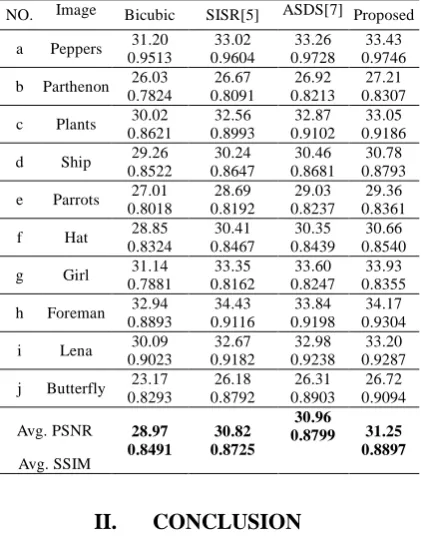
Objectively, we evaluate the quality of the resultant images with via Peak Signal to Noise Ratio(PSNR) and Structural Similarity (SSIM)metrics[13].Table 1 reports the PSNR and SSIM results of the above four algorithms with x3 magnification factors when applied to the ten test images. As presented in Table1, our method is superior to the other SR approaches in terms of average metric values. The average metric values of the Bicubic interpolation algorithm is the lowest, because it only considers the smoothness prior of the image. Taking into account the sparse prior, local and nonlocal information of the image, the PSNR/SSIM results has greater improvement than the Bicubic interpolation.In addition, this algorithm exploit the test image itself to guide the multi-dictionary learning is able to provide high-res images with best recover accuracy and the Combined NLM(C-NLM) regularization term constructed can further improve the expression accuracy of image patches, thus the reconstruction effect relative to the other three algorithms have certain improvement.
Table 1
PSNR(dB)and SSIM results(3x) on ten test images. For each test image, there are two rows. The first row is the PSNR and the second one is the SSIM.
NO. Image Bicubic SISR[5] ASDS[7] Proposed
a Peppers 0.9513 31.20 0.9604 33.02 0.9728 33.26 0.9746 33.43
b Parthenon 26.03 0.7824 26.67 0.8091 26.92 0.8213 27.21 0.8307
c Plants 30.02 0.8621 32.56 0.8993 32.87 0.9102 33.05 0.9186
d Ship 29.26 0.8522 30.24 0.8647 30.46 0.8681 30.78 0.8793
e Parrots 27.01 0.8018 28.69 0.8192 29.03 0.8237 29.36 0.8361
f Hat 0.8324 28.85 0.8467 30.41 0.8439 30.35 0.8540 30.66
g Girl 31.14 0.7881 33.35 0.8162 33.60 0.8247 33.93 0.8355
h Foreman 32.94 0.8893 34.43 0.9116 33.84 0.9198 34.17 0.9304
i Lena 30.09 0.9023 32.67 0.9182 32.98 0.9238 33.20 0.9287
j Butterfly 23.17 0.8293 26.18 0.8792 26.31 0.8903 26.72 0.9094
Avg. PSNR 28.97 0.8491
30.82 0.8725
30.96
0.8799 31.25 0.8897
Avg. SSIM
II.
CONCLUSION
REFERENCES
[1]. KIM Kwang In, KWON Younghee. Single-image super-resolution using sparse regression and natural image prior [J]. Pattern Analysis & Machine Intelligence IEEE Transactions on, 2010, 32(6): 1127-33. [2]. TIMOFTE Radu, DE Vincent, GOOL Luc Van. Anchored Neighborhood Regression for Fast
Example-Based Super-Resolution; proceedings of the IEEE International Conference on Computer Vision, F, 2013 [C].
[3]. YANG Jian-chao , Wright John , Huang Thomas, et al. Image super-resolution as sparse representation of raw image patches [C].Computer Vision and Pattern Recognition(CVPR) 2008. IEEE Conference on, 2008, pp. 1-8.
[4]. YANG Jian-chao , Wright John , Huang Thomas, et al. Image Super-Resolution Via Sparse Representation [J]. IEEE Transactions on Image Processing A Publication of the IEEE Signal Processing Society, 2010, vol. 19, pp. 2861-2873
[5]. ZEYDE Roman , ELAD Michael , PROTTER Matan. On single image scale-up using sparse-representations.[C] International Conference on Curves and Surfaces, 2010, pp:711-730
[6]. YIN Hai-tao , LI Shu-tao ,HU Jian-wen. Single image super resolution via texture constrained sparse representation [J]. 2011, 1161-4.
[7]. DONG Wei-sheng , ZHANG Lei , SHI Guang-ming , et al. Image deblurring and super-resolution by adaptive sparse domain selection and adaptive regularization [J]. IEEE Transactions on Image Processing A Publication of the IEEE Signal Processing Society, 2011, 20(7): 1838-57.
[8]. EMMANUEL J C, DONOHO D L. Curvelets - A Surprisingly Effective Nonadaptive Representation For Objects with Edges [J]. Astronomy & Astrophysics, 2000, 283(3): 1051-7.
[9]. A. M. Bruckstein, D. L. Donoho, and M. Elad. From sparse solutions of systems of equation to sparse modeling of signals and images. SIAM Rev. vol. 51, no. 1, pp. 34-81,Feb. 2009
[10].ELAD M, AHARON M. Image denoising via sparse and redundant representations over learned dictionaries [J]. IEEE Transactions on Image Processing, 2006, 15(12): 3736-45.
[11].PROTTER M, ELAD M, TAKEDA H, et al. Generalizing the Nonlocal-means to super-resolution reconstruction [J]. IEEE Transactions on Image Processing A Publication of the IEEE Signal Processing Society, 2009, 18(1): 36-51.
[12].TAKEDA H, FARSIU S, MILANFAR P. Kernel Regression for Image Processing and Reconstruction [J]. Image Processing IEEE Transactions on, 2007, 16(2): 349-6