Indian J. Plant Physiol., Vol. 7, No.4, (N.S.) pp. 375-379 (Oct.- Dec., 2002)
EFFECT OF GROWTH REGULATORS ON VEGETATIVE PROPAGATION OF
AMOORA WALLICHII, CALLICARPA ARBOREA AND FICUS FISTULOSA
T.C. SARMA
Plant Sciences & Ecology Division, Regional Research Laboratory, Jorhat-785 006, Assam
Received on 28 Feb .. 2002, Revised on I Oct., 2002
SUMMARY
A field experiment was conducted to study the effects of growth regulators, viz. IAA, IBA and NAA at different concentrations (50, 100, 200 and 300 ppm) and two dipping periods of 12 and 24 hours on the forest tree species, viz. Amoora wallichii King, Callicarpa arborea Roxb and Ficus fistulosa (Reinwdt) King. As compared to control, rooting, roots per cutting and survival percentage were increased significantly under all concentrations ofiAA, IBA and NAA. Growth regulators have marked influence on the parameters like sapling height, diameter and number of leaves and leaf area. With the application of higher dose of growth regulators, better results were recorded. Dipping of cutting in the solution of growth regulators for 24 hours showed better results than for 12 hours dipping. Sapling generated from stem cuttings ofthe tree species invariably get ready for transplantation after 120 days of planting. This study suggests that growth regulators can successfully be used for asexual reproduction of three species for large scale multiplication.
Key words : Growth regulators, rooting and survival, tree species, vegetative propagation.
INTRODUCTION
Vegetative means of propagation in trees is potentially useful to multiply into an endless number of individuals having identical characteristics-the whole population constituting a clone for plantation purposes (Sarma 1996). Somatic propagation of tree species is very important to develop fast and economically superior stock in forestry, particularly to obtain increased volume and quality of production (Chauhan and Sehgal 1982, Sarma and Borodoloi 1990). Asexual reproduction through clone offers the advantages of genetic uniformity and immediate availability of superior individuals for large scale plantation. One of the most successful methods of vegetative propagation of a forest tree species is the rooting of stem per branch cuttings (Ghosh and Bhatnagar 1977). The multiplication of plants by rooting stem cuttings is essential for any programme on improvement of forest biomass, whether it is designed to improve growth and yield or to introduce genes of other desirable characters. The root generating capacity of stem cuttings, does not
Indian J. Plant Physiol., Vol. 7, No.4, (N.S.) pp. 375-379 (Oct.-Dec., 2002)
express intselfbecause oflack of some of the internal and or exteral conditions that are necessary for the expression of these potentiality (Jain 1982). Amoora wal!ichii, Callicarpa arborea and Ficus fistulas a have acquired a great importance in forestary because of fast growth and vanety of industrial use oftheir timber. This investigation was undertaken to study the effect ofiAA, IBA and NAA in enhancing rooting of stem cuttings, survival and t,:rrowth of saplings of these forest plant species.
MATERIALS AND METHODS
Experiments were conducted at the farm of Regional Research Laboratory, Jorhat, Assam during the period of 1998-2000. Stem cuttings measuring 30 em length and approximately 2.0 em mid-diameter were taken from healthy branch of Amoora wa!lichii King, Callicarpa arborea Roxb and Ficus fistulosa (Reinwdt) King and treated with four concentrations (50, 100, 200 and 300 ppm) of indole acetic acid (IAA), indole butyric acid. (IBA) and naphthalene acetic acid (NAA) along with one
control (distilled water). The periodicity of dipping (soaking) was 12 and 24 hours. Experimental design was Randomized Block Design with 3 replications. Under each treatment 100 cuttings of each plant were maintained in nursery beds prepared of well pulverized soil treated with 10 t/ha of well rotten cow-dung. Cuttings were spaced at 30 x 40 em row spacing to facilitate intercultural activities like hand weeding, hoeing etc. Cuttings were inserted in a pre-made 15 em deep hole. Watering was done regularly with occasional hand weeding.
Observations were made on rooting, number of roots per cutting and survival of cutting after 90 days of planting. Number of leaves per sapling, total leaf area, sapling height and sapling diameter recorded after 120 days of planting. Each cutting having more than one sprout and only one leading sprout was kept per cutting for growth and rest were plucked.
RESULTS AND DISCUSSION
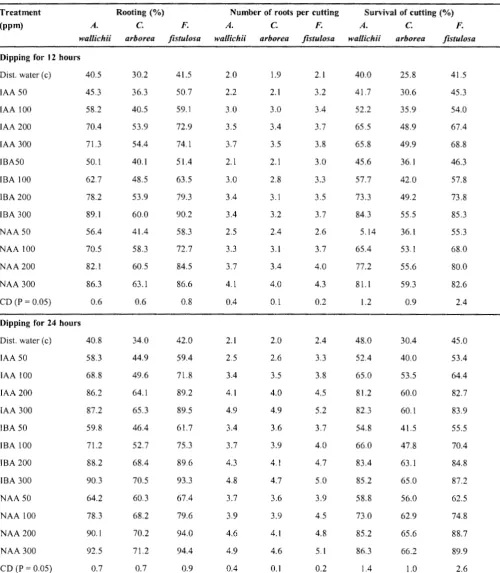
The growth promoting chemicals showed striking effect on rooting and root per cutting as observed on 90 days after planting of the cuttings. Rooting percentage and number of roots per cutting were higher, when cuttings were dipped for 24 hours as compared to 12 hours of dipping in different concentration of IAA, IBA and NAA. These parameters were found to be higher in all concentrations as compared to the control. Invariably, IBA at 300 ppm showed better result when all the plants were kept at different dipping periods. With the increased concentration of IAA, IBA and NAA, percentage of rooting and root per cutting were higher. However, differential behaviour was noted in case of plant species. Higher rooting and root per cutting were recorded in case of Ficus fistulosa followed by Amoora wallichii and Callicarpa arborea. Rooting percentage varied from 36
to 94 considering the treatments and plants. Number of roots per cutting at 90 days of planting were found to vary from 2 to 5 (Table 1 ).
The stimulation of rooting under soaking or dipping treated with IAA, IBA and NAA may be attributed to leaching of rooting inhibitors, which enhance the quality and quantity of roots and promote the activity of naturally occurring compounds for the development of roots
376
(Haiss1gn 1965). The stimulating response in rooting of plant cuttings with the application of growth promoting substances was reported by Klein (1953), Nanda eta!.
(1970), Pal (1982), Sarma and Bordoloi (1990), Thatoi et a!. (2000). Ghosh and Bhatnagar (1977) reported that rooting response of branch cuttings to different growth regulators was found favourable and best results were obtained with 200 ppm of IAA in Populus gamblei.
Similar effects on root formation in certain tree species were also reported by Al-Kinany (1981 ), Lahiri (1979), Nanda (1979), Chauhan and Sehgal (1982) and Jain (1982).
It has been observed that rooting and subsequent sprouting of cutting may not result in 100% survival of saplings. Sometimes rooted cuttings with sprout died due to various uncontrolled factors. As shown in Table 1, there is variation in survival percentage of the cuttings of different tree species. Survival percentage was higher while dipping the cuttings in hormones for 24 hours as compared to 12 hours. Survival of cuttings was maximum in F.fistulosa (89.9%) followed by A. wallichii (86.3%)
and C. arborea (66.2%). Survival percentage was
increased with the increase in hormone concentration. It
may be due to more number of roots per cutting, which also helped early establishment of saplings. Similar findings were reported by Pal (1982) in Populus robust a
and Sarma and Bordoloi (1990) in Populus deltoides.
Table 2 shows data on number ofleaves per sapling, total leaf area, sapling height and diameter recorded at 120 days after planting of cuttings. Observations on the growth parameters indicated the positive response of IAA, IBA and NAA in all treatments for all plant species. Though the leaf area of the three plant species varied individually but the effect ofhormones was noticed. Leaf area increased with the increase ofhormone concentation. Sarma and Bordoloi (1990) in certain tree species recorded similar observations.
Sapling height and diameters were recorded after 120 days of planting of the cuttings and at that time the saplings were ready for transplantation. Better growth of the saplings was always associated with the higher concentration ofhormones, which induced properrooting in cuttings. It was observed that the average sapling
EFFECT OF GROWTH REGULA TORS ON TREE SPECIES
Table 1. Effect of growth regulators on rooting, number of roots per cutting and survival of cuttings after 90 days of
planting
Treatment Rooting(%) Number of roots per cutting Survival of cutting(%)
(ppm) A. C. F. A. C. F. A. C. F.
wallichii arborea fistulosa wallichii arborea fistulosa wallichii arborea fistulosa
Dipping for 12 hours
Dist. water (c)
IAA 50 IAA 100 IAA 200 IAA 300 IBA50 IBA 100 IBA 200 IBA 300 NAA50 NAA 100 NAA 200 NAA 300 CD (P = 0.05)
Dipping for 24 hours
Dist. water (c)
IAA 50 IAA 100 IAA 200 IAA 300 IBA 50 IBA 100 IBA 200 IBA 300 NAA50 NAA 100 NAA 200 NAA 300 CD (P = 0.05)
40.5 45.3 58.2 70.4 71.3 50.1 62.7 78.2 89.1 56.4 70.5 82.1 86.3 0.6 40.8 58.3 68.8 86.2 87.2 59.8 71.2 88.2 90.3 64.2 78.3 90.1 92.5 0.7 30.2 36.3 40.5 53.9 54.4 40.1 48.5 53.9 60.0 41.4 58.3 60.5 63.1 0.6 34.0 44.9 49.6 64.1 65.3 46.4 52.7 68.4 70.5 60.3 68.2 70.2 71.2 0.7 41.5 50.7 59.1 72.9 74.1 51.4 63.5 79.3 90.2 58.3 72.7 84.5 86.6 0.8 42.0 59.4 71.8 89.2 89.5 61.7 75.3 89.6 93.3 67.4 79.6 94.0 94.4 0.9 2.0 2.2 3.0 3.5 3.7 2.1 3.0 3.4 3.4 2.5 3.3 3.7 4.1 0.4 2.1 2.5 3.4 4.1 4.9 3.4 3.7 4.3 4.8 3.7 3.9 4.6 4.9 0.4
Indian J. Plant Physio/., Vol. 7, No.4, (N.S.) pp. 375-379 (Oct.-Dec., 2002)
~
Table
2.
Effect
of
growth
regulators
on
sapling
growth
at
120
days
of
planting
cuttings
00
Treatment (ppm)
No.
of
leaf
per
sapling
A.
C.
F.
Total
leaf
area
(sq.
em)
Sapling
height
(em)
A.
C.
F.
A.
C.
F.
Sapling
diameter
(mm)
A.
C.
F.
wal/ichii
arborea
fistulosa
wallichii
arborea
fistulosa
wallichii
arborea
fistulosa
wallichii
arborea
fistulosa
,...
§,"
"'
<... ~ ~ 't> ~ c.; c;· :-. < 2.. .-....! z 0 • .P.z
en u u w -....} Y' ,_,. -....} >D 0 ~b
0 " N 0 0 NDippin1:
for
12
hours
Dist.
water
(c)
14.5
IAA5
16.1
IAA
100
16.5
IAA
200
16.7
IAA
300
17.3
IBA50
16.1
IBA
100
16.3
IBA
200
16.4
IBA
300
16.6
NAA
50
16.4
NAA
100
16.5
NAA
200
16.7
NAA
300
17.3
CD
(P
=
0.05)
0.1
Dipping
for
24
hours
Dist.water(c)
15.5
IAA
50
16.8
IAA
100
IAA
200
IAA
300
IBA
50
IBA
100
JBA
200
IBA
300
NAA50 NAA
100
NAA
200
NAA
300
CD
(P
=
0.05)
17.4 17.7 17.9 16.7 16.8 17.5 17.8 16.9 17.4 17.8 18.1 0.1
17.3 19.4 20.2 20.3 21.6 19.2 19.6 20.0 20.1 19.8 20.0 20.1 21.8 0.3 17.5 20.8 22.0 22.4 22.7 22.1 22.3 22.8 23.4 20.0 21.5 22.3 23.1 0.4
15.0 16.1 16.2 16.4 16.8 16.0 15.8 16.2 16.4 16.0 i6.3 16.4 16.7 1.1 15.5 16.7 17.2 17.5 17.7 16.6 16.8 17.1 17.6 16.6 17.0 17.6 17.9 1.2
263.9 292.3 295.0 301.3 311.4 285.9 294.8 296.5 299.1 296.5 297.9 302.4 306.5
1.6
283.2 306.7 310.4 316.8 322.4 301.3 303.5 305.5 319.0 304.5 312.2 320.5 325.7
1.7
346.7 388.8 399.5 400.5 402.7 3/19.7 392.1 400.3 406.6 397.7 298.7 401.4 410.2
2.1
344.9 410.1 428
8
430.4 450.3 445.0 446.1 456.0 467.9 402.1 410.3 425.8 438.3
2.2
249.3 267.6 268.3 280.2 290.4 264.2 268.0 281.1 285.7 283.9 285.3 288.4 290.5
1.2
270.6 291.6 301.3 305.9 311.4 293.1 294.4 301.1 308.8 287.9 294.0 304.3 314.3
1.3
109.4 116.6 120.0 121.6 125.3 116.0 121.0 123.3 128.3 118.0 122.0 126.0 129.6
1.9
116.0 117.0 122.3 127.0 131.0 116.8 119.3 121.6 127.6 120.3 122.3 126.0 132.3
2.0
104.2 106.3 110.6 115.0 120.0 107.3 110.4 113.5 122.0 109.3 114.6 118.7 120.4
1.8
106.5 109.3 116.3 120.3 126.3 110.6 113.6 112.3 123.0 115.0 118.0 120.0 127.6
1.9
110.0 111.6 115.6 116.0 120.3 113.6 115.3 118.0 122.6 114.3 117.3 119.7 127.5 2.3 114.8 116.0 118.0 122.6 130.7 114.5 117.4 120.7 127.0 117.3 121.5 125.0 132.0 2.4
17.4 18.0 18.6 20.6 21.6 19.3 20.6 23.6 24.3 18.3 19.6 24.3 26.3 2.3 19.8 20.3 22.6 27.0 29.6 20.0 24.3 25.6 32.0 23.3 25.0 29.0 32.3 2.4
16.0 16.3 17.6 18.3 20.0 17.0 18.0 19.0 19.3 16.6 17.6 8.6 20.6 1.5 18.0 18.3 19.6 21.0 23.6 18.3 19.0 21.0 25.0 18.3 20.0 24.6 26.3 1.6
EFFECT OF GROWTH REGULATORS ON TREE SPECIES
height and diameter (bottom) were 100 em and 20 mm respectively. Pal (1982) reported similar observations and noted that IAA and IBA did not effect the number of buds that sprouted per cutting but hormones increased the sapling height and leaf area. Sharma and Raina (1982) also observed that 50 ppm of IBA for 24 hours dipping was the best dose in case of Moringa oleifera. Nagpal et
al. (1982) reported best results with IAA, while
propagating Olea europea by air layering. Amoora wallichii, Callicarpa arborea and Ficus fistulosa are important forest plants. Present study indicates that these tree species, are not rooted easily but can be propagated by treating them with growth regulators.
REFERENCES
AI-Kinany, A. ( 1981 ). Effect of auxins on root formation in the vegetative propagation of Populus alba, Populus tremula, Picea abies and Juniperus communis. Indian Forester
107: 537-550.
Chauhan, P.S. and Sehgal, R.N. (1982). Propagation of forest trees by stem cuttings. In : P .K. Kosi a ( ed. ), Proc. Symp. on Improvement ofForestBiomass, pp 155-159.1ndianSocietyofTreeScientist, Solan.
Ghosh, R.C. and Bhatnagar, H.P. ( 1977). Rooting response ofbranch cutting of Populus gamblei Dode. Indian Forester 103: 382-386.
Haissgn, B.E. ( 1965). Organ formation in vitro as application to forest tree propagation. Bot. Rev. 31: 607-626.
Jain, M.K. (1982). Some physiological aspects of rooting in forest trees. In: P.K. Khosla (ed.), Proc. Symp. on Improvement of Forest Biomass, pp. 161-168. Indian Society of Tree Scientist Solan.
Indian J. Plant Physio/., Vol. 7, No.4, (N.S.) pp. 375-379 (Oct.-Dec., 2002)
Klen, S. (1953). Some aspects of metabolism in rooting of vine cuttings. Pales. Bot. (Jerusaleum) 6: 114.
Lahiri, A.K. ( 1979). Vegetative propagation of forest trees. Indian Forester 105: 101-105.
Nagpal, R., Puri, S. and Khosla P.K. (1982). Propagation of Olea europea Linn. by air layering. In : P.K. Khosla (ed.), Proc. Symp. on Improvement of Forest Biomass, pp. 193-199. Indian Soceity of Tree Scientis, Solan.
Nanda, K. K. ( 1979), Adventitious root formation in stem cuttings in relation to hormones and nutrition. In : S.S. Bir (ed.), Recent Researches in Plant Sciences, pp. 461-492. Kalyani Publishers, New Delhi.
Nanda, K.K., Anand, V.K. and Kumar, P. (1970). Some investigations on auxin effects on rooting of stem cuttings of forest plants. Indian Forester 96: 171.
Pal, M. ( 1982). Interaction between auxins and ethrel in root formation on stem cuttings of Populus robusta Schnied In: P.K. Khosla ( ed. ), Proc. Symp. on Improvement of Forest Biomass, pp. 169-173. Indian Society of Tree Scientist, Solan.
Sarma, T.C. and Bordoloi, D.N. (1990). Role of growth regulating substances on vegetative propagation of certain tree species. Advan. Forestry Res. India 6: 253-266.
Sarma, T.C. (1996). Asexual reporduction of popular (Populus deltoides G-3) and harvesting of biomass for pulp production. Advan. Forestry Res. India. 14: 89-100.
Sharma, G.K. and Raina, V. (1982). Propagation techniques of Moringa oleifera Lam. In: P.K. Khosla (ed.), Proc. Symp. on Improvement of Forest Biomass, pp. 175-181. Indian Society of Tree Scientist, Solan.
Thatoi, H.N., Mishra, P.K., Ouseph, A. and Acharyyo, LN. (2000). Rooting of stem cuttings of Cerbera manghas (L.) and Merope angulata (Kunz) Swingle through application of growth regulators :A tool for conservation of endangered mangroves. Indian Forester 126: 985-992.