Ocean Sci., 15, 1247–1266, 2019 https://doi.org/10.5194/os-15-1247-2019 © Author(s) 2019. This work is distributed under the Creative Commons Attribution 4.0 License.
Synoptic-scale variability of surface winds and ocean response to
atmospheric forcing in the eastern austral Pacific Ocean
Iván Pérez-Santos1,2, Romanet Seguel2,3,4, Wolfgang Schneider5,6, Pamela Linford7, David Donoso5,8, Eduardo Navarro3,6, Constanza Amaya-Cárcamo9, Elías Pinilla4, and Giovanni Daneri10
1Centro i-mar de la Universidad de los Lagos, Puerto Montt, Chile
2Centro de Investigación Oceanográfica COPAS Sur-Austral, Universidad de Concepción, Concepción, Chile
3Programa de Postgrado en Oceanografía, Departamento de Oceanografía, Universidad de Concepción, Concepción, Chile 4Instituto de Fomento Pesquero, Putemún, Castro, Chile
5Departamento de Oceanografía, Campus Concepción, Universidad de Concepción, Concepción, Chile 6Millennium Institute of Oceanography (IMO), University of Concepción, Concepción, Chile
7Programa de Doctorado en Ciencias mención Conservación y Manejo de Recursos Naturales, Centro i-mar, Universidad de Los Lagos, Puerto Montt, Chile
8Pontificia Universidad Católica de Valparaíso, Valparaíso, Chile
9Departamento de Geofísica, Universidad de Concepción, Concepción, Chile 10Centro de Investigaciones en Ecosistemas de la Patagonia, Coyhaique, Chile Correspondence:Iván Pérez-Santos ([email protected])
Received: 11 October 2018 – Discussion started: 16 November 2018
Revised: 22 July 2019 – Accepted: 9 August 2019 – Published: 16 September 2019
Abstract. In the Southern Hemisphere, macroscale atmo-spheric systems such as westerly winds and the southeast Pacific subtropical anti-cyclone (SPSA) influence the wind regime of the eastern austral Pacific Ocean. The average and seasonal behaviors of these systems are well known, although wind variability at different time and distance scales remains largely unexamined. Therefore, the main goal of this study was to determine the variabilities of surface winds on a spatiotemporal scale from 40 to 56◦S, using QuikSCAT, Advanced Scatterometer (ASCAT), and the fifth major global European Centre for Medium-Range Weather Forecasts (ECMWF) reanalysis (ERA5) surface-wind infor-mation complemented with in situ meteorological data. In addition, interactions between the atmospheric systems, to-gether with the ocean–atmosphere response, were evaluated for the period 1999–2018. The empirical orthogonal func-tion detected dominance at the synoptic scale in mode 1, rep-resenting approximately 30 % of the total variance. In this mode, low and high atmospheric pressure systems character-ized wind variability for a 16.5 d cycle. Initially, mode 2 – which represents approximately 22 % of the variance – was represented by winds from the west/east (43–56◦S),
1248 I. Pérez-Santos et al.: Synoptic scale variability of surface winds and ocean response
allowed us to understand, for the first time, their direct re-lationship with recorded nighttime air temperature maxima (locally referred to as “nighttime heatwave events”). In the context of global climate change, greater attention should be paid to these processes based on their possible impact on the rate of glacier melting and on the austral climate.
1 Introduction
The eastern austral Pacific Ocean (40 to 56◦S) is under the influence of westerly winds and the southeast Pacific sub-tropical anti-cyclone (SPSA) (Tomczak and Godfrey, 1994; Stewart, 2002). In this region, westerly winds are stronger than those in the Northern Hemisphere on average and ex-tend in a belt from 40 to 60◦S (Talley et al., 2011). The SPSA shows an annual migration, reaching its southern position (∼40 to 46◦S) in the austral summer, due to the poleward displacement of the intertropical convergence zone (Rahn and Garreaud, 2013; Ancapichun and Garcés-Vargas, 2015; Schneider et al., 2017). The counterclockwise rotation of winds from the SPSA generates northerly winds along the coastlines of Chile and Peru, contributing to the maintenance of upwelling conditions all year and producing one of the highest productivity marine ecosystems in the world (Kämpf and Chapman, 2016). The system is well known for the con-tribution of the westerly winds and the SPSA to the circu-lation regimen (e.g., the formation of the Humboldt Current system) (Thiel et al., 2007; Fuenzalida et al., 2008).
While most studies have focused on the behavior of the SPSA (Rahn and Garreaud, 2013; Ancapichun and Garcés-Vargas, 2015; Schneider et al., 2017) and the effect of oceanic–atmospheric interaction, little is known about the variability in the surface winds in the eastern austral Pacific Ocean. Therefore, the principal goal of this study was to de-termine the spatiotemporal variability of the surface winds that extend from 40–56◦S using different satellite wind prod-ucts, reanalysis climate data sets, and in situ meteorologi-cal information. The interaction between the austral Pacific surface-wind regimen and the SPSA was also considered with oceanic–atmospheric dynamics.
The principal hypotheses of our study were as fol-lows: (1) the passage of synoptic-scale atmospheric events throughout the eastern austral Pacific Ocean, such as low and high atmospheric pressure (LAP and HAP) systems, dominates the surface-wind variations in the study area; and (2) the interaction between synoptic-scale atmospheric events, such as the SPSA with LAP systems, allows the ad-vection of warm air over Patagonia and creates maximum surface air temperatures during nighttime, especially in fall and winter.
In terms of time–distance scales, atmospheric systems have been categorized as macro-, meso-, and microscale (Or-lanski, 1975; Ray, 1986; Holton, 1992). The macroscale
def-inition is divided into planetary and synoptic scales. Winds that impact the globe belong to the planetary scale, such as the westerly and trade winds and El Niño (Tomasz, 2014), extending over distances from 1000 to 40 000 km, with timescales of weeks or longer. Synoptic-scale sys-tems cover approximately 100–5000 km, with a timescale of days to weeks and include events such as atmospheric pres-sure systems like subtropical anti-cyclones and hurricanes. Mesoscale events cover a distance of 1–100 km and timescale of minutes to hours and include events such as thunder-storms, tornadoes, and sea/land breezes, while microscale systems cover a range of>1 km and include events such as turbulence, dust devils, and gusts, occurring in seconds to minutes. In this paper, we evaluate the oceanic response to synoptic-scale atmospheric events, including LAP and HAP systems. From a meteorological point of view, in a LAP sys-tem, winds rotate clockwise (Southern Hemisphere) around a core of low pressure and are generally associated with se-vere weather conditions (e.g., intense wind, rain, and clouds). In contrast, in a HAP system, winds rotate counterclockwise (Southern Hemisphere), and high pressure is located in the center of the event, producing mostly good weather condi-tions with clear skies.
The passage of LAP events throughout Patagonian fjords and channels, such as Puyuhuapi Fjord, creates intense verti-cal mixing that favors microalgal blooms, increasing primary production during the winter season to reach a magnitude similar to the traditionally productive spring–summer season (Montero et al., 2017). In the case of HAP events, which produce alongshore winds (northward), the contribution to the upwelling conditions (offshore Ekman transport) in the northern part of the eastern austral Pacific coastline has not been quantified. Similarly, LAP systems also produce along-shore winds, although in the opposite direction (southward), and favor downwelling; the mechanisms and effects of these events are addressed in Sect. 3.2.
north-I. Pérez-Santos et al.: Synoptic scale variability of surface winds and ocean response 1249
ward wind occurs in spring–summer due to the SPSA influ-ence.
In this paper, statistical analyses including empirical or-thogonal functions (EOFs) using the surface-wind products from the QuikSCAT and ASCAT satellites and the ERA5 re-analysis from 1999 to 2015 allowed the estimation of the importance of synoptic-scale events in the wind variability of the eastern austral Pacific Ocean. In addition, the ocean– atmosphere response to the surface wind was evaluated using reanalysis data to the present day, in combination with a time series for chlorophyll a (Chla), fluorescence, and sea sur-face temperature data from the Moderate Resolution Imaging Spectroradiometer (MODIS) Aqua satellite. Air temperature and atmospheric pressure from ERA5 and in situ data from buoy and meteorological stations were also included in the analyses.
2 Materials and methods
2.1 Satellite and reanalysis surface-wind data
Surface-wind data were obtained from SeaWinds scat-terometers mounted on the QuikSCAT and ASCAT satel-lites. QuikSCAT wind vectors were obtained daily in a 0.5◦×0.5◦ grid (ftp://ftp.ifremer.fr/ifremer/cersat/products/ gridded/mwf-quikscat/data/, last access: 31 August 2019). The root mean square errors (RMSEs) for wind veloc-ity and direction were specified to be less than 1.9 m s−1 and 17◦, respectively (Piolle and Bentamy, 2002). Analysis of QuikSCAT satellite wind data covered the period from July 1999 to November 2009. For the ASCAT wind prod-uct, the temporal resolution was also daily averaged at a spatial resolution of 0.25◦×0.25◦ over two swaths with widths of 550 km each (Bentamy et al., 2008). The AS-CAT data were validated with moored buoys from the Na-tional Data Buoy Center (NDBC), MF-UK (Météo-France and UK Met Office), TAO buoys, QuikSCAT scatterometers, and ECMWF. Comparison between ASCAT and QuikSCAT data demonstrated good agreement for a wind speed range of 3–20 m s−1; however, ASCAT underestimated wind speeds outside this range. The RMSE was not uniform worldwide, with values of 1.5–3.5 m s−1at high latitudes compared to a global average of 2 m s−1from a wind direction of 18◦ (Ben-tamy et al., 2008). Furthermore, comparison of ASCAT wind fields with data from moored buoys had correlation coeffi-cients of 0.86 with RMSE values of 2 m s−1(Bentamy and Croize-Fillon, 2011). In this study, the ASCAT product was used for the period April 2007 to December 2015.
The ERA5 reanalysis climate data set of surface wind was added to the paper because it offered continued surface-wind data with high temporal and spatial resolution from 1979 to the present day (https://cds.climate.copernicus.eu/#!/home, last access: 31 August 2019). Data covering the period from 1999 to 2018 were included. The ERA5 reanalysis used
4D-Var data assimilation in CY41R2 from the ECMWF with 137 levels in the vertical and the top level at 0.01 hPa. This data set is available in hourly temporal resolution with a regu-lar spatial grid of 0.25◦×0.25◦. Hourly surface-wind data were averaged daily for the analyses presented in Figs. 2–10. As surface-wind input, ERA5 incorporated different satel-lite scatterometer data such as AMI (ERS1 and ERS2), ASCAT (MetOp-A/B), OSCAT (OCEANSAT-2), and Sea-Winds (QuikSCAT). Furthermore, in situ data provided by the World Meteorological Organization information system (WMO-WIS) (e.g., land stations, drifting buoys, ship sta-tions, radiosondes, radars, and aircraft data) were also added. To understand the origin and influence of the “nighttime heat-wave events” in Patagonia, the air temperature (2 m) and sur-face atmospheric pressure from ERA5, with hourly temporal resolution, were utilized.
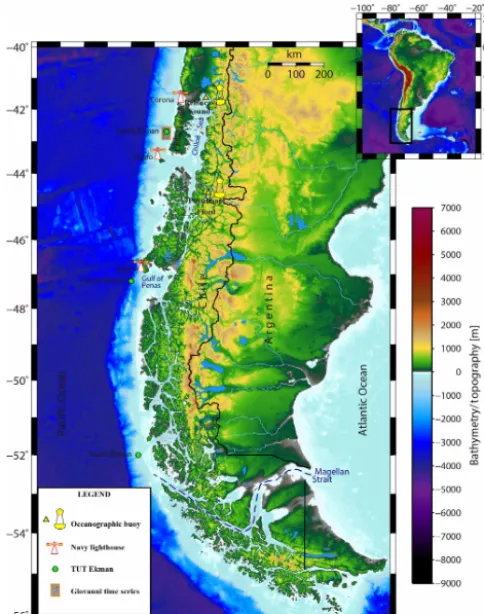
Local and regional validation process analyses were per-formed using data from navy lighthouses (NLHs) located in the coastal zone (Fig. 1). The data from the NLHs covered the periods 2009–2011 and 2014, when the operation of the QuikSCAT, the ASCAT, and the ERA5 surface-wind prod-ucts coincided. Additionally, data from an oceanographic buoy moored in Reloncaví Sound (Fig. 1) were used for com-parison with the ERA5 reanalysis from 2017 to 2018. A Tay-lor diagram was applied to all data sets as a validation tool (Taylor, 2001). In general, the validation between satellites and reanalysis surface-wind products with the in situ wind data demonstrated satisfactory results, with correlation co-efficients of 0.5–0.9 and RMSE and standard deviations of
∼2–4 m s−1. The ERA5 data showed the highest statistical results among the surface-wind products (see Figs. S1–S5 in the Supplement for further details regarding the validation process).
2.2 Environmental data from buoys and meteorological stations
1250 I. Pérez-Santos et al.: Synoptic scale variability of surface winds and ocean response
Figure 1.Map of the study area and geographical position of the sampling stations. Bathymetric image of the seafloor and topogra-phy obtained from https://www.gmrt.org/GMRTMapTool/ (last ac-cess: 31 August 2019).
2.3 Satellite-derived sea surface temperature, Chla, and fluorescence data
Satellite-derived images and a time series of Chla concentra-tions, normalized fluorescence line heights (FLHs), and sea surface temperature (SST) were obtained from the MODIS sensor on the Aqua satellite. The data were obtained with a spatial resolution of 4 km2per pixel, at nadir, over cloud-free ocean areas, with a temporal resolution of 8 d, covering the period from 2002 to 2018. Chla, FLH, and SST images and time series were extracted from the geospatial interactive online visualization and analysis infrastructure (Giovanni; https://giovanni.gsfc.nasa.gov/giovanni/, last access: 31 Au-gust 2019) and used as measures of the marine response to the surface winds and the associated processes (e.g., ET and EP).
2.4 Derived variables
The influence of surface winds on the ocean response was monitored throughout the calculation of the ET and EP. Both processes participate in the injection of nutrients from the deep layer to the euphotic zone, where the phytoplankton are
more abundant, increasing the primary biological production (Thurman and Trujillo, 2004). In the ET, the wind blowing toward the Equator (polar) on the western coastline generates an offshore (onshore) mass transport to the ocean, causing the upwelling (downwelling) of rich water. In contrast, EP originates from the divergence (convergence) of wind stress curl, contributing to the upwelling (downwelling) of water due to the positive (upward) and negative (downward) EP velocities (Tomczak and Godfrey, 1994; Stewart, 2002).
Using QuikSCAT and ASCAT surface-wind data, the com-ponents of the zonal and meridional wind stress (τu andτv, respectively) were calculated as shown in Eq. (1):
τu=ρaCduU10, τv=ρaCdvU10. (1) In Eq. (1),ρais air density (1.2 kg m−3);Cdis a dimension-less drag coefficient;u andv are the zonal and meridional wind components, respectively; andU10is the magnitude of the wind vector 10 m above sea level.Cdwas calculated us-ing the formula proposed by Yelland and Taylor (1996), in which the coefficient varies as a function of the wind veloc-ity, according to Eqs. (2) and (3):
Cd=0.29+ 3.1
U10 + 7.7
U102
×10−3,
for U10≤6 m s−1, (2)
Cd=0.60+0.070U10×10−3,
for 6 m s−1≤U10≤26 m s−1. (3) Ekman surface transport, M (m2s−1), was calculated for each grid point of the satellite wind field using Eq. (4) be-low (Smith, 1968):
M= τ
ρwf
, (4)
whereτ is the wind stress vector, ρw is the water density (1025 kg m−3), andf is the Coriolis parameter. The EP ve-locity, WE (m3s−1), was calculated according to Eq. (5) (Smith, 1968):
WE= 1
ρwf
∇ ×τ, (5)
where∇ ×τ is the wind stress curl, which was derived by first-order cross differencing of the wind stress field. This implies that no curl computation was possible for the grid points nearest the coast. This drawback was overcome by ap-plying co-kriging to the wind stress curl in two dimensions, which in turn allowed extrapolation toward the coast (Mar-cotte, 1991).
To quantify the relative importance of EP for the total up-welling transport (TUT), EP velocities were integrated up to
I. Pérez-Santos et al.: Synoptic scale variability of surface winds and ocean response 1251
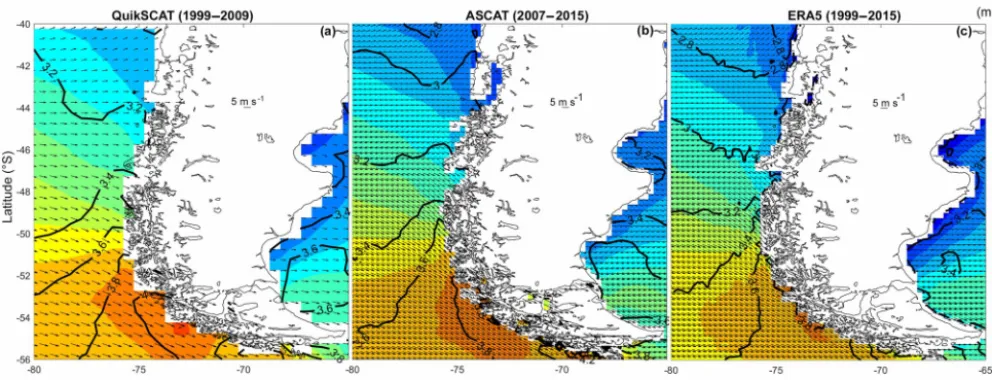
Figure 2.Long-term mean of daily surface wind from(a)QuikSCAT (1999–2009),(b)ASCAT (2007–2016), and(c)ERA5 reanalysis climate data sets (1999–2015). Black line: standard deviations of daily data. Colored bar: surface-wind magnitude.
to obtain the vertical transport (m3s−1) for each selected transect and compare it with the ET obtained using Eq. (4), following the methodology proposed by Pickett and Paduan (2003). In Fig. 11, TUT was averaged every 8 d for compar-ison with the MODIS Aqua variables (e.g., Chla, FLH, and SST).
2.5 Data analysis
Zonal and meridional surface winds from QuikSCAT (1999– 2009), ASCAT (2007–2015), and ERA5 reanalysis (1999– 2015) were used to apply EOF analysis (Emery and Thom-son, 1998; Kaihatu et al., 1998) to determine the modes of variability that dominated the spatiotemporal behavior of the wind field in the eastern austral Pacific Ocean. Before com-puting the EOFs, long-term means and linear trends were re-moved for each scatterometer (QuikSCAT and ASCAT) and the reanalysis product (ERA5) separately. To complete this process, the mean and linear trend calculations were applied to all grid points covering the entire data set period.
A Morlet wavelet analysis was applied (Torrence and Compo, 1998) to the time-dependent coefficients of the three leading modes, resulting from real-vector EOF analysis of the QuikSCAT, ASCAT, and ERA5 reanalysis surface-wind fields. This wavelet analysis allowed for the distinction of time and duration of the dominant periods of the different at-mospheric processes. The wavelet spectra were used to cal-culate the time-averaged spectra for the entire sampling pe-riod and are subsequently referred to as the global wavelet spectrum (Torrence and Compo, 1998).
3 Results
3.1 Surface-wind features and variability
Analysis of the surface-wind long-term daily mean, for the period 1999–2015, using the QuikSCAT and ASCAT satel-lite products and the ERA5 reanalysis climate data set, showed similar patterns (Fig. 2). In general, westerlies were the predominant surface winds, especially between 42 and 45◦S, although a more detailed analysis indicated different features. First, north of 42◦S, the wind was slightly west– southwesterly. Second, south to 45◦S, the wind started an inclination from the west to the northwest direction, and third, between 52 and 56◦S, the wind blew along the austral coast of the Magellan region, while in the rest of the study area, the wind direction was perpendicular to the coast. The surface-wind average registered as a meridional gradient, in which low speeds (5–6 m s−1) were observed in the north-ern domain, and stronger winds (10–2 m s−1) were registered closer to 51◦S. The standard deviations were similar between the satellite products (±3.0 to±4.2 m s−1), representing the same meridional gradient observed in the surface-wind mag-nitude, but the ASCAT data registered a lower variability and less intense surface-wind magnitudes, compared with the data obtained by QuikSCAT (Fig. 2a and b). Nevertheless, lower standard deviations and wind magnitudes were ob-tained by the ERA5 reanalysis data (Fig. 2c). Computations of the seasonal cycle, using all data sets (e.g., QuikSCAT, ASCAT, and ERA5), showed a similar meridional gradient to that obtained in the average analysis, highlighting the time persistence and high intensity of the northwesterly winds in the open ocean water of the Magellan region (51 to 56◦S).
to-1252 I. Pérez-Santos et al.: Synoptic scale variability of surface winds and ocean response
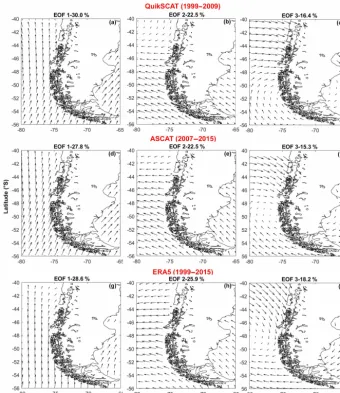
Figure 3.Eastern austral Pacific Ocean from 1999 to 2015: normalized eigenvector patterns from QuikSCAT(a, b, c), ASCAT(d, e, f), and ERA5 reanalysis(g, h, i).
tal variance. The EOF for the QuikSCAT (1999–2009) daily data showed a concentration of∼70 % of the total variance in the first three empirical modes: EOF-1=30.01 %; EOF-2=22.5 %; EOF-3=16.4 % (Fig. 3a–c). For the equiva-lent ASCAT (2007–2015) daily wind data, the EOF repre-sented ∼65 % of the total variance, in the first three em-pirical modes: EOF-1=27.9 %; EOF-2=22.5 %; EOF-3=
15.3 % (Fig. 3d–f). In contrast, the ERA5 reanalysis data showed similar variance but covered the total sampling pe-riod with EOF-1=28.6 %, EOF-2=25.9 %, and EOF-3=
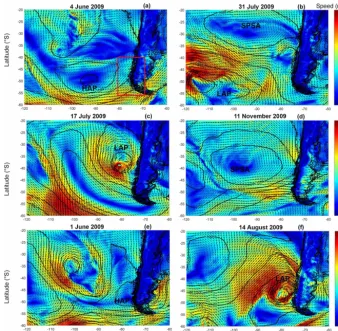
18.2 % (Fig. 3g–i). The spatial structures of the first three modes from the QuikSCAT, ASCAT, and ERA5 databases were similar (Fig. 3). In terms of the spatial structure of mode 1 (Fig. 3a, d, and g), southerly and southwesterly winds dominated the study area when the time-dependent coeffi-cient was positive (Figs. 4a, 5a and 6a, PC-1). When prin-cipal component 1 (PC-1) was negative, the spatial structure
of mode 1 rotated, and northerly and northeasterly winds oc-curred.
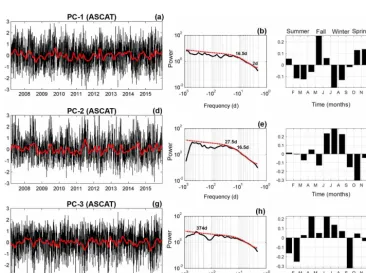
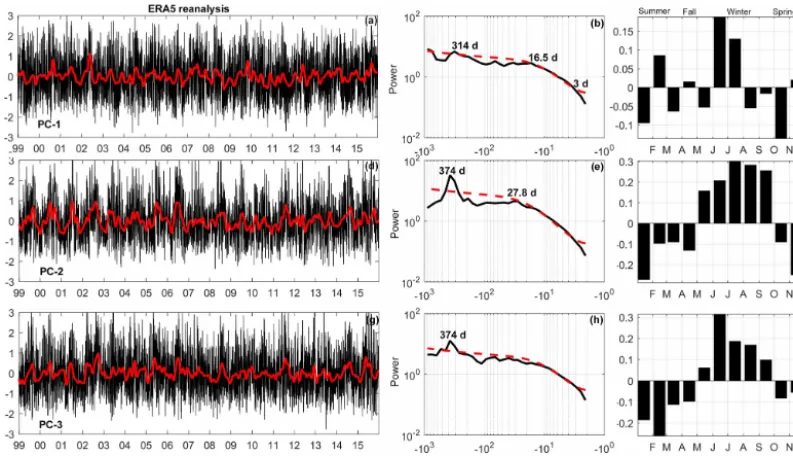
The global spectrum analysis performed for PC-1 de-noted the dominant 16.5 d cycle (Figs. 4b and 5b). The PC-1 monthly mean calculation demonstrated that southerly winds occurred mostly during the fall and spring, while northerly winds were more frequent during the winter, spring, and summer (Figs. 4c and 5c). The global spectrum of the com-plete and continuous ERA5 reanalysis data set again showed the 16.5 d cycle and the approximately 314 d annual cycle (Fig. 6b). In the monthly mean calculations, observations showed an alternating dominance of southerly and northerly winds (Fig. 6c). The southerly and northerly winds were as-sociated with the passage of intense HAP (Fig. 7a) and LAP (Fig. 7b) systems throughout the study region.
west-I. Pérez-Santos et al.: Synoptic scale variability of surface winds and ocean response 1253
Figure 4. (a, d, g)Normalized time series of the time-dependent coefficient (black lines) from the 30 d low-pass-filtered time series (solid red lines).(b, e, h)Global wavelet spectra (solid black lines) with 95 % confidence interval (dashed red lines) and(c, f, i)long-term monthly mean of EOF modes from surface wind daily data on QuikSCAT from 1999 to 2009: mode 1(a, b, c), mode 2(d, e, f), and mode 3(g, h, i).
1254 I. Pérez-Santos et al.: Synoptic scale variability of surface winds and ocean response
Figure 6. (a, d, g)Normalized time series of the time-dependent coefficient (black lines) from the 30 d low-pass-filtered time series (solid red lines).(b, e, h)Global wavelet spectra (solid black lines) with 95 % confidence interval (dashed red lines) and(c, f, i)long-term monthly mean of EOF modes from surface wind daily data of ERA5 reanalysis from 1999 to 2015: mode 1(a, b, c), mode 2(d, e, f), and mode 3(g, h, i).
erly winds (negative time-dependent coefficient) (Fig. 3b, e, and h). The global spectrum for the PC-2 (Fig. 4d and e) represented the dominance of the 374 d annual cycle for the QuikSCAT database. The low-pass-filtered time series for the PC-2 (Fig. 4d, red line) showed the occurrence of the most positive values during fall and winter, represented by the easterly winds (Fig. 4f). The negative part of the PC-2 was observed during spring and summer, highlighting the presence of the westerly winds (Fig. 4f). Even though the spatial structure of mode 2 from the ASCAT database pre-sented a similar pattern to QuikSCAT mode 2, the annual cy-cle period was not detected in the spectrum of PC-2 (Fig. 5d and e). In this analysis, 27.5 d and 16.5 d cycles were ob-tained. The monthly mean for PC-2 coincided with the results from QuikSCAT during winter (easterly winds) and spring (westerly winds) but was different in summer and fall, when the wind direction varied (Fig. 5f). For PC-2, the global spec-trum signal and monthly mean calculations, obtained using the ERA5 data, reflected a combination of results registered with the QuikSCAT and ASCAT data sets, highlighting the dominance of the 374 and 27.8 d cycles (Fig. 6d–f). Figure 7c and d show examples of the atmospheric systems involved in the wind direction variability characteristic of this mode.
The spatial structure of mode 3 can be represented by a clockwise atmospheric circulation (e.g., Fig. 7e) of surface winds in the same direction as the LAP system when the time-dependent coefficient was positive (Fig. 3c, f, and i). The rotation of the winds became counterclockwise (e.g., Fig. 7f) when the time-dependent coefficient was negative, representing a structure similar to that seen for a HAP
sys-tem (Figs. 4g, 5g, and 6g). Periods of 2–8 d were detected in the spectrum analysis of all data sets (QuikSCAT, AS-CAT, and ERA5), while semiannual (157 d) and annual cy-cles were also observed (Figs. 4h, i, 5h, i, and 6h, i).
To capture the influence of the LAP and HAP systems in the EOF patterns, the ERA5 data set was used to carry out a further EOF analysis, but this time the study region was expanded to the west (120◦W) and the north (30◦N). This EOF analysis confirmed our previous conclusions (Figs. S6– S7).
I. Pérez-Santos et al.: Synoptic scale variability of surface winds and ocean response 1255
Figure 7.Snapshots of the surface winds representing EOF eigenvector spatial structures for mode 1(a, b), mode 2(c, d), and mode 3(e, f). Surface wind and atmospheric pressure data were obtained from the ERA5 reanalysis climate product. The surface-wind vectors were plotted with a spatial resolution of 1◦×1◦. The red rectangle in panel(a)indicates the study area.
3.2 Derived parameters from surface winds and ocean implications
The average dominance of the westerly surface-wind stress generally produced a northerly ET in the study region (Fig. 9a–c). On average, the ET ran parallel to the coast, from 40 to 47◦S and to 56◦S. The inclination of the coast-line and the influence of westerly wind stress contributed to the change in the ET direction, orienting mostly perpendic-ular to the coast. This region (48–56◦S) demonstrated the highest ET value (2.16 m2s−1) recorded due to the pres-ence of the most intense regional winds (Fig. 2). Moreover, a wide area of positive (upward motion) and maximum Ek-man pumping (EP of 0.25 m d−1) was observed at approxi-mately 51◦S in the QuikSCAT data; the positive EP extended across the study area (Fig. 9a). The same area of positive and intense EP was observed in the ASCAT database; how-ever, in the northern part of the study region, between 40 and 48◦S, the upward EP was located closer to the coast and cov-ered approximately the first 100 km (Fig. 9b). The long-term mean of daily ET and EP, calculated with ERA5, was
sim-ilar to that obtained for the QuikSCAT period, showing the greatest concurrences with areas where EP was maximized (Fig. 9c). However, the ERA5 values were higher when EP was 0.57 m d−1at 50.5◦S, 76.25◦W. The EP was also high in the ERA5 data set along the coastline between 40 and 44◦S (Fig. 9).
1256 I. Pérez-Santos et al.: Synoptic scale variability of surface winds and ocean response
Figure 8. Morlet wavelet power spectrum applied to the three series of the EOF time-dependent coefficient from QuikSCAT(a, c, e), ASCAT(b, d, f), and ERA5(g, h, i). The fine contour lines enclose regions of confidence levels of>95 % for a red noise process with a lag-1 coefficient between 0.52 and 0.55, and the thick contour lines indicate the cone of influence. The color bar relates colors on the power spectrum.
Figure 9.The long-term mean of daily ET (red arrows) and EP (color bars) from(a)QuikSCAT (1999–2009),(b)ASCAT (2007–2016), and
(c)ERA5 reanalysis (1999–2015). The black lines represent the zero value of EP, where a positive number is a region favorable to upwelling and negative to downwelling.
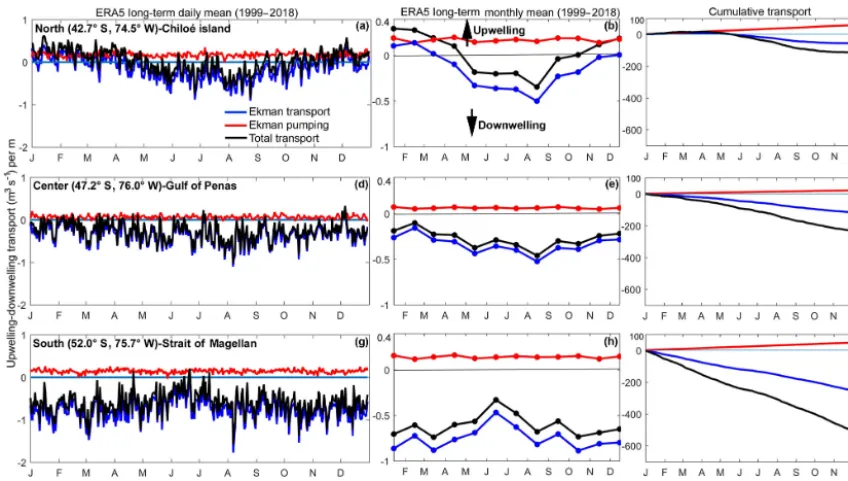
positive and dominated the TUT (Fig. 10a). The long-term monthly mean of the time series showed the dominance of downwelling conditions from May to October (austral fall– winter). The upwelling typically began in November and fin-ished in April, with a significant contribution from the EP
(Fig. 10b). The cumulative transport was generally favorable to downwelling from May to December, with reduced up-welling in the summer (Fig. 10c).
I. Pérez-Santos et al.: Synoptic scale variability of surface winds and ocean response 1257
Figure 10.Quantification of the cross-shore transport using ERA5 reanalysis from the north, center, and south time series (see Fig. 1 for the position) from 1999 to 2018(a, d, g)representing the long-term daily mean,(b, e, h)the long-term monthly mean, and(c, f, i)cumulative ET, EP, and TUT. The TUT is the sum of the ET and EP. The positive/negative values of transport indicate upwelling/downwelling conditions.
TUT (±0.97 m3s−1), but offshore ET events decreased and EP showed reduced positive values (Fig. 10d). Downwelling conditions prevailed due to the dominance of the ET during the year (Fig. 10e), and the cumulative transport was negative (downwelling) for ET and TUT and higher than observed in the northern time series (Fig. 10f).
In the southern part of the study region, close to the en-trance of the Strait of Magellan, the absolute maximum (−8.25 m3s−1) was reported, along with higher variability of the TUT (±1.24 m3s−1), which was dominated by the ET. The EP was positive and favorable for upwelling but less intense than for the ET (Fig. 10h). The long-term monthly mean for transport showed the highest values for the ET and the highest contribution of this process to the TUT, even though the EP was positive and favorable for upwelling (Fig. 10i). The cumulative transport was also the most im-portant compared with the other time series (Fig. 10j).
Downwelling conditions generally dominated the study re-gion, but in the open ocean water around Chiloé Island, up-welling was observed during spring–summer due to the con-tribution of the wind stress curl that generated positive EP velocities. Considering the previous results showing that sur-face winds (ET and EP) contributed to the injection of sub-surface water to the sub-surface layer, the time series of TUT, together with satellite data for Chl a, FLH, and SST, were used to evaluate the oceanic response to favorable upwelling conditions (Fig. 11). The time series of TUT from 2002 to 2018 showed an annual cycle in which upwelling conditions occurred during spring and summer (Fig. 11a, red shaded
area), while downwelling conditions were typically observed in the fall and winter (Fig. 11a, blue shaded area). The Chla
anomalies showed a positive response to the TUT (Fig. 11b) with a correlation coefficient of 0.32. Because the Chla sig-nal was contaminated with suspended solid sediments and other non-biological signals, an FLH time series was incor-porated into the analysis, showing a correlation coefficient of 0.54 with Chla. In this case, FLH also exhibited a pos-itive relationship with TUT; the correlation coefficient was 0.27 (Fig. 11c). Negative SST anomalies were also observed during the fall and winter and at a lower frequency during the spring and summer compared to that the frequency of the upwelling response (Fig. 11d). The correlation coeffi-cient between the SST anomalies and TUT was 0.29. From an interannual point of view, a high number of positive Chla
and FLH anomalies was observed in 2008, 2014, and 2016, and SST anomalies were observed in 2004, 2008–2009, and 2016–2017. For the TUT time series, no interannual vari-ability was observed, but from 2017 to the end of 2018, de-creasing amounts of positive TUT were observed. The SST (Fig. 11e and g) and Chlaimages (Fig. 11f and h) obtained during the upwelling provided evidence of the oceanic re-sponse to the TUT. Along the west coast of Chiloé Island, the SST dropped by approximately 4◦C and Chlaincreased
1258 I. Pérez-Santos et al.: Synoptic scale variability of surface winds and ocean response
Figure 11.Time series of(a)the TUT from ERA5,(b)the Chlaanomalies,(c)the FLH anomalies, and(d)the SST anomalies from the MODIS Aqua satellite data.(e–h)Examples showing the ocean response to ET and EP along the northern coast of Patagonia. SST(e, g)and Chla(f, h)from MODIS Aqua. Time series of TUT(a)was obtained from point north of Chiloé Island (see Fig. 10a) and time series from
I. Pérez-Santos et al.: Synoptic scale variability of surface winds and ocean response 1259
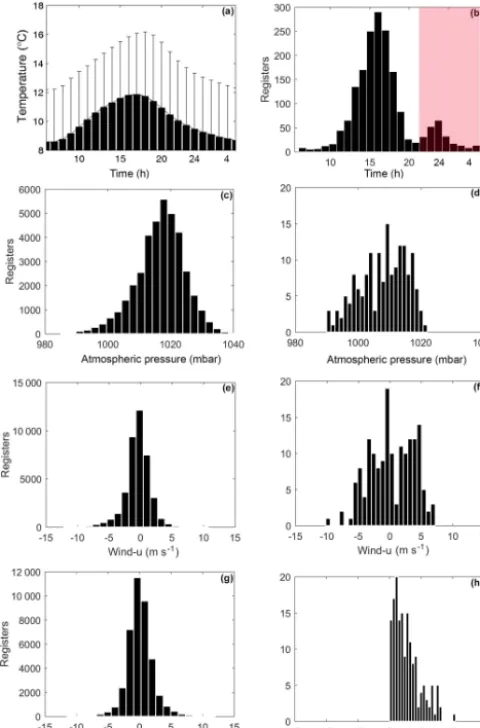
Figure 12. (a)SAT long-term hourly means with the(b)histogram of the maximum SAT. The red shaded area in panel(b)shows the time of the second air temperature maxima. The error bars in(a)
represent the standard deviations of SAT.(c, e, g)Complete data set of atmospheric pressure and zonal (wind-u) and meridional wind (wind-v) components.(d, f, h)Atmospheric pressure and zonal and meridional wind values related to the second SAT maxima. Data were obtained from the Puyuhuapi Fjord oceanographic buoy and meteorological station in the period 2011–2017.
3.3 Relationship of synoptic events with nighttime heatwaves
The long-term hourly mean of the surface air temperature (SAT) obtained from the buoy and meteorological station data showed a markedly diurnal cycle, where the SAT maxi-mum was registered in the afternoon (15:00–18:00 LT), while the absolute minima were observed early in the morning (06:00–08:00 LT) (Fig. 12a). The histogram of the SAT ab-solute maxima demonstrates a bimodal structure (Fig. 12b), with an initial peak in the afternoon, as was observed in the diurnal cycle (Fig. 12a), and a second peak at night from
∼21:00 to 05:00 LT.
The balance of this subsection describes the processes in-volved in the SAT nighttime maximum, known in this pa-per as “nighttime heatwave events”. The original time series of atmospheric pressure and zonal (wind-u) and meridional wind (wind-v) components showed the range and intensity of different variables during the same time of SAT occurrence (Fig. 12c, e, and g). These data were also obtained from the buoy and meteorological station. Alternatively, Fig. 12d, f, and h only represented the occurrence of the variable during the SAT nighttime maximum. During this time, the atmo-spheric pressure ranged from 990 to∼1020 mbar, highlight-ing the presence of LAP systems (Fig. 12d), while the surface wind was predominant from the northwest and northeast di-rection (Fig. 12f and h). The time series registered 162 night-time heatwave events from 2011 to 2017 (Fig. 13a and c). On average, approximately 32 events occurred every year (aver-aged using the complete years of 2012, 2015, and 2016).
The normalized time series of the SAT nighttime maxi-mum (nighttime heatwave events) with the atmospheric pres-sure demonstrated a notable agreement (Fig. 13a), show-ing a high correlation coefficient (0.96) between the vari-ables (Fig. 13b). A similar pattern was observed between the meridional wind component and the nighttime heatwave events (Fig. 13c), also registering a high correlation coef-ficient (0.78) (Fig. 13d). The temperature range from these events was 5 to 20◦C, with the most common temperatures between 10 and 12◦C (Fig. 13e). The monthly histogram of the nighttime heatwave events showed most cases occurred in the fall and winter, with fewer incidences in the summer (Fig. 13f). Figure 14 presents one example of the 162 events detected in this study, which occurred during fall 2011, as shown in the atmospheric data from the oceanographic buoy installed in Puyuhuapi Fjord. The maximum SAT was ob-served on 21 April 2011 at midnight (00:00 LT), coinciding with a decreased atmospheric pressure and increased surface-wind intensity (Fig. 14a).
1260 I. Pérez-Santos et al.: Synoptic scale variability of surface winds and ocean response
Figure 13.Time series of the nighttime heatwave events.(a)Normalized time series of SAT nighttime maximum (black dots) and atmospheric pressure (red dots).(b)Cross-correlation coefficient between variables from panel(a).(c)Normalized time series of SAT nighttime maximum (black dots) and meridional wind component (red dots).(d)Cross-correlation coefficient between variables from panel(c).(e)Histogram and (f)long-term monthly mean from time series of SAT nighttime maximum in the period 2011 to 2017. Data were obtained from the Puyuhuapi Fjord oceanographic buoy (2011–2013) and meteorological station (2014–2017). From July 2013 to April 2014, no data were collected. The blue circle in panels(a, c)denotes the position of the nighttime heatwave events described in Figs. 14 and 15.
the Strait of Magellan, due to the LAP winds (Fig. 14e). At-mospheric conditions returned to normal days after the pas-sage of the LAP (Fig. 14f and g) as shown in Fig. 14b and c. A second example, using atmospheric data from the winter of 2012, better demonstrated the increased SAT over Patag-onia due to the LAP system influence (Fig. 15). In this case, the maximum air temperature was again registered when the
I. Pérez-Santos et al.: Synoptic scale variability of surface winds and ocean response 1261
Figure 14.Hourly air temperature, atmospheric pressure, and wind speed data from the Puyuhuapi Fjord oceanographic buoy(a)and surface winds, atmospheric pressure, and surface air temperature from the ERA5 reanalysis climate product(b–g)during April 2011. The surface-wind vectors(b, d, f) were plotted with a spatial reso-lution of 1◦×1◦.
event, warm air was transported along the coast of Patago-nia to∼56◦S (Fig. 15d and e). Pre-event atmospheric con-ditions were restored 1 d after the passage of the LAP sys-tem (Fig. 15f and g). Other studies were incorporated in the paper to demonstrate the relationship between atmospheric pressure, winds, and surface air temperature during nighttime heatwaves events (see Fig. S9).
4 Discussion
The combination of QuikSCAT, ASCAT, and ERA5 surface-wind products, together with in situ measurements of surface-wind from oceanographic buoys and meteorological stations, has
Figure 15.Hourly air temperature, atmospheric pressure, and wind speed data from the Puyuhuapi Fjord oceanographic buoy(a)and surface winds, atmospheric pressure, and surface air temperature from the ERA5 reanalysis climate product(b–g)during July 2012. The surface-wind vectors(b, d, f)were plotted with a spatial reso-lution of 1◦×1◦.
1262 I. Pérez-Santos et al.: Synoptic scale variability of surface winds and ocean response 4.1 Surface-wind variability
Satellite data on the long-term surface-wind daily means, over the period 1999–2015, demonstrated that between 42 and 45◦S, the normal wind was perpendicular to the coast and blew from the west. From 45 to 56◦S, the predominant wind direction changed to the northwest, reaching its high-est intensity in the Magellan region where it blew parallel to the coast. At the other end of the study region (40–42◦S), the predominant wind was from the southwest, although the intensity was less than in the Magellan region (Fig. 2). To date, the wind regime for this region has only been pre-sented as a conceptual model to show the influence of the westerlies on the westerly drift current (Thiel et al., 2007; Arkhipkin et al., 2009; Kilian and Lamy, 2012) and to present the general atmospheric circulation applicable to the west coast of South America (Rahn and Garreaud, 2013; Talley et al., 2011). Even though maps similar to Fig. 2 were pre-sented in Aguirre et al. (2012) and Saldías et al. (2018) using QuikSCAT data, details of the surface-wind behavior could not be determined. In addition, wind regime studies, which included derived variables such as EP and ET, focused on the central and northern regions of the Chilean and Peruvian coasts, north of 40◦S. The main goals of these studies were to explain the dynamic of the SPSA and improve the under-standing of the wind’s influence on this circulation regime (Ancapichun and Garcés-Vargas, 2015; Bravo et al., 2016; Fuenzalida et al., 2008; Schneider et al., 2017). Recently, the behavior and evolution of the ET in northern Patago-nia and its implications in ocean response were investigated (Narváez et al., 2019). In the next section, these results will be incorporated and discussed.
LAP and HAP systems dominated mode 1 of the EOF, contributing∼30 % of the total variance (Figs. 3–6). In this mode, southerlies related to the passage of the HAP systems, and northerlies produced by the LAP systems (Fig. 7), oc-curred on a timescale of 16.5 d (Figs. 4–6 and 8). This il-lustrated the variability of surface winds in the eastern aus-tral Pacific Ocean, complementing the westerly winds which have been seen to dominate the wind regime in average and seasonal data (Fig. 2).
EOF analysis detected wind from the west in mode 2, ac-counting for 22 % of the total variance. This wind occurred mainly during spring–summer before veering to an easterly wind for fall–winter (Figs. 3–6). The cycle change was ob-served in this mode using the individual QuikSCAT and AS-CAT data sets and confirmed by the continuous data set of the ERA5 reanalysis (Fig. 8). During the first period, an an-nual cycle dominated mode 2 (1999–2009), but in the second period (2009–2015), this dominance reduced, and cycle pe-riods of 27.5 and 16.5 d were observed (Fig. 8). The period of 16.5 d denoted the importance of the synoptic timescale, while the 27.5 d cycle suggested the influence of the re-cently reported, the Southern Hemisphere’s baroclinic annu-lar mode (BAM), which has been described as displaying an
energy band lasting between 20 and 30 d (Thompson and Barnes, 2014; Thompson and Woodworth, 2014). BAM’s influence was observed by Ross et al. (2015) in a Patago-nian fjord (47.8◦S) using acoustic Doppler current profiler (ADCP) data combined with in situ surface-wind and atmo-spheric pressure records. These data highlighted the contri-bution of this atmospheric phenomenon to the intensification and frequency of the LAP systems that occur throughout the Patagonian region. In addition, Narváez et al. (2019) reported the dominance of the BAM on an intraseasonal timescale, showing the essential influence of this cycle on the atmo-spheric and oceanographic conditions of northern Patagonia (40–45◦S).
Finally, the EOF analysis allowed for the detection of the high surface-wind variability in the eastern austral Pa-cific Ocean, showing the dominance of the atmospheric pres-sure systems (e.g., LAP and HAP systems) over the vari-ous timescales. These atmospheric synoptic events occurred throughout the study region, coinciding with the significant areas of the strongest westerly wind belt on Earth (Chelton et al., 2004).
4.2 Oceanic–atmospheric interactions
I. Pérez-Santos et al.: Synoptic scale variability of surface winds and ocean response 1263
oceanic water to the surface layer. During the annual cycle, favorable upwelling conditions were observed from Novem-ber to April (Figs. 10 and 11), the time of year with more intense photosynthetically available radiation (PAR) for phy-toplankton species (Daneri et al., 2012). To date, coastal up-welling quantification, using only the ET, has been reported as far south as the central coastal region of Chile (∼36◦S) (Sobarzo and Djurfeldt, 2004; Sobarzo et al., 2007), and recent analyses have been extended to 45◦S (Narváez et al., 2019). However, our work has shown that coastal up-welling can also occur by the contribution of EP and must be added to the TUT quantification for a realistic evaluation of the ocean response to surface winds. For example, in the California upwelling system, EP is more significant than ET for the TUT, especially during spring and summer (Pickett and Paduan, 2003). In northern Chile (27–32◦S), EP repre-sented∼40 % of the TUT, causing changes in the SST spa-tial structure (Bravo et al., 2016). Around Cabo Frío (22◦S, 42◦W), EP was also the primary contributing process in the upwelling of the coldest water to the surface layer (Castelao and Barth, 2006).
From an interannual point of view, the TUT favored up-welling from spring 2015 to summer 2016, contributing to high Chlaand FLH readings during summer 2016 (Fig. 11). A strong harmful algal bloom (HAB) was reported in north-ern Patagonia during February and March 2016, causing the death of ∼40 000 mt (metric tons) of salmon (Díaz et al., 2019; Paredes et al., 2019). The main factors involved in the 2016 HAB included increased solar radiation, SST, and water column stratification, which were highlighted as trig-ger mechanisms (Léon-Muñoz et al., 2018). However, the results presented in this paper show that EP and ET favor the upwelling of nutrient-rich water to the euphotic layer, which can contribute to HAB development. Additionally, a high ammonium concentration was observed 2 months later in the open oceanic water off the west coast of Chiloé Is-land (41◦4601500S, 75◦4303100W) due to the shedding of∼
4600 mt of dead salmon to the sea (Buschmann et al., 2016). As Fig. 11 shows, during this time, EP favored the vertical as-cent of water, inhibiting the sinking of the biochemical waste. Therefore, the Ekman upwelling process must be something for the decision-makers to consider during future environ-mental emergencies.
In general, however, downwelling conditions dominated by onshore ET, were observed in the study area, especially in the south close to the Magellanic region (Figs. 9 and 10). We have hypothesized that the irregular orographic structure of the coastline from 44 to 56◦S, where the coast is comprised of many islands and channels, could reduce the possibility of the oceanic water sinking at the coastline passing into the interior of the Patagonian fjords and carrying the eggs and larvae of many species and nutrients and enhancing biologi-cal production.
Figure 16.A conceptual model of the “nighttime heatwave event” in the eastern austral Pacific Ocean.(a)The initial condition, where a low atmospheric pressure system with cold air and a high atmo-spheric pressure system with warm air are regionally present, al-though separate;(b) the low atmospheric pressure system moves northward and encounters the high atmospheric pressure system, transporting warm air to Patagonia.
It was not only the ocean that responded to the synoptic-scale variability of the surface wind; the atmospheric con-ditions were also influenced. This study registered approx-imately 160 events in which the SAT nighttime maximum (“nighttime heatwave events”) occurred in response to the influence of low atmospheric pressure systems with winds from the northwest and northeast directions predominat-ing, registering a high correlation coefficient between the SAT nighttime maximum with the atmospheric pressure and meridional wind components (Figs. 12 and 13). Various ex-amples demonstrated the importance of the synoptic-scale events in modifying climate conditions in the austral region (Figs. 14, 15, and S9), where the LAP systems contribute to the origin of the nighttime heatwave events.
1264 I. Pérez-Santos et al.: Synoptic scale variability of surface winds and ocean response
and their impact on the Patagonian climate depends on the intensity of the LAP system winds and the heat content of the SPSA. In the contexts of climate change and variability, any changing trends in these events should be considered as mechanisms that could contribute to increased glacial melt-water and alteration of the austral climate.
5 Conclusions
In our study, satellite and reanalysis wind data were used to understand surface-wind variability in the eastern austral Pa-cific Ocean, a region generally dominated by strong wester-lies, and the SPSA. The EOF demonstrated that within the area, modes 1, 2, and 3 of wind variability showed synop-tic timescale dominance due to the effects of low and high atmospheric pressure systems. Generally, downwelling con-ditions prevailed in the study region due to onshore ET, but offshore ET and upward EP were observed during spring and summer in the northern domain (∼40 to 48◦S), contributing to reduced SST and increased Chla. The arrival of the south-ern edge of the SPSA during spring and summer created up-welling conditions dominated by EP; this is the first time that this condition has been reported so far south. In addition, the SPSA was involved in generating the nighttime heatwaves, acting with the LAP systems to produce the nighttime air temperature maxima.
Data availability. All data sets used in this paper can be requested from the corresponding author.
Supplement. The supplement related to this article is available on-line at: https://doi.org/10.5194/os-15-1247-2019-supplement.
Author contributions. IPS designed the experiment, was responsi-ble for collection and analysis of the satellite data, and was the project leader. RS was responsible for collection and analysis of the satellite and in situ data, as well as manuscript revision. WS de-signed the experiment, collection, and analysis of the satellite data, as well as manuscript revision. PL was responsible for data analysis of ERA5 and generation of Fig. 1. DD was responsible for data anal-ysis of ERA5 and the validation process. EN was responsible for data analysis. CAC was responsible for the validation process. GD was responsible for manuscript revision. All authors contributed to the writing of the manuscript.
Competing interests. The authors declare that they have no conflict of interest.
Acknowledgements. Surface-wind data were collected as part of FONDECYT (grant nos. 3120038 and 11140161) by Iván Pérez-Santos, with assistance from Wolfgang Schneider’s research group.
We thank Raul Montoya for the EOF functions. We are grateful to Centro Copas Sur Austral for providing data from its oceanographic buoy and a partial scholarship for Romanet Seguel to complete a magister in oceanography at the University of Concepción, Chile. We thank Centro de Investigación en Ecosistemas de la Patago-nia (CIEP) for providing meteorological information. The ERA5 reanalysis data were provided by the Copernicus Climate Change Service (C3S) (2017): ERA5 (fifth generation of the ECMWF at-mospheric reanalyses of the global climate) Copernicus Climate Change Service Climate Data Store (CDS). We also thank FOND-EQUIP EQM160167 and the Chilean Navy for providing wind data from oceanographic buoy and navy lighthouses. We appreciate the tremendous effort of the anonymous reviewers which led to im-proved manuscript quality.
Financial support. Financial support was provided by FONDE-CYT (grant nos. 3120038 and 11140161) and by Centro Copas Sur Austral PFB31 and AFB170006.
Review statement. This paper was edited by Markus Meier and re-viewed by two anonymous referees.
References
Aguirre, C., Pizarro, Ó., Strub, P. T., Garreaud, R., and Barth, J. A.: Seasonal dynamics of the near-surface along-shore flow off central Chile, J. Geophys. Res., 117, C01006, https://doi.org/10.1029/2011JC007379, 2012.
Ancapichun, S. and Garcés-Vargas, J.: Variability of the South-east Pacific Subtropical Anticyclone and its impact on sea sur-face temperature off north-central Chile, Cienc. Mar., 41, 1–20, https://doi.org/10.7773/cm.v41i1.2338, 2015.
Arkhipkin, A. I., Schuchert, P. C., and Danyushevsky, L.: Otolith chemistry reveals fine population structure and close affinity to the Pacific and Atlantic oceanic spawn-ing grounds in the migratory southern blue whitspawn-ing ( Mi-cromesistiusaustralisaustralis), Fish. Res., 96, 188–194, https://doi.org/10.1016/j.fishres.2008.11.002, 2009.
Bentamy, A., Croize-Fillon, D., and Perigaud, C.: Charac-terization of ASCAT measurements based on buoy and QuikSCAT wind vector observations, Ocean Sci., 4, 265–274, https://doi.org/10.5194/os-4-265-2008, 2008.
Bentamy, A. and Croize-Fillon, D.: Gridded surface wind fields from Metop/ASCAT measurements, Int. J. Remote Sens., 33, 1729–1754, 2011.
Bravo, L., Ramos, M., Astudillo, O., Dewitte, B., and Goubanova, K.: Seasonal variability of the Ekman transport and pumping in the upwelling system off central-northern Chile (∼30◦S) based on a high-resolution atmospheric regional model (WRF), Ocean Sci., 12, 1049–1065, https://doi.org/10.5194/os-12-1049-2016, 2016.
I. Pérez-Santos et al.: Synoptic scale variability of surface winds and ocean response 1265
Castelao, R. M. and Barth J. A.: Upwelling around Cabo Frio, Brazil: The importance of wind stress curl, Geophys. Res. Lett., 33, L03602, https://doi.org/10.1029/2005GL025182, 2006. Chelton, D. B., Schlax, M. G., Freilich, M. H., and Milliff, R. F.:
Satellite measurements reveal persistent small scale features in ocean winds, Science, 303, 978–983, 2004.
Daneri, G., Montero, P., Lizárraga, L., Torres, R., Iriarte, J. L., Jacob, B., González, H. E., and Tapia, F. J.: Primary Produc-tivity and heterotrophic acProduc-tivity in an enclosed marine area of central Patagonia (Puyuhuapi channel; 44◦S, 73◦W), Biogeo-sciences Discuss., 9, 5929–5968, https://doi.org/10.5194/bgd-9-5929-2012, 2012.
Díaz, P., Álvarez, G., Varela, D., Pérez-Santos, I., Díaz, M., Mo-linet, C., Seguel, M., Aguilera-Belmonte, A., Guzmán, L., Uribe, E., Rengel, J., Hernández, C., Segura C., and Figueroa, R. Impacts of harmful algal blooms on the aquaculture industry: Chile as a case study, Perspectives in Phycology, 6, 39–50, https://doi.org/10.1127/pip/2019/0081, 2019.
Emery, W. J. and Thomson R. E.: Data analysis methods in physical oceanography, Pergamon Press, Oxford, 634 pp., 1998. Epifanio, C. E. and Garvine, R. W.: Larval transport on the Atlantic
Continental Shelf of North America: A review, Estuar. Coast. Shelf S., 52, 51–77, https://doi.org/10.1006/ecss.2000.0727, 2001.
Escribano, R., Bustos-Ríos, E., Hidalgo, P., and Morales, C. E.: Non-limiting food conditions for growth and pro-duction of the copepod community in a highly pro-ductive upwelling zone, Cont. Shelf Res., 126, 1–14, https://doi.org/10.1016/J.CSR.2016.07.018, 2016.
Fuenzalida, R., Schneider, W., Garcés-Vargas, J., and Bravo L.: Satellite altimetry data reveal jet-like dynamics of the Humboldt Current, J. Geophys. Res., 113, C07043, https://doi.org/10.1029/2007JC004684, 2008.
Garland, E. D., Zimmer, C. A., and Lentz, S. J.: Larval distributions in inner-shelf waters: The roles of wind-driven cross-shelf cur-rents and diel vertical migrations, Limnol.Oceanogr., 47, 803– 817, 2002.
Holton, J.: An Introduction to Dynamic Meteorology, Academic Press, San Diego, 511 pp., 1992.
Iriarte, J. L., Vargas, C. A., Tapia, F. J., Bermúdez, R., and Urrutia, R. E.: Primary production and plankton car-bon biomass in a river-influenced upwelling area off Concepción, Chile, Prog. Oceanogr., 92–95, 97–109, https://doi.org/10.1016/J.POCEAN.2011.07.009, 2012. Kaihatu, J. M., Handler, R. A., Marmorino, G. O., and Shay,
L. K.: Empirical orthogonal function analysis of ocean sur-face currents using complex and real-vector methods, J. At-mos. Ocean. Tech., 15, 927–941, https://doi.org/10.1175/1520-0426(1998)015<0927:EOFAOO>2.0.CO;2, 1998.
Kämpf, J. and Chapman, P.: Upwelling systems of the world: a scientific journey to the most productive marine ecosystems, Springer, Berlin, 425 pp., 2016.
Kilian, R. and Lamy, F.: A review of Glacial and Holocene paleoclimate records from southernmost Patagonia (49–55◦S), Quaternary Sci. Rev., 53, 1–23, https://doi.org/10.1016/j.quascirev.2012.07.017, 2012.
León-Muñoz, J., Urbina, M. A., Garreaud, R., and Iriarte, J. L. : Hydroclimatic conditions trigger record harmful algal bloom in western Patagonia (summer 2016), Scientific Reports, 8, 1330, https://doi.org/10.1038/s41598-018-19461-4, 2018.
Marcotte, D.: Cokrigeage with MATLAB, Comput. Geosci., 17, 1265–1280, https://doi.org/10.1016/0098-3004(91)90028-C, 1991.
Montero, P., Daneri, G., Cuevas, L. A., González, H. E., Jacob, B., Lizárraga, L., and Menschel, E.: Productiv-ity cycles in the coastal upwelling area off Concep-ción: The importance of diatoms and bacterioplankton in the organic carbon flux, Progr. Oceanogr., 75, 518–530, https://doi.org/10.1016/j.pocean.2007.08.013, 2007.
Montero, P., Pérez-Santos, I., Daneri, G., Gutiérrez, M., Igor, G., Seguel, R., Crawford, D., and Duncan, P.: A winter dinoflagellate bloom drives high rates of primary production in a Patagonian Fjord ecosystem, Estuar. Coast. Shelf S., 199, 105–116, 2017. Narváez, D., Vargas, C., Cuevas, A., García-Loyola, S., Lara,
C., Segura, C., Tapia, F., and Broitman, B.: Dominant scales of subtidal variability in coastal hydrography of the Northern Chilean Patagonia, J. Marine Syst., 193, 59–73, https://doi.org/10.1016/j.jmarsys.2018.12.008, 2019.
Orlanski, I.: A rational subdivision of scales for atmospheric pro-cesses, B. Am. Meteorol. Soc., 56, 527–530, 1975.
Paredes, J., Varela D., Martínez C., Zúñiga A., Correa K., Villarroel A., and Olivares B.: Population genetic structure at the northern edge of the distribution of Alexandrium-catenella in the Patagonian Fjords and its expansion along the open Pacific Ocean coast, Front. Mar. Sci., 5, 532, https://doi.org/10.3389/fmars.2018.00532, 2019.
Pickett, M. H. and Paduan J. D.: Ekman transport and pumping in the California Current based on the U.S. Navy’s high resolution atmospheric model (COAMPS), J. Geophys. Res., 108, 3327, https://doi.org/10.1029/2003JC001902, 2003.
Piolle, J. F. and Bentamy, A.: Mean Wind Fields (MWF product), User Manual, QuikSCAT, CERSAT, Plouzané, 42 pp, 2002. Rahn, D. and Garreaud, R.: A synoptic climatology of the
near-surface wind along the west coast of South America, Int. J. Cli-matol., 34: 780-792. https://doi.org/10.1002/joc.3724, 2013. Ray, P. S.: Mesoscale meteorology and forecasting, American
Me-teorological Society, Boston, MA, 793 pp., 1986.
Ross, L., Valle-Levinson, A., Pérez-Santos, I., Tapia, F., and Schnei-der, W.: Baroclinic annular variability of internal motions in a Patagonian fjord, J.Geophys. Res.-Oceans, 120, 5668–5685, https://doi.org/10.1002/2014JC010669, 2015.
Rykaczewski, R. R. and Checkley, D. M.: Influence of ocean winds on the pelagic ecosystem in upwelling regions, P. Natl. Acad. Sci. USA, 105, 1965–1970, 2008.
Saldías, G. S., Sobarzo, M., and Quiñones, R.: Fresh-water structure and its seasonal variability off west-ern Patagonia, Progr. Oceanogr., 174, 143–153, https://doi.org/10.1016/j.pocean.2018.10.014, 2018.
1266 I. Pérez-Santos et al.: Synoptic scale variability of surface winds and ocean response
Sobarzo, M. and Djurfeldt, L.: Coastal upwelling process on a continental shelf limited by submarine canyons, Con-cepción, central Chile, J. Geophys. Res., 109, C12012, https://doi.org/10.1029/2004JC002350, 2004.
Sobarzo, M., Bravo, L., Donoso, D., Garcés-Vargas, J., and Schnei-der, W.: Coastal upwelling and seasonal cycles that influence the water column over the continental shelf off central Chile, Prog. Oceanogr., 75, 363–382, 2007.
Stewart, R. H.: Introduction to physical oceanography, Spring 2002 edn., Department of Oceanography, Texas A and M University, 350 pp., 2002.
Talley, L. D., Pickard, G. L., Emery, W. J., and Swift, J. H.: Descrip-tive physical oceanography, an introduction, 6th edn., Academic Press, Elsevier, 1–983 pp., 2011.
Taylor, K. E.: Summarizing multiple aspects of model perfor-mance in a single diagram, J. Geophys. Res., 106, 7183–7192, https://doi.org/10.1029/592 2000JD900719, 2001.
Thiel, M., Macaya, E. C., Acuña, E., Arntz, W. E., Bastias, H., Brokordt, K., Camus, P. A., Castilla, J. C., Castro, L. R., Cortés, M., Dumont, C. P., Escribano, R., Fernandez, M., Gajardo, J. A., Gaymer, C. F., Gomez, I., González, A. E., González, H. E., Haye, P. A., Illanes, J.-E., Iriarte, J. L., Lancellotti, D. A., Luna-Jorquera, G., Luxoro, C., Manriquez, P. H., Marín, V., Muñoz, P., Navarrete, S. A., Perez, E., Poulin, E., Sellanes, J., Sepúlveda, H. H., Stotz, W., Tala, F., Thomas, A., Vargas, C. A., Vasquez, J. A., and Vega, J. M.: The Humboldt Current System of North-ern and Central Chile: oceanographic processes, ecological inter-actions and socioeconomic feedback, Oceanogr. Mar. Biol., 45, 195–344, 2007.
Thompson, D. W. J. and Barnes, E. A.: Periodic variability in the large-scale southern hemisphere atmospheric circulation, Sci-ence, 343, 641–645, 2014.
Thompson, D. W. J. and Woodworth, J. D.: Barotropic and baro-clinic annular variability in the southern hemisphere, J. Atmos. Sci., 71, 1480–1493, https://doi.org/10.1175/JAS-D-13-0185.1, 2014.
Thurman, H. V. and Trujillo, A. P.: Introductory Oceanography, 10th edn., Pearson, Prentice Hall, Upper Saddle River, New Jer-sey 07458, 597 pp., 2004.
Tomasz, N.: El Niño/Southern oscillation and selected environmen-tal consequences, Adv. Geophys., 55, 77–122, 2014.
Tomczak, M. and Godfrey, J. S.: Regional Oceanography: An Intro-duction, Pergamon Press, Oxford, England, 422 pp., 1994. Torrence, C. and Compo, G. P.: A practical
guide to wavelet analysis, B. Am. Meteorol. Soc., 79, 61–78, https://doi.org/10.1175/1520-0477(1998)079<0061:APGTWA>2.0.CO;2, 1998.