R E S E A R C H A R T I C L E
Open Access
Validation study of the Chinese Early
Development Instrument (CEDI)
Patrick Ip
1*, Sophia Ling Li
1, Nirmala Rao
2, Sharon Sui Ngan Ng
3, Winnie Wai Sim Lau
1and Chun Bong Chow
1Abstract
Background:The Early Development Instrument (EDI) is a comprehensive instrument used to assess school readiness in preschool children. This study was carried out to evaluate the psychometric properties of the Chinese version of the EDI (CEDI) in Hong Kong.
Methods:One hundred and sixty-seven children were purposefully sampled from kindergartens in two districts with very different socioeconomic statuses. The CEDI was assessed for concurrent validity, internal consistency and test-retest reliability. The developmental vulnerability identified using the CEDI scores was further examined in relation to the socioeconomic status of the district and family.
Results:The CEDI displayed adequate internal consistency, with Cronbach’s alphas ranging from 0.70 to 0.95 on its five domains. Concurrent validity was supported by moderate and significant correlations (0.25 to 0.49) on the relevant domains between the CEDI and a comparable measure. The level of test-retest reliability was good, with a kappa statistic of 0.89. In general, girls outperformed boys, particularly in the social, emotional and communication/ general knowledge domains. After controlling for the uneven distribution of sex, children from socioeconomically disadvantaged districts and families were found to be at greater risk of developmental vulnerability than their more advantaged counterparts.
Conclusion:The evidence gathered in this study supports the CEDI’s use as a valid and reliable instrument in assessing school readiness and identifying developmentally vulnerable children in Chinese populations. Its preliminary findings on the socioeconomic gradients of child development suggest that the CEDI is a promising tool for leveraging evidence-based, context-sensitive policies and practices to foster the development of all children.
Keywords:Early Development Instrument, Early child development, Validity, Chinese population, Socioeconomic gradient
Background
Early childhood development is the foundation of hu-man and community development [1]. The early years of life are a critical developmental period for both resili-ence and vulnerability [2]. School readiness among pre-school children has become an important concern for educators, academics and policy-makers [3]. Rather than focus on standard test scores and cognitive capabilities, the Early Development Instrument (EDI), which was developed in Canada by Janus and Offord in 2007 [4], is a comprehensive teacher-completed instrument that
assesses school readiness. It covers five major develop-mental domains, including physical health and well-being, social competence, emotional maturity, language and cognitive development, and communication skills and general knowledge.
Research shows the EDI to be a valid, reliable and stable measure [5-7], and to have small to moderate levels of association with other teacher-reported mea-sures. Studies show its internal consistency to be high, ranging from 0.84 to 0.96, and inter-rater reliability to be satisfactory, ranging from 0.53 to 0.80. Janus et al. (2007) reported the test-retest correlation of the EDI ad-ministered twice to the same group of children within a reasonable period of time to be high (0.82 to 0.94) [8], * Correspondence:[email protected]
1
Department of Paediatrics and Adolescent Medicine, Queen Mary Hospital, The University of Hong Kong, Pok Fu Lam, Hong Kong, China
Full list of author information is available at the end of the article
and there is also evidence of its predictive validity for primary school performance when administered during kindergarten [9].
Although the EDI is reliable at the individual level, one of its strengths is to allow the aggregation of indi-vidual data to the group or community level, thus permitting examination of the role of socioeconomic in-equalities in child development from multiple perspec-tives [10-13]. Mapping the socioeconomic inequality patterns in early child development can aid communities and countries in forming universal and targeted policies to improve outcomes for all children [14,15].
The aim of this study was to examine the internal consistency, concurrent validity and test-retest reliability of the Chinese Early Development Instrument (CEDI). The CEDI data were also analyzed in relation to socio-economic indicators to explore the potential existence of socioeconomic disparities in child development among preschoolers in a Chinese community.
Methods
Participants and procedures
In 2011, four Chinese-speaking kindergartens were ran-domly selected from Hong Kong Island (HKI) and Yuen Long District (YL), two major administrative districts in Hong Kong with dramatically different economic levels. HKI is a wealthy district with median monthly family income of around US$4240, which is 33.2% higher than the population average, whereas the corresponding figure for YL is around US$2680, 15.7% below the popu-lation average [16]. Ethical approval for this study was granted by the ethics committee of the University of Hong Kong.
All four kindergartens contacted agreed to join the study. With the approval of their principals, all third-year kindergarten (K3) children and their teachers and parents were invited to participate. In total, 175 children were contacted, and 167 K3 children were assessed with both the Chinese Early Development Instrument (CEDI) and the Hong Kong Early Child Development Scale (HKECDS). Informed written consent was obtained from the parents of all participating children. Of these chil-dren, 15 from each district were then re-assessed with the CEDI by the same teacher four weeks later to evalu-ate the instrument’s test-retest reliability. The teacher who was most familiar with each child was invited to rate him or her with the CEDI. To minimize measure-ment errors introduced by different raters, all of the teachers were trained beforehand in the instrument’s use. This training took the form of two three-hour work-shops with home exercises assigned in between. The teachers were given a Chinese version of the CEDI teacher’s guide, which is a comprehensive and user-friendly reference book on the instrument’s use, coding
and interpretations of items in the local context. The HKECDS results were assessed by a separate team of trained research assistants with no knowledge of the CEDI results, and the children’s parents were asked to complete a family questionnaire (FQ). The completed CEDI, HKECDS and FQ were collected by the research team.
Measures and variables
Chinese early development instrument (CEDI)
The CEDI was translated from English into Traditional Chinese with the permission of the EDI authors [4] using the back-translation method to translate and adapt the assessment instrument in a trans-cultural context [17]. A bilingual local university faculty member special-izing in early childhood education translated the original English-language version into traditional Chinese. An-other bilingual faculty member from the same depart-ment then translated it back into English separately. Local experts in child development, including university faculty, pediatricians, kindergarten teachers and educa-tion experts, were consulted on the local relevance of the instrument’s items, as well as the appropriateness and accuracy of their wording. Three items referring to English letters within the language and cognitive devel-opment domain required further modification to fit the context of the learning and use of Chinese characters. The finalized CEDI was then sent to the EDI authors at the Offord Centre for Child Studies (in Hamilton, ON, Canada) for review, and their approval was subsequently obtained.
Consistent with the EDI, the CEDI is also made up of 103 items assessing five developmental domains: a) physical health and wellbeing, b) social competence, c) emotional maturity, d) language and cognitive develop-ment, and e) communication skills and general know-ledge. The domain scores range from 0 to 10, and the items reflect children’s developmental milestones rather than specific curriculum goals. Children who score in the bottom 10th percentile in at least one of the five
do-mains are deemed vulnerable in terms of school
readi-ness, indicating that the problems they have within a given developmental area are likely to interfere with their success in school. The most recent evidence from the longitudinal study in Australia suggested that the
vulnerabilityat school entry predicts the literacy and nu-meracy outcomes throughout primary school years [18].
personal, social and self-care; b) language development; c) pre-academic learning; d) cognitive development; e) gross motor; f ) fine motor; g) physical fitness, health and safety (knowledge about); and h) self and society. Compared to the CEDI domain structure, the HKECDS places greater emphasis on knowledge and learning and less on social and emotional assessment. Therefore, we expected the conceptually comparable domains between
the two measures (CEDI with HKECDS) to be: a) the
physical and well-being domain with gross and fine
motor ability; b) language and cognitive development
with language, pre-academic learning, and cognitive
development; and c) communication skills and general
knowledge with language and cognitive development
and self and society. However, none of the HKEDCS domains specifically matches the social and emotional domain of the CEDI. The concurrent validity of the CEDI was assessed by its correlations with the HKECDS.
Family questionnaire (FQ)
Information on the socioeconomic background of the participating children was obtained from their parents using the FQ, a self-developed, pre-tested questionnaire. Maternal education was measured with a single item on a scale ranging from 1 to 7, with higher scores representing higher education levels. In analysis of this study, maternal education was divided into three categories: junior second-ary education and below was defined as“low”, senior sec-ondary education to an associate degree as“medium”and a Bachelor’s degree and above as “high”. Family income was measured with one item soliciting total monthly family in-come on a scale ranging from 1 to 10 (from < HK$4000 to > HK$80,000) (US$1≈HK$7.8). With reference to Hong Kong’s family income distribution in 2011 [16], family in-come was further categorized into four context-meaningful groups: < $8000 was deemed the lowest 10th percentile of family income distribution; $8000 ~ < $20,000 was below the population median ($22,000); 20,000 ~ < 80,000 cov-ered the population median and the majority of the top half; and >= $80,000 was the highest 10th percentile.
Data analysis
Because of the uneven sex distribution between the sam-pled districts, with many more girls in the HKI sample than the YL sample, statistical adjustment was adopted in the following analyses wherever appropriate. Concurrent valid-ity was assessed using the partial correlations between the CEDI and HKECDS domain scores, with sex controlled. Because the two instruments differed in their conceptual structure of child development measurement, the two best correlation coefficients were highlighted in the correl-ation matrix. Internal consistency was calculated using
Cronbach’s α for each of the five CEDI domains. The
test-retest reliability of the two scales was determined
using the kappa statistic (k). The relationship between child development vulnerabilities and socioeconomic indicators (district, family income and maternal educa-tion) was measured by the adjusted odds ratios from logistic regressions after controlling for sex. Statistical analysis was performed using SPSS (version 17), and
p<0.05 was considered statistically significant.
Results
Characteristics of subjects
Of the 167 children who participated in the study, seven were excluded from analysis, four of them because of a special needs designation and three because of missing data on one or more domains. In view of the wide age range of the remaining 160 children (5.43 to 7.31 years), we further restrained our analysis to children born in 2005, which resulted in 151 children in the same age
co-hort. Table 1 summarizes the subjects’ characteristics.
Sixty-six (43.7%) children were from HKI (the wealthy district) and 85 (56.3%) from YL (the poor district). Be-cause the children in the HKI kindergartens were pre-dominately female, the sex distribution of our sample is severely imbalanced, with two-thirds of the subjects girls. The samples from the two districts also differed significantly in terms of the socioeconomic indicators of maternal education and family income.
Internal consistency
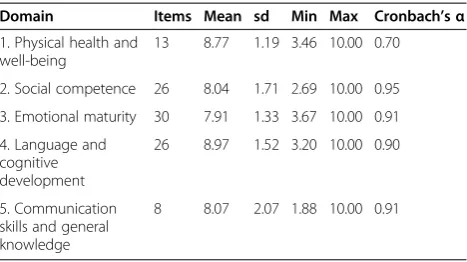
Cronbach’sα, a measure of internal consistency, ranges from 0.70 to 0.95 for the five CEDI domains (Table 2).
Concurrent validity
Based on the partial correlations with sex controlled, Table 3 highlights the two strongest correlations with the HKECDS for each CEDI domain. As expected, the
Table 1 Major socioeconomic characteristics of subjects
N (%) HKI (%) YL (%) p-value
Male 52 (34.4) 10 (15.2) 42 (49.4)
Females 99 (65.6) 56 (84.8) 43 (50.6) < 0.001
Maternal Education^
Low 13 (8.8) 0 13 (15.9) < 0.001
Medium 95 (64.2) 29 (43.9) 66 (80.5)
High 40 (27.0) 37 (56.1) 3 (3.7)
Family Income (HK$) < 0.001
< 8000 18 (12.2) 0 18 (22.2)
8000 ~ < 20,000 49 (33.3) 2 (3.0) 47 (58.0)
20,000 ~< 80,000 60 (40.8) 45 (68.2) 15 (18.5)
>= 80,000 > 80,000 20 (13.6) 19 (28.8) 1 (1.2)
physical health and well-being domain correlates best with gross and fine motor, language and cognitive development with pre-academic learning and language development, and communication and general know-ledge with language and cognitive development. Because no HKECDS domain specifically measures social and emo-tional development, the social competence and emoemo-tional maturity domains of the CEDI were found to correlate best with gross motor and language development.
Reliability
The test-retest reliability of the CEDI after a four-week interval was analyzed in 30 participants using the kappa statistic (k). The kappa coefficient was 0.89, thus demon-strating the instrument’s stability over time.
Vulnerability
The cut-offs for vulnerability derived from our sample in Hong Kong are largely comparable with the Canadian normative references in the physical, social and emo-tional domains, but higher in the language/cognitive
and communication/general knowledge domains [8]. As shown in Table 4, 28.5% of the children in our study were found to be developmentally vulnerable in at least one CEDI domain, and 13.9% in at least two. Further, significantly more boys than girls (46.2% boys versus 19.2% girls) were identified as vulnerable (p < 0.05) in at least one developmental domain.
Relationship with socioeconomic status of district and family
District
Comparison of the socioeconomic status of the two communities in which the participating kindergartens were located showed a significantly higher proportion of children from the socioeconomically disadvantaged dis-trict, YL (42.4%), to display developmental vulnerability in at least one of the CEDI domains relative to their HKI counterparts (16.3%). After adjusting for the uneven distribution of sex in our sample, the excessive risk of vulnerability for the YL children still remained signifi-cant (aOR = 4.46, 95% CI: 1.74-11.41;p< 0.005).
Family income
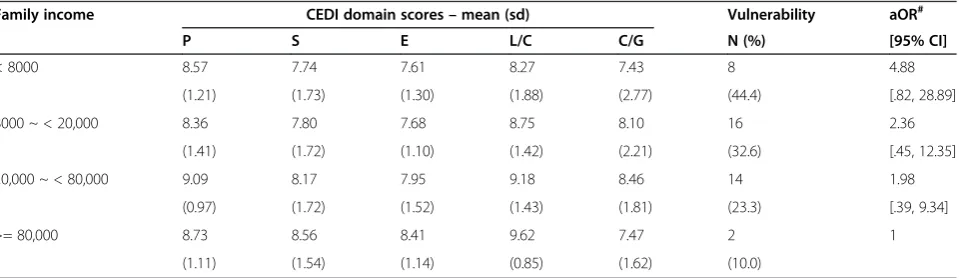
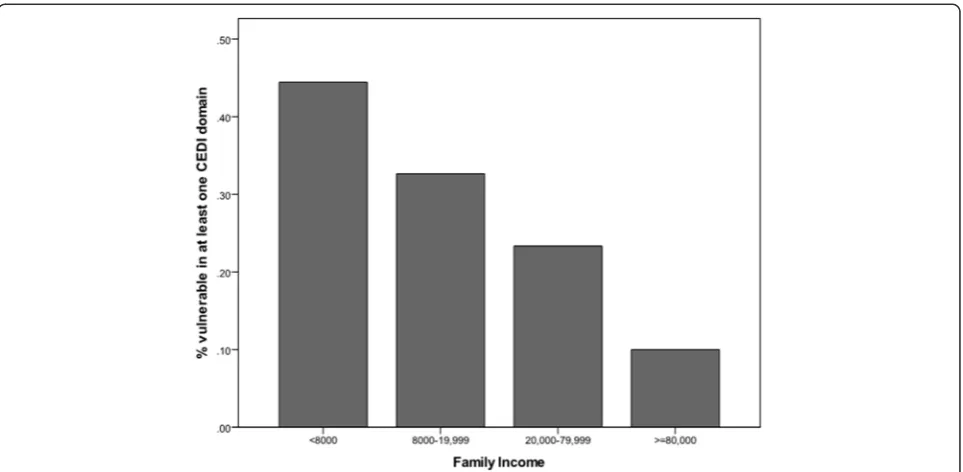
Investigation of the relationship between a vulnerable classification in one or more developmental domains and family income revealed a decreasing gradient (see Table 5 and Figure 1), indicating that children from poorer families are at greater risk of developmental vul-nerability than those from relatively wealthy families. After taking the uneven sex distribution into account, the gradient trend between vulnerability and family in-come remained, as shown in the decreasing adjusted odds ratio with increasing family income in Table 5, although the relationship was no longer statistically significant because of the reduced sample size.
Maternal education
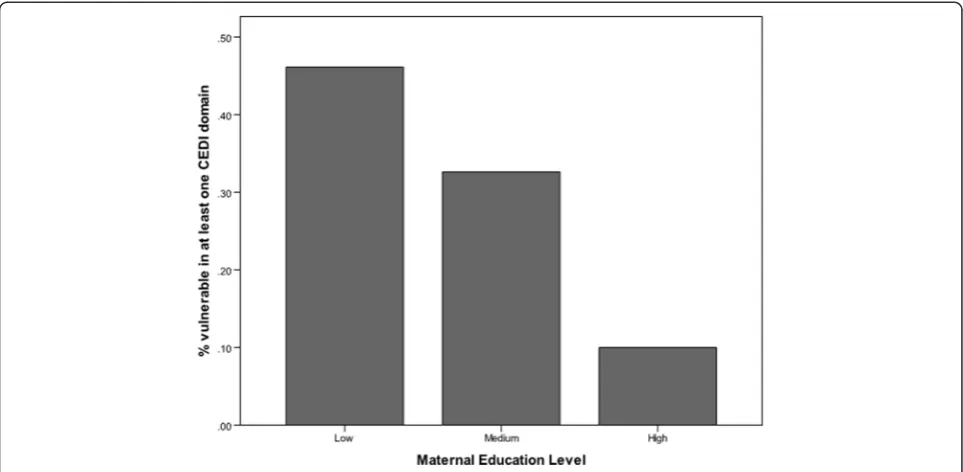
Across all of the CEDI domains, a decreasing gradient can be seen in the mean of the domain scores with ma-ternal education level (see Table 6). The lowest mean scores were found in the group of children whose mothers had a junior secondary level of education or less, whereas the highest scores were found in the group whose mothers held a Bachelor’s degree or higher aca-demic qualification. A similar decreasing gradient with maternal education level was also found in the propor-tion of children identified as vulnerable in one or more developmental domains (see Table 6 and Figure 2). After controlling for the effect of sex, the gradient trend be-tween vulnerability and maternal education remained significant (p<0.05), as illustrated in the decreasing ad-justed odds ratios with higher maternal education shown in Table 6.
Table 2 Summary of domain scores and internal consistency with Cronbach’sα
Domain Items Mean sd Min Max Cronbach’sα
1. Physical health and well-being
13 8.77 1.19 3.46 10.00 0.70
2. Social competence 26 8.04 1.71 2.69 10.00 0.95
3. Emotional maturity 30 7.91 1.33 3.67 10.00 0.91
4. Language and cognitive development
26 8.97 1.52 3.20 10.00 0.90
5. Communication skills and general knowledge
8 8.07 2.07 1.88 10.00 0.91
Table 3 Partial correlations between CEDI and HKECDS domain scores, with sex as the control variable
CEDI P S E L/C C/G
HKECDS
Gross Motor .30** .41*** .31*** .13 .26*
Fine Motor .25** .32*** .11 .25** .23*
Language Development .16 .35*** .32*** .47*** .37***
Pre-academic Learning .22* .22* .30*** .49*** .19*
Cognitive Development .17 .27** .27** .39*** .28**
Personal, Social, Self-care Environment
.19* .19* .20* .32*** .21*
Self and Society .21* .32*** .26** .43*** .27**
Physical Fitness, Health and Safety (Knowledge about…)
.09 .20* .24** .41*** .23**
Discussion
This study examined the internal consistency, concur-rent validity and reliability of the Chinese Early Develop-ment InstruDevelop-ment (CEDI), which was adapted from the EDI [4]. CEDI is a population tool to assess children’s development at aggregate level and it is not mean to assess children’s school readiness at the individual level. The preliminary evidence obtained therein supports the CEDI’s use as a valid and reliable measure of early child development and school readiness in Chinese populations.
The internal consistency of the five CEDI domains ranged from 0.70 to 0.95, which is comparable with that
of the EDI domains [4]. As a Cronbach’s α ranging
be-tween 0.70 to 0.90 is generally considered good [20], we can conclude that the CEDI domains demonstrate an adequate level of internal consistency. The test-retest re-liability of the CEDI was also found to be good (0.89). These two psychometrical properties of the CEDI are largely comparable with those of the EDI when used in English-speaking countries [7,8].
The CEDI’s concurrent validity was established through comparison with the Hong Kong Early Child
Development Scale (HKECDS) [19], a direct assess-ment of early childhood developassess-ment developed locally in Hong Kong. After controlling for sex, strong and significant correlations remained between the CEDI and HKECDS in the expected domains. The correl-ation coefficients (0.25 to 0.49) were comparable to those reported between the EDI and direct child-based assessment, which ranged from 0.34 to 0.49 [21]. The moderate correlations in the current study were expected because the comparison was between a teacher evaluation (CEDI) and direct child-based assess-ment (HKECDS) across a wide range of differently catego-rized domains. Stronger correlations have been reported in studies comparing the EDI with other teacher-rated mea-sures [21], although such comparisons are often subject to the problem of shared method variance [22].
In addition, although lacking pre-specified correlates, the social and emotional domains of the CEDI were found to correlate best with the gross motor and lan-guage domains of the HKECDS. Children with advanced motor development may display more constructive en-gagement in early activities, and thus have a better chance of acquiring key social and emotional abilities,
Table 4 Cut-offs for vulnerability and distribution by sex
CEDI
P S E L/C C/G Total
Cut-offs
HK 6.9567 5.3846 6.0000 6.4400 5.0000
Canada 7.0833 5.5769 6.0000 5.7692 4.3750
Vulnerability N (%)
16 (10.6) 15 (9.9) 16 (10.6) 16 (10.6) 23 (15.2) 43 (28.5)
Male 9 (17.3) 12 (23.1) 10 (19.2) 8 (15.4) 14 (26.9) 24 (46.2)
Female 7 (7.1) 3 (3.0)*** 6 (6.1)* 8 (8.1) 9 (9.1)*** 19 (19.2)***
Note: For the CEDI domains: P = Physical Health and Well-being; S = Social Competence; E = Emotional Maturation; L/C = Language and Cognitive Development; and C/G = Communication and General Knowledge; ***p < .001, **p < .01 and *p < .05.
Table 5 Descriptive statistics for the CEDI domain scores and vulnerability by family income level
Family income CEDI domain scores–mean (sd) Vulnerability aOR#
P S E L/C C/G N (%) [95% CI]
< 8000 8.57 7.74 7.61 8.27 7.43 8 4.88
(1.21) (1.73) (1.30) (1.88) (2.77) (44.4) [.82, 28.89]
8000 ~ < 20,000 8.36 7.80 7.68 8.75 8.10 16 2.36
(1.41) (1.72) (1.10) (1.42) (2.21) (32.6) [.45, 12.35]
20,000 ~ < 80,000 9.09 8.17 7.95 9.18 8.46 14 1.98
(0.97) (1.72) (1.52) (1.43) (1.81) (23.3) [.39, 9.34]
>= 80,000 8.73 8.56 8.41 9.62 7.47 2 1
(1.11) (1.54) (1.14) (0.85) (1.62) (10.0)
and vice versa [23,24]. Similarly, children experiencing delayed language development are likely to find it more difficult to acquire appropriate social and emotional skills [25,26].
In this study, vulnerability was defined according to our Hong Kong sample rather than using Canadian normative data. Although doing so undoubtedly intro-duced bias, given the small sample size and non-representative sampling structure, the value of using cut-offs from a local sample is that there are recog-nized differences between the Canadian and Hong Kong Chinese populations with regard to the cultural and developmental context of preschool children, including societal expectations, parenting and the kindergarten environment. Further examination of the
relationship between socioeconomic disadvantage and developmental vulnerability revealed the children from an underprivileged district (Yuen Long [YL]) and family (as measured by family income, and maternal education) to be at greater risk of vulnerability in one or more developmental domains. Observations with the CEDI in the Hong Kong Chinese popula-tion are consistent with EDI observapopula-tions in Western societies [11,13].
Limitations
This study suffered several limitations. First, its main limitation lies in recruitment of the sample. Though kindergartens were randomly selected from Hong Kong Island (HKI) and Yuen Long (YL), the HKI
Figure 1Developmental vulnerability versus family income.
Table 6 Descriptive statistics for CEDI domain scores and vulnerability by maternal education level
Maternal education
CEDI domain score–mean (sd) Vulnerability aOR#
P S E L/C C/G N (%) [95% CI]
Low 8.38 (1.10) 7.88 7.65 8.35 7.88 18 5.39*
(1.72) (1.19) (1.98) (2.46) (37.5) [1.14, 25.46]
Medium 8.85 8.10 7.91 9.18 8.11 23 3.41*
(1.26) (1.75) (1.40) (1.22) (1.91) (25.8) [1.09, 10.73]
High 9.29 8.18 8.66 9.58 8.58 0 1
(0.89) (1.47) (0.80) (0.73) (1.48) (0)
sample included significantly more girls than boys, and the reverse was true for the YL sample, because of the natural sex composition of the kindergartens recruited. Although this severe sex imbalance may not have posed serious harm in testing the psychometric prop-erties of the CEDI, as the EDI factor structure has been reported stable between boys and girls [4], quantitative interpretations of the coefficients should be made with caution. To account for the compound effect between the imbalanced sex distribution and the difference in the socioeconomic status of the two districts, analyses between the CEDI and other factors were statistically adjusted for sex. Second, the EDI is intended for use and interpretation at the group level, whereas the current validation of the CEDI was conducted at the individual level. Third, because of the relatively small sample size, confirmatory factor analysis was not conducted in this study. Fourth, the CEDI question-naire was completed by the kindergarten teacher who was most familiar with each tested child, and we did not repeat the test with a different teacher; therefore, inter-rater reliability was not assessed.
Conclusion
In conclusion, the evidence presented herein shows the CEDI to be a psychometrically sound measurement tool for early child development and the assessment of school readiness in Chinese populations. As the EDI has gained significant international popularity in the past decade, with successful adaptation and application
in 23 countries, this validation study opens up the exciting possibility of placing Chinese children’s devel-opment on an international scale for comparison.
Competing interests
The authors declare that they have no competing interests.
Authors’contributions
PI designed the study, interpreted the data and wrote the manuscript. SLL analyzed the data and drafted the manuscript. NR participated in preparation of assessment tools and interpretation of data. SSNN participated in training of teachers and preparation of assessment tools. WWSL participated in training of teachers and data collection. CBC participated in research design and data interpretation. All authors read and approved the final manuscript.
Acknowledgements
We thank the developer of the EDI, Dr. Magdalena Janus and the Offord Centre for Child Studies at McMaster University for allowing us to use the EDI in this study, all of the parents and lovely children who participated in this study, as well as the principals and teachers of the four
participating kindergartens, and Dr. R. Christopher Sheldrick for his advice on the manuscript.
Disclosure of funding
The work described in this paper was fully supported by a grant from the Research Grants Council of the Hong Kong Special Administrative Region, China (Project No. 746111).
Author details 1
Department of Paediatrics and Adolescent Medicine, Queen Mary Hospital, The University of Hong Kong, Pok Fu Lam, Hong Kong, China.2Faculty of Education, The University of Hong Kong, Pok Fu Lam, Hong Kong, China. 3Department of Early Childhood Education, Hong Kong Institute of Education, Tai Po, Hong Kong, China.
Received: 17 July 2013 Accepted: 20 September 2013 Published: 23 September 2013
References
1. Shonkoff JP, Phillips DA:From neurons to neighborhoods: the science of early
childhood development.Washington, DC, USA: National Academies Press; 2000.
2. Fergusson DM, Horwood LJ:Resilience to childhood adversity: results of a 21-year study.InResilience and vulnerability : adaptation in the context of
childhood adversities.Edited by Luthar SS. Cambridge: Cambridge University
Press; 2003:130–156.
3. Blair C:School readiness - integrating cognition and emotion in a neurobiological conceptualization of children’s functioning at school entry.Am Psychol2002,57(2):111–127.
4. Janus M, Offord DR:Development and psychometric properties of the early development instrument (EDI): a measure of children’s school readiness.Can J Behav Sci2007,39(1):1–22.
5. Guhn M, Goelman H:Bioecological theory, early child development and the validation of the population-level early development instrument.
Soc Indic Res2011,103:193–217.
6. Forer B, Zumbo BD:Validation of multilevel constructs: validation methods and empirical findings for the EDI.Soc Indic Res2011,103(2):231–265. 7. Janus M, Brinkman SA, Duku EK:Validity and psychometric properties of
the early development instrument in Canada, Australia, United States, and Jamaica.Soc Indic Res2011,103(2):283–297.
8. Janus M, Brinkman S, Duku E, Hertzman C, Santos R, Sayers M, Schroeder J, Walsh C:The early development instrument: a population-based measure for
communities (a handbook on development, properties, and use).Ontario, CA:
Offord Centre for Child Studies; 2007.
9. Lloyd JEV, Hertzman C:From kindergarten readiness to fourth-grade assessment: longitudinal analysis with linked population data.Soc Sci Med2009,68(1):111–123.
10. Cushon JA, Vu LTH, Janzen BL, Muhajarine N:Neighborhood poverty impacts children’s physical health and well-being over time: evidence from the early development instrument.Early Educ Dev2011,22(2):183–205.
11. Hertzman C, Bertrand J:Children in poverty and the use of early development instrument mapping to improve their worlds.Paediatr Child
Health2007,12(8):687–692.
12. Kohen D, Oliver L, Pierre F:Examining the effects of schools and neighbourhoods on the outcomes of kindergarten children in Canada.
Int J Speech-Lang Pa2009,11(5):404–418.
13. Carpiano RM, Lloyd JE, Hertzman C:Concentrated affluence, concentrated disadvantage, and children’s readiness for school: a population-based, multi-level investigation.Soc Sci Med2009,69(3):420–432.
14. Noble KG, McCandliss BD, Farah MJ:Socioeconomic gradients predict individual differences in neurocognitive abilities.Dev Sci2007,10(4):464–480. 15. Bradley RH, Corwyn RF:Socioeconomic status and child development.
Annu Rev Psychol2002,53:371–399.
16. Hong Kong population census.[http://www.census2011.gov.hk]
17. Hambleton RK:Issues, designs, and technical guidelines for adapting tests into multiple languages and cultures.InAdapting educational and
psychological tests for cross-cultural assessment.Edited by Hambleton RK,
Merenda PF, Spielberger C. London: L.E.A; 2005:3–38.
18. Brinkman S, Gregory T, Harris J, Hart B, Blackmore S, Janus M:Associations between the early development instrument at age 5, and reading and numeracy skills at ages 8, 10 and 12: a prospective linked data study.Child Indic Res. published online on 14 April 2013. DOI 10.1007/s12187-013-9189-3. 19. Rao N, Sun J, Ng SSN, Ma K, Becher Y, Lee D, Lau C, Zhang L, Chow CB, Ip P:
The Hong Kong early child development scale: a validation study.
Child Indic Res2013,6(1):115–135.
20. Streiner DL, Norman GR:Health measurement scales: a practical guide to their
development and use.Oxford, UK: University Press; 1995.
21. Brinkman SA, Silburn S, Lawrence D, Goldfeld S, Sayers M:Investigating the validity of the Australian early development index.Early Educ Dev2007, 18(3):427–451.
22. Donaldson SI, Grant-Vallone EJ:Understanding self-report bias in organizational behavior research.J Bus Psychol2002,17(2):245–260. 23. Wilson A, Piek JP, Kane R:The mediating role of social skills in the
relationship between motor ability and internalizing symptoms in pre-primary children.Infant Child Dev2013,22(2):151–164.
24. Whittingham K, Fahey M, Rawicki B, Boyd R:The relationship between motor abilities and early social development in a preschool cohort of children with cerebral palsy.Res Dev Disabil2010,31(6):1346–1351.
25. Cohen NJ, Menna R, Vallance DD, Barwick MA, Im N, Horodezky NB:Language, social cognitive processing, and behavioral characteristics of psychiatrically disturbed children with previously identified and unsuspected language impairments.J Child Psychol Psyc1998,39(6):853–864.
26. Beck L, Kumschick IR, Eid M, Klann-Delius G:Relationship between language competence and emotional competence in middle childhood.
Emotion2012,12(3):503–514.
doi:10.1186/1471-2431-13-146
Cite this article as:Ipet al.:Validation study of the Chinese Early
Development Instrument (CEDI).BMC Pediatrics201313:146.
Submit your next manuscript to BioMed Central and take full advantage of:
• Convenient online submission
• Thorough peer review
• No space constraints or color figure charges
• Immediate publication on acceptance
• Inclusion in PubMed, CAS, Scopus and Google Scholar
• Research which is freely available for redistribution