S T U D Y P R O T O C O L
Open Access
Study protocol: the relation of birth weight and
infant growth trajectories with physical fitness,
physical activity and sedentary behavior at 8-9
years of age - the ABCD study
Arend W van Deutekom
1,2*, Mai JM Chinapaw
3, Tanja GM Vrijkotte
4and Reinoud JBJ Gemke
1,2Abstract
Background:Low birth weight and accelerated infant growth have been identified as independent risk factors for childhood and adult obesity and cardiovascular disease. This led to the‘Developmental Origins of Health and Disease’(DOHaD) hypothesis, stating that environmental factors during pregnancy and early postnatal life affect disease risk in later life. There is growing evidence that perinatal factors may influence adult health through the programming of energy balance regulation, including sedentary behavior and physical activity. The present study focuses on the influence of birth weight and infant growth on physical fitness, physical activity and sedentary behavior in 8-9 year old children, as this might partly explain the higher obesity and cardiovascular risk associated with low birth weight and accelerated infant growth. In addition, this study provides the opportunity for a validation study of a linguistic and cross-cultural translated physical activity questionnaire compared to accelerometer data. This article describes the study protocol for this study.
Methods/Design:This is a study embedded in the Amsterdam Born Children and their Development (ABCD) birth cohort. In 200 children of Dutch ethnicity, physical fitness, physical activity and sedentary behavior were assessed at age 8-9. We measured aerobic fitness using the 20 meter multistage shuttle run test, and neuromuscular fitness using the standing broad jump and handgrip strength test. Sedentary behavior and physical activity levels were measured using accelerometry. All children also completed a translated physical activity questionnaire, the scores of which will be compared to accelerometry data to assess the construct validity of the questionnaire in Dutch school-aged children.
Discussion:This study will be the first population-based prospective cohort study to address the association of both prenatal and postnatal growth with physical fitness and objectively-assessed physical activity and sedentary behavior. This will contribute to a better understanding of the way perinatal growth relate to lifestyle and obesity in later life. The results may guide both future studies in the field of DOHaD, and public health strategies in the prevention of childhood obesity.
Keywords:Developmental origins of health and disease, Birth weight, Child growth, Physical fitness, Muscle strength, Aerobic fitness, Physical activity, Sedentary behavior, Physical activity questionnaire
* Correspondence:[email protected] 1
Department of Pediatrics, EMGO Institute for Health & Care Research, VU University Medical Center, Amsterdam, the Netherlands
2
Institute for Cardiovascular Research VU, VU University Medical Center, Amsterdam, the Netherlands
Full list of author information is available at the end of the article
Background
In the 1980s Barker and Hall reported a series of studies regarding the association between low birth weight and death from coronary heart disease, suggesting that pre-natal environmental factors are involved in the aetiology of adult-onset diseases [1,2]. In the following decades nu-merous epidemiological studies substantiated a close asso-ciation between low birth weight and an increased risk of developing adult diseases, including cardiovascular disease [3,4], stroke [5], type 2 diabetes mellitus [6], hypertension [7], adiposity [8], osteoporosis [9], polycystic ovarian syn-drome [10], depressive disorders [11], and psychoses [12]. These observations led to the ‘Developmental Origins of Health and Disease’ (DOHaD) hypothesis [13]. This hy-pothesis proposes that the fetus adapts to a substrate-limited intrauterine environment with so called predictive adaptive responses, resulting in permanent changes in tis-sue differentiation and hormonal and metabolic set points. In this way programming results in irreversible adapta-tions which enhance survival during postnatal nutritional constraint, but may increase susceptibility to adult-onset diseases in a substrate-rich environment after birth.
As the number of DOHaD related studies grew, several important additions and refinements to the hypothesis were made. First, an important feature of the epidemio-logical observations is that adult disease risk is continuous within the normal range of birth weight, rather than being a pathological feature which is expressed below a critical cut-off point [14]. Second, in addition to the role of the intrauterine environment, more recent observations have also drawn attention to the significance of infant growth in the predisposition to adult disease. Accelerated growth in infancy increases risk of obesity [15], type 2 diabetes [16], hypertension [17] and cardiovascular disease [18]. Thus, the critical window for developmental responses may ex-tend into early postnatal life. Last, subtle sex differences in the progression and development of adult diseases are ob-served, with female offspring being relatively protected from the adverse effects of perinatal malnutrition [19,20]. The cause of this sex difference remains unclear, but a pro-tective effect of female sex hormones is proposed as an in-triguing mechanistic explanation.
Obesity plays a critical role in the association between perinatal growth and adult disease, often preceding insulin resistance, dyslipidemia, and hypertension in children and young adults [21]. Given that obesity is fundamentally the result of an inadequate energy balance regulation, in which energy intake exceeds expenditure, its developmen-tal origins cannot be explained by structural changes or neuroendocrine dysregulation alone [22]. Therefore, re-search on the pathogenesis of obesity has recently focused on the developmental origins of behavior that is closely re-lated to energy expenditure and energy intake, i.e., feeding behavior, physical activity and sedentary behavior.
Physical activity (PA) and sedentary behavior are com-ponents of energy expenditure that vary considerably be-tween persons as well as for a given person over time [23,24]. Sedentary behavior refers to activities that in-volve little energy expenditure, such as lying down, sit-ting, watching television, using the computer and other forms of screen based entertainment [25]. Sedentary be-havior is thereby a distinct class of bebe-haviors rather than being the absence of PA.
Both PA and sedentary behavior are of particular inter-est in the study of the developmental origins of energy bal-ance regulation. Animal studies have shown that offspring of nutritionally impaired pregnancies are significantly less physically active than controls, and show increased seden-tary behavior [26-28]. These effects on PA and sedenseden-tary behavior seem to originate from programming of the hypothalamic pathways which regulate energy homeosta-sis [29]. In humans, several clinical studies also identified low birth weight as a predictor for lower PA levels and more sedentary behavior in children and adults [30-34], al-though others failed to confirm this relationship [35-41], and there are suggestions that the association may be lim-ited to very low birth weight individuals [32].
Physical fitness is generally defined as the ability to per-form sports or occupations, and is bidirectionally related to PA [42]. As recent data indicates, regular PA improves physical fitness, and conversely, a high level of physical fit-ness promotes higher PA levels [43]. It is therefore appar-ent that unfit children are less inclined to be physically active, which has considerable potential to increase later disease risk. There are many dimensions to fitness, of which aerobic fitness (also known as cardiorespiratory en-durance) and muscular strength are most consistently as-sociated with physical performance and cardiovascular health [44-46]. Although fitness can be improved by regu-lar PA, it is partly genetically determined, and perinatal in-fluences may attenuate or strengthen this predetermined fitness level [47]. Indeed, several studies consistently found lower muscle mass and strength in lower birth weight adults and children [48]. For aerobic fitness, the findings are less robust. A number of studies found a significant positive association between birth weight and aerobic fit-ness in childhood and adulthood [34,49,50], but others did not [51,52]. Differences in subject age, sample size, type of fitness test used and severity of growth retardation in the cohort may explain these contradictory reports.
glucose tolerance and post-prandial lipidemia, and modi-fied clotting factors [42,53]. Therefore, variations in phys-ical fitness and PA might impact future health of children irrespective of obesity risk.
In recent years, sedentary behavior has been identified as a distinct health risk factor. For example, sedentary behavior has been shown to be positively associated with an increased risk of type 2 diabetes, cancer, and all-cause and CVD mortality in adults [54-56]. These associations are shown to be at least partially independent of levels of PA. Reviews of the relationship between sedentary be-haviors and obesity in children and adolescents found a positive association, suggesting that sedentary behavior is a risk factor for the development of obesity in children [57,58]. Another review, however, concluded there was insufficient evidence for a longitudinal relationship be-tween childhood sedentary time and cardiovascular health indicators, because of a lack of high quality stud-ies addressing this topic [59].
Based on the aforementioned data, we hypothesize that low birth weight and accelerated infant growth is associated with lower levels of aerobic fitness, muscular strength and PA and more time spent on sedentary be-havior in school aged children, contributing to the in-creased propensity to obesity and related diseases in later life. The hypothesized model is shown graphically in Figure 1.
This paper describes the rationale and design of a study aiming to examine the association of birth weight and infant growth trajectories with aerobic fitness, muscular strength and objectively assessed sedentary behavior and PA levels in 8-9 year old children. In order to assess whether an accurate assessment of regular PA can be obtained by self-report questionnaires in Dutch children, we will additionally validate a linguistic and cross-cultural translation of a commonly used PA questionnaire in 8-9 year old children. If validity of this questionnaire has been
confirmed in our subgroup, we may use it to assess PA and sedentary behavior of our entire cohort in a future phase of the ABCD study. This article outlines the devel-opment of this PA questionnaire.
Study objectives
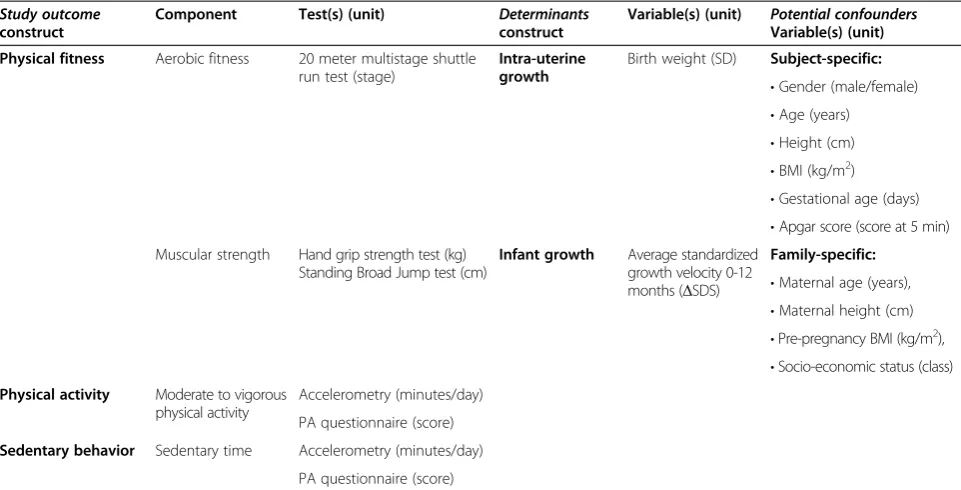
The primary study objectives are to examine the associ-ation of birth weight and infant growth trajectories with (i) aerobic fitness assessed by the 20 meter multistage shuttle run test (20-m MSRT), (ii) muscular strength assessed by the standing broad jump (SBJ) and hand grip strength test, and (iii) physical activity levels and sedentary time assessed by accelerometry, at 8 to 9 years of age. We will control for potential confounders, such as maternal factors (e.g., maternal age, pre-pregnancy body-mass index (BMI), maternal height, socio-economic status) and child factors (e.g., gender, age, height, BMI, gestational age, Apgar score), and test for possible effect modification by gender. (see Table 1) A secondary objective is to examine the construct validity of a self-report extensive PA ques-tionnaire, based on the internationally employed Physical Activity Questionnaire for Older Children (PAQ-C) and Children’s Leisure Activities Study Survey (CLASS). This PA questionnaire is provided in the appendix (see Additional file 1).
Methods/Design Setting
This study is embedded in the Amsterdam Born Children and their Development (ABCD) study, a prospective birth cohort study aimed at the identification of prenatal and early life influences on health at birth and in later life. The project is carried out by a multidisciplinary team of re-searchers from the Public Health Service Amsterdam, the Academic Medical Center and VU University Medical Center.
The design and conceptual framework of the overall ABCD-study has been previously described in detail [60]. In summary and relevant to the current study, the ABCD-study included 8266 women pregnant between January 2003 and March 2004. These woman completed questionnaires during and after their pregnancies, cover-ing sociodemographic data, lifestyle, dietary habits and psychosocial factors, conventional medical and obstetric history, and perinatal details. Birth weight of the children was obtained from the Child Health Care Registration, the office that also performs neonatal blood screening for in-born errors of metabolism, as is routinely performed in the Netherlands in the 1stweek of life. Until the age of 4 years, height and weight measures of these children were rou-tinely collected as part of regular preventive Child Health Care. These measurements took place during on average 14 regular follow-up moments and were performed by qualified nurses and physicians. Of the 6735 women who gave permission for follow-up of their child, 6575 mothers also consented to follow up of their child’s growth data.
In 2008, around their 5thbirthday, 3321 children com-pleted a‘health check’. At the appointment for this health check we collected data on anthropometrics, blood pres-sure, heart rate variability, body composition and a capil-lary blood sample to determine lipid profile, glucose, insulin, C-peptide, HbA1c and albumin. In addition, par-ents completed questionnaires about the child’s health, development and behavior, family socio-demographics,
maternal lifestyle and psychosocial conditions and family history of medical conditions.
Birth weight and infant growth
The primary determinants in our study are birth weight and infant growth trajectories. Birth weight is hereby used as a surrogate marker for intrauterine growth, and an established index for the intrauterine environment.
Birth weight is expressed as standard deviation (SD) score, adjusted for maternal height, weight, parity, ethni-city and fetal sex, in accordance with the recommenda-tions of Gardosi [61]. Low birth weight is defined as a birth weight below the 10thpercentile (-1.28 SD). Infant growth is expressed as the average standardized growth velocity, defined as the change in SD score between birth and 12 months. We will examine growth in weight-for-age, height-for-age and weight-for-height. We expect the association with the outcome measures to differ for each expression of growth, with the strongest association for weight-for-age. Accelerated growth is defined as >0.67 change in SD score. This 0.67 SD represents the distance between two adjacent growth lines on standard infant and childhood growth charts (i.e., the 2nd, 10th, 25th, 50th, 75th, 90thand 98th cen-tile lines). The adopted definitions of low birth weight and accelerated infant growth are based on recommendations of Monteiro et al. [15], and in line with recent other studies addressing the DOHaD hypothesis [62-65].
Table 1 Overview of study variables
Study outcome
construct
Component Test(s) (unit) Determinants
construct
Variable(s) (unit) Potential confounders
Variable(s) (unit)
Physical fitness Aerobic fitness 20 meter multistage shuttle run test (stage)
Intra-uterine growth
Birth weight (SD) Subject-specific:
•Gender (male/female) •Age (years)
•Height (cm) •BMI (kg/m2) •Gestational age (days) •Apgar score (score at 5 min) Muscular strength Hand grip strength test (kg)
Standing Broad Jump test (cm)
Infant growth Average standardized growth velocity 0-12 months (ΔSDS)
Family-specific:
•Maternal age (years), •Maternal height (cm) •Pre-pregnancy BMI (kg/m2), •Socio-economic status (class) Physical activity Moderate to vigorous
physical activity
Accelerometry (minutes/day)
PA questionnaire (score)
Sedentary behavior Sedentary time Accelerometry (minutes/day)
PA questionnaire (score)
Current study population
The current study is conducted in a subgroup of the ABCD-birth cohort. At the time of the data collection, the children were 8 or 9 years of age. Children were eligible for this study if (i) they fully completed the ABCD age 5 health check and (ii) were of Dutch ethnicity (i.e. with both parents born in the Netherlands). This is to exclude confounding by ethnicity. Exclusion criteria were (i) a per-sonal history of neurological, cardiovascular or metabolic disease, (ii) any musculoskeletal injury or disability or (iii) the use of any medication at the time of data collection.
Sample size calculation
Based on the literature, we expected to find a difference be-tween low birth weight and normal birth weight children of 1 stage on the 20-m MSRT, with a SD of 2 stages [49,66], and a difference of 10 cm on the SBJ test, with a SD of 25 cm [67]. A similar difference in 20-m MSRT and SBJ test scores between children with normal and accelerated infant growth was anticipated, but as there is no litera-ture on this topic available, a scientific basis for this as-sumption is lacking. With a significance level of 5% and a power of 80% in total 100 children per group were required.
Recruitment
To ensure an adequate number of children in each sub-group, we selected more children with low birth weight and/or accelerated growth than that would be selected by random sampling. This to ensure power of the study that may be lost in a more generalized sampling technique.
A recruitment letter, explaining study objective and design in detail, was sent to all children´s parents. For the children, simplified written information was pro-vided. Informed and written consent were obtained from parents before participation. The Amsterdam Medical Center’s Ethics Committee approved the study protocol, and all procedures were performed in accordance with the ethical standards of the Helsinki Declaration of 1975 as revised in 2008 [68].
Study design
Three identical measurement periods were arranged two or three weeks apart. Each measurement period consisted of (A) the self-completion of a PA questionnaire, (B) a physical fitness test battery, and (C) wearing an accelerom-eter for 7 consecutive days.
A. Modified physical activity questionnaire
After written consent was obtained, a PA questionnaire was sent to the children by surface mail. The question-naire was completed at home and handed back at the day of the physical fitness test battery. Responses were checked for completeness by staff.
The PA questionnaire is a cross-cultural adaptation of the Physical Activity Questionnaire for Older Children (PAQ-C) [69] and the Children’s Leisure Activities Study Survey (CLASS) [70]: two standardized activity question-naires for children, both of which recall activities over the previous 7 days.
The PAQ-C is a 7-day self-reported recall instrument, developed to assess general levels of PA throughout the elementary school year for children approximately 8 to 14 years of age [71]. It provides a summary PA score de-rived from nine items. Each question is scored on a 5-point scale, with higher scores indicating higher levels of activity. The first question is a checklist of 22 common leisure and sports activities. Because the PAQ-C only as-sesses the frequency of activities, we added elements of the CLASS addressing duration of the activities. For each PA in the checklist, children were asked to report the fre-quency and duration spent in that activity. The next six items addresses PA during physical education classes, re-cess, lunch break, right after school, in the evenings, and on the weekend. Item eight asks which statement “ de-scribes you best for the last 7 days” with five statements describing low to very high activity levels. The ninth item asks the child how often he/she participated in PA on each day of the week [69].
The PAQ-C is widely accepted [72-74] and recom-mended [75] for international and national studies. In addition, a systematic review of measurement properties of self-report PA questionnaires for children concluded good to moderate validity and reliability of the PAQ-C [76]. The CLASS questionnaire was found to have weak to moderate validity and reliability. Nonetheless, both the PAQ-C and CLASS questionnaire were considered amongst the most promising PA questionnaire for children [76].
Translation of the physical activity questionnaires
produced a prefinal version. The project manager and all involved researchers replaced PA items that are rarely conducted by Dutch children (e.g., Australian football, cross-country skiing) by items that are more commonly practiced (e.g., playing tennis, badminton, practicing judo). This version was administered to 10 Dutch children of pri-mary school age (i.e., the target population) checking the comprehensibility of each item. As there were no ambigu-ities reported, we concluded that the adapted version retained its equivalence in an applied situation. The final PA questionnaire used in this study is provided in the Appendix (see additional file 1).
B. Physical fitness test battery
A physical fitness test battery was developed using the evidence-based recommendations of the ALPHA health-related fitness test battery for children and adolescents [80] and the Eurofit Fitness test Battery [81]. We successively assessed anthropometry, blood pressure, maximum muscle strength, explosive muscle strength and aerobic fitness.
Anthropometry
Height and weight were measured with the children dressed in light sportswear. Height was measured to the nearest millimetre using a Leicester portable height meas-ure (Seca), and weight to the nearest 100 gram using a Marsden weighing scale, model MS-4102.
Blood pressure
Blood pressure was measured two times on the right arm in a sitting position after a few minutes rest. If the differ-ence between the measurements was more than 10 mmHg for either systolic or diastolic pressure, a third measure-ment was obtained. The device used was the Omron 705 IT (Omron Healthcare Inc, Bannockburn, IL, USA) with an appropriate sized cuff. Outcome measures were systolic pressure (SP), diastolic pressure (DP), and mean arterial pressure (MAP), all expressed in mmHg. MAP was cal-culated using the following equation: MAP = DP + 1/3 (SP-DP) [82].
Muscular strength
With the standing broad jump (SBJ) and hand grip strength test we assessed explosive muscle strength and maximum muscle strength, respectively.
In the SBJ test, the child attempts to jump as far as possible with feet together. From a starting position im-mediately behind a line with feet slightly apart, the child jumps using both feet with take-off and landing, swing-ing the arms and bendswing-ing the knees to provide forward drive. The distance was measured from the take-off line to the point where the back of the heel nearest to the take-off line lands, and reported in centimetres. The test was repeated twice, and the best score retained.
Hand grip strength was measured using a hand dyna-mometer, with the scores recorded in kilograms (kg). The reported precision is 0.5 kg. The test was performed twice (alternately with both hands), with the dynamometer ad-justed to the age- and gender-specific optimal grip span, as this seems the most appropriate protocol to evaluate maximal hand grip strength in children [83].
The SBJ test seems to be the most valid test assessing lower body muscular strength compared to other mus-cular strength tests (i.e., bent and extended arm hang, squat jump, countermovement jump, Abalakov jump), showing the highest associations with isokinetic parame-ters [80]. In addition, Castro-Piñero et al. concluded that the SBJ test can be considered a general index of lower body muscular fitness in children, based on a strong as-sociation with other lower body muscular strength tests (R2= 0.83–0.86), as well as with upper body muscular strength tests (R2= 0.7-0.9) [67]. Milliken et al. analysed the association between hand grip strength and chest press in children aged 7-12 years and found that the hand grip strength test is valid to assess upper body maximal strength (R2= 0.70) [84].
Aerobic fitness
We measured aerobic fitness using the 20 meter multi-stage shuttle run test (20-m MSRT); a simple non-invasive, valid and reliable field test providing an estimate of maximal cardiorespiratory capacity [85]. The test was conducted as described by Léger et al. [86] On an outdoor field, children were required to run between two lines 20 m apart, while keeping pace with beeps emitted from a pre-recorded CD. The initial speed was set at 8.5 km•h-1 (2.4 m • s-1), increasing by 0.5 km • h-1 (0.1 m • s-1) with each stage thereafter (one stage takes one minute). Children were instructed to run in a straight line, to pivot and turn on completing a shuttle, and to pace themselves in accordance with the beeps. The test ended when the child failed to reach the end line concurrent with the beeps on two consecutive occasions. The children were verbally encouraged by the researchers to run for as long as possible throughout the course of the test. The last completed half-stage of the 20-m MSRT was recorded and used as a valid proxy for aerobic fitness [87,88].
C. Accelerometry
Accelerometers have shown to provide reliable estimates of overall PA, sedentary behavior and PA-related energy ex-penditure among children [93,94]. In this study, PA and sedentary behavior were objectively assessed using two models of Actigraph (ActiGraph, LLC, Fort Walton Beach, FL) accelerometers, namely triaxial Actitrainers (dimen-sions: 8.6 cm × 3.3 cm × 1.5 cm, weight: 51 grams) and GT3Xs (dimensions: 3.8 cm × 3.7 cm × 1.8 cm, weight: 27 grams). These are omnidirectional accelerometers, sensitive to movement in all directions.
Researchers distributed the accelerometers face-to-face at the end of the physical fitness test battery. Informa-tion about accelerometer use was given to the children and parents orally. Researchers placed the accelerometer to the children’s waist using an elastic waistband, and they told the children not to remove the device for 7 days except during sleeping, swimming and bathing. Additionally, children and parents received a brochure with information about accelerometer use and a compli-ance log. Children had to self-complete this complicompli-ance log for the duration of the accelerometer data collection, as this is an effective, low cost method to increase com-pliance [95]. Each day, the children recorded the time they got up and went to bed, whether or not it was a school day, and whether the accelerometer was removed during the day, and if so, for what reason. After the pro-posed wearing period, the devices were collected at the child’s home by the researchers. Downloading the data from accelerometers was done as soon as possible on the same computer where it was initialized to prevent disturbances that can be caused by the time offset be-tween computers [96].
The accelerometer signal is summarized over a user-defined period of time, called epoch, into what are called counts. The higher the number of counts, the higher the intensity of PA. As children tend to have short bursts of PA [97], we selected an epoch length of 15 seconds to accur-ately capture this spasmodic PA pattern [98]. Non-wearing time was defined as more than 20 minutes of consecutive zero counts. Wearing time was calculated by subtracting non-wearing time from 24 hours. To capture a representa-tive portion of daily PA, only days with at least 10 hours of wearing time were considered valid [99]. Children who had at least three valid weekdays and one valid weekend day were included in further data analysis [100]. Based on the cut-off values of Treuth et al. we defined minutes spent in sedentary, light, moderate and vigorous activity, as <100, 100–2999, 3000–5199 and≥5200 counts per mi-nute (c.p.m.), respectively [101].
Statistical analysis
Data will be presented as means ± SD for continuous variables, and as percentages for categorical variables.
For every primary outcome, its association with stan-dardized birth weight and infant growth will be assessed using multivariable linear regression analysis. First, birth weights and infant growth trajectories will be dichoto-mized as normal vs. low birth weight and normal vs. accel-erated infant growth, respectively, and analyzed together in a linear regression analysis to account for mutual inter-ference. To assess whether the effect of low birth weight and accelerated infant growth exceeds the sum of each ex-posure separately, we will subsequently add an interaction term of birth weight with infant growth to the model. A p-value less than 0.10 for the interaction term is consid-ered indicative of effect modification, after which a sub-group analysis will be performed with the children divided into four subgroups (normal birth weight and normal in-fant growth; low birth weight and normal inin-fant growth; normal birth weight and accelerated infant growth; low birth weight and accelerated infant growth).
A scatterplot will be employed to identify potential lin-ear associations of either birth weight or infant growth with the outcome variable. If the scatterplot suggests a linear association of either birth weight or infant growth with the outcome, we will additionally run the analysis with the respective dichotomized variable replaced by its continuous equivalent.
The model will be adjusted for potential confounding, by addition of the potential confounders group-wise in a multivariable linear regression analysis. The first group of potential confounders are subject-specific variables (gender, current age, height, BMI, gestational age, Apgar score), the second are family-specific variables (socio-economic status (defined as maternal level as education), maternal age, maternal height, maternal pre-pregnancy BMI). Effect modification by gender will be evaluated by addition of an interaction term of gender with either birth weight or infant growth.
Validity assessment of the questionnaire
according to accelerometry data will be examined using the Bland–Altman procedure [103]. A similar approach will be used to assess the agreement between self-reported and accelerometry assessed sedentary time. The Bland-Altman procedure plots the differences between the self-reported and accelerometry data against their mean, where ±1.96 SD of the differences provides an interval within which 95% of the differences between the two sets of measurements are predicted to fall. A higher level of agreement is illustrated by a mean difference closer to zero and a smaller range of the 95% confidence interval.
Discussion
Although low birth weight and accelerated infant growth have been consistently linked to childhood and adult obesity [8,15], the underlying disturbances in energy bal-ance regulation still remain poorly understood. The present study focuses on the developmental origins of physical fitness, physical activity and sedentary behavior in 8-9 year old children, as this might partly explain the higher obesity and cardiovascular risk associated with low birth weight and accelerated infant growth. In addition, this study provides the opportunity for a valid-ation study of a linguistic and cross-cultural translated PAQ-C and CLASS questionnaire compared to acceler-ometer data. If the validation study suggests that the translated questionnaire is a valid tool to assess PA and sedentary behavior in this subgroup, it may be used in a later stage of the ABCD study, to assess PA and seden-tary behavior in our entire birth cohort.
To our knowledge, this study is the first prospective cohort study addressing the association of both birth weight and infant growth with objectively assessed PA and sedentary behavior, aerobic fitness and muscular strength in later childhood. A major strength of this study is that it is conducted within the framework of the ABCD study, a prospective cohort study with extensive data on birth outcome, growth patterns, and lifestyle fac-tors, amongst others. This provides the opportunity to control for a broad range of potential confounders, like BMI, gestational age, Apgar score, maternal age, mater-nal pre-pregnancy BMI, and socio-economic status. All these variables are prospectively collected and assessed during the course of the ABCD study [60].
A limitation of this study is that only children of Dutch ethnicity are included, to exclude confounding by ethnicity. As there are known ethnic differences in both obesity risk [104,105] and PA levels and sedentary be-havior [106,107], the results might not be applicable to other ethnic groups. In addition, selective nonresponse in this study may lead to an oversampling of physically fit children, as these children might be more willing to participate in a study on PA and fitness. Both these as-pects hamper the generalizability of the results.
In this study design, and in many others, birth weight below the 10th percentile is used to identify intrauterine growth retardation [108]. However, this is only a very crude indicator [109], and there is increasing evidence that insults during fetal life can have long-term consequences independently of birth weight [110]. On the other hand, a low birth weight subject could be small at birth because of genetic reasons or maternal characteristics, and indeed have had a perfectly well-nourished fetal life. The use of customized growth standards to identify low birth weight subjects, in line with Gardosi’s recommendations [61], may partly avoid misclassification. Nonetheless, instead of a‘present’or ‘absent’ definition of low birth weight, it is considered more informative to assess whether there is a continuous association of outcome with birth weight [110]. In fact, substantial epidemiological data indicate there is a continuous inverse association of birth weight with certain chronic diseases [7,9,111]. In line with this, if we find a linear association of birth weight and/or infant growth with the outcome measure, we will report the re-sults of linear regression analyses with birth weight both dichotomized as well as a continuous variable.
While the significance of infant growth in the predispos-ition to adult disease has extensive support from observa-tional studies, it is not clear whether the detrimental adult outcomes (obesity and cardiovascular disease) are related to a specific time window. Different studies vary widely in definition and duration of accelerated growth, with the period of growth evaluated being as short as 1 week [112] up to the first 7 years of life [18]. A consistent age interval used in several studies was 0-1 year and 0-2 years, all of which also used the +0.67 weight-for-age SD score vari-ation cut-off point as a definition for accelerated growth [15]. In line with the recommendations [15] and recent other studies [62-65], we will adopt the 0-1 year age inter-val and the 0.67 SD score variation for the period of infant growth and the definition of rapid growth, respectively.
and physical activity with obesity and cardiovascular risk profile, this will have detrimental effects on later health [42,53].
If the present study indeed shows that physical fitness, PA and sedentary behavior are significantly associated with birth weight and infant growth, further assessment of the potential mechanisms underlying these associations is re-quired. For example, animal studies provide evidence that sympathetic nervous system (SNS) function is likely to be involved in the developmental origins of later obesity risk. Perinatal insults have been reported to alter SNS develop-ment, which may persist throughout life [114]. In human studies, an inverse association between birth weight and SNS activity in middle-aged adults [115], young adults [116] and adolescents [117] was found, although a study in neonates born small for gestational age found no such as-sociation [118]. SNS hyperactivity may contribute to obes-ity through increased food intake [119], altered glucose metabolism [120], and decreased energy expenditure [121]. Whether these developmentally-induced variations in SNS function influence PA and fitness remains to be investi-gated. In addition, alterations in body composition are widely believed to contribute to the pathogenesis of obesity and its complications. Low birth weight has been linked to lower adult and childhood muscle mass [48] and altered muscle metabolism [122]. To what extent these develop-mental influences on skeletal muscle mass and function explain variations in physical fitness and activity needs further investigation.
In conclusion, this study examines developmentally-induced variations in physical fitness, PA and sedentary behavior in children aged 8-9 years and contributes to an improved understanding of the perinatal influences on en-ergy balance regulation. This knowledge may guide future studies in the field of developmental origins of obesity and related diseases. In addition, the results might initiate pre-ventive public health strategies, as the early promotion of an active lifestyle may be an effective and efficient way to attenuate later disease risk in low birth weight and infant growth accelerated children.
Additional file
Additional file 1:PA Questionnaire.Physical Activity Questionnaire. Physical Activity Questionnaire as used in the study, based on the Physical Activity Questionnaire for Older Children (PAQ-C) and Children’s Leisure Activities Study Survey (CLASS), cross-culturally adapted to represent common Dutch physical activities.
Abbreviations
ABCD:Amsterdam born children and their development; BMI: Body mass index; CLASS: Children’s leisure activities study survey; c.p.m.: Counts per minute; DOHaD: Developmental origins of health and disease; DP: Diastolic pressure; kg: Kilograms; MAP: Mean arterial pressure; MET: Metabolic equivalent units; MVPA: Moderate to vigorous physical activity; PA: Physical activity; PAQ-C: Physical activity questionnaire for older children; SBJ: Standing broad jump; SD: Standard
deviation; SNS: Sympathetic nervous system; SP: Systolic pressure; 20-m MSRT: 20 meter multistage shuttle run test.
Competing interests
The authors declare that they have no competing interests.
Authors’contributions
AD: Conception and design of study. Drafting the article and revision on critically important intellectual content. Final approval of the manuscript version to be published. MC: Conception and design of study. Drafting the article and revision on critically important intellectual content. Final approval of the manuscript version to be published. TV: Conception and design of study. Establishing and coordinating the ABCD-birth cohort. Drafting the article and revision on critically important intellectual content. Final approval of the manuscript version to be published. RG: Conception and design of study. Establishing the ABCD-birth cohort. Drafting the article and revision on critically important intellectual content. Final approval of the manuscript version to be published. All authors read and approved the final manuscript.
Author details
1Department of Pediatrics, EMGO Institute for Health & Care Research, VU
University Medical Center, Amsterdam, the Netherlands.2Institute for Cardiovascular Research VU, VU University Medical Center, Amsterdam, the Netherlands.3Department of Public and Occupational Health, EMGO institute for Health & Care Research, VU University Medical Center, Amsterdam, the Netherlands.4Department of Public Health, Academic Medical Centre, University of Amsterdam, Amsterdam, the Netherlands.
Received: 28 June 2013 Accepted: 1 July 2013 Published: 9 July 2013
References
1. Barker DJ, Osmond C:Infant mortality, childhood nutrition, and ischaemic heart disease in England and Wales.Lancet1986,1(8489):1077–1081. 2. Barker DJ, Winter PD, Osmond C, Margetts B, Simmonds SJ:Weight in
infancy and death from ischaemic heart disease.Lancet1989, 2(8663):577–580.
3. Frankel S, Elwood P, Sweetnam P, Yarnell J, Smith GD:Birthweight, body-mass index in middle age, and incident coronary heart disease.Lancet1996, 348(9040):1478–1480.
4. Rich-Edwards JW, Stampfer MJ, Manson JE, Rosner B, Hankinson SE, Colditz GA, Willett WC, Hennekens CH:Birth weight and risk of cardiovascular disease in a cohort of women followed up since 1976.BMJ1997, 315(7105):396–400.
5. Lawlor DA, Ronalds G, Clark H, Smith GD, Leon DA:Birth weight is inversely associated with incident coronary heart disease and stroke among individuals born in the 1950s: findings from the Aberdeen Children of the 1950s prospective cohort study.Circulation2005, 112(10):1414–1418.
6. Curhan GC, Willett WC, Rimm EB, Spiegelman D, Ascherio AL, Stampfer MJ: Birth weight and adult hypertension, diabetes mellitus, and obesity in US men.Circulation1996,94(12):3246–3250.
7. Huxley RR, Shiell AW, Law CM:The role of size at birth and postnatal catch-up growth in determining systolic blood pressure: a systematic review of the literature.J Hypertens2000,18(7):815–831.
8. Yu ZB, Han SP, Zhu GZ, Zhu C, Wang XJ, Cao XG, Guo XR:Birth weight and subsequent risk of obesity: a systematic review and meta-analysis.
Obes Rev2011,12(7):525–542.
9. Baird J, Kurshid MA, Kim M, Harvey N, Dennison E, Cooper C:Does birthweight predict bone mass in adulthood? A systematic review and meta-analysis.Osteoporos Int2011,22(5):1323–1334.
10. Ibanez L, de Zegher F, Potau N:Premature pubarche, ovarian
hyperandrogenism, hyperinsulinism and the polycystic ovary syndrome: from a complex constellation to a simple sequence of prenatal onset.
J Endocrinol Invest1998,21(9):558–566.
11. Wojcik W, Lee W, Colman I, Hardy R, Hotopf M:Foetal origins of depression? A systematic review and meta-analysis of low birth weight and later depression.Psychol Med2013,43(1):1–12.
13. Gluckman PD, Hanson MA:Developmental Origins of Health and Disease. Cambridge, United Kingdom: Cambridge University Press; 2006. 14. Barker DJ:In utero programming of chronic disease.Clin Sci (Lond)1998,
95(2):115–128.
15. Monteiro PO, Victora CG:Rapid growth in infancy and childhood and obesity in later life–a systematic review.Obes Rev2005,6(2):143–154. 16. Norris SA, Osmond C, Gigante D, Kuzawa CW, Ramakrishnan L, Lee NR,
Ramirez-Zea M, Richter LM, Stein AD, Tandon N,et al:Size at birth, weight gain in infancy and childhood, and adult diabetes risk in five low- or middle-income country birth cohorts.Diabetes Care2012,35(1):72–79. 17. Eriksson JG, Forsen T, Tuomilehto J, Osmond C, Barker DJ:Fetal and
childhood growth and hypertension in adult life.Hypertension2000, 36(5):790–794.
18. Eriksson JG, Forsen T, Tuomilehto J, Winter PD, Osmond C, Barker DJ: Catch-up growth in childhood and death from coronary heart disease: longitudinal study.BMJ1999,318(7181):427–431.
19. Gilbert JS, Nijland MJ:Sex differences in the developmental origins of hypertension and cardiorenal disease.Am J Physiol Regul Integr Comp Physiol2008,295(6):R1941–R1952.
20. Grigore D, Ojeda NB, Alexander BT:Sex differences in the fetal programming of cardiovascular disease.Gend Med2008,5:S121. Suppl A. 21. Goodman E, Dolan LM, Morrison JA, Daniels SR:Factor analysis of
clustered cardiovascular risks in adolescence: obesity is the predominant correlate of risk among youth.Circulation2005,111(15):1970–1977. 22. Hill JO, Wyatt HR, Peters JC:Energy balance and obesity.Circulation2012,
126(1):126–132.
23. Belcher BR, Berrigan D, Dodd KW, Emken BA, Chou CP, Spruijt-Metz D: Physical activity in US youth: effect of race/ethnicity, age, gender, and weight status.Med Sci Sports Exerc2010,42(12):2211–2221.
24. Verloigne M, Van Lippevelde W, Maes L, Yildirim M, Chinapaw M, Manios Y, Androutsos O, Kovacs E, Bringolf-Isler B, Brug J,et al:Levels of physical activity and sedentary time among 10- to 12-year-old boys and girls across 5 European countries using accelerometers: an observational study within the ENERGY-project.Int J Behav Nutr Phys Act2012,9:34. 25. Pate RR, O'Neill JR, Lobelo F:The evolving definition of "sedentary".Exerc
Sport Sci Rev2008,36(4):173–178.
26. Vickers MH, Gluckman PD, Coveny AH, Hofman PL, Cutfield WS, Gertler A, Breier BH, Harris M:Neonatal leptin treatment reverses developmental programming.Endocrinology2005,146(10):4211–4216.
27. Vickers MH, Breier BH, McCarthy D, Gluckman PD:Sedentary behavior during postnatal life is determined by the prenatal environment and exacerbated by postnatal hypercaloric nutrition.Am J Physiol Regul Integr Comp Physiol2003,285(1):R271–R273.
28. Bellinger L, Sculley DV, Langley-Evans SC:Exposure to undernutrition in fetal life determines fat distribution, locomotor activity and food intake in ageing rats.Int J Obes (Lond)2006,30(5):729–738.
29. Remmers F, de Waal HA D-v:Developmental programming of energy balance and its hypothalamic regulation.Endocr Rev2011,32(2):272–311. 30. Lussana F, Painter RC, Ocke MC, Buller HR, Bossuyt PM, Roseboom TJ:
Prenatal exposure to the Dutch famine is associated with a preference for fatty foods and a more atherogenic lipid profile.Am J Clin Nutr2008, 88(6):1648–1652.
31. Stein AD, Rundle A, Wada N, Goldbohm RA, Lumey LH:Associations of gestational exposure to famine with energy balance and macronutrient density of the diet at age 58 years differ according to the reference population used.J Nutr2009,139(8):1555–1561.
32. Kajantie E, Strang-Karlsson S, Hovi P, Raikkonen K, Pesonen AK, Heinonen K, Jarvenpaa AL, Eriksson JG, Andersson S:Adults born at very low birth weight exercise less than their peers born at term.J Pediatr2010, 157(4):610–616. 616 e611.
33. Kaseva N, Wehkalampi K, Strang-Karlsson S, Salonen M, Pesonen AK, Raikkonen K, Tammelin T, Hovi P, Lahti J, Heinonen K,et al:Lower conditioning leisure-time physical activity in young adults born preterm at very low birth weight.PLoS One2012,7(2):e32430.
34. Rogers M, Fay TB, Whitfield MF, Tomlinson J, Grunau RE:Aerobic capacity, strength, flexibility, and activity level in unimpaired extremely low birth weight (<or = 800 g) survivors at 17 years of age compared with term-born control subjects.Pediatrics2005,116(1):e58–e65.
35. Hallal PC, Wells JC, Reichert FF, Anselmi L, Victora CG:Early determinants of physical activity in adolescence: prospective birth cohort study.
BMJ2006,332(7548):1002–1007.
36. Hallal PC, Dumith SC, Ekelund U, Reichert FF, Menezes AM, Victora CG, Wells JC:Infancy and childhood growth and physical activity in adolescence: prospective birth cohort study from Brazil.Int J Behav Nutr Phys Act2012, 9:82.
37. Ridgway CL, Brage S, Sharp SJ, Corder K, Westgate KL, van Sluijs EM, Goodyer IM, Hallal PC, Anderssen SA, Sardinha LB,et al:Does birth weight influence physical activity in youth? A combined analysis of four studies using objectively measured physical activity.PLoS One2011,6(1):e16125. 38. Pearce MS, Basterfield L, Mann KD, Parkinson KN, Adamson AJ, Reilly JJ:
Early predictors of objectively measured physical activity and sedentary behaviour in 8-10 year old children: the Gateshead Millennium Study.
PLoS One2012,7(6):e37975.
39. Mattocks C, Deere K, Leary S, Ness A, Tilling K, Blair SN, Riddoch C:Early life determinants of physical activity in 11 to 12 year olds: cohort study.Br J Sports Med2008,42(9):721–724.
40. Campbell CP, Barnett AT, Boyne MS, Soares-Wynter S, Osmond C, Fraser RA, Badaloo AV, Taylor-Bryan C, Forrester TE:Predictors of physical activity energy expenditure in Afro-Caribbean children.Eur J Clin Nutr2010, 64(10):1093–1100.
41. Andersen LG, Angquist L, Gamborg M, Byberg L, Bengtsson C, Canoy D, Eriksson JG, Eriksson M, Jarvelin MR, Lissner L,et al:Birth weight in relation to leisure time physical activity in adolescence and adulthood: meta-analysis of results from 13 nordic cohorts.PLoS One2009,4(12):e8192.
42. Cumming S, Riddoch C:Physical activity, physical fitness, and health: current concepts.In , Paediatric Exercise Science and MedicineEdited by Armstrong N, Van Mechelen W. New York: Oxford University Press; 2008:327–338.
43. Dennison BA, Straus JH, Mellits ED, Charney E:Childhood physical fitness tests: predictor of adult physical activity levels?Pediatrics1988, 82(3):324–330.
44. Sandvik L, Erikssen J, Thaulow E, Erikssen G, Mundal R, Rodahl K:Physical fitness as a predictor of mortality among healthy, middle-aged Norwegian men.N Engl J Med1993,328(8):533–537.
45. Shrier I:Muscle strength and body size and later cerebrovascular and coronary heart disease.Clin J Sport Med2010,20(2):131.
46. Grontved A, Ried-Larsen M, Moller NC, Kristensen PL, Froberg K, Brage S, Andersen LB:Muscle strength in youth and cardiovascular risk in young adulthood (the European Youth Heart Study).Br J Sports Med2013. 47. Montgomery H, Safari L:Genetic Basis of Physical Fitness.Ann Rev
Anthropol2007,36(1):391–405.
48. Dodds R, Denison HJ, Ntani G, Cooper R, Cooper C, Sayer AA, Baird J:Birth weight and muscle strength: a systematic review and meta-analysis.
J Nutr Health Aging2012,16(7):609–615.
49. Boreham CA, Murray L, Dedman D, Davey Smith G, Savage JM, Strain JJ: Birthweight and aerobic fitness in adolescents: the Northern Ireland Young Hearts Project.Publ Health2001,115(6):373–379.
50. Burns YR, Danks M, O'Callaghan MJ, Gray PH, Cooper D, Poulsen L, Watter P: Motor coordination difficulties and physical fitness of extremely-low-birthweight children.Dev Med Child Neurol2009,51(2):136–142. 51. Ortega FB, Labayen I, Ruiz JR, Martin-Matillas M, Vicente-Rodriguez G, Redondo C, Warnberg J, Gutierrez A, Sjostrom M, Castillo MJ,et al:Are muscular and cardiovascular fitness partially programmed at birth? Role of body composition.J Pediatr2009,154(1):61–66. e61.
52. Salonen MK, Kajantie E, Osmond C, Forsen T, Yliharsila H, Paile-Hyvarinen M, Barker DJ, Eriksson JG:Developmental origins of physical fitness: the Helsinki Birth Cohort Study.PLoS One2011,6(7):e22302.
53. Twisk JW, Ferreira I:Physical activity, physical fitness, and cardiovascular health.In , Paediatric Exercise Science and MedicineEdited by Armstrong N, Van Mechelen W. New York: Oxford University Press; 2008:339–351. 54. Proper KI, Singh AS, van Mechelen W, Chinapaw MJ:Sedentary behaviors
and health outcomes among adults: a systematic review of prospective studies.Am J Prev Med2011,40(2):174–182.
55. Van Uffelen JG, Wong J, Chau JY, van der Ploeg HP, Riphagen I, Gilson ND, Burton NW, Healy GN, Thorp AA, Clark BK,et al:Occupational sitting and health risks: a systematic review.Am J Prev Med2010,39(4):379–388. 56. Lynch BM:Sedentary behavior and cancer: a systematic review of the
literature and proposed biological mechanisms.Canc Epidemiol Biomarkers Prev2010,19(11):2691–2709.
58. Rey-Lopez JP, Vicente-Rodriguez G, Biosca M, Moreno LA:Sedentary behaviour and obesity development in children and adolescents.
Nutr Metab Cardiovasc Dis2008,18(3):242–251.
59. Chinapaw MJ, Proper KI, Brug J, van Mechelen W, Singh AS:Relationship between young peoples' sedentary behaviour and biomedical health indicators: a systematic review of prospective studies.Obes Rev2011, 12(7):e621–e632.
60. van Eijsden M, Vrijkotte TG, Gemke RJ, van der Wal MF:Cohort profile: the Amsterdam Born Children and their Development (ABCD) study.Int J Epidemiol2011,40(5):1176–1186.
61. Gardosi J:New definition of small for gestational age based on fetal growth potential.Horm Res2006,65(Suppl 3):15–18.
62. Perala MM, Kajantie E, Valsta LM, Holst JJ, Leiviska J, Eriksson JG:Early growth and postprandial appetite regulatory hormone responses.Br J Nutr2013:1–10.
63. Webster V, Denney-Wilson E, Knight J, Comino E:Describing the growth and rapid weight gain of urban Australian Aboriginal infants.J Paediatr Child Health2013,49(4):303–308.
64. Faienza MF, Brunetti G, Ventura A, D'Aniello M, Pepe T, Giordano P, Monteduro M, Cavallo L:Nonalcoholic Fatty liver disease in prepubertal children born small for gestational age: influence of rapid weight catch-up growth.Horm Res Paediatr2013,79(2):103–109.
65. Rios-Castillo I, Cerezo S, Corvalan C, Martinez M, Kain J:Risk factors during the prenatal period and the first year of life associated with overweight in 7-year-old low-income Chilean children.Matern Child Nutr2012. 66. Fjortoft I, Pedersen AV, Sigmundsson H, Vereijken B:Measuring physical
fitness in children who are 5 to 12 years old with a test battery that is functional and easy to administer.Phys Ther2011,91(7):1087–1095. 67. Castro-Pinero J, Ortega FB, Artero EG, Girela-Rejon MJ, Mora J, Sjostrom M,
Ruiz JR:Assessing muscular strength in youth: usefulness of standing long jump as a general index of muscular fitness.J Strength Cond Res 2010,24(7):1810–1817.
68. Decleration of Helsinki:Ethical Principles for Medical Research Involving Human Subjects.http://www.wma.net/en/30publications/10policies/b3/index.html 69. Kowalski KC, Crocker PRE, Donen RM:The physical activity questionnaire for
older children (PAQ-C) and adolescents (PAQ-A) manual.Saskatoon: College of Kinesiology, University of Saskatchewan; 2004.
70. Telford A, Salmon J, Jolley D, Crawford D:Reliability and validity of physical activity questionnaires for children: The Children's Leisure Activities Study Survey (CLASS).Pediatr Exerc Sci2004,16(1):64–78. 71. Crocker PR, Bailey DA, Faulkner RA, Kowalski KC, McGrath R:Measuring
general levels of physical activity: preliminary evidence for the Physical Activity Questionnaire for Older Children.Med Sci Sports Exerc1997, 29(10):1344–1349.
72. Janz KF, Lutuchy EM, Wenthe P, Levy SM:Measuring activity in children and adolescents using self-report: PAQ-C and PAQ-A.Med Sci Sports Exerc 2008,40(4):767–772.
73. Moore JB, Hanes JC Jr, Barbeau P, Gutin B, Trevino RP, Yin Z:Validation of the Physical Activity Questionnaire for Older Children in children of different races.Pediatr Exerc Sci2007,19(1):6–19.
74. Voss C, Ogunleye AA, Sandercock GR:Physical Activity Questionnaire for Children and Adolescents: English norms and cut-points.Pediatr Int2013. 75. Biddle SJ, Gorely T, Pearson N, Bull FC:An assessment of self-reported
physical activity instruments in young people for population surveillance: Project ALPHA.Int J Behav Nutr Phys Act2011,8:1. 76. Chinapaw MJ, Mokkink LB, van Poppel MN, van Mechelen W, Terwee CB:
Physical activity questionnaires for youth: a systematic review of measurement properties.Sports Med2010,40(7):539–563.
77. Wild D, Grove A, Martin M, Eremenco S, McElroy S, Verjee-Lorenz A, Erikson P:Principles of Good Practice for the Translation and Cultural Adaptation Process for Patient-Reported Outcomes (PRO) Measures: report of the ISPOR Task Force for Translation and Cultural Adaptation.Value Health 2005,8(2):94–104.
78. Beaton DE, Bombardier C, Guillemin F, Ferraz MB:Guidelines for the process of cross-cultural adaptation of self-report measures.Spine (Phila Pa 1976)2000,25(24):3186–3191.
79. Bullinger M, Alonso J, Apolone G, Leplege A, Sullivan M, Wood-Dauphinee S, Gandek B, Wagner A, Aaronson N, Bech P,et al:Translating health status questionnaires and evaluating their quality: the IQOLA Project approach. International Quality of Life Assessment.J Clin Epidemiol1998,
51(11):913–923.
80. Ruiz JR, Castro-Pinero J, Espana-Romero V, Artero EG, Ortega FB, Cuenca MM, Jimenez-Pavon D, Chillon P, Girela-Rejon MJ, Mora J,et al:Field-based fitness assessment in young people: the ALPHA health-related fitness test battery for children and adolescents.Br J Sports Med2011, 45(6):518–524.
81. Adam C, Klissouras V, Ravazzolo M, Renson R, Tuxworth W:EUROFIT: European test of physical fitness - Manual.Rome: Rome, Council of Europe, Committee for the Development of Sport; 1988.
82. Haque IU, Zaritsky AL:Analysis of the evidence for the lower limit of systolic and mean arterial pressure in children.Pediatr Crit Care Med J Soc Crit Care Med World Fed Pediatr Intensive Crit Care Soc2007,8(2):138–144. 83. Espana-Romero V, Artero EG, Santaliestra-Pasias AM, Gutierrez A, Castillo MJ,
Ruiz JR:Hand span influences optimal grip span in boys and girls aged 6 to 12 years.J Hand Surg Am2008,33(3):378–384.
84. Milliken LA, Faigenbaum AD, Loud RL, Westcott WL:Correlates of upper and lower body muscular strength in children.J Strength Cond Res2008, 22(4):1339–1346.
85. Stickland MK, Petersen SR, Bouffard M:Prediction of maximal aerobic power from the 20-m multi-stage shuttle run test.Can J Appl Physiol 2003,28(2):272–282.
86. Leger LA, Mercier D, Gadoury C, Lambert J:The multistage 20 metre shuttle run test for aerobic fitness.J Sports Sci1988,6(2):93–101. 87. Artero EG, Espana-Romero V, Castro-Pinero J, Ortega FB, Suni J, Castillo-Garzon
MJ, Ruiz JR:Reliability of field-based fitness tests in youth.Int J Sports Med 2011,32(3):159–169.
88. Castro-Pinero J, Artero EG, Espana-Romero V, Ortega FB, Sjostrom M, Suni J, Ruiz JR:Criterion-related validity of field-based fitness tests in youth: a systematic review.Br J Sports Med2010,44(13):934–943.
89. Cooper KH:The New Aerobics.27th edition. New York: M. Evans and Company, Inc.; 1970.
90. Kline GM, Porcari JP, Hintermeister R, Freedson PS, Ward A, McCarron RF, Ross J, Rippe JM:Estimation of VO2max from a one-mile track walk, gender, age, and body weight.Med Sci Sports Exerc1987,19(3):253–259. 91. Paliczka VJ, Nichols AK, Boreham CA:A multi-stage shuttle run as a
predictor of running performance and maximal oxygen uptake in adults.
Br J Sports Med1987,21(4):163–165.
92. Ramsbottom R, Brewer J, Williams C:A progressive shuttle run test to estimate maximal oxygen uptake.Br J Sports Med1988,22(4):141–144. 93. Tanaka C, Tanaka S, Kawahara J, Midorikawa T:Triaxial accelerometry for
assessment of physical activity in young children.Obesity (Silver Spring) 2007,15(5):1233–1241.
94. Basterfield L, Adamson AJ, Pearce MS, Reilly JJ:Stability of habitual physical activity and sedentary behavior monitoring by accelerometry in 6- to 8-year-olds.J Phys Act Health2011,8(4):543–547.
95. Sirard JR, Slater ME:Compliance with wearing physical activity accelerometers in high school students.J Phys Act Health2009, 6(Suppl 1):S148–S155.
96. Yildirim M, Verloigne M, de Bourdeaudhuij I, Androutsos O, Manios Y, Felso R, Kovacs E, Doessegger A, Bringolf-Isler B, te Velde SJ,et al:Study protocol of physical activity and sedentary behaviour measurement among schoolchildren by accelerometry–cross-sectional survey as part of the ENERGY-project.BMC Publ Health2011,11:182.
97. Bailey RC, Olson J, Pepper SL, Porszasz J, Barstow TJ, Cooper DM:The level and tempo of children's physical activities: an observational study.
Med Sci Sports Exerc1995,27(7):1033–1041.
98. McClain JJ, Abraham TL, Brusseau TA Jr, Tudor-Locke C:Epoch length and accelerometer outputs in children: comparison to direct observation.
Med Sci Sports Exerc2008,40(12):2080–2087.
99. Colley R, Connor Gorber S, Tremblay MS:Quality control and data reduction procedures for accelerometry-derived measures of physical activity.Health Rep2010,21(1):63–69.
100. Trost SG, McIver KL, Pate RR:Conducting accelerometer-based activity assessments in field-based research.Med Sci Sports Exerc2005, 37(11 Suppl):S531–S543.
101. Treuth MS, Schmitz K, Catellier DJ, McMurray RG, Murray DM, Almeida MJ, Going S, Norman JE, Pate R:Defining accelerometer thresholds for activity intensities in adolescent girls.Med Sci Sports Exerc2004,36(7):1259–1266. 102. Ainsworth BE, Haskell WL, Herrmann SD, Meckes N, Bassett DR Jr, Tudor-Locke
103. Bland JM, Altman DG:Statistical methods for assessing agreement between two methods of clinical measurement.Lancet1986,327(8476):307–310. 104. Staiano AE, Katzmarzyk PT:Ethnic and sex differences in body fat and
visceral and subcutaneous adiposity in children and adolescents.Int J Obes (Lond)2012,36(10):1261–1269.
105. Fredriks AM, Van Buuren S, Sing RA, Wit JM, Verloove-Vanhorick SP: Alarming prevalences of overweight and obesity for children of Turkish, Moroccan and Dutch origin in The Netherlands according to
international standards.Acta Paediatr2005,94(4):496–498. 106. Gortmaker SL, Lee R, Cradock AL, Sobol AM, Duncan DT, Wang YC:
Disparities in youth physical activity in the United States: 2003-2006.
Med Sci Sports Exerc2012,44(5):888–893.
107. van Rossem L, Vogel I, Moll HA, Jaddoe VW, Hofman A, Mackenbach JP, Raat H:An observational study on socio-economic and ethnic differences in indicators of sedentary behavior and physical activity in preschool children.Prev Med2012,54(1):55–60.
108. Pollack RN, Divon MY:Intrauterine growth retardation: definition, classification, and etiology.Clin Obstet Gynecol1992,35(1):99–107. 109. Miller HC, Hassanein K:Diagnosis of impaired fetal growth in newborn
infants.Pediatrics1971,48(4):511–522.
110. Preedy VR, Rinaudo P, Delle Piane L, Revelli A:Low Birth Weight, A Marker of Intrauterine Stress and Adult Disease.InHandbook of Growth and Growth Monitoring in Health and Disease.Edited by Preedy VR. New York: Springer New York; 2012:325–341.
111. Newsome CA, Shiell AW, Fall CH, Phillips DI, Shier R, Law CM:Is birth weight related to later glucose and insulin metabolism?–A systematic review.Diabet Med2003,20(5):339–348.
112. Stettler N, Stallings VA, Troxel AB, Zhao J, Schinnar R, Nelson SE, Ziegler EE, Strom BL:Weight gain in the first week of life and overweight in adulthood: a cohort study of European American subjects fed infant formula.Circulation2005,111(15):1897–1903.
113. Blair SN, Cheng Y, Holder JS:Is physical activity or physical fitness more important in defining health benefits?Med Sci Sports Exerc2001, 33(6 Suppl):S379–S399. discussion S419-320.
114. Young JB:Developmental origins of obesity: a sympathoadrenal perspective.Int J Obes (Lond)2006,30(Suppl 4):S41–S49.
115. Phillips DI, Barker DJ:Association between low birthweight and high resting pulse in adult life: is the sympathetic nervous system involved in programming the insulin resistance syndrome?Diabet Med1997,14(8):673–677.
116. Weitz G, Wellhoener P, Heindl S, Fehm HL, Dodt C:Relationship between metabolic parameters, blood pressure, and sympathoendocrine function in healthy young adults with low birth weight.Exp Clin Endocrinol Diabetes2005,113(8):444–450.
117. IJzerman RG, Stehouwer CD, de Geus EJ, van Weissenbruch MM, de Waal HA D-v, Boomsma DI:Low birth weight is associated with increased sympathetic activity: dependence on genetic factors.Circulation2003, 108(5):566–571.
118. Schaffer L, Burkhardt T, Muller-Vizentini D, Rauh M, Tomaske M, Mieth RA, Bauersfeld U, Beinder E:Cardiac autonomic balance in small-for-gestational-age neonates.Am J Physiol Heart Circ Physiol2008, 294(2):H884–H890.
119. Young JB, Shimano Y:Effects of rearing temperature on body weight and abdominal fat in male and female rats.Am J Physiol1998,274(2 Pt 2):R398–R405. 120. Phillips DI, Matthews SG:Is perinatal neuroendocrine programming
involved in the developmental origins of metabolic disorders?World J Diabetes2011,2(12):211–216.
121. Bachman ES, Dhillon H, Zhang CY, Cinti S, Bianco AC, Kobilka BK, Lowell BB: betaAR signaling required for diet-induced thermogenesis and obesity resistance.Science2002,297(5582):843–845.
122. Yates DT, Macko AR, Nearing M, Chen X, Rhoads RP, Limesand SW: Developmental programming in response to intrauterine growth restriction impairs myoblast function and skeletal muscle metabolism.
J Pregnancy2012,2012:631038.
doi:10.1186/1471-2431-13-102
Cite this article as:van Deutekomet al.:Study protocol: the relation of birth weight and infant growth trajectories with physical fitness, physical activity and sedentary behavior at 8-9 years of age - the ABCD study.BMC Pediatrics201313:102.
Submit your next manuscript to BioMed Central and take full advantage of:
• Convenient online submission
• Thorough peer review
• No space constraints or color figure charges
• Immediate publication on acceptance
• Inclusion in PubMed, CAS, Scopus and Google Scholar
• Research which is freely available for redistribution