MODIFIED CLIPPING AND FILTERING
TECHNIQUE FOR PEAK-TO-AVERAGE
POWER RATIO REDUCTION OF OFDM
SIGNALS USED IN WLAN.
P.K.SharmaDepartment of Electronics and Communication Engineering,
Bhagwan Parshuram Institute of Technology, GGSIP University, Delhi, India
Seema Verma Department of Electronics Banasthali University, Rajasthan, India
A.Basu
Department of Electronics and Communication Engineering,
Bharati Vidyapeeth’s College of Engineering, GGSIP University, Delhi, India Abstract :
Orthogonal Frequency Division Multiplexing (OFDM) has several attributes which make it a preferred modulation scheme for high speed wireless communication. However, the increased Peak-to-Average Power Ratio (PAPR) of the signal is a significant drawback for OFDM systems since it restricts the efficiency of the transmitter. This paper is focused in the domain of PAPR reduction of OFDM signals. The main idea is to use a combination of data interleaving with clipping and filtering and use of optimum clipping ratio (Υ) in order to increase the overall performance of the system and the PAPR and BER is evaluated in AWGN channel. The main advantage of the proposed combination lies in reducing PAPR and significantly reduction in BER in the presence of AWGN channel.
Keywords: Orthogonal Frequency Division Multiplexing(OFDM), Peak-to-Average Power Ratio (PAPR), Complementary Cummulative Distribution Function(CCDF), Clipping and Filtering(CF), Interleaving(IL).
1. INTRODUCTION
clipping noise that will result in performance degradation. In addition, clipping will also cause spectral re-growth in out-of-band which may cause interference to other systems. So in the recent decade, numerous solutions and improved algorithms have already been proposed to reduce PAPR [8, 9]. The large PAPR will cause the error rate performance loss is the clipping noise generated by clipping when the signal is passed through a non-linear amplifier. The nonlinear distortion causes both in-band and out-of-band interference of signal. The in-band interference increases the BER of the received signal through warping of the signal constellation and intermodulation, while the out-of-band interference causes adjacent channel interference through spectral spreading [10].
2. OFDM System Model
The time-domain baseband OFDM signal x(t) can be expressed as
√
∑
, 0
Or (1)
1
√
2
, 0
Where N is the number of subcarriers, T is the OFDM symbol period and denotes (k+N) modulo N. The length-N vector
X = [ X0, X1, X2, . . . . ., ⁄ ,0 , 0, . . . . . . . . 0 , 0 ,X ⁄ , . . . , N ]
represents one OFDM symbol, where each element of the vector corresponds to one complex symbol transmitted on one of the subcarriers. The number of active subcarriers conveying information is Nact, while the other carriers are set to zero to avoid spectral overlapping. A cyclic prefix, i.e., a guard interval is added to each OFDM symbol to avoid intersymbol interference (ISI).
This results in a high PAR of x(t), which is defined as
| | (2) The value for γ can be very large and does not depend on the signal constellation of the OFDM subcarriers. The theoretical maximum value of γ is Nact which occurs when all the subcarriers align in phase. As it is unlikely that this event will occur, it is fairly common to compute the PAR by treating γ as a random variable. The calculated PAR value, γp, is given by the complementary cumulative density function (CCDF) which is defined as
Pr[γ > γp ]= Pc
for a specified probability of occurrence Pc.
2.1. Clipping and Filtering Technique
Based on the central limit theory, can be approximated as a complex Gaussian process when N is large. Assume that has zero mean and variance . Then, its magnitude Z(t) = | | is a Rayleigh process, and the real and imaginary parts of , denoted as and , respectively, are identically distributed (real) Gaussian signals with zero mean and variance .
Now, let us consider clipping using a soft limiter.
=
| |
| | (4)
Where represents the phase of , and A is the clipping level. When A is large, the clipping occurs rarely, and the clipping noise is a series of pulses. The clipping and filtering operation is performed digitally at the transmitter as described in [3]. To reduce peak power regrowth and distortion, the time domain signal is usually oversampled by a factor greater than two. Following oversampling, the amplitude of the time domain signal samples are limited by a threshold A. Let be a clipped time sample with the phase left unchanged. Then, It was shown in [3] and [8] that the clipped signal
|
|
can be modeled as the aggregate of an attenuated signal component and clipping noise .= α + n = 0,1,..., JN-1 (5)
where the attenuation factor α is a function of the clipping ratio γ, defined as γ = A/√Pin, with Pin the average signal power before clipping, [3]:
α
1
γ√
erfc
γ
(6)
To remove the out-of-band components resulting from clipping, the time domain samples in Eq. (5) are converted
back to frequency domain by applying the discrete Fourier transform (DFT) to the sequence
|
|
, to obtain the sequence . Using Eq. (5), the termsX
can be expressed as= α + k = 0, 1,…… JN-1 (7)
Where
X
andD
are respectively, the DFT of|
|
and as in Eq. (5). In particular,D
is the sequence representing the clipping noise in the frequency domain. Out-of-bandcomponents are removed by processing only the in-band-components
X
through an N-point IDFT.3. Modified CF Technique with Optimum value of Υ
3.1. The Proposed Algorithm
We have chosen a concatenation of interleaving with repeated clipping and filtering using optimum value of Υ and frequency domain filtering. A schematic diagram of the proposed OFDM transmitter is shown in Fig.1
Fig.1. Simplified clipping and filtering with Optimum value of Υ
First, the interleaving approach is used and the signal with lowest PAPR is then passed through clipping and filtering method. The intention to combine these two methods is to obtain signal with lower PAPR than in the case of interleaving method and with lower distortion (and thus lower bit error rate) than in the case of standalone Repeated clipping and filtering. As both methods used in the combination suffer from high complexity, the main disadvantage of the combined method is above all the complexity. Moreover, side information (SI) to identify the interleaver with lowest PAPR has to be sent to receiver for each OFDM symbol. Without this side information, it is not possible to decode the data. As the correct decoding of side information is fundamental for the performance of OFDM modem, the side information can thus be either mapped using modulation with lower number of states or encoded by FEC. The complexity of the presented combined method can be dramatically reduced using the recently proposed method Simplified clipping and filtering [4] instead of the repeated clipping and frequency domain filtering method.
Fig.2 shows the clipping and frequency domain filtering of the input OFDM signal.
The modified CF algorithm can be stated as below.
1. Convert the OFDM symbol to time domain as (n) = IFFT ( ).
2. Calculate the optimum value of clipping level and Clip (n) to the threshold A. 3. Convert (n) to frequency domain to obtain by doing FFT of (n).
4. Clipped the OFDM signal using optimum value and pass through a frequency domain filter based upon Hanning Windowing to reduce the PAPR of OFDM signal.
5. Convert to time domain and transmit the OFDM Signal. Interleaving
(W)
Encode
r
oversampling) IFFT(with ClippingFFT Out-of-Band
Removal IFFT
Input
Sc (1)
Sc (2)
Sc(N) 0
0 Input
OFDM
OFDM Output CLIP
4. Simulations and Results
For the experiments, OFDM with following parameters has been considered. Total number of subcarriers N=64. Four times oversampling through zero padding has been used. Data have been mapped using QPSK. The only parameter that influences the PAPR reduction performance is a number of interleaver (ways) z used. As the random character of input bit stream is expected, the amount of PAPR reduction does not depend on exact
parameters of matrices to interleave. In the receiver, the matrix transposed to the matrix selected in the transmitter is used to de-interleave. The influence of on
z
the Complementary Cumulative Distribution Function (CCDF) ofPAPR is depicted in Fig.3. Increasing of
z
results in the PAPR reduction, but the complexity is also increased. The disadvantage of interleaving method is a need for transmission of side information about the interleaver with lowest PAPR through the channel. If the side information is corrupted, all data from corresponding OFDM symbol are lost. For the simulation of combined method, the interleaving withz =
16 and the Simplified clipping and filtering with number of equivalent repetitions k=3 have been used. The clipping level has been set to A=3.24dB.Fig. 3. PAPR of modified clipping and filtering
As the filtering increase the PAPR, the overall process of clipping and filtering has to be k times repeated.
Fig.3. shows the PAPR CCDF as a function of number of repetitions k . Note that the complexity growths with k
(two FFT’s per each stage) . As the PAPR reduction is not linear dependent on k and further increase of k does not improve PAPR significantly, we have chosen k = 3 as optimal value for further experiments. The complexity of the previous method can be reduced using the method proposed by Wang and Tellambura in
Fig.4. BER as a function of SNR for Modified CF
The Bit Error Rate against SNR for the proposed combined method in the presence of AWGN noise is presented in Fig.4.The BER of simplified clipping and filtering is also plotted to show how the combination with interleaving can improve the performance. The combined method gives better results for SNR greater than 3 dB. For SNR=10 dB the combination improves the BER fifteen times approximately. For small SNR (smaller than 3 dB), both cases perform similarly, the BER of repeated clipping and filtering without interleaving is even slightly smaller.
4.1 Comparison between CCDF without IL and with IL
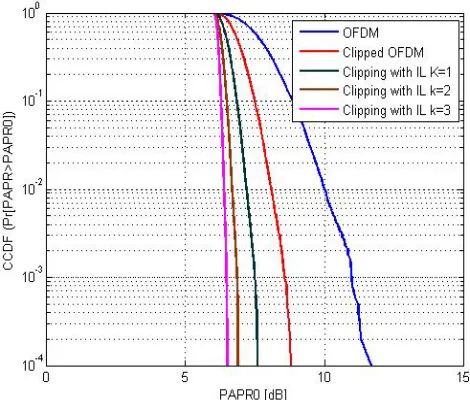
The CCDF results for both repeated clipping and filtering method and its noniterative equivalent are shown in Fig.5. For K=1, both methods give the same results, while for K>1 they slightly differ. The reason is that the
expression for is valid only in special conditions (high number of subcarriers, high A, …) and is only
Fig.5. CCDF=f (PAPR) for combined IL and Modified clipping and filtering method.
5. CONCLUSION
In this paper, a new combined method for PAPR reduction of OFDM signals has been proposed. This method combines two basic PAPR reduction methods – Interleaving and Repeated (or Simplified) clipping and filtering. The main advantage of the proposed combination lies in substantial BER reduction in AWGN channel. The disadvantage of the method is a need for side information transmission. Moreover the paper briefly discuss the influence of side information coding on total bit error probability. The goal of further research could be for example in elimination of side information transmission. The PAPR and BER can be further improved by using a new algorithm based on digital filtering in the frequency domain.
REFERENCES
[1] T.Jiang and Y.Wu, “An Overview: Peak-to-Average Power Ratio Reduction Techniques for OFDM Signals,” IEEE Transactions on Broadcasting, Vol.54, No.2, June 2008, pp.257-268.
[2] J. Armstrong, “Peak-to-average power reduction for OFDM by repeated clipping and frequency domain filtering”, Electronics Letters, 28TH February 2002, Vol. 38, No. 5, pp. 246-247.
[3] H. Ochai, H. Imai, “Performance of the Deliberate Clipping with Adaptive Symbol Selection for Strictly Band-Limited OFDM Systems”, IEEE Journal on Selected Areas in Communications, Vol. 18, No. 11, November 2000, pp. 2270-2277.
[4] L. Wang, Ch. Tellambura, “A Simplified Clipping and Filtering Technique for PAR Reduction in OFDM Systems”, IEEE Signal Processing Letters, Vol. 12, No. 5, June 2005, PP.453-456.
[5] A.K.Gurung et. al. “ Power Saving Analysis of Clipping and Filtering Method in OFDM Systems”,Telecommunication Networks and Applications Conference, ATNAC 2008IEEE,pp.204-208.
[6] H.Chan and A.Haimovich “An Iterative Method to Restore the Performance of Clipped and Filtered OFDM Signals,Communications,2003.ICC’03.IEEE International Conference, vol.5, pp.3438-3441.
[7] S.Kimura,T.Nakamura,M.Saito and M.Okada,“ PAR reduction of OFDM signals based on deep clipping,” ISCCSP 2008, Malta, 12-14 March 2008, IEEE, pp.911-916.
[8] D.Qing and Z.Hongsheng, “ An Improved Algorithm to Reduce PAPR Based Clipping and Filtering”Wireless Communications,Networking and Mobile Computing,2008.WiCOM’08International Conference,pp.1-4.
[9] S.H.Leung et. al. “Algorithm for repeated clipping and filtering in peak-to-average power reduction for OFDM” Electronics Letters, 5th December 2002,Vol. 38, No.25,pp.1726-1727.