DEPENDABLE AND RELIABLE ROUTING WITH
SPATIAL AND TEMPORAL FEATURES IN
WIRELESS SENSOR NETWORKS
Ms. Nalini. B. Jori
1, Mrs. Neeta. N. Thune
2 1, 2Department of E&TC Engineering, PVPIT, Pune University, Pune, (India)
ABSTRACT
In the world of computer Network, Wireless Sensor Network (WSN) is the latest research field. Because in
WSN contains various varieties of real time applications. It also consist of individual and small sensor nodes
which is applied in a remote area and it is useful to collect, detect and process data and broadcast it to the user.
The nodes are able to move and synchronize with the neighbors in such network. Due to the mobility of nodes
and nodes get added and removed, the network changes dynamically. In wireless sensor network, a geographical
based multipath routing for in network data aggregation is proposed in this paper. Based on geographical
distances routing path is selected and packets travel over lesser distance. Due to this energy efficiency is
improves. The reliable of path ensures by the Multipath router and in case one path is failure then other path is
always available. At cluster head, data is aggregated and forwarded the data towards sink. Also, in this paper we
approach a Spatial based multipath routing for the network aggregation in Wireless sensor network
Index Terms - Wireless Sensor Networks, Energy Efficient, Reliable
I. INTRODUCTION
Alliance of electronics pasture, information technology is nothing but a wireless sensor network (WSN). It is
spatially dispersed in individual devices that professionally sense physical or environmental conditions like
sound, pressure, vibration, motion at different places etc [1]. The equation Sensing + CPU + Radio = Thousands
of real time applications shows the idea of WSN. With the help of radio frequency channel (RF) the small size
sensor network which is present in WSN gatherer the data, and process it at the time of comminuting with other
nodes in the network. Routing is nothing but a process of determining path between source and destination for
data transmission. For in network data aggregation in WSNs spatial based routing is implemented in this paper.
Sensor node is normally unfeasible Due to node deployment recharging. Therefore, in wireless sensor network
energy saving is one of the significant intend issues. The power consumption of sensors is dominated by data
transmission and reception [2]. To prolong the lifetime of network should be required efficient energy and this is
obtained by the scheming the routing protocol. Furthermore WSNs are a data ambitious network that generally
manufactures big quantity of information that required to be routed frequently in a multihop fashion, towards the
sink node. Data aggregation is one of the effectual techniques to save the energy in WSNs. Data in-network
routing proposes for with obtainable dispensation ability transported by the intermediate sensor nodes along the
routing paths. In this paper we approach a Geographical based multipath routing for in-network data aggregation
in WSNs. The superfluous data are mislaid in data aggregation and it leads to minimize the communication cost.
Whereas, multipath geographical based routing towards the sink node. [1] The routing principle that trusts on
geographic position information is nothing but a geographical routing. In 1980s, for routing by using position
information idea are firstly proposed in the packet area networks. The own location is determined by the each
node and the source is must be aware about the destination location is the requirement of a geographic routing
[4]. How to give guarantee of the delivering the sense data even after interruption in communications and nodes
failures are the main challenge in the routing algorithm. It is also become more critical when along with routing
paths packets with aggregated data contains information from sources data aggregation is performed. If the packet
is lost, a considerable amount of information also is lost. High aggregation rate, a reduced number of messages
for setting up a routing tree, a reliable data transmission, and a reliable data transmission are the characteristics
present in the data aggregation routing protocol, in the WSN context.
II.
RELATED
WORK
In the literature [1], [3] found a few approaches regarding the situation of Wireless Sensor Network, were data
in-network routing mentions to the dissimilar habits that intermediate nodes forwarded data packets to the sink node.
2.1 Tree structure Approaches
The hierarchical relationship of nodes in the network is established in the tree structure. The node selection is
depend on the tree structure aggregation point works and followed preferred direction. When two or more than
two data packets arrive at at the same node of a tree at that time routing of data aggregation is executed. Here this
node aggregates its own data with all receivers’ data and forwarded only one packet to its neighbors which is
lower in the tree structure. If the packet is lost at an influenced level of a tree the data from the whole sub tree will
also be lost as well due to the channel impairments. The conventional tree based protocol built the shortest path
routing tree (SPT) [1]. The nodes reported its information with the help of shortest path to the sink node at the
time of event detection [5], [6], [7].
The tree structure advantages are,
Firstly create tree structure and then decided either react to the query sent or route the gathered data by the
sink node [8], [9].
Network use hierarchical relationship.
The tree structure disadvantages are,
Due to the channel impairments or technological difficulty, if the data lost at influenced level of the tree then
whole data from the sub tree also be lost.
Needs device for tolerance of fault to dependability forwarded data packets towards the sink node.
2.2 Clusters Structure Approaches
Here also nodes prearranged in hierarchical manner in the network in this approach. Were cluster are formed by
dividing nodes partially. Here cluster head noting but a special node elected from the cluster which have high
computing power and aggregated data and use to forward the result of such aggregation towards the sink node.
Here the election of cluster head is done on the base of distance from the sink node. The nodes which is closer to
the sink node elected as a cluster node. Gathering information from the remaining nodes and forwarding those
gather data towards the sink node are the responsibilities of the cluster head [1], [6]. In the next section we
proposed an algorithm which is used in the data aggregation with geographical base routing algorithm in the
are selected on the basis of the spatial correlation of the nodes in wireless sensor network and the residual power
of each node. Where, these cluster-head nodes broadcast their status to other nodes in the network. Here each
node decided that which cluster it want to belong and joint that particular cluster. And after that the each cluster
head aggregate the data acquire by the nodes and forwarded towards the base station. Our simulation result
clearly shows that our approach algorithm is clever to dispense energy indulgence evenly throughout the sensor
nodes and prolong or increase the lifetime of the whole network effectively [10], [11], and [12].
III.
SYSTEM
ARCHITECTURE
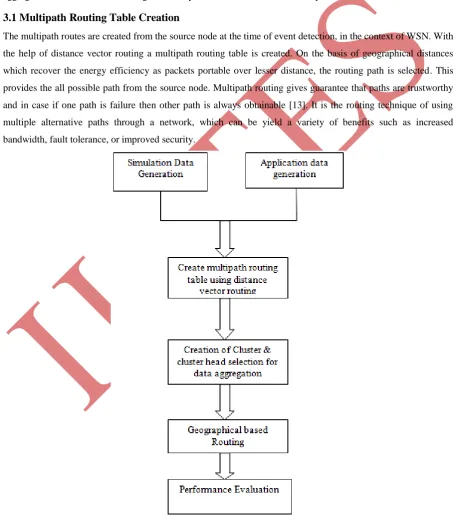
Projecting a system architecture which is creating a geographical based multipath routing for in network
aggregation in WSNs are our main goal. Our system architecture has different phases which are describe here.
3.1 Multipath Routing Table Creation
The multipath routes are created from the source node at the time of event detection, in the context of WSN. With
the help of distance vector routing a multipath routing table is created. On the basis of geographical distances
which recover the energy efficiency as packets portable over lesser distance, the routing path is selected. This
provides the all possible path from the source node. Multipath routing gives guarantee that paths are trustworthy
and in case if one path is failure then other path is always obtainable [13]. It is the routing technique of using
multiple alternative paths through a network, which can be yield a variety of benefits such as increased
bandwidth, fault tolerance, or improved security.
Figure 1: A Geographical Based Multipath Routing For In Network Aggregation in WSNS System
3.2 Cluster Creation and Cluster Head Selection
In this approach the nodes which are closer to the sink node are selected as a cluster head. The cluster head which
is nothing but a coordinator is elected on the basis of closest to the base station at the time of event detection
through the one or more than one nodes. Else which is closest to the already established path is elected as
coordinator or cluster head. Forwarding the data packets towards the sink node are responsibilities of a cluster
head. It is also have a high computation power and residual energy. Here only one node is selected as
coordinators that means leader and remaining nodes will be preserved as a collaborators. The coordinator gathers
the information collected by the collaborators and sends them to the sink.
3.3 Geographical Based Routing
The method to transport a message to a node in a network is called as geometric routing. It is also called as
position based routing. Routing decision is based on multipath routing table created by distance vector routing.
Cluster head aggregate the data and forward that data towards the sink node. It is used multiple paths which is
created with the help of distance vector routing and as a Euclidean distance calculates the distance among the two
nodes and also on the base of its distance the next nodes are selected that is the shortest distance node is selected
[14]. Every path created using multipath routing are calculated by cluster head and from this selected path, cluster
head select the path which have shortest path to the sink [3]. Based on the location of sensor nodes, the routing is
performed. Using distance vector routing, it select the best route according to the selection of multipath routing
table for every node n. Multipath routing which is based on geographical safeguards that paths are reliable and in
case one path is failure then there is always present the another path and data is aggregated by the cluster head
and forwarded that data to the sink.
IV.
PERFORMANCE
EVALUATION
Based on the following factors our approach shows the algorithm performance
Communication Cost
If any aggregated data loss
Total energy saved
Whole distance saved
Dependable data aggregation
Total aggregation
4.1 Communication Cost
Extra the communication cost cause the climbable system, at the time of measuring the performance
communication cost should be abridged.
4.2 If Any Aggregated Data Loss
It is one of the most significant presentation events completed the network. It is nothing but an amount of data
lost at the time of routing.
4.3 Total Energy Saved
4.3.1 Mathematical Model
Problem Definition:
Formation of geographic routing for in network aggregation in wireless sensor network.
Mathematical model project:
Let total number of wireless sensor networks be the N.
Let ni be the single sensor node
Where i= {1, 2… N}
Let Pi = {p1, p2, p3, p4,……pmi} be the set m multiple paths for node n towards sink S.
Let
(
,
)
i
i a
l
C
C
be the set of co-ordinates of noden
.Let
(
,
)
s
s a
l
C
C
be the set of coordinates of sink, S.We express our problematic as from any node n, to Sink S, aggregate the packets after any event and with the
help of geographic routing find the shortest path to sink S.
4.3.2 Algorithm
Step1: With the help of distance vector routing, generate the multipath routing table for every node n.
Step2: Election of cluster head
The node which has highest outstanding energy will be elected as a cluster head and all remaining nodes in the
cluster forwarded data towards the cluster head.
Step3: the multiple path which are generated in Step1 are taken by the cluster head to calculate the distance
among two nodes using the equation
2 2
2
1
,
)
(
)
(
)
(
2 1 2
1 l a a
l
c
c
c
c
n
n
C
Where,
C (n1, n2) is the distance between two nodes. And
)
,
(
&
)
,
(
2 1 11
a
l
a
l
c
C
c
c
c
C
Are coordinates of node n1, n2 respectively.
The total distance for every path Pi is calculated by using the equation
k i a a l l sni
c
ic
ic
ic
iC
0 2 2 ) ,(
(
1)
(
1)
Where, K is the total number of nodes in path
p
i.Step4: After that the path which have shortest distance to the sink, is selected by the cluster head.
Algorithm
Step1: Let x is a distance and µ is a time.
Were xµ.
Total distance = xµ + i
Where,
µi is an ith aggregation time and i = {1, 2 …n}
is a number of aggregation.
V.
RESULT
Here, we show the result graph which shows the number of hops verses distance were number of hops increases,
the distance will be increases.
Here, this graph represent that, at some number of hopes the time remain constant, after that there is found
VI.
CONCLUSION
In this paper, we have monitored the multipath routing which is based on the geographical. It is used to save the
node energy and increased the lifetime of network model because it route the packets via shortest distance. As
well as calculated aggregation also used for saving the energy. It is also used to verdict the trustworthy path
from the present set of path. The time required for sending data is equal to the number of nodes present in that
particular. The contribution of work is design system architecture. We trust that this will be help in fast
construction, effective energy and dependable WSN applications.
VII. ACKNOWLEDGMENT
I, Nalini Jori, Student of M.E (VLSI AND EMBEDDED SYSTEM), Dept. OF ECE, PVPIT, PUNE
UNIVESITY, PUNE would like to thank Associate Prof. MS. Neeta Thune for her constant encouragement and
support throughout the completion of the paper. I deeply express my gratitude to all the ECE department Staffs
for their valuable advice and co-operation.
REFERENCES
[1] I.F. Akyildiz, W. Su, Y. Sankarasubramaniam, and E. Cyirci, “Wireless Sensor Networks: A Survey,”
Computer Networks, vol. 38, no. 4, pp. 393-422, Mar. 2002.
[2] K. Romer and F. Mattern, “The Design Space of Wireless Sensor Networks,” IEEE Wireless Comm., vol.
11, no. 6, pp. 54-61, Dec. 2004.
[3] G. Anastasi, M. Conti, M. Francesco, and A. Passarella, “Energy Conservation in Wireless Sensor
Networks: A Survey,” Ad HocNetworks, vol. 7, no. 3, pp. 537-568,
http://dx.doi.org/10.1016/j.adhoc.2008.06.003, May 2009.
[4] A. Boukerche, R.B. Araujo, and L. Villas, “Optimal Route Selection for Highly Dynamic Wireless Sensor
and Actor Networks Environment,” Proc. 10th ACM Symp. Modeling, Analysis, and Simulation of Wireless and Mobile Systems (MSWiM ’07), pp. 21-27,2007.
[5] O. Younis, M. Krunz, and S. Ramasubramanina, “Node Clustering in Wireless Sensor Networks: Recent
Developments and Deployment Challenges,” IEEE Network, vol. 20, no. 3, pp. 20-25, Dec. 2006.
[6] S. Olariu, Q. Xu, and A. Zomaya, “An Energy-Efficient Self- Organization Protocol for Wireless Sensor
Networks,” Proc. IEEE Intelligent Sensors, Sensor Networks and Information Processing Conf.(ISSNIP),
pp. 55-60, Dec. 2004.
[7] H.S. AbdelSalam and S. Olariu, “A Lightweight Skeleton Construction Algorithm for Self-Organizing
Sensor Networks,” Proc. IEEE Int’l Conf. Comm. (ICC), pp.
1-5,de/db/conf/icc/icc2009.html#AbdelSalamO09, 2009.
[8] L. Villas, A. Boukerche, R.B. de Araujo, and A.A.F. Loureiro, “Highly Dynamic Routing Protocol for
Data Aggregation in Sensor Networks,” Proc. IEEE Symp. Computers and Comm. (ISCC),pp.
496-502,2010
[9] L.A. Villas, A. Boukerche, H.A. de Oliveira, R.B. de Araujo, and A.A. Loureiro, “A Spatial Correlation
Aware Algorithm to Perform Efficient Data Collection in Wireless Sensor Networks,”Ad Hoc
[10] I. Chatzigiannakis, T. Dimitriou, S.E. Nikoletseas, and P.G. Spirakis, “A Probabilistic Algorithm for
Efficient and RobustData Propagation in Wireless Sensor Networks,” Ad Hoc Networks,vol. 4, no. 5, pp.
621-635, 2006.
[11] I. Chatzigiannakis, S. Nikoletseas, and P.G. Spirakis, “Efficient and Robust Protocols for Local Detection
and Propagation in Smart Dust Networks,” Mobile Networks and Applications, vol. 10,nos. 1/2, pp.
133-149, 2005.
[12] C. Efthymiou, S. Nikoletseas, and J. Rolim, “Energy Balanced Data Propagation in Wireless Sensor
Networks,” Wireless Networks, vol.12, no. 6, pp. 691-707, 2006.
L.A. Villas, D.L. Guidoni, R.B. Arau´ jo, A. Boukerche, and A.A.
Loureiro, “A Scalable and Dynamic Data Aggregation Aware Routing Protocol for Wireless Sensor Networks,” Proc. 13th ACM
[13] Int’l Conf. Modeling, Analysis, and Simulation of Wireless and Mobile Systems, pp. 110-117,