418 | P a g e
ESTIMATED POWER DELAY PROFILE WITH
WIENER FILTER ALGORITHM FOR MIMO-OFDM
SYSTEMS
K.Sagar
1, M.Sreedhar Reddy
21,2
ECE,Malla Reddy College of Engineering and Technology/JNTUH,(India)
ABSTRACT
This letter proposes a power delay profile (PDP) estimation technique for linear minimum mean
square error (LMMSE) channel estimator of multiple-input multiple-output orthogonal frequency division
multiplexing (MIMO-OFDM) systems. For practical applications, only the pilot symbols of all transmit antenna
ports are used in estimating the PDP. The distortions caused by null subcarriers and an insufficient number of
samples for PDP estimation are also considered. The proposed technique effectively reduces the distortions for
accurate PDP estimation. Simulation results show that the performance of LMMSE channel estimation using the
proposed PDP estimate approaches that of Wiener filtering due to the mitigation of distortion effects.
I.INTRODUCTION
MULTIPLE-INPUT multiple-output orthogonal frequency division multiplexing (MIMO-OFDM) is one of the most
promising techniques for wireless communication systems, including the 3rd Generation Partnership Project
Long Term Evolution (3GPP LTE) [1], [2] and IEEE 802.16 (WiMAX). MIMO-OFDM provides a considerable
performance gain over broadband single-antenna systems by obtaining the spatial diversity or multiplexing gain
[3], [4]. Most receiver techniques of MIMO-OFDM systems are designed with the assumption that channel state
information (CSI) is available, in order to achieve the maximum diversity or multiplexing gain. The
performance gain depends heavily on accurate channel estimation, which is crucial for the MIMO-OFDM
systems. The pilot-aided channel estimation, based on the linear minimum mean square error (LMMSE)
technique, is optimum in the sense of minimizing mean square error (MSE) when the receiver knows the
channel statistics [8]. To obtain the frequency domain channel statistics at the receiver, power delay profile
(PDP) estimation schemes have been proposed [9], [10]. These schemes are based on the maximum likelihood
(ML) estimation by taking advantage of the cyclic prefix (CP) segment of OFDM symbols. However, the ML
PDP estimators require very high computational complexity for obtaining an accurate PDP.
Another approach for improving the performance of LMMSE channel estimation employs an approximated PDP
(i.e., uniform or exponential model) with the estimation of second-order channel statistics, which are mean delay
and root-mean-square (RMS) delay spread [11]. The channel delay parameters are estimated using pilots with
low computational Manuscript received September 29, 2011. The associate editor coordinating the review of
this letter and approving it for publication was M. Tao. This work was supported by the National Research
419 | P a g e
are with the Department of Electrical Engineering, Pohang University of Science and Technology (POSTECH),Pohang 790-784, therefore, the LMMSE channel estimator with the approximated PDP is appropriate for
practical applications such as a WiMAX system. However, the performance degradation is caused by both the
correlation mismatch and the estimation error of delay parameters. To reduce the mismatch in the frequency
domain, we propose a PDP estimation technique for the LMMSE channel estimator of MIMO-OFDM systems.
For practical applications, the proposed technique uses only the pilot symbols of all transmit antenna ports to
estimate the PDP with low computational complexity. In addition, the proposed technique effectively mitigates
the distortion effects, incurred by null subcarriers and an insufficient number of estimated channel impulse
response (CIR) samples. Simulation results show that the performance of LMMSE channel estimation with the
proposed PDP estimate approaches that of Wiener filtering.
II. SYSTEM MODEL
The system under consideration is a MIMO-OFDM system with 𝑃 transmits and 𝑄 receive antennas,
and 𝐾 total subcarriers. Suppose that the MIMO-OFDM system transmits 𝐾𝑑 subcarriers at the central spectrum
assigned for data and pilots with 𝐾−𝐾𝑑 virtual subcarriers, in order to control interferences with other systems.
The CIRs corresponding to different transmit and receive antennas in MIMO systems usually have the same
PDP [12]. Let 𝐶[𝑘𝑝, 𝑛𝑝] be the pilot subcarrier for the 𝑝pth transmit antenna at the 𝑛𝑝 th OFDM symbol, which
is a QPSK modulated signal from known sequences between the transmitter and receiver. We assume that the
pilot subcarriers are distributed over a time and frequency grid as in Fig. 1, to preserve the Orthogonality of
pilots among different transmits antennas. 𝑘𝑝 And 𝑛𝑝𝒯𝑝 represent the index sets for the pilot subcarriers of the
𝑝pth antenna port in the frequency and time domains, respectively. At the 𝑛𝑝th OFDM symbol, the number of
pilot subcarriers is defined as 𝐾𝑝=𝑝. The pilot inserted OFDM symbol is transmitted over the wireless channel
after performing an inverse fast Fourier transform (IFFT) and adding a CP. It is assumed that the length of CP,
𝐿𝑔, is longer than the channel maximum delay, 𝐿𝑐, making the channel matrix circulate (𝐿𝑐 ≤ 𝐿𝑔). At the
receiver, after perfect synchronization, the removal of CP, and FFT operation, the received pilot symbol for the
𝑞th receive antenna can be represented as
Where is an 𝐿𝑔×1 CIR vector at the 𝑝pth
transmit antenna and 𝑞th receive antenna. (⋅ )𝑇 and (⋅ )𝐻 represent the transpose operation, and the transpose
and conjugate open[ ration of a vector or matrix, respectively. x𝑝 = 𝐶𝑝[𝑖1, 𝑛𝑝],
denotes a pilot vector at the 𝑛𝑝th OFDM symbol for
and 𝑘=1, 2, . . .,𝐾𝑝. 𝑑𝑖𝑎(x𝑝) is the 𝐾𝑝×𝐾𝑝 diagonal matrix whose entries are the
420 | P a g e
. n𝑞 is a complex additive white Gaussian noise (AWGN) vector at the 𝑞pth receiver antenna with each entryhaving a zero-mean and variance of 𝜎2 𝑛.
III.PROPOSED METHOD FOR THE PDP ESTIMATION:-
From (1), the CIR at the (𝑝, 𝑞)pth antenna port can be estimated approximately using the regularized
least squares (RLS) channel estimation with a fixed length of 𝐿𝑔 as
Where 𝜖=0.001 is a small regularization parameter, and I𝐿𝑔 is the 𝐿𝑔×𝐿𝑔 identity matrix. F𝐻𝑝
F𝑝 in (2) is ill-conditioned due to the sparsity of pilot tones in the frequency domain and the Presence of virtual
subcarriers [8]. To derive the PDP from the estimated CIR in (2), the ensemble average of ˆh𝑅,,𝑞ˆh𝐻𝑅,𝑝,𝑞 is
given by
Where Note that the diagonal elements of
the channel covariance matrix, Rhh, represent the PDP of multipath channel within the length of 𝐿𝑔, and all
off-diagonal elements are zeros. Hence, the covariance matrix can be expressed as Rhh=𝑑𝑖𝑎𝑔 (ph), where ph=[𝑝0,
𝑝1, . . . , 𝑝𝐿𝑐h, 0, . . . , 0]𝑇 and 𝑝𝑙=𝐸{h𝑝,𝑞|[𝑛𝑝, 𝑙]|2}. Unfortunately, Rhh is distorted by W, which is an
ill-conditioned matrix due to the presence of F𝐻F𝑝. Thus, instead of calculating W−1, we investigate the method
for eliminating the spectral leakage of W. The covariance matrix of the estimated CIR is defined as Rhhˆ
=WRhhWh which can be expressed as
Where u 𝑙 is a unit vector with the 𝑙pth entry being one and otherwise zeros. Let ph and tl be the 𝐿𝑔×1 vectors
defined as ph=𝐷(Rhˆhˆ ) and t𝑙=𝐷𝑔 ( W𝑑𝑖𝑎𝑔(u𝑙)W𝐻 ) , respectively, where 𝐷𝑔(A) is the column vector
421 | P a g e
Where T=[t0, t1, ..., t𝐿𝑔−1] is defined as a distortion matrix by W. It is noted that the distortion matrix is astrictly diagonally dominant matrix, satisfying [T]𝑖∣ > Σ 𝑗∕=𝑖 [T]𝑖𝑗∣ for all 𝑖, 𝑗, since the non-diagonal elements
of T are composed of the leakage powers of u𝑖 for all 𝑖. From the Gershgorin circle theorem, a strictly
diagonally dominant matrix is non-singular. In addition, the distortion matrix is a well-conditioned matrix.
Hence, the distortion of W can be eliminated as
where g𝑝,𝑞[𝑛𝑝]=T−1𝐷𝑔 ( ˆh𝑅,𝑝,𝑞 ˆh𝐻𝑅,𝑝,𝑞 ) is defined as the received sample vector for estimating PDP at
the (𝑝, 𝑞)pth antenna port on the 𝑛𝑝pth OFDM symbol, and ˜w = T−1𝐷𝑔(W𝑅𝐿𝑆,𝑝W𝐻𝑅𝐿𝑆,𝑝).
where ˜n𝑝,𝑞 = T−1𝐷𝑔(W𝑅𝐿𝑆,𝑝n𝑞n𝐻𝑞W𝐻𝑅𝐿𝑆,𝑝) and e𝑝,𝑞 = 2𝑅𝑒{T−1𝐷𝑔(Wh𝑝,𝑞n𝐻𝑞W𝐻𝑅𝐿𝑆,𝑝)}. Here,
𝑅{a} denotes the real part of a. We assume that ˜n𝑝, is an effective noise by AWGN. Then, the sample average
of g𝑝,[𝑛𝑝] is given by
Where 𝑁 = |T𝑝| 𝑃𝑄 represents the total number of samples for PDP estimation. 𝒯 is the number of pilot
symbols at the 𝑘𝑝pth subcarrier in a time slot. When 𝑁 is sufficiently large, the PDP can be perfectly estimated,
since〈 𝐷(h𝑝,𝑞h𝐻𝑝,𝑞)〉 𝑁→ ph,(˜n𝑝,𝑞)𝑁→ 𝜎2𝑛˜w, and (e𝑝,𝑞)𝑁→ 0. However, it is difficult for a receiver of
practical MIMO-OFDM systems to obtain such a large number of samples. With an insufficient number of
samples, the PDP can be approximated as ph ( ≈𝐷𝑔( h𝑝,𝑞h𝐻𝑝,𝑞)) 𝑁.
To improve the accuracy of PDP estimation with insufficient samples, we mitigate the effective noise as follows
Where z𝑁 = (e𝑝,)𝑁 +(˜n𝑝,𝑞)𝑁−𝜎2𝑛 ˜w is defined as a residual noise vector, in which each entry has a
422 | P a g e
Since [ph] ≥ 0 for all 𝑖, the PDP can initially be estimated aswhere s𝑝,𝑞[𝑛𝑝] is the sample vector of proposed PDP estimator with the 𝑙pth entry
Where 𝑔𝑙 𝑝,[𝑛𝑝]= [g𝑝,𝑞[𝑛𝑝]]𝑙 and ˜ 𝑤𝑙=[˜w]𝑙. To mitigate the detrimental effect of residual noise z𝑁, the
proposed scheme estimates the average of residual noise at the zero-taps of ph. At the 𝑙pth entry of ˆp𝑖𝑛𝑖𝑡, the
zero-tap can be detected as
Where 𝛽𝑡= 1 𝐿𝑔 Σ 𝐿𝑔−1 𝑙=0 ˆ𝑝𝑙 𝑖𝑛𝑖𝑡 is defined as a threshold value for the zero-tap detection. Then, the
average of residual noise at the zero-taps can be estimated as
The above equation represents the total number of detected zero-taps. With the mitigation of residual noise, the
lth tap of the PDP estimate, ˆp, can be expressed as
Then, the estimated PDP in (15) can be used to obtain the frequency-domain channel correlation in the LMMSE
channel estimator.
Where FL is the Kd × Lg matrix obtained by taking the first Lg columns of the DFT matrix. ˆp
423 | P a g e
From the matrix inversion lemma, ( FpDg(ˆp)FpH + 𝜎2𝑛I𝐾𝑝)−1 in is converted aswhere A ≜(F𝑝𝐷𝑔(p)F𝐻𝑝+ 𝜎2𝑛I𝐾𝑝)and B ≜𝐷𝑔(¯e𝑝𝑑𝑝)(I𝐿𝑔+F𝐻𝑝A−1F𝑝𝐷𝑔(¯e𝑝𝑑𝑝))−1 Then, the
coefficient matrix for LMMSE channel estimation with ˆp can be rewritten as
Where W𝑜𝑝𝑡, ≜F𝐿𝐷𝑔(p)F𝐻𝑝(F𝑝𝐷𝑔(p)F𝐻𝑝 + 𝜎2𝑛I𝐾𝑝)−1is the coefficient matrix for Wiener filtering and
W𝑒𝑟𝑟,𝑝 is given by
The error covariance matrix of LMMSE channel estimation with the imperfect PDP can be obtained as
where ˆh𝐿𝑆,𝑝,𝑞 ≜ 𝑑𝑖𝑎𝑔(x𝑝)𝐻y𝑝[𝑛𝑝]. Using the error covariance matrix, the frequency-domain MSE of the
proposed scheme is given by
where 𝑇𝑟(E𝑝) denotes the trace operation of E𝑝. With a sufficiently large number of samples, ¯e𝑝𝑑𝑝 → 0.
424 | P a g e
The additional complexity by the proposed PDP estimation technique is 𝑂 (𝐿3𝑔 + 𝐾𝑝𝐿2𝑔 + |𝒯𝑝|𝑃𝑄𝐿 ) , whichmainly comes from computing (2) and (6). When the pilot spacing is fixed in the frequency domain, all entries
of F𝑝 and T are constant. Thus, (F𝑝F𝐻𝑝 + 𝜖I𝐿𝑔 )−1F𝐻𝑝 and T−1 can be computed only once, and their values
can be stored. The additional complexity is then reduced to 𝑂 (𝐿2𝑔 + |𝒯𝑝|𝑃𝑄𝐿 )
IV.SIMULATION RESULTS
We consider a MIMO-OFDMsystem with the physical layer parameters for the downlink of 3GPP LTE
[14]. The system bandwidth is 5 MHz with 301 subcarriers for transmitting data information and pilots
including a DC subcarrier at 2-𝐺𝐻𝑧 carrier frequency. The width of each subcarrier is 15 kHz with an FFT size
of 512. The MIMO-OFDM system utilizes four transmit and two receive antennas (𝑃=4,=2). We assume that the
pilots of the four transmit antenna ports are distributed as the time and frequency grid of the LTE system in Fig.
1. The length of CP is 40 (𝐿𝑔=40). For all simulations, the channel estimator is based on a cascaded 2×1D
LMMSE technique during 14 OFDM symbols,as shown in Fig. 1, where the filtering in frequency domain is
followed by the filtering in time domain over slowly fading channels with the Doppler frequency of 5 Hz.
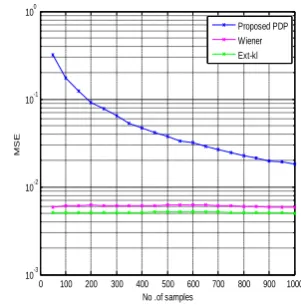
Figure 2 shows the MSE performance of the 2×1D LMMSE technique using the estimated PDP. All underlying
links are modeled as extended typical urban (ETU) channels [14]. The performance of the 2×1D Wiener filter
with exact PDP is included as a lower bound. For performance comparisons, we plot the performance of
frequency domain regularized LS channel estimation in which the PDP information is not required. The
performance of the 2×1D LMMSE technique using the approximated PDP, which is uniform or exponential
model with the channel delay parameter estimation in [11], is
.
0 100 200 300 400 500 600 700 800 900 1000 10-3
10-2 10-1 100
No .of samples
M
S
E
Proposed PDP Wiener Ext-kl
Figure-1 Simulation and analysis results of LMMSE channel estimation over ETU channel with
425 | P a g e
0 5 10 15 20 25 30
10-3 10-2 10-1 100 ---SNR ---M S E Estimated PDP Constant PDP Exp.PDP Wiener Ext-kl 1D LMMSE
Figure 2 hows the different previous techniques estimation with proposed algorithm using pilot signal
to noise ratio (db) to mean square error. It shows estimated result approach approaches to wiener filtering.
5 10 15 20 25 30 35
10-4 10-3 10-2 ---Lch ---M S E Estimated PDP Constant PDP Exp.PDP Wiener Ext-kl 1D LMMSE
Figure -3 Performance of LMMSE technique using the estimated PDP over 6-ray exponential channel
with variable channel maximum delays (Pilot SNR= 30 𝑑𝐵).Here channel length delay Lch is estimated using
mean square error.
V.CONCLUSIONS
We proposed a PDP estimation technique for the LMMSE channel estimator in MIMO-OFDM systems. The
CIR estimates at each path of the MIMO channels were used to obtain the PDP. For accurate PDP estimation,
we considered the spectral leakage effect from virtual subcarriers, and the residual noise caused by the
insufficient number of estimated CIR samples. The proposed technique effectively mitigates both the spectrum
leakage and residual noise. Simulation results show that the performance of LMMSE channel estimation using
426 | P a g e
REFERENCES
[1] TS 36.211, “Physical channels and modulation,” in 3GPP TSG RAN1,Rev. 10.1.0, Jan. 2011.
[2] T.W. Yune, C. H. Choi, G. H. Im, J. B. Lim, E. S. Kim, Y. C. Cheong, and K. H. Kim, “SC-FDMA with
iterative multiuser detection: improvements on power/spectral efficiency,” IEEE Communication. Mag.,
vol. 48, no. 3, pp. 164–171, Mar. 2010.
[3] U. K. Kwon, D. Kim, and G. H. Im, “Amplitude clipping and iterative reconstruction of MIMO-OFDM signals with optimum equalization,” IEEE Trans. Wireless Communication., vol. 8, pp. 268–277, Jan. 2009. [4] L. Zheng and D. N. Tse, “Diversity and multiplexing: a fundamental tradeoff in multiple antenna channels,”
IEEE Trans. Inf. Theory, vol. 49,
pp. 1073–1096, May 2003.
[5] H. C. Won and G. H. Im, “Iterative cyclic prefix reconstruction and channel estimation for a STBC OFDM system,” IEEE Communication. Lett.,vol. 9, pp. 307–309, Apr. 2005.
[6] T. Yoo and A. Goldsmith, “Capacity and power allocation for fading MIMO channels with channel estimation error,” IEEE Trans. Inf. Theory, vol. 52, pp. 2203–2214, May 2006.
[7] M. G. Song, D. Kim, and G. H. Im, “Recursive channel estimation method for OFDM-based cooperative systems,” IEEE Communication. Lett., vol. 14, no.11, pp. 1029–1031, Nov. 2010.
[8] S. Omar, A. Ancora, and D. T. M. Slock, “Performance analysis of general pilot-aided linear channel
estimation in LTE OFDMA systems with application to simplified MMSE schemes,” in Proc. IEEE
PIMRC2008.
[9] T. Cui and C. Tellambura, “Power delay profile and noise variance estimation for OFDM,” IEEE
Communication. Lett., vol. 10, pp. 25–27, Jan.2006.
[10] X. Gong, C. Zhao, W. Xu, and M. Jiang, “Power delay profile estimation for MIMO-OFDM systems over
time-varying multipath channels,” in Proc. IEEE ICCT 2010.
[11] K. C. Hung and D. W. Lin, “Pilot-based LMMSE channel estimation for OFDM systems with power-delay
profile approximation,” IEEE Trans. Veh. Technol., vol. 59, pp. 150–159, Jan. 2010.