281 | P a g e
DESIGN AND ANALYSIS OF ELECTRICALLY
POWERED MIXER FOR PHENYL
Sachin N. Waghmare
1, Suraj P. Mail
2, Pranav S. Nalawade
3,
Digambar A. Mohite
4, Pranil D. Salunke
51
Faculty,
2,3,4,5Students, MechEnggDept, Rajendra Mane College of Engg& Technology,
Ambav (Devrukh), Ratnagiri,Maharashtra, (India)
ABSTRACT
Now-a-days cleaning has become most important part in Hospitals, Educational institutions and Industries. And for making these cleaning solution large human efforts has to be made by the worker.This paper describes about the mechanical design and analysis of mixer on the fluid that is to be stirred in the mixing vessel. As we all knew thatmixing is a very important processin any chemical, paints andfood process industry. Toattain the uniform mixing of the solutionwith the desired quality and in order to remove the drudgery of human folk this newly designed mixer is suggested.
The cleaning department requires large amount of cleaning chemical solutions (phenyl) daily. A mixer is a chemical mixing machine which rotatesunidirectional. This mixer is driven by an electrical motor. This type of chemical mixers are used in process industries like paint industries, chemical industry, food processing plants etc. They are mainly employedfor mixing of powders, chemical solutions semisolid fluids etc.
Keywords: -agitator, chemical solution (phenyl), electrical motor, Uni-directional mixer.
I.INTRODUCTION
Mixing is a process where liquids or powders are mixed together in the form of uniform mixture whereasstirring
is the process to mix the fluid and powder to dissolve them thoroughly in a given mixture and form a uniform
product as output. It is the process which determines uniformity and quality of product. In case of process
industries, process of mixing and stirring forms an integral and important part of the total manufacturing
process.In either of above cases thorough mixing of material is desirable to give good and quality
mixture.Mixing powders of different material in order to form a uniform product as it is quiet easy to mix a
powder but when it is desirable to mix powder in a fluid matter specially when the density of powder is high the
problem occurs due to heavy weight of particles of powder which has a tendency to settle down.
This mixer is been designedand fabricated for mixing of chemical solution ,which is used to for cleaning
purposes in educationalinstitutes, offices, hospitals, large shop floor industriesetc. To keep this working area
clean, large amount ofcleaning solutions is required daily for variouscleaning purposes. This solutions are
preparedmanually, as a results large amount of human effortsare required, the amount of time required to
preparethis solution is also very long duration, and it becomes verydifficult to store the solution, hence to
overcome allthis factors this electrically poweredchemical mixer is been designed.By implementation of this
282 | P a g e
will be comparatively less also large amount of solution can be stored which can be further used as per therequirement.
II.LITERATURE REVIEW
Jagdish M. Chahandeet al. (2015)presented the methodology for design and fabrication of Planetary Mixer for
Preparing Cake Cream with the related search. The study specifies factors influencing the cake cream making
process and recommends a number of design options for planetary mixer. These are based on a systematic study
of the cake cream making process and testing of a prototype model of planetary mixer.
Rafiqueet al. (2013) studied for contra–rotating mixing flow within a cylindrical container. The behavior
compared against previously simulated numerical results and found with good agreement. Two-dimensional
incompressible complex flow of Newtonian fluid is relevant to the food industry. The numerical method
adopted is a finite element semi-implicit time-stepping Taylor-Galerkin/pressure-correction multi stepping
scheme, posed in a cylindrical coordinate system. The flow replicates the behaviour of actual industrial dough
mixing.
B.Kumar and E.Rajasekaran(2014)suggested a new design for the agitators. By careful study of threedifferent
models in all aspects one had been taken for the final fabrication. To finalize the best design,simulation which
had used to conduct required experiment? Required inputs had been taken fromdifferent literature surveys and
the discussion with the experts who were on the field and real time study had been conducted to get the exact
requirement of the customer.
H.S.Pordal and C.J.Matice studied inadequate understanding of mixing had resulted in unsatisfactory product
quality, increase cost of production and loss of revenue.The use of analysis tool varying rigor to solve mixing
problem was described. This solution strategy can be applied to solve mixing problemsrelated to the design of
process, Scale-up and scale-down of equipment.
AshishPanchgatte et al (2015) used planetary machine involved a rotating stirrer that revolves about the fixed
container axis as well as incorporatedan strainer that changes the flow pattern and also acted as a wiper.
Machine has variable mixing speed feature at the same time delivers heavy torque to the stirrer for proper
mixing.
TomasJiroutand FrantisekRieger (2011) studied effect of impeller type on off-bottom particle suspension. On
the basis of numerous suspension measurements there were proposed correlations for calculation just-suspended
impeller speed of eleven impeller types and geometries in the wide range of concentrations and particle
diameters. The suspension efficiency of tested impellers was compared by means of the power consumption
required for off-bottom suspension of solid particles.
R.K.Thakur et al (2003 described the field of static mixers including recent improvements and applications to
industrial processes. The most commonly used static mixers are described and compared.Their respective
advantages and limitations are emphasized. Efficienciesof static mixers are compared based both n theory and
experimentalresults from the literature.
ChristophErbacher (1999) a device for rapid mixing of two solutions was presented. As the main mechanism for
mixing is diffusional mass transport, the flow has to be splitinto several laminar which are narrower than the
283 | P a g e
Flow through device with a channel system that is 600µm wide at its narrowest spot.DivyaRajavasathavi (2012) used the effect of fluid flow and impeller characteristics on the mixing and
hydrodynamic behaviourof a continuous stirred tank reactor (CSTR) was been studied using computational fluid
dynamics software, Ansys Fluent 12.0. Various mathematical models like equation of continuity, momentum,
volume of fluid method, laminar and the turbulent equations have been used todescribe the flow behavior in the
reactor. The hydrodynamic behavior was understood by velocity and pressure profiles and also by the vortices
plots.
Raghunath Rajput (2015)presented the properly mixing of the fluid in mixing vessel. In order to have a
homogeneous mixing the directions of rotation of stirrer shaft which rotated stirrer blades in opposite directions
in one cycle which formed turbulent flow pattern there by leading to creation of irregular flow pattern and
resulting into thoroughlymixed paint mixture preparation which created the good quality paint.
Sharma Alok and Genitha Immanuel (2014) presented research was carried out with objective to study the effect
of different types of Impellers and Baffles on mixing and examined the correlation between mixing time and
mass transfer of Aerobic Stirred Tank Fermenter. An Aerobic Stirred Tank fermenter was assembled with
different Impellers and Baffles alternately. The four different Impellers used were Rushton Impeller, Marine
Impeller, A320 Impeller and HE3 Impeller while walled and unwalledbaffles were used in combination with
these Impellers.
Ronald Weetman and Bernd Gigas(2002)described the mechanical design of mixer with the emphasized on the
fluid forces that were imposed on the impeller by the continuum in the mixing vessel. The analysis shown was a
result of transient fluid flow asymmetries mixing in the mixing impeller.These loads were dynamics and were
transmitted from the impeller blades to the mixer shaft and gear reducer. A general result for a form of fluid
force equation was been developed.
V.B. Bhandari& The data book of PSG Institute of technology (2013) has published his latest edition of book
―Design of Machine Elements‖, it consist of design parameters for design of various mechanical components.
Tanguy et al. (1999) in this paper the mixing hydrodynamics in a double planetary mixer was investigated
numerically and experimentally over the course of a cross-linking reaction. Use of various visualization
techniques, it was shown that this mixer provided good radial dispersion capabilities but poor axial
(top-to-bottom) pumping, irrespective of the viscosity level. Overall, the numerical predictions and the experimental
results exhibited good agreement although at 85% conversion, the numerical model was not accurate enough to
predict adequately the power consumption due to physical phenomena notconsidered in the computations.
M. V Joshi & V. V. Mahajani(1996) has published his 3rd edition of book ―Process Equipment Design‖, it
consist of design parameters for design of various mechanical components like Agitators, Coupling, Pressure
Vessel.
III.PROPOSED METHODOLOGY
A chemical mixer is being designed which consist of a container impeller blades, electrical motor, pair of
pulleys, pedestal bearings and drive shafts. We are using the container made up ofPVC; it is placed at about
6inches from ground, so that it is easy to pour the material for the workers preparing the chemical
284 | P a g e
shaft. This machine is designed to mix the cleaning solution used for cleaning the floors. In electrically poweredsystem an electrical motor is used to run the motor shaft. As the motor shaft rotates, the pulley mounted on
motor shaft also rotates. The power transmission will be takes place from motor to impeller shaft. As the
impeller shaft rotates the impeller blades also rotate along the direction. And hence the mixing of chemical
ingredients is obtained. The speed of the electrical motor is controlled using speed regulator. The 3d model of
chemical mixer is as shown in fig 1.
Fig1.Praposed Model of Mixer
IV. DESIGN CALCULATIONS
285 | P a g e
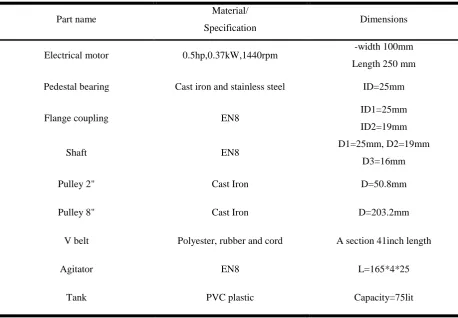
Table No.1 list of components
Part name Material/
Specification Dimensions
Electrical motor 0.5hp,0.37kW,1440rpm -width 100mm Length 250 mm
Pedestal bearing Cast iron and stainless steel ID=25mm
Flange coupling EN8 ID1=25mm
ID2=19mm
Shaft EN8 D1=25mm, D2=19mm
D3=16mm
Pulley 2" Cast Iron D=50.8mm
Pulley 8" Cast Iron D=203.2mm
V belt Polyester, rubber and cord A section 41inch length
Agitator EN8 L=165*4*25
Tank PVC plastic Capacity=75lit
V.RESULTS
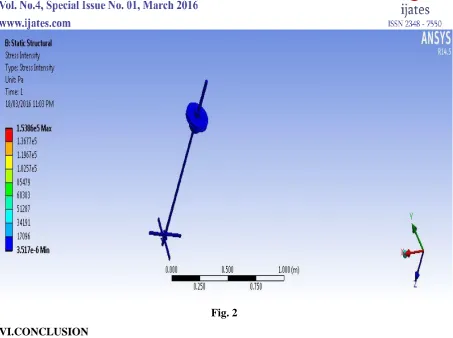
We carried the study from the data used for solving the problem in order to proceed for finding out the
dimensions of the agitator which will provides us minimum hydrostatic pressure acting on the agitator blade.
We assume certain dimensions of acceleration in (m/s2) and speed in (rpm) through a basic knowledge of
ANSYS SOFTWARE and then analyzed the same in flow simulation for boundary conditions as shown in the
fig 2.
Boundary Condition 1
Magnitude: - Acceleration = 0.024 m/s2
Boundary Condition 2
Speed = 350rpm.
Boundary Condition 3
Density of Phenyl = 0.909 gm/cm3
286 | P a g e
Fig. 2
VI.CONCLUSION
At 300 rpm, mixture is taking 600 seconds for uniformly preparing phenyl of 50 liters capacity.The capacity and
the time taken can be varied by changing mixer speed with the help of rheostat. The optimum solution is to
achieve the maximum cleaning solution for the purpose of cleaning.
This mixer is been designed and fabricated for mixing of chemical solution ,which is used to for cleaning
purposes in educational institutes, offices, hospitals, large shop floor industries etc.
By implementation of this mixer in various applications the time required to make the solution will be reduced
and the man power required will be comparatively less also large amount of solution can be stored which can be
further used as per the requirement.
VII. AKNOWLEDGEMENT
We would like to express our sincere thanks to Konark Engineering at Ratnagiriwho helped us out in fabrication
ofElectrically Powered Mixer for Phenyl, after a lot of practice and hours put into it. Our sincerethanks toProf.
S. N. Waghmare of Mechanical Department for giving us the opportunity to take up this paper, for his guidance
and supervision in all respects of this paper.
REFERENCES
1] RagunathRajaput, TamboliNajirkhan& S.T Waghmodenovateur publications (2015): International journal
of innovations in engineeringresearch and technology [IJIERT] ISSN: 2394-3696 volume 2.
2] Alok and Immanuel, J Bioprocess Biotech (2014):4:7 "Effects of Different Impellers and Baffles on
287 | P a g e
3] AshishPanchgatte, Dattakharsade, Sandeshpanale, Harshwardhanpatil (2015): "A Research Paper onPlanetary Mixer with Strainer",InternationalJournal of Engineering and Technical Research (IJETR)
ISSN: 2321-0869, Volume-3, Issue-5,May 2015.
4] V.B. Bhandari 2013, ―Design of Machine Elements‖ and PSG Institute of technology 2013 ―PSG data
book‖.
5] Jirout,T. &Rieger,F. (2011). ―Impeller Design for Mixing of Suspension‖, Chemical Engineering
Research And Design, 89(7),1144-1151.
6] Thakur, R. K., Vial, C., Nigam, K. D. P., Nauman, E. B., &Djelveh, G. (2003). "Static mixers in the
process industries—a review", Chemical Engineering Research and Design, 81(7), 787-826.
7] Memon, R. A., Baloch, M. E., Solangi, M. A., &Baloch,(2013)" A. Numerical Analysis of Rotating
Mixing of Fluids in Container Induced by Contra Rotating Stirrers", International Journal of Modern
Engineering Research (IJMER) Vol. 3, Issue. 5, Sep - Oct. 2013 pp-2754-2757 ISSN: 2249-6645
8] Rieger, F., Jirout, T., Ceres, D., &Seichter, P. (2013). "Effect of impeller shape on solid particle
suspension.Chemical and Process Engineering", 34(1), 139-152.
9] Pordal, H. S., &Matice, C. J. Design, Analysis and Scale-up of Mixing Processes.
10] Alok, S., & Immanuel, G. (2014) Effect of different impellers and baffles on aerobic stirred tank
fermenter using computational fluid dynamics. Journal of Bioprocessing&Biotechniques, 2014.
11] Rajavathsavai, D. (2012). Study of Hydrodynamic and Mixing Behaviour of ContinuousStirred Tank
Reactor Using CFD Tools (Doctoral dissertation).
12] Weetman, R. J., &Gigas, B. (2002) Mixermechanicaldesign-fluid forces. In proceedings of the
international pump users symposium (pp. 203-214).
13] Tanguy, P. A., Thibault, F., Dubois, C., &Ait-Kadi, A. (1999). Mixing hydrodynamics in a double
planetary mixer. Chemical Engineering Research and Design, 77(4), 318-324.
14] M. V Joshi & V. V. Mahajani(1996) ―Process Equipment Design‖Published by Raju Berry for
MacMillan India Ltd. New Delhi.
15] Jagdish M. Chahande, Dr. A. V. Vanalkar, V. D. Dhopte, (2015) "Methodology for Design and
Fabrication of Planetary Mixer for Preparing Cake Cream - a Review",IJSRD - International Journal for
Scientific Research &Development,Vol. 3, Issue 01, 2015, ISSN: 2321-0613
BIBLIOGRAPHY
Sachin N. Waghmare is working as Assistant Professor in Mechanical
Engineering Department at Rajendra Mane College of Engg& Technology
for last 11 years. He received his MTech in Mechanical Engineering at
VeermataJijabai Technological Institute (VJTI),from Mumbai University.
His research interest is in the field of reliability, quality, manufacturing and
288 | P a g e
SurajPradeep Mail has completed his Diploma in Automobile Engineering atRajendra Mane Polytechnic, Ambav,Ratnagiri. Presently he is pursuing B.E.
in Mechanical Engineering at Rajendra Mane College of Engineering and
Technology, Ambav, Ratnagiri. His research interests include Design,
Production and Energy
PranavShantaramNalawade is pursuing his B.E. in Mechanical Engineering
at Rajendra Mane College of Engineering and Technology, Ambav,
Ratnagiri.His research interests include Design, Production& further studies
in Mechanical Engineering.
DigambarAnantMohite is pursuing his B.E. in Mechanical Engineering at
Rajendra Mane College of Engineering and Technology, Ambav, Ratnagiri.
His research interests include Design& further studies in Mechanical
Engineering.
PranilDashrathSalunke has completed his Diploma in Mechanical
Engineering at RajaramShinde institute of Engineering and Technology,
Pedhambe, Chiplun. Presently he is pursuing B.E. in Mechanical Engineering
at Rajendra Mane College of Engineering and Technology, Ambav,