444 | P a g e
STUDY OF CURISE-MISSILE-TECHNOLOGY
1
Roshan Dudave,
2Akash Surwade,
3sandesh Dhatrak,
4Ajay Dhumal,
1,2,3,T.E. Mechanical Scholar BVCOE&RI Nashik,
4Assistant Professor Mechanical Dept. BVCOE&RI
Nashik.(India)
ABSTRACT
Unmanned Combat Air Vehicles, or UCAV, are increasingly an important capability available to military
commanders and, as they become more capable, they will be able to replace cruise missiles in many of their
traditional roles. This article looks at some of the possible tends for both UCAVs and cruise missiles in order to
predict if cruise missiles will be able to survive the competition. A cruise missile is basically a small, pilotless
airplane. Cruise missiles have an 8.5-foot (2.615-meter) wingspan, are powered by turbofan engines and can fly
500 to 1,000 miles (805 to 1,610 km) depend on the configuration. A cruise missile's job in life is to deliver a
1,000-pound (450-kg) high-explosive bomb to a exact location -- the target. The missile is destroyed when the
bomb explodes. Cruise missiles come in a number of varying and can be launched from submarines, destroyers
or aircraft.
I. INTRODUCTION
A cruise missile is basically a small, pilotless airplane. Cruise missiles have an 8.5-foot (2.61-meter) wingspan,
are powered by turbofan engines and can fly 500 to 1,000 miles (805 to 1,610 km) depending on the
configuration. A cruise missile's job in life is to deliver a 1,000-pound (450-kg) high-explosive bomb to a
precise location -- the target. The missile is destroyed when the bomb explodes. Cruise missiles come in a
number of variations and can be launched from submarines, destroyers or aircraft.
445 | P a g e
II. DEFINITION
An unmanned self-propelled guided vehicle that sustains flight through aerodynamic lift for most of its flight
path and whose primary mission is to place an ordnance or special payload on a target. This definition can
include unmanned air ve-hicles (UAVs) and unmanned control-guided helicopters or aircraft.
III. GENERAL DESIGN
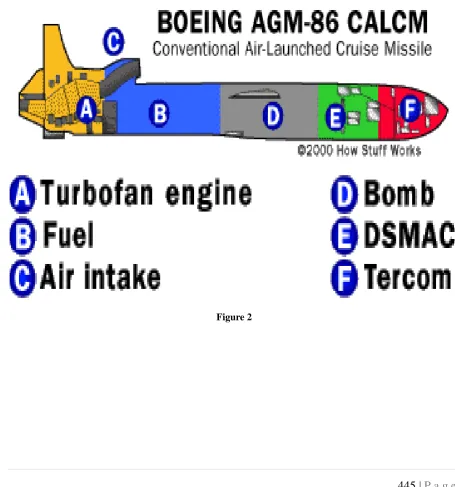
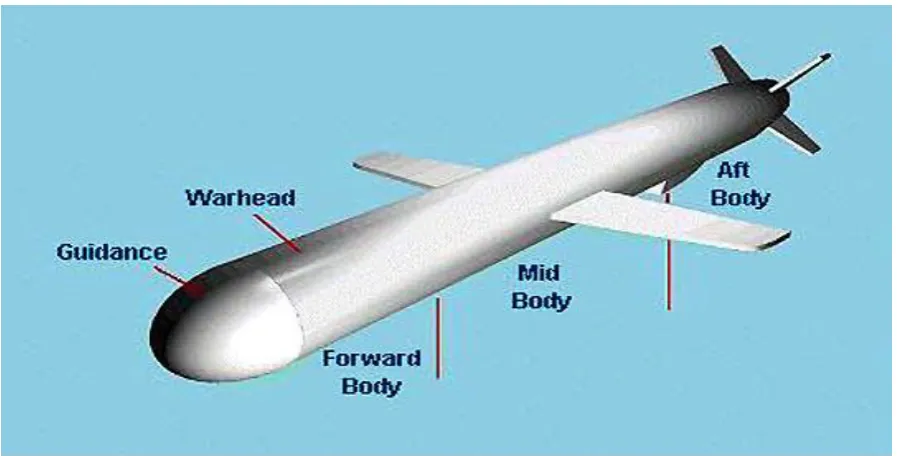
Cruise missiles generally consist of a guidance system, payload, and propulsion system, housed in an airframe
with small wings and empennage for flight control(Ref. fig. 4 & 5). Payloads usually consist of a conventional
warhead or a nuclear warhead. Cruise missiles tend to be propelled by a jet engine, turbofan engines being
preferred due to their greater efficiency at low altitude and sub-sonic speed
.
446 | P a g e
Figure 3IV. GUIDANCE SYSTEMS
The purpose of a guidance subsystem is to direct the missile to target intercept regardless of whether or not the
target takes deliberate evasive action. The guidance function may be based on information provided by a signal
from the target, information sent from the launching ship, or both. Every missile guidance system consists of
two separate systems-an attitude control system and a flight path control system. The attitude control system
maintains the missile in the desired attitude on the ordered flight path by controlling it in pitch, roll, and yaw.
This action, along with the thrust of the rocket motor, keeps the missile in stabilized flight. The flight path
control system guides the missile to its designated target. This is done by determining the flight path errors,
generating the necessary orders needed to correct these errors, and sending these orders to the missile's control
subsystem. The control subsystem exercises control in such a way that a suitable flight path is achieved and
maintained. The operation of the guidance and control subsystems is based on the closed-loop or servo principle
. The control units make corrective adjustments to the missile control surfaces when a guidance error is present.
The control units also adjust the wings or fins to stabilize the missile in roll, pitch, and yaw. Guidance and
stabilization are two separate processes, although they occur simultaneously.Guidance systems also vary greatly.
Low-cost systems use a radar altimeter, barometric altimeter and clock to navigate a digital strip map. More
advanced systems use inertial guidance, satellite navigation and terrain contour matching (TERCOM). Use of an
automatic target recognition (ATR) algorithm/device in the guidance system increases accuracy of the missile.
447 | P a g e
V. TYPES OF GUIDANCE SYSTEMS
5.1. Inertial navigation system
An inertial guidance system is one that is designed to fly a predetermined path. The missile is controlled by
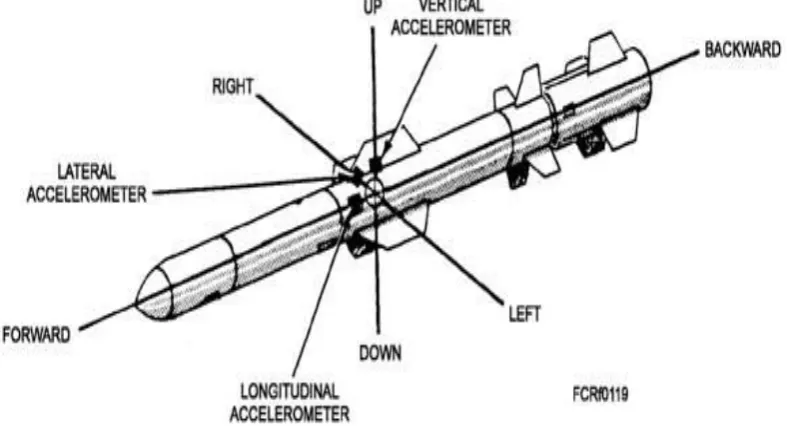
self-contained automatic devices called accelerometers.Accelerometers are inertial devices that measure
accelerations. In missile control, they measure the vertical, lateral, and longitudinal accelerations of the
controlled missile (Ref. fig. 6) .Although there may not be contact between the launching site and the missile
after launch, the missile is able to make corrections to its flight path with amazing precision. During flight,
unpredictable outside forces, such as wind, work on the missile, causing changes in speed commands. These
commands are transmitted to the missile by varying the characteristics of the missile tracking or guidance beam,
or by the use of a separate radio uplink transmitter. This data is taken by onboard computers and converted onto
precise position of the missile.Lately, however, inertial systems have been combined with GPS (Global
Positioning System) to navigate missiles more accurately. However, even with the best inertial systems
available, missiles suffer from a phenomenon called drift. This is measured in distance (meters) per hour. For
example, during the making of the Tomahawk Cruise missiles it was determined that even with the inertial
navigation system, it would have a drift of 900 meters per hour. This essentially means that if the missile flew
for one hour, it could miss the target by as much as 900 meters! Further, while ICBMs travel at sonic and
supersonic speeds, smaller Cruise’s speed was subsonic. So, the chances of missing the target are higher.
448 | P a g e
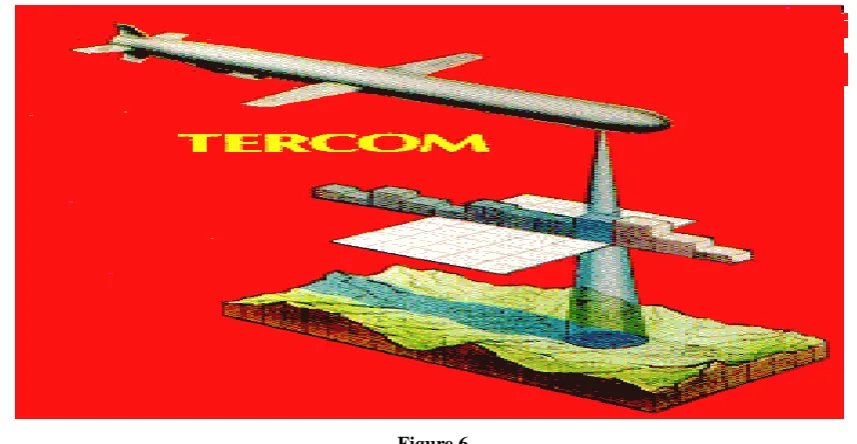
Figure 55.2. TERCOM (Terrain Contour Matching)
Terrain Contour Matching, or TERCOM, is a navigation system used primarily by cruise missiles. It uses a
pre-recorded contour map of the terrain that is compared to measurements made during flight by an on-board radar
altimeter. A TERCOM system considerably increases the accuracy of a missile compared to inertial navigation
systems (INS). The increased accuracy allows a TERCOM-equipped missile to fly closer to obstacles and
generally lower altitudes, making it harder to detect by
ground radar.
Figure 6
TERCOM navigation "maps" consist of a series of strips of land that the missile is expected to fly over, encoded
as a series of altitudes (Ref.fig 8). Since a radar altimeter measures distances, height over the ground, and not an
absolute altitude, the maps generally encode a series of changes in altitude, not the absolute altitude itself.
449 | P a g e
produced, typically from data from radar mapping satellites. When flying over water, contour maps are replacedby magnetic field maps.The missile's radar altimeter feeds measurements into a smaller buffer, which
periodically "gates" the measurements over a period of time and averages them out to produce a single
measurement. The series of such numbers held in the buffer produce a strip of measurements similar to those
held in the maps. The two are compared to overlay the buffer's strip on the known map, and the positioning of
the strip within the map produces a location and direction. The guidance system can then use this information to
correct the flight path of the missile. During the flight to the target the accuracy of the system has to be high
enough only to avoid terrain features. This allows the maps to be relatively low resolution in these areas. Only
the portion of the map for the terminal approach has to be higher resolution, and would normally be encoded at
the highest resolutions available to the satellite mapping system. TERCOM systems have the advantage of
offering accuracy that is not based on the length of the flight; an inertial system slowly drifts after a "fix", and its
accuracy is lower for longer distances. TERCOM systems receive constant fixes during the flight, and thus do
not have any drift. Their absolute accuracy, however, is based on the accuracy of the radar mapping information,
which is typically in the range of meters, and the ability of the processor to compare the altimeter data to the
map quickly enough as the resolution increases. This generally limits first generation TERCOM systems to
targets on the order of hundreds of meters, limiting them to the use of nuclear warheads. Use of conventional
warheads requires further accuracy, which in turn demands additional terminal guidance systems.One
disadvantage of TERCOM systems is that the entire route has to be pre-planned, including its launch point. If
the missile is launched from an unexpected location or flies too far off-course, it will never fly over the features
included in the maps, and become lost. The INS system can help in this regard, allowing it to fly to the general
area of the first patch, but gross errors simply cannot be corrected. This makes TERCOM based systems much
less flexible than more modern systems like GPS, which can be set to attack any location from any location, and
does not require any sort of pre-recorded information which means they can be targeted immediately prior to
launch.
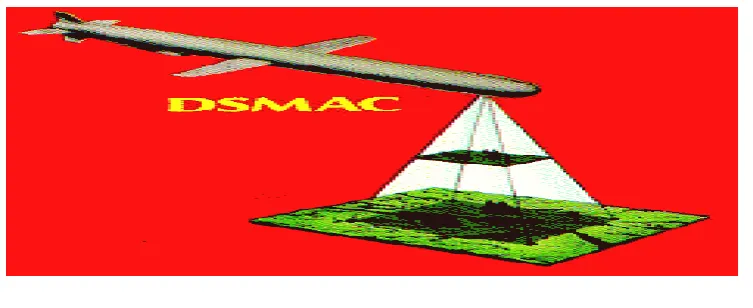
5.3. DSMAC (Digital Scene-Mapping Area Correlator)
Figure 7
Early cruise missiles did not have the mapping satellites to draw information from, and there were plans to use a
450 | P a g e
surveillance aircraft were put into a carousel in the missile, which were selected at timed intervals and imagedusing a television camera( Ref. fig 9). Another camera took pictures out of the bottom of the missile, imaged
onto a similar display. A computer compared the two displays and attempted to line up areas of high contrast,
similar to the contrast seekers used in the Maverick missile, and the offsets needed to align the two images could
be decoded into a location and heading. However, this system proved to be very slow, and no such system was
ever employed operationally, its role being taken up by TERCOM.The massive improvements in memory and
processing power from the 1950s when these scene comparison systems were first invented to the 1980s when
TERCOM was widely deployed changed the nature of the problem considerably. Modern systems can store
numerous images of a target as seen from different directions, and often the imagery can be calculated using
image synthesis techniques. Likewise, the complexity of the live imaging systems has been greatly reduced
through the introduction of solid-state technologies like CCDs. The combination of these technologies produced
the Digital Scene-Mapping Area Correlator (DSMAC). DSMAC systems are often combined with TERCOM as
a terminal guidance system, allowing point attack with conventional warheads.
VI. SATELLITE NAVIGATION
Another way to navigate a cruise missile is by using a satellite positioning system, such as GPS (Ref. fig 10) .
Satellite navigation systems are precise and cheap. Unfortunately, they rely on satellites. If the satellites are
interfered with (e.g. destroyed) or if the satellite signal is interfered with (e.g. jammed), the satellite navigation
system becomes inoperable. Therefore, the GPS-based navigation is useful in a conflict with a technologically
unsophisticated adversary. On the other hand, to be ready for a conflict with a technologically advanced
adversary, one needs missiles equipped with TAINS and DSMAC.
Figure 8
Advantages and Disadvantages of cruise missiles
Advantages:
1. The big advantage of the cruise missile is its smallness and cost. The missile's small size and weight of less
451 | P a g e
comparison with only two Hound Dogs) or as many as 50 by a Boeing 747 or similar wide-bodied transportconverted into a missile carrier.
2. Its small size also improved the weapon’s chances of penetration, especially when combined with its ability to
fly along the contour of the earth, as low as 20 meters above a level surface or within 100 meters of
mountainous terrain, according to some published reports.
3. The map matching system (TERCOM) is combined with an inertial navigational system in a system called
TAINS. This not only gets the cruise to its target but also with an accuracy heretofore unheard of for an
intercontinental weapon: less than 100 meters, an accuracy that brings the cruise missile full circle by making
nonnuclear warheads feasible.
Disadvantages :
1. The missiles aren't always accurate, they're expensive, and they're becoming scarce.
2. The lack of a human pilot means you can't re-use the thing, whereas you can get multiple missions out of a
piloted aircraft.
3. While they’re cheaper than ballistic missiles, they're more expensive than the gravity bombs you'd drop from
a manned aircraft.
4. Finally, their low and slow flight means they can be engaged by a much wider variety of systems, including
MANPADS and SAMs, with consequently less chance of reaching target.
VII. CONCLUSIONS
Currently cruise missiles are among the highly expensive of single-use weapons, up to several million dollars
apiece. However, they are cheaper than human pilots when total process of preparing (training) and
infrastructure costs are taken into account. cruise missiles are much more complex to detect and intercept than
other aerial assets, making them particularly suited to attacks against static air protection systems. Guidance
System used in cruise missile is a complex system which involves some different systems working in tandem.
Development of missile involves huge expenditures it is essential that guidance system is properly designed for
exact interception of targets.
REFERENCES
[1] www.airpower.maxwell.af.mil/airchronicles [2] www.foreignaffairs.com/.../cruise-missiles-technology-strategy-politics [3] everything2.com/title/Cruise+Missile [4] www.ausairpower.net/DT-CM-Guidance [5] www.howstuffworks.com[6] www.aerospaceweb.org/.../ missiles