A Randomized, Double-Blind, Placebo-Controlled Trial of the Effects of
Prophylactic Theophylline on Renal Function in Term Neonates
With Perinatal Asphyxia
Alejandro G. Jenik, MD*; Jose´ M. Ceriani Cernadas, MD*; Adriana Gorenstein, MD‡; Jose´ A. Ramirez, MD*; Nestor Vain, MD‡; Marcelo Armadans, MD§; and Jorge R. Ferraris, MD*
ABSTRACT. Background. The kidney is the most
damaged organ in asphyxiated full-term infants. Experi-ments in rabbits and rats have shown that renal adeno-sine acts as a vasoconstrictive metabolite in the kidney after hypoxemia and/or ischemia, contributing to the fall in glomerular filtration rate (GFR) and filtration fraction. Vasoconstriction produced by adenosine can be inhib-ited by the nonspecific adenosine receptor antagonist, theophylline. Gouyon and Guignard performed studies in newborn and adult rabbits subjected to normocapnic hypoxemia. Their results clearly showed that the hypox-emia-induced drop in GFR could be avoided by the ad-ministration of low doses of theophylline.
Objective. This study was designed to determine whether theophylline could prevent and/or ameliorate renal dysfunction in term neonates with perinatal as-phyxia.
Setting. Buenos Aires, Argentina.
Study Design. We randomized 51 severe asphyxiated term infants to receive intravenously a single dose of either theophylline (8 mg/kg; study group: n ⴝ 24) or placebo (control group:nⴝ27) during the first 60 min-utes of life. The 24-hour fluid intake and the urine vol-umes formed were recorded during the first 5 days of life. Daily volume balances (water output/input ratio and weights) were determined. Severe renal dysfunction was defined as serum creatinine elevated above 1.50 mg/dL, for at least 2 consecutive days after a fluid challenge, or rising levels of serum creatinine (.3 mg/dL/day). The GFR was estimated during the second to third days of life by endogenous creatinine clearance (mL/minute/1.73 m2) and using Schwartz’s formula: GFR (mL/minute/1.73 m2)ⴝ.45ⴛlength (cm)/plasma creatinine (mg/100 mL) during the first 5 days of life. Tubular performance was assessed as the concentration of2-microglobulin (2M) determined by enzyme immunoassay, on the first voided urine 12 hours after theophylline administration. The statistical analysis for the evaluation of the differences between the groups was performed with Student’stand 2tests as appropriate.
Results. During the first day of life, the 24-hour fluid balance was significantly more positive in the infants receiving placebo compared with the infants receiving theophyline. Over the next few days, the change in fluid balance favored the theophyline group. Significantly higher mean plasma values were recorded in the placebo
group from the second to the fifth days of life. Severe renal dysfunction was present in 4 of 24 (17%) infants of the theophylline group and in 15 of 27 (55%) infants of the control group (relative risk: .30; 95% confidence in-terval: .12–.78). Mean endogenous creatinine clearance of the theophylline group was significantly increased com-pared with the creatinine clearance in infants receiving placebo (21.84ⴞ7.96 vs 6.42ⴞ4.16). The GFR (estimated by Schwartz’s formula) was markedly decreased in the placebo group. Urinary2M concentrations were signif-icantly reduced in the theophylline group (5.01 ⴞ 2.3 mg/L vs 11.5ⴞ7.1 mg/L). Moreover, 9 (33%) patients of the theophylline group versus 20 (63%) infants of the control group had urinary 2M above the normal limit (<.018).
There was no difference in the severity of the asphyxia between infants belonging to the theophylline and con-trol groups in regards of Portman’s score. Except for renal involvement, a similar frequency of multiorganic dys-function, including neurologic impairment, was ob-served in both groups.
The theophylline group achieved an average serum level of 12.7 g/mL (range: 7.5–18.9g/mL) at 36 to 48 hours of live versus traces (an average serum level of .87 g/mg) in the placebo group.
Conclusions. Our data suggest that prophylactic the-ophylline, given early after birth, has beneficial effects on reducing the renal dysfunction in asphyxiated full-term infants. A single dose of 8 mg/kg of theophylline within the first postnatal hour in term neonates with severe perinatal asphyxia results in a significant decrease in serum creatine and urinary2M, together with a sig-nificant increase in the creatine clearance. The potential clinical relevance of the data would be the avoidance of the contributory role of hypoxemia in the development of acute renal failure. Additional studies will be neces-sary before the use of theophylline in asphyxiated new-borns can be considered for clinical practice. Pediatrics
2000;105(4). URL: http://www.pediatrics.org/cgi/content/ full/105/4/e45; perinatal asphyxia, theophylline, renal function.
ABBREVIATIONS. ARF, acute renal failure; GFR, glomerular fil-tration rate; FF, filfil-tration fraction; 2M,2-microglobulin; CNS, central nervous system.
F
etal and neonatal asphyxia are the primary causes of transient renal impairment or acute renal failure (ARF) in neonates.1,2 Circulatory adaptive responses to perinatal asphyxia may lead to renal injury as a consequence of decreased perfusion of the kidney.3,4Recently, Gunn et al5reported that From the *Department of Pediatrics of the Hospital Italiano; ‡SanatorioGu¨emes; and §Clı´nica Maternal Lomas, Buenos Aires, Argentina. Received for publication May 24, 1999; accepted Nov 10, 1999.
Reprint requests to (A.G.J.) Carlos Villate 909, Olivos, 1636, Buenos Aires, Argentina. E-mail: [email protected]
all the infants with hypoxic-ischemic encephalopa-thy included in their study developed signs of ARF. A persistent tubular dysfunction at 1 year old has been described in infants with a neonatal history of renal failure associated with asphyxia.6
The study of the protection of renal adverse effects of hypoxemic and/or ischemic impairments has been the focus of numerous investigations. Experi-mental data obtained from animal models suggest that various pharmacological agents, such as meth-ylxantines,7calcium entry blockers,8and atrial natri-uretic peptide,9 are effective in the prevention of renal impairment associated with hypoxemia.
Experiments in rabbits10 and rats11 have shown that renal adenosine acts as a vasoconstrictive me-tabolite in the kidney after hypoxemia and/or isch-emia, contributing to the fall in glomerular filtration rate (GFR) and filtration fraction (FF).12 Vasoconstric-tion produced by adenosine can be inhibited by the nonspecific adenosine receptor antagonist, theophyl-line.13
Gouyon and Guignard7performed studies in new-born and adult rabbits subjected to normocapnic poxemia. Their results clearly showed that the hy-poxemia-induced drop in GFR could be avoided by the administration of low doses of theophylline. To determine whether theophylline could prevent and/or ameliorate the renal dysfunction in term in-fants with severe asphyxia, we designed a random-ized, multicenter, double-blind, placebo-controlled trial.
METHODS
Infants eligible for study admission were of term or postterm gestation and had severe birth asphyxia manifested by: 1) history of fetal distress (late decelerations, decreased heart rate variability, or bradicardia (⬍100 beats/minute with or without meconium stained amniotic fluid); 2) 5-minute Apgar score of 6 or lower; 3) base deficit equal to or greater than 15 mEq/L in cord blood or admission arterial blood sample; and 4) requirement of immediate neonatal ventilation with mask or traqueal tube for⬎2 minutes after delivery.
Exclusion criteria applied on infants were: 1) any condition that was abnormal or unrelated to asphyxia; 2) small for gestational age; 3) congenital abnormalities of kidneys and/or urinary tract; 4) cardiovascular pathology not related to prenatal asphyxia; 5) prenatal or neonatal exposure to medications that might have modified renal hemodynamics and renal function; 6) polycythe-mia; 7) clinical evidence of potential antenatal injury, ie, micro-cephaly, multiple pregnancy, hypothyroidism, or chromosomal disorders; and 8) pharmacological depression.14
The study population included infants born at 3 hospitals of Buenos Aires, Argentina (Hospital Italiano, Sanatorio Gu¨emes, and Clı´nica Maternal Lomas).
Infants were managed according to an identical special protocol approved by the local ethics committees of each hospital.
After parental consent was obtained, infants were randomized by sequential computer-generated numbers to receive intrave-nously a single dose of either theophylline (8 mg/kg; 1.6 mL/kg) or an equal volume of placebo (5% dextrose in water). The loading infusion was administrated as soon as possible after admission to the neonatal intensive care unit over a 5-minute period within the first hour after birth. Investigators and caregivers were blinded to the assignment of the patient. Preparation of both treatment and placebo drugs were provided by Phoenix Pharmaceutical (Buenos Aires, Argentina) in vials with the same external appearance and placed in consecutive numbered sealed opaque envelops based on a randomized table with predetermined group allocation.
The theophylline dose selected for this trial was based on studies by Kelly and Shannon15that used a 7.5-mg/kg dose in
term newborns with apnea without finding adverse side effects, except for vomiting in 2 patients.
The Score of Portman et al16was used to determine the severity
of the asphyxia and to assess whether patients belonging to both groups had potentially the same multiorganic risk predictability. The score (range: 0 –9) was based on fetal heart rate, 5-minute Apgar score, and base deficit in the first hour of life. According to Portman et al,16the score for severe asphyxia was defined as⬎6
and for moderate asphyxia as⬍5.
The indication for treatment of hypotension was a systemic mean arterial blood pressure⬍45 mm Hg.17
Infants initially received an intravenous infusion of D10W at a rate of 60 mL/kg/day. Fluid and electrolyte intake was subse-quently adjusted as indicated by the clinical status of each patient. After a poor response of a reduced urine output with a fluid challenge, a 2-mg/kg dose of furosemide was given. Fluid restric-tion was instituted in the infants with oliguric renal failure.
The 24-hour fluid intake and the urine volumes formed were recorded during the first 5 days of life. Hourly urinary output was carefully collected by attaching a urine bag to the perineum or was measured via a urine catheter. The spilled urine was measured by weighing the diapers. All fluid volume infusions, transfusions, and medications administered were recorded. Daily volume bal-ances (water output/input ratio and weights) were determined.
Body weight was measured on admission to the unit and then every 24 hours for the first week of life.
To assess renal function, we determined daily serum creatinine levels (Yaffe method, Astra, Beckman) and electrolytes in the first week of life; 12-hour urine collections were obtained between the second and third days of life to evaluate urine creatinine levels and electrolytes.
The GFR was estimated during the second to third days of life by endogenous creatinine clearance (mL/minute/1.73 m2) and also using Schwartz’s formula18: GFR (mL/minute/1.73 m2)⫽
.45⫻length (cm)/plasma creatinine (mg/100 mL) during the first 5 days of life.
Criteria for post asphyxia severe renal dysfunction were: a serum creatinine elevated above 1.50 mg/dL, for at least 2 con-secutive days after a fluid challenge consisting of a total of 20 mL/kg of normal saline, or rising levels of serum creatinine (.3 mg/dL/day). These values are according to literature data1,17and
also correspond to ⫹2 standard deviation over mean normal standard value that we obtained from 55 healthy neonates born at a gestational age of⬎37 weeks (unpublished data). Oliguria was defined as a urine output of⬍1 mL/kg per hour for at least 24 hours, based on our experience and literature data.19
Hematuria was assessed using standard dipstick reagent strips (Multistix, Bayer Diagnostics, Buenos Aires, Argentina).
Tubular performance was assessed as the concentration of 2-microglobulin (2M) determined by enzyme immunoassay (En-zygnost (R) ⫺ 2M), on the first voided urine 12 hours after theophylline administration. All urine samples were collected be-fore the administration of the first dose of aminoglycoside antibi-otics. Suprapubic compression was performed at the beginning of each urine collection to ensure that the urine preserved in the bladder had not been formed before the inutero asphyxia event. Urine samples were frozen promptly and stored at⫺20°C until determinations were performed. Our data from healthy infants showed that the 95% confidence limit (mean⫹2 standard devia-tion) for urinary2M concentration was 3.8 mg/L.20We used this
value as the upper limit of normal. Our data were consistent with those reported by Tack et al21who found that the 95% confidence
limit for2M concentrations in healthy infants was 4.00 mg/L on the first voided specimens.
Serum theophylline levels were determined at 36 to 48 hours of life.
Continuous variables with normal distribution were analyzed by Student’sttest. The2test was used for analysis of discrete
data. Differences were considered significant at P ⬍ .05. The results are reported as mean⫾standard deviation.
RESULTS General Features
congen-ital malformations, 2 because of pharmacological de-pression, 1 because of maternal heroin addiction, 1 because the mother died just after delivery, and 1 because the mother had renal failure with a serum creatinine value of 2.1 mg/dL. Fifty-one asphyxiated term infants were enrolled in the study. Twenty-four infants randomized were assigned to the theophyl-line group, and 27 to the placebo group.
Intubation was performed in 41 patients; biochem-ical resuscitation in 28.
There were no significant differences in birth weight, gestational age, sex, cesarean rate, presence of meconium-stained amniotic fluid, individual com-ponents of the asphyxia morbidity score (fetal heart rate, 5-minute Apgar score, and base excess), arterial blood pH, and blood pressure. No infants were breech or small for gestational age (⬍10th percen-tile). Each group received either theophylline or an equal volume of placebo at similar chronological ages (45 ⫾7 vs 38⫾ 5.0 minutes; Table 1).
Four of these critically ill infants died. One patient belonging to the theophylline group died from per-sistent pulmonary hypertension. There were 3 neo-natal deaths in the placebo group: 2 of them attrib-utable to multisystemic organ failure, and 1 caused by overwhelming sepsis.
All asphyxiated infants required respiratory sup-port; none hyperventilated. Involvement of 1 or more organs occurred in 75% of the infants. Central
nervous system (CNS) involvement (seizures, tran-sient cerebral irritability, and feeding problems) oc-curred in 38 (74%) of the infants. Clinical seizures required treatment with anticonvulsants in 13 con-trol infants and 9 infants receiving theophylline. Pul-monary involvement (meconium aspiration, persis-tent pulmonary hypertension, and mild respiratory distress syndrome) was evidenced in 18 (35%) in-fants. Seven infants had abnormal echocardiographic findings (tricuspid or mitral regurgitation and/or myocardial dyskinesia not affecting ventricular out-put). Gastrointestinal involvement (bloody stools, necrotizing enterocolitis, and bilious residuals) oc-curred in 11 (21%) infants. We found no significant differences in frequency and severity of CNS, pul-monary, heart, and gastrointestinal involvement be-tween the 2 groups. However, severe renal dysfunc-tion was present in 4 (17%) infants of the theophylline group and in 15 (55%) of the control group (relative risk: .30; 95% confidence interval: .12-.78;P ⬍.001; Fig 1).
Renal Evaluation
Table 2 summarizes the balances during the first 5 days of life in the 2 groups of asphyxiated neonates. During the first day of life, the 24-hour fluid balance was significantly more positive in the infants receiv-ing placebo compared with the infants receivreceiv-ing the-ophylline. Over the next days, the change in fluid
Fig 1. The frequency of organ involvement for the 2 groups of asphyxiated neonates.
*p⫽.001
TABLE 1. Clinical Characteristics on the First Day of Life in the Two Groups of Asphyxiated Neonates*
Theophylline Group n⫽24
Placebo Group n⫽27
P Value
Birth weight (g) 3.256⫾309 3.387⫾376 .99† Gestation age (wk) 39.3⫾1.6 39.4⫾1.4 .81†
Cesarean section (%) 14 (58) 13 (48) .46‡
Meconium staining of amniotic fluid (%) 17 (70) 18 (67) .98‡ Initial arterial blood gases values
pH 7.04⫾.13 7.02⫾.17 .64†
Base excess (mEq/L) ⫺18.32⫾2.45 ⫺19.15⫾4.07 .38†
Asphyxia score⬎6 (%) 18 (75) 21 (77) .92‡
Age of starting loading infusion of theophylline or placebo (m) 45⫾7 38⫾5.0 .24† Inotropic agents infused (%) 14 (58) 17 (63) .96‡ Mean blood pressure (mm Hg; 12 h of life) 51⫾8 49⫾6 .31†
* Values are expressed as mean⫾standard deviation. † Student’sttest.
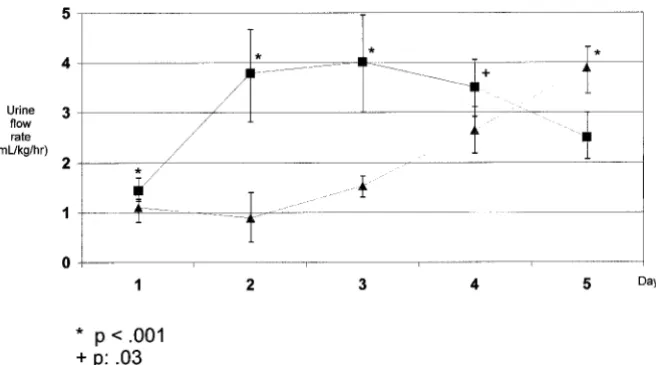
balance favored the theophylline group. The diuretic response was significantly greater in the theophyl-line group (Fig 2). On the first day of life, plasma creatinine values were similar in the 2 groups, but significantly higher mean plasma creatinine values were recorded in the placebo group from the second to the fifth days of life (Table 3). During the second to the third days of life, mean endogenous creatinine clearance (mL/minute/1.73 m2) of the theophylline group was significantly increased compared with the creatinine clearance in infants receiving placebo (21.84 ⫾ 7.96 vs 8.42 ⫾ 4.16; P ⬍ .001). The GFR (estimated by Schwartz’s formula) were markedly decreased in the placebo group (Table 3). No differ-ence was found in sodium excretion obtained from 12-hour urine collections between the second and third days of life in the theophylline group with respect to the control group (45⫾55 mEq/L vs 57⫾ 49 mEq/L; P ⫽ .24). Urinary 2M concentrations were significantly reduced in the theophylline group (5.01 ⫾ 2.3 mg/L vs 11.5 ⫾ 7.1 mg/L; P ⫽ .005). Moreover, 9 (33%) patients of the theophylline group versus 20 (63%) infants of the control group had urinary2M above the normal limit (P ⬍.018).
Dipstick testing for hematuria over the first 3 days of life demonstrated large blood on at least one oc-casion in 15 of 24 in the theophylline group and 19 of 27 in the control group (P⫽.766).
Serum Theophylline Levels
The theophylline group achieved an average se-rum level of 12.7g/mL (range: 7.5–18.9g/mL) at
36 to 48 hours of life versus traces (an average serum level of .87 g/mg) in the placebo group.
DISCUSSION
Our findings indicate that treatment with a single dose of 8 mg/kg of theophylline within the first postnatal hour in term neonates with severe perina-tal asphyxia results in a significant decrease in serum creatinine and urinary2M, together with a signifi-cant increase in the creatinine clearance. In addition, the present study shows that using theophylline in neonatal asphyxia helps to reduce the severe renal dysfunction. All infants reported in this study were critically ill according to their immediate postpartum conditions and exhibited numerous signs of multi-systemic dysfunction.
The kidney is the most damaged organ in asphyx-iated full-term infants.2,22 Acute hypoxemia is asso-ciated with an increase in renal vascular resistance and a decrease in GFR and FF.23 During oxygen deficit, when adenosine triphosphate hydrolysis pre-vails over adenosine triphosphate synthesis, adeno-sine (a direct degradative product of 5⬘adenosine monophosphate) increases and activates its receptors resulting in an increment of the renal vascular resis-tance (preglomerular vasoconstriction and post-glomerular vasodilatation) thus decreasing GFR and FF.24
Hemodynamic renal changes produced by adeno-sine were observed during ischemic or hypoxemic experimental studies.25Moreover, adenosine admin-TABLE 2. Balances: Comparison of Weight and Water Output/Input Ratio During the First Five Days of Life in the Two Groups of Asphyxiated Neonates
Days of Life Water Output/Input Ratio P Value
Weight P
Value* Theophylline Group Placebo Group Theophylline Group Placebo Group
1 .23⫾.18 .71⫾.3 ⬍.001 3.190⫾301 3.481⫾383 .004
2 1.45⫾.11 .36⫾.8 ⬍.001 3.126⫾293 3.421⫾368 .003
3 1.6⫾.55 .92⫾.6 ⬍.001 3.050⫾289 3.319⫾364 .005
4 1.38⫾.6 1.7⫾.54 .05 2935⫾106 3097⫾389 .047
5 NE NE 3019⫾284 3107⫾401 .375
NE indicates not evaluated in all the patients. * Student’sttest.
istrated into the renal artery led to decreased GFR26 in humans.
Adenosine receptor antagonists like theophylline can inhibit renal vasoconstriction in response to ex-ogenous and endex-ogenous adenosine and have been successfully used to improve renal function after experimental ARF induced by glycerol,27 endotox-in,28 and radiocontrast administration in several an-imal models.29It has been observed in rats that the-ophylline attenuates the extent of GFR reduction when it is administrated during maintenance phase of post-ischemic ARF.30 Kemper31 demonstrated in anesthetized rats that administration of theophylline (8mg/kg), before adenosine infusion, prevents a sharp fall in glomerular filtration in comparison to adenosine alone. Gouyon and Guignard7 demon-strated in newborn and adult animals that the fall in glomerular filtration induced by hypoxemia can be prevented by theophylline in low doses. These au-thors used rabbits as a animal model that showed, in hypoxemia episodes, renal changes similar to those observed in human hypoxemic newborns. Used commonly for apnea of prematurity, theophylline has also been shown to prevent both the reduction of GFR after contrast media application in humans and the renal insufficiency induced by hypoxemia in newborns with respiratory distress syndrome.32,33
In our study, the incidence of glomerular dysfunc-tion and proximal tubular damage, evidenced by elevated serum creatinine concentrations and high urinary levels of 2M, respectively, were consider-ably lower in the group receiving theophylline. The mechanism by which the administration of theoph-ylline results in lower serum creatinine and better diuresis could be attributable, at least in part, to an increase in GFR explained by the adenosine block-ade.36Moreover, daily fluid balance was significantly more negative in the theophylline group. The GFR was estimated by endogenous creatinine clearance and using Schwartz’s formula. With both methods, we obtained significantly increased values in the the-ophylline group. Zacchello et al35 concluded that Schwartz’s formula provides an adequate estimation of neonatal creatinine clearance as a marker for GFR in neonatal asphyxia. Although the levels of urine sodium showed no difference between the 2 groups, these results need to be interpreted with caution because it is known that theophylline causes natri-uresis.34 Theophylline levels were within the thera-peutic range in patients of the theophylline group and no side effects were observed.
In newborn asphyxiated piglets, a supply of 8 mg/kg of theophylline attenuates in a nonsignificant way the increase in brain circulation that normally takes place in hypoxia episode.36It has been reported that pretreatment of rats with aminophylline in ex-perimental cerebral ischemia reduced the mortality rate from 56% to 10%.37 Bona et al38 showed that acute treatment with adenosine A1 antagonist before hypoxic-ischemic reduces brain damage in rat pups. Significant cerebroprotection was reported in new-born rats by potentiation of endogenous extracellular adenosine levels with either the adenosine deami-nase inhibitor deoxycoformycin or the adenosine transport inhibitor propentofylline.39 However, we found no significant differences in the incidence of CNS involvement and seizures between the 2 groups of asphyxiated neonates.
CONCLUSION
Our data suggest that prophylactic theophylline treatment, given early after birth, has beneficial ef-fects reducing the renal involvement in asphyxiated full-term infants, with no significant changes in CNS involvement. The potential clinical relevance of these data would be the avoidance of the contributory role of hipoxemia in the development of ARF. Additional and larger studies will be necessary before the use of theophylline in asphyxiated newborns can be consid-ered for clinical practice.
ACKNOWLEDGMENTS
This study was supported by a grant from the National Acad-emy of Medicine of Argentina.
We thank Dr S. Silberstein for assistance with the manuscript.
REFERENCES
1. Karlowicz MG, Adelman RD. Nonoliguric and oliguric acute renal failure in asphyxiated term neonates.Pediatr Nephrol. 1995;9:718 –722 2. Willis F, Summers J, Minutillo C, Hewitt I. Indices of renal tubular
function in perinatal asphyxia.Arch Dis Child Fetal Neonatal Ed. 1997;77: F57–F60
3. Behrman RE, Lees MH, Peterson EN, De Lannoy CW, Seeds AE. Dis-tribution of the circulation in the normal and asphyxiated fetal primate.
Am J Obstet Gynecol. 1970;108:956 –969
4. Rudolph AM. The fetal circulation and its response to stress.J Dev
Physiol. 1984;6:11–19
5. Gunn AJ, Gluckman PD, Gunn TR. Selective head cooling in newborn infants after perinatal asphyxia: a safety study.Pediatrics. 1998;102: 885– 892
6. Di Pietro A, Proverbio MR, Pescatore L, et al. Valutazione del danno renale in corso di sindrome anossica neonatale: follow-up di un anno. [English translation: Evaluation of kidney damage in neonatal anoxia syndrome: a 1-year follow-up].Pediatr Med Chir. 1989;11:637– 638 7. Gouyon JB, Guignard JP. Theophylline prevents the hypoxemia-TABLE 3. Renal Evaluation: The GFR (Estimated by Schwartz’s Formula) and Plasma Creatinine in the First Five Days of Life in the Two Groups of Asphyxiated Neonates*
Days of Life Glomerular Filtration Rate PValue Plasma Creatinine (mg/dL) PValue†
Theophylline Group Placebo Group Theophylline Group Placebo Group
1 23.17⫾10.3 22.07⫾9 .68 1.0⫾.3 1.05⫾.4 .62
2 24.01⫾8.6 14.9⫾6.8 ⬍.001 .97⫾.17 1.51⫾.41 ⬍.001 3 25.94⫾11.2 11.36⫾5.1 ⬍.001 1.02⫾.69 1.94⫾1.1 ⬍.001
4 27.29⫾9.1 32.41⫾7.4 ⬍.03 .89⫾.7 1.59⫾.7 ⬍.001
5 32.41⫾7.4 18.0⫾9.8 ⬍.001 .71⫾.2 1.36⫾.9 ⬍.001
induced renal hemodynamic changes in rabbits.Kidney Int. 1988;33: 1078 –1083
8. Burke TJ, Arnold PE, Gordon JA, Bulger RE, Dobyan DC, Schrier RW. Protective effect of intrarenal calcium membrane blockers before or after renal ischemia: functional, morphological, and mitochondrial studies.J Clin Invest. 1984;74:1830 –1841
9. Wiesel PH, Semmekrot BA, Grigoras O, Heumann C, Guignard JP. Pharmacological doses of atrial natriuretic peptide ameliorate the acute renal dysfunction induced by systemic hypoxemia.J Pharmacol Exp Ther. 1990;254:971–975
10. Busch EW, Borcke IM von, Martinez B. Abbauwege und Abbaumuster der Purinnucleotide in Herz-, Leber-, und Nierengewebe von Kan-inchen nach Kreislaufstillstand. [English translation: Pathway and pat-tern for purine catabolism in rabbit heart, liver and kidney tissues during circulation stasis].Biochim Biophys Acta. 1968;166:547–556 11. Osswald H, Schmitz HJ, Kemper R. Tissue content of adenosine, inosine
and hypoxanthine in the rat kidney after ischemia and postischemic recirculation.Pflugers Arch. 1977;371:45– 49
12. Churchill PC, Bidani AK. Hypothesis: adenosine mediates hemody-namic changes in renal failure.Med Hypotheses. 1982;8:275–285 13. Osswald H. Renal effects on adenosine and their inhibition by
theoph-ylline in dogs.Naunyn Schmiedebergs Arch Pharamcol. 1975;288:79 – 86 14. Volpe JJ, ed.Neurology of the Newborn. 3rd ed. Philadelphia, PA: WB
Saunders; 1995
15. Kelly DH, Shannon DC. Treatment of apnea and excessive periodic breathing in the full-term infant.Pediatrics. 1981;68:183–186
16. Portman RJ, Carter BS, Gaylord MS, Murphy MG, Thieme RE, Meren-stein GB. Predicting neonatal morbidity after perinatal asphyxia: a scoring system.Am J Obstet Gynecol. 1990;162:174 –182
17. Cloherty JP, Stark AR.Manual of Neonatal Care/Joint Program in
Neona-tology, Harvard Medical School. 4th ed. Philadelphia, PA:
Lippincott-Raven; 1998
18. Schwartz GJ, Haycock GB, Edelmann CM Jr, Spitzer A. A simple esti-mate of glomerular filtration rate in children derived from body length and plasma creatinine.Pediatrics. 1976;58:259 –263
19. Shaffer SE, Norman ME. Renal function and renal failure in the new-born.Clin Perinatol. 1989;16:199 –218
20. Jenik A, Fustin˜ana C, Sorroche P, Ferraris J, Ceriani Cernadas JM. Evalu-acio´n de la Funcio´n Tubular Renal en Recie´n Nacidos (RN) Mediante el Dosaje de 2 Microglobulina Urinaria (2 M).[English translation:Neonatal Tubular
Function Assessment Using2-Microglobulin (2 M)]. 29aReunio´n de la
Sociedad Latinoamericana de Investigacio´n Pedia´trica (SLAIP); October 27–30, 1997; Vin˜a del Mar, Chile. No. 56. Abstract
21. Tack ED, Perlman JM, Robson AM. Renal injury in sick newborn infants: a prospective evaluation using urinary2-microglobulin con-centrations.Pediatrics. 1988;81:432– 440
22. Perlman JM, Tack ED, Martin T, Shackelford G, Amon E. Acute sys-temic organ injury in term infants after asphyxia. Am J Dis Child. 1989;143:617– 620
23. Gouyon JB, Vallotton M, Guignard JP. The newborn rabbit: a model for
studying hypoxemia-induced renal changes. Biol Neonate. 1987;52: 115–120
24. Hall JE, Granger JP, Hester RL. Interactions between adenosine and angiotensin II in controlling glomerular filtration.Am J Physiol. 1985; 248:F340 –F346
25. Gouyon JB, Guignard JP. Functional renal insufficiency: role of adeno-sine.Biol Neonate. 1988;53:237–242
26. Edlund A, Ohlsen H, Sollevi A. Renal effects of local infusion of aden-osine in man.Clin Sci (Colch). 1994;87:143–149
27. Bowmer CJ, Collis MG, Yates MS. Effect of the adenosine antagonist 8-phenyltheophylline on glycerol-induced acute renal failure in the rat.
Br J Pharmacol. 1986;88:205–212
28. Prada J, Churchill P., Bidani A. Protective effect of theophylline in endotoxin-mediated acute renal failure (ARF) in rats.Kidney Int. 1986; 29:308. Abstract
29. Deray G, Martinez F, Cacoub P, Baumelou B, Baumelou A, Jacobs C. A role for adenosine calcium and ischemia in radiocontrast-induced in-trarenal vasoconstriction.Am J Nephrol. 1990;10:316 –322
30. Lin JJ, Churchill PC, Bidani AK. Theophylline in rats during mainte-nance phase of post-ischemic acute renal failure.Kidney Int. 1988;33: 24 –28
31. Kemper R.Die Antagonistischen Wirkungen von Adenosine und Theophyllin
Auf Die Nierenfunktion der Rate. [English translation: The Antagonist
Effects of Adenosine and Theophylline on the Renal Function of Rats].
Aachen, Germany: 1977. MD thesis
32. Erley CM, Duda SH, Schlepckow S, et al. Adenosine antagonist theoph-ylline prevents the reduction of glomerular filtration rate after contrast media application.Kidney Int. 1994;45:1425–1431
33. Huet F, Semama D, Grimaldi M, Guignard JP, Gouyon JB. Effects of theophylline on renal insufficiency in neonates with respiratory distress syndrome.Intensive Care Med. 1995;21:511–514
34. Gouyon JB, Guignard JP. Renal effects of theophylline and caffeine in newborn rabbits.Pediatr Res. 1987;21:615– 618
35. Zacchello G, Bondio M, Saia OS, Largaiolli G, Vedaldi R, Rubaltelli FF. Simple estimate of creatinine clearance from plasma creatinine in neo-nates.Arch Dis Child. 1982;57:297–300
36. Laudignon N, Farri E, Beharry K, Rex J, Aranda JV. Influence of aden-osine on cerebral blood flow during hypoxic hypoxia in the newborn piglet.J Appl Physiol. 1990;68:1534 –1541
37. Scheinberg P. Correlation of brain monoamines and energy metabolism changes. In: American Neurological Association, American Heart
Association: Stroke Council, Princeton Conference (1976). Cerebrovascular
diseases. New York, NY: Raven Press; 1976 –1979:167–171
38. Bona E, Åde´n U, Fredholm BB, Hagberg H. Reduction of neonatal hypoxic-ischemic brain damage after acute adenosine antagonist treat-ment.Pediatr Res. 1995;37:376A. Abstract
DOI: 10.1542/peds.105.4.e45
2000;105;e45
Pediatrics
Nestor Vain, Marcelo Armadans and Jorge R. Ferraris
Alejandro G. Jenik, José M. Ceriani Cernadas, Adriana Gorenstein, José A. Ramirez,
Asphyxia
Prophylactic Theophylline on Renal Function in Term Neonates With Perinatal
A Randomized, Double-Blind, Placebo-Controlled Trial of the Effects of
Services
Updated Information &
http://pediatrics.aappublications.org/content/105/4/e45
including high resolution figures, can be found at:
References
http://pediatrics.aappublications.org/content/105/4/e45#BIBL
This article cites 34 articles, 7 of which you can access for free at:
Subspecialty Collections
sub
http://www.aappublications.org/cgi/collection/fetus:newborn_infant_ Fetus/Newborn Infant
http://www.aappublications.org/cgi/collection/agency_abcs Agency ABC's
following collection(s):
This article, along with others on similar topics, appears in the
Permissions & Licensing
http://www.aappublications.org/site/misc/Permissions.xhtml
in its entirety can be found online at:
Information about reproducing this article in parts (figures, tables) or
Reprints
http://www.aappublications.org/site/misc/reprints.xhtml
DOI: 10.1542/peds.105.4.e45
2000;105;e45
Pediatrics
Nestor Vain, Marcelo Armadans and Jorge R. Ferraris
Alejandro G. Jenik, José M. Ceriani Cernadas, Adriana Gorenstein, José A. Ramirez,
Asphyxia
Prophylactic Theophylline on Renal Function in Term Neonates With Perinatal
A Randomized, Double-Blind, Placebo-Controlled Trial of the Effects of
http://pediatrics.aappublications.org/content/105/4/e45
located on the World Wide Web at:
The online version of this article, along with updated information and services, is
by the American Academy of Pediatrics. All rights reserved. Print ISSN: 1073-0397.