1 | P a g e
ATTENUATION OF INDUSTRIAL NOISE BY USING
NATURAL SOUND ABSORPTION MATERIALS
Mr.RupeshR.Kadam
1, Dr.D.N.Mudgal
21
PG Student, Civil Engineering Department, AMGOI, Vathar, Maharashtra, (India)
2
Executive Director, AMGOI, Vathar, Maharashtra, (India)
ABSTRACT
A comfortable workplace free from unwanted noise is dream of every industrial worker. In heavy industries workers are continuously exposed to noises the whole work day.Higher noise level in heavy industries is harmful for workers. It causes ill effects like hearing loss, tired, weakness, higher blood pressure on health of industrial workers. Therefore, to improve the environment of the workplace and reduce unwanted noise in industries it isvery important to find out effective and harmless noise control methods. The research work was conducted to investigate use of natural materials for industrial noise reduction to give effective solution for existing industrial noise problem .specimens having size of 75 mm (dia.) and 12.5mm, 25mm (thick.) were cast using material viz;Holy basil (Tulsi), Banana, Cement, Adhesive wood grip). Tulsi and banana mixed with cement and wood grip at ratio 0.5:0.5:0.5:0.5and 1:1:0.5:0.5 with addition of water. Noise reduction coefficients of prepared specimens were calculated by using an experimental set-up. Experimental set-up consisted Noise level meter, function generator, speaker. Noise reduction capacity of materials was calculated by using Noise reduction coefficient (NRC). Effectiveness of natural materials for industrial noise reduction is discussed in this paper.
Keywords: Banana, Holy Basil,Impedance Tube, Noise Reductioncoefficient (NRC).
I. INTRODUCTION
A comfortable environment free from unwanted noises at workplace is dream of every industrial worker. In heavy industries workers exposed to higher noise the whole day work. Higher noise level may leads to some discomfort, inconvenience, annoyance, and creating noises, which causes noise pollution affecting on quality and working capacity of workers.Noise pollution has more prevalent issue in present days and still it is measure ignored issue in industrial construction. Noise pollution in heavy industries is severe an environmental problem all over the world.Ear problem (HL) is the most prominent psychological problem caused by the unwanted sound.
2 | P a g e
the market but they have induce health risks to lungs and eyes while their processing [1]. There ismuch more interest in developing sustainable and eco-friendly sound absorbers either from natural agricultural wastes or recycled materials. By using such materials in industrial construction noise can be reduced more effectively in economical way.
In previous study K.N.Hemantha dedigamainvestigated noise reduction capacity of salvinia dust with cement [1]. They have also found that specimens of larger particle size have more Noise Reduction Coefficient (NRC) than that of Noise Reduction Coefficient of specimens of smaller particle size.Further they found that NRC increases with increase in specimen thickness.
In present study Banana and Tulsi (holy basil) materials are studied for their noise reduction properties. Banana was selected due to its local availability. As texture of banana consist fiber attempt has been made to use banana in the manufacturing of noise reduction materials.
Tulsi is an essential part of worship of Vishnu. Holy basil or Ocimum Tenuiflorum is the scientific name of tulsi and it is used in many medicines. A tulsi stem fiber possesses low density, spun fiber having large pores with interconnected channels. It is also light weight and porous in nature. It is easily available in the market at moderate prices. These materials selected on the basis of their noise reduction properties such as tortuosity, light weight, particle size, porosity, density, thickness, air flow resistance etc; studied from the reviewed literatures and understanding the characteristics.
II. RESEARCH METHODOLOGY
Research methodology includes development of experimental set up, specimen preparation and laboratory testing.
2.1 Specimen preparation methodology
Circular shaped specimens were prepared by mixing cement, adhesive (wood grip), holy basil (Tulsi) and banana at different mix proportions. Thickness of specimen was kept 12.5mm and 25mm while diameter is kept 75mm each specimen. The plastic mould (1000 guage PVC pipe ring) was used for casting of al specimens. As shown in fig.1
Fig.1 Mould used for Specimen Casting
Different mix proportions as 0.5:0.5:0.5:0.5 and 1:1:0.5:0.5 is used to cast specimens.
Particle sizes were selected in two categories as follows;
3 | P a g e
ii)1.18 mm – 2.36 mm
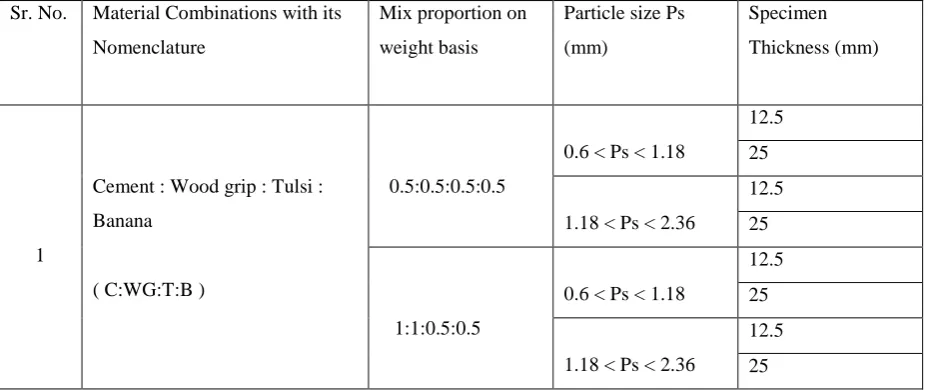
To obtain the fraction of mentioned particle size sieve analysis is carried out according to IS:2720 (part iv)-1985.Specimens were prepared using selected particle sizes of selected materials to investigate effect of particle size and specimen thickness on sound absorption capacity of specimen. Specimens were kept in laboratory for one week hardening. Various material combinations and their proportions used for specimen proportions is
given in table 1.
Table 1: Material combinations and their mix proportions used for specimen preparation
Sr. No. Material Combinations with its Nomenclature
Mix proportion on weight basis
Particle size Ps (mm)
Specimen Thickness (mm)
1
Cement : Wood grip : Tulsi : Banana
( C:WG:T:B )
0.5:0.5:0.5:0.5
0.6 < Ps < 1.18
12.5
25
1.18 < Ps < 2.36
12.5
25
1:1:0.5:0.5
0.6 < Ps < 1.18
12.5
25
1.18 < Ps < 2.36
12.5 25
2.2 Development of Experimental Set up
Experimental set up were developed similar like impedance tube system. Impedance tube method usually gives accurate measurement for sound absorption coefficient according to the ISO 10534-2. Experimental set up is developed with following apparatus and equipment‟s.
Function generator model specification Caddo 4061, 3 MHz function- pulse generator with 40 MHz frequency counter was used as sound generator, Pyramid 4080 with frequency response 60 – 20,000 Hz and 250 watt power rating to generate sound of higher intensity inside the impedance tube, Sound level meter ( model SL-4010) with calibration certificate. The tube material is not specified in ISO 10534-2 but it is strongly recommended that tube must be sufficient rigid to avoid transmission of noiseof outside noise sources inside the tube.ISO 10534-2 recommends the length of the tube at least 10–15 times of the diameter and wall thickness should be 5% of the diameter.
4 | P a g e
Fig.2 Impedance Tube System for Sound absorption Measurement
This experimental set up is well developed than previous experimental set up used by Chaturangani et al 2011. In previous experimental set up sensor of noise level meter is not provided any cover for eliminating effect of outside noise sources. In current experimental set up sensor of noise level meter is provided inside the tube for eliminating effect of outside or background noise sources.
2.3 Laboratory Experimental Work
Apparatus was prepared as shown in Fig.2 Noise levels were measured without placing the specimen in the frequency range 63 Hz – 16000 Hz, beginning from 63 Hz and gradually increased up to 16000Hz. This procedure is repeated twice to take accurate measurements. Noise reduction coefficient is used to quantify the effect of noise reduction at each frequency (63 Hz – 16000 Hz). Noise reduction coefficient can be determined as the ratio between reduced noise intensity due to the placing specimen to the incident noise intensity without placing the specimen.
Reduced Noise intensity (dB)
Noise Reduction Coefficient = ________________________________ --- (1)
Incident Noise intensity (dB)
Here,
Noise reduction is the difference between noise level measured without placing specimen specimen ( „a‟ dB) in the propagation tube and Noise level measured with placing specimen („b‟ dB) in propagation tube.
Noise Reduction Coefficient (NRC) = (a-b)/a ---(2)
5 | P a g e
III. RESULTS AND DISCUSSIONS
Noise Reduction Coefficients for different material combinations with different thickness and different mix proportion were investigated. From the calculation of NRC it is observed that Noise Reduction Coefficient is increases with increase in particle size and specimen thickness. Following material combinations observed effective for noise reduction.
Table 2. Calculated Noise Reduction Coefficients of effective material combinations
Material Combin ation Mix proporti on Particle size ( mm )
Speci men thickne ss ( mm )
Octave band frequencies ( Hz )
63 125 250 500 1000 2000 4000 8000 160 00
Noise reduction coefficient
C : WG : T : B
0.5 : 0.5 : 0.5 :
0.5
0.6 < Ps < 1.18
25 0.14 0.15 0.10 0.01 0.13 0.38 0.31 0.36 0.59
1.18 < P s< 2.36
25 0.14 0.14 0.10 0.03 0.11 0.32 0.33 0.41 0.50
1:1:0.5: 0.5
1.18<Ps <2.36
25 0.16 0.16 0.13 0.01 0.11 0.41 0.30 0.33 0.45
Fig. 3 shows Noise Reduction Coefficients for the materiel combinations Cement:Wood grip:Tulsi:Banana having specimen thickness 25 mm and particle size in between 0.6 mm –1.18 mm. at frequency 2KHz and 4KHz NRC is 0.38 and 0.36 respectively.i.e. selected material is perform well at moderate frequency. NRC is increased from 0.36 to 0.59 at 8KHz-16KHz frequency range. Hence selected material combination gives better noise reduction at higher frequency up to 59%and it brought 100dBnoise level up to 64dB and 41dB at frequency range 8 KHZ and 16KhHz respectively at industrial working place.
0 0.050.1 0.150.2 0.250.3 0.350.4 0.450.5 0.550.6 0.65
0.063 0.125 0.25 0.5 1 2 4 8 16
NRC
frequency
Cement:Woodgrip:Tulsi:Banana= 0.5:0.5:0.5:0.5, Specimen Thickness=25mm, Particle size=0.6mm-1.18mm
6 | P a g e
Fig.4 showsNoise Reduction Coefficient for material combination Cement:Wood grip:Tulsi:Banana (0.5:0.5:0.5:0.5) having specimen thickness 25mm and particle size in between 1.18 mm<Ps< 2.36 mm.At frequency range 2 KHz - 4 KHzNRC increased from 0.32 to 0.33. it means selected material is effective for noise reduction atmoderate frequency range. NRC value is increased from 0.41 to 0.50 at 8 KHz – 16KHz frequency range.Noise level of 100dB can be brought up to 59 dB and 50 dB respectively at industrial workingplace. i.e. selected material performs well at (2KHz – 16KHz) moderate frequency and higher frequency
ranges.
Fig.4 Graph Of Cement:Woodgrip:Tulsi:Banana showing NRC
Fig. 5 Shows NRC values for material combination Cement: Wood grip: Tulsi:Banana(1:1:0.5:0.5) having specimen thickness 25 mm and particle size 1.18mm to 2.36mm. Noise Reduction Value is increased up to 0.41 at 2 KHz frequency. At frequency range 4KHz to KHz NRC is increase from 0.30 to 0.45. Hence noise level of 100 dB can be effectively brought up to 70dB, 67dB and 55dB at 4KHz,8KHz and16 KHz frequencies respectively.
0
0.050.1
0.150.2
0.250.3
0.350.4
0.450.5
0.550.6
0.063 0.125 0.25 0.5 1 2 4 8 16
NRC
Frequency
Cement:Woodgrip:Tulsi:Banana= 1:1:0.5:0.5, Specimen Thickness=25mm, Particle size= 1.18mm-2.36mm
7 | P a g e
IV. CONCLUSION
The noise reduction property of the Cement: Wood grip:Tulsi:Banana observed better material combination. Noise Reduction Coefficient values obtained at different frequency ranges (Moderate and High) is found better and high noise level of 100 dB can be brought to permissible acceptable limit of ambient noise standards both during day and night time. Selected material is easily available in the market with low cost. Hence industrial environmental can be easily improved by application of this material in industrial construction. From the analysis it is clearly seen that overall efficiency of selected material is better. It is recommend that this material combination is more suitable.
REFERENCES
[1] Lamyaa Abd AL-Rahman, Raja Ishak Raja and Roslan Abdul Rahman, “Attenuation ofNoise by Using Absorption Materials and Barriers: A Review”, University TechnologyMalaysia, 81310, Skudai, Johor, Malaysia.International Journal of Engineering and Technology Volume 2 No. 7 pp. 1207-1217, July, 2012.
[2] Narendra Singh and S. C. Davar, (Department of Commerce, Kurukshetra University,Kurukshetra 136119, Haryana, India), (2004), “Noise Pollution- Sources, Effects andControl”, J. Hum. Ecol., 16(3): pp.181-187. [3] K.N. Hemantha Dedigama, S.M.P. Shyaman Premarathne, G.H.M.J.Subashi De Silva, G.S.Y. De Silva,
N.D. Jayasundara, (2012), “Investigation of Natural Material to Reduce Industrial Noise”,University of Ruhuna Shrilanka.
[4] Cyril M. Harris, (1966), “Absorption of sound in Air versus Humidity and Temperature”, Department of Electrical Engineering, Columbia University, New York 10027, Vol. 40-1, pp. 148-159.
[5] Gabriela Christina Candido da Silva, Maria Alzira de Araujo Nunes, Renato Vilela Lopes and Antonio Boson Almeida, (2013), Faculty of University of Brasil, “Design and Construction of a Low Cost Impedance Tube for Sound Absorption Coefficient Measurements”,22nd International Congress of Mechanical Engineering. ISSN 2176- 5480. pp. 105-115.
[6] Marcos D Fernandez, Samuel Quintena, Noelia Chaverria and Jose Ballesteros (2009), “Noise Exposure of Workers of the Construction Sector”,Journal of Applied Acoustics, 70 pp. 753-760.
[7] F. Asdrubali 1,S.Schiavoni K. V. Horoshenkov, (2012), ( University of Perugia, Department of Industrial Engineering, Perugia, Italy and school of engineering, design and technology, university of Bradford (UK), “A review of sustainable materials for acoustic applications”, Building Acoustics Volume 19, number 4,
2012, pages 283-312.
[8] Hoda S. Seddeq, (housing & building research center, acoustic department, egypt),(2009), “factors influencing acoustic performance of sound absorptive materials”,Australian Journal of Basic and Applied