c
ASYMSIM: META PATH-BASED SIMILARITY WITH ASYMMETRIC
RELATIONS
BY
JONATHAN CHRISTOPHER TEDESCO
THESIS
Submitted in partial fulfillment of the requirements
for the degree of Master of Science in Computer Science
in the Graduate College of the
University of Illinois at Urbana-Champaign, 2013
Urbana, Illinois
Advisers:
Professor Jiawei Han
Lecturer Cinda Heeren
Abstract
Peer similarity search is a deceptively complex problem in information network analysis. Past re-search has primarily focused on similarity re-search in homogeneous networks, but real world data is often best represented using heterogeneous information networks, with multiple node and relation types carrying real-world semantics. Recent work addresses similarity search in heterogeneous net-works by introducing the concept ofmeta paths, or paths that connect object types via a sequence of relations. These meta path-based similarity measures can capture the subtlety of peer similarity for paths containing symmetric edges, but real data contains asymmetric relations that play a signifi-cant role in peer similarity semantics, for instance citations in bibliographic networks. In this paper, we revisit the problem of peer similarity search among objects of the same type in heterogeneous information networks. We present an efficient meta path-based peer similarity measure,AsymSim, which both captures the semantics of peer similarity and remains sensitive to asymmetric relations in the network, allowing us to extract deeper peer semantics. We discuss how to efficiently handle
AsymSim queries online and perform experiments on real DBLP data to verify the effectiveness of our proposed measure.
Acknowledgments
There are numerous colleagues and friends that have contributed to this work; without them, this research would not have been possible. I would like to thank my adviser Jiawei Han for his tireless work and encouragement, and my co-adviser Cinda Heeren for her discussion and support. I would like to thank Tim Weninger for his assistance obtaining the resources for running my experiments, and the research group for their co-operation while I ran many of these experiments. Finally, I would like to thank my parents and Courtney for their continuous love and support.
Table of Contents
Chapter 1 Introduction . . . 1
Chapter 2 Related Work . . . 3
2.1 Previous Similarity Measures . . . 3
2.2 Insufficiency for Asymmetric Relations . . . 3
Chapter 3 Problem Formalization . . . 5
3.1 Heterogeneous Information Network . . . 5
3.2 Meta Path-Based Similarity Framework . . . 6
Chapter 4 AsymSim . . . 8
4.1 AsymSim: Asymmetric Similarity Measure . . . 8
4.2 PathSim Derivation . . . 10
4.3 Commuting Matrix Computation . . . 10
4.4 Path Length Generalization . . . 11
Chapter 5 Experiments . . . 14
5.1 Experimental Setup . . . 14
5.2 Similar Authors in DBLP . . . 14
5.3 Similar Papers in DBLP . . . 18
5.4 Path Length Performance . . . 24
Chapter 6 Discussions . . . 26
Chapter 7 Conclusion . . . 27
References . . . 28
Appendix A Author Case Studies Figures . . . 29
A.1 ‘Rakesh Agrawal’ Case Study . . . 29
A.2 ‘AnHai Doan’ Case Study . . . 29
Chapter 1
Introduction
Heterogeneous information networks consist of multi-typed objects and relations connecting them, and their intuitive, rich representation for real-world data has caused them to grow in popularity re-cently. However, the complexity of multiple types makes extracting data from these networks more challenging than from homogeneous networks containing only single typed objects and relations. These networks intuitively represent datasets such as bibliographic and social media networks, and it is critical to understand how to search such networks in a domain-independent way, without neces-sarily using the attribute data for particular objects in the network. For example, in a bibliographic network, we may be interested in finding similar authors, papers, or venues in the network based on their connectivity in the network without using domain-dependent information, such as the text similarity of their papers.
Similarity search has long been a fundamental focus in data mining, and was first introduced in the context of numerical and categorical data. Recent work such as personalized PageRank [3] and SimRank [2] proposed novel approaches to similarity search in information networks by leveraging structural links, but only in the context of single-typed, or homogeneous, information networks. Although these algorithms extend to heterogeneous networks, they do not capture the types associated with objects and relations, which carry important semantic meaning. In [9], Sun et al. propose a novel meta path-based framework for extracting data based on the multi-typed data of networks, and introduce a peer similarity search algorithm calledPathSim that efficiently computes top-k peer similarity based on the network structure surrounding the objects.
PathSim applies to meta paths containing only symmetric relations (edges), but asymmetric relations are often valuable, such as citations in bibliographic networks. We propose AsymSim, which uses the notion of meta paths combined withmeta neighbors, or neighbors along meta path instances in the network, to capture peer similarity with asymmetric relations in heterogeneous networks. Our approach thus uses a meta path-based approach to capture semantics in the network in a flexible way, allows efficient top-k search, and captures both symmetric and asymmetric relations.
The contributions of the paper are summarized as follows:
1. We proposeAsymSim for similarity search in heterogeneous networks, capturing both asym-metric and symasym-metric relations.
2. We introduce an extension to the meta path-based framework called meta neighbors, that increase the descriptive power of the framework.
3. We constructAsymSimso that it reduces to PathSim for symmetric paths, allowing the same performance benefits and balance of visibility as PathSim.
4. We demonstrate the effectiveness of our results using demonstrative examples and case studies on the full DBLP dataset, showing AsymSim to be the first measure to capture peer similarity semantics while leveraging citation data.
In Chapter 2, we introduce previous similar work. In Chapter 3 we formalize the problem, and raise several areas for improvement over existing work. In Chapters 4 and 5, we introduce our approach and demonstrate its effectiveness on the full DBLP network. Finally, we discuss open questions and future directions for our work in Chapter 6, and conclude in Chapter 7.
Chapter 2
Related Work
Past work in data mining has addressed similarity search in the context of categorical and numerical data, but not until recently has the similarity search problem been proposed in the context of information networks.
2.1
Previous Similarity Measures
Similarity measures such as SimRank [2] and Personalized PageRank [3] represent state of the art similarity measures on homogeneous information networks. Personalized PageRank adapts the PageRank [5] algorithm using personalization vector indicating the query nodes. SimRank [2] is based on intuition that similar objects are related to similar objects, and defines a recursive iterative measure over objects in the graph. Although these measures can be extended to heterogeneous networks by ignoring the types associated with objects and relations in the network, this approach ignores the semantic meaning of different relations and paths in the graph. Further, the random walk-based nature of these measures make them biased towards highly visible objects in the network. Measures such as PopRank [4] and ObjectRank [1] first experimented with assigning weights for measures based on types of edges in heterogeneous networks, and showed promising results. A recent measure, PathSim [9] develops this principle more fully, introducing the notion of meta paths in a heterogeneous network, or paths based on the general structure of a network that hold semantic meaning in the data. PathSim takes an alternate approach from its predecessors, considering only counts of instances of these meta paths in heterogeneous networks, rather propagating a random walk score.
2.2
Insufficiency for Asymmetric Relations
We can classify each of these measures into one of three categories: path count-based, random walk-based, or pairwise random walk-based measures.
P-PageRank, or personalized PageRank, falls into the category of arandom walk-based measure. This approach is intuitive and clearly defined on homogeneous networks, but is biased towards highly visible objects in the network.
SimRank, apairwise random walk measure, is based on the intuition that two objects are similar if they are related to similar objects. This measure is again intuitive and effective in homogeneous networks, but favors objects with skewed distributions of in versus out edges, and objects where adjacent paths meet at a small number of nodes.
PathSim addresses the problems with SimRank and P-PageRank by introducing a balance of visibility factor for each of the two nodes being compared, thus capturing the subtlety of peer similarity. However, while P-PageRank and SimRank are defined over directed networks, PathSim is only applicable to paths containing symmetric relations in heterogeneous networks. Trying to apply PathSim to asymmetric relations results in invalid similarity scores, since the normalization for the measure relies entirely on this assumption of symmetric edges.
Based on the problems with these measures, we know that an ideal heterogeneous network similarity measure on objectsxandy should:
1. Be defined on heterogeneous networks to capture the semantics of multiple object and relation types connectingxandy
2. Balance scores based on the visibility of x and y, so that measures are not biased towards highly visible objects or particular structures in the graph
3. Be defined for paths containing both symmetric and asymmetric relations
To this end, we introduce AsymSim, a meta path-based similarity measure that captures peer relationships similar to PathSim, while preserving asymmetry in the graph.
Chapter 3
Problem Formalization
3.1
Heterogeneous Information Network
A heterogeneous information network is an information network that contains multiple types of vertices.
DEFINITION 1 Information Network. An information network is defined as a directed graph
G = (V, E) with an object type mapping function φ : V → A and a link type mapping function
ψ:E →R, where each object v ∈V belongs to one particular object type φ(v)∈A, and each link
e∈E belongs to one particular relation typeψ(e)∈R.
Notice that we explicitly assign types to objects and relationships individually, and that each node or edge maps to exactly one type. We notate relations between nodes based on their connecting edges, so that if nodesAandBare connected with an edgeeof typeR, we sayARBholds; likewise, we define the inverse of a relation, so that forARB,BR−1Anaturally holds. When there are multiple types of objects or relations,|A|>1 or|R|>1, the information network is called aheterogeneous information network; otherwise, we refer to it as a homogeneous information network.
To simplify the description of new heterogeneous information networks, we re-introduce the concept of a network schema from [9], a meta description of the network, which describes the general structure of the network using object and relation types. The network schema for an information network captures the types of objects and links can exist, defining a class of concrete information networks.
DEFINITION 2 Network Schema. A network schema is schema description defining a tem-plate for an information network G= (V, E) with object type mappingφ : V → A and link map-ping ψ : E → R, and is a directed graph defined over object types A and relations R, denoted as
TG= (A, R).
Using this notion of network schema, we can describe a class of information network. Consider a
bibliographic information network, as introduced in [9] and described in the following example.
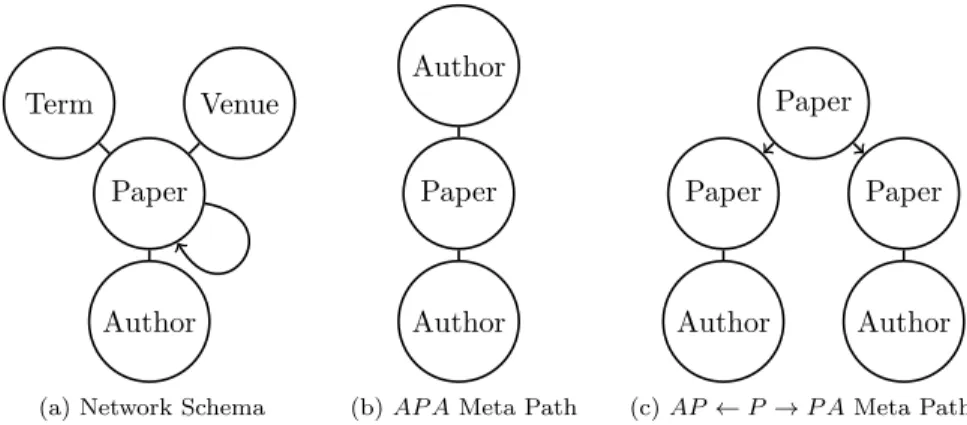
EXAMPLE 1 A bibliographic information network is a heterogeneous network containing four types of objects: papers (P), venues (conferences or journals) (C), authors (A), and terms (T). These object types and their potential relations are shown in the network schema in Figure 3.1a. Links exist between authors and papers representing writingor written-byrelations, between venues and papers representing publishingor published-inrelations, between papers and terms representing
Paper
Term Venue
Author
(a) Network Schema
Paper Author Author (b)AP AMeta Path Paper Author Paper Paper Author (c)AP←P →P AMeta Path
Figure 3.1: Bibliographic Network Schema and Meta Paths
When discussing the semantics of these heterogeneous networks,objectsin the connected data correspond to vertices in the network, and relations between objects in the data correspond to edges in the network. For example, in DBLP, authorship connects author and paper objects together, and we say it issymmetric, since it does not make sense to discuss authorship in a particular direction. Conversely, the citation relation is anasymmetricrelation connecting two paper objects, since citations between papers appear in only one direction.
3.2
Meta Path-Based Similarity Framework
In information networks, two objects are often connected by multiple paths in the network. In heterogeneous information networks, these paths may contain various semantic meanings, based on the types of nodes along the path. For example, in a bibliographic information network, two authors may be connected via anauthor-paper-authorpath, representing coauthorship, author-paper-venue-paper-author path, representing publishing in the same conference, and so on. We formally define the semantic meaning of these paths by considering paths in the network as instances of particular
meta paths, defined below.
DEFINITION 3 Meta path. A meta pathP is a path defined on the graph of the network schema
TG= (A, R), and is denoted in the form of A1
R1
−−→A2
R2
−−→ · · · Rl
−→Al+1. This defines a composite
relationR=R1◦R2◦ · · · ◦Rlbetween type A1 andAl+1, where◦denotes the composition operator
on relations.
We say that a path pin a particular network follows some meta path P if the ordered nodes and edges ofpmatch the object types and relations ofP. Formally, a pathp= (v1v2v3· · ·vk) in a
particular network follows some meta pathP if∀i, φ(vi) =Ai, and∀i, ei=hvivi+1i, ψ(ei) =Ri.
Thelengthof a meta pathP is the number of relations inP, and issymmetricif the relation defined by P is symmetric, that is if R is equivalent to R−1. Note that for meta path relation
R = R1◦ R2 ◦ · · · ◦Rl, the symmetry of R is not necessarily related to the symmetry of any
individual relationRi.
R may be symmetric even if some relation Ri is not. Consider bibliographic coupling for two
co-citation, represented by AP ←P →P A. Although both of these meta paths contain asymmetric relations, the composite relation between authors defined by the meta path is symmetric. Figure 3.1b shows the co-authorship meta path,AP A, a symmetric meta path containing only symmetric relations, while Figure 3.1c illustrates the co-citation meta path, which is symmetric but contains asymmetric relations.
We refer to paths followingP in an information networkGas path instances ofP in G, and define thereverse meta pathP−1ofP to be the meta path defined byR−1.
DEFINITION 4 Meta neighbor. A set of meta neighborsNx,d,P represents the set of all objects
in the network that connect to objectxalong instance of meta path P in direction d. For example,
Nx,in,P ={y|p=yRx ∈P} represents the set of objects y where at least one meta path instance
exists in the network that starts aty and ends at x,y∈A1 andx∈Al+1.
To simplify the notation of meta paths, we use type names denoting the meta path if the resulting path is unambiguous. For example, in the bibliographic network, the co-author relation can be described using the meta pathA–P–A, orAP Afor short if there is no ambiguity. We likewise shorten paths containing asymmetric relations, as long as the shortened version is also unambiguous. For example, we may shortenA–P →P–A to AP → P A, since the authorship relation (A–P) is always symmetric.
Given a user-specified meta path P, a similarity measure can be defined for a pair of objects
x∈A1, y∈Al given P. In general, we define a meta path-based similarity framework for objects
x and y on a meta path as: s(x, y, P) = Σp∈Pf(p), where P is a particular meta path defined
on network schema TG, p is a particular path instance of P defined on network G, and f(p) is
some function on a single path instancep. Since we only focus on peer similarity, we only consider measures for same-typed nodes in the network, making the assumption that A1 = Al for any
meta pathPi = (A1R1A2R2· · ·Rl−1Al). Although an individual relationRi of some path may be
Chapter 4
AsymSim
In this section, we introduceAsymSim, including its intuition, examples, and relationship to existing similarity measures.
4.1
AsymSim: Asymmetric Similarity Measure
Motivated by problems with existing peer similarity search measures, we proposeAsymSim, a meta path-based peer similarity measure on heterogeneous networks. Our intuition behind this measure is that two objects should be connected and have similar visibility in the network, and that we should be able to define this measure for meta paths containing both symmetric and asymmetric relations. However, since peer similarity should be symmetric between two nodesxandy, we allow asymmetric relations within a path, but still only allow symmetric paths, thus defining a symmetric measure between the two objects.
DEFINITION 5 AsymSim. Given symmetric meta path P =Q−1Q, AsymSim between xand
y along P is defined as:
s(x, y, P) = 2 P z∈Nin,Q|pz x||pz y| P z∈Nx,in,Q|pz x| 2+P z∈Ny,in,Q|pz y| 2 (4.1)
wherepz x represents the set of path instances ofQfromz toxin the network,Nx,in,Q represents
the in-neighbors toxin the network along instances ofQ, andNin,Q={Nx,in,Q∩Ny,in,Q}.
The numerator captures the contextual similarity of the two nodes in the graph. Specifically, the numerator of this measure is based on the number of path instances from shared in neighbors of
xandy. This value is the product of the number paths toxand toy, for each shared in-neighborz
ofxandy(twice the sum of this value for eachz). The numerator thus captures the path instances of P connecting xand y. The denominator normalizes by the visibility of each nodexand y, by looking at the number of paths from each in-neighbor ofxtox, and similarly fory(the sum of the counts squared, for each in-neighborz).
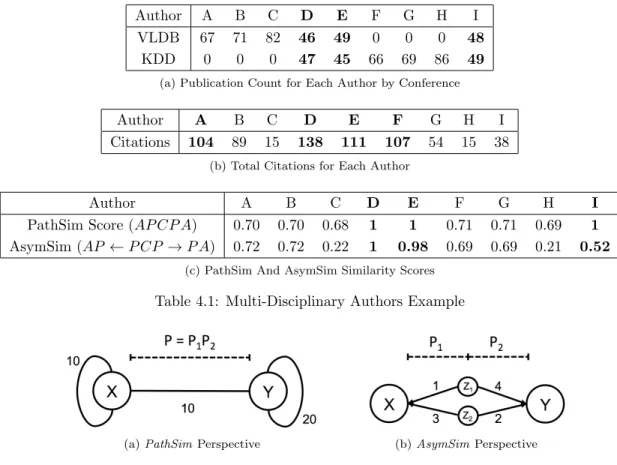
Consider a toy example with eight authors and two research areas, saydata mininganddatabases, with once conference each, KDD and VLDB respectively. In our example, three of these eight authors are multi-disciplinary authors, having published papers in both research areas, while the rest have published papers in only one or the other. In Table 4.1a, we show the number of papers published by each author in each conference, represented by the number ofAP Cmeta path instances connecting the author and conference nodes in the network. In Table 4.1b, we show the total number
Author A B C D E F G H I
VLDB 67 71 82 46 49 0 0 0 48
KDD 0 0 0 47 45 66 69 86 49
(a) Publication Count for Each Author by Conference
Author A B C D E F G H I
Citations 104 89 15 138 111 107 54 15 38
(b) Total Citations for Each Author
Author A B C D E F G H I
PathSim Score (AP CP A) 0.70 0.70 0.68 1 1 0.71 0.71 0.69 1
AsymSim (AP ←P CP →P A) 0.72 0.72 0.22 1 0.98 0.69 0.69 0.21 0.52 (c) PathSim And AsymSim Similarity Scores
Table 4.1: Multi-Disciplinary Authors Example
(a)PathSimPerspective (b)AsymSimPerspective
Figure 4.1: Illustration ofPathSim andAsymSim for Symmetric Paths
of citations for each author, or equivalently, the number of incomingP →P Ameta path instances to each author.
In our example, we consider the problem of finding the most similar author to D. Note that we have three multi-disciplinary authors in this example: D, E, and I. A, E, and F are the authors with the most similar citation counts in the network. Intuitively, if we consider both the publication record and citation record of the authors, we would say thatE is the most similar author toD, since
E is the only author similar in both ways.
In Table 4.1c, we see the similarity scores according to PathSim with meta pathAP CP A. We can see that it clearly distinguishes multi-disciplinary authors, but does not distinguish based on the reputation (citation count) of authors, since it evaluatesE andI to be equally similar toD. On the other hand, we show the results usingAsymSimwith meta pathAP ←P CP →P A, which captures conferences with papers that cite both authors. This path is symmetric, but contains asymmetric relations, and captures both the publication and citation records of each author. In Table 4.1c, we see that E is found to be the most similar author to D using this path with AsymSim, which matches our intuition.
In the following sections, we further explain the intuition behind this measure and its relations to PathSim, including how to efficiently compute this measure.
SIGMOD VLDB ICDE KDD Mike 2 1 0 0 Jim 50 20 0 0 Mary 2 0 1 0 Bob 2 1 0 0 Ann 0 0 1 1
(a) Path Instances forAP CMeta Path
Jim Mary Bob Ann
PathSim 0.0826 0.8 1 0
AsymSim 0.0826 0.8 1 0
(b) Similarity To ‘Mike’
Table 4.2: DBLP Authors Example [9]
4.2
PathSim Derivation
For the case of paths containing only symmetric relations, AsymSim is equivalent to the PathSim, since AsymSim simply computes PathSim by between x and y by calculating the count of path instances through each midpoint object along P = P1P2. In Figure 4.1, we see an illustration of
the shift in perspective from PathSim to AsymSim. Consider the PathSim perspective for path
P =P1P2 in Figure 4.1 with nodesX andY. In this example, we have 10 path instances between
X and Y, 10 path instances fromX back to X, and 20 instances fromY back toY. So, we would compute the PathSim similarity scores(x, y) = 2(10)
10 + 20 = 2 3.
Alternatively, we could consider the midpoint objects along each path instance ofP, looking at path instances ofP1 andP2to neighbors of X andY. Without loss of generality, suppose that we
have two nodesZ1 and Z2 alongP, connected to X andY as shown in Figure 4.1. Then, we can
calculate the total number of instances ofP by counting the total number of possible paths fromX
toY alongP1P2, i.e. through Z1or Z2. In our example, this yields 1·4 instances of P throughZ1
and 3·2 instances ofP throughZ2, for a total (1·4) + (3·2) = 10 path instances ofP betweenX
andY.
If we assume the network is setup as shown in Figure 4.1, all cycles includingX orY must pass throughZ1 or Z2, and so we can directly count the number of possible cycles fromX and Y by
counting all possible combinations of paths fromX orY toZ1 orZ2and back. Using this strategy,
we get 4·4 = 16 cycles forY throughZ1and 2·2 = 4 cycles forY throughZ2, for 42+ 22= 20 self
loops forY. Similarly, we count 1 + 3·3 = 12+ 32= 10 self loops forX. Thus, we get aAsymSim
score of 2(1·4 + 3·2) (42+ 22) + (12+ 32) = 20 30 = 2 3.
Likewise, consider the DBLP graph example in Table 4.2a, as shown in [9]. In Table 4.2b, where we compute PathSim on the meta pathAP CP A, and AsymSim using the path AP CP Aby countingCP Apath instances from shared conference meta neighbors to the two author objects in the network. Since each relation in the meta path is symmetric, we compute identical similarity measures to Mike as shown in [9].
4.3
Commuting Matrix Computation
Let us discuss how we can computeAsymSim on a real data set. First, we introduce the concept of acommuting matrix [9]:
commuting matrix M for meta path P = (A1 R1 −−→ A2 R2 −−→ · · · Rl −→ Al+1) is defined as M =
WR1WR2· · ·WRl, whereWRi is the adjacency matrix for relationRi, between typesAi andAi+1.
Thus, for two objects x and y along meta path P, the count ‘in-neighbors’ of xand y along instance ofP correspond to the counts in columns i andj in M. We refer to these columns as vi
andvj, forxandyrespectively, and use dot products involving this vectors to calculate theAsymSim
measure between xand y. So, we compute AsymSim using MP, with meta path Q= P−1P, as
s(x, y, Q) = 2vivj
vivi+vjvj
.
To compute the most similar objects to a given object using the AsymSim measure, we must be able to executed top-k queries efficiently at query time. For longer meta paths, computing meta path instances between objects at run-time becomes impractical to store for large networks [9].
To address this problem, for a longer meta pathP, we can decomposeP into shorter meta paths
P =P1P2, and store commuting matrices forP1 andP2 (matricesM1 andM2), rather than forP
directly. Then, we can computeM forP at query time, by taking the product of matricesM1 and
M2, soM =M1M2.
Using this practice, we can decompose long meta paths into any number of commuting matrices that store shorter meta paths. To reduce the space complexity for storing each of these matrices, we can use sparse matrices, only materializing the sparse matrix M at query time, which will be dense compared to the smaller individual matrices corresponding to shorter meta paths withinP.
4.4
Path Length Generalization
Likewise, these meta path-based approaches are rigid in terms of the path length. Although we can control the particular path to use, and weight together multiple measures using various paths, these meta path-based metrics are not well-suited to capturing various length paths at their core. For example, it is difficult to quantify the relative importance of the meta pathAP Aversus (AP A)2=
AP AP Aversus (AP A)3=AP AP AP A.
We make two observations about our intuition for longer paths. First, a fixed, short length path will certainly return the most similar nodes in a network, but may miss objects in the network that are slightly beyond the chosen path. On the other hand, the longer a meta path becomes, the less meaningful its similarity results may become. Intuitively, in the DBLP network, two authors may still be similar if they are connected by the (AP A)2 = AP AP A path but not by the AP A
path. However, for longer paths, such as (AP A)3 or (AP A)10, similarity is propagated to remote
neighborhoods in the network, and we introduce many ‘similar’ objects that are not semantically meaningful.
We propose balancing these opposing forces by defining similarity measures along arbitrarily long meta paths, discounting the contribution of longer meta paths to the total score based on their length with respect to the original meta path.
Specifically, for meta pathP, we propose two iterative measures, wherekis the maximum number of iterations, or maximumkforPk:
1. Constant, or AsymSimC. Discount the value of the meta path Pi by Ci, for constant
Author D E I J AsymSimC,k= 1 1 0.960 0.380 0 AsymSimC,k= 2 1 0.960 0.380 0.120 AsymSimC,k= 3 1 0.960 0.380 0.220 AsymSimC,k= 4 1 0.960 0.380 0.270 AsymSimC,k= 50 1 0.960 0.380 0.310
(a)AsymSimCwithC= 0.5,P= (AP←P AP→P A)
Author D E I J AsymSimP A,k= 1 1 0.960 0.380 0 AsymSimP A,k= 2 1 0.950 0.310 0.120 AsymSimP A,k= 3 1 0.940 0.280 0.150 AsymSimP A,k= 4 1 0.940 0.270 0.190 AsymSimP A,k= 50 1 0.940 0.270 0.240 (b)AsymSimP F withC= 0.5,P = (AP←P AP →P A)
Figure 4.2: AsymSim Similarity for Generalized Paths
s(x, y, P) =AsymSimC(x, y, P) = k
X
i=1
Ci−1AsymSim(x, y, Pi) (4.2) 2. Preferential Attachment, orAsymSimP A. Discount the value of the meta pathPiby both
a constantCi,C∈[0,1] and the similarity score of the previous iteration:
s(x, y, P) =AsymSimP A(x, y, P) = k X i=1 Ci−1AsymSim(x, y, Pi−1)AsymSim(x, y, Pi) (4.3)
In the numerator for each measure, we weight the similarity along various length repetitions of some meta path, and the denominator for each normalizes the final measure such thats(x, y, P)∈ [0,1].
Consider the network described in Figure 4.1, but let us introduce another multi-disciplinary author J identical publications to D, E, and I, and the same total number of citations as D. SupposeJ is cited only by authorsE andI, but it not cited byD directly.
If we consider the citation meta path, AP → P A, since there are no such paths connected D
to J, our measure would say that D and J have a similarity of 0. However, D and J are highly connected along the (AP →P A)2 meta path, although they have no connections alongAP →P A,
and although this is not as significant as being directly connected via theAP →P Apath, we would intuitively say that there is some nonzero similarity.
In Figure 4.2, we show the similarity according to these two measures for the subset of multi-disciplinary authors for this network. For each example, we look at several iterations of the measures (k= 1,2,3,4,50), for a meta pathP =AP →P A. Using AsymSimC, we see that the similarity
ofJ toD increases through the first several iterations and levels off, without significantly affecting the scores of other objects in the network. On the other hand,AsymSimP A also increases the score
ofJ during the first several iterations, but is slower to level off. Since this measure is based on the measure of the previous iteration, the scores of less similar nodes change more than the scores of highly similar nodes, effectively smoothing the scores of lower scoring nodes.
Although further study is necessary to choose a suitableC value, this approach shows promise for lessening the rigidity of fixed-length meta path similarity measures, and only requires only a fixed numberk iterations to calculate.
Chapter 5
Experiments
5.1
Experimental Setup
We use the ”four area dataset” introduced in [9], based on a DBLP dataset downloaded in 2009 and clustered into four research areas: database, data mining, machine learning, and information retrieval [8]. This dataset contains 20 conferences, 28K authors, 28K papers, and 13K terms extracted from the DBLP dataset, representing top conferences, authors, and papers from each area. We remove stop words from paper titles and terms, and perform stemming to further reduce the number of nodes in the network. Further, we add citations for this subset from a newer Arnetminer 2011 DBLP dataset [13] [10] [12] [11], which adds 46K citations between the papers in our network.
5.2
Similar Authors in DBLP
Let us revisit the problem of finding similar peer authors in the DBLP information network. Intu-itively, we consider two authors to be similar if they publish similar work and have similar ‘visibility’ in the network. Further, we intuitively attach significance to the number of times an author has been cited, since this generally correlates well to their ‘reputation’ in their research area. Thus, similar authors should also have similar numbers of citations.
In the DBLP network, these characteristics manifest themselves through meta path instances in the network. In previous work, we consider meta paths with only symmetric relations in the network, which captures peer similarity based on research area and number of publications, but overlooks citation information. Using AsymSim, we capture more information by using both symmetric and asymmetric meta paths in the network.
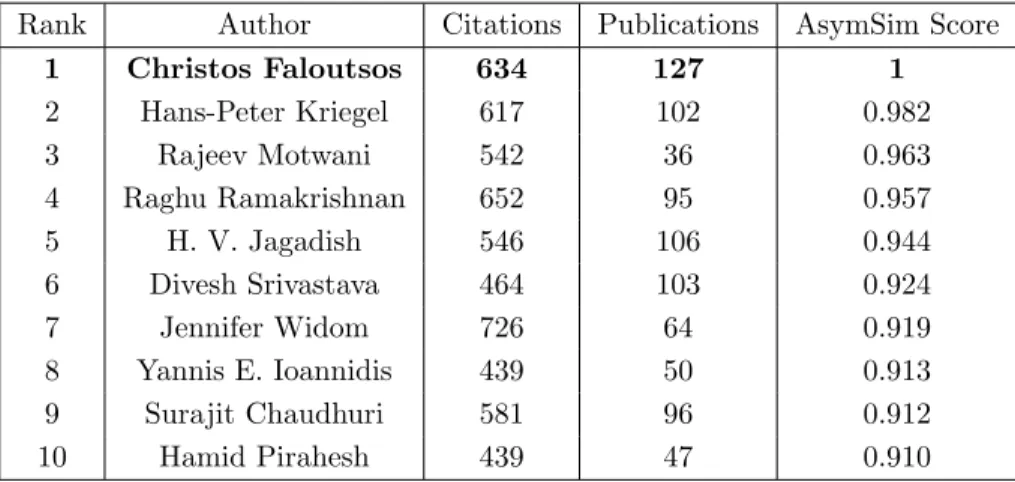
Consider the question ‘Who is most similar to Christos Faloutsos?’. Intuitively, we would say authors in the same research area, with similar publication record, and who have been cited similarly in the network. In Table 5.1, we show the top 10 most similar authors according to theAP CP A
meta path using PathSim, showing the total citation count of each author in our network. This meta path captures the number of times authors are published in the same conferences. Although we see that the results are intuitive based on the research areas and number of publications of each author, the number of citations, or ‘reputation’ of the authors in the research area are not necessarily very similar. For example, the citation counts ofRakesh Agrawal andChristos Faloutsos
are very dissimilar, but they are considered very similar by PathSim, since their publication records are similar.
Rank Author Citations Publications PathSim Score 1 Christos Faloutsos 634 127 1 2 Jiawei Han 665 168 0.906 3 Rakesh Agrawal 1511 105 0.901 4 Hans-Peter Kriegel 617 102 0.839 5 Jian Pei 270 70 0.831 6 Raghu Ramakrishnan 652 95 0.809 7 H. V. Jagadish 546 106 0.804 8 Nick Koudas 351 79 0.788 9 Hector Garcia-Molina 613 98 0.779 10 Divesh Srivastava 464 103 0.775
Table 5.1: Similarity to Christos Faloutsos UsingPathSimwith AP CP Ameta path Rank Author Citations Publications AsymSim Score
1 Christos Faloutsos 634 127 1 2 Hans-Peter Kriegel 617 102 0.982 3 Rajeev Motwani 542 36 0.963 4 Raghu Ramakrishnan 652 95 0.957 5 H. V. Jagadish 546 106 0.944 6 Divesh Srivastava 464 103 0.924 7 Jennifer Widom 726 64 0.919 8 Yannis E. Ioannidis 439 50 0.913 9 Surajit Chaudhuri 581 96 0.912 10 Hamid Pirahesh 439 47 0.910
Table 5.2: Similarity to Christos Faloutsos UsingAsymSim withAP ←P CP →P Ameta path
AP ← P CP → P A meta path with AsymSim, which captures the number of times authors are cited by papers in the same conferences. Although the list is similar to the results ofPathSimusing
AP CP A, we see that authors with dissimilar citation counts are discounted, and so the overall results are more intuitive.
Note that this similarity measure does not directly measure the similarity of the citation counts of authors, but rather calculates paths throuigh conference papers that cite both authors. While this path helps capture the citation count of authors, certain authors that have similar citation counts to Christos Faloutsos may not appear as one of the most similar authors under this experiment if they are not similarly cited from the same conferences. For example, in Table 5.1, Jiawei Han appears in the top most similar authors as Christos Faloutsos, and has a similar citation count. However, Han does not appear in the top most similar authors under the AsymSim experiment in Table 5.2, indicating that although the two authors are published in the same conferences and have a similar citation count, they do not have as high of a score as authors that were cited similarly from the same conference papers. This subtlety is captured by the meta path chosen, and so is configurable by the user.
Rank Author Citations Publications AsymSim Score 1 Christos Faloutsos 634 127 1 2 Hans-Peter Kriegel 617 102 0.579 3 Bernhard Seeger 389 36 0.546 4 Nick Roussopoulos 336 35 0.506 5 H. V. Jagadish 546 106 0.436 6 Ralf Schneider 242 4 0.426 7 Norbert Beckmann 210 1 0.391 8 Timos K. Sellis 230 28 0.389 9 Dimitrios Gunopulos 264 46 0.297 10 Philip S. Yu 556 216 0.291
Table 5.3: Similarity toChristos Faloutsos UsingAsymSim withAP ←P AP →P Ameta path Rank Author Citations Publications AsymSim Score
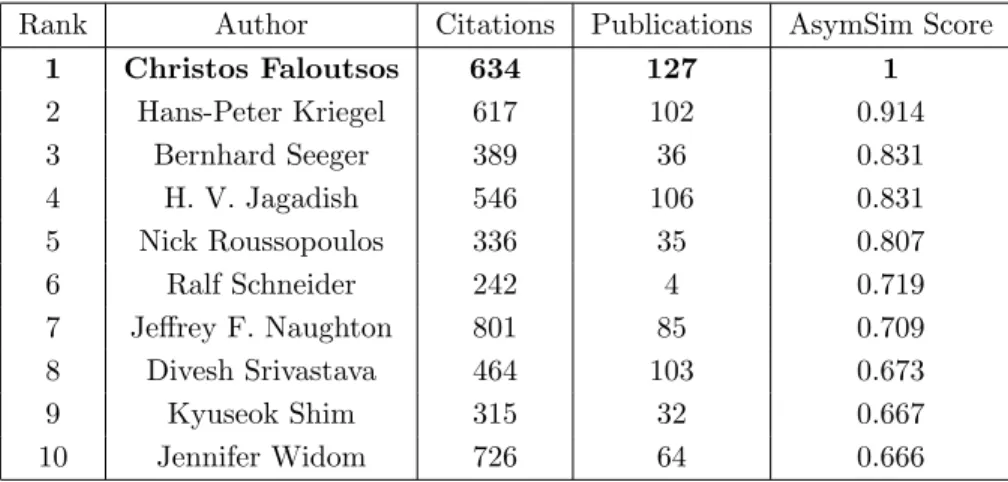
1 Christos Faloutsos 634 127 1 2 Hans-Peter Kriegel 617 102 0.914 3 Bernhard Seeger 389 36 0.831 4 H. V. Jagadish 546 106 0.831 5 Nick Roussopoulos 336 35 0.807 6 Ralf Schneider 242 4 0.719 7 Jeffrey F. Naughton 801 85 0.709 8 Divesh Srivastava 464 103 0.673 9 Kyuseok Shim 315 32 0.667 10 Jennifer Widom 726 64 0.666
Table 5.4: Similarity toChristos Faloutsos UsingAsymSim withAP ←P T P →P Ameta path results in drastically different similarity semantics in the network. Consider the same problem addressed with the AP ←P AP → P A or AP ←P T P → P A paths, which are not sensitive to the conference, but rather capture only when two authors have been cited by the same authors or papers on the same subject. These examples are shown in Tables 5.3 and 5.4, respectively. Using a path such asAP ← P →P A, the results for which are shown in Table 5.5, captures when two authors are cited by the same paper. This approach is more rigid, and we see the intuitive difference in the results than for other paths.
Consider another case study, with author ‘Sergey Brin’. This author published relatively few papers, but was cited many more times than authors with a similar number of publications. In Table 5.6, we see the most similar authors computed using theAP CP A meta path withPathSim. Note that authors considered similar using this measure have a significantly different citation count than Brin.
In Table 5.7, we see the similarity scores for this same author using AsymSim with the AP ←
P CP →P Ameta path, which represents conferences with papers citing both authors. This captures authors that are both in the same research area and have a similarreputation in the network. In Table 5.7, we see that similar authors returned using this method have both similar citation and
Rank Author Citations Publications AsymSim Score 1 Christos Faloutsos 634 127 1 2 Nick Roussopoulos 336 35 0.452 3 Hans-Peter Kriegel 617 102 0.451 4 Timos K. Sellis 230 28 0.406 5 Bernhard Seeger 389 36 0.402 6 Ralf Schneider 242 4 0.350 7 Norbert Beckmann 210 1 0.330 8 Ibrahim Kamel 88 10 0.321 9 H. V. Jagadish 546 106 0.287 10 Stefan Berchtold 110 12 0.197
Table 5.5: Similarity toChristos Faloutsos UsingAsymSim withAP ←P→P Ameta path Rank Author Citations Publications PathSim Score
1 Sergey Brin 166 7 1
2 Nicola Onose 6 7 0.944
3 Larry Kerschberg 10 7 0.933
4 Ion Stoica 10 5 0.929
5 Yannis Vassiliou 35 5 0.929
6 Boon Thau Loo 28 5 0.929
7 Fatma ¨Ozcan 24 6 0.914
8 Xin Dong 21 6 0.914
9 Abhijit Pol 7 6 0.914
10 Chun Zhang 181 6 0.914
Table 5.6: Similarity toSergey Brin UsingPathSim withAP CP Ameta path publication counts to Brin.
Capturing the citation counts of authors in similarity search has practical significance, but is overlooked by using only symmetric paths in the network. Taking advantage of a single asymmetric path, we are able to distinguish between ‘leaders‘ and ‘followers‘ in the network. Although this does not directly consider the number of papers published by each author, we can combine information from these new meta paths and from symmetric paths to capture richer data for authors in the DBLP network.
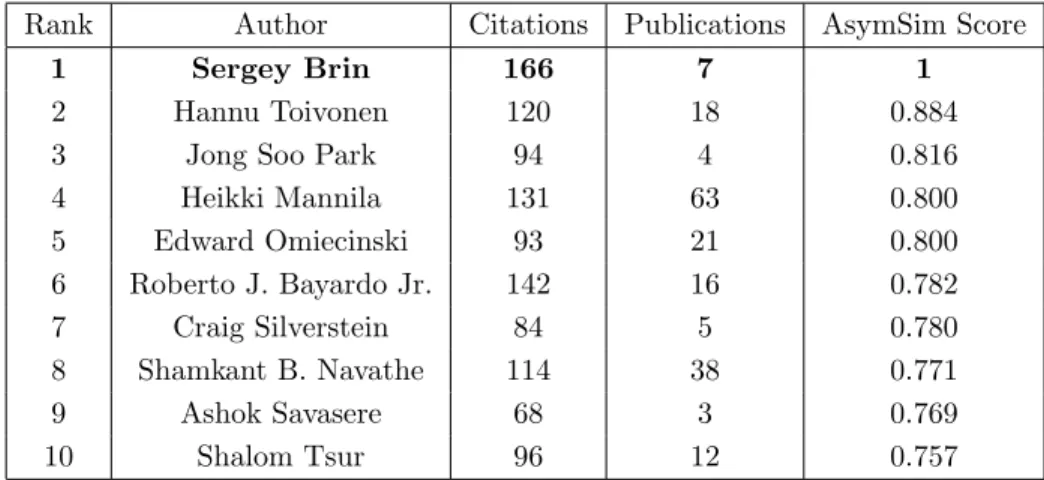
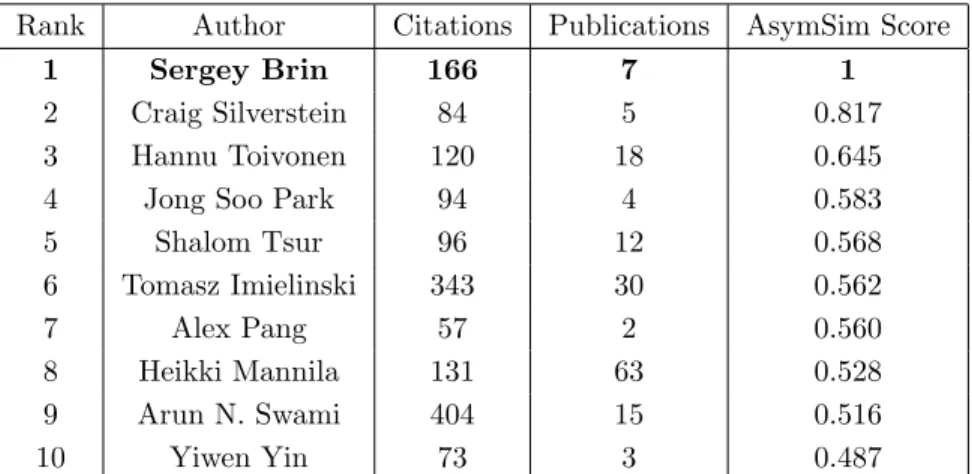
Again, we see that the semantics clearly vary significantly based on the path chosen for this author. In Tables 5.9 and 5.8, we see authors that are cited by the same authors and cited by the same papers, respectively. These paths, AP ←P AP → P Aand AP ←P T P →P A, capture research area without necessarily enforcing that the authors publish in the same particular conferences. However, since an author is likely to cite the most reputable of any sources that address a particular topic,AP ←P AP →P Ain particular introduces subtle semantics.
As shown with ‘Christos Faloutsos’, theAP ←P →P A, shown in Table 5.10, is more rigid and noisy, looking at papers that cite both authors. Since a particular paper often only cites a small number of papers that address a particular research area, this path may be biased towards papers
Rank Author Citations Publications AsymSim Score 1 Sergey Brin 166 7 1 2 Heikki Mannila 131 63 0.953 3 Roberto J. Bayardo Jr. 142 16 0.946 4 Hannu Toivonen 120 18 0.929 5 Prabhakar Raghavan 195 24 0.924 6 Eamonn J. Keogh 142 55 0.910
7 Mohammed Javeed Zaki 116 32 0.901
8 Wei Wang 135 83 0.898
9 Ke Wang 114 55 0.889
10 Tian Zhang 127 4 0.884
Table 5.7: Similarity toSergey Brin UsingAsymSim withAP ←P CP →P Ameta path Rank Author Citations Publications AsymSim Score
1 Sergey Brin 166 7 1
2 Hannu Toivonen 120 18 0.884
3 Jong Soo Park 94 4 0.816
4 Heikki Mannila 131 63 0.800 5 Edward Omiecinski 93 21 0.800 6 Roberto J. Bayardo Jr. 142 16 0.782 7 Craig Silverstein 84 5 0.780 8 Shamkant B. Navathe 114 38 0.771 9 Ashok Savasere 68 3 0.769 10 Shalom Tsur 96 12 0.757
Table 5.8: Similarity to Sergey Brin UsingAsymSim withAP ←P T P →P Ameta path that write high quality papers, or are considered ‘leaders’ in their areas.
Numerous additional case studies for author similarity are provided in Appendix A. These examples include many of the same meta paths shown in this section, for highly visible authors ‘Rakesh Agrawal’ and ‘Philip S. Yu’, as well as a less widely published author, ‘AnHai Doan’.
5.3
Similar Papers in DBLP
Consider another challenging similarity search problem in the DBLP network: finding similar papers to a given paper. Intuitively, we consider a paper to be similar if it deals with the same subject, and is similarly influential in the research area.
In the DBLP network, two papers may be considered similar if they are published in the same conference (P CP), are written by the same author (P AP), or contain the same terms (P T P). In the DBLP network, each paper is associated with exactly one conference, and a small number of authors, but many terms, and so theP T P provides the most meaningful results for finding similar papers, of these three paths.
Rank Author Citations Publications AsymSim Score
1 Sergey Brin 166 7 1
2 Craig Silverstein 84 5 0.817
3 Hannu Toivonen 120 18 0.645
4 Jong Soo Park 94 4 0.583
5 Shalom Tsur 96 12 0.568 6 Tomasz Imielinski 343 30 0.562 7 Alex Pang 57 2 0.560 8 Heikki Mannila 131 63 0.528 9 Arun N. Swami 404 15 0.516 10 Yiwen Yin 73 3 0.487
Table 5.9: Similarity toSergey Brin UsingAsymSim with AP ←P AP →P Ameta path
Rank Author Citations Publications AsymSim Score
1 Sergey Brin 166 7 1 2 Craig Silverstein 84 5 0.676 3 Shalom Tsur 96 12 0.500 4 Rajeev Motwani 542 36 0.412 5 Ashok Savasere 68 3 0.297 6 Jeffrey D. Ullman 438 43 0.289 7 Tomasz Imielinski 343 30 0.280 8 Arun N. Swami 404 15 0.267 9 Hannu Toivonen 120 18 0.265 10 Edward Omiecinski 93 21 0.261
Rank Paper Citations PathSim Score
1 Mining Association Rules between Sets 258 1.0
of Items in Large Databases
2 The Rough Set Approach 0 0.722
to Association Rule Mining
3 Mining Association Rules 0 0.71
in Hypertext Databases
4 Sampling Large Databases 50 0.706
for Association Rules
5 Ordinal Association Rules for 1 0.703
Error Identification in Data Sets
6 Association Rules 0 0.688
in Incomplete Databases
7 Mining Association Rules 0 0.688
with Item Constraints
8 Fast Algorithms for Mining 305 0.686
Association Rules in Large Databases
9 Discovering Association Rules 0 0.667
in Large, Dense Databases
10 Association Rules 0 0.667
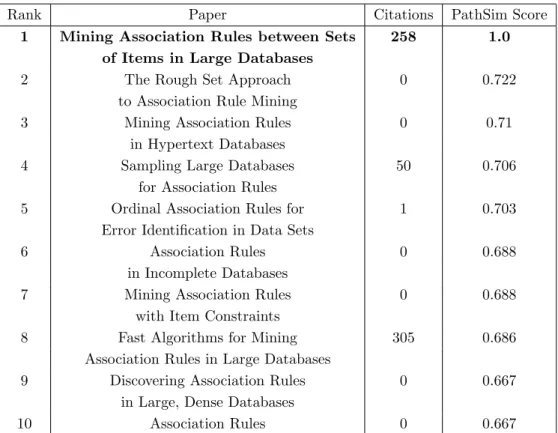
Table 5.11: Similarity toMining Association Rules between Sets of Items in Large Databases Using
Rank Paper Citations AsymSim Score
1 Mining Association Rules between Sets 258 1.0
of Items in Large Databases
2 Fast Algorithms for Mining 305 0.969
Association Rules in Large Databases
3 An Effective Hash Based 60 0.628
Algorithm for Mining Association Rules
4 Mining Quantitative Association Rules 65 0.575 in Large Relational Tables
5 An Efficient Algorithm for Mining 57 0.543
Association Rules in Large Databases
6 Discovery of Multiple-Level Association 46 0.503 Rules from Large Databases
7 Dynamic Itemset Counting and Implication 57 0.447 Rules for Market Basket Data
8 Finding Interesting Rules from Large 48 0.432
Sets of Discovered Association Rules
9 Sampling Large Databases 50 0.425
for Association Rules
10 Beyond Market Baskets: Generalizing 54 0.397
Association Rules to Correlations
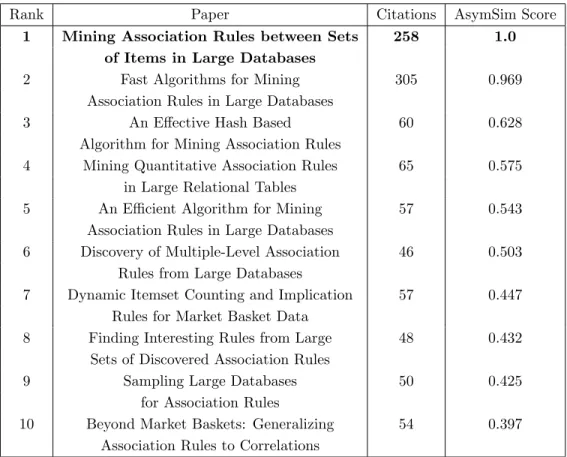
Table 5.12: Similarity toMining Association Rules between Sets of Items in Large Databases Using
Rank Paper Citations AsymSim Score
1 Mining Association Rules between Sets 258 1.0
of Items in Large Databases
2 Fast Algorithms for Mining 305 0.986
Association Rules in Large Databases
3 BIRCH: An Efficient Data Clustering 126 0.717
Method for Very Large Databases
4 Mining Sequential Patterns 106 0.712
5 Automatic Subspace Clustering of High 89 0.626
Dimensional Data for Data Mining Applications
6 Mining Frequent Patterns 73 0.561
without Candidate Generation
7 Text Categorization with Suport Vector 161 0.553
Machines: Learning with Many Relevant Features
8 The R*-Tree: An Efficient and Robust 210 0.534
Access Method for Points and Rectangles
9 Mining Quantitative Association Rules 65 0.472
in Large Relational Tables
10 A Comparative Study on 112 0.47
Feature Selection in Text Categorization
Table 5.13: Similarity toMining Association Rules between Sets of Items in Large Databases Using
Rank Paper Citations AsymSim Score
1 Mining Association Rules between Sets 258 1.0
of Items in Large Databases
2 Fast Algorithms for Mining 305 0.684
Association Rules in Large Databases
3 Mining Sequential Patterns 106 0.465
4 Beyond Market Baskets: Generalizing 54 0.457
Association Rules to Correlations
5 An Effective Hash Based 60 0.438
Algorithm for Mining Association Rules
6 BIRCH: An Efficient Data Clustering 126 0.427
Method for Very Large Databases
7 Mining Frequent Patterns 73 0.417
without Candidate Generation
8 Discovery of Multiple-Level Association 46 0.394 Rules from Large Databases
9 Exploratory Mining and Pruning 47 0.39
Optimizations of Constrained Association Rules
10 Mining Quantitative Association Rules 65 0.384
in Large Relational Tables
Table 5.14: Similarity toMining Association Rules between Sets of Items in Large Databases Using
research area, and cannot be captured by these paths. Meta paths with only symmetric relations cannot capture this citation relationship, since citations are represented as asymmetricP →Pmeta paths in the network.
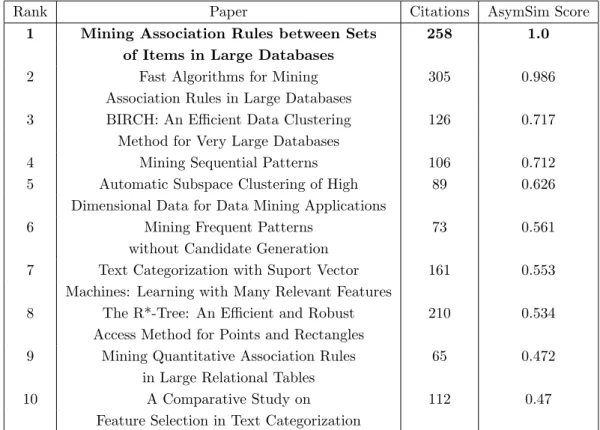
For example, consider a highly cited paper in our subset of the DBLP network, called Mining Association Rules between Sets of Items in Large Databases. In Table 5.11, we show the most similar papers to this paper in the network, according to theP T P meta path usingPathSim. Although we see that the most similar papers deal with the same topics, many papers that have few or no citations are returned. On the other hand, consider the results from usingAsymSimwith theP ←P T P →P
meta path, which captures papers that are cited by papers with the same terms. These results are shown in Table 5.12, and we clearly see that not only are papers covering similar topics returned, but these papers have similar citation counts to the query paper. Thus, these results match our intuition much more closely.
With this same query paper, we may adjust the query meta path to capture different semantics in the network. In Table 5.13, we show the most similar papers according to theP ←P CP →P
meta path, which captures how often two papers are cited from the sameconference, which is more restrictive and may indicate additional information such as the quality of the paper, based on the quality of the conference. Likewise, Table 5.14 shows the most similar papers according to authors that cite both, along meta pathP ←P AP →P. This could be considered a generalization of the co-citation measure, and capture subtleties such as author affinity to a particular set of papers.
5.4
Path Length Performance
We run several experiments to verify the efficiency improvement achieved using commuting matrices on long meta paths. In Figure 5.1a, we show the performance of the proposed commuting matrix-based approach to compute AsymSim. For two base meta paths, AP A and AP → P A, we show the increase in running time for computing AsymSim for (AP A)2 and (AP → P A)2. As we see in Figure 5.1a, the running time for directly computing these longer paths increases dramatically, while the running time increases only slightly using the commuting matrix approach. We gain this performance advantage by computing the adjacency matrix of the base meta path, performing matrix multiplication to get the adjacency matrix for the full meta path. Figure 5.1b shows the breakdown of running time between computing these partial adjacency matrices and the matrix multiplication for each example. As shown here, computing longer paths increases the running time only by the time for the additional matrix multiplications, and so with repetitions of the base meta path, the total time increases linearly. In practice, we may compute these partial adjacency matrices offline, so that only the matrix multiplication needs to be performed at query time.
(a) Time for Direct Computation Versus Using Commuting Ma-trices
(b) Breakdown of Commuting Matrix Computation
Chapter 6
Discussions
AsymSim has several properties ideal for a similarity measure. These properties are formally shown in [9], but we outline the similar argument for two properties in brief:
1. Symmetric: AsymSim is defined only on symmetric meta paths P, whereP =P−1. Thus,
s(x, y, P) =s(x, y, P−1) =s(y, x, P), and so AsymSim is a symmetric measure.
2. Self-Maximum: In the AsymSim computation, since the number of paths to meta-neighbors of each objectx(incoming path instances ofQforP =Q−1Q) is always greater than or equal to the number of those paths ofP that connect through the meta-neighbors toy, we know that the AsymSim measure will always be at most 1. Since the measure is based on path counts, the value is always at least 0, and since the number of paths through meta-neighbors along
Q−1 is equivalent to the sum of the number of meta paths through each individual neighbor, AsymSim is exactly 1 for anys(x, x, P). Therefore,s(x, x, P)∈[0,1] for any objectxor meta pathP.
In our work, we focus on peer similarity using a single meta path, although in practice, multiple meta paths may be weighted together to construct a more fine-grained similarity measure for partic-ular applications. AsymSimcan be easily used in this framework, by simply weighting our similarity scores across various meta paths. We choose to focus on in-neighbors for the nodes involved in the similarity measure. We believe that this is intuitive and simpler than balancing a measure between in and out neighbors, but also realize that out-neighbors may play a role in similarity semantics that is overlooked by our current method.
AsymSim and PathSim measures capture only the local structure of the network. These measures are not well-suited to similarity globally in the network, such as finding authors with the most similar
citation count in the network, irrespective of the similarity of their work. These types of similarity measures carry important semantic meaning, but further work needs to be done to extend the meta path-based framework to handle these measures, perhaps by generalizing the computation using the meta path commuting matrix.
Chapter 7
Conclusion
Similarity search is a fundamental problem in data mining, and for heterogeneous networks, this is particularly true. Peer similarity search on heterogeneous information networks contains subtle semantics, and users may want to adjust these semantics while using the same similarity measure. Previous work such as PathSim [9] addresses this problem by introducing a framework that allows users to define similarity semantics using meta paths, or paths traversing a particular series of object and relation types. PathSim is only defined on meta paths containing symmetric relations, but asymmetric relations may be valuable for peer similarity. In DBLP, ignoring asymmetric relations means ignoring citations, an important relation between papers that helps establish the ‘reputation’ of documents, authors, and conferences.
We propose AsymSim, a peer similarity measure that handles both symmetric and asymmetric relations in information networks, while capturing the same desirable semantics shown in existing work, such as heterogeneous types and balance of visibility. We introduce the concept of meta neighbors to the meta path-based framework, and show that AsymSim captures the semantics of the peer similarity search problem in a more intuitive and descriptive way than existing methods. We demonstrate this improvement through case studies on the DBLP dataset, and show that AsymSim can be computed efficiently using adjacency matrices for path instances in the network, called commuting matrices.
References
[1] Heasoo Hwang. Objectrank: a system for authority-based search on databases. InIn SIGMOD 06: Proceedings of the 2006 ACM SIGMOD international conference on Management of data, pages 796–798. ACM Press, 2006.
[2] Glen Jeh and Jennifer Widom. Simrank: a measure of structural-context similarity. In Proceed-ings of the eighth ACM SIGKDD international conference on Knowledge discovery and data mining, KDD ’02, pages 538–543, New York, NY, USA, 2002. ACM.
[3] Glen Jeh and Jennifer Widom. Scaling personalized web search. In Proceedings of the 12th international conference on World Wide Web, WWW ’03, pages 271–279, New York, NY, USA, 2003. ACM.
[4] Zaiqing Nie, Yuanzhi Zhang, Ji rong Wen, and Wei ying Ma. Object-level ranking: Bringing order to web objects. InStudy of the eXplicit Control Protocol (XCP). IEEE Infocom, 2005. [5] Lawrence Page, Sergey Brin, Rajeev Motwani, and Terry Winograd. The pagerank citation
ranking: Bringing order to the web. Technical Report 1999-66, Stanford InfoLab, November 1999. Previous number = SIDL-WP-1999-0120.
[6] Yizhou Sun, Rick Barber, Manish Gupta, Charu C. Aggarwal, and Jiawei Han. Co-author relationship prediction in heterogeneous bibliographic networks. In Proceedings of the 2011 International Conference on Advances in Social Networks Analysis and Mining, ASONAM ’11, pages 121–128, Washington, DC, USA, 2011. IEEE Computer Society.
[7] Yizhou Sun and Jiawei Han. Mining Heterogeneous Information Networks: Principles and Methodologies. Morgan & Claypool, 2012.
[8] Yizhou Sun, Jiawei Han, Jing Gao, and Yintao Yu. itopicmodel: Information network-integrated topic modeling. In Proceedings of the 2009 Ninth IEEE International Conference on Data Mining, ICDM ’09, pages 493–502, Washington, DC, USA, 2009. IEEE Computer Society. [9] Yizhou Sun, Jiawei Han, Xifeng Yan, Philip S. Yu, and Tianyi Wu. Pathsim: Meta path-based
top-k similarity search in heterogeneous information networks. InIn VLDB’ 11, 2011.
[10] Jie Tang, Limin Yao, Duo Zhang, and Jing Zhang. A combination approach to web user profiling. ACM TKDD, 5(1):1–44, 2010.
[11] Jie Tang, Duo Zhang, and Limin Yao. Social network extraction of academic researchers. In
ICDM’07, pages 292–301, 2007.
[12] Jie Tang, Jing Zhang, Ruoming Jin, Zi Yang, Keke Cai, Li Zhang, and Zhong Su. Topic level expertise search over heterogeneous networks.Machine Learning Journal, 82(2):211–237, 2011. [13] Jie Tang, Jing Zhang, Limin Yao, Juanzi Li, Li Zhang, and Zhong Su. Arnetminer: Extraction
Appendix A
Author Case Studies Figures
This appendix shows additional results of similarity case studies for particular authors in DBLP.
A.1
‘Rakesh Agrawal’ Case Study
In our dataset, ‘Rakesh Agrawal’ is the highest cited author, and thus as an extreme example in the dataset, is an interesting case study to consider for the similarity measures we study.
A.2
‘AnHai Doan’ Case Study
‘AnHai Doan’ is an interesting case study in the DBLP network, since he is one of the less visible authors, and his citation count is not exceptionally higher than his publication count.
A.3
‘Philip S. Yu’ Case Study
In the DBLP network, ‘Philip S. Yu’ is one of the most highly cited and published authors, but is not an extreme example as we saw with ‘Rakesh Agrawal’.
Rank Author Citations Publications PathSim Score
1 Rakesh Agrawal 1511 105 1 2 Hector Garcia-Molina 613 98 0.958 3 H. V. Jagadish 546 106 0.942 4 Nick Koudas 351 79 0.935 5 Jeffrey F. Naughton 801 85 0.927 6 Surajit Chaudhuri 581 96 0.927 7 Divesh Srivastava 464 103 0.924 8 Michael Stonebraker 463 74 0.922 9 Raghu Ramakrishnan 652 95 0.912 10 Christos Faloutsos 634 127 0.901
Rank Author Citations Publications AsymSim Score 1 Rakesh Agrawal 1511 105 1 2 Ramakrishnan Srikant 696 34 0.746 3 Jiawei Han 665 168 0.701 4 Philip S. Yu 556 216 0.573 5 Raghu Ramakrishnan 652 95 0.482 6 Arun N. Swami 404 15 0.454 7 Rajeev Motwani 542 36 0.423 8 Jian Pei 270 70 0.418 9 Tomasz Imielinski 343 30 0.379 10 Charu C. Aggarwal 238 65 0.326
Table A.2: Similarity toRakesh Agrawal UsingAsymSim withAP ←P AP →P Ameta path
Rank Author Citations Publications AsymSim Score
1 Rakesh Agrawal 1511 105 1 2 Jiawei Han 665 168 0.771 3 Ramakrishnan Srikant 696 34 0.753 4 Christos Faloutsos 634 127 0.683 5 David J. DeWitt 876 74 0.671 6 Philip S. Yu 556 216 0.671 7 Jeffrey F. Naughton 801 85 0.656 8 Hans-Peter Kriegel 617 102 0.653 9 Jennifer Widom 726 64 0.643 10 Raghu Ramakrishnan 652 95 0.639
Table A.3: Similarity toRakesh Agrawal UsingAsymSim withAP ←P CP →P Ameta path
Rank Author Citations Publications AsymSim Score
1 Rakesh Agrawal 1511 105 1 2 Ramakrishnan Srikant 696 34 0.763 3 Jiawei Han 665 168 0.656 4 Arun N. Swami 404 15 0.619 5 Philip S. Yu 556 216 0.547 6 Rajeev Motwani 542 36 0.525 7 Tomasz Imielinski 343 30 0.504 8 Jeffrey F. Naughton 801 85 0.496 9 David J. DeWitt 876 74 0.494 10 Jennifer Widom 726 64 0.480
Rank Author Citations Publications AsymSim Score 1 Rakesh Agrawal 1511 105 1 2 Ramakrishnan Srikant 696 34 0.690 3 Arun N. Swami 404 15 0.395 4 Tomasz Imielinski 343 30 0.362 5 Jiawei Han 665 168 0.344 6 Philip S. Yu 556 216 0.221 7 Raghu Ramakrishnan 652 95 0.204 8 Jeffrey D. Ullman 438 43 0.191 9 Rajeev Motwani 542 36 0.190 10 Jian Pei 270 70 0.188
Table A.5: Similarity toRakesh Agrawal UsingAsymSim withAP ←P →P Ameta path
Rank Author Citations Publications PathSim Score
1 AnHai Doan 118 26 1 2 Jignesh M. Patel 92 25 0.976 3 Xuemin Lin 53 25 0.961 4 Balakrishna R. Iyer 122 23 0.957 5 Jayant R. Haritsa 44 35 0.955 6 Jun Yang 93 34 0.948 7 Walid G. Aref 63 33 0.947 8 Ming-Chien Shan 38 23 0.941 9 Won Kim 162 30 0.938 10 Anastassia Ailamaki 71 25 0.938
Table A.6: Similarity toAnHai Doan UsingPathSimwithAP CP A meta path
Rank Author Citations Publications AsymSim Score
1 AnHai Doan 118 26 1 2 Jayant Madhavan 98 10 0.769 3 Alon Y. Halevy 236 34 0.718 4 Erhard Rahm 89 16 0.532 5 Philip A. Bernstein 171 44 0.436 6 Bin He 41 10 0.421 7 Pedro Domingos 291 47 0.410
8 Kevin Chen-Chuan Chang 112 32 0.388
9 Ren´ee J. Miller 152 29 0.366
10 Joann J. Ordille 83 4 0.343
Rank Author Citations Publications AsymSim Score
1 AnHai Doan 118 26 1
2 Moni Naor 122 3 0.978
3 Anant Jhingran 92 14 0.977
4 Kevin Chen-Chuan Chang 112 32 0.973
5 Stefano Ceri 96 36 0.957 6 Krithi Ramamritham 114 41 0.956 7 Venkatesh Ganti 124 21 0.955 8 Qiong Luo 109 19 0.954 9 Erhard Rahm 89 16 0.952 10 Narain H. Gehani 80 14 0.941
Table A.8: Similarity toAnHai Doan UsingAsymSim withAP ←P CP →P Ameta path
Rank Author Citations Publications AsymSim Score
1 AnHai Doan 118 26 1 2 Jayant Madhavan 98 10 0.931 3 Erhard Rahm 89 16 0.787 4 Alon Y. Halevy 236 34 0.747 5 Philip A. Bernstein 171 44 0.736 6 Joann J. Ordille 83 4 0.678 7 Susan B. Davidson 106 24 0.669 8 Bin He 41 10 0.663
9 Mauricio A. Hern´andez 119 13 0.660
10 Ren´ee J. Miller 152 29 0.644
Table A.9: Similarity toAnHai Doan UsingAsymSim withAP ←P T P →P Ameta path
Rank Author Citations Publications AsymSim Score
1 AnHai Doan 118 26 1 2 Jayant Madhavan 98 10 0.718 3 Alon Y. Halevy 236 34 0.593 4 Erhard Rahm 89 16 0.451 5 Philip A. Bernstein 171 44 0.388 6 Pedro Domingos 291 47 0.374 7 Bin He 41 10 0.320 8 Ren´ee J. Miller 152 29 0.265
9 Kevin Chen-Chuan Chang 112 32 0.257
10 Jaewoo Kang 25 7 0.225
Rank Author Citations Publications PathSim Score 1 Philip S. Yu 556 216 1 2 Jiawei Han 665 168 0.920 3 Christos Faloutsos 634 127 0.759 4 Hans-Peter Kriegel 617 102 0.689 5 Wei Wang 135 83 0.679 6 Rakesh Agrawal 1511 105 0.645 7 Divesh Srivastava 464 103 0.639
8 Beng Chin Ooi 130 70 0.606
9 Hector Garcia-Molina 613 98 0.593
10 Nick Koudas 351 79 0.592
Table A.11: Similarity toPhilip S. Yu UsingPathSim withAP CP A meta path
Rank Author Citations Publications AsymSim Score
1 Philip S. Yu 556 216 1 2 Charu C. Aggarwal 238 65 0.618 3 Rakesh Agrawal 1511 105 0.573 4 Ramakrishnan Srikant 696 34 0.565 5 Jiawei Han 665 168 0.554 6 Arun N. Swami 404 15 0.395 7 Johannes Gehrke 320 56 0.390 8 Jian Pei 270 70 0.383 9 Rajeev Motwani 542 36 0.382 10 Raghu Ramakrishnan 652 95 0.350
Table A.12: Similarity toPhilip S. Yu UsingAsymSim withAP ←P AP →P Ameta path
Rank Author Citations Publications AsymSim Score
1 Philip S. Yu 556 216 1 2 Jiawei Han 665 168 0.946 3 Ramakrishnan Srikant 696 34 0.941 4 Arun N. Swami 404 15 0.899 5 Christos Faloutsos 634 127 0.893 6 Rajeev Motwani 542 36 0.884 7 Tomasz Imielinski 343 30 0.843 8 Johannes Gehrke 320 56 0.842 9 Hans-Peter Kriegel 617 102 0.831 10 Jian Pei 270 70 0.798
Rank Author Citations Publications AsymSim Score 1 Philip S. Yu 556 216 1 2 Jiawei Han 665 168 0.802 3 Arun N. Swami 404 15 0.713 4 Rajeev Motwani 542 36 0.709 5 Raghu Ramakrishnan 652 95 0.706 6 Johannes Gehrke 320 56 0.704 7 Ramakrishnan Srikant 696 34 0.704 8 Dimitrios Gunopulos 264 46 0.687 9 Miron Livny 277 35 0.673 10 Tomasz Imielinski 343 30 0.668
Table A.14: Similarity to Philip S. Yu UsingAsymSim withAP ←P T P →P Ameta path
Rank Author Citations Publications AsymSim Score
1 Philip S. Yu 556 216 1
2 Charu C. Aggarwal 238 65 0.449
3 Ming-Syan Chen 116 61 0.332
4 Jiawei Han 665 168 0.291
5 Haixun Wang 100 67 0.273
6 Jong Soo Park 94 4 0.255
7 Joel L. Wolf 71 8 0.228
8 Rakesh Agrawal 1511 105 0.221
9 Ramakrishnan Srikant 696 34 0.185
10 Johannes Gehrke 320 56 0.182