Technology roadmapping in security and
defence foresight
Silvia Vicente Oliva
and
Angel Martinez-Sanchez
Abstract
Purpose–This paper aims to provide an analysis of Spanish Defence National Foresight Exercise.
Design/methodology/approach – The analysis is based on a content analysis of public domain
Spanish Defence National Foresight Exercise, and a study directed to analyse the impact on defence technological and industrial base.
Findings–Foresight studies on the defence and security environment uses hybrid methodologies, but
rarely involve all the stakeholders, and specially the citizens. The authors place a particular emphasis on the impact of these defence and security foresight studies, and following policies to increase the competitiveness and advanced technologies in the future. The analysis of the Spanish contractors allows an evaluation of the roadmaps as a policy instrument for the industrial defence industry. The main challenges for the next exercises in the European countries are to increase the interest in the firms’ intelligence systems, and the participation and representation of citizens as a way to guarantee their rights. Therefore, a technology roadmap must be complemented with other more participative foresight methods.
Originality/value–Foresight studies on the defence and security environment have been the subject of
very few systematic analyses of impact. This paper makes a contribution to such analysis.
KeywordNational foresight exercise
Paper typeResearch paper
1. Introduction
Foresight is considered a set of strategic tools that support government and industry decisions with adequate lead time for societal preparation and strategic response (Calof and Smith, 2010). However, there are very few systematic analyses available in the defence and security environment (James and Teichler, 2014).
To provide anticipation and intelligence for foresight exercises, especially if geopolitics and international affairs are relevant to analysis, some methodologies (i.e. mapping and scenarios) are conceived as common suitable methods by several countries. These methodologies can help foresee disruptive innovations and the remote chance of outlier “black swan” events (Saritas and Aylen, 2010; Teleb, 2007). The occurrence of unpredictable events (i.e. natural disasters, political instability, terrorism and asymmetric warfare, espionage, etc.) has a massive impact on citizens around the world, and since the recent terrorism events, Europe is more sensitized than ever with the Security and Defence (S&D) issues.
In the field of public decisions and science, technology and innovation (STI) strategy-making, defence technology is confronting increasing difficulties, new challenges and opportunities (Linstone, 2002). New and more complex tasks than ever are rapidly emerging in areas concerning S&D against new types of threats that require additional research and development (R&D) of new techniques (Thorleuchter and Van den Poel, 2011). Many S&D issues are always related to technological development, and technology
Silvia Vicente Oliva is based at the Centro Universitario de la Defensa, Zaragoza8, Spain. Angel Martinez-Sanchez is Professor at Direccion y Organizacion de Empresas, Universidad de Zaragoza Escuela de Ingenieria y Arquitectura, Zaragoza, Spain. Received 4 December 2017 Revised 7 August 2018 Accepted 8 August 2018
foresight exercises allow government priorities for technology investments and innovation policy issues to be addressed. Technology foresight exercises in this sector are challenging because they involve an overwhelming number of technologies that impact citizen security, geopolitics, as well as industrial and international policy. Moreover, stakeholder participation is sometimes at odds with national interests in several issues related to an exercise.
Technology roadmaps (TRs) provide visual descriptions and facilitates the structured dialogue essential to a foresight process (Barker and Smith, 1995). TR is a foresight method suitable for R&D planning because they provide a framework that links business to technology and helps identify relationships between existing and developing technologies, products, and markets over time (Leeet al., 2007;Phaalet al., 2004). However, TRs are not frequently used by Ministries of Defence (MoDs). In fact, we have not found a single published study in the form of a TR by any MoD–except Spain’s–and to our knowledge there are no published studies that analyse the impact of TRs on S&D firms either. In the Spanish Defence National Foresight Exercise, there is a TR for each goal of the defence strategy (published in 2010). This makes the Spanish exercise something unique that requires to evaluate its strengths and weaknesses and considers the conclusions for the European countries with common goals in politics for their industrial base. To determine the business impact of this exercise, we have carried out an ad hoc study among some Spanish MoD contractors which reveals part of the impact of policy-making on the contractors’ strategy process, as well as indicates the potential implications for these companies.
Our conclusions have implications for theory, policy and practice for the future exercises. Due to the nature of TRs, some limitations are inherent to the methodology and so more participation in the exercise and implications in the result disseminations are proposed. One of our contributions is the suggestion of using hybrid approaches to complement the TR to achieve more benefits. Another contribution is to urge MoDs to design a set of policy tools that improve the impact of national exercises on countries’ firms. For practitioners, recommendations are directed to strengthen their technology strategy considering commercial and politic issues.
The article is structured as follows. Section 2 reviews the literature about foresight in security and defence technology. Section 3 presents and analyses the Spanish Defence National Foresight Exercise and the impact it has had on Spanish contractor firms. The article then continues in Section 4 with a discussion, and finally Section 5 collects the conclusions of our study.
2. Foresight in security and defence
2.1 A general vision
Historically, R&D in the defence sector has been an engine for the generation of innovations which are subsequently transferred to other products in the civil sector, such as the origin of the internet or the global positioning system. However, rising development costs, the growing branches of the technological areas related to S&D products and services, as well as their rapid changes favour the current tendency to use technologies designed for civil purposes, but also suitable for S&D needs, such as commercial-off-the-shelf software. Dual-use technologies have potential and/or current applications for military and civil purposes (Molas-Gallart, 1997), and their launch in the marketplace makes it even more difficult to study the foresight in S&D technologies separately from other technologies:
The planning and preparation of national defence strategies require a long-term approach, which should be multidisciplinary, participatory and contextualised with the geo-political and institutional frame of the country. As decisions about S&D issues have long-range impacts and
political implications, governments should shape them based upon a complex and politically shared foresight process (Correˆa and Cagnin, 2013, p. 1).
Most foresight exercises carried out by MoDs fulfil these characteristics. Moreover, sharing foresight expertise across government departments is also quite a challenge (Dreyer and Stang, 2013). The case of military foresight programmes in some countries is illustrative in this regard. While there is some cooperation between military and civilian foresight projects, military foresight programmes in many countries remain separate from work in other government departments.
In recent decades, several countries have conducted foresight exercises by MoD, and they provided information to all stakeholders with different levels of detail (Australia, 2011;Herz
et al., 2006;Hundley and Gritton, 1994;Narula, 2013;Yasunagaet al., 2009). Most studies have confronted the individual vision of participants (research defence centres, universities, firms and experts in general) with the big picture shaped by everyone’s contributions. Thus, technology foresight in S&D can also integrate both science-push and market-pull approaches within the same strategic vision (Barker and Smith, 1995) and, as a result, reinforce the performance of national and supranational STI.
In 2014, the Chief Force Development of the Government of Canada published a study about their future security environment (Goverment of Canada, 2014). It is not a policy document and does it prescribe any capability requirements either, but it was generated through constant engagement with stakeholders. It contains geopolitical, economic, environmental, societal, STI, and military trends with a vision until the year 2040.
A revision of trends and megatrends in the USA has been predicted up to the year 2030 (National Intelligence Council, 2012). Among the topics that might affect S&D issues, technology and its diffusion is only a part of the report, and it is acknowledged as a game-changer. Since the 1940s in the USA, the RAND Corporation has had a significant role in shaping foresight, developing game-theory models of decision-making and military scenarios (Dreyer and Stang, 2013), and frequently producing technology foresight studies. In the European Union (EU), researchers and intelligence analysts have developed several studies about strategic trends, major challenges and potential scenarios related to S&D issues. These include the studies byMissiroli (2013) and Amanatidouet al. (2012), and projects such as the SANDERA study on EU policy instruments for strengthening European synergy in defence research. However, all of the studies go beyond a technological vision and include issues about political affairs and geopolitical relations.
The first foresight programme of the UK (1993-1995) considered, among other issues, “Defence and aerospace” topics with an exercise based on the Delphi methodology (Georghiou, 1996). However, Keenan (2000) showed that their impacts were both delayed and diminished because the deliverables were delivered out of time. Nowadays, the UK publishes its description about a future S&D context in a separate communication. The last report extends until 2045 [Concepts and Doctrine Centre Development (CDDC), 2014] and its vision is presented in thematic and geographic areas. Among the issues that the report considers, defence capabilities have a small gathering of these areas. The first report of that sequence was a trend analysis supported by a wide external consultation of experts to make the information included in the report both comprehensive and independent.
Our review of the literature shows that most of the published S&D foresight reports are based on horizon scanning and trend impact analysis methodologies. MoDs and their associated agencies detect early signals of potentially important developments in geopolitics, the economy, society, the environment and climate change, STI, military technologies and capabilities, etc. New concepts are emerging every day to consider new strategic variables in the analysis.
2.2 Technology roadmaps for security and defence technology foresight
According toKappel (2001), TRs are the most useful foresight method when coordination is otherwise difficult and the customers’ voices–the MoD, citizens, etc.–need strengthening. The discussion about how to balance qualitative and quantitative methodologies to inform this process has already been initiated (Zhanget al., 2015). Moreover, with the completion of TR implementation, any organisation might be assured that its required technology and infrastructure will be ready when needed (Gerdsriet al., 2009), and at the same time that they might adopt a fast response to face “black swans” due to the high impact they have on human security. Under these assumptions, TRs developed by a MoD could be one of the best foresight methods for very intensive technology environments, as they suit their technological goals better than others.
TRs arise from the technical group areas required and desired, including research requirements (Phaalet al., 2004), and experts on technology are needed. Moreover, some issues related to the capabilities planning are secret or confidential because revealing them might pose potential danger to citizens or harm a MoD’s and their country’s interests. It should be noted that the final destination of S&D technology foresight exercises should be capability-based planning, which has become the gold standard for defence planning (De Spiegeleire, 2011). Due to the political and economic impacts of this planning, roadmapping is not only helpful for the stakeholders to share their knowledge and vision but also can work as a tool for new business creation (Yasunagaet al., 2009), which is a current need for the S&D industrial base in every country.
According to the development objectives of the TR by a government (Yasunaga et al., 2009), the goals of the TR in the focus area “Security and Defence” might be as follows: to enhance public understanding about the mission of the S&D investments; to help people in the R&D community understand future market trends and prioritise critical technology and built “common understandings” for planning dual-use technologies and consortiums formed by different agents of the STI system; and to promote cross-sector alliances (academia–industry alliances, inter-industry alliances, etc.) to stimulate interdisciplinary technology. Therefore, the antecedents might be based on other methods such as horizon scanning or trend analysis–as many other national exercises embodied in the previous section have shown–given that they provide the specific context in which to analyse S&D issues.
Although an analysis of the level of implementation of the TR objectives (design and implementation) seems reasonable for evaluating the impact of the exercise, there is no consensus among scholars about a framework for foresight exercise evaluation (Sokolova, 2015). Among the classic evaluation criteria are the efficiency of implementation, their impact and effectiveness, the appropriateness of the objectives and the “behavioural additionality” criterion (Georghiou and Keenan, 2006). This last criterion provides a broader vision of the exercise evaluation. Additionally, it allows evaluating the actors’ behaviour resulting from the MoD’s intervention and whether the behaviour would be different. The analysis of ended TRs exercises contributes to the evaluation of TRs in the S&D context related to the design, implementation and results of the foresight exercise, as well as to the analysis of the impact of that exercise.
3. Spanish defence national foresight exercise
The literature examines the theoretical foundations of foresight, which generally recognises that there is a gap between practice and theory in the field (Hideg, 2007). Analysing the impact of public information about technological foresight provided by MoDs in Europe requires a review not only of the academic literature but also reports from the European Commission (EC), European Defence Agency (EDA) and National North Atlantic Treaty Organization (NATO). Thus, the extensive review evidences that the Spanish exercise
complies with the principles of future-oriented technology Analysis (FTA), which considers many forms of analysing future technology and its consequences: future orientation, participation, evidence, multidisciplinarity, coordination, action orientation and open foresight (Havas, 2005;Cagninet al., 2008). The FTA is linked to innovation policy in two main ways: it is an advisory and strategic function and can focus on both the demand and supply side of innovation. Consequently, the analysis of the Spanish exercise has been conducted according to these principles.
To describe the tasks and the organisation of the Spanish exercise[1], we analyse every phase of the foresight process ofAndersen and Rasmussen (2012). The first is the planning phase, which comprises the preparation and organisation of the foresight exercise. It includes the aim and motivation of the exercise, the target groups, the methods and participation. The second is the main phase, which produces sustainable knowledge, visions and future possibilities. It includes mapping (of several issues, including the scope, the system description and the strategic environment), generating foresight (future trends and visions), prioritising (among the alternatives) and planning (recommendations, action plan and policy implications). Finally, the third phase follows the exercise and comprises the dissemination of the results, the alignment of resources and stakeholders and the process of evaluation and learning. Due to the dates, the exercise was planned before the economic crisis of the European area, and so later budget cuts might have affected the main and follow-up phases. The next four subsections explain each of these phases for the Spanish exercise and the impact on defence technology and the industrial base of the country.
3.1 Planning phase: preparing and organising
The analysis which contributed to the technology foresight exercise was published in, Spain in theDefence Technology and Innovation Strategy (ETID). The performing organisation was the General Directorate of Armament and Material (DGAM), the governing body of the general state administration responsible for the direction, planning, implementation, and control of the procurement of weapon systems. It contributes to the ETID’s design in conjunction with domestic players. The exercise was designed by experts, and six functional areas or technological goals were defined relating to research and technology activities to cover the full spectrum of technologies of interest to the MoD. CapTechs[2] from the EDA and NATO were analysed due to the agreements subscribed to in the R&D aims. Later, experts from Academia, industry and research centres contributed to the development of the roadmap.
The description of the characteristics and assessment of the Spanish exercise are shown in
Table I. The analysis was realised according to public information of the exercise and based on the characterisation byMartin and Johnston (1999).
The typology of the FTA and its characteristic determination would enable important conclusions regarding the Defence Technology and Innovation Strategy and companies with related technologies. The Spanish Defence FTA typology (Table II) is outlined according to the issues of content and process, and the values according to (Cagninet al., 2008, p. 32). The content is motivated by the development of know-how in some technological goals related to multiple technologies: armaments, ISTAR (Intelligence, Surveillance, Target Acquisition and Reconnaissance), platforms, personal protection, platforms and critical assets, and information and communication technology (ICT).
Its purpose is oriented towards action in the long term (more than 15 years) in the Spanish defence sector, with a high degree of uncertainty as to how this should be accomplished, as the EDTIB is under transformation due to overcapacity and the duplication of capacities throughout Europe. The FTA was a closed process where the experts were called to attend workshops, although the final elaboration was made by the MoD.
3.2 Main phase
The strategic environment in which the Spanish Defence Exercise was carried out was both the EU and NATO alliance. This phase is the main activity of the exercise because it is focused on mapping, generating of foresight, prioritising and planning.
The roadmaps for every technological sub-area are available in a public version in the web site (Spanish Ministry of Defence, 2015). For instance, the Roadmap for the Technology Goal TG 4.3.4 “To increase technological capabilities to reduce the physical load transported by combatants, reducing their dependence on batteries and increasing the energy efficiency of systems” is described as follows. Among the antecedents that are described in the left side of the figure, there are international and national projects and work groups. Some R&D projects carried out by civilian organisations and supported by the EC in its VII Framework Programme (FP7) are included. The RTO’s Task Group (SET-046) was formed by members from ten countries allied in NATO. This programme focuses on power management and reducing power consumption across all electronic systems, and specifically on the individual soldier war fighter to achieve the target mission duration carrying and using his/her future electronic equipment, using a power system of acceptable weight and volume. Another antecedent is the Spanish programme COMFUT “The Future Combatant”, which aims at an individual soldier integrated into a team that is able to fight on the digitised battlefield on which the future army will operate and that must also be able to fight and survive in a networked fighting environment. The Spanish MoD provides partial funding to projects proposed by companies whose objectives are national dual-use technologies via the “COINCIDENTE” programme, and H2B-M and FCSAI suit this TR. Table I Characteristics of the Spanish exercise
Issue Dimension State values
Content Motivation Normative: how the technology goals certain desired objectives can be reached through certain technology development
Drivers Technology development
Scope Multiple technologies: Armaments, ISTAR (Intelligence, Surveillance, Target Acquisition and Reconnaissance), Platforms, Personal Protection, Platforms and Critical Assets, Information and Communication Technologies (ICT)
Locus Sector: Defence–Nation: Spain
Degree of uncertainly Foresight: Highly uncertain Time horizon Long (þ15 years)
Purpose Action-oriented
Process Target users Knowledgeable: Defence Sector and Diverse (i.e. Dual-Use Technologies producers) Participation Closed process
Study duration Not public
Table II Characteristics and assessment of the Spanish exercise
Characteristic Assessment
Performing organization The General Directorate of Armament and Material (DGAM)–Spanish Ministry of Defence Specificity Selected foci: Technology to increase military capabilities
Main aims Determining priorities of technological capabilities of defence and relevant players such firms, universities and technological centres
Balance between STI push vs demand pull More emphasis on demand pull
Top down vs bottom up Balanced
Interested vs 3rd party Interested party
Time horizon 20 years
Methodological approach SemiformalþRoadmapping
3.3 Follow-up phase: disseminating and learning
To evaluate the successes and weaknesses of the Spanish exercise, we take into account the classic criteria of foresight exercise evaluation (Georghiou and Keenan, 2006): the efficiency of its implementation, its impact and effectiveness and its appropriateness. To test the efficiency, the right people have to be involved in the exercise; thus, the analysis of the TR dissemination and impact on the set targeted industry was required.Table IIIshows several success factors and weakness of the Spanish exercise. The instrumental use is guaranteed because the outputs of the foresight process are being used directly to inform decision-making processes (i.e. the COINCIDENTE programme).
The outcomes and outputs’ impacts and the effectiveness of the Spanish exercise are wider than the version of the TR for each technology goal. Although a common goal of the foresight is the reorientation of the STI system, during 2014 and 2015, the innovation and technology centres that depend on the MoD reorganised their structure under the technology centre named the National Institute for Aerospace Technology “Esteban Terradas” (INTA).
The last relevant element of the follow-up phase in a foresight process is learning. In the Spanish exercise, learning appears at many levels, not only inside the MoD, because many stakeholders were involved and with different agendas. However, one of the considerations for future S&D exercises might be a greater diffusion among all stakeholders. In order to evaluate the appropriateness of the results, the public policy intervention, and the alternatives that may occur, the key question concerns “behavioural additionality” (Georghiou and Keenan, 2006): What would the difference in an actor’s behaviour be as a result of the foresight intervention?
3.4 Impact on Spanish defence technological and industrial base
The Spanish security, defence, aeronautics and space firms invoiced 9.4bn (euros) in 2014, 82 per cent of which was provided from exports and 10 per cent of which was invested in R&D. This provided direct, stable and highly qualified employment to 49,994 people. This represented 1 per cent of Spain’s gross domestic product (GDP) and 5.5 per cent of the industrial GDP of Spain[3].
3.4.1 Cases selection and methods for analysis.To analyse the influence on strategic foresight in defence firms, from October 2014 to June 2015 we carried out a study of the MoD’s contractors. The case study methodology represents the best way to investigate the firms because it is especially applicable when studying phenomena that cannot be separated from their context and whose relations are too complex to use quantitative methods. The five firms studied (two large firms and three small- and medium-sized enterprises (SMEs) were chosen because they only have Spanish private capital, have patents in relevant business areas (with a direct effect or not in defence products and services) and are contractors at different levels of the supply chain, but also because they have direct contracts with the MoD for technology, products or services related to the scope of the ETID. The selection of firms covered the technologies for S&D incorporated in
Table III Evaluation of the exercise
Successes Weaknesses
Involvement of stakeholders Limited involvement of users
Process benefits Influence on corporate foresight in defence sector¨s firms
Relating priorities to present and future spending Slowing implementation into action Adaptation to national context of the priorities (STI-Spanish Strategy) Low involvement of citizens Adaptation to the international defence context (Cap-Techs-EDA and NATO)
products, goods and services related to infrastructure, logistics support, vehicles, avionics, remotely piloted aircraft systems (RPAS), command and control systems, simulation, optronics, embedded electronics, armaments, ICT and software. These selection criteria enable us to analyse the Spanish firms that are more relevant in the S&D sector to analyse the influence the Spanish exercise made by policy makers had on the firms’ activities. After the public documentation study of the MoD, we contacted experts in foresight and the defence economy from Spain, Colombia and Mexico to properly configure an interview outline for the semi-structured interviews that were conducted during the months of May and June 2015. The interviewed people were the R&D director managers of each firm, although some other employees with responsibilities related to technology and commercial issues were also consulted to reduce inconsistencies (Eisenhardt and Graebner, 2007). The interviews were recorded for more than 300 min and transcribed in nearly 100 pages about technology strategy and related issues, such as the technological information provided by the MoD. To overcome common method bias and improve internal and external validity and case study rigour, the data were triangulated (Gibbert et al., 2008). Organisational documents such as patents, collaborative projects with public support whose deliverables are published in open access, websites, financial reports and memorandums, and reports supplemented the interviews by providing additional insights into the context of the planning and generating of foresight in these companies. The appendices include the cross analysis among the selected topics at least in four cases in an axial coding process, where the categories are related to their subcategories tested in a previous open coding (Corbin and Strauss, 1990).
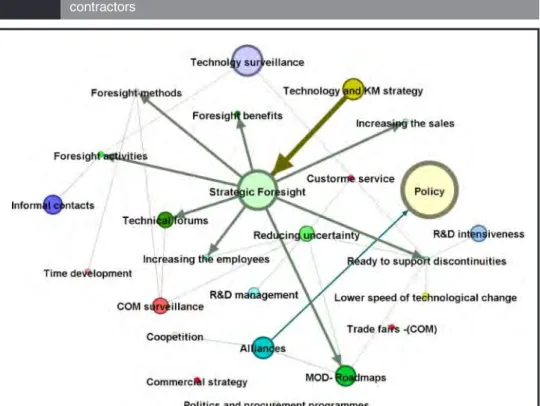
3.4.2 Case study results.The general perception about technology foresight–as a tool for making decisions–is that it has low relevance because they are more in need of ensuring specific contracts with the MoD with their current technologies and products. According to the managers of the firms, activities related to technology foresight are made mainly for big companies because they have more resources to plan and execute R&D projects (technology-push). These investments in time and resources may be useful in the future, even if they may not have a commercial purpose now (market-pull) or they are a potential failure. The interviewed firms are not familiar with the MoD TR because they do not include recommendations in the short term for them, and do not provide highly differentiated information from other sources. However, the large firms (more than three hundred employees) interviewed were more familiar with international organisation workgroups (EDA and NATO) and had even participated in some of them, and they had found the Spanish exercise to be coherent with their technology surveillance. As a result, their interest in the TR published by the MoD was only informative because they are able to launch R&D projects according to their own proper analysis, although the consultation on their related technologies for the public TR was a confirmatory input to keep on-going projects and ideas for new R&D projects in the future.
Figure 1 shows the relations modelled by Gephi software with the (Fruchterman and Reingold, 1991) algorithm applied to the semantic relations among the different issues concerning this technology strategy. More incidence in the responses was considered as more important according to frequency and occurrence in one to five firms (size of the node), and a different range of colours was used for issues related to technology (green), the environment (blue) or commercial functions (red).
These results from the interviewed firms indicate that the TR information published by the MOD (MOD-Roadmaps) is not as important to them as it should be, especially if we consider that the MoD is their major client. They acknowledged that it is beneficial for the firms to be involved in the Spanish exercise, although the information published for public use is not relevant enough to help define their technological strategy. Therefore, the information from the MOD is not an input for the strategic areas of the studied firms. However, they value that the information could be useful, especially in terms of preparing to
face technological discontinuities, and also for building alliances, developing strategic foresight and reducing the uncertainty in the firm’s technological area.
4. Discussion
Government funding of defence-related R&D influences innovation in civilian technologies, although this is still a controversial issue (Mowery, 2012). However, studies support that the collaboration between civilians and researchers incorporated in the MoD can influence the rate and direction of scientific activity (Colatat, 2015). Research in selected technological areas will increase the efficiency of military operations and will reduce human and environmental loses (Saritas and Burmaoglu, 2016).
The Spanish MoD might have chosen such a methodology to mobilise the changes that were required to face the future. Therefore, the main reason for this methodology is the modernisation of the security and safety systems and structures in a specific economic context where public budgets for defence are ramping down and where R&D for dual-use technologies is more urgent every day and foresight for S&D will have more impact on future investments. The TR is considered among the analysis methods that are more relevant to the stages of commercialising and launching innovations, and that is precisely why the actors involved in the Spanish exercise could have lost opportunities. TRs work well in combination with most other methods because they provide a way for industry to play within its comfort zone of uncertainty, but involvement also means a key challenge as part of strategy or policy-making (Smith and Saritas, 2011;Zhanget al., 2015). More open and visionary exercises might reach desirable audiences that are not targeted with the current methods, including SMEs and citizens. A policy toolbox is one of the desired responses after a foresight exercise, which is useful in this case to increase citizens’ S&D culture, as well as due to the benefits derived from it.
Figure 1 Impact of the Spanish defence national foresight exercise on Spanish defence contractors
Likewise, technology foresight may orient innovation towards future users’ demands during the early phase of the innovation development, and it may also be useful in the growth phase of a technology (Kappel, 2001;Salo and Cuhls, 2003).
Our research shows that in the case of the Spanish Defence National Foresight Exercise, the TR has been mainly performed by specialists. However, the individuals in future societies will be more aware of being part of a single human community in a highly interconnected world. This means that increasingly individual empowerment requires more participation and foresight exercises should actively incorporate citizens. Citizens are more aware of the risks posed by a lack of security. Asymmetric warfare has the capacity to unpredictably and quickly unbalance the regular S&D plans. Therefore, the larger participation of citizens within the planning phase of foresight exercises may favour public investment in S&D. However, their nature (secrecy, confidentiality, etc.) makes this involvement more difficult in practice.
SMEs should also participate to improve the industrial base of Europe. Our study following the Spanish exercise shows the lack of interest or awareness among SMEs of the potential benefits of integrating the information supplied by the TR with the firm’s competitive strategy. European programmes on S&D should be more politically active to incorporate SMEs in their foresight exercises from the very beginning, that is, the exercise’s phase planning.
Other methods of exercise foresight allow the combination of experience, interaction, creativity and evidence in their planning and main phases. The participation of every stakeholder in defence and security issues (privacy over the issues should be assured) enables a better way to disseminate the results and increases the effect of innovation policies beyond the sector.
5. Conclusions
Our conclusions and the propositions for future empirical research are directed towards the impact analysis of Spanish technology foresight exercises in S&D issues regarding governments, firms and citizens. The qualitative and quantitative impacts of technology foresight exercises should pay attention to both the contribution of national S&D of their citizens, and to the science and technology system. Their contributions should be directed to improve efficiency, and the effect on their upcoming decisions.
Policy makers have an interest in maintaining and reinforcing a strategic industrial base of S&D firms with high-technology capabilities. The increasing specialisation requirements and dual-use technologies will allow access to new providers if they are capable of including technology related to the future developments when new R&D projects are launched. Therefore, the capability that an organization has built up in managing alliances makes an important contribution to the enhancement of alliance success (Draulanset al., 2003). As a result, collaboration between partners contributes to the development of long-term relationships, sometimes with the support of strategic players (i.e. MoDs or industry). The results of national foresight exercises must be disseminated as much as possible and provide a forward-looking approach. A toolbox that benefits the stakeholder, specifically an industrial policy for the S&D sector, would be welcome. Some dual-use technologies are considered as game-changing, it means that can be applied to a relevant problem in a manner that radically alters the symmetry of military power between competitors. The use of game-changing technologies outdates the policies, doctrines and organizations. In this scenario, a well-known capacity of the industry by MoD, and sharing technology information can reinforce the final phase of the foresight exercise.
These exercises are contributions that favour the consolidation and specialisation in high value-added activities in all current and potential suppliers of products, goods and services for S&D purposes. In this context, primary defence contractors should have the resources
and capabilities to feed big systems of technological surveillance and access experts to develop novelties in a relatively short time. However, a large percentage of European companies are small. Potential technology suppliers for S&D purposes could enhance European competitiveness and the efficiency of public finance.
A desirable issue for future foresight exercises would be to increase citizens’ participation in them, but it would be complicated in the field of S&D technology. However, society should participate in a preliminary phase of the next exercise to contribute its vision of the fundamental rights of citizens, the social component of the future decisions, etc.
The conclusions of our study should be interpreted in the light of its research limitations. For instance, we have not tested the impact of the exercise on non-target audiences (i.e. Spanish firms that have dual-use technologies), and we only use the public information provided by the MoD for the analysis. Future studies about the impact of foresight exercises in the defence sector should incorporate a wider focus (i.e. citizens, research centres) because they influence and have implications for strategic decision-making in science and technology systems. Therefore, the impact of TRs should be larger than we have found and could even go beyond the S&D industry. A longitudinal study could be useful to analyse the impact of every phase of the study and improve the dissemination and learning phase that support new policy instruments; the efficiency of the exercise could even be measured in economic terms for some of the agents of the national system, such as firms.
Notes
1. The reasons to justify the design and the development of this exercise are not published. The authors are not policy makers, and they did not take part in any way in the Spanish exercise. 2. CapTech (Capability Technology group) is a working group of the EDA Research & Technology
Directorate dedicated to a particular technology area. Their purpose is the generation of collaborative projects within the scope of technology and the support of EDA participating Member States in the preparation of wider programmes.
3. Data from TEDAE: http://tedae.org/es/acciones/la-industria-espanola-de-defensa-aeronautica-y-espacio-facturo-9-4-millardos-de-euros-en-2014
References
Amanatidou, E., Popper, R. and Teichler, T. (2012), “Drivers, trends and grand challenges in security”, Overview Briel–EFP Briel No. 248.
Andersen, P.D. and Rasmussen, B. (2012),Fremsyn: Metoder, Praksis og Erfaringer, Styrelsen for Forskning og Innovation, København.
Australia, D.F. (2011),Defence Simulation Strategy and Roadmap, Department of Defence, Camberra. Barker, D. and Smith, D.J.H. (1995), “Technology foresight using roadmaps”,Long Range Planning, Vol. 28 No. 2, pp. 21-28.
Cagnin, C., Keenan, M., Johnston, R., Scapolo, F. and Barre, R. (2008),Future-Oriented Technology Analysis, Springer-Verlag, Berlin, Heidelberg.
Calof, J. and Smith, J. (2010), “The integrative domain of foresight and competitive intelligence and its impact on R&D management”,R&D Management, Vol. 40 No. 1, pp. 31-39.
Colatat, P. (2015), “An organizational perspective to funding science: collaborator novelty at DARPA”, Research Policy, Vol. 44 No. 4, pp. 874-887.
Concepts and Doctrine Centre Development (CDDC) (2014),Strategic Trends Programme: Global Strategic Trends - Out to 2045, 5th ed., CDDC.
Corbin, J. and Strauss, A.L. (1990), “Grounded theory research: procedures, canons and evaluative criteria”,Zeitschrift Fu¨r Soziologie, Vol. 19 No. 6, pp. 418-427.
Correˆa, C.R. and Cagnin, C. (2013),Prospective Games for Strategic Decisions in Defence and Security in Brazil–a Proposed Model, International Foresight Academy, Winterthur/Zurich.
De Spiegeleire, S. (2011), “Ten trends in capability planning for defence and security”,The RUSI Journal, Vol. 156 No. 5, pp. 20-28.
Draulans, J., DeMan, A.P. and Volberda, H.W. (2003), “Building alliance capability”, Long Range Planning, Vol. 36 No. 2, pp. 151-166.
Dreyer, I. and Stang, G. (2013), “Foresight in governments–practices and trends around the world”, Foresight in EUISS Yearbook of European Security.
Eisenhardt, K.M. and Graebner, M.E. (2007), “Theory building from cases: opportunities and challenges”,Academy of Management Journal, Vol. 50 No. 1, pp. 25-32.
Fruchterman, T. and Reingold, E. (1991), “Graph drawing by force directed placement”, Software: Practice and Experience, Vol. 21 No. 11, pp. 1129-1164.
Georghiou, L. (1996), “The UK technology foresight programme”, Futures, Vol. 28 No. 4, pp. 359-377.
Georghiou, L. and Keenan, M. (2006), “Evaluation of national foresight activities: assessing rationale, process and impact”, Technological Forecasting and Social Change, Vol. 73 No. 7, pp. 761-777.
Gerdsri, N., Vatananan, R.S. and Dansamasatid, S. (2009), “Dealing with the dynamics of technology roadmapping implementation: a case study”,Technological Forecasting and Social Change, Vol. 76 No. 1, pp. 50-60.
Gibbert, M., Ruigrok, W. and Wicki, B. (2008), “What passes as a rigorous case study?”,Strategic Management Journal, Vol. 29 No. 13, pp. 1465-1474.
Goverment of Canada (2014), “The future security environment (2013-2040)”, available at: http:// publications.gc.ca/site/archivee-archived.html?url=http://publications.gc.ca/collections/collection_2015/ mdn-dnd/D4-8-2-2014-eng.pdf
Havas, A. (2005),Terminology and Methodology for Benchmarking Foresight Programmes, Budapest. Herz, J.C., Lucas, M. and Scott, J. (2006), “Open technology development roadmap plan”,
Hideg, E´ . (2007), “Theory and practice in the field of foresight”,Foresight, Vol. 9 No. 6, pp. 36-46. Hundley, R. and Gritton, E.C. (1994),Future Technology-Driven Revolutions in Military Operations. Results of a Workshop, Santa Monica, CA.
James, A. and Teichler, T. (2014), “Defence and security: new issues and impacts”,Foresight, Vol. 16 No. 2, pp. 165-175.
Kappel, T.A. (2001), “Perspectives on roadmaps: how organizations talk about the future”,The Journal of Product Innovation Management, Vol. 18, pp. 39-50.
Keenan, M. (2000), “An evaluation of the implementation of the UK technology foresight programme”, Prest, University of Manchester.
Lee, S., Kang, S., Park, Y. and Park, Y. (2007), “Technology roadmapping for R&D planning: the case of the Korean parts and materials industry”,Technovation, Vol. 27 No. 8, pp. 433-445.
Linstone, H.A. (2002), “Military technology and its frustrations”,Technological Forecasting & Social Change, Vol. 69 No. 7, pp. 759-764.
Martin, B. and Johnston, R. (1999), “Technology foresight for wiring up the national innovation system”, Technological Forecasting & Social Change, Vol. 60 No. 1, pp. 37-54.
Missiroli, A. (2013),Enabling the Future: European Military Capabilities 2013-2025: Challenges and Avenues, Paris.
Molas-Gallart, J. (1997), “Which way to go? Defence technology and the diversity of ‘dual-use’ technology transfer”,Research Policy, Vol. 26 No. 3, pp. 367-385.
Mowery, D.C. (2012), “Defense-related R&D as a model for ‘grand challenges’ technology policies”, Research Policy, Vol. 41 No. 10, pp. 1703-1715.
Narula, K. (2013), “Energy strategy for the Indian Navy: need, scope and a roadmap”,Strategic Analysis, Vol. 37 No. 3, pp. 310-321.
National Intelligence Council (2012), “Global trends 2030: alternative worlds”, available at:http://info. publicintelligence.net/GlobalTrends2030-TalkingPoints.pdf
Phaal, R., Farrukh, C.J.P. and Probert, D.R. (2004), “Technology roadmapping: a planning framework for evolution and revolution”,Technological Forecasting and Social Change, Vol. 71 No. 1-2, pp. 5-26. Salo, A. and Cuhls, K. (2003), “Technology foresight-past and future”,Journal of Forecasting, Vol. 22 Nos 2/3, pp. 79-82.
Saritas, O. and Aylen, J. (2010), “Using scenarios for roadmapping: the case of clean production”, Technological Forecasting and Social Change, Vol. 77 No. 7, pp. 1061-1075.
Saritas, O. and Burmaoglu, S. (2016), “Future of sustainable military operations under emerging energy and security considerations”,Technological Forecasting and Social Change, Vol. 102, pp. 331-343. Smith, J.E. and Saritas, O. (2011), “Science and technology foresight baker’s dozen: a pocket primer of comparative and combined foresight methods”,Foresight, Vol. 13 No. 2, pp. 79-96.
Sokolova, A. (2015),An Integrated Approach for the Evaluation of National Foresight: The Russian Case, Technological Forecasting and Social Change.
Spanish Ministry of Defence (2015), “Technology roadmaps. 4.3.4 to increase technological capabilities to reduce the physical load transported by combatants, reducing their dependence on batteries and increasing the energy efficiency of systems”, available at:www.tecnologiaeinnovacion.defensa.gob.es/ es-es/Contenido/Paginas/detallepublicacion.aspx?publicacionID=122
Teleb, N. (2007),The Black Swan: The Impact of the Highly Improbable, Allen Lane, London.
Thorleuchter, D. and Van den Poel, D. (2011), “Semantic technology classification: a defence and security case study”, 2011 International Conference on Uncertainty Reasoning and Knowledge Engineering, pp. 36-39.
Yasunaga, Y., Watanabe, M. and Korenaga, M. (2009), “Application of technology roadmaps to governmental innovation policy for promoting technology convergence”,Technological Forecasting and Social Change, Vol. 76 No. 1, pp. 61-79.
Zhang, Y., Robinson, D.K.R., Porter, A.L., Zhu, D., Zhang, G. and Lu, J. (2015), “Technology roadmapping for competitive technical intelligence”,Technological Forecasting and Social Change.
About the authors
Dr Silvia Vicente Oliva is an Assistant Professor of Innovation Management and Technology Policy at the Centro Universitario de la Defensa (Zaragoza, Spain). This center provides the Management Engineering degree course to officer cadets in the General Corps of the Spanish Army. She received her PhD in Project Engineering from the University of Zaragoza and her research interests include R&D project management, technology foresight and innovation. Her research has been published in, among others, theInternational Journal of Project Managementand International Journal of Innovation Management. Silvia Vicente Oliva is the corresponding author and can be contacted at:[email protected]
Angel Martinez-Sanchez is a Full Professor at the Department of Business Management at the University of Zaragoza in Spain. He received his PhD in Engineering from the University of Zaragoza and has been a Research Fellow at universities in Europe, North America, Australia and Japan. Dr Sanchez’s research interests focus on innovation and technology management, production and supply chain management, teleworking and information technologies and human resources management. He has published in journals such as
Journal of Management, International Journal of Operations and Production Management, Journal of Product Innovation Management, R&D Management, TechnovationandSupply Chain Management, as well as numerous conference proceedings, books and research reports.
For instructions on how to order reprints of this article, please visit our website:
www.emeraldgrouppublishing.com/licensing/reprints.htm
Or contact us for further details:[email protected]