© 2013. The copyright of this document resides with its authors. It may be distributed unchanged freely in print or electronic forms.
Abstract
In this paper a feasibility study of brain MRI dataset classification, using ROIs which have been segmented either manually or through a superpixel based method in conjunction with statistical pattern recognition methods is presented. In our study, 471 extracted ROIs from 21 Brain MRI datasets are used, in order to establish which features distinguish better between three grading classes. Thirty-eight statistical measurements were collected from the ROIs. We found by using the Leave-One-Out method that the combination of the features from the 1st and 2nd order statistics, achieved high classification accuracy in pair-wise grading comparisons.
Keywords, Brain tumour grading, MRI images, superpixel segmentation, pattern recognition, SVM classification.
1
Introduction
Brain tumours are caused by abnormal and uncontrolled growing of the cells inside the brain or spinal canal. The primary tumours are those started in the brain and are categorised in four main types: Gliomas, Meningiomas, Pituitary adenomas and Nerve sheath tumours. The most popular grading system for tumours is that suggested by the World Health Organization (WHO). Regarding to the WHO grading system, the tumours are graded from I to IV, corresponding to least advanced to the most advanced diseases, respectively.
Utilizing computer-aided procedures for medical diagnosis and treatment is a growing field of research nowadays. Image processing and pattern recognition algorithms are widely used for analysis and interpretation of medical images. Feature extraction is the most important and impartible element of classification and pattern recognition tasks. In
Brain Tumour Grading in Different MRI
Protocols using SVM on Statistical
Features
Mohammadreza Soltaninejad1 [email protected] Xujiong Ye1 [email protected] Guang Yang 2 [email protected] Nigel Allinson1 [email protected] Tryphon Lambrou1 [email protected] 1School of Computer Science,
University of Lincoln, UK
2
St. George's, University of London, UK
the case of medical images, such as MRI, the reduction of dimensionality is of high importance. MRI images are three-dimensional volumetric data acquired with different protocols, which lead to extraction of high dimensional information in the form of statistical features. Classification of high dimensional data is based on these extracted features.
Several techniques have been used to detect and classify brain tumours in MRI images. Joshi et al. [1] developed a system for detection of Astrocytoma cancer tumours and classify them base on artificial neural network. They use grey-level co-occurrence matrix for texture feature selection and Neuro-Fuzzy classifier to classify the tumours. Georgiadis et al. [2] proposed a method to classify primary tumours and metastatic, which are originated outside brain. They applied non-linear least square feature transformation and combined it with a probabilistic neural network (PNN). Zacharaki et al. [3] used SVM with recursive feature elimination for classification of tumour grades in MRI images using texture, shape and rotation invariant texture features. They suggested one-versus-all SVM classification and majority voting for multi-class problem.
In this paper, we intend to classify tumour grades II, III and IV using different MRI acquisition protocols i.e. FLAIR, and T2. Region of interest segmentation is performed separately for each protocol. The segmentation is based on a superpixel based method with nearly similar intensity features. Then 1st order and 2nd order statistical textural features are extracted. The aim is to classify the tumours using the features collected from every individual protocol as well as their combinations. For this task, a support vector machine (SVM) classifier is utilized to classify different combinations of the data. The evaluation is performed using the overall classification accuracy and comparison of the results is based
on the abo .
This paper is organised as follows. Section 2 explains the stages of the proposed method, which is partitioned into the main stages of the algorithm. Section 3 represents the experimental results. Finally, section 4 discusses the conclusion and future works.
2
Tools and Methods
2.1
Data Description
We acquired MR data using a GE Signa LX 1.5T MRI system (GE Healthcare, Milwaukee, WI, USA) equipped with a maximum field gradient strength of 22mT/m and using a quadrature head coil. The MRI sequences used in this study are described below:
FLAIR (TE = 133 ms, TR = 9000 ms, inversion time 2200 ms, band width = 61.04Hz). FLAIR were acquired in the axial plane with a field of view (FOV) 240 x 240 mm2, matrix size 256 x 256 and 5 mm slice thickness with no slice gap.
Axial T2 weighted MRI using a single-shot spin echo echo-planar-imaging (EPI) sequence. The sequence covered whole brain with 50 contiguous slices that were acquired as two interleaved series of four repeats, i.e., 2.8 mm thick slices with 2.8 mm gaps. Other parameters were set as TR = 8000 ms, TE = 88 ms, acquisition matrix 96 x 96, FOV = 24 cm, and resulted in in-plane resolution of 2.5 mm.
Another T2 weighted MRI data were acquired using a dual echo sequence with FOV of either 220 x 220 mm2 or 240 x 240 mm2 , a 256 x 256 acquisition matrix, 29 slices with 5 mm thickness and a TR = 3500 ms and TE = 98 ms [4].
A cohort consisting of 21 patients entered retrospectively into our study, each with a brain tumour, who has been imaged with the aforementioned MRI sequences. The dataset consists of 6 grade II tumours, 4 grade III tumours, and 11 grade IV tumours. Each patient has a histological ground truth. Patient ages at the time of scanning ranged from 22 to 73 (mean 55), and consisted of 7 females and 14 males. All the MRI datasets have been realigned to remove eddy current effects by affine registration using FSL [5].
2.2
Superpixel Segmentation and Grouping
The image is segmented to small partitions using linear iterative clustering superpixel (SLIC) [6].The initial superpixel centres are located by uniform sampling the pixels in one slice in 2D space. The search space is a square window with the size of two times more than a superpixel size to decrease computations time. The cluster labels are updated in each iteration, based on the location and intensity distance of the pixels in search area to the centres. Therefore, the centres location is changed in every loop by calculating the gravity centres of new labels. A seed point is selected in an arbitrary slice by the user. The mean intensity value of the superpixel which contains this point is determined. The mean intensity value of the all the neighbouring superpixels are checked. The superpixels with values in a confidence margin of 3 are assumed to be in the region of interest. The process is repeated until we ensure that there is no new superpixel with similar value to add to the ROI.
2.3
Feature Extraction
Our statistical pattern recognition approach uses the classical steps of feature extraction, classification and feature selection, which are further described below.
The first step of our pattern recognition approach is the feature extraction step, which is the transformation of patterns into features that are regarded as a compacted representation. The usage of statistical features for the analysis and classification of textured images has been extensively demonstrated in the literature. Overall thirty eight statistical image features were collected from each image, given by category as:
The selected regions of interest (ROI) in the previous stage are based on the intensity mean of the superpixels. First Order Statistics [7] which express the distribution of grey levels (i.e. the intensity) within the selected ROI. These features are based on the histogram of the image, since they represent the frequency distribution of the grey level in the ROI. These 16 in total features are average, standard deviation, variance, mean of the absolute deviation, median absolute deviation, coefficient of variance, skewness, kurtosis, maximum , minimum, median and mode of the intensity values, central moments, range, interquartile range and entropy.
Second Order Statistics [7] which are measurements collected by the Grey-Tone Spatial-Dependent Matrices. These matrices of grey-tone spatial-dependence frequencies are a function of the angular relationship between neighbouring image elements, and additionally a function of the distance between them. This is performed for one neighbouring pixel in the selected ROI in four different directions [0°, 45°, 90°, and 135°]. However, in our case the average feature vector of the four directional feature vectors was estimated in order to reduce the dimensionality of the feature combinations. The features which can be extracted by the grey-tone spatial-dependence matrices are: autocorrelation, contrast, correlation 1, correlation 2, cluster prominence, cluster shade, dissimilarity, energy, entropy, homogeneity, maximum probability, sum of squares' variance, sum
average, sum variance, sum entropy, difference variance, difference entropy, information measure of correlation 1, information measure of correlation 2, inverse difference, and inverse difference moment normalized.
2.4
Support Vector Machine Classification
Support vector machine (SVM) is a supervised learning method, which is used for classification and regression tasks [8]. The data must include exactly two number of classes. The SVM finds the best hyperplane for separation of the classes, which presents the largest margin between them. The margin is defined as the maximum distance in which in the best case scenario the data points of the different classes are separable in the feature space. The aim of using SVM is to find a hyperplane in the feature space to separate them with the minimal error (i.e. maximum distance from the clusters closets points).
3
Results
The aim of this study is to examine the performance of the linear SVM classification on brain MRI datasets which have been delineated either manually or using a superpixel based method, and in particular, to determine whether we can distinguish between different grades of cancer brain tissue.
The performance of the linear SVM classifier was evaluated by using the Leave-One-Out method. In addition, for each set of features all possible combinations were tested up to three dimensional decision spaces. Those features, which achieve the best classification rate, were used in the pattern recognition process. This phase is called feature selection, and aims to reduce the features set to a subset, which consists only of meaningful information (i.e. features that characterize best) about the images we want to classify. The classification accuracy results presented in this paper are those, which fulfil the requirement that the overall accuracy is more than 80%.
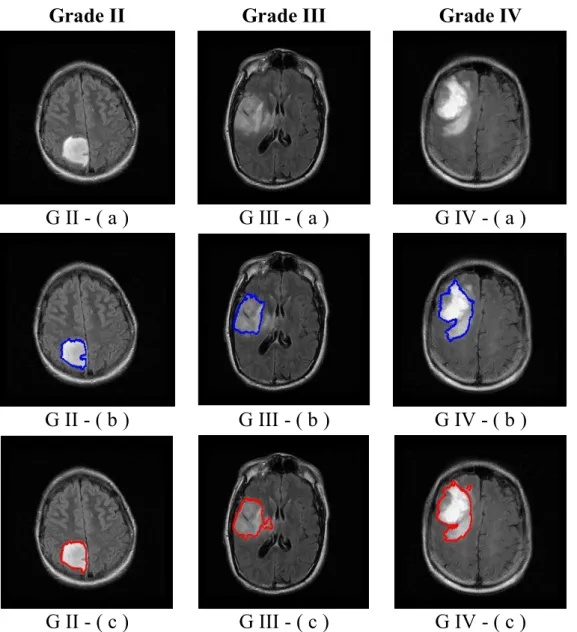
Figure 1, shows three examples of grades II, III, and IV, acquired using the FLAIR MRI protocol. Each column presents the original image, as well as the results of the superpixel and the manual segmentation.
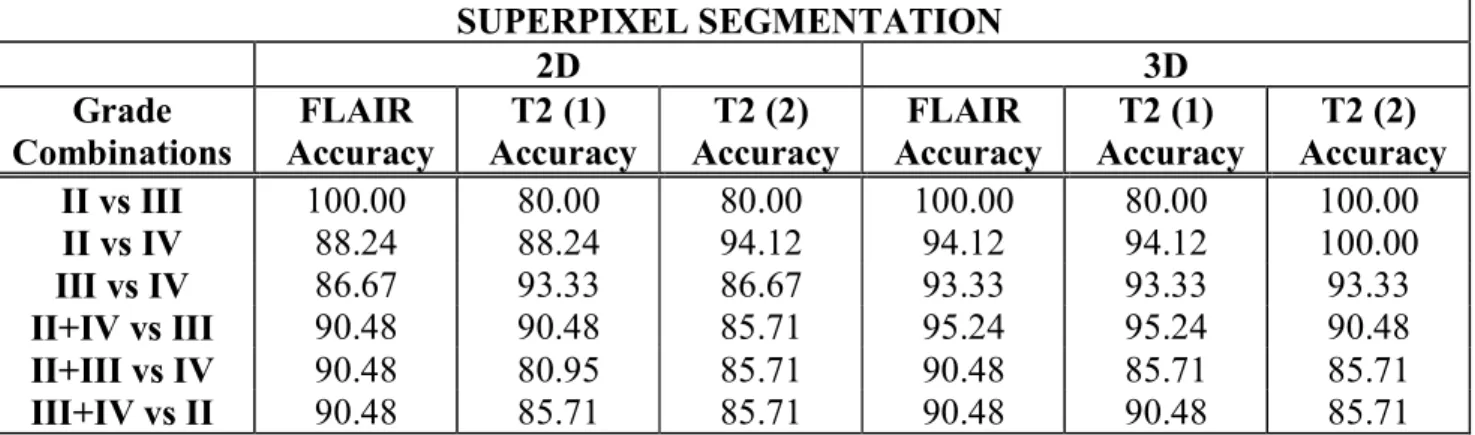
In terms of classification accuracy, we tested all the pair-wise combinations between the different grades present in our cohort. In addition comparisons between datasets using different acquisition MRI protocols were also performed. These results are presented in Tables 1 and 2, for ROIs extracted manual and with superpixel segmentation, respectively. It is worth noticing that the best classification results were achieved in three-dimensional space, for both manual and superpixel ROIs.
In terms of the performance of the Statistical Features extracted from all the brain MRI images, we concluded that: Features from the 1st Order Statistics obtained from either the manual or the superpixel segmentation, produced classification accuracy results above the thresholds set. Features from the 2nd Order Statistics obtained from either the manual or the superpixel segmentation produced the best classification accuracy results. The overall number of feature combinations which exceeded the inclusion threshold of 80.00%, is greater on features from the superpixel segmentation than that of the manual delineation (34652 to 29429).
The usage of statistical features for the analysis and classification of textured images has been extensively demonstrated in the literature. Our results suggest that features from
the 2nd Order Statistics achieved the best classification accuracy results, since such measurements focus on the overall nature of the texture such as homogeneity, contrast, the presence of organized structure, complexity, and the grey tone transitions within the image.
Grade II Grade III Grade IV
G II - ( a ) G III - ( a ) G IV - ( a )
G II - ( b ) G III - ( b ) G IV - ( b )
G II - ( c ) G III - ( c ) G IV - ( c )
Figure 1: Examples of Grade II, III, and IV brain oedemas: a) original MRI slice, b) superpixel segmentation, c) manual segmentation.
MANUAL SEGMENTATION 2D 3D Grade Combinations FLAIR Accuracy T2 (1) Accuracy T2 (2) Accuracy FLAIR Accuracy T2 (1) Accuracy T2 (2) Accuracy II vs III 90.00 80.00 90.00 90.00 80.00 90.00 II vs IV 94.12 92.36 94.12 100.00 82.36 94.12 III vs IV 93.33 93.33 86.67 93.33 93.33 93.33 II+IV vs III 90.48 85.71 85.71 90.48 85.71 90.48 II+III vs IV 90.48 80.95 90.48 95.24 80.95 90.48 III+IV vs II 90.48 80.95 90.48 95.24 80.95 90.48 Table 1: Overall classification accuracy for 2D and 3D decision space, using the manual
SUPERPIXEL SEGMENTATION 2D 3D Grade Combinations FLAIR Accuracy T2 (1) Accuracy T2 (2) Accuracy FLAIR Accuracy T2 (1) Accuracy T2 (2) Accuracy II vs III 100.00 80.00 80.00 100.00 80.00 100.00 II vs IV 88.24 88.24 94.12 94.12 94.12 100.00 III vs IV 86.67 93.33 86.67 93.33 93.33 93.33 II+IV vs III 90.48 90.48 85.71 95.24 95.24 90.48 II+III vs IV 90.48 80.95 85.71 90.48 85.71 85.71 III+IV vs II 90.48 85.71 85.71 90.48 90.48 85.71 Table 2: Overall classification accuracy for 2D and 3D decision space, using the superpixel
segmented ROIs.
4
Conclusion
In this paper a feasibility study of brain MRI dataset classification, using ROIs which have been segmented either manually or using a superpixel based method in conjunction with statistical pattern recognition methods is presented. In our study, 471 extracted ROIs from 21 Brain MRI dataset were used, in order to establish which features distinguish better between three grading classes. Thirty-eight statistical measurements were collected from the ROIs. We found by using the Leave-One-Out method that the combination of the features from the 1st and 2nd Order statistics, achieved overall classification accuracy above the self-imposed threshold of 80.00% that we had originally set.
References
[1] D. M. Joshi, N. K. Rana, V. M. Misra. Classification of brain cancer using artificial neural network, Proceedings of the 2010 2nd International Conference on Electronic Computer Technology, 112-116, Kuala Lumpur, Malaysia, May 2010.
[2] P. Georgiadis, D. Cavouras, I. Kalatzis, A. Daskalakis, G. C. Kagadis, K. Sifaki, M. Malamas, G. Nikiforidis, E. Solomou, Improving brain tumor characterization on MRI by probabilistic neural networks and non-linear transformation of textural features, Computer Methods and Programs in Biomedicine, 89 (1) : 24-32, 2008.
[3] E. I. Zacharaki, S. Wang, S. Chawla, D. Soo Yoo, R. Wolf, E. R. Melhem, C. Davatzikos. Classification of brain tumour type and grade using MRI texture and shape in a machine learning scheme, Magnetic Resonance in Medicine, 62(6): 1609-1618, 2009.
[4 -brain DTI segmentation technique for brain
Resonance in Medicine (ISMRM), 2012, vol. 20, p. 188.
[5] M. Jenkinson, C.F. Beckmann, T.E. Behrens, M. W. Woolrich, and S. M. Smith. Fsl. NeuroImage, 62:782 790, 2012.
[6
Compared to State-of-the-Art Superpixel Methods, IEEE Transactions on Pattern Analysis and Machine Intelligence, 34 (11): 2274-2282, 2012.
[7] A.K. Jain, -Hall International Editions,
N.J., USA, 1989.
[8] N. Cristianini, and J. Shawe-Taylor. An Introduction to Support Vector Machines and Other Kernel-based Learning Methods, First Edition, Cambridge: Cambridge University Press, 2000.