IMR-DCAL SPECIAL PAPER
A study and analysis of recommendation
systems for location-based social network
(LBSN) with big data
Murale Narayanan
a,*
, Aswani Kumar Cherukuri
ba
Information Technology, EMC Corporation, India Center of Excellence, Bangalore, India bSchool of Information Technology & Engineering, VIT University, Vellore, Tamil Nadu, India
Received 28 March 2014; revised 15 June 2015; accepted 22 January 2016; available online 13 February 2016
KEYWORDS Big data; Data mining; Recommendation system; Social network; LBSN
Abstract Recommender systems play an important role in our day-to-day life. A recom-mender system automatically suggests an item to a user that he/she might be interested in. Small-scale datasets are used to provide recommendations based on location, but in real time, the volume of data is large. We have selected Foursquare dataset to study the need for big data in recom-mendation systems for location-based social network (LBSN). A few quality parameters like par-allel processing and multimodal interface have been selected to study the need for big data in recommender systems. This paper provides a study and analysis of quality parameters of rec-ommendation systems for LBSN with big data.
© 2016 Production and hosting by Elsevier Ltd on behalf of Indian Institute of Management Bangalore.
Introduction
Recommender systems or recommendation systems (RS) collect information based on the preferences of users (for example—songs, movies, jokes, books, travel destination and e-learning material). Recommender systems work based on users’ information from different sources and provide rec-ommendation of items. This information can be explicit (user rating) and implicit (monitoring user’s behaviour), with
mil-lions of users using social networking services like Face-book, Twitter, and so forth. The rich knowledge that has accumulated in these social networking sites enables a variety of recommendation systems for its users.
A social network is an abstract structure comprised of in-dividuals connected by one or more types of relations, such as friendship, shared knowledge, and common interests as stated byZheng, Zhang, Xie, and Ma (2009). Location data add strength to the connection of the social networks. A location can be rep-resented in relative, absolute, and symbolic form. Location is usually represented in three kinds of geographical representations—a point location, a region, and a trajectory. In recent times, localisation techniques have enhanced social networking services, allowing the users to share their location-related content, and locations such as geo-tagged
* Corresponding author. Tel.+91 9972565848; fax: 41659511.
E-mail address:[email protected](M. Narayanan).
Peer-review under responsibility of Indian Institute of Management Bangalore.
a v a i l a b l e a t w w w. s c i e n c e d i r e c t . c o m
ScienceDirect
j o u r n a l h o m e p a g e : w w w. e l s e v i e r. c o m / l o c a t e / i i m b
http://dx.doi.org/10.1016/j.iimb.2016.01.001
0970-3896 © 2016 Production and hosting by Elsevier Ltd on behalf of Indian Institute of Management Bangalore.
photos and notes. This is known as location-based social net-works (LBSNs) (Zheng et al., 2009). An LBSN adds a location to an existing social network, and also tells the people in their social network that they can share their location-related in-formation. Based on the location-related information, a new abstract structure is derived and connects connected indi-viduals based on their location-related content, such as photos, texts and videos. Instant location and the history of a person are given as a timestamp during a certain period.
The advances in wireless communication technologies and location acquisition enables people to add a location dimension to traditional social networks and promotes a bunch of LBSN services, such as Foursquare, GeoLife and Loopt, where users can easily share their experiences in the physical world through mobile devices. The location dimen-sion bridges the gap between the physical world and the digital online social networking services, giving rise to new opportunities and challenges in traditional recommender systems in the following aspects—complex objects and rela-tions, and rich knowledge.
Location is one of the important components of user context and implies extensive knowledge about a user’s in-terests and behaviour, thereby providing us with opportuni-ties to better understand users in an abstract structure not only according to user behaviour, but the mobility of the user and his/her activities in the physical world. In recent times based services, such as tour guide and location-based social network, have accumulated a lot of location data. Today, the positioning function in mobile devices, such as GPS-phones, lets people know their locations easily. This loca-tion data provide various localoca-tion-based services on the web and has shown itself to be attractive to the users. In real time, data are huge in volume, but data warehouses use small-scale datasets of users for recommendation.
When it comes to real-time scenario, these techniques may fail because millions of users will use social networks at the same time. The major challenges to be addressed in LBSN rec-ommendation are 1) location-context awareness; 2) hetero-geneous domain and 3) rate of growth.
Different types of data sources are used in recommenda-tion systems for LBSNs, including 1) user profiles, 2) user online histories and 3) user location histories. This involves huge volumes of data in real-time scenario. Most recommenda-tion systems in LBSNs currently use only one type of data source to make recommendations. Moreover, many of the data sources are related and may mutually reinforce each other. By considering more diversified data sources, more effec-tive recommendations can be provided. For instance, the user online interactions, social structures and location histories are all very relevant to friend recommendation. If two users have more online interactions, are close in the social struc-ture, and have overlapped location histories, these users are likely to be compatible. A friend recommender system that can consider all these factors will make higher quality friend recommendations.
We carried out an analysis, based on the characteristics of a recommender system, to give a comparison between big data and data warehouse with a dataset collected from Four-square users, using a qualitative approach. This paper is organised as follows: Section 2 deals with literature review; Section 3 explains the challenges of the domain; Section 4 provides the objective of the paper; Section 5 details the
dataset discussed in this paper; Section 6 gives characteris-tics of a location-based recommendation system; Section 7 explains the qualities of the location-based recommenda-tion system, and Secrecommenda-tion 8 provides the conclusion.
Related work
Social media recommendations
Social media recommendation aims to provide users with sug-gestions of photos, videos, or other web content they might like. Using location information in LBSNs can improve both the effectiveness and efficiency of traditional social media recommendations. Several works in spatial keyword search for web content show the effectiveness of this pairing (Bouidghaghen, Tamine, & Boughanem, 2011; Cao, Cong, & Jensen, 2010b, 2011; Chen, Geyer, Dugan, Muller, & Guy, 2009; Zhang, Chee, Mondal, Tung, & Kitsuregawa, 2009). Location-aware image ranking algorithms have been pro-posed to increase the relevance of search results (Arase, Xie, Duan, Hara, & Nishio, 2009; Kawakubo & Yanai, 2011; Silva & Martins, 2011), which in turn improves the quality of the image tags, using a recommender system to automatically infer and suggest candidate location tags (Daly & Geyer, 2011).
The efficiency of recommendation systems can be signifi-cantly improved by using location data to prune out irrel-evant information (Scellato, Mascolo, Musolesi, & CrowCroft, 2011). This improves the efficiency of content delivery net-works using a novel caching mechanism based on geographic location. A real-time recommendation system, as suggested inSandholm and Dung (2011), has been built for online web content using a collaborative filtering method to make more diverse and personalised recommendations within a geo-graphical area.Levandoski, Sarwat, Eldawy, and Mokbel (2012)
have proposed a novel location-aware recommendation system (LARS) framework to exploit users’ ratings of locations using a technique that uses the distance of querying users to in-fluence recommendations.
Categorisation by methodology
Although traditional recommendation systems have been suc-cessful by using community opinions, such as inventories in Amazon (Linden, Smith, & York, 2003) and news from Google (Das, Datar, Garg, & Rajaram, 2007) incorporating location information requires novel approaches. In this section, we cat-egorise the major methodologies used by recommendation systems in location-based social networks as being based on — 1) content-based recommendation and 2) link analysis.
Content-based recommendations
Content-based recommendation systems, such as context aware and location based using Bayesian model (Park, Hong, & Cho, 2007; Ramaswamy et al., 2009), match user prefer-ences discovered from users’ profiles with features ex-tracted from locations, such as tags and categories, to make recommendations. These systems require accurate and struc-tured information for both the user profiles and the loca-tion features to make high-quality recommendaloca-tions. The major advantage of the content-based approach in such a system is that it is robust against the cold start problem for
both new users and locations. As long as the newly added users or locations have the appropriate descriptive content, they can be handled effectively. However, content-based recom-mendation systems have many drawbacks with regard to LBSNs: 1) content-based recommendation systems do not con-sider the aggregated community opinions (inferred from users), which may result in low-quality recommendations; and 2) content-based recommendation systems require that the struc-tured information for both users and locations be created and maintained, which can be costly, especially in LBSNs in which the majority of the content (such as user profiles and loca-tion tags) is generated by the users.
Link analysis-based recommendations
Link analysis algorithms, such as PageRank (Page, Brin, Motwani, & Winograd, 1999), and Hypertext Induced Topic Search (HITS) (Chakrabarti et al., 1998; Kleinberg, 1999), are widely used to rank web pages. These algorithms extract high-quality nodes from a complex network by analysing the struc-ture. In LBSNs, there are interconnected networks of different types, such as user–user, user–location and location–location networks.Zheng et al. (2009)extend the HITS algorithm for discovering experienced users and interesting locations in an LBSN. In their system, each location is assigned a popularity score, and each user is assigned a hub score, which indi-cates their travel expertise. Based on a mutually reinforc-ing relationship, a rankreinforc-ing of expert users and interestreinforc-ing locations is computed. Similarly,Raymond, Sugiura, and Tsubochi (2011)extend a random walk-based link analysis al-gorithm to provide location recommendation.
Challenges
Most recommendation systems in LBSNs currently use only one type of data source to make recommendations. As previ-ously mentioned, there are different types of data in LBSNs. Many of the data sources are related and may mutually re-inforce each other. By considering more diversified data sources, more effective recommendations can be provided. The recommendation methodologies used in the existing rec-ommendation systems have their own drawbacks. For example, in collaborative filtering (CF)-based recommenda-tion systems, data sparsity and cold starts are challenging problems. Link analysis-based recommendation systems avoid these problems, but only to provide generic recommenda-tions that ignore users’ personal preferences. By integrat-ing CF and link analysis-based techniques, a hybrid recommendation system could overcome the weaknesses of both. For example, cold start problem arises due to insuffi-cient amount of data for making reliable recommendations, while starting a recommendation system (Kleinberg, 1999). This problem can be overcome when we use big data that is a collection of large and complex datasets. The objective of this work is to address the previously discussed issues using big data and to report the impact of big data; where big data can store large volume of data and it can be accessed to get information about both user and location.
Objective of the paper
There are several approaches for a recommender system. Rec-ommender systems use data warehouse bases to collect
information about users. In real time, user information data are huge, so we are going to analyse a recommender system with big data. Data in a data warehouse are unmodified and consistent. Data formats are standardised through data ware-house to generate reports, and dashboards to forecast trends and predict the future. In data warehouse, data are inte-grated and provide interactive tools to users. Datasets for rec-ommender systems play an important in LBSN to provide recommendations to users. To provide recommendation, data have to be available any time and need to be distributed. Our objective is to analyse whether data warehouse or big data is better for recommender systems. This can be done in two ways: qualitative and quantitative. Our analysis was quali-tative, based on few parameters such as parallel processing and multimodal interface.
Characteristics of recommendation systems
Recommender systems should make use of the user’s informa-tion, the user’s friendships, location details, the user’s inter-ests, his/her social circles and the like. To extract this information, recommender systems would need to process struc-tured and unstrucstruc-tured data laterally, which helps to dis-cover unknown relationships from the data and extract information from multimodal interfaces. The present recom-mender systems use data warehouses for operation, but in real time, recommender systems have to recommend dynamically based on user information, do parallel processing, and handle structured and unstructured data as previously mentioned.
Many data warehouses have components that sense prob-able customer churn and use a recommendation system to convince the consumer to stay. Using predictive analytics and user profiles, personalised offers are sent proactively to po-tential users to earn their constant loyalty. In many indus-tries, this application is mandatory. Big data helps in pulling click streams from various websites to discover consumer preferences/interests. This is also helpful to get churn results, and preference/interest data of the user.
The data warehouse and big data are not highly differen-tiated in some categories. And so, either tool could be the right solution. Choosing the best tool depends on the require-ments. Further, big data and the data warehouse can work together in an information supply chain.
The analysis of a recommender system can be done using a qualitative or quantitative approach. This study analyses RS qualitatively. We took up few important parameters to analyse recommender systems using big data and data ware-house. Some parameters are explained below.
Structured and unstructured data
The data extracted from users and the source for recom-mender systems consist of structured and unstructured data. Data warehouse does not handle unstructured data, which is an important source for a recommender system. This is ac-complished by using big data.
Distributed or centralised data
Recommender systems need distributed data to suggest offers to the users based on their interests, but in data warehouse,
all data are centralised. Massive data sets are used to study the location of the user, but these data do not fit in data ware-house. Big data has been a boon to these approaches.
Data mining
The data mining algorithm should run in parallel to provide quick results. Big data runs predictive analytics in parallel against huge quantities of data. The data warehouse uses in-tegrated data where big data often has raw data in quan-tity. Therefore, one way to choose between big data and the data warehouse for data mining is based on the data itself.
Parallel processing
Recommender systems depend on running complex jobs to process huge amounts of data. When the request has to run in parallel to achieve scalability and the programme is highly complex, big data has many advantages. Thus, any system that has to be run parallelly favours big data.
Multimodal interface
Multimodal data access (such as audio, video and clicks) is used for interaction data, users’ affective responses, and con-textual information; and exploits this information to provide meaningful recommendations. These unstructured data cannot be stored in a data warehouse. Thus, multimodal interface favours big data.
Dataset
We chose Foursquare1dataset of DavidFloyer (2013), the most
popular LBSN, to study the user’s check-in behaviour and social-historical ties on LBSNs. In the Foursquare dataset, we get a user’s check-in history with timestamps and his/her friendship information. To collect user check-ins, Four-square does not have any public application programme in-terface (API). So, we were not able to get the check-in history directly. However, users in Foursquare can choose to list on their respective Twitter accounts and publish their check-in messages as tweets on Twitter, and these can be ac-cessed through Twitter’s public API. This contains a unique URL that points to a Foursquare web page, including the geo-graphical information of the user’s check-in location. We ob-tained check-ins with timestamps ranging from August 2010 to November 2011. To keep the friendships identical to the Foursquare data, the Foursquare user’s social circle was di-rectly used from Foursquare. In our experiment, we consid-ered users who had at least 10 check-ins. We obtained 43,108 unique geographical locations as the location vocabulary. In this dataset, the user’s location is stored in terms of latitude
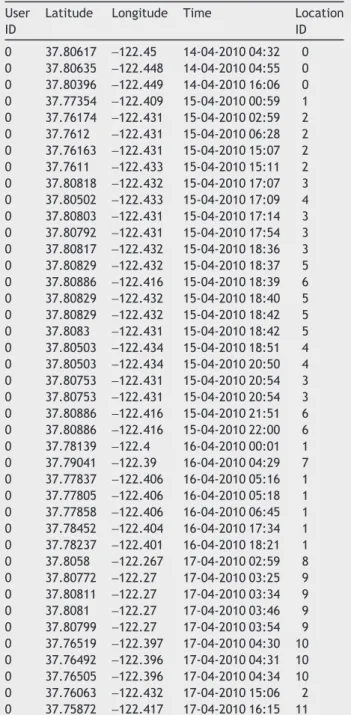
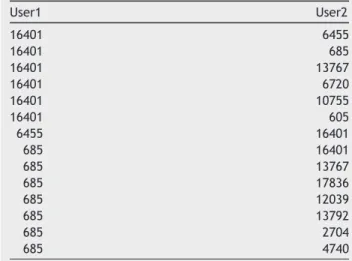
and longitude. Sample data of the dataset are provided in
Table 1andTable 2.
The dataset information is as follows: no. of users: 18107; no. of check-ins: 2073740 and no. of links: 115574.
This dataset contains information about: check-in infor-mation of Foursquare users; friendship network of Four-square users; and home location of FourFour-square users.
Qualities of recommender systems
A qualitative study for recommender systems was carried out based on the parameters mentioned previously. We tried to
1 Foursquare is a local search and discovery service mobile app that provides users search results, by considering the places visited by the user and things that the users like, as data in the app. This app pro-vides recommendations to the users about places to visit.
Table 1 Sample data of Foursquare check-ins. User
ID
Latitude Longitude Time Location
ID 0 37.80617 −122.45 14-04-2010 04:32 0 0 37.80635 −122.448 14-04-2010 04:55 0 0 37.80396 −122.449 14-04-2010 16:06 0 0 37.77354 −122.409 15-04-2010 00:59 1 0 37.76174 −122.431 15-04-2010 02:59 2 0 37.7612 −122.431 15-04-2010 06:28 2 0 37.76163 −122.431 15-04-2010 15:07 2 0 37.7611 −122.433 15-04-2010 15:11 2 0 37.80818 −122.432 15-04-2010 17:07 3 0 37.80502 −122.433 15-04-2010 17:09 4 0 37.80803 −122.431 15-04-2010 17:14 3 0 37.80792 −122.431 15-04-2010 17:54 3 0 37.80817 −122.432 15-04-2010 18:36 3 0 37.80829 −122.432 15-04-2010 18:37 5 0 37.80886 −122.416 15-04-2010 18:39 6 0 37.80829 −122.432 15-04-2010 18:40 5 0 37.80829 −122.432 15-04-2010 18:42 5 0 37.8083 −122.431 15-04-2010 18:42 5 0 37.80503 −122.434 15-04-2010 18:51 4 0 37.80503 −122.434 15-04-2010 20:50 4 0 37.80753 −122.431 15-04-2010 20:54 3 0 37.80753 −122.431 15-04-2010 20:54 3 0 37.80886 −122.416 15-04-2010 21:51 6 0 37.80886 −122.416 15-04-2010 22:00 6 0 37.78139 −122.4 16-04-2010 00:01 1 0 37.79041 −122.39 16-04-2010 04:29 7 0 37.77837 −122.406 16-04-2010 05:16 1 0 37.77805 −122.406 16-04-2010 05:18 1 0 37.77858 −122.406 16-04-2010 06:45 1 0 37.78452 −122.404 16-04-2010 17:34 1 0 37.78237 −122.401 16-04-2010 18:21 1 0 37.8058 −122.267 17-04-2010 02:59 8 0 37.80772 −122.27 17-04-2010 03:25 9 0 37.80811 −122.27 17-04-2010 03:34 9 0 37.8081 −122.27 17-04-2010 03:46 9 0 37.80799 −122.27 17-04-2010 03:54 9 0 37.76519 −122.397 17-04-2010 04:30 10 0 37.76492 −122.396 17-04-2010 04:31 10 0 37.76505 −122.396 17-04-2010 04:34 10 0 37.76063 −122.432 17-04-2010 15:06 2 0 37.75872 −122.417 17-04-2010 16:15 11
study certain use cases that were distinctive to big data or the data warehouse; there was also overlap where either tech-nology could be efficient. We have taken a few quality pa-rameters to study and analyse the big data in recommender systems. The comparison of the quality parameters with big data and data warehouse is provided inTable 3.
The qualitative comparative study favours the big data ap-proach because:
• The recommender system data is distributed through many systems.
• The data schemes are simple and flat, which helps to es-tablish the user experience.
• The availability and quality of data were indefinite at the beginning and needed much iteration before the appro-priate data could be selected and transformed.
• Large amounts of data need to be extracted. It was not pos-sible to centralise the data for recommender systems. • Even financially the big data approach is more efficient than
data warehousing, i.e. break even months are fewer for big data.
Conclusion
Till date, recommender systems make recommendations only by getting data from data warehouses. Due to the dynamic nature of the recommender system, the data have to be dis-tributed. The recommender system has to work parallelly to provide recommendation to the user and to support differ-ent interfaces. Big data excels in handling unstructured, raw and complex data with huge programming flexibility. This study analyses the use of big data in recommendation systems qualitatively. In future research, we will attempt to analyse the recommendation system in social networks quantitatively.
References
Arase, Y., Xie, X., Duan, M., Hara, T., & Nishio, S. (2009). A game based approach to assign geographical relevance to web images. InProceedings of the 18th International Conference on World Wide Web(pp. 811–820). ACM.
Bouidghaghen, O., Tamine, L., & Boughanem, M. (2011). Personal-izing mobile web search for location sensitive queries. InMobile Data Management (MDM)(Vol. 1. IEEE, pp. 110–1182011). 12th IEEE International Conference.
Cao, X., Cong, G., & Jensen, C. (2010b). Retrieving top-k prestige-based relevant spatial web objects. InProceedings of the VLDB Endowment(p. 3, 1–2, 373–384).
Cao, X., Cong, G., & Jensen, C. (2011). Collective spatial keyword querying. InProceedings of the 2011 International Conference on Management of Data(pp. 373–384). ACM.
Chakrabarti, S., Dom, B., Raghavan, P., Rajagopalan, S., Gibson, D., & Kleinberg, J., (1998). Automatic resource compilation by ana-lyzing hyperlink structure and associated text. Computer Net-works and ISDN Systems. (pp. 30, 1–7, 65–74).
Chen, J., Geyer, W., Dugan, C., Muller, M., & Guy, I. (2009). Make new friends, but keep the old: recommending people on social networking sites. InProceedings of the 27th International Con-ference on Human Factors in Computing Systems(pp. 201– 210). ACM.
Daly, E., & Geyer, W. (2011). Effective event discovery: using loca-tion and social informaloca-tion for scoping event recommendaloca-tions. InProceedings of the Fifth ACM Conference on Recommender Systems(pp. 277–280). ACM.
Das, A., Datar, M., Garg, A., & Rajaram, S. (2007). Google news per-sonalization: scalable online collaborative filtering. In Proceed-ings of the 16th International Conference on World Wide Web(pp. 271–280). ACM.
Floyer, D., (2013). Financial comparison of big data MPP solution and data warehouse appliance. Wikibon Article.
Kawakubo, H., & Yanai, K. (2011). Geovisualrank: a ranking method of tagged images considering visual similarity and geo-location proximity. InProceedings of the 20th International Con-ference Companion on World Wide Web(pp. 69–70). ACM. Kleinberg, J. (1999). Authoritative sources in a hyperlinked
environ-ment.Journal of the ACM (JACM),46(5), 604–632.
Levandoski, J., Sarwat, M., Eldawy, A., & Mokbel, M. (2012). Lars: a location-aware recommender system. InIEEE International Con-ference on Data Engineering.
Linden, G., Smith, B., & York, J. (2003). Amazon.com recommen-dations: item-to-item collaborative filtering.Internet Comput-ing,IEEE,7(1), 76–80.
Page, L., Brin, S., Motwani, R., & Winograd, T. (1999), The page rank citation ranking: bringing order to the web. Stanford Technical Report.
Park, M., Hong, J., & Cho, S., (2007). Location-based recommenda-tion system using Bayesian user’s preference model in mobile
Table 2 Sample data of Foursquare check-ins.
User1 User2 16401 6455 16401 685 16401 13767 16401 6720 16401 10755 16401 605 6455 16401 685 16401 685 13767 685 17836 685 12039 685 13792 685 2704 685 4740
Table 3 Qualities of recommender systems.
Parameters Data
warehouse
Big data Structured or unstructured data NA ++ Distributed or centralised data NA ++
Parallel processing NA ++
Multimodal interface NA ++
Unrestricted or ungoverned explorations
NA ++
Central processing unit (CPU) intense analysis
++ ++
Discover unknown relationship between data
++ ++
Interactive reports and online analytical processing (OLAP)
++ NA
Security ++ NA
devices. Ubiquitous Intelligence and Computing,(pp. 1130– 1139).
Ramaswamy, L., Deepak, P., Polavarapu, R., Gunasekara, K., Garg, D., Visweswariah, K., et al. (2009). Caesar: a context-aware, social recommender system for low-end mobile devices. InMobile data management: systems, services and middleware, 2009. MDM‘09. Tenth International Conference on IEEE(pp. 338–347). Raymond, R., Sugiura, T., & Tsubochi, K. (2011). Location
recom-mendation based on location history and spatio temporal correlations for an on-demand bus system. InACM SIGSPATIAL. ACM.
Sandholm, T., & Dung, H. (2011). Real-time, location-aware collab-orative filtering of web content. InProceedings of the 2011 Work-shop on Context-Awareness in Retrieval and Recommendation(pp. 14–18). ACM.
Scellato, S., Mascolo, C., Musolesi, M., & CrowCroft, J. (2011). Track globally, deliver locally: improving content delivery networks by tracking geographic social cascades. InProceedings of the 20th International Conference on World Wide Web(pp. 457–466). ACM. Silva, A., & Martins, B. (2011). Tag recommendation for geo-referenced photos. InProceedings of the 3nd ACM SIGSPATIAL In-ternational Workshop on Location Based Social Networks. ACM. Zhang, D., Chee, Y., Mondal, A., Tung, A., & Kitsuregawa, M. (2009). Keyword search in spatial databases: towards searching by docu-ment. InIEEE International Conference on Data Engineering(pp. 688–699). IEEE.
Zheng, Y., Zhang, L., Xie, X., & Ma, W. (2009). Mining interesting locations and travel sequences from GPS trajectories. In Pro-ceedings of the 18th International Conference on World Wide Web