Classification
Zeynep Akata, Florent Perronnin, Zaid Harchaoui, Cordelia Schmid
To cite this version:
Zeynep Akata, Florent Perronnin, Zaid Harchaoui, Cordelia Schmid. Good Practice in
Large-Scale Learning for Image Classification.
IEEE Transactions on Pattern Analysis and
Ma-chine Intelligence, Institute of Electrical and Electronics Engineers, 2014, 36 (3), pp.507-520.
<
10.1109/TPAMI.2013.146
>
.
<
hal-00835810
>
HAL Id: hal-00835810
https://hal.inria.fr/hal-00835810
Submitted on 19 Jun 2013
HAL
is a multi-disciplinary open access
archive for the deposit and dissemination of
sci-entific research documents, whether they are
pub-lished or not.
The documents may come from
teaching and research institutions in France or
abroad, or from public or private research centers.
L’archive ouverte pluridisciplinaire
HAL
, est
destin´
ee au d´
epˆ
ot et `
a la diffusion de documents
scientifiques de niveau recherche, publi´
es ou non,
´
emanant des ´
etablissements d’enseignement et de
recherche fran¸
cais ou ´
etrangers, des laboratoires
publics ou priv´
es.
Good Practice in Large-Scale Learning for
Image Classification
Zeynep Akata,
Student Member, IEEE,
Florent Perronnin, Zaid Harchaoui,
Member, IEEE,
and Cordelia Schmid,
Fellow, IEEE
Abstract—We benchmark several SVM objective functions for large-scale image classification. We consider one-vs-rest, multi-class, ranking, and weighted approximate ranking SVMs. A comparison of online and batch methods for optimizing the objectives shows that online methods perform as well as batch methods in terms of classification accuracy, but with a significant gain in training speed. Using stochastic gradient descent, we can scale the training to millions of images and thousands of classes. Our experimental evaluation shows that ranking-based algorithms do not outperform the one-vs-rest strategy when a large number of training examples are used. Furthermore, the gap in accuracy between the different algorithms shrinks as the dimension of the features increases. We also show that learning through cross-validation the optimal rebalancing of positive and negative examples can result in a significant improvement for the one-vs-rest strategy. Finally, early stopping can be used as an effective regularization strategy when training with online algorithms. Following these “good practices”, we were able to improve the state-of-the-art on a large subset of 10K classes and 9M images of ImageNet from 16.7% Top-1 accuracy to 19.1%.
Index Terms—Large Scale, Fine-Grained Visual Categorization, Image Classification, Ranking, SVM, Stochastic Learning
F
1
I
NTRODUCTIONImage classification is the problem of assigning one or multi-ple labels to an image based on its content. This is a standard supervised learning problem: given a training set of labeled images, the goal is to learn classifiers to predict labels of new images. Large-scale image classification has recently received significant interest from the computer vision and machine
learning communities [4], [20], [22], [48], [62], [66], [72],
[82], [89]. This goes hand-in-hand with large-scale datasets
being available. For instance, ImageNet (www.image-net.org) consists of more than 14M images labeled with almost 22K
concepts [21], the Tiny images dataset consists of 80M
im-ages corresponding to 75K concepts [72] and Flickr contains
thousands of groups (www.flickr.com/groups) with thousands (and sometimes hundreds of thousands) of pictures, that can
be exploited to learn object classifiers [80], [58].
Standard large-scale image classification pipelines use high-dimensional image descriptors in combination with linear
classifiers [48], [66]. The use of linear classifiers is motivated
by their computational efficiency – a requirement when dealing with a large number of classes and images. High-dimensional descriptors allow separating the data with a linear classifier, i.e., they perform the feature mapping explicitly and avoid using nonlinear kernels. One of the simplest strategies to
learn classifiers in the multi-class setting is to train
one-vs-rest binary classifiers independently for each class. Most image classification approaches have adopted this strategy not
• Z.Akata and F.Perronnin are with the Xerox Research Centre Europe, Meylan, France
• Z.Akata, Z. Harchaoui and C. Schmid are with INRIA Rhone-Alpes, Montbonnot, France.
only because of its simplicity, but also because it can be easily parallelized on multiple cores or machines. The two top systems at the ImageNet Large-Scale Visual Recognition
Challenge (ILSVRC) 2010 [6] used such an approach [48],
[66].
Another approach is to view image classification as a ranking problem: given an image, the goal is to rank the labels according to their relevance. Performance measures such as the top-k accuracy reflect this goal and are used to report results on standard benchmarks, such as ILSVRC. While the one-vs-rest strategy is computationally efficient and yields competitive results in practice, it is – at least in theory – clearly suboptimal
with respect to a strategy directly optimizing a ranking loss [9],
[17], [38], [75], [82], [86], [88].
In this paper, we examine whether these ranking approaches scale well to large datasets and if they improve the perfor-mance. We compare the one-vs-rest binary SVM, the
multi-class SVM of Crammer and Singer [17] that optimizes top-1
accuracy, the ranking SVM of Joachims [38] that optimizes the
rank as well as the recent weighted approximate ranking of
Westonet al. [82] that optimizes the top of the ranking list. The
datasets we consider are large-scale in the number of classes (up to 10K), images (up to 9M) and feature dimensions (up to 130K). For efficiency reasons we train our linear classifiers
using Stochastic Gradient Descent (SGD) algorithms [44] with
the primal formulation of the objective functions as in [11],
[67] for binary SVMs or in [54] for structured SVMs. By
using the exact same optimization framework, we truly focus on the merits of the different objective functions, not on the merits of the particular optimization techniques.
Our experimental evaluation confirms that SGD-based learn-ing algorithms can work as well as batch techniques at a frac-tion of their cost. It also shows that ranking objective funcfrac-tions seldom outperform the one-vs-rest strategy. Only when a small
RECOMMENDATIONS FOR LARGE-SCALE IMAGE CLASSIFICATION
1) Stochastic training: learning with stochastic gradient de-scent is well-suited for large-scale datasets
2) Class imbalance: optimizing the imbalance parameter in one-vs-rest strategy is a must for competitive performance 3) Early stopping: regularizing through early stopping results
in fast training and good generalization performance
4) Step-size: a small-enough step-size w.r.t learning rate is often sufficient for state-of-the-art performance
5) One-vs-rest: one-vs-rest strategy is a flexible option for large-scale image classification
6) Capacity saturation: for a sufficiently large feature repre-sentation all strategies lead to similar performance
amount of training data is available, did we observe a small-but-consistent improvement with ranking based methods. The gap between the accuracy of different learning algorithms reduces in case of high-dimensional data. We also experimen-tally show that for the one-vs-rest strategy carefully tuning the optimal degree of imbalance between the positive and the negative examples can have a significant impact on accuracy. This is observed especially when the feature dimensionality is “small” with respect to the problem complexity, in particular with respect to the number of classes. Furthermore, early stopping can be used as an effective regularization strategy for fast training with SGD. Following these “good practices”, we were able to improve the state-of-the-art on a large subset
of 10K classes and 9M of images of ImageNet [21] from
16.7% accuracy to 19.1%. We summarize our findings in the “recommendation box” at the top of this page.
The paper is organized as follows. Section2reviews related
work in computer vision and machine learning. Section 3
presents the different objective functions for linear
classifica-tion that we used in our evaluaclassifica-tion and Secclassifica-tion4describes the
SGD-based optimization framework. Experimental results are
presented in Section 5 for five state-of-the-art datasets: three
fine-grained subsets of ImageNet (i.e. Fungus, Ungulate and Vehicles) as well as the ILSVRC 2010 and the very large-scale ImageNet10K datasets. The code used for our experimental
evaluation is available at http://lear.inrialpes.fr/software.
A preliminary version of this article has appeared in [55].
This version adds (1) a significantly expanded related work section; (2) experiments for fine-grained classification; (3) an experimental comparison with batch solvers; (4) experiments with few training samples showing the gain of ranking over other objective functions in this setting; (5) experiments on both synthetic data and real data to explore the notion of dataset density; and (6) a comparison with very recent work
on deep learning [40], [42].
2
R
ELATEDW
ORKRecently, many large-scale datasets were collected and made
publicly available, such as LabelMe [64], Tiny-images [72]
and ImageNet [21]. Most of today’s approaches for image
classification first extract visual image descriptors and then apply a classifier. In the following, we first review previous work related to visual descriptors, and then give an overview of classification approaches.
2.1 Visual Descriptors
A large part of the literature on image classification has been devoted to the design of suitable image representations. A very successful representation paradigm has been to extract local
patch-level descriptors from an image, such as SIFT [50] or
color descriptors [13], and to aggregate them using operations
such as average-pooling or max-pooling. The Bag-of-Visual-Words (BOV), which describes an image as a histogram of
quantized local descriptors [69], [18], has been the most
popular image representation for image classification. It has been improved in many ways over the years. For instance,
to go beyond the orderless assumption, Lazebnik et al. [41]
proposed Spatial Pyramid Matching (SPM), where statistics over spatial regions are aggregated. Several works have also tried to to go beyond the hard quantization of local descriptors. One possible way to do so is to soft-assign the local descriptors
using a generative model of the descriptors [27], [76]. Another
approach is based on sparse coding, which forces a descriptor
to be assigned to a small number of visual words [87], [12].
While sparse-coding has been shown to yield excellent results,
especially in combination with max-pooling [12], it involves
a costly iterative optimization process. Hence, efficient alter-natives have been sought such as Locality-constrained Linear
Coding (LLC) [81], [48] which performs a local embedding of
the descriptors. The BOV histogram was shown to be partic-ularly successful in image classification tasks in combination with nonlinear kernel classifiers such as the Support Vector Machine (SVM) (see for instance the results of the successive
PASCAL VOC competitions [25]).
However, one of the limitations of nonlinear SVM classifiers is that they do not scale well with the number of training samples. Therefore, several works have proposed to perform an explicit embedding of the image representations in a new space where the BOV histograms are more linearly separable. Maji
and Berg [51] proposed mappings for the Intersection Kernel
(IK). Vedaldi and Zisserman [77] and Perronnin et al. [57]
subsequently generalized this principle to additive classifiers.
Gong and Lazebnik [31] benchmarked several feature mapping
techniques and showed that data-dependent mappings have an edge over data-independent ones in large-scale scenarios.
While the BOV computes for each local descriptor only simple statistics such as visual word occurrence counts, other approaches have proposed computing higher-order statistics. This includes the Fisher Vector (FV) of Perronnin and Dance
[56] which consists in computing the deviation of a set of local
descriptors from an average Gaussian Mixture Model (GMM).
normalization steps [57]. Other higher-order representations have been proposed including the Vector of Locally
Aggre-gated Descriptors (VLAD) [36] and the Super Vector (SV)
[90]. Since these techniques perform an explicit embedding
of local descriptors in a very high-dimensional space, they
typically work well with simple linear classifiers. Chatfieldet
al. [16] benchmarked five local descriptor encoding techniques (BOV with hard coding, soft coding and sparse coding as well
as SV and FV coding); the FV of [57] was shown to yield the
best results on two standard datasets. A weakness of high-dimensional representations such as the FV is that they take
a lot of space in RAM or on disk [66], [49]. Consequently,
they are difficult to scale to large datasets and several works proposed more compact features for classification. One line of work consists in describing an image with a set of
high-level concepts based on object classifiers [80], [73], [7] or
object detectors [47]. Coding techniques such as Product
Quantization (PQ) [35] have also been used to compress the
data [66], [60], [78]. While S´anchez and Perronnin proposed to
learn classifiers using Stochastic Gradient Descent (SGD) (see
section 2.3) and on-the-fly decompression of training samples
[66], Vedaldi and Zisserman showed that classifiers can be
learned in the compressed space directly [78].
The standard feature extraction pipeline that aggregates patch descriptors can be criticized as being too shallow to learn complex invariances and high-level concepts. Recently, several large-scale works have considered the learning of features
directly from pixel values using deeper architectures [5], [42],
[40]. One of the crucial factors to obtain good results when
learning deep architectures with millions if not billions of parameters seems to be the availability of vast amounts of
training data (see section 10.1 in [5]). In [42], [19], the features
are learned using a deep autoencoder which is constructed by replicating three times the same three layers – made of local filtering, local pooling and contrast normalization – thus resulting in an architecture with 9 layers. The learned features were shown to give excellent results in combination with a
simple linear classifier. In [40], a deep network with 8 layers
was proposed where the first 5 layers are convolutional [43],
[45], [34], the remaining three are fully connected and the
output of the last fully connected layer is fed to a softmax which produces a distribution over the class labels.
In this work, we will use mostly the FV representation as it was shown to yield excellent results in large-scale classi-fication while requiring only modest computational resources
[66]. However, we believe our conclusions to be generic and
applicable to other image features.
2.2 Classifier Strategies
We underline that in most previous works tackling large-scale visual data sets, the objective function that is optimized is always the same: one binary SVM is learned per class in a
one-vs-rest fashion [20], [66], [48], [62]. Some approaches use
simple classifiers such as nearest-neighbor (NN) [72]. While
exact NN can provide a competitive accuracy when compared
to SVMs as in [82], [20], it is not straightforward to scale
to large data sets. On the other hand, Approximate Nearest
Neighbor (ANN) can perform poorly on high-dimensional image descriptors (significantly worse than one-vs-rest SVMs)
while still being much more computationally intensive [82].
One-vs-rest (OVR) strategies offer several advantages such as the speed and simplicity as compared to multiclass classifiers
(see [61] from Rifkin and Klautau as a defense of OVR).
Indeed, OVR classifiers can be trained efficiently by decom-posing the problem into independent per class problems.
On the other hand, several versions of multi-class SVMs
were proposed. In [85], Weston and Watkins propose a
multi-class SVM with a loss function that consists in summing the losses incurred by each class-wise score. Note that this version of multi-class SVM is statistically not consistent for
large samples [71]. Lee et al. [46] introduced a statistically
consistent version of multi-class SVM, which can be thought of a “hinge-loss” counterpart of multinomial classification. In this work, we use the multiclass SVM formulation of Crammer
and Singer from [17], a computationally attractive variant that
was proven to be consistent for large-scale problems. Many alternative approaches for multi-class classification
were proposed in the literature. In [24], Dietterich and Bakiri
introduce error correcting codes as a basis of multiclass
classification. In [1] Allweinet al. combine several multiclass
classifiers using AdaBoost. In [79], Vural and Dy approach the
problem from the decision trees perspective by partitioning the
space inN−1 regions.
When the target loss function is not classification accuracy but a more sophisticated performance measure such as mean-average-precision, a natural approach is to build ranking
algo-rithms. In [38], Joachims proposed a ranking SVM, allowed to
rank highly related documents on the higher ranks of the list.
In [32], Grangieret al. improve the baseline ranking SVM by
giving weights to classifiers. Usunier et al. [75] penalize the
loss encountered at the top of the list more than the bottom.
Another ranking framework [83] from Westonet al. uses linear
classifiers trained with SGD and a novel sampling trick to approximate ranks. To break the time-complexity of training to sub-linear in the number of classes, various approaches have
been proposed which employ tree structures [52], [4], [29],
[14], [53], [30]. In [8], Beygelzimeret al. create a model for
error-limiting reduction in learning. According to this model, the tree (multiclass) reduction has a slightly larger loss rate
than binary classifiers. The reader may refer to [63] for an
extended survey of top-down approaches for classification.
2.3 Algorithms and Solvers
Here, we review the currently publicly available solvers for SVM-like classification and ranking algorithms. We shall not review other approaches, as we do not include them in our benchmarks. There are two main families of algorithms for optimization SVM objectives: batch algorithms, and on-line/incremental algorithms.
State-of-the-art batch optimization algorithms for non-linear SVMs are based on a variant of coordinate-descent called
se-quential minimal optimization (SMO)[59]. The main strength
of batch approaches is the high robustness to the settings of the algorithms parameters, that is initialization, line-search,
number of iterations, etc. Such algorithms are implemented
in the most popular toolboxes LibSVM [15] from Chang et
al., SVMlight [37], and Shogun [28]. State-of-the art batch algorithms for linear SVMs are based on coordinate-descent approaches with second-order acceleration. The widely used
LibLinear toolbox [33] from Hsiehet al. provides an efficient
implementation of such algorithms. The weakness of batch methods is the difficulty to scale up to large datasets.
State-of-the-art stochastic (online) optimization algorithms for linear SVMs are based on stochastic gradient descent
(SGD). The well known online SVM solver Pegasos [67] from
Shalew-Shwartz et al. and libSGD [10] from Bottou provide
an implementation of these algorithms. The main strength of SGD algorithms is their built-in ability to scale up to large datasets. However, without a careful setting of the parameters, SGD algorithms can have slow convergence and struggle to match the performance of their batch algorithm counterparts. In this paper, we highlight the “golden rules” while using SGD to get competitive performance with batch solvers, and provide empirical evidence of the success of our methodology.
3
O
BJECTIVEF
UNCTIONSLet S = {(xi, yi), i = 1. . . N} be the training set where
xi∈ X is an image descriptor,yi∈ Y is the associated label
and Y is the set of possible labels. Let C =|Y| denote the
number of classes. We shall always take X =RD.
Supervised learning corresponds to minimizing the empiri-cal risk with a regularization penalty
Minimize
W
λ
2Ω(W) +L(S;W), (1)
where W is the weight matrix stacking the weight vectors
corresponding to each subproblem. The objective decomposes into the empirical risk
L(S;W) := 1 N N X i=1 L(xi, yi;W) (2)
with L(xi, yi;W) a surrogate loss of the labeled example
(xi, yi), and the regularization penalty Ω(W) :=
C
X
c=1
kwck2 (3)
The parameter λ ≥ 0 controls the trade-off between the
empirical risk and the regularization. We first briefly review the classical binary SVM. We then proceed with the multiclass, ranking and weighted approximate ranking SVMs. We finally discuss the issue of data re-weighting.
3.1 Binary One-Vs-Rest SVM (OVR)
In the case of the one-vs-rest SVM, we assume that we have
only two classes and Y = {−1,+1}. Let 1(u) = 1 if u is
true and 0 otherwise. The 0-1 loss 1(yiwTxi <0) is
upper-bounded by
LOVR(xi, yi;w) = max{0,1−yiwTxi} (4) If we have more than two classes, then one transforms the C-class problem into C binary problems and trains
indepen-dently C one-vs-rest classifiers.
3.2 Beyond Binary Classification
In the following sections, we treat the classes jointly and the
label set contains more than two labels i.e. Y ={1, . . . , C}.
Let{wc, c= 1. . . C} denote theC classifiers corresponding
to each of the C classes. In this case, W is a C × D
dimensional vector obtained by concatenating the different wc’s. We denote by ∆(y,y¯) the loss incurred for assigning
labely¯ while the correct label wasy. In this work, we focus
on the 0/1 loss,i.e.∆(y,y¯) = 0if y= ¯y and1 otherwise. In
what follows, we assume that we have one label per image to simplify the representation.
Multiclass SVM (MUL). There exist several flavors of the
multiclass SVM such as the Weston and Watkins [84] and
the Crammer and Singer [17] formulations (see [71] for
a comprehensive review). Both variants propose a convex
surrogate loss to∆(yi,yiˆ)with
ˆ
yi= arg max y
wT
yxi, (5)
i.e. the loss incurred by taking the highest score as the pre-dicted label. We choose the Crammer and Singer formulation, corresponding to LMUL(xi, yi;w) = max y ∆(yi, y) +wTyxi −wTy ixi (6)
which provides a tight bound on the misclassification
er-ror [74]. Note that this can be viewed as a particular case
of the structured SVM [74].
Ranking SVM (RNK).Joachims [38] considers the problem of ordering pairs of documents. Adapting the ranking
frame-work to our problem the goal is, given a sample(xi, yi)and
a label y6=yi, to enforcewyixi >wTyxi. The rank of label
y for samplex can be written as:
r(x, y) = C X c=1 1(wT cx≥w T yx) (7)
Given the triplet (xi, yi, y), 1(wTcx ≥ wTyx) is
upper-bounded by:
Ltri(xi, yi, y;w) = max{0,∆(yi, y)−wTyixi+w
T
yxi} (8)
Therefore, the overall loss of(xi, yi)writes as:
LRNK(xi, yi;w) = C X y=1 max{0,∆(yi, y)−(wy i−wy) Tx i} (9)
Weighted Approximate Ranking SVM (WAR). An issue with the Ranking SVM (RNK) is that the loss is the same when going from rank 99 to 100 or from rank 1 to rank 2. However, in most practical applications, one is interested in the top of the ranked list. As an example, in ILSVRC the measure
used during the competition is a loss at rank 5. Usunieret al.
[75] therefore proposed to minimize a function of the rank
which gives more weight to the top of the list.
Letα1≥α2 ≥. . . αC≥0 be a set of C coefficients. For
sample (xi, yi)the loss is ℓr(xi,yi)withℓdefined as
ℓk= k
X
j=1
The penalty incurred by going from rank ktok+ 1isαk.
Hence, a decreasing sequence{αj}j≥1 implies that a mistake
on the rank when the true rank is at the top of the list incurs a higher loss than a mistake on the rank when the true rank is lower in the list. We note that this Ordered Weighted Ranking (OWR) objective function is generic and admits as special
cases the multiclass SVM of Crammer and Singer (α1 = 1
andαj = 0forj≥2) and the ordered pairwise ranking SVM
of Joachims (αj= 1,∀i).
While [75] proposes an upper-bound on the loss, Westonet
al. [82] propose an approximation. We follow [82] which is more amenable to large-scale optimization and write:
LWAR(xi, yi;w) = C X y=1 ℓr∆(xi,yi) Ltri(xi, yi, y;w) r∆(xi, yi) , (11) where r∆(x, y) = C X c=1 1(wTcx+ ∆(y, c)≥wTyx) (12)
is a regularized rank. Following [82], we choose αj = 1/j.
As opposed to other works [86], [88], this does not optimize
directly standard information retrieval measures such as Av-erage Precision (AP). However, it mimics their behavior by putting emphasis on the top of the list, works well in practice and is highly scalable.
Data Rebalancing. When the training set is unbalanced, i.e. when some classes are significantly more populated than others, it can be beneficial to reweight the data. This imbalance can be extreme in the one-vs-rest case when one has to deal
with a large number of classesCas the imbalance between the
positive class and the negative class is on averageC−1. In the
binary case, the reweighting can be performed by introducing
a parameterρand the empirical risk then writes as:
ρ N+ X i∈I+ LOVR(xi, yi;w) + 1−ρ N− X i∈I− LOVR(xi, yi;w) (13)
whereI+ (resp.I−) is the set of indices of the positive (resp.
negative) samples andN+(resp.N−) is the cardinality of this
set. Note that ρ= 1/2 corresponds to the natural rebalancing
of the data, i.e. in such a case one gives as much weight to
positives and negatives.
When training all classes simultaneously, introducing one parameter per class is computationally intractable. It would
require cross-validating C parameters jointly, including the
regularization parameter. In such a case, the natural re-balancing appears to be the most natural choice. In the multi-class case, the empirical loss becomes:
1 C C X c=1 1 Nc X i∈Ic LMUL(xi, yi;w) (14)
whereIc={i:yi =c} andNc is the cardinality of this set.
One can perform a similar rebalancing in the case of LRNK
andLWAR.
4
O
PTIMIZATIONA
LGORITHMSWe employ Stochastic Gradient Descent (SGD) to learn linear
classifiers in the primal [67], [11]. Such an approach has
recently gained popularity in the computer vision community
for large-scale learning [57], [58], [82], [66], [48], [62]. In the
following, we describe the optimization algorithms for various objective functions and give implementation details.
4.1 Stochastic Training
Training with Stochastic Gradient Descent (SGD) consists at each step in choosing a sample at random and updating the
parameterswusing a sample-wise estimate of the regularized
risk. In the case ofROVRandRMUL, the sample is simply a pair
(xi, yi)while in the case ofRRNK andRWAR it consists of a
triplet(xi, yi,y¯)wherey¯6=yi. Letztdenote the sample drawn
at stept(whether it is a pair or a triplet) and letR(zt;w)be
the sample-wise estimate of the regularized risk.wis updated
as follows:
w(t)=w(t−1)−ηt∇w
=w(t−1)R(zt;w) (15)
whereηt is the step size.
We provide in Table1 the sampling and update procedures
for the objective functions used in our evaluation, assuming
no rebalancing of the data. For ROVR, RMUL and RRNK,
these equations are straightforward and optimize exactly the
regularized risk. For RWAR it is only approximate as it does
not compute exactly the value of r∆(xi, yi), but estimates it
from the number of samples k which were drawn before a
violating sampley¯such thatLtri(xi, yi,y¯;w)>0 was found.
Ifk samples were drawn, then:
r∆(xi, yi)≈ ⌊
C−1
k ⌋. (16)
For a large number of classes, this approximate procedure
is significantly faster than the exact one (see [82] for more
details). Note also that we implement the regularization by
penalizing the squared norm ofw, while [82] actually bounds
the norm ofw. We tried both strategies and observed that they
provide similar results in practice.
4.2 Implementation Details
We use as basis for our code the SGD library for binary
classification available on Bottou’s website (version 1.3)[10].
This is an optimized code that includes fast linear algebra and a number of optimizations such as the use of a scale variable
to updatew only when a loss is incurred.
We now discuss a number of implementation details.
Bias. Until now, we have not considered the bias in our ob-jective functions. This corresponds to an additional parameter per class. Following common practice, we add one constant
feature to each observationxi. As is the case in Bottou’s code,
we do not regularize this additional dimension.
Stopping Criterion. Since at each step in SGD we have a noisy estimate of the objective function, this value cannot be used for stopping. Therefore, in all our experiments, we use a validation set and stop iterating when the accuracy does not
Sampling Update
ROVR Draw(xi, yi)fromS. δi= 1 ifLOVR(xi, yi;w)>0,0otherwise. w(t)= (1−ηtλ)w(t−1)+ηtδixiyi RMUL Draw(xi, yi)fromS. y¯= arg maxy∆(yi, y) +wy′xiandδi=
1 ify¯6=yi 0 otherwise. w(yt)= 8 > < > : w(yt−1)(1−ηtλ) +δiηtxi ify=yi w(yt−1)(1−ηtλ)−δiηtxi ify= ¯y w(yt−1)(1−ηtλ) otherwise. RRNK Draw(xi, yi)fromS. δi= 1 ifLtri(xi, yi,y¯;w)>0,0otherwise.
Drawy¯6=yi fromY. w(yt)= 8 > < > : w(yt−1)(1−ηtλ) +δiηtxi ify=yi w(yt−1)(1−ηtλ)−δiηtxi ify= ¯y w(yt−1)(1−ηtλ) otherwise.
RWAR Draw(xi, yi)fromS. δi= 1 ify¯s.t.Ltri(xi, yi,y¯;w)>0was sampled,0otherwise. For k= 1,2, . . . , C−1, do: Drawy¯6=yi fromY. IfLtri(xi, yi,y¯;w)>0, break. w(yt)= 8 > < > : w(yt−1)(1−ηtλ) +δiℓ ⌊C−1 k ⌋ ηtxi ify=yi w(yt−1)(1−ηtλ)−δiℓ ⌊C−1 k ⌋ ηtxi ify= ¯y w(yt−1)(1−ηtλ) otherwise. TABLE 1
Sampling and update equations for various objective functions.
Regularization. While a vast majority of works on large-margin classification regularize explicitly by penalizing the
squared norm of w or by bounding it, regularizing implicitly
by early stopping is another option [2]. In such a case, one sets
λ= 0and iterates until the performance converges (or starts
descreasing) on a validation set. In our experiments, applying this strategy yields competitive results.
Step Size.To guarantee converge to the optimum, the sequence
of step sizes should satisfyP∞
t=1ηt=∞and
P∞
t=1ηt2<∞.
Assumingλ >0, the usual choice isηt= 1/λ(t+t0), where
t0is a parameter. Bottou provides in his code a heuristic to set
t0. We tried to cross-validatet0but never observed significant
improvements. However, we also experimented with a fixed
step sizeη as in [2], [82].
Rebalancing. All sampling/update equations in Table 1 are based on non-rebalanced objective functions. To rebalance the data, we can modify either the sampling or the update equations. We chose the first alternative since, in general, it led to faster convergence. If we take the example of LOV R then the sampling is modified as follows: draw y =
+1 with probabilityρ, y = −1with probability 1−ρ. Then
drawxi such thatyi=y.
5
E
XPERIMENTSIn Section 5.1 we describe our experimental setup. In
Sec-tion5.2, we provide a detailed analysis of the different
objec-tive functions and parameters for three fine-grained subsets of ImageNet (Fungus, Ungulate, Vehicle). We believe that these fine-grained datasets can provide useful insights about the different objective functions since they correspond to different
class densities as shown in [20]. In Section 5.4, we provide
results on ImageNet10K.
5.1 Experimental Setup
In this section, we describe the datasets and image descriptors used in our experiments.
Total # of Partition images classes train val test
Fungus 88K 134 44K 5K 39K Ungulate 183K 183 91.5K 5K 86.5K Vehicle262 226K 262 113K 5K 108K ILSVRC10 1.4M 1,000 1.2M 50K 150K ImageNet10K 9M 10,184 4.5M 50K 4.45M TABLE 2
The datasets used in our evaluation.
Datasets. For our fine-grained image categorization experi-ments, we use three subsets of ImageNet: Fungus, Ungulate
and Vehicle [20]. These datasets contain only the leaf nodes
under the respective parent class (i.e. fungus, ungulate or vehicle) in the hierarchy of ImageNet. Unless stated otherwise, we used the following set-up: half of the data is used for training, 5K images for validation and the remainder for testing.
For our large-scale experiments, we use ILSVRC 2010 [6]
and ImageNet10K [20]. For ILSVRC2010, we follow the
stan-dard training/validation/testing protocol. For ImageNet10K,
we follow [66] and use half of the data for training, 50K
images for validation and the remainder for testing. The
properties of the datasets are summarized in Table2.
In all experiments, we compute the (flat) top-1 or top-5
accuracy per class and report the average as in [20], [66],
[82]. We could also have used a hierarchical loss which takes
into account the fact that some errors are more costly than
others. The choice of a flatvs. a hierarchical loss is directly
related to the choice of the cost function ∆ (see section3).
In preliminary experiments, this choice had only very limited impact on the ranking of the different objective functions. This effect was also observed during the ILSVRC 2010 and 2011 competitions which might explain why the hierarchical measure was dropped in 2012. In what follows we report only accuracies with a flat loss.
images to 100K pixels (if larger) while keeping the aspect
ratio. We extract approx. 10K SIFT descriptors [50] at 5
scales for 24×24 patches every 4 pixels. The SIFT descriptors
are reduced from 128-dim to 64-dim using PCA. They are then aggregated into an image-level signature (e.g. BOV or
FV) using a probabilistic visual vocabulary, i.e. a Gaussian
Mixture Model (GMM). By default, we use Fisher Vectors
(FV) withN =256 Gaussians. We also report results with the
bag of visual words (BOV) given its popularity in large-scale
classification [20], [82]. Our default BOV uses N = 1,024
codewords. Note that our purpose is not to compare the BOV
and FV representations in this work (see [16] for such a
comparison). Unless it is stated otherwise, we use spatial
pyramids with R = 4 regions (the entire image and three
horizontal stripes).
Our experiments on large-scale datasets require image sig-natures to be compressed. For the FV we employ Product
Quantization (PQ) [35]. We use sub-vectors of 8 dimensions
and 8 bits per sub-vector. This setting was shown to yield
minimal loss of accuracy in [66]. For the BOV we use
Scalar Quantization with 8 bits per dimension as suggested
in [20]. Signatures are decompressed on-the-fly by the SGD
routines [66].
5.2 Analysis on Fine Grained Datasets
Distinguishing between semantically related categories which are also visually very similar is referred to as fine-grained
visual categorization (see [23] for a study of the relationship
between semantic and visual similarity in ImageNet). It has several applications such as the classification of mushrooms for edibility, animals for environmental monitoring or vehicles for traffic related applications. In this section we analyze the
performance of the objective functions described in Section 3
in the context of fine-grained visual categorization. We report results on three subsets of ImageNet: Fungus, Ungulate and
Vehicle [20].
Comparison between SGD and Batch Methods.
It is known that SGD can perform as well as batch solvers
for OVR SVMs at a fraction of the cost [11], [67]. However,
public SGD solvers do not exist for other SVM formulations such as w-OVR, MUL, RNK or WAR. Hence, as a sanity check, we compared our w-OVR and MUL SGD solvers to publicly available batch solvers. We compared our w-OVR
SGD to LibSVM [15] and MUL SGD to LibLINEAR [26] and
SVMlight [39]. Given the cost of training batch solvers, we restrict our experiments to the small dimensional BOV vectors
(N = 1,024×R = 4 → 4,096 dimensions). Furthermore,
we perform training on subsets of the full training sets: for each class we use 10, 25, 50 and 100 random samples within the training set. We repeat the experiments 5 different times for 5 random subsets of training images. Top-1 classification
accuracy is reported in Figure 1 and2.
These experiments show that stochastic and batch solvers perform on par for w-OVR and MUL SVMs. Somewhat surprisingly, SGD solvers even seem to have a slight edge over batch solvers, especially for the MUL SVM. This might
be because SGD uses as stopping criterion the accuracyon the
(a) w-OVR SVM: LibSVMvs. SGD
LibSVM (batch) / SGD (online) Fungus Ungulate Vehicle 10 12 / 7 31 / 18 107 / 39 25 95 / 16 175 / 36 835 / 119 50 441 / 38 909 / 67 3,223 / 271 100 1,346 / 71 3,677 / 133 11,679 / 314
(b) MUL SVM: SVMlightvs. SGD
SVMlight (batch) / SGD (online)
Fungus Ungulate Vehicle 10 45 / 36 324 / 81 557 / 209 25 99 / 72 441 / 198 723 / 369 50 198 / 261 855 / 420 1,265 / 747 100 972 / 522 1,674 / 765 3,752 / 1,503
TABLE 3
Average training time (in CPU seconds) on Fungus, Ungulate, Vehicle for 10, 25, 50, 100 training samples
per class using 4,096-dim BOV.
validation set measured with the true target loss(top-1 loss in this case). In contrast, batch solvers stop upon convergence of a surrogate objective function on the training set. The training times of SGD and batch solvers are reported in Table
3 (in CPU seconds on 32GBs RAM double quad-core
multi-threaded servers using a single CPU). As expected, the CPU time of SGD solvers is significantly smaller than for batch solvers and the difference increases for larger training sets.
Importance of Data Rebalancing in OVR.
In this section we investigate the effect of data rebalancing for OVR SVMs. Note that more sophisticated strategies could
also be used, as in [70]. Here we simply emphasize that
in terms of performance, it is always beneficial to
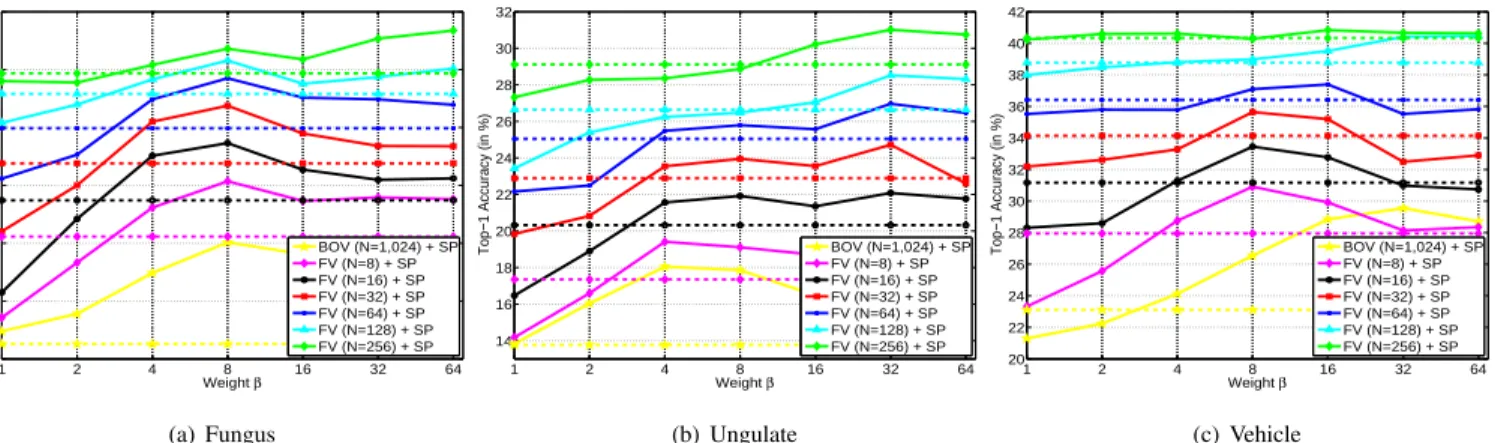
cross-validate the imbalance parameter of one-vs-rest classifiers. We compare unweighted OVR (u-OVR) and weighted OVR (w-OVR). Since we do the reweighting by biasing the sampling,
we introduce the imbalance parameterβ= (1−ρ)/ρwhich is
the (average) number of negatives sampled for each positive.
β = 1 corresponds to the natural rebalancing of the data
(giving the same weight to positives and negatives). The solid
lines in Figure3show the results with w-OVR and the dashed
lines with u-OVR. We ran experiments with BOV descriptors
withN =1024 Gaussians and FV descriptors withN =8, 16,
64, and 256 Gaussians using a pyramid withR= 4regions.
We can draw the following conclusions. First, rebalanc-ing makes a significant difference for smaller dimensional features, but has less impact on high-dimensional features.
Second, it is crucial to correctly set the parameter β, as
natural rebalancing generally does not lead to the best results.
Indeed, the optimal β depends on many factors including
the dataset, the feature type and the feature dimensionality.
We observe empirically that the optimalβ typically increases
with the number of classes. For instance, on ILSVRC 2010 and ImageNet10K respectively, the best w-OVR results are
obtained with β = 64 and β = 256(with the 4K-dim BOV
features). In the following, we will use the weighted version
of OVR,i.e. w-OVR.
10 25 50 100 4 6 8 10 12 14 Number of Images N
Top−1 Accuracy (in %)
w−OVR (SGD) w−OVR (libSVM) (a) Fungus 10 25 50 100 5 10 15 Number of Images N
Top−1 Accuracy (in %)
w−OVR (SGD) w−OVR (libSVM) (b) Ungulate 10 25 50 100 8 10 12 14 16 18 20 22 24 Number of Images N
Top−1 Accuracy (in %)
w−OVR (SGD) w−OVR (libSVM)
(c) Vehicle
Fig. 1. Comparison of SGD and libSVM for optimizing the w-OVR SVM using 4,096-dim BOV descriptors. From left to right: Fungus, Ungulate and Vehicle.
10 25 50 100 4 5 6 7 8 9 10 11 12 13 Number of Images N
Top−1 Accuracy (in %)
Multiclass (SGD) Multiclass (SVMlight) Multiclass (LibLinear) (a) Fungus 10 25 50 100 4 5 6 7 8 9 10 11 12 13 Number of Images N
Top−1 Accuracy (in %)
Multiclass (SGD) Multiclass (SVMlight) Multiclass (LibLinear) (b) Ungulate 10 25 50 100 8 10 12 14 16 18 20 22 24 Number of Images N
Top−1 Accuracy (in %)
Multiclass (SGD) Multiclass (SVMlight) Multiclass (LibLinear)
(c) Vehicle
Fig. 2. Comparison of SGD, SVMlight and LibLinear for optimizing the MUL SVM using using 4,096-dim BOV. From
left to right: Fungus, Ungulate and Vehicle.
1 2 4 8 16 32 64 10 12 14 16 18 20 22 Weight β
Top−1 Accuracy (in %) BOV (N=1,024) + SP FV (N=8) + SP FV (N=16) + SP FV (N=32) + SP FV (N=64) + SP FV (N=128) + SP FV (N=256) + SP (a) Fungus 1 2 4 8 16 32 64 14 16 18 20 22 24 26 28 30 32 Weight β
Top−1 Accuracy (in %) BOV (N=1,024) + SP FV (N=8) + SP FV (N=16) + SP FV (N=32) + SP FV (N=64) + SP FV (N=128) + SP FV (N=256) + SP (b) Ungulate 1 2 4 8 16 32 64 20 22 24 26 28 30 32 34 36 38 40 42 Weight β
Top−1 Accuracy (in %) BOV (N=1,024) + SP FV (N=8) + SP FV (N=16) + SP FV (N=32) + SP FV (N=64) + SP FV (N=128) + SP FV (N=256) + SP (c) Vehicle
Fig. 3. Influence of data rebalancing in weighted One-vs-Rest (w-OVR). The value of the weight parameter indicates the number of negative training samples for one positive sample (solid lines). The results of unweighted One-vs-Rest (u-OVR) are shown with dashed lines.
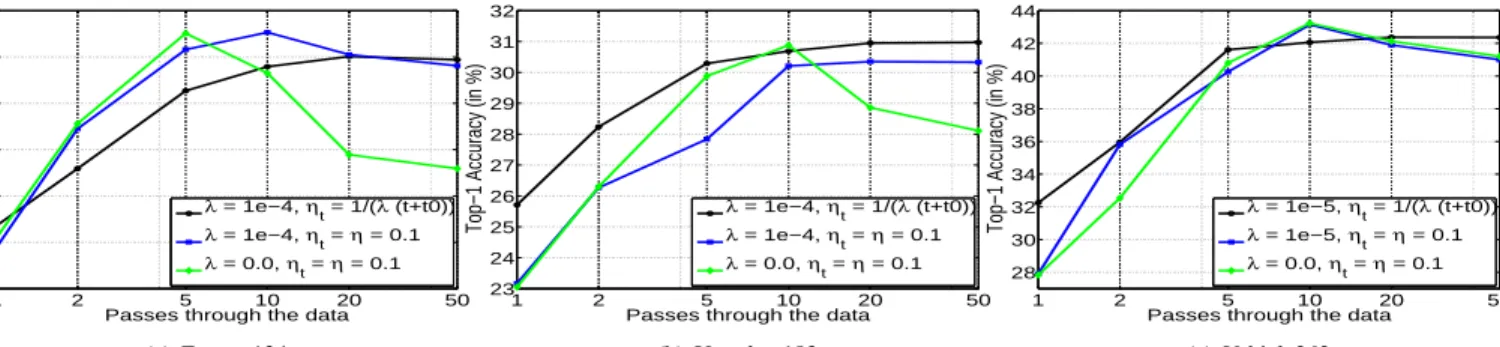
We run experiments on high-dimensional features (the
130K-dim FV for N =256 and R =4), i.e. for which
regularization is supposed to have a significant impact. The following experiments focus on w-OVR but we obtained very similar results for MUL, RNK and WAR. We compare three regularization strategies:
(i) Using explicit regularization (λ > 0) and a
de-creasing step size ηt = 1/(λ(t+t0) [10]. Setting
t0 correctly is of paramount importance for fast
convergence and Bottou [10] proposes a heuristic to
sett0automatically1. We attempted to cross-validate
t0, but always found the optimal value to be very
close to the one predicted by Bottou’s heuristic.
(ii) Using explicit regularizationλ >0and a fixed step
size ηt=η.
(iii) Using no regularization (λ= 0) and a fixed step size
ηt =η,i.e. implicitly regularizing with the number of iterations.
Results are provided in Figure 4 with β set by
cross-1. This heuristic is based on the assumption that the input vectors areℓ2
-normalized and uses the fact that the norm of the optimalw, denotedw∗, is bounded [67]:||w∗|| ≤1/√λ.t
0 is set so that the norm ofwduring the
Fungus Ungulate Vehicle
no replacement 19.75 27.86 38.40
replacement 19.55 27.79 39.53
TABLE 4
Comparison of sampling with and without replacement for w-OVR. Top-1 accuracy (%) on Fungus, Ungulate,
Vehicle using 130K-dim FVs.
validation. All three strategies perform similarly showing that implicit regularization with fixed step size can be an effective learning strategy. We observe that for smaller datasets it is important to stop early for optimal performance. This is consistent with regularization being less important when training data is plentiful. We also experimented with the implicit regularization with early stopping on the small-scale
PASCAL VOC 2007 dataset [25] and observed a small drop of
performance compared to explicit regularization (from 62.1% to 60.2%) which might indicate that this strategy is better suited to large-scale datasets.
Analysis of Sampling in w-OVR.
In this section, we show the effect of sampling the negative data points with or without replacement during SGD training
for w-OVR. We experiment with our best features, i.e. the
130K-dim FV for compatibility with our previous results. The
results are reported in Table4 in terms of top-1 accuracy. We
can see that sampling without replacement does not improve the accuracy significantly. In what follows, we draw negative samples with replacement.
Influence of Training Data Size.
We now compare the four different objective functions: w-OVR, MUL, RNK and WAR. We are interested in understand-ing whether the amount of trainunderstand-ing data has an impact on their relative performance. We run experiments with 10, 25, 50 and 100 training samples per class. The experiments are repeated 100 times for 10 and 25 training samples and 5 times for 50 and 100 training samples. We use the 4,096 dimensional BOV
descriptors and report the results in Figure 5.
Despite its simplicity and its supposed sub-optimality, w-OVR provides a competitive performance. It seems that RNK has an edge over the three other objective functions for a very small number of training samples. We provide in Table
5 the numerical results for 10 and 25 training samples. To
understand whether the observed differences are significant, we performed two types of tests. We performed the sign test
[68], [65], which counts the number of times an algorithm
performs better than the other one, and the paired t-test, which tests whether the observed differences in accuracies are purely
due to random errors. We show in Table 6 the probability
for both tests to reject the null hypothesis, i.e. the probability
that the observed differences happen by chance. In all cases
the probabilities are close to zero, i.e. the null hypothesis is
rejected with high confidence, thus indicating that the modest improvement of RNK with respect to w-OVR, MUL and WAR for a small number of training samples is significant.
Our interpretation of this result is as follows. The OVR objective function for a given class can be written as a sum of
losses over samples (xi, yi). In contrast, using the weighted
(a) 10 training images per class Mean (µ) / Std deviation (σ)
Fungus Ungulate Vehicle
w-OVR 5.26 / 0.20 5.24 / 0.14 9.66 / 0.20 MUL 5.06 / 0.28 5.11 / 0.16 9.43 / 0.19 RNK 5.61 / 0.64 5.52 / 0.26 10.18 / 0.33
WAR 5.26 / 0.25 5.19 / 0.17 9.52 / 0.25 (b) 25 training images per class
Mean (µ) / Std deviation (σ)
Fungus Ungulate Vehicle
w-OVR 7.52 / 0.25 7.77 / 0.15 14.05 / 0.19 MUL 6.90 / 0.19 7.57 / 0.19 13.75 / 0.23 RNK 7.89 / 0.24 8.11 / 0.18 14.65 / 0.32
WAR 7.66 / 0.24 7.80 / 0.18 13.83 / 0.27
TABLE 5
The average and standard deviation of the top-1 accuracy in on Fungus, Ungulate, Vehicle with 10 and 25
training images per class (repeated 100 times) using 4,096-dim BOV.
ranking framework of Usunieret al. [75] (see also our section
3.2) the MUL, RNK and WAR objective functions can be
written as sums of losses over triplets (xi, yi, y). Since the
number of triplets is C times larger than the number of
samples, one could expect the latter objective functions to have an edge over OVR in the small sample regime. However, while the RNK objective function is an unweighted sum over triplets, the MUL and WAR objective functions correspond to weighted sums that give more importance to the top of the list.
In other words, because of the weighting, theeffective number
of tripletsis much smaller than the actual number of triplets in the objective function. For instance, in the case of MUL, only the top triplet has a non-zero weight which means that the effective number of triplets equals the number of samples. This may explain why eventually MUL does not have an edge over OVR in the small sample regime. Similarly, the WAR weighting can be viewed as a smooth interpolation between the MUL weighting and the RNK weighting. Although the WAR weighting – which is inversely proportional to the triplet rank – makes sense for our classification goal, it is by no
means guaranteed to be optimal. While Usunieret al. propose
alternative weight profiles (see section 6 in [75]), we believe
that such weights should be learned from the data in order to give full strength to the WAR objective function. However, it is not straightforward to devise a method to learn these weights from the data. Furthermore, from our experiments, the optimal weighting profile seems to be dependent on the number of training samples.
Influence of Class Density.
We observed in Fig 5 that MUL can perform poorly,
especially on the very challenging Fungus dataset. Note that
this is the densest of the three fine-grained subsets2.
To better understand the influence of data density, we first experimented on synthetic data. The data is composed of 2D
2. The density of a dataset [20] is defined as the mean distance between all pairs of categories, where the distance between two categories in a hierarchy is the height of their lowest common ancestor. Small values imply dense datasets and indicate a more challenging recognition problem.
1 2 5 10 20 50 16 17 18 19 20 21 22
Passes through the data
Top−1 Accuracy (in %) λ
= 1e−4, ηt = 1/(λ (t+t0)) λ = 1e−4, ηt = η = 0.1 λ = 0.0, ηt = η = 0.1 (a) Fungus134 1 2 5 10 20 50 23 24 25 26 27 28 29 30 31 32
Passes through the data
Top−1 Accuracy (in %) λ
= 1e−4, ηt = 1/(λ (t+t0)) λ = 1e−4, ηt = η = 0.1 λ = 0.0, ηt = η = 0.1 (b) Ungulate183 1 2 5 10 20 50 28 30 32 34 36 38 40 42 44
Passes through the data
Top−1 Accuracy (in %) λ
= 1e−5, ηt = 1/(λ (t+t0))
λ = 1e−5, ηt = η = 0.1
λ = 0.0, ηt = η = 0.1
(c) Vehicle262
Fig. 4. Impact of regularization on w-OVR. Results on Fungus, Ungulate, Vehicle using 130K-dim FVs. One pass here means seeing all positives for a given class + (on average)βtimes more negatives.
10 25 50 100 4 5 6 7 8 9 10 11 12 13
Influence of number of training images with all SGD methods on Fungus
Number of Images N Top−1 Accuracy (in %) w−OVR MUL RNK WAR (a) Fungus 10 25 50 100 4 5 6 7 8 9 10 11 12 13 14 15
Influence of number of training images with all SGD methods onUngulate
Number of Images N Top−1 Accuracy (in %) w−OVR MUL RNK WAR (b) Ungulate 10 25 50 100 8 10 12 14 16 18 20 22
Influence of number of training images with all SGD methods on Vehicle
Number of Images N Top−1 Accuracy (in %) w−OVR MUL RNK WAR (c) Vehicle
Fig. 5. Comparison of four objective functions (w-OVR, MUL, RNK and WAR) as a function of the number of training images on Fungus, Ungulate, Vehicle using 4,096-dim BOV
p-values (t-test, sign test)
RNK vs MUL RNK vs WAR RNK vs w-OVR
F10 9.82e-12, 5.07e-20 5.48e-6, 5.52e-17 4.81e-7, 9.44e-20 F25 9.32e-51, 3.15e-28 1.39e-10, 2.49e-08 3.55e-20, 1.42e-13 U10 3.16e-34, 5.10e-25 5.97e-25, 3.31e-18 1.03e-20, 3.77e-21 U25 2.69e-36, 1.23e-23 1.84e-18, 1.04e-16 4.49e-26, 3.31e-18 V10 1.36e-35, 5.58e-19 2.06e-26, 5.58e-19 1.23e-26, 3.31e-18 V25 8.34e-35, 3.31e-18 2.74e-30, 3.31e-18 3.02e-33, 3.31e-18
TABLE 6
RNK method in comparison with all of the other SGD methods (F:Fungus, U:Ungulate, V:Vehicle). 10 and 25
refer to the number of training samples per class. Features: 4,096-dim BOV.
σ= 0.1 0.25 1.0 2.0 3.0 5.0 w-OVR 100.00 96.30 47.04 33.08 27.78 24.48 MUL 100.00 95.70 44.96 26.70 23.32 22.36 RNK 100.00 96.28 47.76 33.24 27.66 24.30 WAR 100.00 96.32 47.48 32.98 27.62 24.62 TABLE 7
Comparison of the accuracies (%) between w-OVR, MUL, RNK and WAR on synthetic data.σis the standard
deviation of the Gaussians.
points drawn from 5 different Gaussian distributions with fixed means and variable standard deviations (0.1 0.25, 1, 2, 3 and
5), see Fig6for a standard deviation of 0.25. As the standard
deviation increases, the overlap between classes increases
Fig. 6. Synthetic dataset with standard deviation 0.25.
significantly. We can see from Table 7 that all classifiers
yield perfect results when the data are well separable, but that MUL performs worse than all the other methods in case of overlapping distributions.
We also experimented on the Fungus dataset. To vary the density, we sub-sampled different numbers of classes: 10, 25, 50, 100. A small number of classes would typically result in a lower class density. We show results with BOV vectors in
Figure7. The ordering of the classifiers does not seem to be
dependent on the number of classes and therefore on the data density. We conducted similar experiments on Ungulate and Vehicle and obtained comparable results.
From the results of our synthetic and real data experiments, it is therefore difficult to argue for the merits of one classifier
10 25 50 100 all 5 10 15 20 25 30 35 40 45 Number of Classes
Top−1 Accuracy (in %)
w−OVR MUL RNK WAR
Fig. 7. Top-1 accuracy as a function of the number of classes.
or the other for denser or sparser datasets.
Influence of Feature Dimensionality.
Again, we compare the four objective functions (w-OVR, MUL, RNK and WAR), but this time we investigate whether the feature dimensionality has an impact on the relative
performance. Fig.8shows results for FVs of different
dimen-sionality, i.e., the number of Gaussians varies from N = 8
to 256. We observe again that the w-OVR provides a com-petitive performance. We also observe that, as the feature dimensionality increases, the difference between the different objective functions becomes smaller (this is also observed on
the ILSVRC 2010 dataset, see [55]).
Hence, for high-dimensional features, the learning objective function seems to have little impact. Put into the perspective of
the statistical learning theory [3], this implies that the impact
of the different choices of surrogate loss is mitigated as the
capacity of the classifier increases. In [3], the ψ(·) function
defines how the performance in the surrogate loss transfers
to the target loss (see Theorem 10 in [3]). For each surrogate
loss there is a correspondingψ(·)function. In our experiments
the different learning objectives corresponding to different surrogate losses lead to similar, yet, good results. Therefore, in these experiments, the capacity of the classifiers at hand is “large” enough, relative to the difficulty of the dataset, so
large that the difference of the corresponding ψ(·)functions
is almost canceled.
5.3 Large-Scale Experiments on ILSVRC2010
We report our results using the ILSVRC 2010 subset of ImageNet that contains 1K classes.
Results. We provide a comparison of the OVR, MUL, RNK and WAR SVMs. We do not report detailed results as on the
fine-grained datasets, as conclusions are very similar, see [55]
for detailed experiments on ILSVRC 2010. We report results
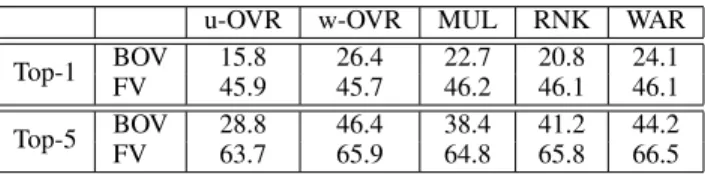
for the 4K-dim BOVs and 130K-dim FVs, see table 8. We
observe that the conclusions drawn from the smaller fine-grained datasets are still valid. First, rebalancing the positives and negatives is important in the case of OVR for low-dimensional training samples. Second, w-OVR is a competitive strategy despite its theoretical sub-optimality compared to the ranking objective functions. Third, for high-dimensional FV
u-OVR w-OVR MUL RNK WAR Top-1 BOV 15.8 26.4 22.7 20.8 24.1
FV 45.9 45.7 46.2 46.1 46.1
Top-5 BOV 28.8 46.4 38.4 41.2 44.2
FV 63.7 65.9 64.8 65.8 66.5
TABLE 8
Comparison of u-OVR, w-OVR, MUL, RNK and WAR. Accuracy (in %) on ILSVRC 2010 for 4K-dim BOV and
130K-dim FV.
u-OVR w-OVR MUL RNK WAR
BOV 4K-dim 3.8 7.5 6.0 4.4 7.0
FV 130K-dim - 19.1 - - 17.9
TABLE 9
Top-1 accuracy (in %) on ImageNet10K.
features all methods perform similarly. The difference between the best and worst performing methods is 0.5% at top-1 and 2.8% at top-5.
Comparison with the State-of-the-Art.In what follows, we report results for the top-5 accuracy which is the standard measure used during the competition. We note that the two winning teams at ILSVRC 2010 reported better results than
our 66.5% at top-5. [66] reports 74.3% by combining SIFT
and color descriptors and by using 520K-dim FVs while [48]
reports 71.8% by combining SIFT and LBP descriptors as well as multiple encoding techniques and spatial pyramids. While better features can indeed increase accuracy, this is out of the scope of our paper. We note however that our 66.5% is slightly above the 65% reported by the challenge winners using their
single best feature [6].
5.4 Large-Scale Experiments on ImageNet10K
We now report our results using on ImageNet10K which contains approx. 10K classes and 9M images.
Results.In Table9, we report results for the 4K-dim BOV and
the 130K-dim FV using top-1 accuracy as in [20], [66]. Given
the cost of running the experiments on the high-dimensional FVs, we carried-out experiments only with the two objective functions which performed best on ILSVRC 2010: w-OVR and WAR. As a conclusion, w-OVR performs better than more complex objective functions (at least on this dataset with those features). Some example classes from ImageNet10K which reflect the difficulty of the dataset along with the top-1
per-class accuracies are presented in Figure 9. Figure 10 gives
more detailed per-class results.
Comparison with the State-of-the-Art.We now compare our
results with results at the scale ofO(104)categories [20], [66],
[82]. Compared to [20], our BOV results are on par (even
slightly better since we report 7.5% while they report 6.4%) and our FV results are significantly (almost 3 times) better due to the use of higher-dimensional features. However, our focus in this work is not on features but on (linear) classifier learning strategies.
8 16 32 64 128 256 10 11 12 13 14 15 16 17 18 19 20 21 Number of Gaussians N
Top−1 Accuracy (in %)
w−OVR MUL RNK WAR (a) Fungus 8 16 32 64 128 256 10 12 14 16 18 20 22 24 26 28 30 32 Number of Gaussians N
Top−1 Accuracy (in %)
w−OVR MUL RNK WAR (b) Ungulate 8 16 32 64 128 256 26 28 30 32 34 36 38 40 42 Number of Gaussians N
Top−1 Accuracy (in %)
w−OVR MUL RNK WAR
(c) Vehicle
Fig. 8. Comparison of Top-1 Accuracy between the w-OVR, MUL, RNK and WAR SVMs as a function of the number of Gaussians used to compute the FV (i.e. as a function of the FV dimensionality). No spatial pyramids were used to speed-up these experiments.
(a) Star Anise (92%) (b) Nest Egg (87%) (c) Ready to Wear (76 %) (d) Stonechat (50%)
(e) Tortrix (25%) (f) Egyptian cobra (10%) (g) Weasel (5%) (h) Felt fungus (0%)
Fig. 9. ImageNet10K results (top-1 accuracy in %) obtained with w-OVR and 130K-dim Fisher vectors. (a-d) Sample classes from the best performing ones until the ones with accuracy 50%. (e-h) Sample classes with performance around 25% until the worst performing ones.
0 50 100 0 500 1000 1500 2000 Top−1 Accuracy (%) Number of classes (a) 0 50 100 0 0.5 1 Percentage of classes Top−1 Accuracy in (%) (b)
Fig. 10. Top-1 accuracies on ImageNet10K. Left: his-togram of the top-1 accuracies of all the 10K classes. Right: percentage of classes whose top-1 accuracy is above a threshold.
Weston et al., who used a different ImageNet subset in
their experiments, show that WAR outperforms OVR [82] on
BOV descriptors, where their OVR baseline did not do any
reweighting of the positives/negatives, i.e. it is similar to our
u-OVR. We also observed that WAR significantly outperforms u-OVR. However, we show that w-OVR performs significantly better than u-OVR and slightly better than WAR.
As for [66], S´anchez and Perronnin use w-OVR with the
natural rebalancing (β = 1). We show that selecting β by
cross-validation can have a significant impact on accuracy: using the same features, we improve their baseline by an
absolute 2.4%, from 16.7% to 19.1%. It is interesting to note that while rebalancing the data has little impact on the 130K-dim FV on ILSVRC 2010, it has a significant impact on ImageNet10K. This is not in contradiction with our previous statement that different objective functions perform similarly on high-dimensional features. We believe this is because there is no such thing as “high-dimensional” features. Features are only high-dimensional with respect to the complexity of the problem and especially the number of classes. While 130K-dim is high-130K-dimensional with respect to the 1K categories of ILSVRC 2010, it is not high-dimensional anymore with respect to the 10K categories of ImageNet10K.
Leet al. [42] and Krizhevskyet al. [40] also report results on the same subset of 10K classes. They report respectively
a top-1 per-image accuracy of 19.2% and 32.6%3. Our
per-image accuracy is 21.0%. However, we did not optimize for this metric which might lead to better results. Note that our study is not about comparing FVs to features learned with deep architectures. We could have used the learned features
of [42], [40] in our study if they had been available, i.e., we
could use as features the output of any of the intermediate
3. While it is standard practice to report per-class accuracy on this dataset (see [20], [66]), [42], [40] report a per-image accuracy. This results in a more optimistic number since those classes which are over-represented in the test data also have more training samples and therefore have (on average) a higher accuracy than those classes which are under-represented. This was clarified through a personal correspondence with the first authors of [42], [40].