
Quaternionic wavelets for texture classification
Rapha¨
el Soulard, Philippe Carr´
e
To cite this version:
Rapha¨el Soulard, Philippe Carr´e. Quaternionic wavelets for texture classification. Pattern Recognition Letters, Elsevier, 2011, 32 (13), pp.1669–1678. <hal-00618159>
HAL Id: hal-00618159
https://hal.archives-ouvertes.fr/hal-00618159
Submitted on 31 Aug 2011
HAL is a multi-disciplinary open access archive for the deposit and dissemination of sci-entific research documents, whether they are pub-lished or not. The documents may come from teaching and research institutions in France or abroad, or from public or private research centers.
L’archive ouverte pluridisciplinaire HAL, est destin´ee au d´epˆot et `a la diffusion de documents scientifiques de niveau recherche, publi´es ou non, ´emanant des ´etablissements d’enseignement et de recherche fran¸cais ou ´etrangers, des laboratoires publics ou priv´es.
Quaternionic Wavelets for Texture Classification
Rapha¨el Soulard, Philippe Carr´e
XLIM-SIC laboratory - CNRS UMR 6172 - University of Poitiers, France
Abstract
This article proposes a study of the recent quaternionic wavelet transform (QWT) from a practical point of view through a digital image analysis appli-cation. Based on a theoretic 2D generalization of the analytic signal leading to a strong 2D signal modeling, this representation uses actual 2D analytic wavelets and yields subbands having a shift-invariant magnitude and a 3-angle phase, using the quaternion algebra.
Our experiment furthers the understanding of this quite sophisticated tool, and shows its practical interest by a clear improvement of a famous wavelet application : texture classification. Thanks to coherent multiscale analysis brought by the QWT we obtain better classification results than with standard wavelets in a similar process.
Keywords: Wavelet transform, 2D Phase, Quaternionic Wavelet Transform, Image texture analysis, Image classification
Email addresses: [email protected](Rapha¨el Soulard), [email protected](Philippe Carr´e)
1. Introduction 1
Since the 90’s wavelets have been widely used for the analysis of
textu-2
ral images [Tuceyran and Jain, 1993; Lasmar and Berthoumieu, 2010].
Ac-3
cordingly the human visual system sees textures through different channels
4
related to particular frequency bands and directions; and wavelet
representa-5
tions offer this kind of decomposition. So by extracting simple features from
6
each subband, the image content can be characterized separately at different
7
scales and orientations, making an efficient texture analysis.
8
In 2001, the well known power of theanalytic signal for signal modeling
9
led to a new definition of wavelets : the Complex Wavelet Transform (CWT)
10
[Selesnick et al., 2005], whose subbands areanalytic signals giving access to a
11
shift-invariant amplitude envelope (magnitude). The CWT codes signals in
12
a more coherent way than standard wavelets (DWT); which overcomes their
13
famous shift-variance problem. Its superiority over DWT for texture
anal-14
ysis has been shown in [de Rivaz and Kingsbury, 1999; Celik and Tjahjadi,
15
2009]. But CWT phase is ambiguous for 2D signals and is almost not used
16
in applications excepted in a very recent work [Celik and Tjahjadi, 2011].
17
In parallel, the work in [B¨ulow, 1999] provides a strong theoretic 2D
gener-18
alization of the analytic signal defined in quaternion algebra. The 3-angle
19
local 2D phase related to it contains 2D geometric information. The Quater-20
nionic Wavelet Transform (QWT) - first proposed in 2004 [Chan et al., 2008;
21
Bayro-Corrochano, 2006] - uses wavelets that are 2D-analytic in the sense of
22
B¨ulow, providing quaternion valued subbands with shift-invariantmagnitude 23
and this new 2D phase. This representation - specially defined for 2D signals
24
- is a great theoretic improvement of CWT yielding a coherent description
of local 2D structures.
26
Currently, many evolutions of wavelets focus on directionality
(Contour-27
lets, Complex Wavelets, Directionlets, Adaptive lifting schemes); bringing
28
some redundancy to fit numerous directions from a quite algorithmic point
29
of view. QWT is a different approach to a coherent representation of local
30
structures in images based on a strong 2D signal processing theory; and sets
31
some redundancy in a local phase rather than in directionality.
32
Given the promising theoretical properties of this new transform, we
pro-33
pose here a global study of this sophisticated tool to further its understanding
34
through a famous application of wavelets. We aim to show its potential and
35
verify its practical superiority over standard DWT in a comparative texture
36
analysis application.
37
The main point is the understanding of the information carried by QWT
38
coefficients. QWT magnitude can intuitively be used like DWT but
interpre-39
tation of phase is far from straightforward. With a first QWT based feature
40
extraction algorithm this work gives an application not did yet to our
knowl-41
edge and furthers practical use of QWT coefficients. We expect QWT to
42
provide better texture analysis than DWT - with simple feature extraction
43
methods - thanks to better separation of information and shift-invariance.
44
An additional experimental comparison is done withCWT because the topic
45
is near.
46
After a presentation of the transform, we propose several feature
extrac-47
tion methods based on both DWT and QWT. To compare with literature,
48
we also describe some CWT based feature descriptors recently published in
49
[Celik and Tjahjadi, 2009, 2011]. The use of QWT phase is then discussed as
Figure 1: Quaternionic wavelet transform of a textural image. From left to right : Original image, magnitude|q|(intensity inverted for visual convenience),ϕ∈[−π;π],θ∈[−π
2; π 2], ψ∈[−π 4; π
4]. The 3 terms of phase are represented in color - the hue corresponding to the angle (cyan for 0, red for±π). Darker zones in phase correspond to negligible magnitude (making phase absurd).
well as the combination of QWT magnitude and phase based features. We
51
finally give experimental classification results to compare DWT and QWT in
52
terms of recognition rates. Note that the point is to observe changes in
recog-53
nition and not to get a competitive texture recognition performance. The
54
aim is to carry out a simple process to help us studying wavelet transforms,
55
rather than achieving excellent recognition. Types of texture better described
56
by one or another transform will be analyzed in terms of visual/geometric
57
content.
58
2. Quaternionic Wavelet Transform 59
The Quaternionic Wavelet Transform (QWT) is a perfect reconstruction
60
2D filterbank decomposition for grayscale images; addressing three common
61
drawbacks of standard DWT :
62
• Oscillations - Using oscillating wavelets complicates the representation
63
of a simple structure, involving several coefficients in a neighborhood
to compensate each other their own oscillations, and so making local
65
analysis difficult.
66
• Shift-variance - The look of a wavelet transform may substantially
67
change by a small shift of the image; causing incoherence while most
68
recognition processes need invariant features.
69
• No phase notion - Fourier phase and local phase from the analytic
70
signal are powerful analysis tools so it is interesting to fit DWT up
71
with a phase notion in a pattern recognition context.
72
The key is to embed the analytic signal modeling into the wavelet
frame-73
work. The Dual-Tree CWT [Selesnick et al., 2005] achieves 1D analytic
74
wavelet analysis with a 2 times redundant perfect reconstruction filterbank
75
overcoming the 3 drawbacks listed above. But its 2D version yields an
am-76
biguous phase failing to efficiently describe local structures. More precisely,
77
the phase angle encodes a local shift around pixel position - in the exact
di-78
rection that is orthogonal to the intrinsic orientation of considered subband.
79
Since the structure may be not well aligned with wavelet orientation, this
80
shift information is not sufficient to accurately localize the structure.
81
The point then is the 2D generalization of analytic signal and the
geo-82
metric meaning of the 2D phase extracted from it.
83
This is why the QWT uses the 2D analytic signal defined in [B¨ulow, 1999]
84
within the quaternion algebra. According to B¨ulow, this generalization is
85
superior to previous attempts in C - including the one implicitly related to
86
2D CWT - and is well adapted for 2D signals whereas standard complex
87
analytic signal is only adapted in 1D. The extracted quaternionic local phase
(3 angles) contains rich geometric information. Note that B¨ulow proposed
89
quaternionic Gabor filters in 1999 [B¨ulow, 1999] and used the phase for image
90
analysis applications.
91
The QWT provides a quaternionic multiresolution analysis with 2D
ana-92
lytic wavelets overcoming the above-cited drawbacks of DWT. Whereas DWT
93
coefficients are real, QWT is quaternion valued i.e. 4-vectors made of one
94
magnitude and a 3-angle phase. Information is better separated to describe
95
more explicitly the image content. In 2004, the Rice University from Houston
96
proposes to use their Dual-Tree algorithm to carry out a QWT with perfect
97
reconstruction filterbanks [Chan et al., 2008] (that we use in this work). Note
98
that at the same time, Bayro proposes a quaternionic Gabor pyramid
[Bayro-99
Corrochano, 2006], windowing the quaternionic Fourier transform (QFT),
100
but this approach has no perfect reconstruction so the use can be limited for
101
example in image coding.
102
In this section we present the quaternionic 2D analytic signal upon which
103
the QWT is based, the definition of the transform, the algorithm we used
104
and the use of this tool.
105
2.1. The Quaternionic Analytic Signal 106
In his thesis [B¨ulow, 1999], T. B¨ulow showed that complex algebra C is
107
only adapted for handling 1D signals and that 2D signals are best described
108
by embedding signal processing tools in the more generalquaternion algebra
109
H. He defined a ‘Quaternionic 2D Fourier Transform’ (QFT) and a
‘Quater-110
nionic 2D Analytic Signal’.
111
A quaternion is a generalization of a complex number, related to 3 imag-inary units i, j, k following the rules i2=j2=k2=−1 and ij=−ji=k; and
written q=a+bi+cj+dk. A polar form q =|q|eiϕejθekψ analogous to the
complex one is defined by one modulus |q| and three angles (ϕ, θ, ψ) called
phase. The phase corresponds here to Euler angles in a 4D Euclidean space :
ϕ = atan( 2(cd+ab), a2−b2+c2−d2 )/2 +kπ ∈[−π;π] θ = atan( 2(bd+ac), a2+b2−c2−d2 )/2 ∈[−π 2; π 2] ψ = arcsin( 2(ad−bc) )/2 ∈[−π 4; π 4] with |q|= 1. See [B¨ulow, 1999] pp 16-21 for a detailed definition.
112
As a fundamental signal processing tool theanalytic signal associated to a real 1D signal f(t) is well known to be constructed by setting its Hilbert transformHf(t) in the imaginary part; being equivalent to a simple spectral operation : fA(t) =f(t) +iHf(t) ⇔ fˆA(ω) = 0 if ω <0 ˆ f(ω) if ω = 0 2 ˆf(ω) if ω >0
Note that the spectrum of fA is null for negative frequencies. 113
Modulus and argument offA can be interpreted as instantaneous magni-114
tude andphase. When the original signal is consideredoscillating or
narrow-115
band these two pieces of data become meaningful - making this tool useful
116
for instance in amplitude and frequency modulation.
117
Looking at one point of interest, we can interpret a high magnitude as a
118
strong ‘presence of some oscillation’ around this point. Phase indicates the
119
relative location of this point within the oscillation.
120
B¨ulow pointed out that instantaneous phase equivalently describes the
121
kind of structure at a point - among four fundamental structures : 0-‘positive
impulse’, π/2-‘falling step’, ±π-‘negative impulse’, −π/2-‘rising step’. This
123
is an important point for pattern recognition and that is why the author
124
wanted to generalize it for 2D signals.
125
Several generalizations to 2D are possible and depend on properties we
126
choose to keep. We consider 2D versions of the Hilbert transform (HT). The
127
partial HT (Hθ) is equivalent to a 1D HT along direction θ. The total HT 128
(HT =H0Hπ/2) is the combination of two partial HT’s alongx and y axes.
129
A 2D analytic signal off can be constructed by addingHθf as the imaginary 130
part; what would cancel out aθ-oriented half-plane in the frequency domain.
131
But this method depends on an arbitrary choice of the direction - not really
132
adapted for our issue. We can use as well HT; what cancels out 3 quadrants 133
of the Fourier domain, but the original signal cannot be retrieved from the
134
analytic signal (This is the classical approach in [Hahn, 1996]).
135
So B¨ulow proposed to embed both partial and total HT’s into a quater-nionic analytic signal :
fA(x, y) = f(x, y) +iH0f(x, y) +jHπ/2f(x, y) +kHTf(x, y)
This method cancels out 3 quadrants of the (quaternionic) Fourier domain
136
and allows retrieval of the original signal. Its polar representation provides
137
2D local magnitude and phase that can be used to analyze 2D signals - in a
138
similar way as with 1D analytic signal.
139
The QWT uses this generalization to carry out an ‘actual’ 2D analytic
140
wavelet transform.
2.2. Quaternionic Wavelets : Definition 142
A standard wavelet transform (DWT) provides a scale-space analysis of
143
an image; yielding a matrix in which each coefficient is related to a ‘subband’
144
(localization in the 2D Fourier domain) and to a position in the image. A
145
‘subband’ means both an oscillation scale (i.e. a 1D frequency band) and a
146
spatial orientation (i.e. rather vertical, horizontal or diagonal).
147
For 2D signals, the QWT provides a richer scale-space analysis than
148
DWT. Its coefficients are analytic according to B¨ulow’s theory and
con-149
trary to DWT the magnitude is near shift-invariant. Thus it inherits the
150
magnitude-phase local analysis from the very useful 1D analytic signal. In
151
the one hand the QWT can be viewed like a local ‘2D Quaternionic Fourier
152
Transform’ (QFT); in the other hand its subbands are ‘2D Quaternionic
153
Analytic Signals’ associated with bandpass filtered versions of the original
154
signal.
155
Note that usual interpretation of magnitude remains analogous to 1D as
156
it indicates the relative ‘presence’ of a local geometric element; whereas the
157
local phase is now represented by 3 angles carrying a complete description of
158
this 2D structure.
159
We start with real separable scaling functionφ and mother wavelets ψD,
ψV, ψH, and we construct their analytic extensions in H :
Real function : Analytic extension :
ψD = ψ h(x)ψh(y) → ψD +iH0ψD+jHπ/2ψD +kHTψD ψV = φ h(x)ψh(y) → ψV +iH0ψV +jHπ/2ψV +kHTψV ψH = ψ h(x)φh(y) → ψH +iH0ψH +jHπ/2ψH +kHTψH φ = φh(x)φh(y) → φ+iH0φ+jHπ/2φ+kHTφ
Mathematically, 2D HT’s of separable functions are equivalent to 1D HT’s along rows and/or columns. So we consider the 1D Hilbert pair of wavelets and scaling functions :
(ψh , ψg=Hψh ) (φh , φg=Hφh )
and we have for instance : H0ψV =Hφh(x)ψh(y) = φg(x)ψh(y). The analytic
2D wavelets can then be written in terms of separable products :
ψD = ψ h(x)ψh(y)+iψg(x)ψh(y)+jψh(x)ψg(y)+kψg(x)ψg(y) ψV = φh(x)ψh(y)+iφg(x)ψh(y)+jφh(x)ψg(y)+kφg(x)ψg(y) ψH = ψ h(x)φh(y)+iψg(x)φh(y)+jψh(x)φg(y)+kψg(x)φg(y) φ = φh(x)φh(y)+iφg(x)φh(y)+jφh(x)φg(y)+kφg(x)φg(y)
From a practical point of view, the mother wavelet is related to a quaternionic
160
2D analytic filter - computable with separable 2D filterbanks. This means
161
the decomposition is heavily dependent on the position of the image with
162
respect to x and y axes (rotation-variance) and the wavelet is not isotropic
163
but the advantage is the easy computation.
164
Each subband from QWT can be seen as the analytic signal associated
165
with a narrowband part of the image. Shift-invariant magnitude |q|
repre-166
sents elements at any space position in each frequency subband; and phase
167
(ϕ, θ, ψ) describes the ‘structure’ of these elements. We discuss below the
168
interpretation of the phase.
169
2.3. Dual-Tree Implementation 170
The QWT is implemented by the Dual-Tree algorithm [Selesnick et al.,
171
2005] - a filterbank using a Hilbert pair as a complex 1D wavelet - originally
Analysis g2 h2 g1 h1 ↓2 ↓2 ↓2 ↓2 D D D D C C -h2=H{h1},g2=H{g1}. Synthesis = = < < ↑2 ↑2 ↑2 ↑2 ˜ g2 ˜ g1 ˜ h2 ˜ h1 + + + 12
-<: Real part,=: Imaginary part
Figure 2: 1D analytic wavelet transform with the Dual-Tree algorithm.
performing a CWT as shown Fig. 2 for the 1D case. It is approximately 173
analytic and achieves near shift-invariance with a redundancy of 2:1. These
174
two filterbanks lead to four separable 2D filterbanks that can be combined
175
to fit the QWT definition. Fig. 1 shows an example of such decomposition.
176
2.4. Interpretation and Use 177
For now, literature is quite poor about QWT and the major difficulty
178
with the use of this transform is the interpretation of the phase.
179
In [B¨ulow, 1999] 2D quaternionic analytic Gabor filters are defined and
180
used in a Gabor based texture segmentation. Filtered images are 2D
ana-181
lytic and form a scale-space analysis of the image; from which are extracted
182
magnitudes and local phases at each point to characterize the texture.
183
A shift theorem similar to this of the well known Fourier transform also
184
stands for the quaternionic Fourier transform defined in [B¨ulow, 1999] : a
185
shift of the image is equivalent to an offset of the two first terms of phase
186
ϕ and θ. As a result, in a Gabor decomposition ϕ and θ describe small
187
2D spatial shifts of the coded structure - around the quaternionic coefficient
188
position. Note that in 1D that shift is equivalent to structural information;
but 2D structures may be more complex than lines or edges (e.g. corners,
190
T-junctions) and cannot be described by this kind of shift coding. The third
191
term ψ completes the structure analysis and is seen as a texture feature.
192
B¨ulow observed that where ψ is around ±π/4 the coded structure is a line
193
or an edge oriented along a diagonal.
194
We found three recent references [Chan et al., 2008; Bayro-Corrochano,
195
2006; Zhou et al., 2007] where ϕand θ are used in disparity estimation. As
196
the QWT performs local QFT’s; the shift theorem approximately stands for
197
QWT so ϕand θ code quite simply spatial shifts of structures.
198
In another application of [Chan et al., 2008] (‘wedgelet’ representation)
199
ϕ and θ are used for wedges position and ψ is used for their orientation.
200
We propose a new application of this transform : the next section deals
201
with texture classification. The difference with the work by B¨ulow is that
202
while segmentation involves detecting where two textures are different, clas-203
sification aims to indicate what kind of texture is observed. In addition, the
204
tool we use (QWT) is slightly different than Gabor filters in that it is related
205
to perfect reconstruction filterbanks.
206
3. Texture Classification 207
Texture classification is the process which - given any textural image
208
- find the class this image most probably belongs to. Texture has still no
209
universal definition, but may be presented by classical cases like ‘tar’, ‘water’,
210
‘sand’, as macroscopic examples, or ‘town’,‘ocean’, ‘forest’, as satellite view
211
examples; and characterized by a sort of uniformity and periodicity. We call
212
a kind of texture a class; according to an arbitrary classification we humans
make instinctively.
214
In this paper, we only discuss wavelet based methods for this
applica-215
tion in order to compare QWT with DWT. Feature extraction via standard
216
wavelet representation of images (DWT) has been widely used in texture
217
analysis [Tuceyran and Jain, 1993; Arivazhagan and Ganesan, 2003; Lasmar
218
and Berthoumieu, 2010] for the two last decades. Accordingly, the multiscale
219
analysis provided by the DWT is well adapted to textural images. From each
220
subband one may calculate a mean, standard deviation, energy, mean power,
221
or more sophisticated statistical modeling. Those features well combined
-222
can form a powerful texture descriptor.
223
The Dual-Tree Complex Wavelet Transform (CWT) - a complex
exten-224
sion of the DWT - is motivating by the near shift-invariance of its
magni-225
tude and the oriented aspect of its wavelets. It was used in [de Rivaz and
226
Kingsbury, 1999; Celik and Tjahjadi, 2009, 2011] revealing its efficiency with
227
respect to DWT in texture analysis. The invariance of magnitude to shifts
228
makes the extracted feature independent of the precise location of textural
229
patterns; and so allows a better characterization. We will include CWT
230
based feature vectors of [Celik and Tjahjadi, 2009, 2011] in our experiments
231
to compare with literature.
232
We here propose to further texture analysis using QWT because we keep
233
the advantages due to shift-invariance while adding new information with
234
the ψ phase. The QWT can be regarded as theproper 2D generalization of
235
analytic wavelets since the quaternionic analytic signal is the proper
gener-236
alization according to B¨ulow. We use the Dual-Tree based QWT algorithm
237
[Chan et al., 2008] and for comparison a DWT with the well known CDF 9/7
wavelets. The latter are widely used and offer a good separation of frequency
239
components; what is well adapted to texture analysis.
240
QWT needs special “Q-Shift” filters designed in [Kingsbury, 2001] to form
241
Hilbert pairs. Three different filter sets are possible : the 9-tap, 14-tap and
242
18-tap Q-Shift filters. In wavelet based texture analysis long filters usually
243
achieve better performance. In this paper we mainly use the 9-tap filters
244
to ensure fairer comparison with 9/7 classical filters; nevertheless the other
245
Q-Shift filters will be treated in the experimental part of the paper.
246
A L-level decomposition provides 3L subbands for analysis and a
low-247
frequency subband. We do not use the latter; as low frequency structures
-248
almost constant - are usually not considered to be a feature of texture.
249
3.1. Texture Databases 250
In order to provide relevant performance with respect to the huge variety
251
of textures we can find, we use several known texture databases :
252
• Brodatz database [Brodatz, 1966] contains 111 photos called textures 253
by the author. We use those [640×640] images to create textureclasses,
254
by cutting each one into 25 [128×128] sub-images considered to belong
255
to the same class.
256
• Outex databases (http://www.outex.oulu.fi/) were specially made
257
for texture classifiers benchmarking. We use the TC12 database that
258
contains 24 classes of 380 [128×128] samples. In each TC12 class we
259
have different images of a same kind of texture at different orientations
260
and under different lightings.
• We also use Outex TC14 database, which has 68 classes of 60 samples
262
with different lightings but only one orientation.
263
3.2. Experimental Protocol 264
Recall that our point is the understanding of the QWT. The recognition
265
scheme must be elementary so we can identify the influence of the choice
266
of transform/features on the recognition rate. This is why we propose to
267
use a simple k Nearest Neighbors classifier (k-NN) without any automatic
268
feature selection or normalization that would drown the contribution of the
269
transform and confuse the interpretation. Note that we use DWT-based and
270
QWT-based feature vectors that will be presented in the next section.
271
Here is the k-NN algorithm. From each image of a training base a
fea-272
ture vector describing the texture is extracted and labelled by its actual class
273
number. When a test image is given, its feature vector is processed and
com-274
pared in the feature space to the feature vectors of the training base in terms
275
of Euclidean distance. According to a parameterk, thek nearest vectors are
276
kept to find the most representative class; that is the most represented class
277
within the k neighbors.
278
In order to evaluate performance we split our available classes into two
279
groups :
280
• A test base : NT examples the program does not know; 281
• A training base : NA labelled examples the program knows. 282
Then recognition rates obtained by using a certain feature extraction method
283
will inform about the quality of this method i.e. the power of description
brought by this feature vector for texture classes. Some classes are better
285
recognized than others so we can study what kinds of texture make DWT or
286
QWT more suitable.
287
Cross validation 288
Since experimental rates will depend on the chosen training base, we
pro-289
pose to iterate the process 100 times with different selections of the training
290
base (but fixed NA). We obtain 100 recognition rates for each feature ex-291
traction method and each texture class. So our recognition rates will be
292
displayed as average rates with a certain deviation, following the so-called
293
cross validation protocol (see Fig. 3 for example). Thanks to cross validation
294
recognition rates are very stables from an experiment to another (rates vary
295
less than 1% experimentally).
296
Sample selection 297
Let us precise how the sample selection is done. We need to separate
sam-298
ples of each class 100 times differently. If we na¨ıvely pick up NA consecutive 299
samples as they are stored in the database, we introduce a bias due to the
300
existing correlation between consecutive samples (e.g. in TC12 basis,
consec-301
utive samples have same orientation). So NA samples are randomly selected 302
from each class while the test base is formed by all remaining samples. This
303
process is repeated at each of the 100 iterations.
304
In the sequel, we first present different feature extraction methods from
305
DWT/QWT magnitude and QWT phase, as well as complex wavelet features
306
from [Celik and Tjahjadi, 2009, 2011] for comparison. Then the experimental
307
classification results related to these descriptors are given and analyzed.
4. Feature extraction 309
Feature extraction is the automatic processing of several numbers
de-310
scribing texture characteristics. The output is a so-calledfeature vector that
311
will be considered in a feature space to compare with other texture samples.
312
Many wavelet based texture classifications use a global measure of energy
313
or statistics from the magnitude; which corresponds to characterize
partic-314
ular bands of the Fourier domain. This type of feature extraction is well
315
adapted to textures that can be viewed as superimposed signals located in
316
the Fourier domain. We will study several methods. First we use
magni-317
tude based features that are analogous for both DWT and QWT. Then we
318
propose QWT phase based features that will improve texture description;
319
and a combination of QWT magnitude and phase. Finally the CWT-based
320
features of [Celik and Tjahjadi, 2009, 2011] - also made of global subband
321
measures - are described.
322
4.1. Magnitude based features 323
After having processed the norm Mij = |qij| of wavelet coefficients of a 324
given image (where iand j are discrete coordinate of a pixel); two measures
325
in each subband are considered.
326 Energy : m = 1 E X i,j Mij2
where E is the total energy of the image minus the low-frequency energy.
327
This normalization makes m the relative amount of energy in a subband.
Standard deviation (St. dev.) : m= s 1 N X i,j (Mij −µ)2
where N is the number of pixels in the subband and µ is the mean.
329
4.2. QWT phase based features 330
We dealt with QWT phase in section 2.4. We will first use some phase
331
features only and then we combine magnitude and phase information. Now,
332
how can we use QWT phase to describe textures?
333
First, ϕ and θ are irrelevant because they inform about position of
el-334
ements whereas we are interested in their structure. We may think of a
335
matching between the 2D shift coding and some 2D kinds of structure -
anal-336
ogously to the 1D phase - but this interpretation is not clear. In addition,
337
our experiments onϕandθ gave very bad results (less than 3% recognition).
338
So we focus on the third term ψ used by B¨ulow in a Gabor based texture
339
segmentation process [B¨ulow, 1999].
340
In this application we assume that textures are stationary so we do not
341
want to describe spatially precise texture patterns but rather extract global
342
measures. However, we want to describe a part of the behavior of the phase
343
within each subband so a measure such as a mean would not be suitable
344
because it is too global. Experimentally, phase means1 by subband give very
345
bad results (less than 1% recognition).
346
1The angle is ‘unwrapped’ in the calculus of a mean. But note thatψ does not show phase wrapping as it lies in [−π/4;π/4].
As we aim to do a fair comparison we won’t carry out a high level
pro-347
cess such as spatial measures (extrema search, connexity . . . ) that would
348
need to be differently adapted to either DWT or QWT. To make the results
349
as comparable as possible our application must keep simple and we would
350
rather extract a single value from a whole subband as a global feature of the
351
phase spatial behavior. To our knowledge, literature is quite poor about the
352
measure of phase. TheGlobal Phase Coherence [Blanchet et al., 2008] gives a
353
measure of image sharpness but relies on a too much restricted mathematical
354
model with respect to the topic of the paper that is a first approach toward
355
QWT. A relative phase distribution measure was used with some complex
356
wavelets in [Vo et al., 2007] but is specially defined for this type of
trans-357
form. The quaternionic phase is a totally different concept than the complex
358
one; so it would be irrelevant to use such a sophisticated measure.
359
It seems that the simple calculus of the standard deviation (st. dev.)
360
within a subband would be adapted because it describes a part of the behavior
361
ofψ. Sinceψ ∈[−π
4,
π
4] (see Euler angles) we avoid the usual problems about
362
circular data (±π discontinuity, phase wrapping) so there is no ambiguity to
363
calculate angle differences and means.
364
To improve robustness the ψ-deviation can be weighted by the QWT
365
magnitude. A high magnitude means an important presence of an element
366
while a low value means ‘no element’ and also provides a numerically unstable
367
phase. So the measure should be more representative by not considering the
368
structure of low magnitude features. The weight functionW is the magnitude
369
of the QWT coefficients normalized so the sum within the subband is 1; and
370
is integrated in the standard deviation formula as defined below. Here are
the two phase measures we use for feature extraction : 372 St. dev.: m = s 1 N X i,j (ψij −µ)2 where µ = N1P
i,jψij, N is the number of pixels in the subband, and (i, j) 373 spans a subband. 374 Weighted st. dev. : m= s X i,j Wij(ψij−µW)2
where µW =Pi,jWijψij is the weighted mean of the subband. 375
4.3. Combination of QWT magnitude and phase 376
Let us now combine the st. dev. QWT magnitude features with the
377
weighted st. dev. QWT phase features (Given experimental results that will
378
be presented in the next section; st. dev. measures are retained for both
379
magnitude and phase).
380
First we experimentally observed that a simple concatenation of both
381
vectors gives very good performance - better than DWT. Here is a classical
382
point in classification : our two features are not of the same kind. One is
383
an amplitude (∈ R+) and the other is an angle (∈ [0,π
2]). It produces a
384
lack of coherence in the final feature vector as all that terms are seen the
385
same way by the Euclidean distance of the k-NN algorithm. A metric often
386
solves this heterogeneity problem but the different metrics we tried did not
387
improve the process. Even considering the optimal metric with respect to our
388
database; performance is not significantly higher since in practice magnitude
and phase features are of the same order of magnitude. So for this paper we
390
finally consider simple concatenation of QWT magnitude and phase features.
391
To compare with literature we propose to also useCWT. Even though the
392
concept is totally different from QWT the underlying algorithm is quite
sim-393
ilar and was used in texture analysis for example in [de Rivaz and Kingsbury,
394
1999; Celik and Tjahjadi, 2009, 2011].
395
4.4. Complex wavelets based features 396
These feature vectors are processed from the 6 subbands of the
Dual-397
Tree Complex Wavelet Transform (CWT). In most cases, classical features
398
such as entropy or energy measures as well as statistics are extracted from
399
the magnitude of each subband. In this experiment we choose to use CWT
400
magnitude based feature vector from [Celik and Tjahjadi, 2009] that uses
401
variance and entropy. The very recent work in [Celik and Tjahjadi, 2011]
402
involves standard deviations and energy measures from both magnitudeand 403
phase. Note that in the original paper the vector is further reduced and
404
weighted based on statistics (PCA) - which we did not reproduce because
405
our scheme needs to be elementary so we can identify the contribution of
406
DWT/CWT/QWT (see discussion section 3.2).
407
It is important to stress that the aim of cited papers is to carry out a
408
good recognition whereas the point of the present paper is the analysis of the
409
QWT. This is why we do not use the whole recognition process described
410
in [Celik and Tjahjadi, 2009, 2011] but just the feature extraction bloc. We
411
refer the reader to original publications for detailed expressions.
412
Now the feature extraction part is done, let us give our experimental
413
results of texture recognition with every feature vectors described above.
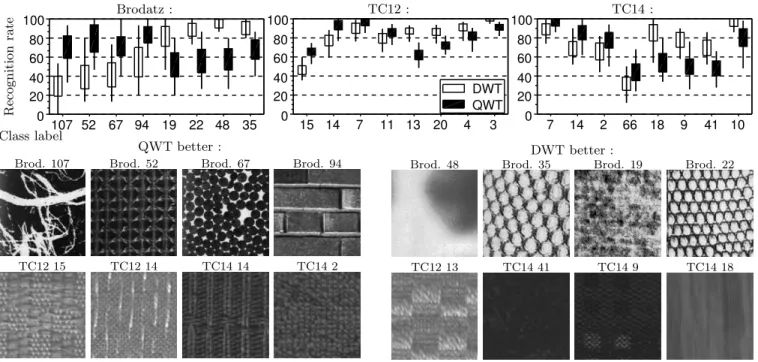
R ec o g n it io n ra te Brodatz : 22 48 107 52 67 19 35 100 80 60 40 20 0 94 TC12 : 0 20 4 13 20 80 60 40 100 15 14 7 11 3 DWT QWT TC14 : 100 80 60 14 2 66 18 9 20 0 10 41 40 7 Class label QWT better :
Brod. 107 Brod. 52 Brod. 67 Brod. 94
TC12 15 TC12 14 TC14 14 TC14 2
DWT better :
Brod. 48 Brod. 35 Brod. 19 Brod. 22
TC12 13 TC14 41 TC14 9 TC14 18
Figure 3: Magnitude based classification performance : cross validation results for some classes of the 3 databases.
The next section also brings analysis of interesting types of textures.
415
5. Experimental results 416
We obtained many results, depending on L (depth of wavelet
decompo-417
sition), chosen feature extraction, value of k, size of training base NA and 418
used database.
419
Experimentally for most feature vectors best results are obtained with
420
L= 3 and k = 3. The larger the training base the better the recognition, so
421
in this comparative study we consider rather small training bases to put the
422
simulation into a rather hard context. The st. dev. measure globally gives
423
slightly better performance than energy, so we will only consider the st. dev.
feature in the sequel.
425
The choice of Q-Shift filters in Dual-Tree algorithm has almost no
influ-426
ence on recognition rates (gain is less than 1% recognition). A reason is that
427
this modification does not affect the first scale (see [Kingsbury, 2001]) so 13
428
of features remain the same. So we keep 9-tap filters.
429
For every result presented in the paper, we keep :
430
• Depth isL= 3 (9 subbands) so feature vectors are of size 9 for DWT/QWT
431
magnitude and phase features, size 18 for QWT combined magnitude
432
and phase, size 36 forCWT magnitude from [Celik and Tjahjadi, 2009]
433
and size 72 for CWT magnitude and phase from [Celik and Tjahjadi,
434
2011].
435
• Number of considered neighbors is k= 3;
436
• Size of the training base per class is NA = 10 (resp. NA = 30 and 437
NA= 10) for Brodatz (resp. TC12 and TC14) database; 438
• Magnitude measure is a standard deviation;
439
• 9-tap Q-Shift filters are used in the Dual-Tree algorithm.
440
We now present experimental results in terms of recognition rates for DWT/QWT
441
magnitude based features, QWT phase features, combination of QWT
mag-442
nitude and phase and CWT based features.
443
5.1. Magnitude based descriptor : comparing DWT and QWT 444
Some cross validation results for magnitude based feature extraction are
445
illustrated Fig. 3. Recognition rates are expressed in terms of mean, standard
deviation and extrema of the rates obtained for each class with the various
447
training bases. Class labels are on the x-axis and recognition rate on the
448
y-axis. For each class the vertical line spans all 100 obtained rates between
449
the minimum and the maximum, the bar is centered on the average rate and
450
is high two times the standard deviation.
451
Note that globally, both transforms have equivalent performance. We
452
do not present results for all classes because they are too numerous but we
453
selected the cases where difference of performance is maximum between DWT
454
and QWT. These extreme cases could give clues about what type of texture
455
is better recognized by either the DWT or the QWT.
456
We propose to analyze the results through particular cases to highlight
457
QWT characteristics. Observing Fig. 3, we see that texture Brod. 67
con-458
tains numerous very similar and randomly placed small black disks.
Shift-459
invariance of QWT magnitude is essential to code those structures with
vari-460
ous positions; whereas each disk is surely quite differently coded in the DWT
461
because of small space shifts. In this case QWT gives a more robust
descrip-462
tion of texture keeping everywhere a coherent representation of the disks
-463
what explains the superiority of QWT for Brod. 67.
464
Let us call ‘common’ orientations multiples of 45◦ i.e. horizontal, vertical
465
and diagonal. We can globally see that textures better recognized by QWT
466
have many structures right aligned with ‘common’ orientations. Those for
467
which QWT is less efficient rather contain structures oriented between them.
468
According to us, this is because QWT phase contains some information
469
about these intermediate orientations. So by using only magnitude,
superior-470
ity of QWT is not visible at those cases where many ‘intermediate’ structures
are present. But for other cases, this superiority is experimentally confirmed
472
as the structures are better encoded by QWT magnitude than by DWT
-473
giving higher recognition rates.
474
To conclude about magnitude based feature extraction, global recognition
475
performance is quite similar between DWT and QWT. But if we look closer at
476
particular textures we see that shift-invariance of QWT improves recognition
477
of textures made of ‘randomly located similar structures’; and that structures
478
aligned with a multiple of 45◦ are better represented in QWT magnitude
479
while other orientations must have their related information in the phase.
480
And works in [B¨ulow, 1999] and [Chan et al., 2008] show that QWT phase
481
can provide a powerful image analysis; making clear that the QWT is not
482
fully exploited here. Now let us use QWT phase to improve recognition and
483
outperform DWT.
484
5.2. Contribution of QWT-phase 485
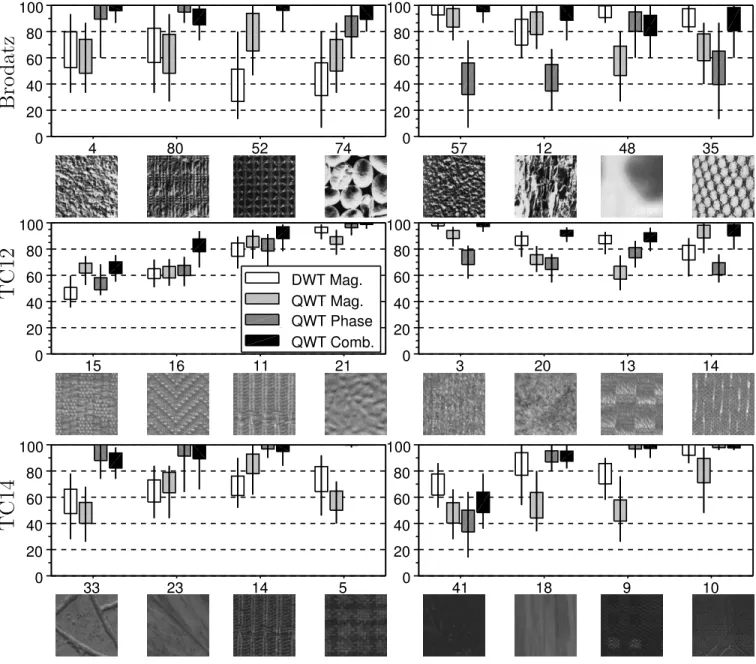
Quite surprisingly phase based features give performance comparable to
486
magnitude as shown Fig. 4 - that also contains next results. This is a very
487
good result. Weighted st. dev. gives much better description than simple
488
st. dev. what confirms the relevance of less considering phase data of low
489
magnitude coefficients. In the sequel we only consider weighted st. dev. as
490
phase measure.
491
All cases occur : for a same texture both magnitude and phase analysis
492
may be efficient or not - the results are very heterogeneous. It is interesting
493
to note that many textures are very well analyzed either by QWT magnitude
494
or by QWT phase - what suggests that the two feature vectors are
comple-495
mentary. The former gives frequency information like DWT and the latter
T
C
14
T
C
12
B
ro
d
at
z
80 74 60 80 40 52 4 20 100 0 80 35 60 12 40 48 57 20 100 0 11 16 15 100 80 60 40 21 20 0 QWT Phase DWT Mag. QWT Mag. QWT Comb. 80 14 60 20 40 13 3 20 100 0 80 5 60 23 40 14 33 20 100 0 80 10 60 18 40 9 41 20 100 0Figure 4: Cross validation results for some classes of the 3 databases. See also Fig. 3. Performance of each class is shown for the measures : DWT magnitude st. dev. (white), QWT magnitude st. dev. (light-gray), QWT phase weighted st. dev. (dark-gray) and QWT combination of magnitude and phase (black).
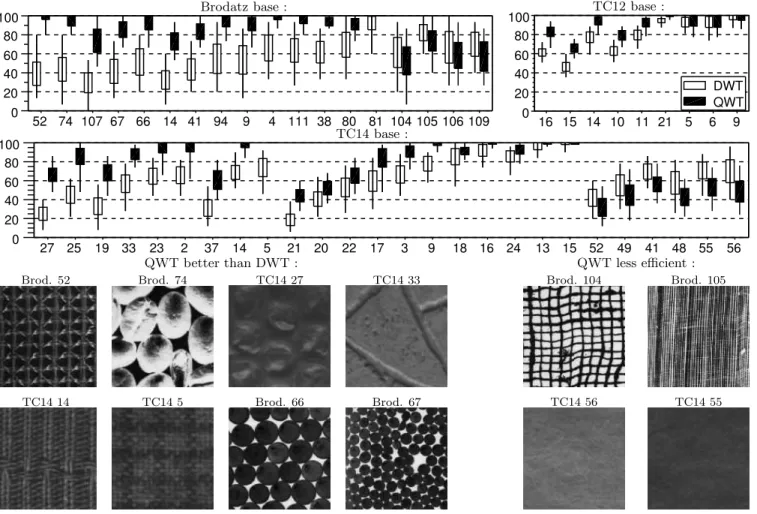
Brodatz base : 100 80 60 38 80 81 104 105 20 0 106 40 109 52 74 107 67 66 14 41 94 9 4 111 TC12 base : 40 6 0 5 21 20 60 100 80 16 15 14 10 11 9 DWT QWT TC14 base : 100 80 60 15 52 49 41 48 20 0 55 40 56 27 25 19 33 23 2 37 14 5 21 20 22 17 3 9 18 16 24 13 QWT better than DWT : Brod. 52 Brod. 74 TC14 27 TC14 33 TC14 14 TC14 5 Brod. 66 Brod. 67 QWT less efficient : Brod. 104 Brod. 105 TC14 56 TC14 55
Figure 5: Final classifier performance for the DWT feature vector and the final QWT feature vector using both magnitude and phase.
provides additional geometric information.
497
We can hardly identify some kind of textures better recognized by either
498
magnitude or phase but the recognition rates really show that magnitude
499
and phase are completing one another; so it seems natural to combine both
500
feature vectors.
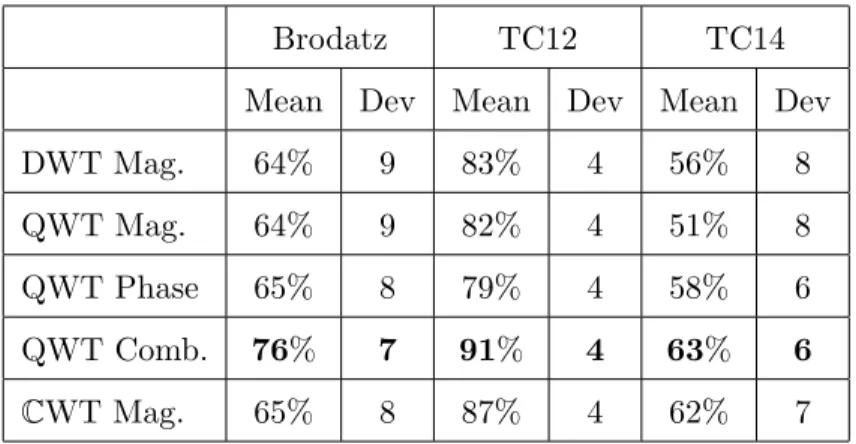
Brodatz TC12 TC14
Mean Dev Mean Dev Mean Dev
DWT Mag. 64% 9 83% 4 56% 8
QWT Mag. 64% 9 82% 4 51% 8
QWT Phase 65% 8 79% 4 58% 6
QWT Comb. 76% 7 91% 4 63% 6
CWT Mag. 65% 8 87% 4 62% 7
Table 1: Final recognition rates.
5.3. Combined QWT magnitude and phase 502
The final feature vector based on QWT magnitude and phase provides
503
very good classification performance with an improvement of about 10%
504
recognition with respect to DWT. We present global recognition rates (mean
505
rate and standard deviation of obtained rates according to cross validation) in
506
table 1. As we cannot present every texture class we selected interesting cases
507
- illustrated Fig. 4 - with recognition rates for respectively DWT magnitude
508
based feature extraction, QWT magnitude, QWT phase, and final QWT
509
feature vector. A sample is displayed under each class of thex-axis. We hope
510
such an illustration will give some insight about visual texture characteristics
511
that we could link with QWT properties. Fig. 5 shows more global results
512
between DWT and QWT to conclude about the general improvement of
513
classification thanks to the QWT. We have about a dozen ‘bad’ cases but
514
the overwhelming majority of classes are better recognized by QWT and
515
figure 5 is very convincing about its superiority.
516
Now we discuss some particular cases to analyzewhy the QWT is better
or worse than DWT.
518
A first remark is about texture Brod. 52 that is strikingly better analyzed
519
by the QWT phase feature vector with 100% recognition. The reason is this
520
texture contains only horizontal, vertical and - mostly - diagonal structures
521
that makes ψ very significant.
522
Most of TC14 classes for which DWT is better are visually similar (see
523
Fig. 5 TC14 55 and 56), almost uniform and hard to distinguish. These
524
images have a pure stochastic behavior so the orthogonality of the DWT is
525
better adapted than the structural analysis brought by QWT - yet this issue
526
is open.
527
The same remark as in section 5.1 about shift-invariance still holds for
528
textures Brod. 52, TC14 14 and TC14 5.
529
Note that most textures for which the single QWT magnitude is very
530
worse than DWT (see Fig. 3) are better represented with the final feature
531
vector which outperforms the DWT. This result shows that QWT magnitude
532
and phase are strikingly complementary because both give separately bad
533
results whereas very efficient when combined. Class TC12 20 (Fig. 4) makes
534
a good example.
535
Finally, this use of quaternionic representation of textures greatly
im-536
proves an analogous standard wavelet based texture analysis. We proposed
537
a wavelet based feature vector that yields an average recognition rate about
538
10% better than standard wavelets; by using both QWT magnitude -
con-539
taining similar information than DWT but with shift-invariance - and QWT
540
phase that provides structural information. Standard DWT does not allow
541
using such a phase - making it a less coherent representation. With this
texture classification we validate the recent QWT from an application point
543
of view as superior to standard DWT.
544
We will now present experimental results with CWT. Recall that CWT
545
coefficients are fundamentally different from QWT coefficients in terms of
546
analysis and interpretation of their geometric meaning. Even if both are
547
computed by a separable Dual-Tree algorithm the combination of the 4
re-548
lated filterbank outputs is different. In the QWT case the 4 outputs are
549
seen like Cartesian components of 3 quaternion valued subbands while for
550
CWT some sums and differences of outputs are considered to be real and
551
imaginary parts of 6 complex subbands - see [Selesnick et al., 2005].
552
This is why analysis provided byCWT has not much to do with QWT;
553
and we will see in the next section that kinds of texture better recognized by
554
QWT or CWT - as well as global performance - are not the same.
555
5.4. Results with complex wavelets 556
Results obtained with features from [Celik and Tjahjadi, 2009, 2011] have
557
to be studied carefully. Recall that we present it to compare with literature
558
and that we considered only the feature extraction part from cited references.
559
So result we get are not comparable with the very high performance of
orig-560
inal papers partly due to a clever choice of classification algorithm together
561
with proper normalization and feature selection/normalization. In addition
562
size of training bases may differ.
563
Globally, the first feature descriptor based on CWT magnitude provides
564
better recognition than DWT but worse than final QWT based features;
565
which is an expectable result. Second feature vector based on both CWT
566
magnitude and phase gave very bad recognition (about 5%). We observe that
R ec o g n it io n ra te Brodatz : TC12 : TC14 : Class label CWT more efficient : Brod. 86 Brod. 4 TC12 19 TC14 25 C WT less efficient : Brod. 75 TC12 23 TC12 24 TC14 56
Figure 6: Complex wavelets based classification performance with feature vector described in [Celik and Tjahjadi, 2009]. We selected cases of biggest difference of performance between DWT/QWT andCWT.
CWT phase measures are numerically unstable because no special weighting
568
is used. In practice many absurd angles - related to the numerous zero
569
coefficients - discredit variance end energy features processed on phase data.
570
In [Celik and Tjahjadi, 2011] a PCA based feature selection is done before
571
classification - what we did not do - so phase based features may be discarded
572
by this stage. Thus we will only study magnitude based analysis from [Celik
573
and Tjahjadi, 2009].
574
We show Fig. 6 classification results with the first feature vector [Celik
575
and Tjahjadi, 2009] in comparison with DWT based st. dev. and QWT based
576
final feature vector. Like previous figures, we present only cases of biggest
577
difference between different methods.
578
As global rates lie between DWT and QWT (see table 1) we can conclude
579
that - by restricting ourselves to simple global features - the oriented behavior
of CWT together with shift-invariance of its magnitude can improve a DWT
581
based analysis but the proposed QWT-phase analysis performs better.
582
An example of the advantage ofCWT directionality is texture TC14 25
583
(Fig. 6). This texture class exhibits straight lines with an orientation around
584
75◦. This is precisely the orientation on which one of the 6CWT subbands is
585
aligned. TheCWT is well suited in this very particular case so the recognition
586
performance is much better than DWT/QWT.
587
However directional analysis brought byCWT is globally not as powerful
588
as the 2D quaternionic phase concept of QWT. The 6 subbands of CWT
589
offer better frequency selectivity than DWT but it still carry some similar
590
“energy” information. On the other hand the fundamental relation between
591
QWT ψ-phase and geometry provides a new kind of additional information
592
that complements “energy” data. Finally our results completely confirm that
593
quaternionic wavelets provide better geometric information than DWT and
594
CWT for a texture analysis purpose.
595
6. Conclusion 596
The Quaternionic Wavelet Transform is a recent improvement of standard
597
wavelets that aims to yield coefficients with a shift-invariant magnitude and
598
a phase containing geometric information. This transform makes use of a
599
2D generalization of the analytic signal : a classical powerful tool for signal
600
analysis. This generalization due to B¨ulow gives a coherent local analysis of
601
2D signals and was naturally embedded into a wavelet framework to overcome
602
common drawbacks of standard wavelets. Redundancy brought by QWT
603
phase adds complete structural information about local features of images.
The QWT is not straightforward to interpret and requires a quite
sophisti-605
cated theoretical framework. But here we gave an application study crossing
606
the gap between that framework and the way to use this tool; by showing
607
its superiority over standard wavelets in a texture analysis context. With a
608
large texture database our QWT based feature extraction gives globally 10%
609
better recognition than DWT. This improvement is due to shift-invariance of
610
QWT magnitude together with the use of QWT phase that contains useful
611
structural information for texture analysis.
612
A comparison is also made with complex wavelets that have been used
613
in literature in similar works. Advantage of complex wavelets is good
di-614
rectionality; which is confirmed in practice by better recognition for some
615
highly oriented textures. But its complex phase fails to provide such
geo-616
metric information as this of QWT. As a result QWT outperforms complex
617
wavelets.
618
Our classification algorithm is a first approach as we focus on studying
619
QWT so there are many ways of improvements in terms of pattern
recog-620
nition. In particular, spatial analysis of subbands is not used and the
clas-621
sification proposed in [Arivazhagan and Ganesan, 2003] for example could
622
be improved by using a comprehensive use of QWT phase to provide an
623
excellent classification that could compete with state of the art algorithms.
624
Our future work implies the monogenic wavelet transform - an
improve-625
ment of the QWT based on another generalization of the analytic signal :
626
the monogenic signal. This transform is harder to implement but can lead to
627
a more coherent signal analysis thanks to better properties. Monogenic
mag-628
nitude is rotation invariant and the phase is easier to interpret than QWT
phase.
630
Acknowledgements 631
This work is supported by the ANR project VERSO - CAIMAN. We also
632
would like to thank the anonymous reviewer for his/her valuable comments.
633
References 634
Arivazhagan, S., Ganesan, L., June 2003. Texture classification using wavelet
635
transform. Elsevier Pat. Rec. Lett. 24 (9-10), 1513–1521.
636
Bayro-Corrochano, E., 2006. The theory and use of the quaternion wavelet
637
transform. J. Math. Imaging Vis. 24 (1), 19–35.
638
Blanchet, G., Moisan, L., Roug´e, B., 2008. Measuring the global phase
co-639
herence of an image.
640
URL http://hal.archives-ouvertes.fr/hal-00212337/en/
641
Brodatz, P., 1966. Textures : A Photographic Album for Artists and
Design-642
ers. Dover publications, New York.
643
B¨ulow, T., 1999. Hypercomplex spectral signal representation for the
pro-644
cessing and analysis of images. Thesis.
645
Celik, T., Tjahjadi, T., 2009. Multiscale texture classification using dual-tree
646
complex wavelet transform. Pattern Recogn. Lett. 30 (3), 331–339.
647
Celik, T., Tjahjadi, T., 2011. Bayesian texture classification and retrieval
648
based on multiscale feature vector. Pattern Recognition Letters 32 (2),
649
159 – 167.
Chan, W., Choi, H., Baraniuk, R., July 2008. Coherent multiscale image
pro-651
cessing using dual-tree quaternion wavelets. IEEE Transactions on Image
652
Processing 17 (7), 1069–1082.
653
de Rivaz, P., Kingsbury, N., 1999. Complex wavelet features for fast texture
654
image retrieval. pp. I:109–113.
655
Hahn, S. L., 1996. Hilbert transforms in signal processing. Artech House,
656
Boston, London.
657
Kingsbury, N., 2001. Complex wavelets for shift invariant analysis and
filter-658
ing of signals. Applied and Computational Harmonic Analysis 10 (3), 234
659
– 253.
660
Lasmar, N.-E., Berthoumieu, Y., 2010. Multivariate statistical modeling for
661
texture analysis using wavelet transforms. Acoustics, Speech, and Signal
662
Processing. Proceedings. (ICASSP). IEEE International Conference on.
663
Selesnick, I. W., Baraniuk, R. G., Kingsbury, N. G., 2005. The dual-tree
com-664
plex wavelet transform. IEEE Signal Processing Magazine [123] November.
665
Tuceyran, M., Jain, A. K., 1993. Texture analysis. In: Handbook of pattern
666
recognition and computer vision. World Scientific Publishing Co., Inc.,
667
River Edge, NJ, USA, pp. 235–276.
668
Vo, A., Oraintara, S., Nguyen, T., 2007. Using phase and magnitude
infor-669
mation of the complex directional filter bank for texture image retrieval.
670
pp. IV: 61–64.
Zhou, J., Xu, Y., Yang, X., 2007. Quaternion wavelet phase based stereo
672
matching for uncalibrated images. Pattern Recogn. Lett. 28 (12), 1509–
673
1522.
![Figure 1: Quaternionic wavelet transform of a textural image. From left to right : Original image, magnitude |q| (intensity inverted for visual convenience), ϕ ∈ [−π; π], θ ∈ [− π 2 ; π2 ], ψ ∈ [− π4 ; π4 ]](https://thumb-us.123doks.com/thumbv2/123dok_us/9227433.2807229/5.918.172.748.190.316/quaternionic-transform-textural-original-magnitude-intensity-inverted-convenience.webp)
![Figure 6: Complex wavelets based classification performance with feature vector described in [Celik and Tjahjadi, 2009]](https://thumb-us.123doks.com/thumbv2/123dok_us/9227433.2807229/32.918.79.840.185.451/figure-complex-wavelets-classification-performance-feature-described-tjahjadi.webp)
