MSI_1502
Individual versus institutional ownership
of university-discovered inventions
Dirk Czarnitzki, Thorsten Doherr, Katrin Hussinger,
Paula Schliessler and Andrew A. Toole
Individual versus institutional ownership of
university-discovered inventions
Dirk Czarnitzki
a,b, Thorsten Doherr
b,c, Katrin Hussinger
c,b,a,
Paula Schliessler
a,band Andrew A. Toole
d,ba) KU Leuven, Dept. of Managerial Economics, Strategy and Innovation, Leuven, Belgium b) Centre for European Economic Research (ZEW), Mannheim, Germany
c) University of Luxembourg, Luxembourg
d) Economic Research Service, US Dept. of Agriculture, Washington D.C., United States
January 2015
Abstract
We examine how the ownership of intellectual property rights influences patenting of university-discovered inventions. In 2002, Germany transferred patent rights from faculty members to their universities. To identify the effect on the volume of patenting, we exploit the researcher-level exogeneity of the 2002 policy change using a novel researcher-level panel database that includes a control group not affected by the law change. For professors who had existing industry connections, the policy decreased patenting, but for those without prior industry connections, it increased patenting. Overall, fewer university inventions were patented following the shift from inventor to institutional ownership.
Keywords: Intellectual property, patents, technology transfer, policy evaluation
JEL – Classification: O34,O38
Acknowledgements: We are grateful for the funding of this research project by the Centre for European Economic Research (ZEW) within the research program "Strengthening Efficiency and Competitiveness in the European Knowledge Economies" (SEEK), and the audience and discussants at EARIE 2014, IIOC 2014, the 2014 Technology Transfer Society Conference, the 2014 Asia Pacific Innovation Conference, the BRICK Workshop on the Organization, Economics and Policy of Scientific Research 2014, TIE Tagung Munich 2014, ZEW PhD Workshop 2014, KOF Research Seminar in Zürich 2014, Department Seminar at the University of Luxembourg 2014, ‘Betriebswirtschaftliches Forschungskolloquium’ at University of Trier. We particularly thank Olof Ejermo, Otto Toivanen, Carolin Haeussler, Henry Sauermann, Thomas Astebro, Christian Rammer, Fabio Montobbio, Georg Licht, Jeongsik Lee for helpful comments. The views expressed in this article are the authors’ and do not necessarily represent the views of the United States Department of Agriculture.
1
1
Introduction
Intellectual property (IP) policies are among the most powerful instruments shaping the incentives that drive the discovery and commercialization of knowledge. For U.S. academic institutions the Bayh-Dole Act of 1980 is perhaps the most influential and far-reaching of these IP policies. The legislation facilitated private institutional ownership of inventions discovered by researchers who were supported by federal funds. Many observers credit the Bayh-Dole Act with spurring university patenting and licensing that, in turn, stimulated innovation and entrepreneurship (The Economist 2002; OECD 2003; Stevens 2004). Based on this perceived success, the Bayh-Dole Act has become a model of university IP policy that is being debated and emulated in many countries around the world including Germany, Denmark, Japan, China, and others (OECD 2003; Mowery and Sampat 2005; So et al. 2008).
The key component of the Bayh-Dole model is granting the university, not the inventor, ownership rights to patentable inventions discovered using public research funds (Crespi et al. 2006; Geuna and Nesta 2006; Kenney and Patton 2009). However, the incentive effects on academic inventors of university versus individual ownership are not well understood. In a theoretical contribution, Hellmann (2007) found that university ownership is efficient when inventors must search for a commercial partner as long as the cost of search is higher for inventors than for the university. Using survey and case study evidence, Litan et al. (2007) and Kenney and Patton (2009) argued that conflicting objectives and excessive bureaucracy make institutional ownership ineffective and suggest an individual ownership system may be superior. Due to a paucity of evidence, however, the U.S. National Research Council recently concluded that “arguments for superiority of an inventor-driven system of technology transfer are largely conjectural” (NRC 2010).
2
Our analysis uses the framework of Pakes and Griliches (1984) and a quasi-experimental research design to provide the first systematic evidence on how intellectual property rights impact patenting of university-discovered inventions. We examine a fundamental change in German patent law from individual to institutional ownership. Prior to 2002, university professors and researchers had exclusive intellectual property rights to their inventions. This “Professor’s Privilege” allowed university researchers to decide whether or not to patent and how to commercialize their discoveries, even if the underlying research was supported by public funds. After 2002, universities were granted the intellectual property rights to all inventions made by their employees and this shifted the decision to patent from the researchers to the universities. The policy goal was to increase patenting of university-invented technologies which is often used as a surrogate indicator of successful university technology transfer.
By changing the agent who makes the patenting decision, the abolishment of
Professor’s Privilege caused a “regime shift” that substituted institutional benefit and cost schedules for those of the individual inventors. The net effect on the volume of patenting depends primarily on the relative costs between the regimes. To identify how the regime shift affected patenting, we exploit the researcher-level exogeneity of the 2002 abolishment of Professor’s Privilege along with the institutional structure of the German research system in which universities and other public research organizations (PROs) co-exist. PRO
researchers were not affected by the ownership change and serve as a control group. We use a difference-in-difference methodology and control for the arrival of new patentable discoveries using publications and peer-to-peer matching.
3
Our analysis shows that fewer university inventions were patented following the 2002 regime shift. For a given discovery, the schedule of benefits to institutional owners, who are the post-change patent decision makers, is lower because the university became an
additional party in the negotiations over the split of expected revenues. This partly explains why fewer inventions qualified for patent protection following the regime shift. However, the effect on expected revenues can be offset if institutional costs (broadly conceived) are sufficiently lower than those faced by individual researchers (Hellmann 2007). Our results show that institutional patenting costs were lower for the subset of university inventors who did not have relationships with industry partners prior to the policy change. For those individuals, patenting increased. But, the data also show that most German patenting professors had prior industry relationships. Post-change institutional costs were not low enough to offset the revenue effect for this group. Our results highlight the critical importance of understanding the nature and strength of faculty-industry relationships before undertaking policy initiatives intended to foster technology transfer.
The remainder of this paper is structured as follows. Section 2 summarizes the background and implementation of the law change in Germany. Section 3 describes the Pakes and Griliches (1984) framework and develops our hypotheses. Section 4 presents the empirical approach, the data collection strategy and provides descriptive statistics. Section 5 shows the econometric results, and robustness checks are presented in Section 6. The final section 7 concludes with a discussion of the implications for policy.
2
The regime change: from inventor to university ownership
In February 2002, the German Federal Government launched a comprehensive new program called “Knowledge Creates Markets” to stimulate technology transfer from
4
universities to private industry for innovation and economic growth1. The program was largely a reaction to the “European paradox” (European commission 1995). At that time, policymakers believed that Germany had one of the world’s leading scientific research enterprises, but was lagging the United States in terms of technology transfer and commercialization. The new program addressed a wide spectrum of science-industry interactions including processes and guidelines governing knowledge transfer, science-based spin-offs, collaboration, and the exploitation of scientific knowledge in the private sector. The abolishment of Professor’s Privilege was one of the most significant changes from both a legal and cultural perspective. Professor’s Privilege originated from Article 5 of the German constitution that protects the freedom of science and research. The new program repealed Clause 42 of the German employee invention law that had granted university researchers - as the only occupational group in Germany - the privilege to retain the ownership rights to their inventions that otherwise rest with the employer2.
Under the new law, German university researchers are required to cull their research findings for inventions and report any inventions to the university – unless the researcher decides to keep his or her inventions secret by not publishing or patenting. The university has four months to consider any submitted inventions for patenting. If the university does not claim the invention, the rights to pursue patenting and commercialization are returned to the researcher. If the university does claim the invention, the inventor receives at least 30% of the revenues from successful commercialization, but nothing otherwise.
Furthermore, the university handles the patenting process and pays all related expenses
1 Bundesministerium für Bildung und Forschung and Bundesministerium für Wirtschaft und Technologie
(2001), Wissen schafft Märkte - Aktionsprogramm der Bundesregierung.
2
Gesetz über Arbeitnehmererfindungen in der im Bundesgesetzblatt Teil III, Gliederungsnummer 422-1, veröffentlichten bereinigten Fassung, das zuletzt durch Artikel 7 des Gesetzes vom 31. Juli 2009 (BGBl. I S. 2521) geändert worden ist.
5
such as processing fees, translation costs and legal expenses. University researchers retain the right to disclose the invention through publication two months after submitting the invention to the university. Prior contractual agreements with third parties also remained valid during a prescribed transition period.3
At the time of the law change, German universities had little experience undertaking technology transfer activities, and only a few universities maintained professionally managed technology transfer offices (TTOs) (cf. e.g. Schmoch et al., 2000). Therefore the government decided to support the commercialization activities by establishing regional patent valorization agencies (PVAs), which was supported with a budget of 46.2 million EUR to be used before the end of 2004 (Kilger und Bartenbach 2002). Universities were free to choose whether to use the PVAs’ services or not. To date, 29 PVAs serve different regional university networks and employ experts specialized in these universities’ research areas. The PVAs support the entire process from screening inventions, finding industry partners, and determining fruitful commercialization paths. They are also supposed to promote collaboration between their member universities and industry.
To date, a handful of prior studies have examined the effects of abolishing Professor’s Privilege on patenting rates and ownership patterns in Germany. Schmoch (2007) found that the number of university-owned patents increased. Based on inventor lists, his data also suggested the most active faculty inventors were discouraged by the abolishment of Professor’s Privilege and that non-patenting professors were encouraged, which suggests the law changed the mix of inventors. In a follow-up study, Cuntz et al. (2012) showed that the share of university-owned inventions increased after 2002 while the share of
3 Contracts made before July 18th 2001 were to be treated under the old law until February 2003 (Gesetz
6
individually or industry- owned university inventions decreased. Von Proff et al. (2012) found that the policy change did not increase university-invented patents. They also suggested an ownership shift from individual and firm-owned patents to universities.4 Our analysis extends this work by combining an established economic framework with a
stronger research design and a more comprehensive researcher-level database allowing the identification of causal effects of the law change.
3
Economic framework and hypotheses
In economic models, patents reflect the combined influence of an agent’s propensity to patent and the arrival of new knowledge through the agent’s inventive process.
(1) (𝑝𝑎𝑡𝑒𝑛𝑡𝑠)𝑖𝑡 = (𝑝𝑟𝑜𝑝𝑒𝑛𝑠𝑖𝑡𝑦 𝑡𝑜 𝑝𝑎𝑡𝑒𝑛𝑡)𝑖𝑡∙ (𝑛𝑒𝑤 𝑘𝑛𝑜𝑤𝑙𝑒𝑑𝑔𝑒)𝑖𝑡
Pakes and Griliches (1984) called this relation the patent indicator function. The propensity to patent can change due to legal or economic conditions that affect the expected benefits and costs of having a patent. It captures the decision to patent. In equation (1), increments to knowledge reflect investments into discovery, which Pakes and Griliches summarized as the “knowledge production function.” Their analysis focused on the relationship between new knowledge and the volume of patenting, holding the propensity to patent constant. In this paper, we focus on how the volume of patents responds to changes in the propensity to patent, holding increments to knowledge constant.5,6
4
Other studies consider the effects of patent ownership rights in other European countries. Examples are Valentin and Jensen (2007), Lissoni et al. (2009, 2013), Della Malva et al. (2013). For a broader discussion of academic patenting in Europe see Lissoni (2013).
5 A substantial literature has emerged that examines how commercial incentives influence the rate,
direction, and disclosure of academic research. This literature focuses on the knowledge production function component of equation (1). Some references include: Jensen and Thursby (2001, 2004); Banal-Estanol and Macho-Stadler (2010); Thursby et al. (2007); Lach and Schankerman (2008); Dechenaux et al. (2009); Azoulay et al. (2007, 2009), Czarnitzki et al. (2011, 2014).
7
Germany’s abolishment of Professor’s Privilege exogenously changed the agent responsible for the decision to patent university-discovered inventions. In terms of equation (1), the law transferred the propensity to patent from the faculty inventor to the university. Under the former Professor Privilege system, faculty inventors would apply for patents on their discoveries when the expected benefits of patent protection were greater than the costs. Since 2002, faculty members no longer make this choice, but instead must disclose any inventions to the university. The university, perhaps with the PVA, decides to apply for a patent based on its assessment of expected benefits and costs. Consequently, the effect of revoking Professor’s Privilege on the volume of patents depends on how the expected benefit and cost schedules shift due to the regime change from the individual faculty inventor to the university.
For any set of discoveries, the schedule of expected benefits considered by the university after the regime change is lower than the schedule of benefits faced by any faculty member prior to the abolishment of Professor’s Privilege. After the policy change, the share of revenue appropriable by the university is limited by three-way bargaining between the university, the faculty member, and the licensee company. Under reasonable assumptions about bargaining power and recognizing that the university cannot increase the market value of the discovery, the university will capture a smaller share of the expected revenue stream in three-way bargaining than the faculty member would under two-way bargaining (Frank et al. 2007; Hellmann 2007).7 If the university and faculty cost
6
We recognize the regime shift could have an indirect influence on patenting through the knowledge production function; however, proprer analysis of this effect would require a separate model focusing on new knowledge (i.e. publications) instead of patents.
7
Under Professor’s Privilege, the faculty member also had a stronger bargaining position for obtaining pecuniary benefits associated with collaborative research and technology development. These non-pecuniary benefits would further reduce the university‘s benefit schedule relative to the faculty member.
8
schedules were the same, the reduction in benefits after abolishment of Professor’s Privilege would lead to fewer patents. Put simply, the policy change would decrease the propensity to patent.
At that time, however, policy makers believed the cost schedules faced by universities would be lower than those faced by individual faculty members. They interpreted the small share of university-owned patents in Germany prior to 2002 as evidence that individual researchers could not afford to undertake the costly and time-consuming process of applying for a patent and pursuing potential licensees (Becher et al. 1996). If the costs of patenting for universities were sufficiently lower, the volume of university inventions receiving patents could increase. So, the net effect of the regime shift on the volume of patenting depends on the costs of the universities compared to the pre-policy costs of faculty inventors.
It is important to remember that the propensity to patent incorporates the benefits and costs of patenting that are expected upon commercialization. The expected revenues from commercialization are compared to the expected costs of achieving commercialization both with and without patent protection. The relevant concept of costs is broader than simply the patent application fees and legal fees. It also includes costs from searching for an industry partner for commercialization, development costs, and so forth. While these costs may be close to homogeneous across universities in the post-policy change period, they are likely to be heterogeneous within the population of university inventors before the
abolishment of Professor’s Privilege.
We can identify two groups in the population of university inventors who faced
9
of university inventors who had relationships with one or more industry partners. These individuals already paid the costs of searching for licensee companies and negotiating their pecuniary and non-pecuniary benefits. In these relationships, industry partners would typically pay the application and legal fees, manage the development process and
commercialize the product or service. For this group of “low cost” university inventors, the regime shift to institutional ownership almost surely led to a higher cost schedule as the university, possibly through the PVA, had to renegotiate established relationships (Frank et al. 2007; Kilger and Bartenbach 2002). For this group, we expect the regime shift in the propensity to patent led to a lower benefits schedule and a higher cost schedule. Our first hypothesis is:
H1: Faculty members who had established connections to industry partners experienced a decrease in the volume of patenting, ceteris paribus.
The second group consists of university inventors who did not have a relationship with an industry partner. These individuals obtained a patent, but still needed to search for a licensee company and negotiate pecuniary and non-pecuniary benefits. For this group of “high cost” university inventors, the university may have a considerable cost advantage. The cost advantage could stem from many sources. Hellmann (2007) postulates that a TTO (or PVA) may have a comparative advantage in identifying potential industry partners due to the efforts of specialized managers or, on the licensee’s side, a single institutional source may make it easier to find university discoveries (e.g. Debackere and Veugelers 2005; Siegel et al. 2003). For this group, we expect the post-policy cost schedule shifted downward more than the post-policy benefits schedule. Our second hypothesis is:
H2: Faculty members who did not have established connections with industry partners experienced an increase in the volume of patenting, ceteris paribus.
10
With cost heterogeneity in the population of university inventors, the net effect of the policy change depends on the share of inventors of each type. If the pre-policy inventor population was predominantly low cost faculty inventors, then the net effect of the policy would be to reduce the volume of patents. Whereas, the policy would increase the volume of patenting of university-discovered inventions if faculty inventors were mostly high cost. As discussed in the data section, most patenting professors were in the low cost group before the policy change.
4
Empirical model and data
Identification Strategy and Estimation Approach
4.1
The German policy change provides a unique opportunity to separate the influence of the propensity to patent from the influence of new knowledge on the volume of patenting. The abolishment of Professor’s Privilege was an exogenous “shock” to the propensity to patent university inventions. As seen in equation (1), once new knowledge is held constant, this exogenous variation will identify the effect of the propensity to patent on the volume of patenting. In the literature on academic research, publications are the accepted standard for measuring knowledge production. The database compiled for this analysis includes complete publication histories for university inventors and their peers in non-university, public research organizations (PROs) such as the Max Planck, Fraunhofer, and Helmholtz institutes as well as other federal and state research institutions.8
8 Major research institutions in Germany are not only universities but other public research institutions
that have many branches in a variety of different scientific disciplines. For instance, the Fraunhofer Society has 59 institutes in Germany with about 17,000 employees, the Max Planck Society has 76 institutes with about 12,000 employees. The Leibniz Association employs 16,100 people in 86 research centers. The Helmholtz Association has about 30,000 employees in 16 research centers.
11
We identify the policy effect using a difference-in-difference (DiD) research design with university inventors as the treatment group and PRO researchers as the control group. Like university professors, PRO researchers conduct academic research at publicly funded institutions in Germany. They work in similar academic fields and experience similar changes in research opportunities that affect the discovery of new knowledge. But unlike university professors, PRO researchers did not have Professor’s Privilege and the patent rights to their inventions were always owned by the institution. To further control for changes in research opportunities, we use peer-to-peer matching between university faculty members and PRO researchers based on characteristics such as publications, scientific discipline, and career age before undertaking DiD estimation. Our DiD setup also accounts for common macroeconomic trends and individual-specific unobserved effects that capture an academic inventor’s “taste” for patenting and commercialization.
For the population of German academic inventors, the DiD model takes the following form:
(2) 𝑃𝐴𝑇𝑖𝑡 = 𝛽0+ 𝛽1(𝑃𝑟𝑜𝑓𝑖∙ 𝑁𝑒𝑤𝑃𝑜𝑙𝑖𝑐𝑦𝑡) + 𝛽2(𝐶𝑎𝑟𝑒𝑒𝑟𝐴𝑔𝑒)𝑖𝑡+ 𝛽3(𝐶𝑎𝑟𝑒𝑒𝑟𝐴𝑔𝑒2)𝑖𝑡+
𝛽4(3𝑦𝑟𝐴𝑣𝑔𝑃𝑢𝑏𝑠)𝑖,𝑡−1+ 𝛿𝑖 + 𝛾𝑡+ 𝑢𝑖𝑡
where 𝑃𝐴𝑇𝑖𝑡 is the volume of patents by researcher i applied for in year t (i.e.
researcher-year observations). The policy effect is captured by the coefficient 𝛽1 of the interaction
term (𝑃𝑟𝑜𝑓 ∙ 𝑁𝑒𝑤𝑃𝑜𝑙𝑖𝑐𝑦). 𝑃𝑟𝑜𝑓 is a dummy variable that takes the value of 1 when the inventor is a university professor and 0 when the inventor is a PRO researcher. 𝑁𝑒𝑤𝑃𝑜𝑙𝑖𝑐𝑦 is a dummy variable that takes the value of 1 following the policy change, 2002 onward, and 0 otherwise. A quadratic specification of career age captures inventor life-cycle effects. We use a three year moving average of past research publications, (3𝑦𝑟𝐴𝑣𝑔𝑃𝑢𝑏𝑠)𝑖,𝑡−1, to
12
of time dummy variables covering 2-year periods. Note that the professor dummy variable gets absorbed into the researcher fixed effects. Similarly, the new policy dummy variable gets absorbed by the general time trend.
As patent counts take only nonnegative integer values, we use the fixed effects Poisson quasi-maximum likelihood estimator (QMLE). As a member of the linear exponential family of distributions, the Poisson QMLE produces consistent estimates of the population
parameters as long as the conditional mean is correctly specified (Gourieroux et al. 1984; Wooldridge 1999). We use robust standard errors to account for any over- or under-dispersion.
Data and descriptive statistics
4.2
As the aim of this research is to examine the effects of abolishing Professor’s Privilege on the decision to patent university-discovered inventions, we focus on German academic inventors. This population includes all researchers affiliated with a university or PRO who appeared as an inventor on at least one patent submitted to the German or European Patent Offices between 1978 and 2008. Academic inventors are a subpopulation of all academic researchers in Germany. The broader population includes academic researchers who only published. However, the transfer of patent rights to institutional ownership did not impact these researchers as they never participated in the intellectual property system over the entire time period.
We constructed a researcher-level panel dataset of academic inventors following a multistep procedure, which is summarized in Appendix A. This process yielded a sample
13
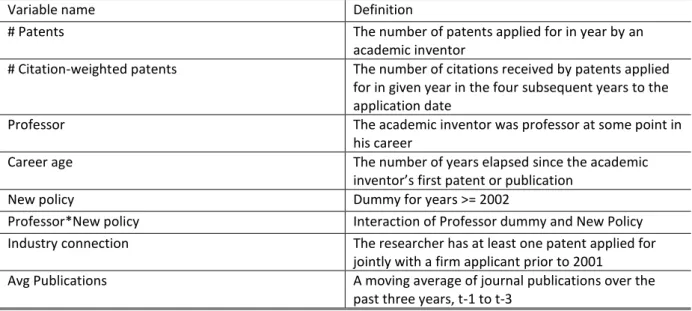
with 3,718 professors and 8,294 PRO researchers.9 We defined the study period to extend from 1995 through 2008 so that we observed enough time periods before and after the policy change. For each inventor, our data contains the individual’s history of patenting between 1978 and 2008 and the individual’s history of publications between 1990 and 2008. Beyond patent and publication characteristics, this information allowed us to calculate each researcher’s career age which is used to model quadratic life cycle effects in equation (2). Career age starts when we observe the researcher’s first publication or patent application and increases incrementally thereafter to a maximum of 35 years after which we assume the researcher retires. To account for earlier exit, we adopted a 5-year rule that has a researcher leaving the panel if he or she had no patenting or publishing activity for five consecutive years.10 Researcher industry connections were determined from the patent data. An academic researcher is identified as having an industry connection when he or she is observed as an inventor on a company owned patent. This allows us to distinguish high cost and low cost academic inventors prior to the abolishment of Professor’s Privilege and to estimate the model on subsamples to test hypotheses 1 and 2. The estimation sample contains 108,263 researcher-year observations. All of the variables used in the analysis are described in Table in Appendix A.
Figure 1 shows the average number of patents per inventor for university and PRO researchers over time. To better compare the trends, annual patents were normalized using 1995 as the reference year (i.e. each data point is relative to 1995). In the years leading up to the policy change, the trends in patents by professors and PRO researchers
9
This sample excludes those researchers who were employed at both a PRO and university, as it is not clear which patent regime applied to these researchers.
10 In section 6 we present an alternative exit rule; however, the results do not change in a meaningful
14
were quite similar. Both series show a peak in 1998 and a downward trend up to 2002. After the abolishment of Professor’s Privilege in 2002, the patenting trends diverge with university professors showing a steeper downward trend than PRO researchers. This suggests that abolishing Professor’s Privilege led to an overall decrease in the volume of patenting of university-discovered inventions and highlights the importance of using a control group for analyzing the policy change.
Figure 1: Trends in German patenting for university and public research organization (PRO) researchers (relative to 1995), 1995-2008.
Finding a decrease in patents per researcher after 1998 was somewhat surprising because it does not mirror the overall trend in German patent applications over this period. Upon further inquiry, the same pattern for academic patents was found by prior researchers (Cuntz et al., 2012; Schmoch 2007; Von Proff et al. 2012). These authors and others have speculated about the reasons for the decrease. Some suggestions include an increased emphasis on publications in academic performance evaluations, decreased entry into
0,4 0,5 0,6 0,7 0,8 0,9 1 1,1 1,2 1,3 19 95 19 96 19 97 19 98 19 99 20 00 20 01 20 02 20 03 20 04 20 05 20 06 20 07 20 08 A ve rag e Pate n ts p e r R e sear ch e r (r e lativ e to 1995 )
15
academic jobs, the end of the New Economy boom, and legal uncertainties surrounding patenting in the field of biotechnology (Cuntz et al. 2012, p.21-22; Schmoch 2007, p. 5-8).
As described in section 3, the overall effect of the policy depends on the composition of university inventors prior to the regime change. If most patenting professors were in the low cost group, the policy would reduce university patenting. The data show that 2,657 (71%) of the university inventors had at least one patent before 2002 and 78% of these inventors had existing industry connections. It is clear that most university inventors were low cost. Among PRO inventors, 5,008 (80%) had patented before the law change and 44% of these inventors had industry connections. The lower percentage of PRO inventors with industry connections probably reflects the institutional ownership system already in place for these researchers.
Table 1 shows descriptive statistics at the researcher-year level for university professors (i.e. the treatment group) and PRO researchers (i.e. the control group) separated into the pre- and post-policy change periods. These groups are further subdivided into those with industry connections in the top portion of the table and those without industry connections in the bottom portion. Looking at academic inventors with industry connections, mean patents by professors declined by 44% after the abolishment of Professor’s Privilege while patenting by PRO researchers declined by 27%. Among those without industry connections, mean patents by professors increased 55% after the law change, but only 9% for PRO
researchers. These findings are consistent with the hypothesized effects discussed in Section 3. Citation-weighted patents, which partially adjust the raw counts for the “quality” of the inventions, also fell more for professors than PRO researchers among those with industry connections. While the average number of patents by university professors
16
without industry connections increased by 55%, the citation-weighted patents actually fell by 15%. The differences in career age show that university professors were slightly older than PRO researchers over the whole sample period.
Table 1: Descriptive Statistics for the treatment and control groups (researcher-year observations)
Prior to law change (1995-2001) After law change (2002-2008)
Professors with industry connection
N = 12508 researcher-years N = 9141 researcher-years
Variable Mean Std. Dev. Min Max Mean Std. Dev. Min Max
# Patents 0.88 2.02 0 64 0.49 1.50 0 28 # Citation-weighted 0.67 2.78 0 119 0.27 1.43 0 39 patents Career age 9.86 6.74 0 34 16.25 6.73 2 35 Avg. publications 2.75 5.51 0 67.33 4.13 6.97 0 67
Control group with industry connection
N = 13101 researcher-years N = 9854 researcher-years # Patents 1.01 1.98 0 44 0.73 1.70 0 26 # Citation-weighted 0.81 2.55 0 55 0.42 1.68 0 41 patents Career age 8.06 6.02 0 34 14.22 6.43 2 35 Avg. publications 1.21 3.41 0 110.67 2.00 3.95 0 64.67
Professors without industry connection
N =6633 researcher-years N = 8121 researcher-years
Variable Mean Std. Dev. Min Max Mean Std. Dev. Min Max
# Patents 0.20 0.59 0 11 0.31 0.84 0 27 # Citation-weighted 0.13 0.75 0 15 0.15 0.77 0 19 patents Career age 5.71 3.89 0 27 9.35 5.92 0 32 Avg. publications 3.03 5.73 0 100.67 3.63 7.07 0 80.67
Control group without industry connection
N = 19855 researcher-years N = 29050 researcher-years # Patents 0.34 0.76 0 13 0.37 0.93 0 24 # Citation-weighted 0.22 0.92 0 16 0.21 1.07 0 61 patents Career age 4.50 4.06 0 29 7.16 5.53 0 35 Avg. publications 1.12 2.51 0 44 1.32 2.89 0 63.67 Note: Avg. publications are a three-year moving average of publication counts in t-1 for each researcher.
5
Econometric Results
Our baseline results identify the treatment effect of Germany’s 2002 policy change that transferred patent ownership rights from inventors to the universities on the decision to
17
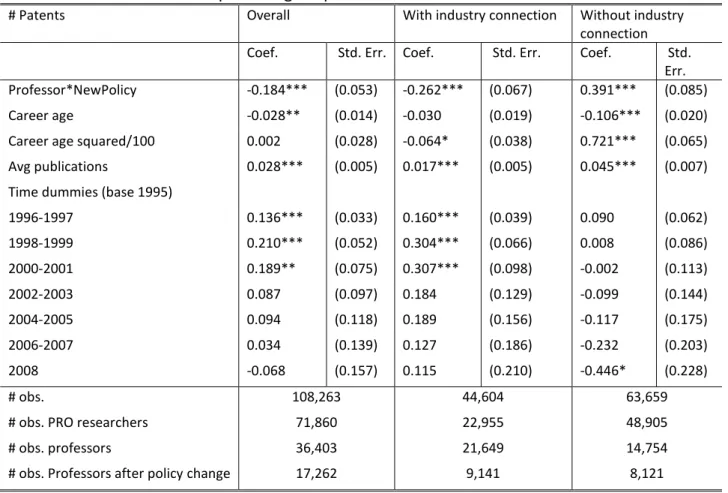
patent. Table 2 presents the parameter estimates based on Poisson QMLE with robust standard errors. The overall treatment effect, which is revealed by the coefficient on (𝑃𝑟𝑜𝑓 ∙ 𝑁𝑒𝑤𝑃𝑜𝑙𝑖𝑐𝑦) in column 2, is negative and statistically significant at the 1% level. This indicates that the overall effect of abolishing Professor’s Privilege was to decrease the volume of patents obtained on university-discovered inventions in Germany. It is
economically significant as well. Holding the arrival of new knowledge and researcher life cycle effects constant, the coefficient estimate shows the volume of university patents decreased by 18%, on average. At least in part, this result reflects the reduction in benefits appropriable by universities after the abolishment of Professor’s Privilege due to three-way bargaining. It would fully describe the effect of the 2002 policy change if university and faculty cost schedules were the same. Turning to the arrival of new knowledge, as captured by a three year moving average of past publications, increases patents by academic
inventors with one additional publication boosting expected patents by 14%.
The overall effect, however, masks potential heterogeneous treatment effects due to differences in patent and commercialization costs before the policy change. Even with the reduction in benefits appropriable by the university, the effect of the policy change on the volume of patenting depends on the costs of the university compared to costs of faculty inventors before the transition to institutional ownership. In Section 3, we argued that faculty with prior industry connections were relatively low cost and postulated that the decrease in patent volume due to the policy change would be even larger for this group. As seen in column 3 of Table 2, this hypothesis is supported. In the subsample of academic inventors with industry connections, the expected number of university patents decreased by 26%, holding other factors constant.
18
For faculty without prior industry connections, we postulated that cost advantages for universities would offset the reduction in benefits and increase patenting. As seen in column 6 of Table 2, treatment effect for this subsample is positive and significant at the 1% level. Holding the arrival of new knowledge and researcher life cycle effects constant, the
estimate shows the volume of university patents increased by 39%, on average. For faculty without prior industry connections life cycle effects are statistically stronger while the link between publications and patents is still positive and significant. As seen in the subsample breakout, the overall decrease in patenting of university-discovered inventions reflects the composition of university inventors before the regime change – most inventors had pre-existing connections with industry.
Table 2: Poisson models of patenting output
# Patents Overall With industry connection Without industry connection Coef. Std. Err. Coef. Std. Err. Coef. Std.
Err. Professor*NewPolicy -0.184*** (0.053) -0.262*** (0.067) 0.391*** (0.085) Career age -0.028** (0.014) -0.030 (0.019) -0.106*** (0.020) Career age squared/100 0.002 (0.028) -0.064* (0.038) 0.721*** (0.065) Avg publications 0.028*** (0.005) 0.017*** (0.005) 0.045*** (0.007) Time dummies (base 1995)
1996-1997 0.136*** (0.033) 0.160*** (0.039) 0.090 (0.062) 1998-1999 0.210*** (0.052) 0.304*** (0.066) 0.008 (0.086) 2000-2001 0.189** (0.075) 0.307*** (0.098) -0.002 (0.113) 2002-2003 0.087 (0.097) 0.184 (0.129) -0.099 (0.144) 2004-2005 0.094 (0.118) 0.189 (0.156) -0.117 (0.175) 2006-2007 0.034 (0.139) 0.127 (0.186) -0.232 (0.203) 2008 -0.068 (0.157) 0.115 (0.210) -0.446* (0.228) # obs. 108,263 44,604 63,659 # obs. PRO researchers 71,860 22,955 48,905 # obs. professors 36,403 21,649 14,754 # obs. Professors after policy change 17,262 9,141 8,121 Robust standard errors. Significance: * p < 0.1, ** p < 0.05, *** p < 0.01.
19
Conditional Difference-in-Difference
One important characteristic of our control group is that they are German academic
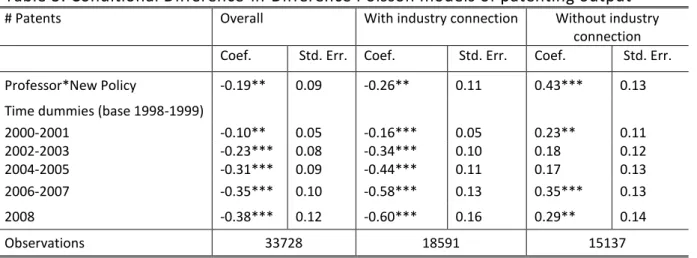
researchers. Like university professors, these individuals understand the literatures in their disciplines as well as other developments in their fields. Peer-to-peer matching can help control for potential changes in research opportunities. We constructed a matched sample of university professors and PRO researchers by applying caliper matching (caliper threshold = 0.005) to identify the nearest neighbor for each university professor. The inventors were matched based on their career achievements in 1998 (4 years prior to policy change) using their publication count, publication subject field11 and career age. We estimate the DiD specification in equation (2) using observations from 1999 through 2008.
The treatment effects from the abolishment of Professor’s Privilege are quite similar in magnitude and significance to those presented in Table 2. The overall treatment effect indicates that patents on university-discovered inventions decreased by 19% instead of 18%, on average. Among those university inventors with prior industry connections, patents decreased by the same magnitude, 26%. The magnitude of the treatment effect for university faculty who were previously high-cost increased by four percentage points and now indicates the policy increased patenting for this group by 43%, on average.
11
The subject fields of the publications have been assigned based on the classification in the ISI Web of Science Citation Index /Science Citation Index. We followed Leydesdorff and Rafols (2009) and defined 18 aggregated publication fields. A researcher has been allocated to one of these aggregated fields by using the field occurring most frequently in his or her publication record.
20
Table 3: Conditional Difference-in-Difference Poisson models of patenting output
# Patents Overall With industry connection Without industry connection Coef. Std. Err. Coef. Std. Err. Coef. Std. Err. Professor*New Policy -0.19** 0.09 -0.26** 0.11 0.43*** 0.13 Time dummies (base 1998-1999)
2000-2001 -0.10** 0.05 -0.16*** 0.05 0.23** 0.11 2002-2003 -0.23*** 0.08 -0.34*** 0.10 0.18 0.12 2004-2005 -0.31*** 0.09 -0.44*** 0.11 0.17 0.13 2006-2007 -0.35*** 0.10 -0.58*** 0.13 0.35*** 0.13 2008 -0.38*** 0.12 -0.60*** 0.16 0.29** 0.14 Observations 33728 18591 15137 Robust standard errors. Significance: * p < 0.1, ** p < 0.05, *** p < 0.01.
6
Robustness checks
Citation-weighted patent volume
6.1
It is well known that the economic value distribution associated with patents is highly skewed with a very small number of patents accounting for most of the value created through invention. So, even though the German policy change reduced the volume of patents, one might wonder whether the policy change simply eliminated the low value patents and thereby resulted in a smaller quantity of higher quality patents. To address this issue, forward citations are commonly used to weight raw patent counts as a way to
partially adjust for the unobserved quality of inventions (Trajtenberg 1990).
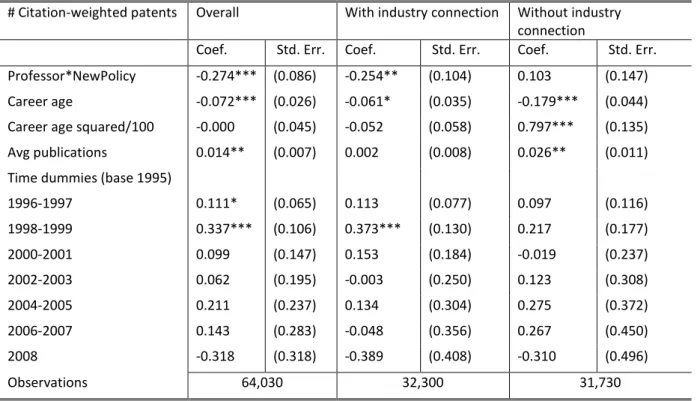
Table 4 reports the results from applying the DiD research design to citation-weighted patents. As before, the parameters are estimated using Poisson QMLE with robust standard errors. From column 2, the overall treatment effect from revoking Professors Privilege was to reduce the volume of university citation-weighed patents by 27%, holding the arrival of new knowledge and researcher life cycle effects constant. For university professors who had prior industry connections, university citation-weighed patents fell by 25%, on average.
21
However, for university professors who did not have prior industry connections, the results are different from those found previously. While the volume of un-weighted patents increased for this group, citation-weighted patents show no significant change. This
suggests that while the new policy increased the volume of patenting by professors without industry connections, it did not improve the average quality of these inventions. Among the other covariates, the only notable difference is that new knowledge is no longer significantly related to citation-weight patents among professors with prior industry connections.
Table 4: Poisson models of Citation-weighted patenting output
# Citation-weighted patents Overall With industry connection Without industry connection
Coef. Std. Err. Coef. Std. Err. Coef. Std. Err. Professor*NewPolicy -0.274*** (0.086) -0.254** (0.104) 0.103 (0.147) Career age -0.072*** (0.026) -0.061* (0.035) -0.179*** (0.044) Career age squared/100 -0.000 (0.045) -0.052 (0.058) 0.797*** (0.135) Avg publications 0.014** (0.007) 0.002 (0.008) 0.026** (0.011) Time dummies (base 1995)
1996-1997 0.111* (0.065) 0.113 (0.077) 0.097 (0.116) 1998-1999 0.337*** (0.106) 0.373*** (0.130) 0.217 (0.177) 2000-2001 0.099 (0.147) 0.153 (0.184) -0.019 (0.237) 2002-2003 0.062 (0.195) -0.003 (0.250) 0.123 (0.308) 2004-2005 0.211 (0.237) 0.134 (0.304) 0.275 (0.372) 2006-2007 0.143 (0.283) -0.048 (0.356) 0.267 (0.450) 2008 -0.318 (0.318) -0.389 (0.408) -0.310 (0.496) Observations 64,030 32,300 31,730 Robust standard errors. Significance: * p < 0.1, ** p < 0.05, *** p < 0.01.
22
Exclusion of pre-policy uncertainty period
6.2
As part of our research process, we reviewed the public discussion regarding the
abolishment of Professor’s Privilege. The possibility of a policy change became public as early as December 1997 when the German Federal Council requested the federal
government to review the efficacy and appropriateness of Professor’s Privilege. At that time, some policy makers were concerned that only 4% of all German patents originated from universities.12 As discussed in section 3, they believed professors were not willing or able to invest the time and money for commercialization, but focused instead on
publications. After this initial inquiry, Professor’s Privilege was debated through March 2001 when the federal government published its action plan for enhanced science-to-industry technology transfer that officially announced the abolishment of the Professor’s Privilege. When the final version of the law was published in October 2001, it was clear that Professor’s Privilege would be abolished effective February 2002.
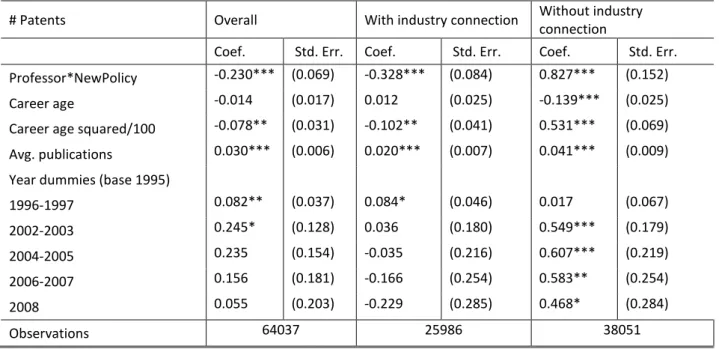
To verify that the timing of the policy change does not affect our findings, we exclude this described pre-policy “uncertainty period” from the sample, and compare academic patenting in 1995-1997 (before the law change and before the public discussion has been initiated) with the time period after the law change, 2002-2008. As seen in Table 5, the coefficient magnitudes on the treatment effects are larger. The effect of new knowledge through publications is smaller, but statistically significant across all specifications.
12 This was discussed in many German newspapers at the time. An example can be found in “Der Spiegel”
which is one of the most prominent weekly news magazines in Germany (see
http://www.spiegel.de/wissenschaft/mensch/patentoffensive-bulmahn-will-hochschullehrerprivileg-abschaffen-a-101092.html). Our data also shows that about 4% of all patents applied for at the German Patent Office and the European Patent Office were university-invented patents. For instance, in 1995 there were 320,000 patents applied for by German inventors at the German Patent Office and the European Patent Office. Out of these, we find 4.7% to be university-inventions. In 2000, there were 460,000 patents out of which 3.3% originated from universities.
23
Table 5: Poisson models of patenting using only 1995-1997 as pre-treatment time periods
# Patents Overall With industry connection Without industry connection
Coef. Std. Err. Coef. Std. Err. Coef. Std. Err. Professor*NewPolicy -0.230*** (0.069) -0.328*** (0.084) 0.827*** (0.152) Career age -0.014 (0.017) 0.012 (0.025) -0.139*** (0.025) Career age squared/100 -0.078** (0.031) -0.102** (0.041) 0.531*** (0.069) Avg. publications 0.030*** (0.006) 0.020*** (0.007) 0.041*** (0.009) Year dummies (base 1995)
1996-1997 0.082** (0.037) 0.084* (0.046) 0.017 (0.067) 2002-2003 0.245* (0.128) 0.036 (0.180) 0.549*** (0.179) 2004-2005 0.235 (0.154) -0.035 (0.216) 0.607*** (0.219) 2006-2007 0.156 (0.181) -0.166 (0.254) 0.583** (0.254) 2008 0.055 (0.203) -0.229 (0.285) 0.468* (0.284) Observations 64037 25986 38051 Robust standard errors. Significance: * p < 0.1, ** p < 0.05, *** p < 0.01.
Note: Avg. publications are a three-year moving average of publication counts in t-1 for each researcher.
Robustness test on the sample exit rule
6.3
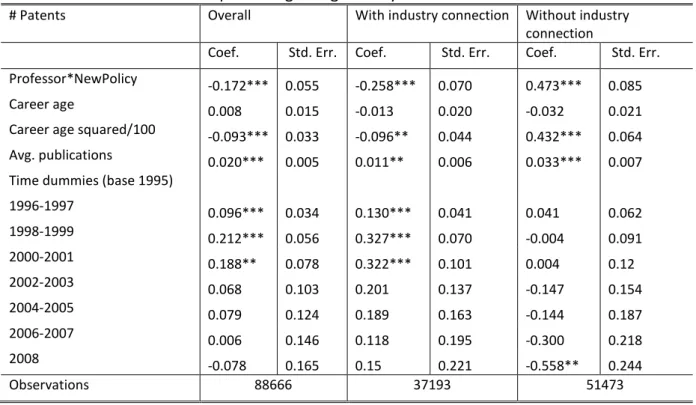
For our main analysis we adopted a 5-year rule that has a researcher leaving the panel if he or she had no patenting or publishing activity for five consecutive years. This rule was necessary due to data limitations that prevent us from observing when a researcher retires or leaves academic employment. To verify our results are not driven by this limitation, we imposed a very strict 2-year rule in which researchers are dropped after two consecutive years of inactivity. The results using the strict exit rule are very similar to those found using the 5-year rule (Table 6).
24
Table 6: Poisson models of patenting using the 2-year exit rule
# Patents Overall With industry connection Without industry connection
Coef. Std. Err. Coef. Std. Err. Coef. Std. Err. Professor*NewPolicy -0.172*** 0.055 -0.258*** 0.070 0.473*** 0.085 Career age 0.008 0.015 -0.013 0.020 -0.032 0.021 Career age squared/100 -0.093*** 0.033 -0.096** 0.044 0.432*** 0.064 Avg. publications 0.020*** 0.005 0.011** 0.006 0.033*** 0.007 Time dummies (base 1995)
1996-1997 0.096*** 0.034 0.130*** 0.041 0.041 0.062 1998-1999 0.212*** 0.056 0.327*** 0.070 -0.004 0.091 2000-2001 0.188** 0.078 0.322*** 0.101 0.004 0.12 2002-2003 0.068 0.103 0.201 0.137 -0.147 0.154 2004-2005 0.079 0.124 0.189 0.163 -0.144 0.187 2006-2007 0.006 0.146 0.118 0.195 -0.300 0.218 2008 -0.078 0.165 0.15 0.221 -0.558** 0.244 Observations 88666 37193 51473
Number of patenting researchers before and after the law change
6.4
The fixed effects regressions presented above estimate the treatment effect of the policy only for scientists that were in the academic system before the policy changed occurred. This is because of the nature of the fixed effects regressions: the treatment dummy, i.e. the policy change variable only changes from the value zero to one for scientists that were in the sample before 2002. If, however, researchers enter the system after 2002 patent more than earlier cohorts, the fixed effects regressions would not pick this up, as the policy change variable would always be equal to one for these researchers.. If the policy change attracted new entrants into academic patenting, it could have increased the total volume of patents. To check for this possibility, we analyze the trend in the number of patenting researchers before and after the law change in 2002 (see Figure 2). The graph shows that
25
the number of patenting professors shows a steady decline after 1999. This suggests that the policy change did not attract more professors into patenting.
Figure 2: Number of patenting scientists before and after the law change.
7
Discussion and Conclusion
In this paper we examine how the ownership of patent rights influences the decision to patent in the context of university-discovered inventions. By changing the agent who makes the patenting decision, Germany’s abolishment of Professor’s Privilege in 2002 caused a regime shift that substituted institutional benefit and cost schedules for those of the individual inventors. Our empirical approach exploits the institutional structure of the German public research system to identify an appropriate control group along with the researcher-level exogeneity of the policy change to implement a difference-in-difference
200 400 600 800 1000 1200 1400 1600 1800 1995 1996 1997 1998 1999 2000 2001 2002 2003 2004 2005 2006 2007 2008 N u mb er o f p ate n ti n g sc ie n ti sts Year Nr of patenting Professors per year Nr of patenting PRO researchers per year
26
approach to causal inference. Our analysis shows that fewer university inventions were patented following the 2002 regime shift from inventor to institutional ownership.
The German policy change that abolished Professor’s Privilege was based on the
presumption that the costs and risks of patenting were so high that professors did not have sufficient incentives to patent their discoveries or pursue commercialization. In retrospect, this presumption appears to be wrong. We find that the treatment effect was
heterogeneous among university professors and depended on the costs of the university compared to costs of faculty inventors before the transition to institutional ownership. Post-policy institutional patenting costs were lower for the subset of university inventors who did not have prior relationships with industry partners. For those individuals, patenting increased after the policy change. Yet, most German professors had prior connections with industry partners leading to higher patenting and commercialization costs under
institutional ownership. For these professors, patenting decreased substantially.
While these findings reflect the medium-term effects of the law change, it could still be possible that the law change results in higher commercialization in the long-run, that is, when new faculty members enter academe who never experienced the old regime of inventor-ownership. However, trends in the number of patenting researchers until 2008 do not suggest more researchers patented after the law change. On the contrary, the number of patenting professors has declined, at least through 2008.
One possible reason for the miscalculation by German policy makers is a failure to adequately assess the nature and extent of technology transfer and patenting relationships prior to the law change. Informal and formal relationships between university researchers and industry firms had evolved under the Professor’s Privilege system. Our results highlight
27
the critical importance of understanding the nature and strength of faculty-industry relationships before undertaking policy initiatives intended to foster technology transfer.
Our findings provide the strongest evidence to date that an inventor ownership system can produce more university-invented patents, and thereby more technology transfer, than an institutional ownership system. Does this imply that other countries such as the U.S. would increase university technology transfer by adopting an inventor ownership system? Not necessarily. The nature and strength of faculty-industry relationships will differ based on each country’s institutions, culture, and historical evolution of networks and trust relationships. Rather than attempting a major policy change as was done in Germany, policymakers in other countries would benefit from a better understanding of current practices. This information could be used to design incremental changes that allow technology transfer processes the flexibility and adaptability needed to fit alternative technologies and markets.
28
References
Azoulay, P., Ding, W. and Stuart, T. (2007), The determinants of faculty patenting behavior: demographics or opportunities? Journal of Economic Behavior & Organization 63, 599-623.
Azoulay, P., Ding, W. and Stuart, T. (2009), The impact of academic patenting on the rate, quality and direction of (public) research output, Journal of Industrial Economics 57(4), 637-676.
Banal-Estanol, A. and Macho-Stadler, I. (2010), Scientific and commercial incentives in R&D: research versus development? Journal of Economics & Management Strategy 19(1), 185-221.
Becher, G., Gering, T., Lang, O. and Schmoch, U. (1996), Patentwesen an Hochschulen: Eine Studie zum Stellenwert gewerblicher Schutzrechte im Technologietransfer Hochschule-Wirtschaft, BMBF (Hrsg.), Bonn.
Bundesministerium für Bildung und Forschung (2012), Bundesbericht Forschung und Innovation, Bonn.
Bundesministerium für Bildung und Forschung and Bundesministerium für Wirtschaft und Technologie (2001), Wissen schafft Märkte - Aktionsprogramm der Bundesregierung, Berlin.
Crespi, G., Geuna, A. and Verspagen, B. (2006), University IRPs and knowledge transfer: Is the IPR owernership model more efficient? SPRU Working Paper No. 154, Brighton. Cuntz, A., Dauchert, H., Meurer, P. and Philipps, A. (2012), Hochschulpatente zehn Jahre
nach Abschaffung des Hochschullehrerprivilegs, Studien zum deutschen Innovationssystem 13-2012, Berlin.
Czarnitzki, D., Glänzel, W. and Hussinger, K. (2007), Patent and publication activities of German professors: an empirical assessment of their co-activity, Research Evaluation
16(4), 311-319.
Czarnitzki, D., Glänzel, W. and Hussinger, K. (2009), Heterogeneity of patenting activity and its implications for scientific research, Research Policy 38, 26-34.
29
Czarnitzki, D., Grimpe, C. and Toole, A. (2014), Delay and secrecy: does industry sponsorship jeopardize disclosure of academic research? Industrial and Corporate Change,
forthcoming.
Czarnitzki, D., Hussinger, K. and Schneider, C. (2011), Commercializing academic research: the quality of faculty patenting, Industrial and Corporate Change 20(5), 1403-1437. Debackere, K. and and Veugelers, R. (2005), The role of academic technology transfer
organizations in improving industry science links, Research Policy 34(3), 321-342. Dechenaux, E., Thursby, M., and Thursby, J. (2009), Shirking, sharing risk and shelving: the
role of university license contracts, International Journal of Industrial Organization 27, 80-91.
Della Malva, A., Lissoni, F., Llerena, P. (2013) Institutional change and academic patenting: French universities and the Innovation Act of 1999, Journal of Evolutionary Economics 23, 211–239.
DER SPIEGEL (2000), Patentoffensive: Bulmahn will "Hochschullehrerprivileg" abschaffen, 3-11-2000, http://www.spiegel.de/wissenschaft/mensch/patentoffensive-bulmahn-will-hochschullehrerprivileg-abschaffen-a-101092.html
European Commission (1995), Green paper on innovation, Brussels.
Frank, A., Meyer-Guckel, V. and Schneider, C. (2007), Innovationsfaktor Kooperation. Bericht des Stifterverbands zur Zusammenarbeit zwischen Unternehmen und Hochschulen. Gesetz über Arbeitnehmererfindungen (ArbnErfG) in der im Bundesgesetzblatt Teil III,
Gliederungsnummer 422-1, veröffentlichten bereinigten Fassung, das zuletzt durch Artikel 7 des Gesetzes vom 31. Juli 2009 (BGBl. I S. 2521) geändert worden ist. Geuna, A. and Nesta, L.J.J. (2006), University Patenting and its Effects on Academic
Research: The Emerging European Evidence, Research Policy 35, 790-807.
Gouriéroux, C., Montfort, A. and Trognon, A. (1984), Pseudo maximum likelihood methods: application to poisson models, Econometrica, 52(3), 701‐721.
Hellmann, T. (2007), The role of patents for bridging the science to market gap, Journal of Economic Behavior & Organization 63, 624-647.
30
Jensen, R. and Thursby, M. (2004), Patent licensing and the research university, NBER Working Paper 10758, Cambridge.
Jensen, R. and Thursby, M., (2001), Proofs and prototypes for sale: the licensing of university inventions, American Economic Review 91(1), 240-259.
Kenney, M. and Patton, D. (2009), Reconsidering the Bayh-Dole act and the current university invention ownership model, Research Policy 38, 1407-1422.
Kenney, M. and Patton, D. (2011), Does inventor ownership encourage university research-derived entrepreneurship? A six university comparison, Research Policy 40, 1100-1112. Kilger, C. and Bartenbach, K. (2002): New rules for German professors, Science 298 (5596),
1173-1175.
Lach, S. and Schankerman, M. (2008), Incentives and invention in universities, RAND Journal of Economics 39(2), 403-433.
Leydesdorff, L. and Rafols, I. (2009), A global map of science based on the ISI subject categories. Journal of the Association for Information Science and Technology 60, 348-362.
Lissoni, F. (2013), Academic Patenting in Europe: A Reassessment of Evidence and Research Practices, Industry and Innovation 20(5), 379-384.
Lissoni, F., Lotz, P., Schovsbo, J., and Treccani, A. (2009), Academic patenting and the professor's privilege: evidence on Denmark from the KEINS database, Science and Public Policy 36 (8), 595-607.
Lissoni, F., Pezzoni, M., Poti, B., Romagnosie, S. (2013), University Autonomy, the Professor Privilege and Academic Patenting: Italy, 1996–2007, Industry and Innovation 20(5), 399-421.
Litan, R., Mitchell,L. and Reedy, R. (2007), Commercializing university innovations:
alternative approaches, in: Jaffe, A., Lerner, J., Stern, S. (eds.), Innovation policy and the economy, vol. 8, University of Chicago Press, Chicago, IL, 31-58.
31
Mowery, D.C., and Sampat, B.N. (2005), The Bayh-Dole Act of 1980 and University-Industry Technology Transfer: A Model for Other OECD Governments? Journal of Technology Transfer 30 (1/2), 115-127.
National Research Council (NRC) (2010), Managing University Intellectual Property in the Public Interest, Committee on Management of University Intellectual Property: Lessons from a Generation of Experience, Research, and Dialogue; Stephen A. Merrill and Anne-Marie Mazza (eds.), The National Academy Press, Washington, D.C
OECD (2003), Turning science into business: patenting and licensing at public research organizations, Paris: OECD.
Pakes, A. and Griliches, Z. (1984), Patents and R&D at the firm level: a first look, in: R & D, Patents, and Productivity, Zvi Griliches (ed.), University of Chicago Press, 55-72.
Schmoch, U. (2007), Patentanmeldungen aus deutschen Hochschulen - Analysen im Rahmen der Berichterstattung zur Technologischen Leistungsfähigkeit Deutschlands, Studien zum deutschen Innovationssystem Nr. 10-2007, Berlin.
Schmoch, U. Licht, G., and Reinhard, M. (eds.) (2000), Wissens- und Technologietransfer in Deutschland, Stuttgart: Fraunhofer IRB Verlag.
Siegel, D., Waldman, D., and Link, A. (2003), Assessing the impact of organizational practices on the relative productivity of university technology transfer offices: an exploratory study, Research Policy 32(1), 27-48.
So, A.D., Sampat, B.N., Rai, A.K., Cook-Deegan, R., Reichman, J.H., Weissman, R. and
Kapczynski, A. (2008), Is Bayh-Dole Good for Developing Countries? Lessons from the US Experience, PLoS Biology 6 (10), 2078-2084.
Stevens, A. (2004), The enactment of Bayh-Dole, Journal of Technology Transfer 29, 93-99. The Economist (2002), Innovation's golden goose - The reforms that unleashed American
innovation in the 1980s, and were emulated widely around the world, are under attack at home, Technology Quarterly, Q4 2002.
Thursby, M., Thursby, J. and Gupta-Mukherjee, S. (2007), Are there real effects of licensing on academic research? Journal of Economic Behavior & Organization 63, 577-598.
32
Trajtenberg, M. (1990), A penny for your quotes: patent citations and the value of innovations, RAND Journal of Economics 21(1), 172-187.
Valentin, F. and Jensen, R.L. (2007), Effects on academia-industry collaboration of extending university property rights, Journal of Technology Transfer 32, 251-276.
Von Proff, S. , Buenstorf, G. and Hummel, M. (2012) University patenting in Germany before and after 2002: what role did the professors' privilege play? Industry & Innovation 19(1), 23-44.
Wooldridge, J. (1999), Distribution-free estimation of some nonlinear panel data models, Journal of Econometrics 90(1), 77-97.
33
Appendix A: Data collection procedure
Our relevant starting population for the patent collection are all patent applications filed at the German Patent and Trademark Office (DPMA) and the European Patent Office (EPO) involving at least one German inventor since 1978 up to 2011 using the PATSTAT database. These are 1,682,585 patent documents. Eventually we will collapse the list of relevant patent documents to the number of inventions, that is, we will account for patent families. Between 1978 and 2011 the grand total of patent families amounts to 1,067,753, and in the time period under review in this paper, 1995-2008, the number of different inventions with at least one German inventor amounts to 624,041.
Searching patents invented by university faculty
Unfortunately, no comprehensive list of German university faculty exists. Therefore, we follow another established strategy to identify patents of university professors (see e.g. Czarnitzki et al. 2007, 2009). In Germany, the award of a doctorate and even more of a professor title is considered a great honor. The “Dr.” is an official part of the name and is, for example, even mentioned in the national IDs and passports. The professor title is protected by the German criminal code (article 132a) against misuse by unauthorized persons. Accordingly this title is used as a name affix not only in academic environment, but also in daily life. Thus, we use the inventor records in the database and search for the title “Prof. Dr.” and a large number of variations of this. This initial search identified 69,250 patent documents between 1978 and 2011.13 After having obtained an initial list of patent
13 One may be concerned that the Professor Doctor title is also given as an honorary title to individuals
who are not employed at universities. While the granting of honorary titles seems to be relatively rare, some of these highly qualified individuals may be labeled as professors in our data process. We believe any misclassification error would work against finding a significant policy effect as these individuals are not affected by the policy change.
34
documents, we then also searched for these inventors again in order to see whether they also patented without the “Prof. Dr.” title. Note that initially we just search for name homonyms of the identified “Prof. Dr.” patents. This step does not involve yet to
disambiguate the records in order to find out which of these patents are invented by the same person and which are other inventors with similar names. The actual disambiguation is done at a later stage using cross-referencing to linked publication records. The search for name homonyms added 197,887 (1978-2011) to the 69,250 patent documents. We thus have a raw list of potentially university-invented patent documents of almost 270,000.
Identifying patents by PRO researchers
The identification of patents by PRO scientists is more straightforward, as they can be searched by applicant names as the IP was always subject to institutional ownership. We obtained a list of about 500 PRO institutes existing in Germany from the “Bundesbericht Forschung und Innovation 2012” published by the federal government. These were searched as applicants in the patent documents, and we identified 27,637 (1978-2011) patent documents. As some of these patents involve co-applications with firms, we cannot assume that all inventors listed on the patents are employees of PROs. Therefore, we first omit the co-assigned patens (about 20% of the 27,637). This detour is necessary in order to avoid that e.g. industry researchers whose employer appears as co-applicant on some patents enter our data of PRO inventors mistakenly. We then searched for all patents by the PRO inventors, in order to come up with a comprehensive list of patents filed by PRO
inventors. Again, we initially search for name homonyms of these inventors as we did for the university faculty. Note that this step also adds the 20% of co-applied patents back into
35
the sample. Now, however, we have identified these not by applicants but PRO inventors. This raw list of potential PRO-researcher patents amounts to 195,498 (1978-2011).
Disambiguation routine – Step 1
The two lists of retained patent documents are now pooled (492,340). Note again that this list includes too many patents because of name homonyms. In addition, some inventors may switch between the two groups of institutions and thus appear in both lists. Therefore, we then implemented a first disambiguation routine based on the patent document data. This step determines which patents are clearly not invented by either university faculty or PRO researchers to extent this is possible to infer from the patent data. This initial
disambiguation leads to a list of 29,476 unique inventors (either university faculty or PRO researchers) with a total of 174,431 patents (1978-2011).
The reason for the large drop in the overall number of patents is the deliberate
oversampling by using the cleaned name (without title) as selection criterion. For example, 979 patents are filed under the common German name “Bernd Müller”, a number much too high for a single person. After the disambiguation procedure 61 distinct persons were identified. Only 3 persons belong to the target group of university faculty or PRO researchers, and these 3 inventors have in total 16 patents.
This disambiguation algorithm is based on a relation network analysis. Every node within this network is a patent connected to other patents by layers of relations defined by shared applicants, co-inventors, citations and joint sets of IPC codes. The analysis uses a hierarchical approach by first traversing connections of high reliability to define sub-clusters that function as new nodes for the next iterative step. By aggregating information within these ‘hypernodes’ new connections emerge that will also be traversed and so on. As every
36
sub-cluster describes a part of an inventor career, suspiciously large sub-clusters can easily be identified, rejected and re-traversed with more restrictive requirements for the
connections. This method implicitly solves the common name problem. The resulting list of unique individuals and their corresponding patents has been checked manually to the largest extent possible.
Collecting publication data from the Web of Science and disambiguation - Step 2
The retained list of initially disambiguated inventors is now used to perform name searches in the Thomson Reuters Web of Science publication database, 1990 – 2008. We first retrieve all publications from Web of Science that match with respect to the names in our inventor list and have at least one German affiliation. This amounts to 882,702 publications; again including name homonyms. Second, we now use the publication information to disambiguate these authors from Web of Science using cross-referencing information on journals, coauthors, citations and affiliations. 580,448 are identified as being authored by the 29,476 inventors in our sample from 1990 to 2008.
In order to ensure that the match between inventors and authors has a high level of quality we then excluded weak matches. For doing so we only keep a researcher based on author-inventor-link if it is either the only match between author and inventor of the same name or if at least one affiliation matches between inventor and author. This reduced our uniquely identified researchers to 18,092.
Compiling the panel database
The final step of the database construction involves generating a panel of unique academic inventors that includes information on their patents, citation-weighted patents and