CloudGenius: Decision Support for Web Server Cloud
Migration
Michael Menzel
Research Center for Information Technology Karlsruhe Institute of Technology
Karlsruhe, Germany
[email protected]
Rajiv Ranjan
School of CSE, University of New South Wales Sydney, Australia
Information Engineering Lab, CSIRO ICT Center Canberra, Australia
[email protected]
ABSTRACT
Cloud computing is the latest computing paradigm that de-livers hardware and software resources as virtualized ser-vices in which users are free from the burden of worry-ing about the low-level system administration details. Mi-grating Web applications to Cloud services and integrat-ing Cloud services into existintegrat-ing computintegrat-ing infrastructures is non-trivial. It leads to new challenges that often require innovation of paradigms and practices at all levels: techni-cal, cultural, legal, regulatory, and social. The key problem in mapping Web applications to virtualized Cloud services is selecting the best and compatible mix of software images (e.g., Web server image) and infrastructure services to en-sure that Quality of Service (QoS) targets of an applica-tion are achieved. The fact that, when selecting Cloud ser-vices, engineers must consider heterogeneous sets of criteria and complex dependencies between infrastructure services and software images, which are impossible to resolve man-ually, is a critical issue. To overcome these challenges, we present a framework (called CloudGenius) which automates the decision-making process based on a model and factors specifically for Web server migration to the Cloud. Cloud-Genius leverages a well known multi-criteria decision making technique, called Analytic Hierarchy Process, to automate the selection process based on a model, factors, and QoS pa-rameters related to an application. An example application demonstrates the applicability of the theoretical CloudGe-nius approach. Moreover, we present an implementation of CloudGenius that has been validated through experiments.
Categories and Subject Descriptors
D.2.2 [Software Engineering]: Design Tools and Tech-niques—Computer-aided software engineering (CASE), De-cision tables, Evolutionary prototyping; H.4.2 [Information Systems Applications]: Types of Systems—Decision sup-port (e.g., MIS)
Keywords
Cloud Computing, Migration Process, Decision Support, Se-lection Algorithm, Factors, Criteria, Service SeSe-lection, Au-tomation
Copyright is held by the International World Wide Web Conference Com-mittee (IW3C2). Distribution of these papers is limited to classroom use, and personal use by others.
WWW 2012, April 16–20, 2012, Lyon, France. ACM 978-1-4503-1229-5/12/04.
1.
INTRODUCTION
The emergence of Cloud computing over the past five years is potentially one of the breakthrough advances in the history of computing. Cloud providers including Amazon Web Services (AWS), Salesforce.com, or Google App En-gine give users the option to deploy their application over a network of infinite resource pool with practically no capital investment and with modest operating cost proportional to the actual use. By leveraging Cloud services to host Web applications organizations can benefit from advantages such as elasticity, pay-per-use, and abundance of resources. How-ever, organisations tend to avoid or delay migrations of Web applications to the Cloud due to multiple hurdles. With Cloud computing being a disruptive technology an adoption brings along risks and obstacles [2]. Risks can turn into ef-fective problems or disadvantages for organizations that may decide to move Web applications to the Cloud. Considering this increases the complexity of the decision associated with migrating a Web application to the Cloud. Such a decision depends on many factors, from risks and costs to security issues and service level expectations [17]. Another critical hurdle is the complexity of migrating a Web application to the Cloud on a technical level while incorporating econom-ical aspects. A migration from an organization-owned data center to a Cloud infrastructure service implies more than few trivial steps. The following steps outline a migration of an organization’s Web application to an equivalent on a Cloud infrastructure service. Steps of a migration to a Platform-as-a-Service (PaaS) offering would differ in several regards.
First, an appropriate Cloud infrastructure service, or In-frastructure-as-a-Service (IaaS) offering, is selected. This demands a well-thought decision to be made that consid-ers all relevant factors, like e.g., price, Service Level Agree-ment (SLA) level, or support quality. The basis of a se-lection are data and measurements regarding each factor that describe the quality and make service options compa-rable. Secondly, the existing Web application and its plat-form, i.e., a Web server, are transferred from the local data center to the selected Cloud infrastructure service. There-fore, the Web application and server must be converted into a format expected by a Cloud infrastructure service. Typi-cally, in this step the whole Web application is bundled as a virtual machine (VM) image that consists of a software stack from operating system and software platforms to the software containing the business logic. Since it is often un-achievable to convert an existing Web application and its
server directly to a Cloud infrastructure service compatible VM image format, an adequate existing VM image offered by the Cloud provider is chosen and customized. Existing images vary in many ways, such as underlying operating sys-tem, software inside the software stack or software versions. Hence, selecting a functionally correct VM image becomes a complex task. Besides, choosing a comprehensive VM image helps to minimize the effort of installing a software stack on a basic image. In the end, the resulting VM image should reflect the original Web server and at least replace it in a sufficing manner. Next, a migration strategy needs to be defined and applied to make the transition from the local data center to the Cloud infrastructure service. A migra-tion strategy defines the migramigra-tion procedure in means of order and data transfer. In case data is affected with the Web application migration all data on the original machine must be transferred to the new system in the Cloud. Finally, all configurations and settings must be applied on the new Web server in the Cloud to finish creating an appropriate equivalent. In sum, the process of migrating an IT system to a Cloud infrastructure service comprises five steps listed in presorted, modifiable order as following:
• Cloud infrastructure service selection
• Cloud VM image selection
• Cloud VM image customization
• Migration strategy definition
• Migration strategy application
The order reflects the fact that an image can be chosen for a certain Cloud infrastructure service only. Alternatively, selecting a Cloud VM image first restrains the number of eligible Cloud infrastructure services, typically to one. In more complex settings multiple components and databases must be migrated in parallel, what requires to apply the steps described above component-wise. Additionally, inter-connections and relations between the components must be considered.
In this paper we introduce the CloudGenius framework that lowers hurdles introduced by the complexity of the Cloud migration process. CloudGenius offers a detailed pro-cess and comprehensive decision support that reduces a Web engineer’s effort of finding a proper infrastructure service and VM image when migrating a Web application to the Cloud.
The paper is structured as follows. First, we reflect related work in Section 2 and then present the CloudGenius frame-work in Section 3. Further, we give an example application of CloudGenius in Section 4 and present CumulusGenius, a prototypical implementation, in Section 5. In Section 6 we present the results of experiments on CumulusGenius’ time complexity before we discuss limitations and future work in Section 7 and conclude in Section 8.
2.
RELATED WORK
There is preliminary work in the field of decision support for Cloud VM images and Cloud services. Dastjerdi et al. [6] propose an approach that selects Cloud VM images and Cloud infrastructure services based on an ontology but lacks a service evaluation. Services that fulfill all requirements can not be differentiated regarding quality and suitability in
this approach due to the missing evaluation. An ontology-based description to formulate requirements and attributes of a service is used since Dastjerdi et al. introduce a cen-tral system that manages service discovery and mediation. Khajeh-Hosseini et al. [11] [12] developed the Cloud Adop-tion Toolkit that offers a decision support for migrating a whole IT infrastructure of an enterprise. The focus of the decision support is on risk management and cost calculation based on workloads. However, the toolkit lacks consider-ing factors that are not cost-related and supports a decision process which stays on an abstract decision level. Regarding multi-component migration planning, Hajjat et al. [8] made some interesting effort with a model that supports decisions in hybrid Cloud setups. The model addresses the trade-off between direct cost savings, network delays, and internet communication costs and takes a set of specific constraints and requirements into account. Ye et al. [20] solve the map-ping of service compositions to Cloud services with a genetic algorithm. The approach considers data and control flow of a composition and evaluates Cloud services by four Qual-ity of Service (QoS) attributes. The approach overlooks the existence of Cloud VM images and focuses on service com-position.
There is an amount of work on Cloud service selections that, however, lacks factoring in the actual Web server and VM image selection, and misses a decision support and a mi-gration process. Chan and Chieu [3] propose a single value decomposition technique-based approach that evaluates and ranks Cloud computing services by QoS attributes. Li et al. [15] present an approach to measure a provider’s perfor-mance capabilities. The work introduces a set of interesting metrics to measure, but a method to choose a provider is missing.
3.
CLOUDGENIUS FRAMEWORK
The complexity of a Web server Cloud migration can be mitigated by a decision support system that is capable of en-hancing the quality of Cloud infrastructure service selections and Cloud VM image selections. Both selection tasks can be translated into decision-making problems between mul-tiple alternatives. Each alternative, a Cloud infrastructure service or Cloud VM image, possesses different attributes which can be compared and evaluated with criteria. Finally, both selections must be joined since an image and a service build a single, combined solution. Usually, every Cloud VM image is only compatible with Cloud infrastructure services of few or a single provider restricting the number of viable combinations. Figure 1 depicts the decisions to be made, as well as influential parameters and potential objects of choice. The problem depiction assumes that a user wants to choose a VM image before an infrastructure service. Solid lined arrows imply parameter inheritance and dashed lined arrows point at options to choose from.
With CloudGenius we propose an approach that trans-lates both selection steps into multi-criteria decision-making problems to determine the most valuable combination of a Cloud VM image and a Cloud infrastructure service. The CloudGenius framework defines a Cloud migration process. Within the process CloudGenius offers a model and methods to determine the best combined choice of a Cloud VM image and a Cloud infrastructure service. The framework lever-ages an evaluation and decision-making framework, called (M C2)2, [16] to support requirements and adopt a profound
Figure 1: Overview of the Selection Problem
multi-criteria evaluation approach. The (M C2)2framework
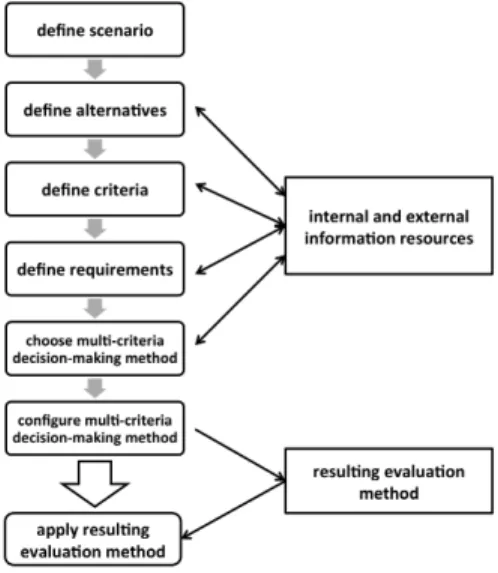
provides a process depicted in Figure 2 that allows to create an evaluation method that contains a requirements check and evaluates multiple alternatives with relative values on a (0-1) scale. Within (M C2)2 process CloudGenius
pro-poses the Analytic Hierarchy Process (AHP) reducing deci-sion modelling effort in comparison to the Analytic Network Process (ANP) suggested by (M C2)2. AHP allows to build
complex weighted sum functions in a structured manner. Weighted sum functions allow compensation between crite-ria what can be influenced by weights derived from trade-offs stated by a user.
Figure 2: Overview of the(M C2)2 Process
CloudGenius allows users to define an abstract Web server and set requirements for a Web server implementation that condition what attributes are acceptable for a Cloud equiv-alent. Besides, a user has to choose relevant factors from a criteria list and define their priorities by setting weights for criteria in pair-wise comparisons. From the informa-tion given by the user the CloudGenius approach employs a model and the user preferences to apply the (M C2)2 frame-work and suggest a best Cloud image and Cloud service combination.
The following subsections give details on CloudGenius’
migration process, its formal model, and the selection and combination steps that lead to an adequate VM image and Cloud service from the abundance of offerings. Moreover, the final subsections address an alternative evaluation vari-ant and the computational complexity of CloudGenius.
3.1
A Cloud Migration Process
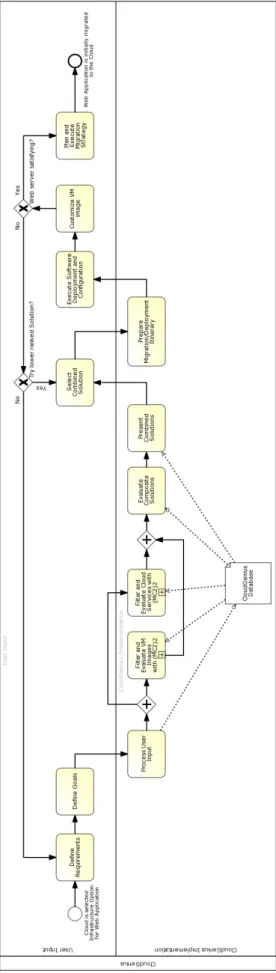
Figure 3 shows the migration process to be followed in the CloudGenius framework modelled in Business Process Model and Notation (BPMN) 2.0. The process illustration intends to define steps and highlight activities. The process is triggered by an event ”Cloud is selected Infrastructure Op-tion” occuring after an organization has identified the Cloud infrastructure for a possible or the best infrastructure option for a Web server. The subsequent steps show the informa-tion and preferences that need to be provided by the orga-nization and Web engineer (see ”User Input” lane) and what is processed and computed by CloudGenius resp. an imple-mentation of the framework (see ”CloudGenius implementa-tion” lane). Two parallel steps that lie in the responsibility of CloudGenius are linking to the sub-process described by the (M C2)2 generic decision-making framework. Therefore, the implementation translates user input and the CloudGe-nius model stored in its database into a model that can be evaluated with (M C2)2. In the process Web engineers pro-vide input and receive suggestions computed by CloudGe-nius. From there the migration is executed with a selected VM image and an infrastructure service target.
In the final steps of the process a user has the chance to enter a loop, try worse alternatives or reconsider with altered requirements and a new focus. Thereby the process allows users to incrementally improve a migration until a satisfying solution has been found. The migration process ends when the Web application has been successfully migrated to the Cloud.
3.2
Formal Model of CloudGenius
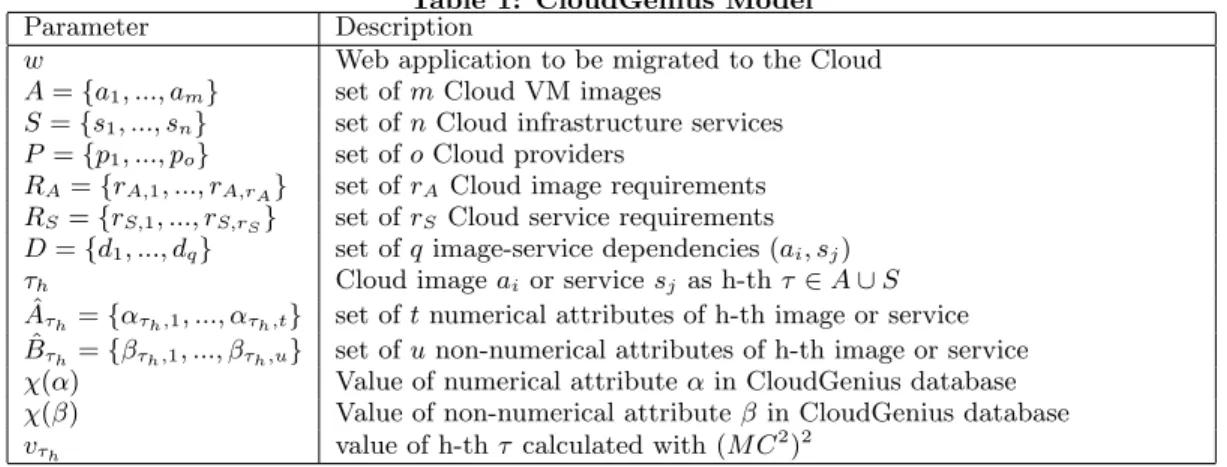
In order to formalize the problem addressed by the Cloud-Genius framework, a formal mathematical model is intro-duced. The model defines the sets of objects involved in the problem and the relations between objects and their eval-uation. Table 1 summarizes the parameters of the model included in CloudGenius.
The model behind CloudGenius consists ofmimagesai,n servicessjandoproviderspk. Ais the corresponding set of Web server images,Sthe set of Cloud infrastructure services and P the set of Cloud providers. ai and sj own numeri-cal, measurable and non-numerical attributes defined in ˆAai,
ˆ
Asj, ˆBaiand ˆBsj. χrepresents a value connected with a nu-merical attributeαor non-numerical attributeβ. Further-more, the model introduces rA VM image related require-ments andrSservice related requirement, and a goal/criteria hierarchy includingggoals andcleaf criteria.
Based on the model CloudGenius determines the best combination (ai, sj) where ai and sj are the image and infrastructure service of provider pk that have the highest value of all combinations according to the user’s preferences and with ai deployable onsj. An evaluation method built with (M C2)2 can be employed to determine the best im-ageai ∈A. Therefore, (M C2)2’s function is interpreted as f(ai,Aaˆi,Baˆ i)7→vaiwhich returns a valuevai for imageai and allows to find
Table 1: CloudGenius Model
Parameter Description
w Web application to be migrated to the Cloud A={a1, ..., am} set ofmCloud VM images
S={s1, ..., sn} set ofnCloud infrastructure services
P ={p1, ..., po} set ofoCloud providers
RA={rA,1, ..., rA,rA} set ofrACloud image requirements
RS={rS,1, ..., rS,rS} set ofrSCloud service requirements
D={d1, ..., dq} set ofq image-service dependencies (ai, sj)
τh Cloud imageaior servicesjas h-thτ ∈A∪S ˆ
Aτh={ατh,1, ..., ατh,t} set oftnumerical attributes of h-th image or service
ˆ
Bτh ={βτh,1, ..., βτh,u} set ofunon-numerical attributes of h-th image or service
χ(α) Value of numerical attributeαin CloudGenius database χ(β) Value of non-numerical attributeβin CloudGenius database vτh value of h-thτ calculated with (M C
2
)2
the valuemax{vs1, ..., vsn}withf(sj,Asˆj,Bsˆj)7→ vsj. In
a final step, given the evaluation results of Cloud VM im-ages and infrastructure services, a best combination is de-termined. Combinations of an image and a service must be feasible, meaning an image has to be deployable on the ser-vice. The feasibility of a combination is indicated by the setDwhich holds all dependencies between images and ser-vices. Not all providers do support standard formats and, thus, setDis required to define the compatibilities between images and services explicitly.
The applicability of the approach correlates with the qual-ity of the data hold in the model. Therefore, the number of images and services must possibly reflect the Cloud market that is of interest for a Web server migration. Moreover, the currentness and quality ofχvalues of all numerical and non-numerical attributes have a high, direct influence on the quality of CloudGenius’ results. Thus, measurements must be accurate and up-to-date implicitly demanding frequent maintenance of the database.
3.3
Web Server Requirements & Preferences
In the first step of applying CloudGenius, a Web engineer has to define and describe the Web server by formulating requirements and their preferences. Requirements formula-tion comprises choosing a Web server attribute and speci-fying a minimum or maximum value for numerical values, and a set of allowed items for non-numerical values. Numer-ical requirements can be of Max or Min type, non-numerNumer-ical requirements of Equals or OneOf type. Table 2 gives an overview of the possible requirement definitions aligned with the (M C2)2framework which uses conjunctive and disjunc-tive satisficing methods for numerical values. The table as-sumes χto be the attribute value under consideration, vr to be the given numerical requirement value,sa given non-numerical value andS a given set of non-numerical values. Boolean expressions mathematically formulate applied re-quirements checks regarding an attribute valueχ and the requirement constraint. A list of available Web server at-tributes to set requirements upon can be drawn from merg-ing all available attributes of Cloud VM images and Cloud infrastructure services listed in Table 3, 4, 5 and 6. The tables includes numerical and non-numerical attributes that can be referred to in a requirement condition of a require-ment with an according numerical or non-numerical type.Stating preferences is carried out by selecting and
weight-Table 2: CloudGenius Requirement Types
Value Type Req. Type Boolean Expression Numerical Max χ(α)< vr
Numerical Min χ(α)> vr Non-numerical Equals χ(β) =s Non-numerical OneOf χ(β)∈S
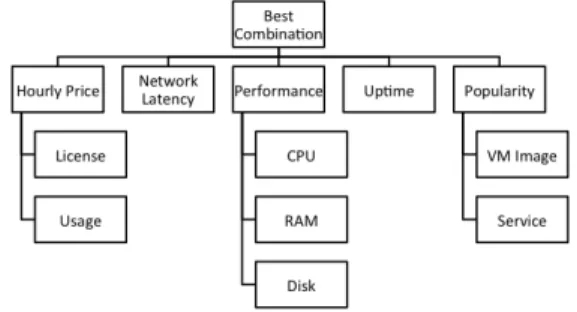
ing goals and criteria. CloudGenius proposes a hierarchy of goals and criteria and asks a Web engineer to weight the items in pair-wise comparisons, in analogy to AHP. Figure 4 and Figure 5 depict the proposed hierarchy offered by CloudGenius. The proposed criteria for CloudVM images and Cloud infrastructure services are derived from Kalepu et al. [10]. For CloudVM images the goal hierarchy com-prises two goals, cheapest and best quality VM images, with one criterion each, hourly price and image popularity. The hierarchy for services consists of three main goals: cheapest, best latency and best quality service, that parent multiple criteria: hourly price, max. and average network latency, performance and uptime. The Performance goal has three sub-goals CPU, RAM and Disk performance. The crite-rion ”popularity” corresponds to ”reputation” and ”uptime” to ”availability” in Kalepu et al..
The selection of goals comprises few, important QoS at-tributes only, but CloudGenius is extensible regarding a wider selection of goals and more complex hierarchy. Since the (M C2)2 evaluation framework supports more complex
goal hierarchies CloudGenius is not limited in this aspect. However, a higher complexity of the goal hierarchy increases the amount of input a user must provide. Our approach keeps the goal hierarchy complexity low but allows users to extend and customize the goal hierarchy to their needs. Possible additional goals are QoS properties proposed by Kalepu et al. [10] such as reliability, accessibility, security or support.
Finally, it is important to find a trade-off for the compen-satory influence of Cloud VM image and Cloud infrastruc-ture service on the combined value in a pair-wise compari-son. The trade-off is incorporated in the calculation of an overall value of a combination of an image and a service.
3.4
Cloud VM Image Selection
A Cloud VM image is a pre-configured, self-contained, virtualization-enabled, and pre-built software resource unit
F ig u re 3: M ig rat io n Pr o c e s s o f th e Cl o ud G e ni us F rame w ork
Figure 4: CloudGenius VM Image Goal Hierarchy
Figure 5: CloudGenius Infrastructure Service Hier-archy
that can be deployed at a Cloud infrastructure service. An example for a Web Server Cloud image is a pre-configured Tomcat Web server on Ubuntu Linux 10.4. Currenlty, there is no widely accepted standard (virtualization) format for a Cloud image, which means that an image is built for a spe-cific virtualization technology and possibly will not run on Cloud services that are managed by non-overlapping virtu-alization technologies. For example, a VMware image can-not be deployed on the Amazon Web Services (AWS) Elastic Compute Cloud (EC2) service, as AWS only supports a pro-prietary virtualization format (also referred to as Amazon Machine Image (AMI) virtualization format).
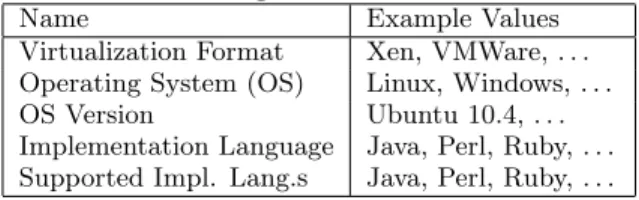
Table 3 gives an overview of the measurable, numerical attributes the CloudGenius framework proposes. The table lists their influence direction, metrics and the range of possi-ble values. A list of non-numerical attributes is presented in Table 4. The variability of an attribute represent the abil-ity to change the value over time, e.g., the popularabil-ity of an image might shrink over time and, thus, is dynamic. Static variability means the value is defined once with the creation of the image, e.g., its operating system, while dynamic at-tribute values are more volatile. Non-numerical atat-tributes are all of static variability, while all numerical attributes are dynamic. Nevertheless, there is no correlation between non-numerical attributes and static variability in general. In parallel, numerical attributes are not always dynamic per se. Attributes, additionally, have either a negative or positive influence on the value. For instance, the higher the license costs the less interesting becomes an image. In contrary, higher popularity is positive for an image. (M C2)2 respects
negative and positive values in its evaluation.
at-Table 3: Cloud Image Numerical Attributes
Name Influence Metric Value Range Hourly License Price Negative $/h 0-∞$/h
Popularity Positive % 0-100 %
Table 4: Cloud image Non-numerical Attributes
Name Example Values
Virtualization Format Xen, VMWare, . . . Operating System (OS) Linux, Windows, . . . OS Version Ubuntu 10.4, . . . Implementation Language Java, Perl, Ruby, . . . Supported Impl. Lang.s Java, Perl, Ruby, . . .
tribute changes and supports users with the introduction of more or other attributes for images. The current attribute selection is derived from literature [6] and own observations, and provides a basic set of attributes that are essential to Cloud VM image selection. Nevertheless, the current Cloud VM image attribute list is not fixed and we hope to be able to build a list of important attributes from usage data of a future, publicly available prototype. Both measurable attributes have been derived from [10] since these two at-tributes have been found to be useful and applicable to VM images.
The VM image selection process requires the (M C2)2
eval-uation framework to evaluate whether an image can deliver the requested functional and non-functional requirements, e.g., ”supports Web applications implemented in Java” or ”has a popularity of over 80% according to user ratings”. It is assumed that all VM images are Web servers what can be ensured by introducing an attribute that describes the VM image software stack and an requirement set automatically that checks if this attribute implies a Web server, i.e., an attribute ”VM Image Feature” and a requirement ”VM Im-age Feature equals ’Web server’”. Every imIm-age that does not meet all formulated requirements is eliminated by (M C2)2 and not considered for composite solutions of an image and a service. Besides, the evaluation framework determines a value for an image and, therefore, involves all numerical im-age attributes.
To create an evaluation method with (M C2)2 that pro-vides the demanded capabilities a Web engineer’s input and CloudGenius’ formal model must be translated into input parameters for the (M C2)2’s evaluation method building process (see Figure 2). Therefore, in the building process the ”Define scenario” step is skipped and in the subsequent step ”Define alternatives” all images from a database which holds the set of images including all image attributes be-come the evaluation alternatives. Further, all numerical at-tributes of images (see Table 3) are translated into a cri-teria hierarchy. The cricri-teria hierarchy corresponds to the proposed goal hierarchy customized and weighted in pair-wise comparisons in step 2 of the process. Any items within the hierarchy that have been deselected are removed from the hierarchy. CloudGenius defines all requirements set on image attributes as the requirements to be considered by the evaluation method. The multi-criteria decision-making method chosen is every time AHP which needs to be config-ured with criteria weights. The weighting of the criteria is inferred from goal preferences which have been gathered in
pair-wise comparisons for all available attributes during the first steps of the CloudGenius process.
Fed with images as alternatives, a criteria hierarchy, re-quirements and criteria weights a new evaluation method based on AHP is created with (M C2)2. The created evalua-tion method matches a funcevalua-tionf(ai,Aaˆ i,Baˆ i)7→vaiwhich
is applied on all images ai. By setting allχ(α) as param-eters in the function a valuevai for every imageai can be determined. The function returns a valuevai = 0 whenever
the attributes ˆ(B)aiofaido not achieve all requirements. In detail, (M C2)2 creates the function described in Equation 1 where wj is the global criteria weight of j-th numerical attribute. f(ai,Aaˆi,Baˆ i) = |Aˆai| P j=0 wjχ(αj,ai) ∀r∈RA:r=true 0 else 7→vai (1) In case, none of the images meets all requirements in a sub-sequent step all images that meet all but one requirement are considered. This procedure is repeated n times until a set of images is found that fulfil all but n requirements. The evaluation will still continue and return evaluation val-ues. CloudGenius expects a created evaluation method to support a requirements check that keeps images with any number of requirements inRA not met, e.g., forn= 1 the evaluation method must keep all images with a single, arbi-trary requirement inRAnot met. This must not be achieved by removing one element fromRA subsequently and apply the evaluation method with a smaller RA set. Instead the requirements check step within the evaluation method must allow n requirement checks to be false for any image. Only then the calculated results are represented by relative values between all image alternatives.
To determine the best image one needs to find the highest value alternative of all evaluation resultsmax{va1, ..., vam}.
A reasonable notion is to order all alternatives resp. images by value what can be achieved with an arbitrary sorting algorithm. Then, depending on the sorting direction, the best alternatives are the top for descending order or bottom ones for ascending order.
3.5
Cloud Infrastructure Service Selection
In parallel to the Cloud VM image selection, the selection of a Cloud infrastructure service proposes a range of numer-ical and non-numernumer-ical attributes and leverages the (M C2)2framework to gain an evaluation methodg(sj,Asˆj,Bsˆ j)7→
vsj formulated in Equation 2 wherewiis the global criteria weight of i-th numerical attribute.
g(sj,Asˆj,Bsˆ j) = |Aˆsj| P i=0 wiχ(αi,sj) ∀r∈RS:r=true 0 else 7→vsj (2) A list of numerical attributes for the Cloud service selec-tion evaluaselec-tion method is given in Table 5, a list of non-numerical attributes in Table 6. The table of numerical attributes implies a dynamic variability for all attributes and presents their metric and value range. The table of
non-numerical attributes implies a static variablity for all attributes and gives example values.
Table 5: Cloud Service Numerical Attributes
Name Influence Metric Value Range Hourly Price Negative $/h 0-∞$/h CPU Perfomance Positive Flops 0-∞Flops RAM Perfomance Positive Flops 0-∞Flops Disk Perfomance Positive Flops 0-∞Flops Max. Latency Negative ms 0-∞ms Avg. Latency Negative ms 0-∞ms
Uptime Positive % 0-100%
Service Popularity Positive % 0-100%
Table 6: Cloud Service Non-numerical Attributes
Name Example Values
Provider Amazon, Rackspace, . . . Location Country Germany, Australia, . . . Cloud infrastructure services possess multiple numerical attributes that imply a caclulation or measurement. Hourly Usage Prices are typically provided from the provider or must be calculated with a provider’s price model. More detailed cost schemes are provided by Klems et al. [13] and Khajeh-Hosseini et al. [12]. To guarantee comparability of costs the attribute might need a corrected metric and needs to be renamed to ”Total Costs” or ”Monthly Costs” accordingly. Performance and latency attributes want to be measured with benchmarking tools as those are often not provided by Cloud providers [14]. The uptime of a service is a long-term experience that can be provided as guaranteed uptime by a provider or his SLA, or retrieved from user experiences. Also, service popularity can be gained from user experiences.
In parallel to the process of building the image selection evaluation method, the evaluation method building process of (M C2)2must be followed (see Figure 2). With all parame-ters set (images as alternatives, a goal and criteria hierarchy, requirements and criteria weights) the (M C2)2 process can
be completed and a new Cloud service evaluation method based on AHP is created. The Cloud service evaluations can be retrieved from applying the new evaluation method g(sj,Asˆj,Bsˆj). The highest ranked Cloud infrastructure
al-ternative ismax{vs1, ..., vsn}.
3.6
Best Combination
In the final step, after both, images and services, have been evaluated and became comparable, combined solutions are build. Every VM imageai can be combined with a ser-vicesjto create a possible solution pair (ai, sj). The newly created solutions are not all actually feasible combinations and, hence, infeasible image-service compositions need to be filtered out. The CloudGenius model holds the setD of all dependencies between images and services that indicate the compatibility of imageaiwith servicesj. Only solution pairs that have a corresponding dependency defined in the setD are interpreted as feasible and have a valuevai,sj >0.
Equa-tion 3 formulates the funcEqua-tionbthat maps solution pairs to a value using an operator•.
vai,sj =b: (ai, sj)7→f(ai,Aaˆi,Baˆ i)•g(sj,Asˆj,Bsˆj)
∀i, j: (ai, sj)∈D (3) CloudGenius proposes•to be the operator + and, hence, allows for compensation between the value of a VM image and a service within total value of a combination. For in-stance, a low quality service and high quality image might be a less good combination than a combination of medium quality image and medium quality service. Furthermore, user defined weights wa and ws that sum up to 1 deter-mine the influence off andgon the total value. Equation 4 formulates the resulting evaluation function suggested by CloudGenius. For more complex combination value compu-tations a functionh(f(·), g(·)) may return the overall value instead of an operator•only. A wider choice of operators or functions is subject to future enhancements and imple-mentations, e.g., ∗ or ×operator helps finding VM image infrastructure service combinations with most balanced val-ues. b(ai, sj) = ( wa∗f(·) +ws∗g(·) (ai, sj)∈D 0 else 7→vai,sj (4)
The best overall solution pair to choose has the value: maxb(ai, sj) = max{va1,s1, ..., va1,s1}
The ranking of only the VM image or the service of a solu-tion within the list of evaluated images or services is an in-teresting indicator reflecting the compensation effect. With the selection of a combined solution the process continues. The image can be deployed on the service and further cus-tomized. The process ends with the execution of a migration strategy that results in a Web application available on Cloud infrastructure services.
3.7
Integrated Evaluation Approach
Alternatively, a best combination can be determined in a single (M C2)2 process using the goal hierarchy and
accord-ing weights from user input depicted in Figure 6. In this variant the compensatory relation between VM image and service is less transparent and can no longer be influenced directly, but is by weighting the goal hierarchy. Hence, we suggest not to use the integrated approach and leave it to an implementation to provide more evaluation options to a user.
3.8
Complexity of CloudGenius Approach
The whole problem addressed by CloudGenius seems rather complex and involves a number of calculations. Hence, ana-lyzing the actual computational complexity of the approach becomes of interest to ensure its applicability. To our best knowledge we defineOof CloudGenius as following:O(m∗ |Baˆ|+n∗ |Bsˆ| | {z } requirements check +m∗ |Aaˆ|+n∗ |Asˆ| | {z } evaluation + m∗n∗ |D| | {z } feasibility check + m∗n | {z } combined value )
The computational complexity is proportional to the the number of VM imagesm, services n. Computations form images and nservices comprise requirements checks in ˆBa and ˆBs, evaluations regarding criteria ˆAa and ˆAs, feasibil-ity check with setD, and combining and evaluating image-service pairs. Evaluations implicate additional computation steps for AHP comprising normalization of matrices and derivation of global weights which are not included for sim-plicity. Based on the givenOwe expect CloudGenius’ time complexity to be quadratic in proportion tomandn.
4.
EXAMPLE APPLICATION
The following example shows CloudGenius’ support for se-lection and its process loop assuming a rich implementation and database.
An e-business relies on own IT infrastructures and suf-fers from high costs maintaining old systems. Thus, the e-business decides to use a Cloud infrastructure for its Web shop and applies the CloudGenius framework for migration. A Web engineer of the e-business has developed a scalable Web application providing a PHP environment that keeps data in the local, privately owned data center. Data mi-gration, hence, is out of focus. Now, she defines require-ments, and selects and weights goals and criteria. Her only requirement demands PHP to be supported as implemen-tation language. Next, she wants all proposed criteria to be considered and weights all hierarchies with an emphasis on latency and costs. With the given input the rich Cloud-Genius implementation starts the selection algorithm and suggests a combination of a Windows-based VM image with a XAMPP1stack pre-installed and an infrastructure service from Amazon. However, after deploying the VM image, and deploying and customizing the Web shop application on the software stack several problems occur that can be traced back to Windows-incompatibilities of the Web application. Now, a new CloudGenius cycle begins and the Web engineer intends to pick a lower ranked non-Windows-based solution. Since the list is showing to many options she decides to step back to the requirements definition and adds a requirement which defines the Operating System to be ”Linux”. In the subsequent steps the CloudGenius implementation refilters all alternative VM images and offers an updated best com-bination list from which the top best alternative is chosen. From here the customization and installation of the Web application works properly. Finally, a migration strategy is planned that replaces the old, local Web application ver-sion. Fortunately, due to the absence of a data migration
1
An Apache httpd, Perl, PHP, and MySQL software stack. See http://www.apachefriends.org/en/xampp.html, visited 2011-10-19.
the migration strategy only comprises adding the new Web application’s URL to an existing load balancer and remove old URLs over time.
5.
CUMULUSGENIUS PROTOTYPE
The complexity of the selection problem leads to the need of a software implementation that is fundamental to make CloudGenius applicable with acceptable effort. Therefore, we promote the CumulusGenius software tool [5] that fully implements the model of VM images, services and providers, as well as requirements and criteria. For computing evalua-tions the Aotearoa software tool’s API [17][1] is used. Auto-mated test deployments of images to infrastructure service mappings are triggered with the jCloud library [9]. The cur-rent version of the CumulusGenius software tool implemen-tation supports Web servers migration to Amazon Web Ser-vices (AWS) including all criteria presented earlier. The tool can be used programmatically as a java library and allows a user to create a data model with his requirements, criteria, and weights as well as attribute values of AMIs and services. The library expects the user to leverage enumeration classes that restrict definitions to supported requirements and cri-teria. The set of AMIs must be defined programmatically.
6.
EXPERIMENTS
The theoretical computational complexity has already been determined earlier and has shown how multiple parameters of the formal model influence the complexity. The following experiment measure the actual time complexity of Cumu-lusGenius and make a comparison to the expectedO.
The experiments were run in a 64Bit Java Virtual Machine version 1.6 on a MacBook Pro 5,5 with an Intel Core 2 Duo 2,5 Ghz CPU and 4GB of RAM. The experiment setup did not consider any requirements and skipped any filtering of infeasible combinations from a setDwhat increases the to-tal number of evaluations but eliminates filtering efforts. In every experiment the number of VM images and infrastruc-ture service has be increased by 100 starting from 100 up to 1000 objects. Images and services were generated and random, plausible attribute values within value ranges were assigned. Figures 7 and 8 depict the average time complexi-ties for generating the model and evaluatingmimages resp. nservices repeated in 20 runs. The experiments have shown that service evaluation is more complex than image evalua-tion originating from the higher number of criteria in service evaluations.
Figure 7: Time Effort for AMI Selection
Figure 9 depicts the measured average time complexity of generating service-image combinations and the respective value from 20 runs for 100 to 1000 images and services. For
Figure 8: Time Effort for Service Selection
combined values, both, images and services, have similar influence, but the computation effort grows non-linear.
0 100 200300 400500 600700 800900 1000 0 100 200 300 400 500 600 700 800 900 1000 0 1000 2000 3000 # of AMIs
Time for Combining (in ms)
# of Cloud Services
ms
Figure 9: Time Effort for Combinations
The aggregated, total time complexity of a best combi-nation computation depicted in Figure 10 reflects the non-linear behavior and the strong influence of a growing service number. In 20 runs 100 to 1000 images and services have been evaluated separately, grouped into combined solutions and an overall value.
0 100 200300 400500 600700 800900 1000 0 100 200 300 400 500 600 700 800 900 1000 0 10000 20000 30000 40000 50000 # of AMIs
Total Computation Time (in ms)
# of Cloud Services
ms
Figure 10: Total Time Effort
The results confirm a quadratic time complexity and show that for a growing number of parameters, i.e., criteria, im-ages, services, a search for a best solution is exhaustive. For large sets of parameters heuristics are an alternative
approach. A first notion is a genetic algorithm employing functionb(see Formula 4) as fitness function.
7.
DISCUSSION & FUTURE WORK
CloudGenius focuses on a migration process for single-tier Web applications and is limited in its applicability for other IT systems. Characteristics in means of criteria and process steps among others are inherent to an approach for Web server migration. A multi-tier decision support would have to consider relations between components and a persistence tier, all having distinct characteristics. Since the effort to evaluate qualitative criteria in pair-wise comparisons for all VM images and infrastructure services would be immense, besides non-numerical criteria the set of criteria is restricted to quantitative numerical criteria. Moreover, CloudGenius assumes a Web engineer expects a full featured VM image instead of a basic image with customization effort, such as a basic Linux OS image.
However, the presented generic framework leaves space for a range of enhancements and deeper evaluations, and, yet, provides an applicable approach. To our knowledge no ex-isting approach has addressed the problem of selecting a VM image and infrastructure service in a migration process. Ma-jor issues are criteria catalogs, the quality and currentness of measured values, and a user-friendly implementation with a comprehensive database. To gain a comprehensive database existing databases such as thecloudmarket.com [18] can be integrated as well as existing benchmarking services (e.g., CloudHarmony [4]) that together with automated bench-marking [7] mitigate staleness of data. Also, an integra-tion of other tools, e.g., for different cost calculaintegra-tions, would add value to the CumulusGenius prototype. Moreover, the current complexity of requirement checks is very basic and might be extended with other approaches such as feature models [19]. Regarding support for different VM image preparation levels future work can comprise a prediction of expected customization effort to compare full feature im-ages with low featured imim-ages. CloudGenius’ limitation to quantitative criteria might be overcome with group ratings or evaluations of qualitative criteria on a rating portal in fu-ture prototype versions. Fufu-ture work also includes extending the support to more application types and to multiple, inter-related components. Besides, support for a persistence layer and system trade-offs such as the CAP theorem or secu-rity vs. latency as well as a wider process loop that begins with an initial Cloud decision are currently studied. Fur-thermore, the process itself might be enhanced with quality guarantees, e.g., guaranteed idempotency.
8.
CONCLUSION
Decision problems occuring during the migration of Web applications to the Cloud are non-trivial. A decision support can decrease effort and remove hurdles. In this paper, we in-troduced the generic CloudGenius framework that provides a migration process and decision support. With CloudGe-nius Web engineers are able to migrate Web applications to the Cloud along a cyclic process that suggests Cloud VM images and Cloud infrastructure services according to an en-gineers’ requirements and goals. We further described lim-itations of the framework and gave an example to provide practical insights and show its applicability. In experiments a prototypic implementation of the framework has been
val-idated and the time complexity of the underlying algorithm was analyzed.
9.
ACKNOWLEDGMENTS
Initial research work on Cloud VM image and infrastruc-ture service data models was done when Dr. Rajiv Ranjan was employed at University of New South Wales on strategic eResearch grant scheme.
10.
REFERENCES
[1] Aotearoa Prototype.http://code.google.com/p/aotearoadecisions/,
accessed 2011-10-19.
[2] M. Armbrust, A. Fox, R. Griffith, A. Joseph, R. Katz, A. Konwinski, G. Lee, D. Patterson, A. Rabkin, I. Stoica, et al. Above the clouds: A berkeley view of cloud computing.EECS Department, University of California, Berkeley, Tech. Rep. UCB/EECS-2009-28, 2009.
[3] H. Chan and T. Chieu. Ranking and mapping of applications to cloud computing services by SVD. In Network Operations and Management Symposium Workshops (NOMS Wksps), 2010 IEEE/IFIP, pages 362–369. IEEE, 2010.
[4] CloudHarmony.http://cloudharmony.com, accessed 2011-10-19.
[5] CumulusGenius Prototype.
http://code.google.com/p/cumulusgenius/,
accessed 2011-11-06.
[6] A. Dastjerdi, S. Tabatabaei, and R. Buyya. An effective architecture for automated appliance management system applying ontology-based cloud discovery. InProceedings of the 2010 10th IEEE/ACM International Conference on Cluster, Cloud and Grid Computing, pages 104–112. IEEE Computer Society, 2010.
[7] S. Haak and M. Menzel. Autonomic benchmarking for cloud infrastructures: an economic optimization model. InProceedings of the 1st ACM/IEEE workshop on Autonomic computing in economics, pages 27–32. ACM, 2011.
[8] M. Hajjat, X. Sun, Y. Sung, D. Maltz, S. Rao, K. Sripanidkulchai, and M. Tawarmalani. Cloudward bound: Planning for beneficial Migration of Enterprise Applications to the Cloud.ACM SIGCOMM
Computer Communication Review, 40(4):243–254, 2010.
[9] jClouds Multi-Cloud Library.
http://code.google.com/p/jclouds/, visited
2011-10-19.
[10] S. Kalepu, S. Krishnaswamy, and S. Loke. Verity: a qos metric for selecting web services and providers. In Web Information Systems Engineering Workshops, 2003. Proceedings. Fourth International Conference on, pages 131–139. IEEE, 2003.
[11] A. Khajeh-Hosseini, D. Greenwood, J. Smith, and I. Sommerville. The Cloud Adoption Toolkit: Supporting Cloud Adoption Decisions in the Enterprise.Software: Practice and Experience, 2010. [12] A. Khajeh-Hosseini, I. Sommerville, J. Bogaerts, and
P. Teregowda. Decision support tools for cloud
migration in the enterprise.Arxiv preprint arXiv:1105.0149, 2011.
[13] M. Klems, J. Nimis, and S. Tai. Do clouds compute? a framework for estimating the value of cloud
computing.Designing E-Business Systems. Markets, Services, and Networks, pages 110–123, 2009. [14] A. Lenk, M. Menzel, J. Lipsky, S. Tai, and
P. Offermann. What are you paying for? performance benchmarking for infrastructure-as-a-service offerings. InCloud Computing (CLOUD), 2011 IEEE
International Conference on, pages 484–491. IEEE, 2011.
[15] A. Li, X. Yang, S. Kandula, and M. Zhang. Cloudcmp: comparing public cloud providers. InProceedings of the 10th annual conference on Internet measurement, pages 1–14. ACM, 2010.
[16] M. Menzel, M. Sch¨onherr, J. Nimis, and S. Tai. (M C2)2: A Generic Decision-Making Framework and its Application to Cloud Computing. InProceedings of the International Conference on Cloud Computing and Virtualization (CCV 2010), Singapore, Mai 2010. GSTF.
[17] M. Menzel, M. Sch¨onherr, and S. Tai. (M C2)2: Criteria, Requirements and a Software Prototype for Cloud Infrastructure Decisions.Software: Practice and Experience, 2011.
[18] The Cloud Market.http://cloudmarket.com, accessed 2011-10-19.
[19] E. Wittern and C. Zirpins. On the use of feature models for service design: the case of value
representation. InTowards a Service-Based Internet. ServiceWave 2010 Workshops, pages 110–118. Springer, 2011.
[20] Z. Ye, X. Zhou, and A. Bouguettaya. Genetic algorithm based qos-aware service compositions in cloud computing. InDatabase Systems for Advanced Applications, pages 321–334. Springer, 2011.