P
erformance Measures and Short-Termism: An Exploratory StudyWORKING PAPER SERIES Working Paper No. 66
February 2009
Marginson, D., McAulay, L., Roush, M. and T. van Zijl,
Correspondence to:
Tony van Zijl, Professor
School of Accounting Commercial Law Victoria University of Wellington, PO Box 600, Wellington, New Zealand. E-mail: [email protected]
Centre for Accounting, Governance and Taxation Research School of Accounting and Commercial Law
Victoria University of Wellington
PO Box 600, Wellington, NEW ZEALAND
Tel: + 64 4 463 6957
Fax: + 64 4 463 5076
Website: http://www.victoria.ac.nz/sacl/cagtr
Performance measures and short-termism:
an exploratory study
David Marginson Cardiff Business School
Aberconway Building Colum Drive Cardiff CF10 3EU UK Email: [email protected] Tel: 029 2087 5481 Laurie McAulay Business School Loughborough University Ashby Road
Loughborough LE11 3TU UK
Email: [email protected] Melvin Roush
College of Business Pittsburgh State University
1701 South Broadway St Pittsburg, KS 66762
USA
Email: [email protected] Tony van Zijl*
School of Accounting and Commercial Law Victoria University of Wellington
P.O. Box 600 Wellington New Zealand
Email: [email protected]
Performance measures and short-termism:
an exploratory study
Abstract
We examine the relationship between performance measurement systems and short-termism. Hypotheses are tested on a sample of senior managers drawn from a major telecommunications company to determine the extent to which the diagnostic and interactive uses of financial and non-financial
measures give rise to short-termism. We find no evidence to suggest that the use of financial measures, either diagnostically or interactively, leads to short-term behaviour. In contrast, we find a significant association between the use of non-financial measures and short-termism. Results suggest that the
diagnostic use of non-financial measures leads managers to make inter-temporal trade-off choices that prioritise the short term to the detriment of the long term, while we find interactive use is negatively associated with short-termism. We find an imbalance in favour of the diagnostic use over the interactive use of non-financial performance measures is associated with short-termism. Overall, findings highlight the importance of considering the specific use of performance measures in determining the causes of short-termism.
Keywords: financial measures, non-financial measures, diagnostic control, interactive control, short-termism.
Performance measures and short-termism:
an exploratory study
1. Introduction
It is a well established orthodoxy that financial measures such as profit and return on capital employed encourage short-termism (see for example: Hayes and Abernathy, 1980; Kaplan, 1984; Johnson and Kaplan, 1987; Ittner,
Larcker and Randall, 2003; Merchant and Van der Stede, 2007). Merchant and Van der Stede (2007: 452-3), for instance, assert that, ‘Management myopia, an excessive focus on short-term performance, is an almost inevitable side-effect of the use of financial results control systems built on accounting measures of performance’. A major response to this proposition has been to recommend the introduction of additional, non-financial
measures, which include customer satisfaction, quality and staff attitude (see, for instance, Ittner and Larcker, 1998; Sliwka, 2002). This recommendation is based upon the proposition that future orientated non-financial measures overcome the short-term orientation encouraged by backward looking financial measures (Ittner, Larcker and Meyer, 2003; Merchant and Van der Stede, 2007). Despite the intuitive appeal of these two propositions, there is surprisingly little supporting empirical evidence. Our aim in this study is to address this lacuna. Specifically, we explore (1) the orthodoxy that financial measures encourage short-termism and (2) the view that short-termism can be overcome by using non-financial measures.
Financial and non-financial performance measurement plays an important role in management control systems generally (Otley, 1999; Bhimani and
Langfield-Smith, 2007); and, more particularly, it has been suggested that ‘virtually all writing on management control systems refers to diagnostic control systems’ (Simons, 1995: 60). A more precise statement of the proposition that begins this paper might therefore be stated in terms of the impact of the diagnostic use of financial measures upon short-termism. The diagnostic use of performance measures (to monitor performance against pre-set standards) can be contrasted with interactive use (to encourage dialogue about strategic uncertainties). These two ways of using performance
measures have been shown to be central to management control within a broader framework which incorporates beliefs systems (the core values and direction of the firm as set out in mission statements, credos and statements of purpose) and boundary systems (rules that establish constraints and define acceptable activities) (Simons, 1995; 2000; see Widener, 2007 for a review).
Prior studies have shown that behavioural and organizational impacts of performance measures may vary according to diagnostic use, interactive use or through a combination of diagnostic and interactive use (Bisbe and Otley, 2004; Henri, 2006). Our study of short-termism therefore concentrates on how diagnostic and interactive uses of financial and non-financial measures affect short-termism. The distinction between interactive and diagnostic use is a new departure for studies of short-termism, since prior research makes no
distinction between what Simons (1995; 2000) argues are the two key roles for organizationally based performance measures.
Our findings suggest that financial measures may have no impact on short-termism irrespective of the manner of their use. These findings support other studies that have failed to find a relationship between financial measures and short-termism (e.g. Van der Stede, 2000; Marginson and McAulay, 2008). In terms of the role played by non-financial measures in overcoming short-termism, our study suggests that non-financial measures used diagnostically may be associated with short-termism, while the interactive use of non-financial measures may be negatively associated with short-termism. Short-termism is also evident where diagnostic use exceeds interactive use of non-financial measures.
The paper makes two contributions. The first is to challenge the enduring orthodoxy that financial performance measures are responsible for short-termism. The unquestioned assumption in the literature is that type of measure (financial versus non-financial) may be of prime importance in shaping managerial short-termism. Our findings challenge this assumption, and we advise that consideration should additionally be given to the specific ways performance measures are used. The second contribution is thus to suggest that, where performance measurement systems create
short-termism, the diagnostic or interactive use of the systems may influence inter-temporal trade-off decisions.
The structure of the paper is as follows. The next section reviews the literature. The literature review begins by discussing the nature of short-termism and then considers performance measurement systems and the
claims that have been made for their effect on short-termism. Section three develops hypotheses by extending the literature review to consider specific arguments relating to the diagnostic and interactive uses of financial and non-financial measures. Sections four and five describe the research method and instruments, Section six presents the results of our analysis and Section seven presents the discussion and conclusions.
2. Short-termism and performance measurement systems
‘Short-termism’ is generally used interchangeably with ‘myopia’ to denote a temporal orientation that prioritises the near term over the longer term. Myopia and short-termism can be defined as a cognitive limitation that affects
decision-making (see Miller, 2002). Alternatively, myopia and short-termism can be defined in terms of disposition. Samuel (2000: 494), for instance, defines shareholder myopia as ‘the tendency of shareholders to focus on the behaviour of stock prices in the short term as opposed to the long term’ (italics introduced by the authors). Similarly, a longstanding practice of measuring short-termism, based upon a variable that assesses the time managers spend on issues that will appear in the profit and loss statement within a specified period of time (see Otley, 1978; Merchant, 1990; Van der Stede, 2000), is consistent with a dispositional view. The underlying assumption appears to be that performance measures influence disposition; and that managers
subjected to control based upon performance measures may, as a consequence, be disposed to engage in short-termism1.
‘Short-termism’ and ‘short-term’ are related but distinguishable terms. The short-term is commonly viewed as a one-year orientation normally consistent with the budgeting cycle (Van der Stede, 2000: 611). The short-term must be distinguished from short-termism because it is not necessarily
disadvantageous to take actions that are beneficial within a one-year period. The experience of financial adversity, for instance, may necessitate decisive short-term actions to ensure long-term survival (Ittner, Larcker and Rajan, 1997: 235; Van der Stede, 2000). A definition of short-termism must therefore be viewed not just in terms of the prioritisation of the short-term, but as actions taken in the short-term which damage the long-term effectiveness of the firm and hence its value (e.g. Merchant, 1990: 299; Laverty, 1996: 826; Van der Stede, 2000: 609-610; Bhojraj and Libby, 2005: 1). The emphasis here is not on cognitive constraints or dispositions, nor on the need for managers to act in the short term, but on the inter-temporal trade-off involved in actions taken to improve reported current performance to the detriment of long-term value.
The introduction stated that there is surprisingly little empirical evidence to support an association between short-termism and financial performance measures. Nevertheless, there is limited support for this relationship.
Merchant (1990: 307-8; 311), for instance, found a short-term orientation that ‘was positively associated with the felt impact of financial controls’. There is also limited empirical evidence to support the corollary that managers who avoid a sole reliance upon accounting performance measures may adopt a more long-term orientation. Building upon the modelling of the short-term effects of budget use proposed by Hopwood (1972), Otley (1978) reported
that managers who adopted a mixed evaluation style that balanced budget and efficiency criteria2 ‘tended to spend a greater proportion of their time on long-term planning’ (pg. 131).
Yet, there is also evidence to suggest that financial measures may be used to support a long-term view (Bhimani and Langfield-Smith, 2007), or that
financial measures may have no effect on managers’ time preferences. Van der Stede (2000: 619) found no support for a direct effect of financial
measures on short-termism and reported that ‘the budgetary control style does not directly affect the business unit managers’ time-orientation’. In place of a direct effect, the association between financial measures and short-termism may be indirect. Van der Stede (2000: 619) found a set of
relationships through which poor past performance led to the use of more rigid controls and reduced slack thereby causing short-termism. Additionally, in a study of US and Japanese managers, Chow, Kato and Merchant (1996) show that culture may mitigate the effects of financial control systems.
Extant research is therefore inconclusive with regard to the role played by financial measures in causing short-termism. The mixed results might be explained in at least two ways. The first explanation centres on the use of proxies to measure short-termism. Two measures of short-term orientation have traditionally been adopted. The first uses Lawrence and Lorsch’s (1967) instrument which asks managers to assess the percentage of time devoted to working on issues that would impact the profit and loss statement within specified time periods. The second measure, adopted by Merchant (1990), is
based upon a variable that measures the discouragement of new ideas, as represented by the effect of financial controls on expenditure for a range of discretionary items. Merchant (1990) adopted both measures and reported different results, with a strong statistical association being reported for the relationship between financial control and the measure of discouragement of new ideas; whilst the results based upon the Lawrence and Lorsch measure were ‘barely statistically significant’ (pp. 307-8). These different results for the different proxies may suggest the possibility that the proxies are measuring different phenomena. The Lawrence and Lorsch measure in particular appears to address respondents’ attitudes towards the short-term without necessarily considering actions which entail an inter-temporal tradeoff; and short-termism in general has proved to be difficult to measure with any precision (Laverty, 1996).
More recent measures of short-termism have either adapted existing proxies or have adopted a more direct measure of short-termism. For example, Gibbs, Merchant, Van der Stede and Vargus (2004) used two separate single item measures to assess different aspects of short-termism: (1) the extent to which formula-based performance measurement system encouraged managers to focus on the short-term; and (2) the amount spent on training3. Alternatively, Marginson and McAulay (2008) developed an instrument that asked
managers to reveal the extent to which they were prepared to sacrifice long term benefits in order to meet short-term performance targets. This instrument provides the most direct attempt to operationalise short-termism as an inter-temporal trade-off in favour of the short-term.
The second possible explanation for the mixed results reported above is that existing studies investigate the relationship between the importance attached to financial measures and short-termism without differentiating among the alternative roles that accounting based controls may play within the firm. The roles of performance measures are diverse. They include: creating a basis for dialogue, legitimating and rationalising action (Burchell, Clubb, Hopwood, Hughes and Nahapiet 1980); scorekeeping, attention directing and problem solving (Simon, Guetzkow, Kozmetsky and Tyndall, 1954; Vandenbosch, 1999); enabling strategic change (Abernethy and Brownell, 1999; Bisbe and Otley, 2004; Henri, 2006); and the roles of diagnostic and interactive control (Simons, 1995; 2000). This latter approach emphasises the importance of the ways in which performance measures are used. Placing use at the centre of the question of the causes of short-termism, as contrasted with a long-term orientation and strategy, is consistent with Simons’ (1990: 127) longstanding research agenda, which has asked, ‘how do top managers actually use planning and control systems to assist in the achievement of organizational goals?’. The next section develops the relationships between diagnostic and interactive use of performance measures and short-termism.
3. Diagnostic and interactive utilisation of performance
measures
This section begins by outlining the nature of diagnostic control. It then
diagnostic use of performance measures can be linked to short-termism. The arguments lead to hypotheses which are presented at the end of the section.
3.1 Diagnostic utilisation of performance measures and short-termism Diagnostic control provides direction and motivation for goal achievement through a focus on monitoring progress against key performance indicators or ‘critical performance variables’ (i.e. those factors enabling the achievement of intended strategy – Henri, 2006, p.5; Simons, 2005).This type of control is a form of learning that entails single loop feedback through which deviations from pre-set standards of performance are corrected (Simons, 1995; Argyris, 1999; Otley, 1999; Vandenbosch, 1999, Henri, 2006). Diagnostic control thereby facilitates management by exception (Widener, 2007). No action is taken where results and actions accord to predetermined standards of
performance; and corrective action is restricted to situations where outcomes do not meet expectations (Merchant and Van der Stede, 2007). Although diagnostic systems can lead to constructive outcomes, they are also
associated with negative control where management by exception focuses attention on mistakes and negative variances (Henri, 2006).
The potential negative consequences can be explained by elaborating a central aspect of Argyris’ (1999) ‘theory of action’, in which organisations and individuals take actions to accomplish intended consequences, and learning is defined as the detection and correction of mismatches between intentions and outcomes. In broad terms, actions may be experienced directly through face-to-face interactions or indirectly through expectations of the anticipated
responses of others (Luckmann, 2008). Where accounting information represents an indirect experience, as in the case where diagnostic control is an automatic process that supports control-at-a-distance (see Simons, 1995: 70-1), the kinds of actions that are encouraged by performance measures may depend upon expectations of the responses of others, particularly those with higher status (Roberts, 1991). Performance measurement systems thereby hold implications for the self-esteem that arises from performing effectively and individuals tend to act so as to maintain a positive sense of self and to avoid feelings of embarrassment, threat, vulnerability or incompetence (Argyris, 1999: 135; also see pages 131-3). In order to maintain self-esteem and a positive sense of self within a wider community, subordinates may pursue actions which send superiors the message superiors appear to want to receive or which reflect the subordinates’ actions in the best possible manner (Birnberg, Turopolec and Young, 1983; Tetlock, 1992). Actions reported by performance measurement systems thereby have implications for the sense of self and self esteem which is constructed through the expected responses of superiors (Hopwood, 1972; Choudhury, 1986; Roberts, 1991).
In the case of diagnostic control systems, it follows that subordinates may sometimes comply with targets or report favourable variances in order to maintain self-esteem even where the consequences are detrimental to the firm in the longer term. This kind of behaviour is an unintended and
dysfunctional consequence that has been classified as a form of gaming and as a defensive behaviour, which protects self by circumventing
1983; Argyris, 1990). Gaming is defined as the act of selecting an activity so as to achieve a favourable measure of performance ‘at the expense of
selecting an alternative course of action that would result in a more desirable level of performance so far as the superior’s true goal is concerned’ (Birnberg et al., 1983: 122). Where the ‘true goal’ is wealth creation in the long term, short-termism is a form of gaming; and Birnberg et al. (1983) illustrate their definition of gaming through an example which shows how managers can act so as to benefit the short-term to the detriment of the long term.
Diagnostic control can be applied to any quantitative, numerically based measure(s) which permit(s) the monitoring of performance against pre-set standard(s) (Simons, 2005). Both financial and non-financial measures may therefore be utilised diagnostically (Simons, 1995). In the specific case of the diagnostic use of non-financial measures, the possibility that such measures might represent ‘leading’ indicators of performance that draw attention to the future (Sliwka, 2002) may become secondary to the consequences of single loop feedback and management by exception, in which the focus is on conformity and maintaining the status quo (Johnson and Gill, 1993; Argyris, 1999). This possibility is implicit in Simons’ (1995: 81-84) analysis of the potential dysfunctional consequences of diagnostic control systems in which he discusses examples drawn from the use of both financial and non-financial measures. We therefore hypothesise that:
H1: Increasing diagnostic use of financial performance measures is associated with increasing short-termism
H2: Increasing diagnostic use of non-financial performance measures is associated with increasing short-termism
3.2 Interactive use of performance measures and rejection of short-termism Where predictable goal achievement justifies the use of diagnostic control, interactive control is designed to encourage creativity and innovation (Simons, 1995). To this end, interactive control stimulates the development of new ideas and initiatives and guides the bottom-up emergence of strategies (Simons, 1995; Henri, 2006: 5). The role of senior managers in this case is to promote evolution and adaptation, stimulate the emergence of new strategies, and encourage subordinates to challenge the status quo and to find new solutions to old problems (Roberts, 1991: 366; Simons, 1995; 2005). Where diagnostic control is concerned with automatic processes and control-at-a-distance, interactive control presents opportunities for senior managers to become personally involved in the decision making of subordinates (Simons, 1995). Senior managers discuss performance measures in face to face meetings in ways that encourage debate and allow subordinates to challenge assumptions and action plans (Simons, 1995). Interactive control thereby supports dialogue about strategic uncertainties by reflecting signals sent by top managers through their use of performance measures (Simons, 1995; Henri, 2006).The interactive use of performance measures therefore
represents a positive control force which seeks to expand opportunity-seeking and learning throughout the organization (Henri, 2006: 5).
There are two interlinking sets of reasons why short-termism can be avoided through the use of interactive control. Firstly, interactive control is forward-looking and is characterised by the continual challenging and debate of
underlying data (Simons, 1995; Widener, 2007). Interactive control is therefore consistent with double-loop learning through which systems are controlled not only through changing actions and but also by revising
objectives and assumptions (Argyris, 1999; Simons, 1995: 106). Double loop learning allows companies to ‘control the long-range effectiveness, and hence, the ultimate destiny of the system’ (Argyris, 1999: 69). Double loop learning also avoids the embarrassment and threat that can be associated with single loop learning (Argyris, 1990: 508; 1999). Interactive control can therefore lead to the avoidance of short-termism through double-loop learning that promotes a long-term orientation and avoids the defensive behaviour that can arise from diagnostic control.
The second reason is based on the claim that managers’ short-termism is associated with efforts to optimise current reported results to the detriment of strategic activities (Sliwka, 2002). Short-termism has thus become equivalent to neglecting strategy; where by definition, short-termism undervalues the long-term. Laverty (2004: 951) argues that, ‘in order to avoid undervaluing the long-term, firms must create processes that allow and encourage employees to understand the opportunities the future presents and how the firm’s
strategies work to take advantage of those opportunities’. The interactive use of performance measures may contribute to such processes. Interactive control has a positive effect on the long-term capabilities of innovativeness, entrepreneurship, learning and market orientation (Simons, 1995) and may consequently give rise to product innovation and encourage new ideas (Bisbe and Otley, 2004). The interactive use of performance measures is essential to
the learning and adaptation which underpins the development of strategy (Abernethy and Brownell, 1999; Simons, 2005). Interactive control therefore encourages strategic activities, thereby promoting a long-term orientation. Where a long-term orientation is conceived as lying on a continuum and at the opposite extreme to short-termism, the interactive use of performance
measures may be negatively associated with short-termism.
With regard to the choice of performance measures, the use of non-financial measures is essential to strategy and encourages firms to undertake
initiatives that are consistent with long-term strategic objectives (Kaplan and Norton, 1996; 2000). Non-financial measures are particularly valuable where ‘the long-term effect of a strategic task is sufficiently high’ (Sliwka, 2002: 514); and non-financial measures discourage managers from ‘stealing from
tomorrow’ (Hodak, 2005). These arguments suggest that the interactive use of non-financial measures alone will be sufficient to discourage short-termism. However, Simons (2005) stresses that it is the interactive use of information per se which is important to its strategic effect; and financial and non-financial measures can be equally effective in this regard. Indeed, financial measures may even support strategic activity (Bhimani and Langfield-Smith, 2007). We therefore hypothesise:
H3. Increasing interactive use of financial measures is negatively associated with short-termism
H4. Increasing interactive use of non-financial measures is negatively associated with short-termism
3.3 The joint utilisation of financial and non-financial measures and short-termism
Firms are known to use diagnostic and interactive controls jointly rather than individually (Simons, 1995; 2005; Henri, 2006; Widener, 2007). The motivation behind combining diagnostic and interactive controls is to create the dynamic tension between predictable goal achievement and creative innovation which is essential to the creation of beneficial effects for the firm (Simons, 1995; 2000; Lillis, 2002; Marginson, 2002; Henri, 2006). It is therefore important to extend the analysis beyond the effects of diagnostic and interactive use of financial and performance measures as represented by hypotheses 1-4 to consider the combination of diagnostic and interactive controls. Different forms of combination are theoretically plausible and both moderating and matching forms of fit can be supported in theoretical terms4.
Moderation is a form of fit where the effect of an independent variable X1 on
the dependent variable Y is conditional on the value of a second independent variable X2 and variables X1 and X2 do not influence each other
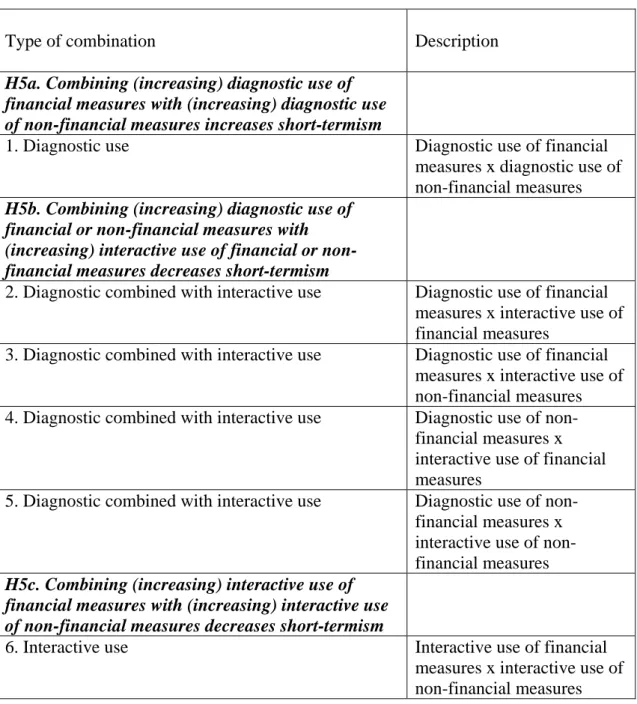
(Venkatraman, 1989; Luft and Shields, 2003; Gerdin and Greve, 2004). The moderation form of fit is appropriate where claims for the efficacy of combining measures are based upon the possibility that short-termism can be avoided where interactive control moderates the effect on short-termism that is caused by diagnostic control. Six interaction terms result from an analysis of the possible combinations of diagnostic and interactive use of financial and non-financial measures and these are shown in Figure 1. It can be seen from Figure 1 that one combination relates entirely to the diagnostic use of
performance measures. The diagnostic use of performance measures can be associated with short-termism where short-termism is a form of gaming or a defensive routine. This argument, which supports hypotheses 1 - 2, gives rise to the following hypothesis:
H5a. Combining (increasing) diagnostic use of financial measures with
(increasing) diagnostic use of non-financial measures increases short-termism
INSERT FIGURE 1 ABOUT HERE
Combinations numbered 2 - 5 in Figure 1 combine diagnostic and interactive use of financial and non-financial measures in different ways. Combining diagnostic and interactive uses leads to dynamic tension that is beneficial to the firm (Simons, 1995; Henri, 2006). Henri (2006) draws upon a varied literature to argue that dynamic tension encourages dialogue and creativity and positively influences the strategic capabilities of market orientation, entrepreneurship, innovativeness and organizational learning. It was argued earlier that processes that are supportive of strategic activities promote a long-term orientation. It follows from this that combining diagnostic and interactive control should be negatively associated with short-termism.
H5b. Combining (increasing) diagnostic use of financial or non-financial measures with (increasing) interactive use of financial or non-financial measures decreases short-termism
The final type of combination presented in Figure 1 relates to the interactive use of both financial and non-financial measures. Interactive use is likely to be strategic and to avoid defensive behaviour, as argued in the development of hypotheses 3 and 4. We therefore present the following hypothesis:
H5c. Combining (increasing) interactive use of financial measures with (increasing) interactive use of non-financial measures decreases short-termism
The matching form of fit applies where the theoretically defined relationship between independent variables may be established without regard to the dependent variable (Venkatraman, 1989). The fit between the independent variables should be capable of theoretical elucidation, as in the case of the concept of the balanced scorecard where the fit, or balance, between different types of financial and non-financial measures is a recognisable construct that is independent of the effects on potential dependent variables. The matching form of fit can be shown to be relevant to combinations involving both
diagnostic and interactive controls and financial and non-financial measures.
Taking combinations of diagnostic and interactive controls first, two arguments are relevant. Firstly, diagnostic use of performance measurement systems ‘ensures that the positive effects of interactive use’ can be realised (Henri, 2006: 537; italics introduced by the authors); and ‘increasing the emphasis on one control component increases the benefits received from increasing the emphasis on other control components’ (Widener, 2007: 760). If the
interactive system is to deliver strategic benefits it follows that support must be provided through the appropriate level of use of the diagnostic system. The second argument is based upon Henri’s (2006: 538) hypothesis that links ‘a balanced use’ of diagnostic and interactive use of performance measurement systems and positive strategic capabilities. The closer the balance or fit in terms of the use of diagnostic and interactive performance measures, then the
greater the positive strategic implications. Given that short-termism is
equivalent to the neglect of strategic activities, two consequences arise from these arguments: 1) imbalance can be expected to be less than optimal, and may even be dysfunctional, and will occur if the effect of diagnostic use of performance measures exceeds the effect of interactive use (and vice versa); and 2) given the arguments that supported hypotheses 1 - 4, an imbalance in favour of diagnostic vis-à-vis interactive use of performance measures will lead to short-termism. These arguments may be applied to both financial and non-financial performance measures on the basis that Simons (1995) argues that it is the ways in which performance measures are used which is of key significance. We hypothesise that:
H6a: Increasing imbalance in favour of diagnostic use over interactive use of both financial and non-financial measures is associated with increasing short-termism
The matching concept of fit also applies in the case of financial versus non-financial measures. The balance between non-financial and non-non-financial
measures is fundamental to the impact of the balanced scorecard (Kaplan and Norton, 1996). In terms of the impact of these measures taken in isolation, financial measures reflect past and current activities and have been classified as lagging indicators of performance (Kaplan and Norton, 1996; Banker, Potter and Srinivasan, 2000; Sliwka, 2002). Non-financial performance
measures are considered to be leading indicators in the sense that they have predictive value for future financial results (Kaplan and Norton 1996; 2000; Banker et al., 2000). Firms have been shown to use more non-financial measures when they have adopted more long-term orientated strategies (i.e.
innovation or prospector types of strategy; Ittner et al., 1997; Said,
HassabElnaby and Wier, 2003; HassabElnaby, Said and Wier, 2005). In terms of the balance or fit between different types of performance measures, non-financial measures augment non-financial measures in order to provide a diverse set of measures which provide strategic information when presented as a combined package (Ittner, Larcker and Randall, 2003). Since combining performance measures so as to ensure an appropriate fit between financial and non-financial measures supports strategy, and since strategic activity is counter to short-termism, it follows that short-termism may result from a failure to combine measures in a balanced way. In particular, underweighting non-financial measures undermines the objectives of the balanced scorecard (Lipe and Salterio, 2000); and thus weakens its strategic impact and makes it more likely that short-termism will result. An imbalance in favour of financial
measures may over-emphasise the past and present; and at the extreme it is the sole use of financial measures that has traditionally been associated with short-termism (e.g. Ittner, Larcker and Meyer, 2003). Given that the balanced scorecard can be used either diagnostically or interactively (Simons, 2005: 142), the following hypothesis can be stated:
H6b: Increasing imbalance in favour of the use of financial measures over non-financial measures for both diagnostic and interactive control is associated with increasing short-termism
4. Method
We tested our hypotheses within the telecommunications industry, drawing respondents from Comtel5, a major organization within this globalised industry. The study of telecommunications firms is particularly apposite to developing our understanding of short-termism because such firms need to
sustain a high rate of strategic adaptation and change in order to prosper in the long-term and yet face intense competition which endangers their short-term survival (Dutton, Ashford, O’Neill, Hayes and Wierba, 1997). The use of a single firm for the sample is both a strength and a weakness. Single site research enables us to focus upon the use of performance measurement systems and to assume consistency of factors which may independently affect the behaviour of respondents. The factors which remain consistent across the present analysis include: organizational size and competencies, performance measurement and reward systems, and organizational strategy. The single site limits our ability to make claims for generalizability. However, drawing respondents from a single organization is not uncommon in the literature. For example, Brownell (1981), Hopwood (1972) and Otley (1978) have all drawn on single organization settings to examine the use of performance measures.
Data were collected via a questionnaire survey distributed to the senior divisional managers of Comtel in the spring/summer of 2006. 284
questionnaires were distributed electronically and 100 usable responses were obtained. The response rate was 35.2%. Non-response bias was assessed on the basis of the familiar assumption that non-respondents are more likely to be similar to late respondents than early respondents (Fowler, 1993). A two-sample t-test showed significant differences in mean values for only age (p<0.05) and diagnostic use of non-financial measures (p<0.05). Given the importance of the latter of these two variables in the study, the analysis was also conducted using the separate groups of early versus late respondents.
No significantly different results were found compared to the composite group of respondents.
Questionnaire instruments were pre-tested and piloted prior to the main study. Two of the research team who were not involved in developing the
questionnaire were asked to assess the questionnaire instruments for ambiguity, style of question and length. The revised questionnaire was then distributed to MBA students studying in the USA and in New Zealand. 45 completed questionnaires were returned in total from these two groups. Responses were analysed using confirmatory factor analysis, scaling, and correlation analysis. Comments made by respondents were also reviewed. These processes led to the research instruments being revised. The final version of each instrument is described below.
5. Measurement instruments
Short-termism
A six-item instrument (reduced to three following principal component factor analysis) was devised to capture short-termism (see items 1-6 in the
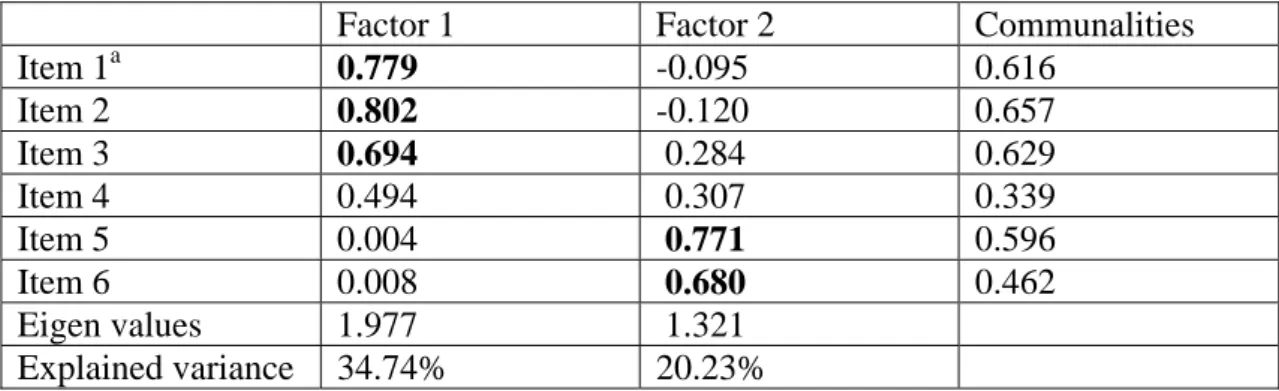
Appendix). The six-item instrument contained three questions based upon the Marginson and McAulay (2008) instrument that provides a direct measure of short-termism as an inter-temporal trade-off and three questions that were reverse scored and which sought to represent a long-term orientation. Factor analysis results shown in Table 1 reveal a two-factor solution. The three items designed to measure short-termism (questions 1 – 3) clearly load onto a separate factor. A Cronbach Alpha of 0.68 was obtained for this three-item
instrument which was used in the analysis. The measure of long-term orientation was included in exploratory analysis but no significant findings resulted and the analysis is not presented here.
INSERT TABLE 1 ABOUT HERE
Diagnostic/interactive use of financial and non-financial measures
We adopted the instruments used by Henri (2006) to measure respondents’ diagnostic and interactive use of financial and non-financial measures, with minor changes to wording being introduced after pre- and pilot testing. Two separate instruments were developed, each comprising 11 items, with four items representing diagnostic use and seven items representing interactive use, as shown in the Appendix (items 7 – 17). Two sections of the
questionnaire were designed to independently assess responses to financial and non-financial measures.
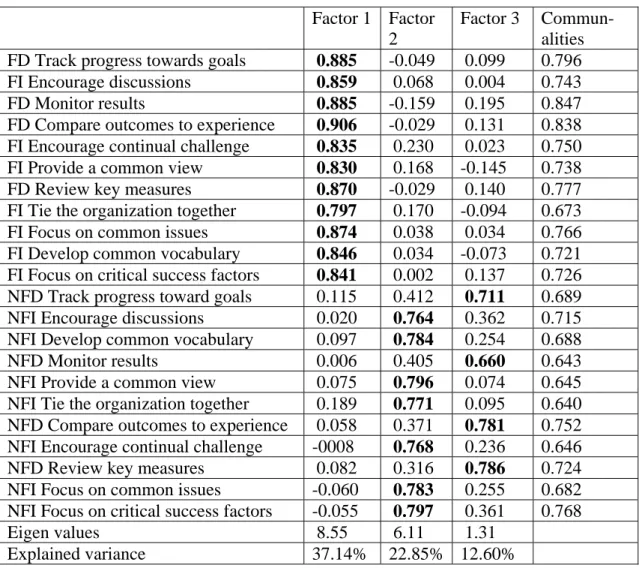
We employed confirmatory factor analysis to check the existence of separate variables for the diagnostic and interactive use of financial and non-financial measures. Principal component factor analysis confirmed the existence of separate sub-dimensions of diagnostic and interactive use for the
non-financial instrument, but not for the non-financial instrument. Table 2 shows that all items for the financial instrument load onto a single factor. This may be
interpreted as suggesting that financial measures were used at Comtel in order to combine diagnostic and interactive use in theoretically justifiable ways6. We established separate instruments for diagnostic and interactive
use of financial and non-financial measures according to theory. Cronbach alpha scores were 0.87 or greater (see rows 2-5 of Table 3). Given the results of the factor analysis, we also conducted additional analysis using an
instrument comprising all 11 items for the financial measure. The results of this analysis are not presented in the paper, but are available on request. They confirm the results of the analysis which is reported.
INSERT TABLE 2 ABOUT HERE
Diagnostic-interactive and financial-non-financial imbalance measures In order to test for the matching concept of fit, variables were created based upon the absolute difference between the standardised scores of the original variables, using the mean as the basis for standardisation (see Alexander and Randolph, 1985; Venkatraman, 1989). The four variables, which are treated as new variables that are independent of the variables upon which they are based (Alexander and Randolph, 1985), were paired as follows: 1) the difference between diagnostic and interactive use of financial measures was paired with 2) the difference between diagnostic and interactive use of non-financial measures; and 3) the difference between the diagnostic use of financial and non-financial measures was paired with 4) the difference between the interactive use of financial and non-financial measures. Hypothesis 6a relates to (1) and (2) and is concerned with the imbalance between diagnostic and interactive use. Hypothesis 6b relates to (3) and (4) and is concerned with the imbalance between the use of financial and
non-financial measures. Cronbach alpha scores are not available because the four variables are single item measures.
Control variables
To reduce the likelihood that demographic characteristics would confound responses to short-termism, three characteristics were measured and
controlled for in the analysis: age, gender, and level of education. These may influence managerial beliefs, values, opinions, and actions (Knight, Pearce, Smith, Olian, Sims, Smith and Flood, 1999), and may thus influence
managers’ time horizons. We also controlled for hierarchical level, given Jaques’ (1990) argument that hierarchy supports diverse temporal orientations, with senior managers providing a long-term orientation.
6. Analysis and results
Table 3 reports means, standard deviations, Cronbach alphas and Pearson correlation coefficients. Tests for multicollinearity among the main effects variables revealed, for financial measures, variance inflation factors of approximately 2.70 and tolerances of approximately 0.37. For non-financial measures, both variance inflation factors and tolerances were well within acceptable limits (<2.0 and >0.50 respectively). Overall, test results suggest no significant problems in terms of using multiple regression to test
hypotheses 1 – 4 (Belsley, Kuh and Welsch, 1980). In the case of hypothesis 6, two approaches were adopted (based upon Alexander and Randolph, 1985): 1) measures of imbalance were included with the main effects
main effects variables, giving rise to three models, which: a) include all four variables; b) include variables related to imbalance between diagnostic and interactive use; and c) include variables related to imbalance between
financial and non-financial measures. Only in the case of the model containing the two variables related to imbalance between diagnostic and interactive use (2b) were tests for multicollinearity acceptable (variance inflation factors and tolerances were <2.0 and >0.5 respectively).
INSERT TABLE 3 ABOUT HERE
We applied Harman’s single-factor test by conducting confirmatory factor analysis using principal component factor analysis involving the main effects variables in order to test for the possibility of common response bias
(Podsakoff, MacKenzie and Lee, 2003). Responses for financial measures load onto one instead of two factors, but generally factor loadings for all variables examined in this study correspond with their theoretical constructs. Neither item misspecification nor cross-loading is a problem.
6.1 Test of hypotheses
We tested hypotheses 1 – 4 using hierarchical multiple regression analysis (Hartmann and Moers, 1999). Three models were developed. The first model contains the control variables only. Model 2 adds the measures for diagnostic and interactive use of financial measures. Model 3 adds the measures for diagnostic and interactive use of non-financial measures. Results are reported in Table 4.
INSERT TABLE 4 ABOUT HERE
The results shown in Table 4 suggest that, whether used diagnostically or interactively, increasing use of financial measures may have no effect on short-termism. Neither hypothesis 1 nor hypothesis 3 is supported. In contrast, the use of non-financial measures both diagnostically and interactively is found to be associated with managers’ inter-temporal trade-off choices. The greater the importance that is attached to the diagnostic use of non-financial measures, the greater managers’ short-termism. Increasing interactive use of non-financial measures is negatively associated with short-termism.
Hypotheses 2 and 4 are therefore supported.
Hypotheses 5a, 5b and 5c predict that interaction terms will be associated either positively or negatively with short-termism. All six interaction terms in Figure 1 were added to model 3 to produce the first analysis. Each of the interaction terms was independently added, in turn, to model 3 as the basis for subsequent analysis. For instance, for one analysis, we included a product term which represented the joint effect of diagnostic use of financial measures and interactive use of non-financial measures (combination 3, Figure 1). None of the interaction terms was significant. The hypotheses (5a, 5b, 5c) are not supported.
Hypothesis 6a predicts that, for both financial and non-financial measures, an imbalance in favour of diagnostic use will lead to short-termism. Table 5 presents the regression model for these two variables. The results of Table 5
suggest that for financial measures, an imbalance in favour of diagnostic use is not associated with managers’ inter-temporal trade-off choices. However, for non-financial measures, an imbalance in favour of diagnostic use is associated with short-termism. H6a is partially supported.
INSERT TABLE 5 ABOUT HERE
Hypothesis 6b predicts that, for both diagnostic and interactive use, an imbalance in favour of financial measures will lead to short-termism. Table 3 shows that the correlations between the two imbalance measures are not significantly correlated with short-termism. Hypothesis 6b cannot be supported.
7. Discussion and Conclusions
Short-termism was apparent at our research site and one aim in developing this study was to explore theoretical explanations and empirical tests to
account for such behaviour. Our results do not support the enduring orthodoxy that financial measures create short-termism, and nor do our results support the proposition that using non-financial measures will impact the short-termism caused by financial measures. Contrary to the proposition that non-financial measures discourage the short-termism that is associated with financial measures (e.g. Ittner and Larcker, 1998; Sliwka, 2002; Merchant and Van der Stede, 2007), our findings suggest that it is not financial or
non-financial measures per se which affect short-termism, but the way in which performance measures are used. It seems that non-financial measures can
create short-termism where they are used diagnostically; whilst the interactive use of non-financial measures may be negatively associated with
short-termism.
Our study explored the impact of combinations of diagnostic and interactive uses of financial and non-financial measures. Two forms of fit were tested. No significant results were found for the moderating effect of non-financial
measures. This appears to be consistent with Henri’s (2006) finding of no overall association between dynamic tension and strategic capabilities. Only partial support for the concept of matching was found. As in the case of the analysis of the main effects, no association was found between the imbalance between the diagnostic and interactive use of financial measures and it was only in the case of non-financial measures that an imbalance in favour of diagnostic use was associated with short-termism.
The differences between the findings for financial and non-financial measures are surprising. If diagnostic use provides an explanation for short-termism, it might be expected that the diagnostic use of financial measures would be associated with short-termism.
In general, there does not appear to be a compelling reason to explain this difference in terms of the characteristics of performance measures. Financial measures, such as return on capital employed, may emphasise the short-term, according to the orthodox view, or may equally be important for strategy and a long term orientation (Bhimani and Langfield-Smith, 2007). Financial
measures such as the Price Earnings ratio include share price data and may drive an external, future, and strategic orientation. In contrast, measures relating to costs and current assets, including cost-income ratios, productivity ratios, stock turnover and the current ratio, appear to be short-term in
orientation. Yet, equally, non-financial measures such as customer
satisfaction or delivery time may encourage either a long-term or a short-term orientation. It therefore appears that further work may be needed to consider ways in which specific measures are used. For instance, a measure of quality used diagnostically may focus attention on the short-term, even where there are long-term issues, whilst a measure of new product development, even when used diagnostically, may encourage a long-term orientation7. The possible consequence is the need for future research to go beyond the general categories of financial versus non-financial to consider how specific types of performance measures, when used diagnostically, may lead to short-termism.
An alternative explanation may be found in the argument that short-termism is a form of gaming and a defensive response that serves to preserve
self-esteem. Based upon Argyris’ (1999) theory of action, it was argued earlier in this paper that short-termism may enable individuals to preserve a positive sense of self through the pursuit of actions that subordinates believe send messages that superiors wish to receive. The link between short-termism and financial measures is therefore premised on the assumption that superiors wish to receive messages communicated in financial terms. In some situations this may not be the case. For Comtel, for instance, discussions with senior
managers revealed that the company: 1) accorded low priority to financial targets at the departmental level following experiences consistent with the dysfunctional effects outlined in the beyond budgeting literature (see Hope and Fraser, 2003); and 2) stressed the importance of non-financial measures in pursuit of a policy based upon the principles of beyond budgeting. There was therefore little if any motivation at the divisional level for managers to maintain self esteem or to act defensively in terms of the financial
performance measurement system. In contrast, non-financial measures were emphasised within the organisation, and so it might be expected that
departmental managers who were short-termist would be managers for whom diagnostic control was important in relation to their use of non-financial
measures.
The findings presented here are premised on the assumption that the short-term is defined as a period of one year. Discussion is required on this point because, whilst this assumption is consistent with prior studies, it is possible that there may be industry level drivers that lead to alternative definitions of the short-term8. Time horizons may also vary according to the responsibility time span of the role (the time required to complete the longest project/task assigned to the role; Jaques, 1990). There is therefore scope to elaborate on the nature of managerial time horizons and we explored two possibilities through further analysis, based on regression analysis and clustering (Everitt, 2001). One is that the utilisation of financial and non-financial measures may be linked to how managers define the short-term. The other is that definitions of what constitute the short-term may underpin the relationship between
financial/non-financial measure utilisation and short-termism. We found no association between how the short-term is defined and how financial and non-financial measures are used. In contrast, analysis of definitions of the short-term based upon time horizons of three, six, twelve and eighteen months confirm the main findings but stress the role of a time horizon of < 6 months as a basis for the associations between diagnostic and interactive uses of non-financial measures and short-termism9. We conclude that future studies may benefit from including the time horizons of managers in their analysis.
There is also scope for future studies which build upon our findings in other contexts and which address the relationship between the diagnostic and interactive utilisation of financial and non-financial measures and
short-termism. Studies where financial measures remain organisationally important at the divisional level would be particularly important in testing the proposition that short-termism is a form of defensive behaviour that results from the
support given by diagnostic use to single loop feedback systems. In single site contexts where financial measures are balanced by non-financial measures at the organisational level we might expect that diagnostic use per se and / or imbalance in favour of diagnostic use will lead to short-termism. Alternatively, cross sectional studies across firms may reveal that diagnostic use and / or imbalance in favour of diagnostic use explain short-termism irrespective of the types of measures adopted. Such studies may consider the impact of industry type; especially due to a limitation of the present study in pursuing a company based within the telecommunications industry, where the prioritisation of non-financial measures over non-financial measures may be a feature of the industry
due to the impact of regulations that stress the importance of safety and customer satisfaction (Ittner et al., 1997).
The research presented here is exploratory and this implies that there are limitations that future research can address. First, the generalizability of the results is limited by the use of respondents from a single organization. As suggested in the previous paragraph, there is a research opportunity to be gained from pursuing the hypotheses across a range of companies. Second, common method bias may not be totally discounted through the use of Harman’s single factor test and remedial strategies are available which may be adopted in future studies (see Podsakoff et al., 2003). The third limitation relates to the development of Marginson and McAulay’s (2008) measure of short-termism. This supports a definition of short-termism that appears to provide valuable research potential; but the measure relating to a long-term orientation requires further development if there are to be future tests of the claims for the long-term orientation that might result from the interactive use of either financial or non-financial performance measures. Fourth is the limitation that both reverse causality and endogeneity may apply; unobserved variables may cause short-termism which in turn causes managers to employ financial and non-financial measures in different ways. Fifth, the explanatory power of our regression models indicates that there are potentially many other
variables which we did not examine in our study but which may motivate managers to adopt a short-term orientation. In particular, this study did not seek to investigate factors such as capital market pressure, reward schemes, culture, trust, role ambiguity and social influence, which may explain
short-termism (Laverty, 1996; 2004; Marginson and McAulay, 2008)10. Likewise, this study did not consider the impacts of culture and environmental
uncertainty that Henri (2006) has shown to be necessary to understanding the impacts of the dynamic tension created by the combined use of diagnostic and interactive performance measurement systems.
A final limitation is that this paper is consistent with others of its type in conflating management control systems and performance measurement systems research through the adoption of phrases such as ‘diagnostic use of performance measurement systems’ and ‘interactive use of performance measurement systems’ (see, for instance, Henri, 2006, for a further example of a paper that draws from both management control and performance in this way)11. Clearly, management control systems and performance measurement systems each have their own traditions and it would not be correct to assume that the concepts of control and performance are interchangeable in all
situations. Indeed, there is a view, expressed recently through, for instance, the debates on Sarbanes Oxley, that control is inimical to performance. Throughout the paper we were careful to use phrases that suggest that
performance measures are used in diagnostic and interactive control systems, following Simons (1995; 2000; 2005), without seeking to make stronger
assertions regarding the underlying relationships. Equally, whilst we draw upon the concepts of single loop and double loop feedback, which are particular forms of control, we do not wish to suggest that other forms of control are not important. Additional theoretical elaboration and clarification is necessary. A variety of papers provide relevant reviews which provide a
starting point for such work. For instance, for reviews of the management control systems literature see Langfield-Smith (1997) and Chenhall (2003). For a review that addresses the enabling and constraining roles of
performance measurement systems, see Wouters and Wilderom (2008).
Notwithstanding these limitations, our findings complement recent contributions which have begun to reassess the value of non-financial performance measurement systems. The balanced scorecard philosophy in particular has spurred interest in the notion of combining leading and lagging performance indicators to optimise firm performance over the longer-term (Kaplan and Norton, 1996; 2000). These claims assume that non-financial measures create effects that are different to, and overcome the limitations associated with, the sole use of financial measures. However, recent literature has begun to question this assumption. For example, Lau and Sholihin (2005) found no differences between financial and non-financial measures for the behavioural consequences of performance measurement systems. In a second example, Ittner, Larcker and Meyer (2003) report a case study based upon a balanced scorecard based reward system, which is claimed by Kaplan and Norton (2001) to have positive effects, and describe how the system was ultimately abandoned. Our findings complement this emerging body of
research by highlighting the need to consider the ways in which performance measures are used in addition to the impact of the measures per se.
Acknowledgements
We thank the editor and two anonymous reviewers for their constructive comments and helpful suggestions. We acknowledge the useful comments given by the Discussant and participants at the AAA Annual Congress (2008). Finally, we would like to thank the 100 managers at Comtel who completed the questionnaire on which this study is based.
1The literature appears to imply that disposition results from the influence of capital markets
or performance measurement systems. These influence behaviour irrespective of
predisposition. There is some evidence to suggest that this need not necessarily be the case. For instance, Hofstede (2001: 361) suggests that in ‘short-term orientated cultures the ‘bottom-line’ ... is a major concern; control systems are focused on it and managers are constantly judged by it’, and that culture predisposes individuals to be short-termist. Performance measurement systems may therefore represent a moderating variable that amplifies existing predispositions.
2
Otley defined two groups of managers, designated B and C based upon the ranking of two questionnaire items: ‘how well I meet my budget’ and ‘how efficiently I run my unit’. Managers in both groups ranked both items among their top three performance criteria and thus
maintained a balance between budget and efficiency criteria.
3
The object of Gibbs et al (2004) study was the determinants of subjectivity in incentives. The authors expected to find that the short-term focus of quantitative measures would lead to the use of subjectivity in determining levels of reward but found a negative relationship contrary to expectations. In contrast, for the measure of short-termism based upon the proxy of long term investments in intangibles, a positive relationship was reported consistent with expectations.
4The third kind of fit which is widely adopted is mediation.Mediation is inappropriate in this
case because there must be a causal relationship between the independent variables for mediation to be appropriate (Gerdin and Greve, 2004). There is no argument in the literature to suggest that any type of use of financial measures gives rise in causal terms to any type of use of non-financial measures.
5
A fictitious name is used to respect confidentiality.
6
We thank an anonymous reviewer for pointing out this possibility. The implication is that the level of dynamic tension or balance between diagnostic and interactive uses of financial measures gave rise to a single factor.
7
We thank an anonymous reviewer for encouraging us to adopt the form of analysis presented throughout this paragraph.
8We are grateful to an anonymous reviewer for suggesting this possibility. 9
Details are available on request.
10
We examined role ambiguity as a potential determinant of short-termism. Our findings support those of Marginson and McAulay (2008), who found increasing role ambiguity to be associated with increasing short-termism. Results are not reported in this paper but are available on request.
11
References
Abernethy, M.A. and Brownell, P. (1999). ‘The role of budgets in organizations facing strategic change: an exploratory study’. Accounting, Organizations and Society, 24(3): 189-204.
Alexander, J.W. and Randolph, W.A. (1985). ‘The fit between technology and structure as a predictor of performance in nursing subunits’. Academy of Management Journal, 28 (1): 844-859.
Argyris, C. (1990). ‘The dilemma of implementing controls: the case of managerial accounting’. Accounting, Organizations and Society, 15 (6): 503-511.
Argyris, C. (1999). On organizational learning (2nd edition), Oxford: Blackwell Publishing.
Banker, R.D., Potter, G. and Srinivasan, D. (2000). ‘An empirical investigation of an incentive plan that includes nonfinancial performance measures’.
Accounting Review, 75(1): 65-92.
Belsley, D. A., Kuh, E., and Welsch, R. E. (1980). Regression diagnostics. New York: Wiley.
Bhimani, A. and Langfield-Smith, K. (2007). ‘Structure, formality and the importance of financial and non-financial information in strategy development and implementation’. Management Accounting Research, 18(1): 3-31.
Bhojraj, S. and Libby, R. (2005). ‘Capital market pressure, disclosure frequency-induced earnings, cash flow conflict, and managerial myopia’. Accounting Review, 80(1): 1-20.
Birnberg, J.G., Turopolec, L. and Young, S.M. (1983). ‘The organizational context of accounting’. Accounting, Organizations and Society, 8 (2/3): 111-129.
Bisbe, J. and Otley, D. (2004). ‘The effects of interactive use of management control systems on product innovation’. Accounting, Organizations and Society, 29(8): 709-737.
Brownell, P. (1981). ‘Leadership style, budgetary participation and managerial behaviour’. Accounting, Organizations and Society, 6 (3): 307-321.
Burchell, S., Clubb, C., Hopwood, A., Hughes, J. and Nahapiet, J. (1980). ‘The roles of accounting in organizations and society’. Accounting,
Organizations and Society, 5(1): 5-27.
Chenhall, R. H. 2003. ‘Management control system design within its organizational context: findings from contingency-based research and
directions for the future’. Accounting, Organizations and Society, 28(2-3): 127-168.
Choudhury, N. (1986). ‘Responsibility accounting and controllability’. Accounting and Business Research, 16(3): 189-198.
Chow, C.W., Kato, Y. and Merchant, K.A. (1996). ‘The use of organizational controls and their effects on data manipulation and management myopia’. Accounting, Organizations and Society, 21(2/3): 175-192.
Dutton, J.E., Ashford, S.J., O’Neill, R.M., Hayes, E. and Wierba, EE. (1997). ‘Reading the wind: how middle managers assess the context for selling issues to top managers’. Strategic Management Journal, 18(5): 407-425.
Everitt, B. (2001). Cluster Analysis. London: Edward Arnold.
Fowler, F.J. (1993). Survey research methods. Newbury Park, CA: Sage. Gerdin, J. and Greve, J. (2004). ‘Forms of contingency fit in management accounting research – a critical review’. Accounting, Organizations and Society, 29(3-4): 303-326.
Gibbs, M., Merchant, K.A., Van der Stede, W.A. and Vargus, M.E. (2004). ‘Determinants and effects of subjectivity in incentives’. Accounting Review, 79(2): 409-436.
Hartmann, F. G., and Moers, F. (1999). ‘Testing contingency hypothesis in budgetary research: an evaluation of the use of moderated regression analysis’. Accounting, Organizations and Society, 24(4): 291-315. HassabElnaby, H.R., Said, A.A. and Wier, B. (2005). ‘The retention of nonfinancial measures in compensation contracts’. Journal of Management Accounting Research, 17: 23-42.
Hayes, R. H. and Abernathy, W. J. (1980). ‘Managing our way to economic decline’, Harvard Business Review, 60(3): 71-79.
Henri, J-F. (2006). ‘Management control systems and strategy: a resource-based perspective’. Accounting, Organizations and Society, 31(6): 529-558. Hodak, M. (2005). ‘Letting go of norm: how executive compensation can do better than “best practice”’. Journal of Applied Corporate Finance, 17 (4): 115-124.
Hofstede, G. (2001). Culture’s consequences: comparing values, behaviours, institutions, and organizations across nations (2nd edition). Thousand Oaks, CA: Sage.
Hope, J. and Fraser, R. (2003). Beyond Budgeting: how managers can break free of the annual performance trap. Boston, MA:.Harvard Business School Press.
Hopwood, A.G. (1972). ‘An empirical study of the role of accounting data in performance evaluation’. Empirical Research in Accounting Studies: Selected Studies. Journal of Accounting Research, 10 (Supplement): 156-182.
Ittner, C. D. and Larcker, D. (1998). ‘Innovations in performance
measurement: trends and research directions’. Journal of Management Accounting Research, 10: 205-238.
Ittner, C. D., Larcker, D. F. and Rajan, M. V. (1997). ‘The choice of
performance measures in annual bonus contracts’. Accounting Review, 72(2): 231-256.
Ittner, C.D., Larcker, D.F. and Meyer, M.W. (2003). ‘Subjectivity and the weighing of performance Measures: evidence from a balanced scorecard’. Accounting Review, 78(3): 725-758.
Ittner, C.D., Larcker, D.F. and Randall, T. (2003). ‘Performance implications of strategic performance measurement in financial service firms’. Accounting, Organizations and Society, 28(7-8): 715-741.
Jaques, E. (1990). ‘In praise of hierarchy’. Harvard Business Review, 70 (6): 127-133.
Johnson, H.T. and Kaplan, R.S. (1987). Relevance lost. Boston, MA: Harvard Business School Press.
Johnson, P. and Gill, J. (1993). Management control and organizational behaviour. London: Chapman.
Kaplan, R.S. (1984). ‘The evolution of management accounting’. Accounting Review, 59(3): 390-418.
Kaplan, R.S. and Norton, D.P. (1996). ‘Using the balanced scorecard as a strategic management system’. Harvard Business Review, 76(1): 75-85. Kaplan, R.S. and Norton, D.P. (2000). ‘Having trouble with your strategy? Then map it’. Harvard Business Review, 80(5): 167-176.
Kaplan, R.S. and Norton, D.P. (2001). The Strategy-Focused Organization: how balanced scorecard companies thrive in the new business environment. Boston, MA: Harvard Business School Press.
Knight, D., Pearce, C.L., Smith, K.G., Olian, J.D., Sims, H.P., Smith, K.A. and Flood, P. (1999). ‘Top management team diversity, group process and
Langfield-Smith, K. (1997). ‘Management control systems and strategy: a critical review’, Accounting, Organizations and Society, 22(2): 207-232. Lau, C.M. and Sholihin, M. (2005). ‘Financial and nonfinancial performance measures: how do they affect job satisfaction?’ British Accounting Review, 37(4): 389-413.
Laverty, KJ. (1996). ‘Economic “short-termism”: the debate, the unresolved issues, and the implications for management practice and research’. Academy of Management Review, 21(3): 825-860.
Laverty, KJ. (2004). ‘Managerial myopia or systemic short-termism? The importance of managerial systems in valuing the long term’. Management Decision, 42(8): 949-962.
Lawrence, P. R. and Lorsch, J.W. (1967). Organization and environment: managing differentiation and integration. Boston, MA: Harvard Business School.
Lillis, A. M. (2002). ‘Managing multiple dimensions of manufacturing
performance – an exploratory study’. Accounting, Organizations and Society, 27(6): 497-529.
Lipe, M.G. and Salterio, S.E. (2000). ‘The balanced scorecard: judgemental effects of common and unique performance measures’. Accounting Review, 75(3): 283-298.
Luckmann, T. (2008). ‘On social interaction and the communicative
construction of personal identity, knowledge and reality’. Organization Studies, 29(2): 277-290.
Luft, J. and Shields, M. D. (2003). ‘Mapping management accounting:
graphics and guidelines for theory-consistent empirical research’. Accounting, Organizations and Society, 28(2-3): 169-249.
Marginson, D. (2002). ‘Management control systems and their effects on strategy formation at middle management levels: evidence from a UK organization’. Strategic Management Journal, 23(11): 1019-31.
Marginson, D. and McAulay, L. (2008). ‘Exploring the debate on
short-termism: a theoretical and empirical analysis’. Strategic Management Journal, 29(3): 273-292.
Merchant, K.A. (1990). ‘The effect of financial controls on data manipulation and management myopia’. Accounting, Organizations and Society, 15(4): 297-313.
Merchant, K.A. and Van der Stede, W.A. (2007). Management control systems: performance measurement, evaluation and incentives (Second edition). Harlow: Pearson Education.