Carr-Hill, R; Rolleston, C; Schendel, R; Waddington, H; (2018) The effectiveness of school-based
deci-sion making in improving educational outcomes: a systematic review. Journal of Development
Effec-tiveness, 10 (1). pp. 61-94. ISSN 1943-9342 DOI: https://doi.org/10.1080/19439342.2018.1440250
Downloaded from:
http://researchonline.lshtm.ac.uk/4647487/
DOI:
https://doi.org/10.1080/19439342.2018.1440250
Usage Guidelines:
Please refer to usage guidelines at
https://researchonline.lshtm.ac.uk/policies.html
or alternatively
contact
[email protected].
Full Terms & Conditions of access and use can be found at
http://www.tandfonline.com/action/journalInformation?journalCode=rjde20
ISSN: 1943-9342 (Print) 1943-9407 (Online) Journal homepage: http://www.tandfonline.com/loi/rjde20
The effectiveness of school-based decision making
in improving educational outcomes: a systematic
review
Roy Carr-Hill, Caine Rolleston, Rebecca Schendel & Hugh Waddington
To cite this article: Roy Carr-Hill, Caine Rolleston, Rebecca Schendel & Hugh Waddington (2018) The effectiveness of school-based decision making in improving educational
outcomes: a systematic review, Journal of Development Effectiveness, 10:1, 61-94, DOI: 10.1080/19439342.2018.1440250
To link to this article: https://doi.org/10.1080/19439342.2018.1440250
Published online: 28 Feb 2018.
Submit your article to this journal
Article views: 52
View related articles
View Crossmark data
ARTICLE
The e
ff
ectiveness of school-based decision making in improving
educational outcomes: a systematic review
Roy Carr-Hilla, Caine Rolleston a, Rebecca Schendelaand Hugh Waddingtonb
aDepartment of Education, Practice and Society, UCL Institute of Education, London, UK;b3ie, London, UK
ABSTRACT
The rhetoric around decentralisation suggests school-based manage-ment improves education outcomes. Existing reviews on school-based decision-making have tended to focus on proximal outcomes and offer very little information about why school-based decision-making has positive or negative effects in different circumstances. The authors sys-tematically searched for and synthesised evidence from 35 quantitative and qualitative studies evaluating 17 individual interventions on the effectiveness of school-based decision-making on educational outcomes. Devolving decision-making to the level of the school appears to have a somewhat beneficial effect on dropout, repetition and teacher atten-dance. Effects on test-scores are more robust, being positive in aggre-gate and for middle-income countries specifically. On the other hand, school-based decision-making reforms appear to be less effective in communities with generally low levels of education, where parents have low status relative to school personnel. The authors conclude that school-based decision-making reforms are less likely to be successful in highly disadvantaged communities.
ARTICLE HISTORY Received 8 February 2018 Accepted 9 February 2018 KEYWORDS
Decentralisation; education outcomes; systematic review
Background
Education is understood to be a fundamental human right that offers individuals the opportunity to live healthy and meaningful lives. Evidence from around the world also indicates that education is vital for economic and social development, as it contributes to economic growth and poverty reduction, sustains health and well-being and lays the foundations for open and cohesive societies (UNESCO2014). In recognition of the vital importance of education, governments across the globe have made a substantial effort to expand and improve their education systems, as they strive to meet the Education for All goals, adopted by the international community in 1990. These efforts have borne remarkable results; it is estimated that the number of out-of-school children has halved over the last decade (UNESCO 2014, 53). However, there are still serious barriers to overcome, particularly in terms of access, completion and learning (Krishnaratne, White, and Carpenter2013). Access to education– particularly for girls, poor children and children in conflict-affected areas– remains a crucial issue.
The devolution of decision-making authority to schools has been widely adopted as a decen-tralisation model by international agencies, including the World Bank, the US Agency for International Development and the UK Department for International Development (DFID) and by governments, as it is assumed that locating decision-making authority within schools will increase accountability, efficiency and responsiveness to local needs (Gertler, Patrinos, and Rubio-Codina 2008). This devolution includes a wide variety of models and mechanisms, differing in terms of CONTACTCaine Rolleston [email protected]
https://doi.org/10.1080/19439342.2018.1440250
which decisions are devolved (and how many), to whom decision-making authority is given and how the decentralisation process is implemented (that is, through ‘top-down’ or ‘bottom-up’ processes). All models and mechanisms are presumed to increase responsiveness to local needs and accountability by bringing community members into direct contact with schools, and to increase efficiency by making financial decisions more transparent to communities, reducing corruption and incentivising investment in high-quality teachers and materials.
However, there is limited evidence from low-income countries of the general relationship between decentralisation reforms and education outcomes. Much of the literature focuses exclu-sively on the proximal outcomes of school-based decision-making. This is likely due to the relative ease of measuring such outcomes, as well as the shorter time generally required to identify impact on intermediate outcomes.
Existing systematic reviews on school-based decision-making have also tended to focus on proximal outcomes (for example, Guerrero et al.2012; on teacher absenteeism; Petrosino et al., 2012; on student enrolment). There are very few that consider the full range of relevant outcomes, such as student learning (for example, Snilstveit et al.2015). The comprehensive reviews that do exist (Santibanez2007; World Bank2007; Bruns, Filmer, and Patrinos2012; Westhorp, Walker, and Rogers 2014) are not systematic reviews as commonly defined, with clear inclusion criteria, systematic literature searches and transparent appraisal and synthesis of the evidence.1 Most of the reviews rely on literature that is now nearly ten years out of date and focus almost exclusively on Central America, referencing almost no evidence from other regions. Existing reviews on this topic also tell us very little about why school-based decision-making has positive or negative effects in different circumstances, a gap which this review also aims to address. There is, therefore, a need for a current globally comprehensive systematic review of the impact of school-based decision-making on a wide range of educational outcomes.
In the following sections, we define school-based decision-making interventions and how they are supposed to work. We then present the review objectives and methods, followed by synthesis of evidence on effects and discussion of the mechanisms underpinning positive and negative effects. Finally, we give implications for policy, programmes and research.
School-based decision-making reforms
Decisions about curricula, finance, management and teachers can all be taken at one or more of several administrative levels: centrally at the national or federal state level, by provinces/regions within a country, by districts or by schools. Often described as‘school-based’or‘community based’ management, the devolution of decision-making authority to schools includes a wide variety of models and mechanisms. These differ in terms of which decisions are devolved (and how many), to whom decision-making authority is given and how the decentralisation process is implemented (that is, through‘top- down’or‘bottom-up’processes).
‘School-based decision-making’can describe models in which decisions are taken by an indivi-dual principal or head teacher, by a professional management committee within a school or by a management committee involving local community members. This last model may simply imply an increased role for parents in the management and activities of the school, or it may include provision of training and materials to empower broader community involvement, depending on the model (Krishnaratne, White, and Carpenter2013).
The devolved decisions can befinancial (for example, decisions about how resources should be allocated within a school; decisions about raising funds for particular activities within a school), managerial (for example, human resource decisions, such as the monitoring of teacher perfor-mance and the power to hire andfire teachers; decisions relating to the management of school buildings and other infrastructure) or related to the curriculum and/or pedagogy (for example, decisions about how elements of a national curriculum will be taught and assessed within a given school). In order to support the process of decision-making, many models also involve some means
of providing information to community members on the performance of an individual school (or school district) relative to other schools (Barrera-Osorio and Linden 2009). These models and mechanisms are considered to potentially increase accountability and responsiveness to local needs by bringing local community members into more direct contact with schools, and to increase efficiency by makingfinancial decisions more transparent to communities, thereby redu-cing corruption and incentivising investment in high-quality teachers and materials.
For the purposes of this review, ‘school-based decision-making’ is defined as including any model in which at least some of the responsibility for making decisions about planning, manage-ment and/or the raising or allocation of resources is located within schools and their proximal institutions (for example, community organisations), as opposed to government authorities at the central, regional or district level. The‘intervention’considered within this review, therefore, isany
reform in which decision-making authority is devolved to the level of the school. Within this broad
definition, there are three main mechanisms discussed in the literature: (1) reforms that devolve decision-making aroundmanagementto the school level; (2) reforms that devolve decision-making aroundfundingto the school level and (3) reforms that devolve decision-making around curriculum,
pedagogy and other aspects of the classroom environmentto the school level.
School-based decision-making is widely promoted by donors in lower-income countries as a means for improving educational quality and is often taken up enthusiastically by national governments. Both generally articulate the ultimate outcome of school-based decision-making models as being a positive change in student outcomes (including but not restricted to learning outcomes). In addition to learning outcomes (most often measured by standardised tests of cognitive skills), there are many other possible student learning outcomes which may be valued by schools, donors and governments, such as improved student ability to demonstrate psychoso-cial and‘non-cognitive’skills. Changes in student aspirations, attitudes and behaviours (such as the adoption of safe sex practices) could also be considered important educational outcomes.
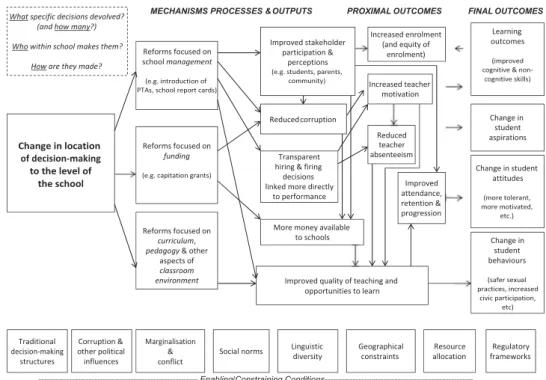
However, devolving decision-making to the level of the school does not lead directlyto such outcomes. Rather, school-based decision-making is likely to impact on outcomes through a number of causal pathways. We developed a conceptual framework depicting our understanding of the causal pathways, contributing factors and underlying processes that could affect the impact of school-based decision-making on educational outcomes (Figure 1), which we used as a‘working hypothesis’(Oliver, Dickson, and Newman2012, 68) to guide the articulation of our specific review questions and review methodology (as recommended by Anderson et al.2011).
Reforms that increase accountability and responsiveness to local needs are assumed to lead to positive stakeholder perceptions of (and engagement in) educational provision, which, in turn, is expected to increase enrolment, attendance and retention and to reduce corruption within schools. It is also presumed that increased accountability will encourage schools to make recruit-ment decisions based on teacher performance, rather than mechanically relying on qualifications or allowing nepotism to interfere. Such personnel practices, in turn, are seen to lead to reduced teacher absenteeism, increased teacher motivation and, ultimately, improvements in the quality of teaching within schools. It is also assumed that local communities will encourage schools to adopt more locally relevant curricula, which can then have a positive impact on the quality of teaching and student opportunities to learn.
At the same time, decentralised funding mechanisms and other reforms aimed at increasing efficiency within schools, particularly when combined with efforts to increase community partici-pation, are presumed to result in more resources being available to schools, another important factor in improving educational quality (Krishnaratne, White, and Carpenter 2013). Increased efficiency is, in turn, assumed to affect the unit costs of educational provision, potentially reducing costs or improving outcomes for a given cost, which may be particularly valued by governments in less well-resourced settings. School-based decision-making mechanisms, therefore, result in many proximal (or intermediate) outcomes, in addition to thefinal outcomes mentioned above. These
proximal outcomes include increased enrolment, improved equality of access, improved atten-dance, improved retention, improved progression and higher quality educational provision.
However, there is growing evidence that decentralisation reforms may have unintended and sometimes negative effects in certain political and economic circumstances (Banerjee et al.2008; Bardhan and Mookherjee2000; Bardhan and Mookherjee2005; Carr-Hill et al.1999; Condy1998; Glassman, Naidoo, and Wood 2007; Pherali, Smith, and Vaux 2011; Rocha Menocal and Sharma 2008; Rose 2003; Unterhalter 2012). Decentralising decision-making may lead to‘elite capture’at the local level and/or further corruption within school systems, for example, or may limit educa-tional opportunity for marginalised ethnic groups. There is some consensus in this literature that decentralisation is only likely to have a positive impact on outcomes when (a) there is clear government policy and/or regulations about the powers and role played by different agencies and stakeholders; (b) there are sufficient financial resources available within the system and (c) there is some form of democratic culture (see De Grauwe et al. 2005; Lugaz et al.2010; Pherali, Smith, and Vaux2011). Those vested with the authority to make decisions on behalf of the school must also have the capacity and knowledge to make such decisions, or their decisions are unlikely to have a positive impact on outcomes (World Bank 2004). This body of evidence highlights the contingency of the effects of decentralisation, linked to important interactions between formal structures of decision-making and informal structures of power and authority within bureaucracies, communities and schools.
Furthermore, each link in the causal chain rests on certain assumptions which must be met for a change in the location of decision-making to have the desired effect(s). For instance, the assertion that involving parents and community members in the hiring andfiring of teachers (an ‘ account-ability’ mechanism employed in many contexts) will improve quality of teaching rests on the assumption that (a) parents and community members will be able to identify high-quality teachers who should be retained and/or rewarded, (b) the incentives provided will positively impact student
What specific decisions devolved? (and how many?) Who within school makes them?
How are they made?
Reforms focused on school management of decision-making Reforms focused on funding Reforms focused on curriculum, pedagogy & other
aspects of classroom environment
MECHANISMS PROCESSES & OUTPUTS PROXIMAL OUTCOMES FINAL OUTCOMES
--- Enabling/Constraining Conditions--- Improved stakeholder participation & perceptions Increased teacher motivation
More money available to schools
Improved attendance, retention & progression
Improved quality of teaching and opportunities to learn Reduced corruption Reduced teacher absenteeism Learning outcomes Increased enrolment (and equity of enrolment) Change in student aspirations Transparent
hiring & firing decisions linked more directly
to performance Change in student attitudes Change in student behaviours Traditional decision-making structures Corruption & other political influences Marginalisation & conflict
Social norms Linguistic diversity Geographical constraints Resource allocation Regulatory frameworks
Figure 1.Conceptual framework.
learning and (c) former more centralised systems were less than optimal with regard to teacher recruitment and accountability, leaving scope for improvement through reform. This is not always achieved. In some contexts, teacher incentive schemes have been found to have a negative impact on overall student learning, if, for instance, they create perverse incentives for teachers to block the enrolment of low-performing students to maintain high average test scores within their classrooms (Glewwe, Ilias, and Kremer2003). The impact of school-based decision-making models is, therefore, likely to differ depending on a wide variety of implementation factors, relating to the objective of the reform, the decisions that are devolved, the individuals given decision-making authority and the nature of the decision-making process.
Objectives and methods
The review aims to answer two questions:
(1) What are the impacts of school-based decision-making on educational outcomes in low- and middle-income countries (LMICs)?
(2) What are the barriers to and enablers of effective models of school-based decision-making? The review followed an explicit protocol (see Carr-Hill et al. 2014). Full details of the review approach are provided by Carr-Hill, Rolleston, and Schendel (2016).
To be included in the review, all studies had to: (1) be empirical in nature and focused on primary and secondary schools within LMICs2; (2) investigate a change in decision-making authority
from a higher level of decision-making authority to the level of the school; (3) provide data on the relationship between school-based decision-making and at least one educational outcome (either proximal, for example, attrition, equality of access, increased enrolment or final, for example, student learning, as captured by test scores, psychosocial and non-cognitive skills, and so forth) and (4) rely on data collected since 1990 be reported in English, French, Spanish or Portuguese.3
Studies of any follow-up duration and studies with multiple follow-ups were included.
We excluded evidence collected in LMICs located within Central and Eastern Europe (including Turkey) or the former USSR, and studies where the intervention was conceptualised, managed and implemented by an external decision-making agency. Studies of interventions aimed exclusively at improving the functioning of devolved decision-making structures – but not introducing new decision-making authority – were excluded (for example, interventions aimed at strengthening the effectiveness of pre-existing village education committees, such as the report card initiative discussed by Banerjee et al. 2008). We also excluded studies investigating a change in decision-making authority to a level higher than the school (for example, studies of decentralisation to the region or district level). Studies that investigated the effects of privatisation of schooling were excluded on a related basis. Further, studies focusing on decision-making at levels lower than the school were also excluded. These include demand-side interventions (for example, conditional cash transfers) intended to influence decisions made at the household, family or child-level.
We conducted a mixed methods review. To be eligible for review under RQ1, studies needed to be causal in nature, meaning we included: (1) experimental designs using randomised or quasi-randomised assignment and (2) quasi-experimental designs collecting longitudinal data at baseline and endline in intervention and comparison groups, as well as those using cross-sectional endline data only, provided an appropriate method of analysis has been used to control for confounding. Any comparison needed to be contemporaneous– that is, data on a reform group and a non-reform group needed to reflect the same time period. All the included studies needed to analyse data at the level of the child or at the level of the school or community. Studies analysing comparison groups at sub-national or country level were excluded, as were studies in which there was clear evidence of spillovers or contamination to comparison groups from the same communities, and studies in which reporting biases were evident were excluded.4
For RQ2, we included studies of any empirical design, so long as they provided evidence on contexts already included in the review, and met the standards of transparency, appropriateness, rigour, validity, reliability and cogency set out by DFID (2014). These included‘process evaluations’ and/or project completion reports of any of the school-based decision-making interventions evaluated in reference to thefirst review question, other empirical studies (employing quantitative, qualitative or mixed methods of analysis) which provided data on either factors found to affect the implementation of one of the school-based decision-making interventions evaluated in reference to thefirst review question, or conditions or circumstances found to affect the impact of one of the included interventions on the specified outcome(s). Studies reporting stakeholder perceptions of a change in outcomes were excluded, as were studies exclusively reporting on processes or outputs (for example, changes in the frequency of community participation).
Potentially relevant literature was identified through afive-stage search strategy for published literature (for example, journal articles, books, conference papers and institutional grey literature, including reports and process evaluations) and unpublished literature (for example, dissertations, theses and unpublished empirical studies showing null and/or negative results). This comprised: (1) identification of existing systematic reviews in related areas; (2) targeted searches in a wide range of bibliographic databases and websites5; (3) hand searches of the eight most relevant journals relating to the topic; (4) citation chasing6and (5) contacting experts involved in the research area. Relevant studies were then appraised for robustness of evidence and methodological rigour prior to synthesis.
We identified 2821 titles (135 from systematic reviews, 2141 from databases and 541 from website and hand searches)7of which 100 met the review eligibility criteria (Figure 2). A total of 30 of the 100 met the design criteria required for RQ1, but three were removed from RQ1 synthesis, due to high risk of bias.8A total of 27 studies were, therefore, included in the review of which 26 studies, investigating the impact of 17 individual interventions, were included in meta-analysis.9A total of 23 non-causal studies were identified and critically appraised, of which 9 were included.
Table 1. Characteristics of included intervention studies. Name of intervention Country, school level Intervention description Level of decentralisation Impact studies (RQ1) and linked studies (RQ2) Outcomes included in meta-analysis RQ1 study design (risk of bias) PDE Brazil, primary schools The programme began in 1998 and was administered by the World Bank-fi nanced Fundescola Project. Schools conducted needs assessment and developed plans to address them, which Fundescola project funded. Initially, 401 schools in 9 states took part. In 2001, the programme was rolled out to more than 5600 schools, with total investment over 1 million dollars. Medium decentralisation RQ1: Carnoy et al. ( 2008 ) RQ2: N/A None (data not available) Quasi-experiment (moderate risk of bias) EDUCO El Salvador, primary schools EDUCO, established in 1991, is a national programme that gives communities autonomy over most educational decisions. Under the EDUCO model, community education associations – in which parents are the majority – are responsible for administering and managing the school, including hiring, fi ring and paying teachers. Community education association members are elected by their peers and receive training on various aspects of school management. Community education association members must be literate and they are elected by their peers. They also receive training prior to assuming their duties. High decentralisation RQ1: Jimenez and Sawada ( 1999 ); Jimenez and Sawada ( 2003 ); Sawada and Ragatz ( 2005 ) RQ2: De Umanzor et al. ( 1997 ) Test scores (language, math) Quasi-experiment (moderate risk of bias) PROHECO Honduras, primary schools The EDUCO programme spawned a number of similar initiatives in Central America, including PROHECO in Honduras. Much like EDUCO, PROHECO schools are managed by parental councils, which have responsibility for a broad range of management duties, including hiring, fi ring and paying teachers. High decentralisation RQ1: Di Gropello and Marshall ( 2005 ) RQ2: N/A Test scores (language, math) Quasi-experiment (moderate risk of bias) ( Continued )
Table 1. (Continued). Name of intervention Country, school level Intervention description Level of decentralisation Impact studies (RQ1) and linked studies (RQ2) Outcomes included in meta-analysis RQ1 study design (risk of bias) Autonomous Schools Program Nicaragua, primary schools In the early 1990s, the Nicaraguan government established ‘ consultative councils ’ in all public schools, in order to stimulate greater participation of teachers and parents in school decisions. Councils consisted of head teachers, teachers, parents and students. In 1993, the consultative councils, at a small sub-sample of public secondary schools, were transformed into School Management Councils in 1993 and given legal status and autonomy over the majority of school decisions. This pilot programme eventually expanded into primary education in 1995. The councils of the newly created autonomous schools, in which parents held the voting majority, had the ability to hire and fi re teachers and the responsibility to maintain their infrastructure and academic quality. They also had control over monthly fi scal transfers that paid for teacher salaries, bene fi ts and basic maintenance, and they had the right to charge and retain fees. The Ministry of Education retained control over sta ff promotion, teacher certi fi cation and the national curriculum. High decentralisation RQ1: King and Ozler ( 2005 ); Parker ( 2005 ) RQ2: Fuller and Rivarola ( 1998 ); Gershberg and Meade ( 2005 ) Test scores (language, math) Quasi-experiment (moderate risk of bias) School-based management Indonesia, primary schools School-based management was established in Indonesia in 2003. SBM grants principals, teachers and other local community-based members with autonomy over academic operations of schools. A grant programme accompanied the reform, which provided a per-student amount to all schools that could be disbursed according to local priorities. In 2006, recognising that school committees were largely not realising the autonomy granted to them through the reform, a fi eld experiment was implemented by the World Bank to test four measures aimed at helping committees to ful fi l their management roles. Medium decentralisation RQ1: Pradhan et al. ( 2011 ) RQ2: Bandur ( 2008 ); Bjork ( 2003 ); Vernez, Karam, and Marshall ( 2012 ) Dropout Repetition Test scores (language, math) RCT (low risk of bias) ( Continued )
Table 1. (Continued). Name of intervention Country, school level Intervention description Level of decentralisation Impact studies (RQ1) and linked studies (RQ2) Outcomes included in meta-analysis RQ1 study design (risk of bias) AGEMAD Madagascar, primary schools The AGEMAD reform sought to improve the e ffi ciency and e ff ectiveness of the education sector in Madagascar by specifying roles and responsibilities and introducing new monitoring tools at each level of the school management hierarchy. At the school level, the intervention focused on the provision of new administrative tools for teachers (for example, lesson planning forms), the introduction of school report cards and the organisation of school meetings with school sta ff , parents and members of the community (intended to increase parental and community involvement in monitoring). An RCT was designed to test the impact of three di ff erent implementation designs: (1) a cascade model in which district o ffi cials were trained to implement the reform through the district; (2) a modi fi ed cascade model in which both district and sub-district o ffi cials were trained the implement the reform and (3) an intensive model in which district o ffi cials, sub-district o ffi cials and individual schools were trained directly. Medium decentralisation RQ1: Glewwe and Maïga ( 2011 ); Lassibille et al. ( 2010 ) RQ2: N/A Test scores (aggregate) RCT (moderate risk of bias) ( Continued )
Table 1. (Continued). Name of intervention Country, school level Intervention description Level of decentralisation Impact studies (RQ1) and linked studies (RQ2) Outcomes included in meta-analysis RQ1 study design (risk of bias) Quality Schools Program (PEC) Mexico, secondary schools PEC was introduced in 2001 and seeks to increase community participation in school-based decision-making, reducing administrative burden for participating schools and providing technical support to participating schools. The programme is guided by national regulations of the federal government but administered by state departments. The federal government provides match funding to encourage state participation in the funding of PEC. In order for a school to qualify for PEC, school directors, teachers and parents need to identify a school ’ s problems and needs and design a school improvement plan. PEC schools qualify for annual programme grants of up to about $5000 and also receive $2 for each dollar that the school raises from the municipal government or private sector. The grant amount depends on the socio-economic status of the community, the educational needs identi fi ed in the school improvement plan and the characteristics of the community population. Communities must spend 80 per cent of their grant in the fi rst four years; funds must be spent on teacher training, interventions for at-risk students, educational materials/teaching equipment or infrastructure. Training is provided to school principals and directors of school-management committees. Medium decentralisation RQ1: Bando ( 2010 ); Murnane, Willett, and Cardenas ( 2006 ); Skou fi as and Shapiro ( 2006 ) RQ2: Reimers and Cardenas ( 2007 ) Dropout Test scores (language, math) Quasi-experiment (low risk of bias) ( Continued )
Table 1. (Continued). Name of intervention Country, school level Intervention description Level of decentralisation Impact studies (RQ1) and linked studies (RQ2) Outcomes included in meta-analysis RQ1 study design (risk of bias) Support to School Management (AGE) Mexico, primary schools AGE, a precursor to PEC, was implemented in the late 1990s as part of a broader school reform that aims to improve service delivery and education quality in highly deprived parts of Mexico. AGE provides a small amount of fi nancial support ($500 – $700 per year depending on the school size) to parents ’ associations who have autonomy in using the funds for school improvement. Parents receive training about the role of parent association, the use of school funds and how to participate in a range of activities that involve e ff ective management of the school. The use of funds is restricted and cannot be used to fund salaries. Medium decentralisation RQ1: Gertler, Patrinos, and Rubio-Codina (2012 ) RQ2: N/A Dropout Repetition Quasi-experiment (moderate risk of bias) Program to Strengthen and Invest Directly in Schools (PEC-FIDE) Mexico, primary schools PEC-FIDE was a spin-o ff of PEC, implemented in six Mexican states in 2008. Schools that had participated in PEC were also eligible for PEC-FIDE, but it was not possible for schools to receive funds from both programmes simultaneously. PEC-FIDE was similar to PEC, in that schools received grants in exchange for collaborative school planning and decision-making. The amount of the grant depended on school enrolment but generally averaged around $4500. Funds could be spent on training, interventions for at-risk students, materials/equipment and infrastructure. School councils – comprising head-teachers, teacher representations and parent representatives – were responsible for drafting School Improvement Plans and received training prior to receipt of the grant. Crucially, schools do not opt in to PED-FIDE; they are assigned to the programme by the state government, depending on programme targets. Medium decentralisation RQ1: Santibañez,
Abreu-Lastra, and O’Donoghue (2014
) RQ2: N/A Dropout Test scores (language, math) Quasi-experiment (moderate risk of bias) ( Continued )
Table 1. (Continued). Name of intervention Country, school level Intervention description Level of decentralisation Impact studies (RQ1) and linked studies (RQ2) Outcomes included in meta-analysis RQ1 study design (risk of bias) Third Elementary Education Project (TEEP) Philippines, primary schools TEEP, implemented from 2000 to 2006 by the Philippine Department of Education, targeted the most deprived public primary and elementary schools in the Philippines. The act legalising the reform (Republic Act 9155) vested decision-making authority in the o ffi ce of the school head, not in the broader community. The Act also grants managerial autonomy, not fi nancial freedom nor autonomy over personnel decisions. Under TEEP, schools received cash grants for maintenance and operating expenses, based on the enrolment of the school. Schools were also allowed and encouraged to raise their own funds from their communities. TEEP was a well-resourced programme that combined physical and soft components with institutional reform. The programme invested in physical buildings and textbooks, provided training to teachers and principals, and facilitated partnership between the school and community. Medium decentralisation RQ1: Khattri, Ling., and Jha ( 2010 ); Yamauchi and Liu ( 2012 ) RQ2: N/A Test scores (math, aggregate) Quasi-experiment (moderate risk of bias) School-based management Philippines, primary schools Prior to the implementation of TEEP, there was a national law in the Philippines that granted principals autonomy over academic, administrative and fi nancial a ff airs in their schools. Although the law encouraged the creation of school management committees, there was no mandate to create such committees, so they were only created if individual principals so desired. Medium decentralisation RQ1: San Antonio ( 2008 ) RQ2: N/A Test scores (math, aggregate) Quasi-experiment (moderate risk of bias) ( Continued )
Table 1. (Continued). Name of intervention Country, school level Intervention description Level of decentralisation Impact studies (RQ1) and linked studies (RQ2) Outcomes included in meta-analysis RQ1 study design (risk of bias) BESRA Philippines, primary schools Building on the success of TEEP, in 2006, the Philippine government mainstreamed SBM by including it as an element of the system-wide Basic Education Reform Agenda (BESRA). BESRA was built around fi ve key reform thrusts relating to teacher development, social support for schools, early childhood development, private sector involvement in education and general improvement of educational governance. The SBM component involved the establishment (or capacity building for existing) school governing councils, the preparation of school improvement plans and an increased level of resources managed and controlled at the school level. As part of BESRA, principals and other school sta ff received training. BESRA was scaled up to schools that were outside the original TEEP catchment area through the use of a partnership model under which non-TEEP schools were partnered with neighbouring TEEP divisions in order to introduce SBM. Unlike TEEP, BESRA did not involve any additional package of investments. Medium decentralisation RQ1: World Bank ( 2013 ); Yamauchi ( 2014 ) RQ2: N/A Test scores (aggregate) Quasi-experiment (moderate risk of bias) ( Continued )
Table 1. (Continued). Name of intervention Country, school level Intervention description Level of decentralisation Impact studies (RQ1) and linked studies (RQ2) Outcomes included in meta-analysis RQ1 study design (risk of bias) Programme for School Improvement Sri Lanka, primary schools PSI was designed to increase involvement of the school community including parents, teachers and past pupils in the management of school. The programme emphasised development of a school improvement plan, e ffi cient utilisation of resources and improved cooperation between schools and communities in order to enhance quality of curricular and co-curricular activities. It also prioritised sta ff training to address the school needs and improve relationship between schools and communities. Under PSI, School Development Committees became responsible for managing schools. A Report Card Programme (SRCP) was implemented simultaneously, on a relatively small scale, in order to inform the school community of their school ’ s performance. Report cards were completed by school personnel and distributed to parents and School Development Committee members. Medium decentralisation RQ1: World Bank ( 2011 ) RQ2: N/A Teacher attendance Test scores (language, math) RCT (moderate risk of bias) Rural Education Program Colombia, multiple school levels The Rural Education Program empowers municipal operating units (comprising local o ffi cials and members of the education sector) to assess needs and choose educational interventions for rural communities. Schools in the project are given the authority to implement/monitor their chosen educational intervention and are also provided with a ‘ basket ’ of educational goods and teacher training. Low decentralisation RQ1: Rodriguez et al. (2010) RQ2: N/A Dropout Test scores (language, math) Quasi-experiment (moderate risk of bias) Whole School Development Gambia, primary schools The WSD programme provided training for head teachers, teachers and representatives of students and parents, in addition to a capitation grant. Grants were controlled by school management committees and could only be spent on teaching and learning activities. Medium decentralisation RQ1: Blimpo and Evans ( 2011 ) RQ2: N/A Teacher attendance Test scores (language, math) RCT (low risk of bias) ( Continued )
Table 1. (Continued). Name of intervention Country, school level Intervention description Level of decentralisation Impact studies (RQ1) and linked studies (RQ2) Outcomes included in meta-analysis RQ1 study design (risk of bias) School-based
Management pilot programme
Niger, primary schools This pilot programme in Niger provided capitation grants to schools. No restrictions were placed on the use of the funds, except that parent associations were given complete authority over their use. Training was provided to committee members prior to disbursement of the grants. Medium decentralisation RQ1: Beasley and Huillery ( 2014 ) RQ2: N/A Dropout
Teacher attendance Test
scores (language, math) RCT (low risk of bias) Extra Teacher Program Kenya, primary schools Parent teacher associations in Kenya traditionally used money raised through school fees to hire short-term contract teachers. However, when the introduction of Universal Primary Education eliminated fees, PTAs no longer had funding available for teacher recruitment. ETP was designed to reinstate the possibility of contract teacher contracts by providing funds to a random sample of school management committees in Western Kenya. Under the programme, SMCs had the authority to hire and monitor contract teachers. A random subsample of schools in the study were provided additional training for SMC members as a supplementary intervention which was found to reduce the likelihood of reduced e ff ort by non-contract teachers. The programme was subsequently scaled up to the national level. High decentralisation RQ1: Bold et al. ( 2013 ); Du fl o, Dupas, and Kremer ( 2012 ) RQ2: N/A Teacher attendance Test scores
(language, math, aggregate)
RCT (low risk of bias) Evaluation of a participatory report card intervention Uganda, primary schools An evaluation was designed to test the relative impact of two kinds of school report card: a standardised report card, designed by the Ministry of Education, and a participatory report card, designed by individual school management committees. Committee members were trained in both treatment groups, but only those in the participatory arm were given the freedom to design their own instrument. Medium decentralisation RQ1: Barr et al. ( 2012 ) RQ2: N/A Teacher attendance Test scores (aggregate) RCT (low risk of bias) Two studies included to answer RQ2 are multi-country studies (Gunnarsson et al. 2008 ; Hanushek, Link, and Woessmann 2011 ).
We created a typology of broad intervention types, based on typologies of school- based management models included by Barrera-Osorio et al. (2009) and Santibanez (2007). The typology was created by coding each study on a range of dimensions, based on elements of our initial conceptual framework, from which we identified three broad intervention types:
(1) High decentralisation(4 interventions), comprising all models in which the school (and/or the
local community) has decision-making authority over nearly all aspects of school manage-ment. Most importantly, the school or school management committee needed to have authority over both financial and personnel decisions (for example, the authority to hire/ fire teachers and the authority to pay salaries).
(2) Medium decentralisation(13 interventions), in which a school or school management
com-mittee needed to have authority over some management decisions. However, schools in this classification would not have authority over personnel decisions.
(3) Low decentralisation(1 intervention) includes models in which schools have the power to
make curricular decisions and/or decisions about infrastructure and buildings. No schools in this classification have authority overfinancial decisions.
We calculated standardised mean differences (SMDs) and associated standard errors from studies to compare effects across studies. SMD provides an estimate of the change in outcomes between intervention and control/comparison groups measured in the standard deviation (SD) of the outcome of interest. It is therefore comparable across studies, subject to certain assumptions.10 Standardised mean differences are scaled naturally so that, for example, an effect size estimate of 0.10 denotes one-tenth of a SD improvement for treatment participants compared to control participants.
We estimated pooled effect sizes using random effects meta-analysis models with inverse variance weights. We explored heterogeneity across studies and within studies, given the variation in samples, interventions, countries and study design methods. Finally, in order to identify the main barriers and enablers that appear to have influenced the impact of the interventions in particular contexts, we examined within-study findings using a framework synthesis approach (Thomas, Harden, and Newman2012).
Description of included interventions
In total, the 35 included studies investigate the effectiveness of 17 individual interventions (Table 1). Many of the 26 included impact studies (RQ1) involve multiple‘treatment’ arms, each reflecting a slightly different variation of school-based decision-making. Of the nine linked studies (RQ2), seven relate to four of the interventions investigated in the impact studies and the remain-ing two are multi-country studies (Gunnarsson et al.2008; Hanushek, Link, and Woessmann2011). The studies represent a diversity of geographic contexts. The region most heavily represented is Latin America (n= 12), with Mexico (n= 5), El Salvador (n= 3) and Nicaragua (n= 2) being the most common individual countries, and Colombia and Honduras are also represented. This is unsurpris-ing, given that Latin American countries were amongst thefirst lower income contexts to attempt to decentralise their education systems. Seven of the studies investigate school-based decision-making in sub-Saharan African contexts (Kenya, Madagascar, Gambia, Niger and Uganda). No African country featured in more than two studies. Finally, seven studies analyse South or Southeast Asian contexts, with the Philippines being the most frequent (n = 5). Other Asian countries include Indonesia and Sri Lanka.
The studies are also quite diverse in terms of income classification. Of the 26 impact studies, 8 were based on low-income contexts, 13 in lower income contexts and 5 in upper middle-income contexts. Most of the studies investigated interventions targeted at primary schools (n= 23) or secondary level (n= 1), while two studies considered outcomes at both primary and
secondary level. A total of 9 studies (32%) used randomisation to assign participants to groups, while 17 (65%) use quasi-experimental approaches. Although the included studies represent a range of publication dates (from 1999 to 2014), all the studies using random allocation have been published since 2008.
Only six of the studies (23%) were published as articles in academic journals; the majority (N= 16, 62%) are World Bank reports or working papers published by economic think tanks. Three of the included studies were published as chapters in one World Bank publication. One is an unpublished PhD thesis. The implication of this is that about two-thirds of our included studies are reports which may never have been through an external peer review process. The risk of bias assessment indicated that eight studies (27%) could be classified as of low risk of bias overall. All of these studies were assessed as having used randomised assignment appropriately and we were not able to identify any sources of bias relating to factors such as method of allocation, attrition, contamination, motivation bias or biases in analysis reporting. Most other studies (63%), including three randomised control trials (RCTs)s, were classified as having moderate risk of bias, usually due to risks of confounding and/or contamination of comparison groups. As mentioned above, three studies (10%) were assessed as having high risk of bias and were excluded from the meta-analysis.
Results of overall synthesis
We were able to report on the impact of any school-based decision-making reform on six educa-tional outcomes: (1) student dropout and attendance; (2) student repetition; (3) teacher atten-dance; and (4) student learning, as assessed through (i) language test scores, (ii) math test scores, (iii) aggregate test scores (that is, tests of more than one subject).
Drop-out
Student drop out and attendance
Seven of the 10 estimates of effects of devolving decision-making to the level of the school on school-level student dropouts are from Latin America. All except two of the 10 estimates are negative and two in Colombia and Mexico are statistically significant (Figure 3). Pooling the findings across studies, we estimate a somewhat beneficial effect on school-level student dropouts –a pooled effect of reducing dropout by 0.07 SDs but not statistically significant at 95 per cent confidence (95% CI =−0.14, 0.01).
However, there is significant heterogeneity in thefindings across studies (I-squared = 88%) and evidence in some contexts does suggest statistically significant reductions in dropouts. For exam-ple, Rodriguez, Sanchez and Armenta (2010) estimate the biggest reduction in Colombia (−0.23 SMD; 95% CI =−0.27,–0.19).
Six also reported effects on student absenteeism or attendance (Barr et al.2012; Blimpo and Evans2011; Di Gropello and Marshall2005; Jimenez and Sawada1999; Lassibille et al.2010; and Sawada and Ragatz 2005). However, none included sufficient data to allow for the calculation of SMDs and subsequent pooling in meta-analysis. Two studies measure absenteeism by collecting data on student attendance on the day of an unannounced visit to a school. Barr et al. (2012) estimate that using a participatory process for developing and using a school report card increased attendance by up to 10 per cent, while Blimpo and Evans (2011) estimate that the Whole School Development intervention reduced student absenteeism by about 5 percentage points from a base of about 23 per cent. However, Jimenez and Sawada (2003) and Sawada and Ragatz (2005), who define absenteeism as the number of days absent in the previous month among students in the 3rd grade,find no difference between EDUCO and traditional schools in overall mean absence. Di Gropello and Marshall (2005), who use a student-reported ordinal measure of attendance,find no evidence that PROHECO schools succeeded in reducing student absences. Lassibille et al. (2010), meanwhile, measure attendance across a given school during the month prior to a visit identify an increase in attendance of approximately 4 percentage points over control schools in schools which
Repetition
benefited from interventions at the school level but no effect in districts implementing only the sub-district- and district-level version of the intervention.
Figure 5.Effects on teacher attendance.
Aggregate Test Score
Student repetition, failure and progression
For repetition, the pooled effect of the impact of a school-based decision-making intervention is a reduction in school-level repetition rates of 0.09 SDs (95%CI =−0.13,−0.04) (Figure 4). Three of the five estimates are from Latin America, one is from Madagascar and one from Indonesia. All but one of the individual study estimates are negative, while only two in Madagascar and Mexico are significant at the 95 per cent level. Analysis does not suggest heterogeneity is significant across studies (I-squared = 18%), suggesting thefindings are consistent across contexts.
Five studies also investigated impacts on student failure rates all in Mexico (Bando2010; Gertler, Patrinos, and Rubio-Codina2012; Murnane, Willett, and Cardenas 2006; Rodriguez, Sanchez, and Armenta2010; Skoufias and Shapiro2006). However, in none of these studies is failure precisely defined, in terms of which subjects are included in the assessment of a student’s failure at the end of a year.
Gertler, Patrinos, and Rubio-Codina (2012) estimate a significant reduction in grade failure for AGE, a finding which is robust to checks on pre-intervention trends between treatment and comparison schools. Rodriguez, Sanchez, and Armenta (2010) also identify a reduction of 1.4 percentage points in PER schools over control schools. Three studies examine failure rates for the programme succeeding AGE, PEC (Murnane, Willett, and Cardenas2006; Skoufias and Shapiro 2006; Bando 2010),finding mixed results. Skoufias and Shapiro (2006) estimated participation in PEC to reduce failure rates by 0.24 percentage points, while Murnane, Willett, and Cardenas (2006)
NOTE: Weights are from random effects analysis Overall (I-squared = 68.7%, p = 0.000) et al (2014a) Khattri Pradhan King and Bando (2010) et al (2010) Santibanez et al (2014b) et al (2010) Ozler (2005a) Bank (2011) et al (2011) Parker (2005b) Bank (2013) Ozler (2005b) Yamauchi Parker (2005a) Marshall (2005) Di Gropello and Evans (2011) Blimpo and and Liu (2012) World Lassibille King and Duflo et Rodriguez Huillery (2014) Beasley and Sawada and Santibanez et al (2012) al (2012) World Ragatz (2005) Study 24 21 0 Follow-Up Time 12 12 0 24 0 0 36 36 15 0 15 36 6 0 12 30 (Months) Philippines Indonesia Nicaragua Mexico Mexico Nicaragua Philippines Nicaragua Honduras Gambia Philippines Madagascar Nicaragua Kenya Colombia Niger El Salvador Mexico Sri Lanka
Country SMD (95% CI) %Weight
0.08 (0.02, 0.13) 0.11 (-0.02, 0.24) 0.07 (-0.03, 0.17) 0.20 (-0.60, 1.01) 0.08 (0.02, 0.14) 0.28 (-0.01, 0.57) -0.15 (-0.29, -0.01) 0.30 (0.14, 0.45) 0.11 (-0.04, 0.26) 0.59 (-0.62, 1.79) -0.18 (-0.42, 0.06) 0.34 (0.15, 0.54) 0.01 (-0.03, 0.04) -0.23 (-0.83, 0.37) 0.24 (0.07, 0.41) -0.02 (-0.09, 0.05) -0.05 (-0.16, 0.07) 0.06 (-0.25, 0.38) 0.03 (-0.25, 0.30) 0.21 (0.07, 0.36) SMD (95% CI) 100.00 6.86 8.07 0.47 % 9.66 2.82 6.53 6.00 6.10 0.21 3.64 4.66 10.32 0.81 5.43 9.13 7.48 2.44 3.08 6.28 Weight
Treatment reduces test-score Treatment increases test-score 0
-1.2 -.8 -.4 0 .4 .8 1.2
Maths
argue PEC schools were more successful than control schools in retaining many students. On the other hand, Bando (2010), using census data in her analysis, suggests a positive association with failure rates that strengthens over time.
Two studies also investigated impacts on student progression and/or continuation (Barr et al. 2012; Jimenez and Sawada2003), offering discrepantfindings. Barr et al. (2012) found no impact on the probability of continued enrolment, as a result of the participatory scorecard intervention. However, Jimenez and Sawada (2003) identify an increase in continuation in EDUCO schools than others.
Teacher attendance
Figure 5reports results from seven studies that measure the impact of a school-based decision-making intervention on teacher attendance. Five estimates are from Africa and the other two from Latin America and Asia. Evidence suggests effects on teacher attendance are positive overall, at 0.10 SD, but not statistically significant (95% CI =−0.05, 0.26). Analysis suggests there is significant heterogeneity in the estimates (I-squared = 72%). Indeed, two studies in Kenya and Uganda found significantly positive effects on teacher attendance.
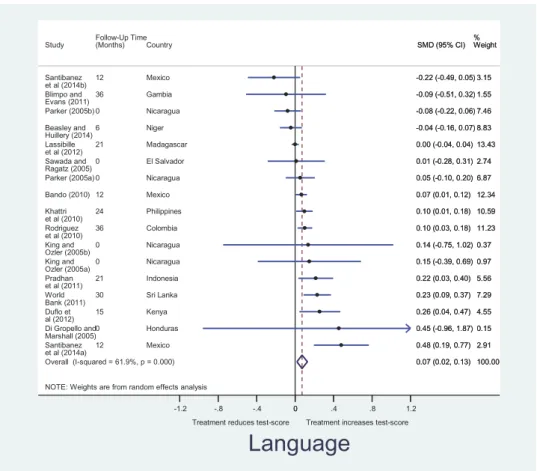
NOTE: Weights are from random effects analysis Overall (I-squared = 61.9%, p = 0.000) Santibanez Lassibille Duflo et Di Gropello and Khattri et al (2014a) Beasley and et al (2010) Evans (2011) Ozler (2005a) al (2012) King and Pradhan et al (2010) Parker (2005b) Bank (2011) Ozler (2005b) Blimpo and Bando (2010) et al (2011) Rodriguez Sawada and et al (2012) World Marshall (2005) Ragatz (2005) King and Parker (2005a) Huillery (2014) Santibanez et al (2014b) Study 12 21 15 0 24 6 Follow-Up Time 0 21 0 36 12 36 0 30 0 0 12 (Months) Mexico Madagascar Kenya Honduras Philippines Niger Nicaragua Indonesia Nicaragua Gambia Mexico Colombia El Salvador Sri Lanka Nicaragua Nicaragua Mexico Country 0.07 (0.02, 0.13) 0.48 (0.19, 0.77) 0.00 (-0.04, 0.04) 0.26 (0.04, 0.47) 0.45 (-0.96, 1.87) 0.10 (0.01, 0.18) -0.04 (-0.16, 0.07) 0.15 (-0.39, 0.69) 0.22 (0.03, 0.40) -0.08 (-0.22, 0.06) -0.09 (-0.51, 0.32) 0.07 (0.01, 0.12) 0.10 (0.03, 0.18) 0.01 (-0.28, 0.31) 0.23 (0.09, 0.37) 0.14 (-0.75, 1.02) 0.05 (-0.10, 0.20) -0.22 (-0.49, 0.05) SMD (95% CI) 100.00 2.91 13.43 4.55 0.15 10.59 8.83 % 0.97 5.56 7.46 1.55 12.34 11.23 2.74 7.29 0.37 6.87 3.15 Weight 0.07 (0.02, 0.13) 0.48 (0.19, 0.77) 0.00 (-0.04, 0.04) 0.26 (0.04, 0.47) 0.45 (-0.96, 1.87) 0.10 (0.01, 0.18) -0.04 (-0.16, 0.07) 0.15 (-0.39, 0.69) 0.22 (0.03, 0.40) -0.08 (-0.22, 0.06) -0.09 (-0.51, 0.32) 0.07 (0.01, 0.12) 0.10 (0.03, 0.18) 0.01 (-0.28, 0.31) 0.23 (0.09, 0.37) 0.14 (-0.75, 1.02) 0.05 (-0.10, 0.20) -0.22 (-0.49, 0.05) SMD (95% CI) 100.00 2.91 13.43 4.55 0.15 10.59 8.83 % 0.97 5.56 7.46 1.55 12.34 11.23 2.74 7.29 0.37 6.87 3.15 Weight
Treatment reduces test-score Treatment increases test-score 0
-1.2 -.8 -.4 0 .4 .8 1.2
Language
Figure 8.Effects on language test score.Table 2. Analysis of e ff ects by level of decentralisation and income context. Moderator variable Pooled SMD 95% CI I-squared (%) Num obs. Student drop outs Low decentralisation − 0.23 − 0.27 − 0.19 n/a 1 Medium decentralisation − 0.04 − 0.07 − 0.00 27.4 9 High decentralisation –– – – 0 Low income − 0.05 − 0.13 0.04 0.0 2 Lower middle-income 0.21 − 1.48 1.87 42.0 2 Upper middle-income − 0.04 − 0.07 0.00 46.9 6 Teacher attendance Low decentralisation –– – – 0 Medium decentralisation 0.03 − 0.13 0.20 65.8 5 High decentralisation 0.28 0.10 0.48 7.8 2 Low income 0.10 − 0.04 0.25 74.6 5 Lower middle-income 0.05 − 1.05 1.15 81.8 2 Upper middle-income –– – – 0 Math test scores Low decentralisation –– – – 0 Medium decentralisation 0.10 0.03 0.17 74.9 11 High decentralisation 0.05 − 0.11 0.22 59.3 7 Low income 0.01 − 0.09 0.11 55.1 6 Lower middle-income 0.11 0.02 0.20 75.0 10 Upper middle-income 0.09 0.03 0.14 0.5 3 Language test scores Low decentralisation 0.10 0.03 0.18 n/a 1 Medium decentralisation 0.08 0.00 0.15 75.1 9 High decentralisation 0.05 − 0.06 0.16 18.4 7 Low income 0.02 − 0.06 0.09 25.6 6 Lower middle-income 0.09 0.03 0.16 41.5 8 Upper middle-income 0.10 − 0.19 0.40 83.7 3
Test scores
Effects on test scores are larger and more robust. Wefind a positive and significant improvement of 0.21 SDs in aggregate test scores11on average (95% CI = 0.09, 0.32) (Figure 6). Thefive estimates of aggregate test scores come from two countries (one from Kenya and four from the Philippines, all of which use the same test data). Two are positive and significant (both in the Philippines) with SMD around 0.3, and none is negative and significant.
We also find positive and significant average improvements of around 0.08 SD in scores on mathematics (95% CI = 0.02, 0.13) (Figure 7) and language (SMD = 0.07, 95% CI = 0.02, 0.13) (Figure 8). The 19 estimates for mathematics tests come from a range of contexts (Africa, Asia and Latin America). Only one estimate is negative and significant, whilefive, from a variety of contexts, are positive and significant – SMD exceeds 0.2 in Sri Lanka, Kenya and the Philippines. There is significant heterogeneity in effects (I-squared = 69%) suggesting further moderator analysis is needed to explain differences between studies. The 17 estimates for language tests12 are from Asia, Africa and Latin America. Six of the 17 estimates are positive and significant, with SMD exceeding 0.2 in Indonesia, Kenya, Sri Lanka and in one Mexico study, while none is negative and significant. The analysis suggests significant residual heterogeneity (I-squared = 62%), which is explored further in moderator analysis.
Adverse outcomes
Devolving decisions to the level of the school can have negative consequences, such as elite capture and disharmony between ethnic groups. Two impact evaluations reported unintended consequences of school-based decision-making reforms. Murnane, Willett, and Cardenas (2006) identified a significant increase in the administrative burden on schools as a result of the PEC programme in Mexico. Duflo, Dupas, and Kremer (2012) note that school management committees in Kenya seemed to be more likely to hire male teachers than females.
Results of moderator and sub-group analyses
We conducted moderator analysis for variables which we believed are likely to affect the impact of school-based decision-making reforms: the level of decentralisation (high, medium or low) and the country income level (Table 2).13The results do not suggest consistent differences across outcomes for decentralisation categories, possibly due to the small numbers of observations by moderator variable groups.
The cross-country study by Hanushek, Link, and Woessmann (2011) found that the impact of school autonomy depends on the level of development of the country implementing the reform. Our own moderator analysis does not suggest effects differ by income group for dropouts and teacher attendance, despite evidence for the latter being dominated by studies from low-income countries where issues relating to teacher attendance may be particularly acute. However, analysis of test scores does suggest impacts pertaining to middle-income countries for mathematics and language, where the overall positive pooled effect is driven by the results for lower-middle income countries (0.09 SMD; 95% CI = 0.03, 0.16). By contrast, and with the exception of one study in Kenya (Duflo, Dupas, and Kremer (2012), now a middle-income country, there is no significant improve-ment in student learning in low-income country settings (SMD = 0.01 SMD; 95% CI =−0.09, 0.11). We examined the possibility impact heterogeneity depending on the length of exposure to the reforms under investigation. Evidence from the US suggests that there can be a time lag of up to eight years between the implementation of a school-based management model and any observable impact on student test scores, although intermediate effects may be more rapidly identifiable (World Bank 2007, p. 13). This could be because schools initially see a decline in performance as school personnel adapt to the new structures, or because school-based management reforms are likely to have a more
Table 3. Meta-regression analysis of test score outcomes. Coe ffi cient Standard error p -Value 95% CI Follow-up period in months 0.0145 0.0060 0.021 0.0024 0.0267 Follow-up in months (squared) − 0.0003 0.0002 0.049 − 0.0007 − 0.0000 =1 if low-income country − 0.0937 0.0485 0.062 − 0.1925 0.0051 Constant − 0.0031 0.0477 0.949 − 0.1003 0.0941 Observations = 36; I-squared = 52.7 per cent; adjusted R 2= 0.378; Model F(3,32) = 3.18 (p = 0.037).
immediate impact on proximal outcomes (for example, teacher attendance), which then have a more gradual impact on student learning over time. Seven of the studies do explicitly include time-lag in heterogeneity analysis, and present inconsistent evidence. Some studies (for example, Duflo, Dupas, and Kremer2012; Gertler, Patrinos, and Rubio-Codina2012; Jimenez and Sawada1999; and Santibañez, Abreu-Lastra, and O’Donoghue2014) identify a possible‘Hawthorne effect’, whereby schools show positive results in thefirst year (possibly due to the energy and momentum created by the new reform), which do not continue to increase with prolonged exposure. A similar effect is identified by Khattri, Ling., and Jha (2010) and Yamauchi (2014), although neither study explicitly presents data on this point. However, other studies (for example, Bando2010; King and Ozler2005; Murnane, Willett, and Cardenas 2006) identify stronger results in communities with longer exposure to the intervention. As studies in both groups examine similar outcomes, it is difficult to draw any conclusions around the differential impact of length of exposure.
We also explored the correlation between the time-lag between the start of the intervention and the impacts observed for test scores, where there were sufficient observations to examine variation by follow-up time, using meta-regression analysis (Table 3). The meta-regression also conditions on country income status and suggests that it may take on average 22 months for reforms to have a maximum effect of 0.16 SD in middle-income country contexts. This suggests results from shorter term follow-ups may be biased downward, if we are to believe indirect treatment comparisons across contexts.
Almost half of the studies, covering 14 interventions, examined impact heterogeneity according to the following factors:
● student-level factorsincluding baseline ability (Pradhan et al.2011), sex (Pradhan et al.2011),
socio-economic background (Rodriguez, Sanchez, and Armenta 2010) and grade level (Beasley and Huillery 2014; Gertler, Patrinos, and Rubio-Codina 2012; King and Ozler 2005; Parker 2005; Rodriguez, Sanchez, and Armenta 2010; Santibañez, Abreu-Lastra, and O’Donoghue2014);
● school-level factorsincluding school size (Beasley and Huillery2014; King and Ozler2005) and
characteristics of teachers (Glewwe and Maïga2011; Barr et al.2012; Jimenez and Sawada2003; Duflo, Dupas, and Kremer2012) and head teachers (Rodriguez, Sanchez, and Armenta2010);
● community-level factorsincluding the level of community disadvantage (Gertler, Patrinos, and
Rubio-Codina 2012; Murnane, Willett, and Cardenas2006; Rodriguez, Sanchez, and Armenta 2010; Skoufias and Shapiro 2006), education levels of parents and school management committee members (Beasley and Huillery 2014; Blimpo and Evans 2011) and the level of community participation (Jimenez and Sawada1999; King and Ozler2005);
● national-level factors including one study examining a sub-group of teachers under a
cen-tralised pay-for-performance scheme that rewarded teachers for strong results on student assessments (Gertler, Patrinos, and Rubio-Codina2012) and
● co-interventionssuch as training (Blimpo and Evans2011; Bold et al.2013; Duflo, Dupas, and
Kremer 2012; Pradhan et al.2011), accountability mechanisms like report cards (World Bank 2011; Barr et al.2012), the election of school management committees (Pradhan et al.2011) and whether the implementing body is government or NGO (Bold et al. 2013; Glewwe and Maïga 2011; Lassibille et al.2010).14
Implementationfidelity was also discussed to a very limited extent (Pradhan et al.2011; Blimpo and Evans2011; Bold et al.2013; Yamauchi2014) but not in formal sub-group analysis.
Thefindings from these analyses varied across contexts, and are reported in full elsewhere (Carr-Hill, Rolleston, and Schendel2016). Briefly, there is some evidence to suggest that school-based decision-making reforms have a stronger impact on wealthier students with more educated parents. It also appears that reforms may be particularly effective for lower grade levels. By contrast, reforms appear to be less effective in disadvantaged communities, particularly if parents
and community members have low levels of education and low status relative to school personnel. This is a particularly important result, given that some studies showing positive impacts explicitly acknowledged having avoided including more remote areas in their analysis (for example, Glewwe and Maïga 2011; and Lassibille et al. 2010). Devolution also appears to be ineffective when communities are not able to participate actively in decision-making processes. Small schools, however, mayfind school-based decision-making to be effective, particularly if community mem-bers establish a collaborative, rather than an adversarial, relationship with teachers. Two studies in particular (Jimenez and Sawada 1999; King and Ozler 2005), both investigating programmes in Latin America, conclude that community participation levels are critical.
Barriers to and enablers of effective school-based decision making
This section draws onfindings from impact evaluations and the linked studies, which were critically appraised prior to synthesis (Table A1). The finding that devolving decisions to the school level does not have a positive effect on the poorest, most disadvantaged communities, is supported by qualitative evidence from Nicaragua. Fuller and Rivarola (1998) found that schools in severely impoverished areas were unlikely to raise additional revenue from the surrounding communities. Gershberg and Meade (2005) found parental contributions to be a significant component of autonomous school budgets, suggesting that disadvantaged communities would be unable to raise sufficient resources under the autonomous schools model.
Low levels of capacity within communities are also barriers. Communities with high levels of illiteracy and/or with few educated parents do not seem to benefit from devolution of decisions to the community level. In their study of Whole School Development programme in the Gambia, Blimpo and Evans (2011) argue that devolution may even be detrimental in such contexts‘because the communities are not well equipped to act on [such information]’(p. 29).
The cross-country study by Hanushek, Link, and Woessmann (2011) finds autonomy reforms improve student achievement in more developed countries but may undermine it in less devel-oped ones. Reimers and Cardenas (2007), in analysis of Mexico’s PEC programme,find that lack of leadership or‘coherence of vision among school staff’ are significant barriers (p. 38). Teachers in Indonesia felt they did not have the capacity to implement the curricular component of that country’s school-based management reform points, nor did they feel adequately supported to use the autonomy given to them (Bjork2003).
There are a variety of reasons why the capacity of institutions and communities can act as a barrier to effective school-based decision-making reforms. First, for such reforms to be effective, school personnel and community members must understand the nature of the reform and crucially must also be able to propose changes that are likely to affect student learning within the school. Santibañez, Abreu-Lastra, and O’Donoghue (2014) and Parker (2005) note that communities in Mexico and Nicaragua did not always fully grasp the nature and the objective of school-based decision-making reforms. Bandur (2008) raises similar concerns in analysis of the national school-based management reform in Indonesia. In the Nicaraguan context, the lack of ownership led to active resistance in some communities (Fuller and Rivarola1998).
Beasley and Huillery (2014) found that school management committees in rural communities in Niger frequently opted to spend their grants on agricultural projects, instead of school materials, teacher incentives or other initiatives likely to affect educational outcomes. Secondly, community members –particularly parents–must have a certain amount of status to play an active role on school management committees. This does not tend to be the situation in rural, poor communities, where school personnel are often perceived as authorityfigures due to their relatively high levels of education (Beasley and Huillery 2014; Gertler, Patrinos, and Rubio-Codina2012). All of these reasons may explain why early interventions devolving decisions to the school level, such as EDUCO in El Salvador, restricted participation in school management decisions to literate members
of the community, a requirement which does not appear to feature in similar models of school-based management implemented more recently in other low-income contexts.
Under-resourced governments may simply be unable to implement and monitor complex decentralisation reforms. Bold et al. (2013)finds that a contract teacher programme, which was effective under NGO implementation, had no effect when scaled up by the government at the national level. Lassibille et al. (2010) and Glewwe and Maïga (2011)find impacts among schools benefiting from direct training by NGO representatives in Madagascar, but not among schools that had been trained by district or sub-district employees (who had themselves been trained by the NGO). National-level programmes unlikely to be effective without sufficient monitoring capacity and accountability mechanisms, both of which are often limited in low-income contexts. Indeed, there may be reason to suspect that government officials may actively hinder the effectiveness of school-based management reforms, as was identified by both Bandur (2008) and Vernez, Karam, and Marshall (2012) in Indonesia, where provincial and district officials were found to actively interfere in school decision-making processes.
Finally, the studies highlight the fact that school-based decision-making reforms can only affect the immediate circumstances of a given school or community. Even if a reform is effective within a community, school-based management reforms cannot address many external factors that can act as significant barriers to impact. Although there are myriad external factors affecting educational outcomes, the included studies referencefive that appear most relevant:
● The strength of the national teacher’s union (Bold et al.2013);
● The strength of the teacher job market (Barr et al.2012; Parker2005);
● Teacher ability/quality (Lassibille et al.2010; Blimpo and Evans2011);
● Constraints imposed by the central system, for example, inefficient mechanisms for distribut-ing salaries in rural areas (Blimpo and Evans2011; Lassibille et al.2010) and
● Security (Beasley and Huillery2014).
Studies also point to several enablers of effective school-based decision-making reforms. First, it appears that smaller schools (for example, one-teacher schools as in Beasley and Huillery2014) are more likely to benefit from local decision-making authority, because it is easier for school manage-ment committees to monitor teachers and stay informed about conditions at the school. Second, devolving personnel decisions and financial and other management decisions enables school-based decision-makers to affect teacher behaviour, including attendance (Sawada and Ragatz 2005; King and Ozler 2005). Finally, Duflo, Dupas, and Kremer (2012) suggest that giving parents the majority voting power on school management committees in Kenya was one of the reasons why local hiring addressed issues of elite capture.
Discussion
We report thefirst mixed-methods systematic review of school-based management. The included studies were systematically critical appraised and met the criteria for relatively low risk of bias.
Our findings are broadly similar to other comprehensive reviews of evidence (for example, Santibanez2007; World Bank2007). However, we offer a body of evidence substantially bigger in size and geographic breadth than these reviews, hence adding to the generalisability of the evidence. Our review includes 26 impact studies and 9 qualitative studies, representing 17 distinct interventions in 13 countries across Latin America (5 countries), sub-Saharan Africa (5 countries) and South/Southeast Asia (3 countries).
Overall, we find that devolving decision-making to the level of the school appears to have a positive effect on repetition and beneficial effects on reducing dropouts and improving teacher attendance in certain contexts. Effects on test scores are more robust, and range between 0.10 and 0.20 SD. In comparative terms, these effects may be considered sizeable when compared to the