This is a PREPRINT of an article published in Linguistics. Copyright © Mouton de Gruyter 2008.
P R E P R I N T N O T I C E
For citation, please consult the published version.
Full reference:
Butler, Christopher S. & Miriam Taverniers. 2008. Layering in structural-functional grammars. Linguistics 46(4): 689-956.
P U B L I S H E D V E R S I O N DOI: 10.1515/LING.2008.024 http://users.UGent.be/~mtaverni/ F U R T H E R I N F O R M A T I O N & C O N T A C T [email protected]
Layering in structural-functional grammars
Christopher S. Butler and Miriam Taverniers
Abstract
This article presents an overview of the notion of layering in three types of structural-functional grammars. Layering is interpreted in a broad sense to refer to two types of linguistic differentiations: (1) on the one hand, a distinction between levels of coding, namely, syntax/grammar, semantics, pragmatics; (2) on the other hand, a
differentiation between speaker-related vs. content-related material in language, i.e., a distinction between interpersonal vs. representational or ideational aspects of
linguistic structuring. We focus on the way in which layering is theorized in three types of linguistic models where layering plays a crucial role in the design of the theory, namely, Systemic-Functional Grammar (SFG), Functional Discourse
Grammar (FDG) and Role and Reference Grammar (RRG). Special attention is paid to recent developments of these theories which have proposed important changes to the conception of layering.
The discussion is organized in terms of four issues: (1) what layers are distinguished (how many?) in the “standard” version of the theory, and how is the relationship between the layers conceived of? (2) What is the motivation and
descriptive evidence for the layered model? (3) What is the relationship between the view of a layered linguistic structure and the way in which different levels of
conception of layering related to the way in which the linguistic model views
language typology? That is, in a typological perspective, what aspects of layering are regarded as universal, and what aspects differ between languages or typological groups of languages?
1 Introduction
The past 40 years have witnessed the steady growth of approaches to grammatical theorising and description which are often brought together under the label ‘functional(ist)’, and offer a very different perspective on language from the ‘formalist’ theories typified by those of Chomsky. We shall not add here to the discussion of what constitutes a functional grammar (see Butler 2003a, 2003b, 2005a, 2005b), nor shall we attempt to defend functionalist positions as against formalist ones: recent treatments of this issue from a functionalist perspective can be found in Butler (2003a: Chapter 1), Gonzálvez-García and Butler (2006), and a formalist view on functionalism in Newmeyer (1998, 2000, 2003a, 2003b, 2005); further material on the relationship between functionalism and formalism is available in Darnell et al.
(1999) and Butler (in press). It will suffice to say that the central claim of functionalism is that language should be seen first and foremost as a system for communication between human beings, and that the shapes which languages take are strongly conditioned by both the nature of human cognitive capacities and the sociocultural contexts in which, and purposes for which, language is used. Although, as pointed out by Newmeyer (2003a: 687, 2005: 135-136), formalists are not necessarily fundamentally opposed to the concept of functional motivation in itself, they have not regarded such motivations as central to their research program.
In addition to claiming that language is not autonomous from language-external factors but must be explained, at least in part, in terms of such factors, most functionalists would also see syntactic phenomena as being motivated by (and not simply correlating with) meaning, to degrees which vary with the particular theory. Ultimately deriving from these underlying tenets are other criteria to which particular functionalist approaches subscribe to varying extents: the need to tackle everything which is systematic in language, rather than just some kind of ‘core’ grammar; recognition of the inherent flexibility of language, which Givón (1995: 5) describes in
terms of the context-dependent, non-atomic nature of meaning, the non-discreteness of linguistic categories, the malleability of structure, the emergence of grammar from the dictates of discourse, and the ‘leakiness’ of grammatical rules; the use of authentic linguistic productions as an important source of data; an interest in linguistic typology; and an approach to language acquisition which focuses on the child’s construction of his or her own grammar, using the input s/he is exposed to, together with general cognitive constraints and dispositions for learning.
Within the broad range of functional approaches, we may distinguish a smaller group of STRUCTURAL-FUNCTIONAL APPROACHES, which are committed to the study of both meaning and formal structure, and of the relationships between the two (see Van Valin 1993: 2). A subset of such approaches are what Butler (2003a: 62) labels STRUCTURAL-FUNCTIONAL GRAMMARS, which are generative, in that “they provide (at least potentially) an explicit framework of rules and principles, linked in specified ways, by means of which the structure and interpretation of linguistic expressions can, in principle, be exhaustively described” (Butler 2003a: 61). According to this criterion, what has been called ‘West Coast Functional Grammar’, typified by the work of scholars such as Talmy Givón, would count as a structural-functional approach, but not as a structural-functional grammar, since it does not attempt to provide an integrated framework for description of the kind just defined. Butler (2003a: Chapter 2) argues that there are three central exemplars of structural-functional grammars: the Functional Grammar (henceforth FG) pioneered by Dik (see particularly Dik 1997a, 1997b), the Role and Reference Grammar (RRG) of Van Valin (Van Valin 2005, Van Valin and LaPolla 1997), and the Systemic Functional Grammar (SFG) of Halliday (Halliday and Matthiessen 1999, 2004). The aim of the present introduction is to give an overview of the state of the art in these three structural-functional theories, as a background against which the papers collected together in this special issue of Linguistics may be interpreted.
A particularly striking feature of structural-functional grammars is the layering which is explored in the papers which follow in this special issue. Basically, the claim is that the clause, and to some extent also phrasal units, can fruitfully be analysed in terms of a number of layers which are related to the functions which language serves in communication, and go beyond the usual treatment in terms of levels of syntax,
semantics and pragmatics, though they are, as we shall see, related to these traditional levels in interesting ways. We would certainly not wish to claim that the layering principle is exclusive to structural-functional grammars: indeed, certain aspects of layering are also evident even in formalist models, as well as in other functional approaches. It is nevertheless fair to say that this principle is of crucial importance to the set of models we are considering here.
This paper will be organised as follows. First, in §2, we shall outline briefly the history of layering in functional grammars, without any detail of particular theories. Then, in §§3-5, we discuss the implementation of the layering principle in SFG, RRG and Functional Discourse Grammar (FDG), this last being most recent manifestation of Dik’s FG. The discussion of each theory will be organised in terms of four key issues:
(i) What is the overall nature of the theory? In particular, what layers are proposed in the ‘standard’ model, what is their nature and how are they related?
(ii) What is the evidence for the layering?
(iii) What relation do layers have with the traditional levels of syntax/semantics/ pragmatics?
(iv) What aspects of layering are considered to be universal, and which vary according to the particular language or typological group? More generally, how does the view of layering taken in the theory relate to its view of language typology?
Much of the material presented in these sections is also discussed in Butler (2003a, 2003b). A brief comparative summary is given in §6.
2 A brief history of layering in structural-functional
grammars
Halliday (1968: 207) notes that there are many references in the literature to the multiple functions of language. Important antecedents of layering in structural-functional grammars can be found, for example, in the work of Bühler (1934), who classified such functions into ‘Darstellung’ (REPRESENTATION), ‘Ausdruck’ (EXPRESSION) and ‘Appel’ (VOCATIVE) types. This classification was further developed by Prague School linguists (see Vachek 1966). Jakobson, in particular, modified and extended Bühler’s scheme into a model of the whole communicative process, replacing Vocative by an instrumentally-oriented CONATIVE function, renaming the representational function as REFERENTIAL and the expressive as EMOTIVE, and adding three further communicative functions, the CODE which is used, the CHANNEL of communication and the POETIC (artistic, creative) function of language. A summary of these and other proposals can be found in Lyons (1977: 51-55).
The important point to note about the functional categories of Bühler and Jakobson is that they are external to language itself, though conditioning the particular forms which communication may take. The layering principle was born when Halliday showed, initially in the late 1960s, that external function is reflected in the internal structuring of the language. As we shall see in §3, Halliday proposes that in all languages, both the paradigmatic selections which can be made from the grammar1 and the syntagmatic structures which are formed by the realisation of sets of paradigmatic choices are patterned in relation to the basic functions which language is called upon to serve: the representation of the world outside us and in our own heads, the setting up and maintenance of interpersonal relations, and the formation of text which is cohesive and also coherent with respect to the situation. These considerations apply not only to the clause, but also, to varying extents, to phrasal units.
The other main influence on layering in current functional grammars was Foley and Van Valin’s (1984) early account of RRG. A central tenet of this theory, which cannot
1
be too highly emphasised, is its strongly typological orientation: from the very beginning, proponents of RRG have sought to discover linguistic universals and to develop a theory which is adequate for any type of language. This requirement strongly influenced the layered model of clause structure which was proposed. Three concentric layers of organisation were posited: the periphery, within which was the core, within which was the nucleus. This type of layering scheme has persisted, in a modified form, into present-day RRG and will be described in detail in §4. Layering applies to both the clause and the noun phrase.
In the late 1980s, layering also found its way into FG, which again has a clearly typological orientation. In his first major exposition of FG, Dik (1978) had distinguished between PREDICATES and the TERMS which act as arguments and (optional) satellites for these predicates, the combination of predicate and arguments constituting the NUCLEAR PREDICATION, which when embellished with satellites becomes an EXTENDED PREDICATION. Hengeveld (1986, 1987, 1988) develops this scheme into one with four layers (predicate, predication, proposition, illocution), each with its own set of operators. Hengeveld (1989) then characterises this scheme in terms of a distinction, already implicit in the 1988 account, between two functions of the predication: to describe the external situation referred to in the speech act, and to represent the propositional content of that speech act. This gives rise to a model in which the predicate and predication layers are seen as constituting a REPRESENTATIONAL LEVEL and the proposition and illocutionary layers as forming an INTERPERSONAL LEVEL. Hengeveld (1989: 128, 1990a: 3) recognises his indebtedness to both Halliday and Foley and Van Valin with respect to the concept of layering now incorporated into the FG model. The basic architecture of four layers was taken on board in Dik’s The Theory of Functional Grammar (Dik 1989), though the higher-order grouping into representational and interpersonal levels is curiously absent from this account, and in the second edition of the book we find only a brief reference to the fact that the “descriptive or representational part of the clause structure” ends with the completion of the extended predication (Dik 1997a: 52), with no complementary reference to the upper levels as constituting an interpersonal level.
We shall see that in the latest model of FG, Functional Discourse Grammar (Hengeveld 2004a, 2004b; Mackenzie and Gómez-González 2005; de Groot and
Hengeveld 2005; Hengeveld and Mackenzie 2006, in preparation) the representational and interpersonal are two of the four levels within the grammatical component of the model, the others being the morphosyntactic and the phonological.
Layering has also been shown to apply to the noun phrase, and there are strong parallels between the clause and NP in this respect (Rijkhoff 1992, 2002, this volume).
3 Layering in systemic functional grammar
3.1 An Overview
In this overview of SFG, we shall deal only with what is sometimes called the Sydney grammar, developed by Halliday and his colleagues. Unfortunately, lack of space precludes a comparison of this version with that known as the Cardiff grammar which has been elaborated by Fawcett and his colleagues. The two versions share many fundamental views and assumptions, but also show important differences (see especially Fawcett 2000).
As we stated in §0, Halliday’s early (late 1960s) description of linguistic structure in terms of different types of functional categories marks the birth of a notion of linguistic ‘layering’ (although the term ‘layering’ was not used by Halliday). It is indeed Halliday’s conception of the internal structure of language as being organised in terms of three metafunctions – ideational, interpersonal and textual – that lies at the basis of what later became SFG, and that has influenced to an important extent the ‘layered’ model of language later proposed in RRG and FG (see §§ 4-5 below). 2 Halliday developed his concept of metafunctional diversity in language alongside a conception of different levels in linguistic structuring (especially semantics and lexicogrammar) in terms of a Hjelmslevian stratification. The notions of stratification and metafunctional diversity indicate two different types of layering that are inherent in SFG, and together form the basis of the functional motif underlying SFG. The
2
For more detailed discussions of SFG which pay attention to the theoretical motifs of metafunctional diversity and stratification, see Butler (1985, 1989), Fawcett (2000), Taverniers (2002).
nature of these two types of layering in SFG can only fully be grasped if they are considered in the larger framework of the design of the theory as a whole, especially in relation to another theoretical motif which provides the first part of the theory’s label, viz. the systemic motif.3
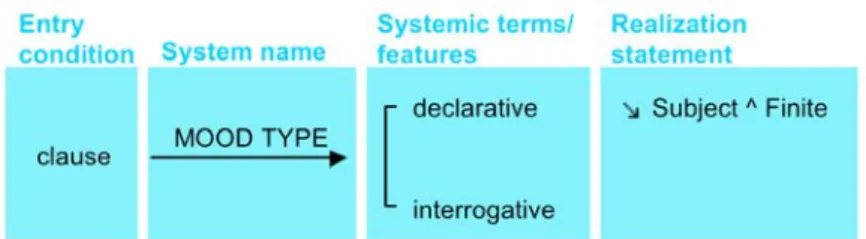
SFG is built up around the fundamental tenet that language is a meaning potential: language is seen as a potential from which choices can be made in particular environment. The notion of a system of choices is formalised in the most important descriptive tool within SFG, viz. the system network. Each system in a system network is a point of choice, consisting of an entry condition (the environment of the choice), a system name, and a number of systemic terms or features (the choices available in the environment). Thus each system represents a particular dimension along differentiations which are made in order to characterise a linguistic phenomenon (an aspect of structure).
Figure 1: Elements of a system in SFG
An example is given in Figure 1. The difference between [declarative] and [interrogative] indicates a dimension of choice (in this case, a contrast), labelled MOOD TYPE (the name of the system), which is available at clause level. In SFG, each linguistic categoryis defined in terms of a selection of a feature (or a combination of selections of features) from a system network (or from different system networks). Besides this definition, each category is also characterised by means of a realisation
3 Halliday (1985, 1994 – and the third edition, Halliday & Matthiessen 2004) and Matthiessen (1993)
are the major publications that represent the ‘standard’ development of the SFG model of the
multifunctional lexicogrammar. Halliday’s major publication An Introduction to Functional Grammar
(1985) is an overview of the functional dimension of the theory, specifying the functional structures for English in terms of the three metafunctions. Matthiessen’s Lexicogrammatical Cartography (1993) focusses on the systemic dimension of the theory, by offering fine-grained system networks for all metafunctional components, accumulating more than a decade of work on the grammar of English.
statement. Such realisation statements, an example of which is also incorporated in the system network (cf. Figure 1), specify structural (syntagmatic) characteristics by which the selected systemic feature(s) is/are realised or encoded in the lexicogrammar (or in phonology). The symbol preceding the realisation statement, “” means ‘is realised by’. In the example at hand, the feature [declarative] is realised as a structure in which the Subject precedes (the sign “^” indicates a sequence) the Finite element. With its twofold set-up containing systems of features as well as realisation statements, the system network and its associated realisation statements are regarded as a tool which represents both paradigmatic and syntagmatic organisation (respectively) axes in the SFG model of language.These two dimensions of the system network are usually referred to in SFG as the system-structure complementarity. We can now turn to the functional dimension in SFG, and its two types of layering. In SFG, language is viewed as comprising a number of levels of symbolisation, which are called strata – a label that is inspired by Hjelmslev’s notion of ‘stratification’ in language. The major strata are: context, semantics, lexicogrammar and phonology/graphology. Following Martin and Matthiessen (1991), they are commonly represented in SFG by means of cotangent circles (see Figure 2). The explicit stratified conception of language creates the possibility of identifying and examining linguistic phenomena from alternative views. In this sense, the notion of stratification offers what Halliday (1996: 16) calls a trinocular vision: any linguistic system can be looked at from its own level, from around; from the higher stratum, from above; and from the lower stratum, from below. Being a functional theory, SFG assigns priority to the perspective ‘from above’: in order to give a functional explanation of a phenomenon one must approach it ‘from above’, from a semantic perspective.
Apart from being stratified, language as a semiotic resource is seen as being organised in terms of three metafunctions: ideational, interpersonal, and textual. Following Matthiessen (1993), the metafunctions can be represented as three general areas spread across the different strata of language, as in Figure 2.
Figure 2: Two types of layering in SFG: stratification and metafunctional diversity
The interpersonal metafunction “serves to establish and maintain social relations: for the expression of social roles, which include the communication roles created by language itself – for example the roles of questioner and respondent, which we take on by asking or answering a question; and also for gettting things done, by means of the interaction between one person and another” (Halliday 1970: 143).
The ideational metafunction “serves for the expression of ‘content’: that is, of the speaker’s experience of the real world, including the inner world of his own consciousness” (Halliday 1970: 143). The ideational metafunction is seen as comprising two sub-components: an experiential sub-function and a logical sub-function. The experiential sub-component is concerned with the construal of experience as such by means of processes, participants, circumstances, and the like; whereas the logical sub-component serves to establish links between various stretches of construals of experience, by means of relations such as coordination, subordination, and so on.
The textual metafunction “enables the speaker or writer to construct ‘texts’, or connected passages of discourse that is situationally relevant; and enables the listener or reader to distinguish a text from a random set of sentences” (Halliday 1970: 143). The textual metafunction is regarded as being of a second-order nature compared to the other two metafunctions. On the one hand, it is carried by the ideational and interpersonal metafunctions, since it is ideational and interpersonal resources together that make it possible to create a larger stretch of discourse. On the other hand, the textual metafunction has an ‘instrumental’ or ‘enabling’ relation (Halliday 1970: 325)
to the other two components: it enables the integration of ideational and interpersonal meanings by providing them with a texture, i.e. by presenting them as texts.
The idea of ‘metafunctional diversity’ is a hypothesis about language which is relevant at two levels: [1] on a general level, it is a hypothesis about the way in which language is capable of functioning in the whole of human life, and [2] on a more particular level, it is a hypothesis about the way in which language, and most notably linguistic structure (lexicogrammatical form), is organised. In general, it is referred to in SFG as the metafunctional hypothesis.
Because the metafunctions are interpreted as pertaining to the general functioning of language (cf. [1] in the previous paragraph), they are seen as permeating the whole linguistic system. This is why, in its most general theoretical conception in SFG, metafunctional diversity is seen as a dimension that cross-cuts the stratification of language into different levels of symbolisation; and it is this ideal representation that is visualised in Figure 2 above. In this sense also, the relationships between the different ‘content’ strata – more specifically, between the levels of lexicogrammar and semantics on the one hand, and between semantics and context on the other, are regarded as solidary or ‘natural’, in that they are functionally motivated.4
The way in which the metafunctional hypothesis shapes the view of linguistic structure in SFG (cf. [2] above) can only be understood in relation to the most important representational and theoretical tool in SFG, viz. the system network. It is in this context, and especially in relation to the system-structure complementarity, that the metafunctional layering inherent in SFG becomes clear.
When Halliday first presents the idea of different functional areas in the organisation of language, it is motivated in terms of a clustering of different types of systems four groups, indicating four distinct functional components (Halliday 1967a, 1967b, 1968). As Halliday sees it, the metafunctions represent three large areas of choice in language.5 Hence, the overall paradigmatic organisation of language is subdivided
4 See Cléirigh (1998) for an application of the metafunctional hypothesis to the phonological stratum. 5
In “Notes on transitivity and theme”, Halliday distinguishes three “main areas of syntactic choice” (viz. transitivity, mood and theme) (Halliday 1967b: 199) and later “four components in the grammar of English representing four functions that the language as a communication system is fulfilling” (viz. experiential, logical, discoursal and speech functional or interpersonal) (Halliday 1968: 207-209). In
into four different system networks: experiential, logical, interpersonal and textual, each of which has its own dependent and interlocking sub-systems. Importantly, the experiential, logical, interpersonal and textual networks are not seen as separate options in a larger network, rather, they are simultaneous sets of systems. Taking the clause as a point of origin, examples of simultaneous system networks from the interpersonal, ideational and textual metafunctions are those of MOOD, TRANSITIVITY and THEME. Overviews of various types of systems are often represented by means of a class-function matrix, the rows indicating different points of origin, and the columns specifying the different kinds of systems that are available within each metafunctional component. An example of a class-function matrix is presented in Table 1.6
Rank Class Interpersonal Textual Experiential Logical
GRAMMAR REFERENCE
Non-structural SUBSTITUTION/
ELLIPSIS CONJUNCTION
GRAMMAR Clause MOOD THEME (MAJOR) TRANSITIVITY
Structural > MOODFULNESS > PROCESS TYPE
> INTERPERSONAL STATUS > AGENCY
> POLARITY > TYPE OF CONSTRUAL
> MOOD TYPE MINOR TRANSITIVITY
> MOOD PERSON > CLAUSAL DEICTICITY
> temporal deixis: PRIMARY TENSE > modal deixis: MODALITY MODAL ASSESSMENT (= COMMENT)
Group Verbal FINITENESS VOICE EVENT TYPE SECONDARY TENSE
(grammatical) PERSON PHASE
CONATION
Nominal INTERPERSONAL DEICTICITY DEIXIS THING TYPE MODIFICATION
> NOMINAL MOOD (= MINI-MOOD) (= PHORICITY) (TYPE OF PARTICIPANT) > QUALIFICATION
> NOMINAL PERSON > CLASSIFICATION
MODAL POST-DETERMINATION > EPITHESIS
ATTITUDINAL MODIFICATION > QUANTIFICATION
Adjective SUB-MODIFICATION QUALITY TYPE (= INTENSIFICATION)
Adverbial MODAL ASSESSMENT (= COMMENT) CIRCUMSTANCE TYPE
& prep. (MINOR TRANSITIVITY)
LEXIS Word connotation LEXICAL COHESION denotation
evaluative lexis (= COLLOCATION)
PHONOLOGY Information unit KEY INFORMATION
(= TONE) C O M P L E X I N G o f c l a u s e s , g r o u p s a n d w o r d s
Table 1: Class-function matrix of English systems in SFG
With regard to structure, the metafunctions are indicated in SFG as simultaneous strands of structuring: each metafunction, and thus each path through a metafunctional “Functional diversity in language”, these types of systems are interpreted in terms of three “functions
of language” (Halliday 1970: 324ff., our emphasis), which are called ideational/experiential, interpersonal and textual (compare also Halliday 1976a: 29, 1973a/1971: 66).
6
The first class-function matrix was proposed in Halliday (1970: 327) and forms the basis for various subsequent refinements. The diagram given here is based on the system networks proposed in Martin (1992), Matthiessen (1993) and Halliday and Matthiessen (1999).
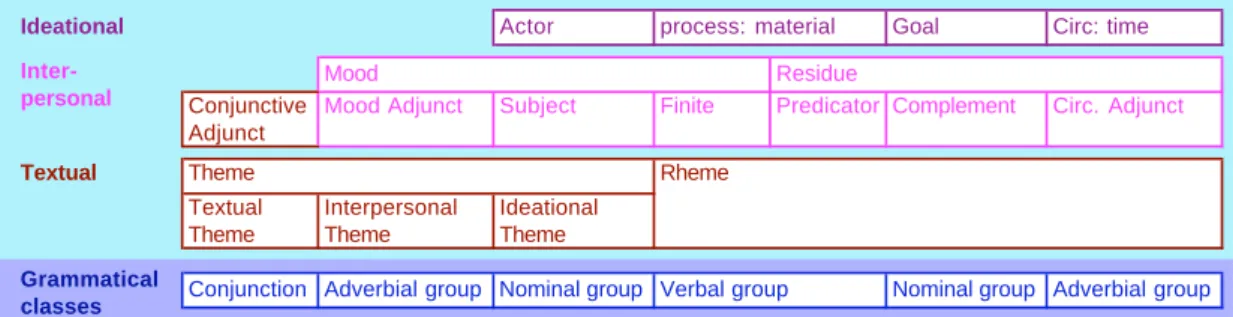
network of options, contributes a strand or layering of structuring. This is represented as three (or four, if taking into account the separate logical sub-component) layers of functional configurations mapped onto one syntagm (represented by a sequence of grammatical classes), as shown in Figure 3. It is important to note that the metafunctional layers are simultaneously present as parallel strands of structuring: each element in the syntagm can be linked to an ideational, an interpersonal and a textual function. For example, in the interpersonal layer, there are the elements of the Mood Adjuncts and the Finite (comprising modal finiteness), but also the Subject and the remainder of the clause (called the Residue) are interpersonal categories. In this respect, SFG differs from both RRG and F(D)G, which propose a hierarchical
layering of structure (cf. §§4-5 below).
But surely they will find their way soon
Ideational Actor Goal Circ: time
Conjunctive Adjunct
Mood Adjunct Subject Finite Predicator Complement Circ. Adjunct
Textual Textual Theme Interpersonal Theme Ideational Theme
Conjunction Adverbial group Nominal group Nominal group Adverbial group
process: material Verbal group Residue Rheme Inter-personal Grammatical classes Theme Mood Grammatical functions
Figure 3: Structural analysis in SFG by means of simultaneous metafunctional strands
3.2 Evidence for layering
7The conception of a stratified model of language in SFG was inspired by two frameworks of studies: the study of language development and an investigation of the use of language in social contexts.
The stratification of ‘semantics’ and ‘lexicogrammar’ that was proposed by Halliday in the 1970s (cf. Halliday 1973a/1971, 1976a, 1973b, 1977, 1978a), was based on an
7 Naturally, the type of evidence for layering in SFG is inherently intertwined with the kind of
phenomena focussed on in different stages of SFG. However, as has been noted at various places (e.g. Butler 1989: 8, 2003a), the changes in the theory have not always been made very clear. This remark also applies to the following section on the relation between layering and the levels of syntax, semantics and pragmatics.
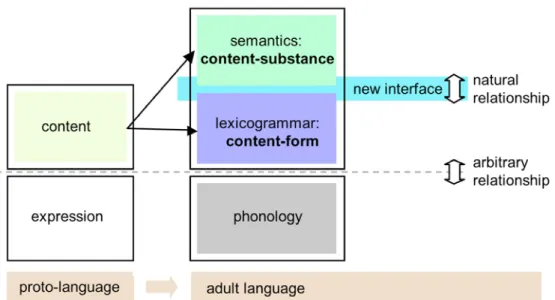
exploration of language development, more specifically the question of how the early linguistic system (proto-grammar) of a very young child is gradually elaborated into an adult language. According to Halliday (1976b/1973, 1984), the proto-linguistic system can be modelled in terms of a simple coding relationship between a content plane and an expression plane, in the Hjelmslevian sense. As the child’s language system develops, it has to fulfill more functions in more diversified contexts, and a one-to-one relationship between content and expression no longer obtains. In modelling this expanding resource, Halliday claims, a new interface is needed, in addition to the levels of content and expression. This is the interface between ‘semantics’ (‘meanings’) and ‘lexicogrammar’ (‘wordings’) within the content plane. The need for both a lexicogrammar and a semantics in the adult language system is explained by Halliday in terms of an internal stratification of the content plane, as visualised in Figure 4: the content plane rather than the expression plane is internally stratified, since the relationship between ‘lexicogrammar’ and ‘semantics’ is ‘natural’ (i.e. it is functionally motivated), whereas phonology generally relates to ‘lexicogrammar’ in an arbitrary way.
Figure 4: Stratified layering in SFG: stratification of the content plane into a semantics and a lexicogrammar in the adult language system
The study of language development inspired a stratified conception of language ‘from around’: starting from the initial content–expression relationship in proto-grammar, in a model of adult grammar an additional interface within the content plane becomes necessary in order to account for more complex types of utterances.
The investigation of the use of language in social contexts (so-called studies of language in relation to ‘social man’ (Halliday 1973a/1971: 48, 1978b)) in the 1970s calls for a stratification of language which is motivated ‘from above’. In this framework, language in general is regarded as one type of social behaviour. In theorising the way in which language is able to function in social settings, a ‘semantic’ stratum is needed as a ‘bridge’ in between a stratum of (social) context and a lexicogrammatical stratum. More specifically, in keeping with the fundamental view of language as a resource, and the important underlying notion of ‘choice’ (cf. §3.1), social behaviour is conceptualised as “behaviour potential”: “[i]t is what the speaker
can do” (Halliday 1973a/1971: 51; our emphasis). In order to link language to the more general social behaviour in which it is embedded, the relationship between ‘what the speaker can do, socially’ and ‘what the speaker can say, in language’ must be defined. This relationship, Halliday argues, is not a direct one, since ‘can do’ as such is not a linguistic concept: it is mediated through the additional stage of ‘what the speaker can mean’. Hence, an important role is assigned to ‘semantics’ as an intermediate level between context and lexicogrammar: the ‘semantic’ stratum indicates those aspects of social context that are intrinsically meaningful, i.e. those aspects that are coded in the lexicogrammatical system of a language. Because of its role as an interface between social context and lexicogrammar, the semantic stratum is also called a sociological semantics or socio-semantics (cf. Halliday 1973c/1972). The initial modelling of language as metafunctionally diversified in SFG was inspired by three general frameworks of systemic functional studies in the 1960s and 1970s: grammatical studies, and the two frameworks mentioned above in relation to the stratified view of language, viz. investigations into language development and explorations of the use of language in social contexts.
As we have seen in §3.1, in his early work on grammar Halliday distinguished three or four areas of syntactic choice – three or four clusterings of systems, which he linked to areas of ‘meaning’ and which he called functions of language, and later ‘metafunctions’. The four components of the linguistic system are described as being related to the way in which language is able to function in general:
If we represent the set of options available to the speaker in the grammar of the English clause, these options group themselves into a small number of
subsets, distinct from one another in that, while within each group of options there is a very high degree of interdependence, between any two groups the amount of interdependence, though by no means negligible, is very much less. This provides a syntactic basis for the concept of language functions […] It seems possible to set up four components in the grammar of English representing four functions that the language as a communication system is required to carry out […] (Halliday 1968: 207–208)
In the stratified system of language, these components of the lexicogrammar are seen as the manifestation of “functionally defined areas of meaning” (Halliday 1976a: 29). Grammatical structure is seen as “the means whereby the various components of meaning, deriving from the different functions of language, are integrated together” (ibid.). The clustering of different types of systems into functional groups was the first basis for the development of the metafunctional hypothesis in SFG. As we shall see below, Davidse’s work on the notions of agnation and enation as two complementary types of systemic relationships provides a further systemic basis for the metafunctional layering in SFG.
Just as it formed an inspiring background for setting up a stratified model of language, Halliday’s investigation of language development, undertaken in the 1970s, formed further support for the idea of metafunctional diversification which had first appeared in his studies of grammar. In a proto-grammar, where a one-to-one relationship obtains between content and expression, simple linguistic signs serve to function in a limited range of contexts, so that a small set of uses of language can be distinguished. Halliday (1973c/1972) distinguishes seven types of such functions, and calls them macro-functions: instrumental, regulatory, interactional, personal, heuristic, imaginative and representational. As the proto-grammar expands, language is used in more and more diversified social contexts, and as a result, the linguistic signs become more complex: a single utterance can now combine various of the earlier ‘simple’ uses of language. This process, according to Halliday, engenders and is in turn enabled by an internal stratification of the content plane, as we have seen above. The new interface within the content plane (semantics/lexicogrammar) is crucial in the development of an adult language system, where the functioning of complex
many-to-many relations between expressions and forms in varied social contexts is organised through an intermediary ‘semantic’ stratum.
In adult language, the semantic stratum is seen as being shaped into three distinct metafunctional components of meaning: ideational, interpersonal and textual (Halliday 1970: 325). These components are called ‘metafunctional’ because they are general, abstract groupings compared to the more specific macro-functions of proto-grammar. In their role of modelling the functional complexity of adult language (i.e. the many-to-many mappings between contents and expressions functioning in a multitude of contextual settings), the metafunctions are regarded as being
simultaneously present in each act of creating meaning.
In the framework of the study of language in different social contexts (cf. especially Halliday’s (1978b) Language as Social Semiotic), it became clear that the hypothesis of the metafunctional organisation of language could be related to a distinction between three dimensions of contextual variation that had already been made in earlier work: field, tenor and mode (e.g. Halliday, McIntosh and Strevens 1964, Strevens 1964, Spencer and Gregory 1964, Gregory 1967). Hence, in Language as Social Semiotic and later work, Halliday correlates the distinction between ideational, interpersonal and textual with the contextual dimensions of field, tenor and mode. This forms the basis for viewing the stratum of context itself as being metafunctionally diversified into three components (Halliday 1978a, and especially 1977). Field (ideational) concerns the type of social action whith takes place in a text, determining the experiences that are construed, especially the ‘subject-matter’. Tenor (interpersonal) refers to the social role relationships that are enacted in language, determining the types of speech function roles which are taken up by the interlocutors. Mode (textual) is the type of symbolic organisation (the status of the text as instrumental to field and tenor), including the medium (e.g. written vs. spoken language).
In later studies of SFG, it is especially the systemic dimension and the structural dimension of the metafunctional hypothesis that receive most attention. The systemic
evidence for a metafunctional layering in SFG is further fleshed out in the work by Davidse. By reconsidering the relationship between features in systemic functional networks in relation to Gleason’s concept of agnation, Davidse (1998) reveals an
important difference between the inherent organisation of interpersonal and experiential networks: interpersonal systems are based on agnation, whereas experiential systems are based on enation.
Gleason introduced the concepts of agnation and enation in his 1963 textbook,
Linguistics and English Grammar, which belongs to a generation of ‘general-structuralist’ textbooks (assembling the insights which had been achieved in the major schools of structuralism), which appeared in North-America and Europe in the period 1955–1965, on the verge of the emergenece of more specific (post-)structuralist linguistic schools, especially in Europe, and just before the rise of Chomskyan transformational-generative grammar in the US. In Gleason’s book, the terms enation and agnation are proposed to refer to two “contrasting types of relations [between structures], neither of which can exist without the other” (Gleason 1963: 199). Two sentences are regarded as enate if they are structurally identical, or, in Gleason’s terms, “if the elements (say, words) at equivalent places in the sentences are of the same classes” (Gleason 1963: 199). Gleason defines agnation as a relationship between constructions which have “the same vocabulary items” but “different structures”. Examples of enate and agnate relationships are shown in (1) and (2), respectively:
(1) a. The dog bit the man. b. The cat ate the canary. (2) a. The dog bit the man.
b. The man was bitten by the dog.
If larger groups of constructions are considered rather than pairs of expressions in isolation, Gleason claims, it appears that enation and agnation are interdependent. As shown in Table 2, a systematic relationship of agnation (shown by a double arrow) holds between groups of constructions within which all members are syntagmatically identical, i.e. groups of enate constructions. Thus, a variation between two agnate types of construals, such as active versus passive, as in Table 2, applies to a group of expressions which are enate. Conversely, a relationship of enation between different expressions can be recognised on the basis of agnation; and this observation provides a more exact definition of enation: two expressions are enate if they share the same sets of agnates. The fact that the expressions in (3)a, (4)a and (5)a on the one hand, and (6)a on the other hand, enter into different relationships of agnation indicates that
they are not to be regarded as enate (Gleason 1963: 203), and hence, that they have to be classified into two groups.
(3) a. A stranger was seen by the man.
b. The man saw a stranger.
c. *The man saw to be a stranger.
(4) a. The man was bitten by the dog.
b. The dog bit the man.
c. *The dog bit to be a man.
(5) a. The glass was broken by the cat.
b. The cat broke the glass.
c. *The cat broke to be the glass.
(6) a. *A stranger was seemed by the man.
b. The man seemed a stranger.
c. The man seemed to be a stranger.
Table 2: Patterns of agnation () in a set of sample clauses
Davidse (1998) projects Gleason’s insights about the relationsips of agnation and enation onto the systemic relationships between features in the system networks found in SFG. She finds that the primary differentiations in experiential networks are based on enation: the features in an experiential network indicate distinct verb classes, which are defined on the basis of sharing particular verbal alternations. For example, the class of [effective] verbs allows the alternation active/passive voice, an alternation which is not available for the class of [middle] verbs. Conversely, in interpersonal and textual systems, the options are agnates: they are general types of possible construals, which can apply either to any kind of clausal syntagm (for example, the features [unmarked theme] or [polar interrogative] in the textual and interpersonal systems), or they can apply to relatively large structures which can be specified in terms of experiential features (for example, the textual feature of [passive] is only available for the experiential class of [effective] constructions). Importantly, this means that experiential categories are lexically-based verb classes that can be differentiated on the basis of interpersonal and textual agnation tests, while interpersonal and textual categories are based on their applicability to different types of (experientially distinguished) verb classes.
The structural dimension of the differentiation between metafunctions was first clear in Halliday’s work in relation to the distinction between logical and experiential components as two sub-functions within the ideational metafunction. In his paper “Modes of meaning and modes of expression”, Halliday (1979) assigns a particular type of structure to each of the three metafunctions, so that three metafunctional realisation patterns (“modes of expression”) are distinguished, as correlating with
three metafunctional “modes of meaning”. Halliday argues that linguistic structure can be patterned in three complementary ways: configurational, prosodic and culminative-periodic structuring. Ideational structure is seen as configurational: it is a constellation of distinct elements. Within the ideational metafunction, the experiential and logical types of structuring, viz. constituency-based and dependency-based structurings, are seen as two complementary types of configurational patterning. The interpersonal mode of expression is defined as prosodic: interpersonal meanings, such as realised by modal verbs or modal adjuncts, is described as being “strung throughout the clause as a continuous motif or colouring”: it is “distributed like a prosody throughout the continuous stretch of discourse” (Halliday 1979: 66). Textual meaning is regarded as being realised in a culminative-periodic structure, in which two systems of prominence (thematic prominence and focal prominence, dealt with in the textual systems of THEME and INFORMATION respectively) organise the textual stretch of discourse into a number of message units or “quanta of information” succeeding one another.
Halliday relates the general metafunctional modes of expression to Pike’s view of language as particle, field and wave, which was based on the different appearances of light (as particle, field, and wave), as studied in physics: according to Halliday, the ideational mode of realisation is particulate, the interpersonal field-like, and the textual wave-like. Pike (1972/1959) interpreted his threefold conception of language in terms of three complementary perspectives, each of which brings out a particular facet of the nature of language. Although Halliday’s metafunctional components are different from Pike’s definitions of language as particle, field and wave, the link which Halliday makes with Pike’s theory emphasises the complementarity of the three metafunctions at the level of lexicogrammatical structure (see also Halliday 1977: 197).
3.3 The relationship between layering and the levels of
syntax, semantics and pragmatics
As we have seen in §3.1, the differentiation between ideational, interpersonal and textual metafunctions on the one hand, and that between context, semantics and lexicogrammar on the other hand, refer to two distinct types of layering in SFG. In the
most abstract, theoretical and ideal view, the two dimensions are interpreted as cross-cutting one another (see especially Figure 2 above).
In the ‘standard’ model, the development of the multifunctional description of language has taken the form of a gradual refinement of the system networks and the functional structures for each metafunction. The evolution from Halliday’s early work to the recent networks is characterised by two tendencies.8 First, as we have seen above, the model became gradually more ‘semantic’: this can be seen in the features of the networks themselves and is rooted in Halliday’s belief that a functional grammar should be pushed as far as possible to the semantics. Second, and concomitant with this, because of the important role assigned to paradigmatic thinking (cf. the ‘systemic’ dimension of SFG), much less attention has been paid to purely syntagmatic features of language. The commitment to paradigmatic thinking and to a ‘semantic’ description lies at the basis of Halliday’s systematic avoidance of the term ‘syntax’, and also of the term ‘pragmatics’.
In the introductory chapter of An Introduction to Functional Grammar, Halliday (1994: xiv) distances himself from the traditional threefold distinction syntax/semantics/pragmatics, because, as he sees it, this distinction suggests an opposition between syntax and semantics – a view, he adds, that lies at the basis of a formal linguistics, especially a linguistics rooted in the philosophy of language. A second reason Halliday adduces for rejecting the syntax/semantics/pragmatics distinction is that this distinction reflects the history of western linguistics, in which first morphology was studied, and this formed the stepping-stone to studies in syntax, and so on. It is this direction of reasoning, in which one starts from forms and then asks questions about what these forms might mean, which Halliday strongly denounces, since, in his view, a functional grammar should start from meaning and then ask “how are these meanings expressed” (Halliday 1994: xiv).
In a 1987 interview (see Thibault 1987), on being asked why he does not make the distinction between semantics and pragmatics, Halliday answers:
8
For a more detailed account of the relationship between lexicogrammar and semantics in the history of SFG, see Butler (1996: 165ff, 2003a: esp. 211ff), Taverniers (2002: Ch.4).
I’ve never seen that it’s necessary. […] it seems to me that pragmatics is simply the name of the semantics of the text. I’m not just making a terminological point. It seems to me that a theory of semantics must encompass both the system and the process in exactly the same way that the grammar encompasses both the system and the process. We don’t want a separate thing called pragmatics. (Halliday in Thibault 1987: 611)
While the rejection of a separate level of ‘pragmatics’ by Halliday is very much in keeping with his view on the syntax/semantics/pragmatics distinction and the prioritising of a ‘semantic theory’, as we have just seen, there is another aspect to it that has to do with the relationship between type and token, and, more fundamentally, with the systemic dimension of SFG. Halliday interprets pragmatics, as a theory of language in use, in terms of an actualisation of language in particular texts. In SFG, this concept of ‘actualisation’ (referred to as ‘instantiation’ – see, e.g. Halliday (1991)) is inherent in the notion of the system network: each instance of language, each ‘act of meaning’ is interpreted as a specific path through a network. What Halliday is saying, in his answer to Thibault’s question, is that in a model which views language as a meaning potential, it is not necessary to have a separate component of ‘language in use’, since the potential, or the system, indicates what can be instantiated.9
3.4 Typology and language universals
Compared to other functional models (as we will see below, §§4-5), SFG has never had a strong typological orientiation. Although Halliday’s first linguistic model was based on a description of Chinese (Halliday ), the major influential writings in SFG – and especially those publications that form the key points in developing the design of the theory – have always, up to the present day, been based largely on English, leading to a particular ‘imbalance’ that Halliday (1993: 4506) himself recognises. However, especially since the 1990s, the model has been applied to languages other than English (e.g. Martin 1995), and there is a growing awareness that it is necessary to incorporate more typologically different languages into the description in order to
9
For a more detailed account of the relationship between Halliday’s model of language and the theory of pragmatics, see Butler (1988).
refine the model. An example of this is the recent publication of Language Typology: A Functional Perspective (Caffarel et al. (eds.) 2004).
As a consequence of the lack of an inherently typological orientation, language universals as such have not played a major role in SFG. Halliday (1961) makes a distinction between a general theory of language and descriptions of particular languages on the other hand. Many aspects of SFG have been presented as ‘general’ aspects, such as the metafunctions themselves, the different modes of expression, the relationship between system and structure. Halliday expects certain of these ‘general’ aspects to be universal (e.g. the metafunctions – cf. Halliday 1994: xxxiii-xxxiv), but the notion of language universals is not further explored.
4 Layering in Role and Reference Grammar
4.1 An overview
The twin pillars on which RRG rests are (i) a model of semantic predicate/argument relations and (ii) a layered structure for the clause (LSC) which, although itself involving syntactic units, is semantically motivated.10 Clearly, we are primarily concerned here with the second of these components, but since the two are intimately related within the overall theory, and since the postulation of parallel semantic and syntactic structures could itself be seen as a kind of layering, we shall outline the semantic model very briefly before describing the layered structure of the clause.
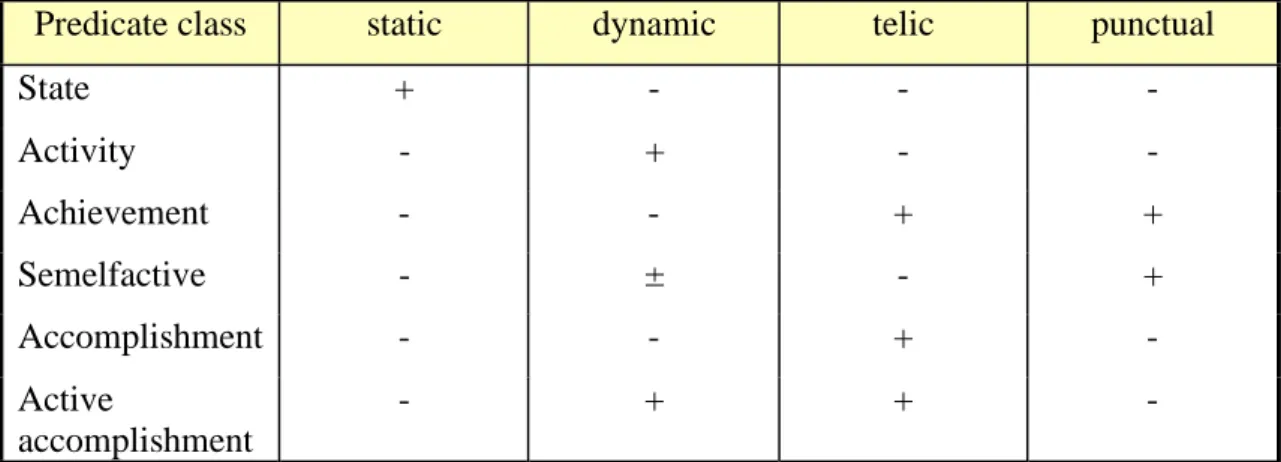
The semantic structure of the clause is based on a system for the lexical decomposition of predicates derived from that of Dowty (1979), which in turn was based on the work of Vendler (1967/1957]). This semantic structure is presented in the form of a LOGICAL STRUCTURE (LS) in which complex lexemes are decomposed into more basic ones, through the use of operators such as BECOME and CAUSE. Six classes of predicates are recognised, each characterised by means of values of a set of four features, as shown in Table 3 (Van Valin 2005: 33):
10
We shall not go into the historical development of the theory (for the main stages, see Foley and Van Valin 1984, Van Valin 1993, Van Valin and LaPolla 1997), but will concentrate on the latest version as presented in Van Valin (2005).
Predicate class static dynamic telic punctual State + - - - Activity - + - - Achievement - - + + Semelfactive - ± - + Accomplishment - - + - Active accomplishment - + + - Table 3: Predicate classes in RRG
Static predicates represent states of affairs which do not involve ‘happening’; dynamic predicates express actions; telic predicates represent states of affairs which involve an inherent end-point; punctual predicates encode events which effectively occur instantaneously. These features can be probed by means of a battery of tests (see Van Valin 2005: 35-41). Each class has a characteristic pattern in its LS, as can be seen from the examples below:
(7) Bernice was tired. (BNC HTY 2826) tired´ (Bernice) [state]
(8) Miss Cress watched her, … (BNC AD1 1859)
do´ (Miss Cress [watch´ (Miss Cress, her)]) [activity] (9) The glass shattered. (BNC CKB 0653)
INGR shattered´ (glass) [achievement] (10) Blue lights flashed. (BNC HTH 1763)
SEML do´ (blue lights, [flash´ (blue lights)]) [semelfactive] (11) Alfred Oliver had died. (BNC ANK 0391)
BECOME dead´ (Alfred Oliver) [accomplishment] (12) They walked to the end of the road … (BNC BN1 1082)
do (they, [walk (they)] & BECOME be-at (end of the road, they) [active accomplishment]
Note that although semelfactives and achievements are both punctual processes, they differ in that only achievements result in a change of state. Note also that active accomplishments are activities which result in a change of state and so are telic. Each of these basic types also exists in a causative variant. Two examples are given below:
(13) He opened it slowly … (BNC EF7 569).
[slow (do (he, Ø))] CAUSE [BECOME open (it)] [causative accomplishment] (14) A solitary man walked his dog home ... (BNC HR9 2432)
[do (solitary man, Ø)] CAUSE [do (dog, [walk (dog)]) & BECOME be-at (home, dog)] [causative active accomplishment]
It is important to realise that elements such as watch, shattered, flash, dead, etc are intended merely as placeholders for an eventually more detailed system of lexical decomposition (for further detail see Van Valin and Wilkins 1993, Van Valin and LaPolla 1997: 116-118, Mairal Usón and Faber 2002).
Two further important characteristics of the semantic structures proposed in RRG should be mentioned. Firstly, thematic roles such as Agent, Patient or Theme are not regarded as primary elements of the theory, but are defined in terms of the positions for arguments in the decomposed semantic structure. Thus, for example, the sole argument of a 1-place stative predicate is the PATIENT, the first argument of a pure location predicate is a LOCATION and the second a THEME, the first argument of a cognition predicate is a COGNIZER (itself a type of EXPERIENCER) and the second the CONTENT, and so on. Secondly, specific thematic relations are grouped together under two semantic MACROROLES, the actor and undergoer, the former being the most agent-like and the latter the most patient-like. These macroroles are important because for some purposes particular thematic roles are treated by the grammar as essentially the same. Actor and undergoer are thus the two chief arguments of a transitive predication, and either one can act as the sole argument of an intransitive predication.
We now turn to the main topic of this section, namely the layered syntactic structure of the clause. This concept of clause structure, which goes back to the work of Foley and Van Valin (1984), partitions the clause into a CORE and a PERIPHERY. The core contains a NUCLEUS and core argument(s); the periphery contains adjuncts. In (16) is shown the layered structure of the clause in (15)
(16) CLAUSE
CORE PERIPHERY
ARGUMENTS ADJUNCT
Gareth ate everything fast
NUCLEUS
The units nucleus, core and periphery are syntactic, but are semantically motivated, in that the nucleus houses the semantic predicate, the core syntactic arguments are arguments in the semantic representation of the predicate, the core consists of these arguments plus the predicate, the periphery contains elements which are not semantic arguments of the predicate, and the whole clause contains the predicate, arguments and non-arguments.
The syntactic units can occur in any order which a particular language permits, so that this model of clause structure is equally applicable to both configurational language such as English and non-configurational languages such as the Australian Aboriginal language Dyirbal, which has very free word order.
The division into core, with its nucleus, and periphery is seen as universal. There are, however, other elements which occur in some languages but not others. In front of the core there may be a PRECORE SLOT (PrCS), which is the position in which topicalised (fronted) elements appear, and in which wh-words are placed in languages such as English, where they are not kept in their normal pattern position. Examples from English are given in (17) and (18), where the elements in the PrCS are in bold type:
(17) This one I’m sure you’ll recognise. (BNC JK2 326) (18) What did you leave behind? (BNC ASN 1838)
In some languages there is a POSTCORE SLOT after the core. Left-dislocated elements occur in the LEFT-DETACHED POSITION (LDP), which is separate from the clause itself, although it is a constituent of the sentence. An example from English is given in (19):
(19) As for him, his heart was still set on finding the sea-king’s palace … (BNC FUB 0043)
Some languages also have a RIGHT-DETACHED POSITION, to the right of the clause proper. An English example is shown in (20):
(20) She is cunning, that girl. (BNC HTX 2807)
The structural elements of the clause are shown in the form of a CONSTITUENT PROJECTION. To this is added an OPERATOR PROJECTION which indicates the various operators, such as tense and illocutionary force, which modify particular layers, as shown in 0 for the one-clause sentence in (15).
(21) constituent SENTENCE projection CLAUSE CORE PERIPHERY NP NUC NP PRED V ADV
Gareth ate everything fast
V NUC
operator CORE
projection CLAUSE TENSE
CLAUSE IF
SENTENCE
The operator projection shows that although illocutionary force and tense both modify the clause, the former has scope over the latter. Other clausal operators include evidentials and status (epistemic modality, external negation). Core operators include internal (narrow scope) negation, root modality, event quantification and those directionals which express the orientation or motion of one participant in relation to
another or to the speaker (e.g. hin and her in German). Nuclear operators include those for aspect, lexically derived negation (e.g. unhappy in English) and those directionals which express the orientation of an action or event with no reference to its participants.
A third projection, the FOCUS STRUCTURE PROJECTION, represents aspects of the information structure, for which RRG took over, with some modifications, the theory elaborated by Lambrecht (1986, 1994), who analyses the information status of referring expressions in terms of the discourse-pragmatic functions of TOPIC and FOCUS. The topic is defined as the entity which the sentence or proposition is about, while the focus is that information which is asserted in a declarative or questioned in an interrogative, and is the most salient part of the utterance. The focus structure thus partitions the sentence into non-presupposed, focal material and pragmatically presupposed, non-focal elements. Languages may express focus by various means, including prosody, constituent order and focus-marking morphemes.11 For any given language, there is a POTENTIAL FOCUS DOMAIN (PDF), which must fall within the scope of the illocutionary force operator, and within which the ACTUAL FOCUS DOMAIN (AFD) for a given sentence must fall. The focus projection shows both domains, as illustrated in (22), which represents the interpretation of (15) in which the intonational prominence falls on fast and the whole of ate everything fast is the non-presupposed, focal information, while Gareth, the topic, constitutes presupposed information (IU represents the basic information units).
11
For details of the taxonomy of focus types in RRG, adapted from Lambrecht’s work, see Van Valin (1993: 25-27, Van Valin and LaPolla (1997: 206-210). For a critical comparison of the treatment of focus phenomena in RRG, FG and SFG, see Butler (2005c).
(22) operator projection constituent projection
SENTENCE SENTENCE
CLAUSE CLAUSE
CLAUSE CORE PERIPHERY
CORE NP NUC NP
NUC PRED
V V
Gareth ate everything fast
IU IU IU IU
PFD
AFD
SPEECH ACT
focus structure projection
We have assumed up to now that only the core can take a peripheral adjunct. In recent work in RRG (Van Valin 2005: 21) it is recognised that adverbs can modify each layer in the structure, and as they act as adjuncts at that layer, it is proposed that each layer (nucleus, core, clause) has its own modifying periphery, rather than that there is a single periphery modifying the core.
It has been recognised for a considerable time that there are close parallels between the structure of clauses and that of noun phrases (see also §5.1; Rijkhoff, this volume). This similarity is reflected in the structure proposed for the NP in RRG. This consists of a core containing the nucleus and possible modifying prepositional phrases, and a Noun Phrase Initial Position (NPIP) which is structurally parallel to the PrCS in clause structure. Like the clause, the NP also has a set of operators modifying each layer of the structure. Van Valin (2005: 24) takes these from the work of Rijkhoff (2002): operators working at the level of the NP itself are concerned with definiteness and deixis, those at the core level with number, quantifiers and negation, and those at the nuclear level with nominal aspect (the count/mass distinction, classifiers). An example of a complete NP structure is shown in (23)
(23) NP
COREN PERIPHERYN
NUCN PP PP PP
N P NP P NP COREP COREN COREN NUCP NP
NUCN PERIPHERY NUCN PREDP COREN
N N N NUCN
N
the destruction of the vines by the oidium disease in the 1850s NUCN NUCN NUCN NUCN
COREN NUM COREN COREN NUM COREN
DEF NP DEF NP DEF NP DEF NP
Finally, we should note that present-day RRG postulates detailed rules for mapping from semantic structures to syntactic structures (needed in modelling language production) and from syntactic structures to semantic structures (needed for comprehension). Lack of space precludes discussion of the complex details of the cross-linguistically tested linking algorithms here: details can be found in Van Valin (2005: Chapters 5 and 7), and a briefer treatment in Butler (2003a: 143-48; 2003b: 241-259).
4.2 Evidence for layering
Foley and Van Valin (1984), in the first major presentation of RRG, adduce three main types of evidence for the recognition of the nucleus, core and periphery within the LSC: the fact that (sets of) operators can be shown to affect only part of the total layered structure; the coding and behavioural properties of the units; and the crucial role of the layered structure in the explanation of clause linkage patterns. Let us examine each of these in turn.
Firstly, as we have seen, there are operators, such as aspect and certain kinds of directionals, which affect only the event/state itself, independently of the rest of the core, i.e. the core arguments. Foley and Van Valin (1984: 79) cite this as part of the evidence for the recognition of the nucleus as a distinct unit within the clause. We might similarly point out that modality, as defined by these authors, “characterizes the speaker’s estimate of the relationship of the actor of the event to its accomplishment, whether he has the obligation, the intention, or the ability to perform it” (Foley and Van Valin 1984: 214), and so affects both the predicate-containing nucleus and an argument of the predicate, but without any reference to other possible elements within the clause, so providing evidence for the core as a unit.
Secondly, there is, as Foley and Van Valin (1984: 79) observe, a wealth of evidence for the core/periphery distinction both from the ways in which these units are coded and from their syntactic behaviour in different languages. They point out that whereas, cross-linguistically, core arguments usually have unmarked morphological or syntactic forms, peripheral elements are often coded by means of marked forms, frequently adpositional. This is the case, for example, in English, where NPs acting as core arguments (the traditional subject and object) are coded non-obliquely, but peripheral elements obliquely, through the association of a preposition with the NP. Furthermore, in languages which have cross-referencing on the verb, usually only core arguments are involved. Again taking English as an example, the only argument which shows agreement with the finite verb is the subject, a core argument. The following examples are from the Australian language Gooniyandi, and are taken from McGregor’s (1990) corpus of that language:
(24) (= McGregor’s 3-41, 1990: 158)
girili waraari ngilanggoowa tree it-stands eastern-end
‘The tree stands on the eastern end (of a row of trees).’ (25) (= McGregor’s 3-37, 1990: 156)
ngamoo nganyi marlami -ya ngaragbiddi boojabij before me nothing LOC they-made-it post-office ‘Before my time they built the old post office.’
While the arguments girili in (24) and boojabij in (25) are cross-referenced on the verb, the adverbial nglianggoowa in (24) and the appositional complex of adpositional phrase and temporal adverbial in (25) are not.
In languages where coding properties do not themselves distinguish between core and peripheral elements, the syntactic behaviour of these elements may provide evidence for the recognition of the two layers. For instance, Foley and Valin (1984: 80) point out that in German, although the nominative case NP is unmarked, this does not apply to either accusative or dative NPs, neither do these NPs agree with the verb. However, only the accusative NPs in the active voice can become the nominative subject of a passive: even in cases where a verb (e.g. helfen, ‘help’) takes an object in the dative case, this object cannot become the subject of a passive. The ability to be a subject is taken to be a central property of core arguments.
Now let us turn to the distinction between the core and the whole clause. Van Valin (1990: 204-207) cites evidence from Icelandic and some other Germanic languages, in which, except in polar questions, the finite verb must come in second position in the clause. This means that if there is a topicalised NP or a preposed adverbial, inversion of the subject and finite verb is obligatory in order to keep the latter in second position, as in the German example in (26), the version in (27) being ungrammatical:
(26) Gestern Abend dachte ich mir: hör auf. yesterday evening thought I to-me stop ‘Yesterday evening I thought to myself: stop it.’
(Herbert Achternbusch Das Kamel, cited as part of the LIMAS corpus, Source no. 407, lines 13-14)
(27) *Gestern Abend ich dachte mir: hör auf.
These syntactic facts can be accounted for in RRG by saying that the finite verb must be in second position in the CLAUSE (except in yes-no questions), and that the subject (or rather, the PSA in RRG) is the initial non-verbal constituent of the CORE. A phrase in the LDP or a complementiser, however, does not trigger inversion, showing that these are outside the clause itself.
A second argument (Van Valin 1990: 207-213) comes from clause structure in typologically different kinds of language. Nichols (1986) proposes a typologically-relevant distinction between DEPENDENT-MARKING LANGUAGES, such as English and German, where the head-dependent relationship is marked on the dependent element, and HEAD-MARKING LANGUAGES, such as Lakhota and Jacaltec (Mayan), in which this relationship is marked on the head. In German, for example, the relationship between a verb and its object is marked on the object, by means of the appropriate case. In a head-marking language, on the other hand, predicate-argument relations are marked on the predicate itself. We saw earlier that in the Australian language Gooniyandi external arguments of the verb are cross-referenced on the verb itself (see examples (24) and) (25). In (28) is shown a further example from McGregor’s Gooniyandi corpus (ERG represents ergative case, CL a classifier element):
(28) (= McGregor’s 5-241, 1990: 379)
gardiya gardlooni nganyi -ngga white-man hit-I:him.CL I ERG ‘It was the white man that I hit.’
Crucially, the arguments nganyingga and gardiya can be omitted, leaving just
gardlooni (see McGregor 1990: 200). Van Valin takes omissibility of this kind this to indicate that the true core arguments in head-marking languages are those attached to the predicate, while the other, omissible expressions are core-external, though clause-internal.
A further important source of evidence for all the distinctions made in the layering model arises from the RRG theory of clause connection. Clause linkage, in the account of Foley and Van Valin and in all subsequent accounts, is modelled in terms of two interacting dimensions: JUNCTURE and NEXUS. Juncture refers to the layer involved in a connection between two clauses, and the hypothesis is that “a token of any layer – nuclear, core, or peripheral – may be joined to any other token of its same type” (Foley and Van Valin 1984: 188). Nexus refers to the type of linkage between clauses. In addition to the traditional categories of COORDINATION and SUBORDINATION, RRG recognises a third type of linkage, COSUBORDINATION, originally proposed by Olson (1981). A clause linked by coordination is neither embedded in another clause nor dependent on it; one linked in a subordinate