Iñiguez-Berrozpe, T. and Boeren, E. (2019) Twenty-first century skills for all: adults and
problem solving in technology rich environments. Technology, Knowledge and
Learning, (doi:
10.1007/s10758-019-09403-y
)
There may be differences between this version and the published version. You are
advised to consult the publisher’s version if you wish to cite from it.
http://eprints.gla.ac.uk/197392/
Deposited on: 9 October 2019
Enlighten – Research publications by members of the University of Glasgow
21st Century Skills for All: Adults and
Problem Solving in Technology Rich
Environments
Abstract: The current Information Society requires new skills for personal, labor and social inclusion. Among the so-called 21st Century Skills (Care, Griffin & Wilson 2018) is Problem Solving in Technology Rich Environments (PS-TRE), a skill evaluated in PISA and PIAAC tests (OECD 2016). This skill, although currently receiving considerable attention in compulsory education, has not received the same level of thought in adult education. In this article, the presence of the PS-TRE skill among adults of working age (25-65 years) in Europe is analysed in relation to the factors that potentially affect a higher level of PS-TRE proficiency. This analysis is carried out using structural equations modelling, taking into account socio-personal and
educational factors, as well as the use of different skills at work and in daily life. The results indicate that educational attainment and the use of different skills (reading, numerical skills, ICT-related skills) at home and at work, as well as participation in non-formal education activities, decisively relate to a higher level of PS-TRE. This result is positively mediated through risk factors such as being older or being a woman. This study concludes that it is necessary to reinforce these skills, not only in children, but also in the adult population, in order to avoid social and labour exclusion.
Keywords: problem solving, adult education, technology, 21st century skills,
Introduction
In recent years, technological revolution has invaded all domains of public and private life. This resulted into a new type of society, the Information Society (Castells 2002). Currently, access to and efficient use of ICT are essential for effective participation in society, both at work and in other social spheres. Technological tools are needed to solve everyday problems, an increasingly important skill labelled ‘Problem Solving in Technology Rich Environments’ (hereinafter PS-TRE) (OECD 2009). PS-TRE has been considered as one of the so-called 21st Century Skills (P21-Partnership for 21st Century Learning 2017; Care, Griffin & Wilson 2018; Griffin, McGaw & Care 2012), being indispensable "to prepare children, youth and adults comprehensively for twenty-first century citizenship and life" (Care, Griffin & Wilson 2018 p.4). Due to its relevance, PS-TRE is now part of the Organisation for Economic Cooperation and Development’s (OECD) Programme for International Student Assessment (PISA), carried out with 15 years-old students, and the Programme for the International Assessment of Adult Skills (PIAAC), carried out with 16-65 years old adults (OECD 2016).
PS-TRE has also been equated with Computational Thinking (Akcaoglu & Koehler 2014; Trawick 2017; Hämäläinen et al. 2015; Yadav et al. 2017), which, in recent years, has been highly
promoted as a transversal competence to acquire during Primary and Secondary Education (Voskoglou & Buckley 2012; Bocconi et al., 2016). This impulse is given, according to Bocconi et al. (2016), not only because it prepares children and young people to think differently, to express themselves through a variety of media, to solve real-world problems and to analyze everyday issues from a different perspective, but also because it prepares them to boost economic growth, and to take up future jobs based on Information and Communication Technologies (ICTs). However, according to Vanek (2017), this indispensable skill for active participation in work and beyond, has not yet strongly featured in adult education strategies, including workplace training. This is quite paradoxical, since technological environments are already part of the entire economic and social sphere, including the need to solve everyday problems within these environments. As highlighted by Vanek (2017) and XXXXXX (2018), lacking PS-TRE skills can exclude adults from the labour market and active participation in society.
In this article, we present a review of previous research in this area, and we analyse PS-TRE skills among adults of working age (from 25 to 65 years old) in Europe through microdata provided by the PIAAC survey (OECD 2016). A multivariate analysis using structural equations modelling (SEM) is performed to determine which factors affect the proficiency score in PS-TRE among the adults. As will be discussed below, this model, including its relevant factors, has been constructed in accordance to previous work by Scandurra and Calero (2017). The results show that, education and skills in all its levels (achieved level of formal education, skills used at home and at work, participation in adult education and training -AET-) decisively influence or mediate between other variables such as gender or age, in obtaining higher proficiency scores in PS-TRE. Given these findings, it is recommended to support further adult education and training initiatives in this area in order to promote social and labour market inclusion for all. This will hopefully eliminate the risk that certain groups in the adult population (especially older adults, women, ethnic minorities, etc.) are excluded from the Information Society, representing a sort of Social Darwinism.
Literature Review
Conceptualization
Before proceeding with the analysis of adults’ PS-TRE from a theoretical and empirical point of view, it is necessary to establish its conceptual delimitation. Given our work uses data collected by the OECD’s PIAAC, we present their definition of problem solving as published in OECD (2009, p.15):
“From a cognitive perspective, problem solving involves a complex hierarchy of processes and skills. The core characteristic of problem solving is that it is impossible for a person to achieve the goal through routine actions. In problem
solving, one has to reflect on the situation in order to identify the proper
arrangement of decisions and actions that may lead to a solution. Thus, the status of problems is conditional and based on a person’s familiarity with the problem or category of problems. Some activities initially experienced as problem solving may become routine activities over time with learning and practice”
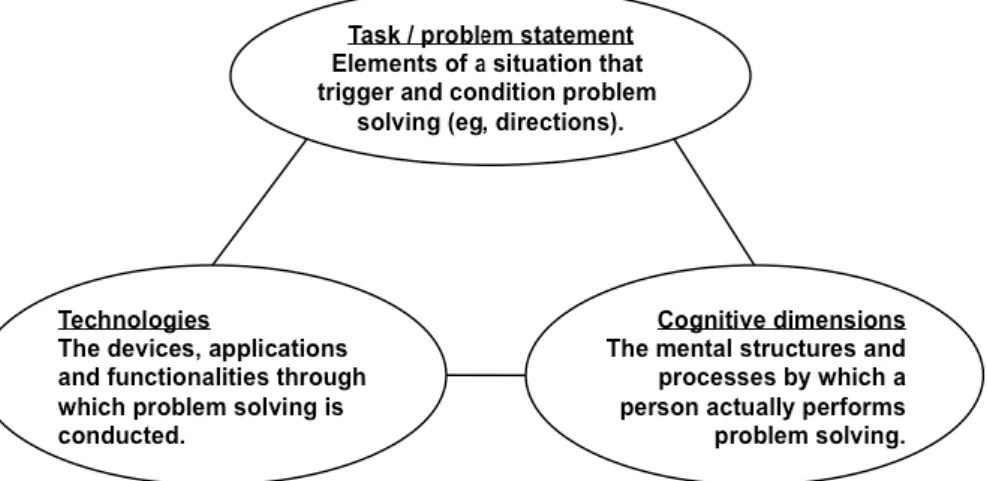
In this study, we use the PIAAC PS-TRE variable, based on its 10 plausible values, as our outcome variable (OECD 2013). PS-TRE has been defined as the use of digital technology, communication tools and networks to acquire and evaluate information, to communicate with others and to perform practical tasks (OECD 2009 p.9). This concept has been used in the PIAAC survey (OECD 2016) as the variable to measure the technological and ICT competence applied by adults to solve everyday tasks or problems. It is part of the cognitive direct skills measures undertaken in PIAAC, together with literacy and numeracy (OECD 2009; Vanek 2017; Rampey et al. 2016; Reder 2015). Vanek (2017) highlights that the PS-TRE skill, instead of simply evaluating the use of common technologies, measures the efficient and creative application of technology in everyday tasks, both at home and at work. This problem-solving skill requires engagement with two aspects: (1) accessing information through communication and information technologies (ICT skills), and, (2) solving everyday problems that exist due to the presence of ICT itself, or that can be solved through them (OECD, 2013). Harris (2015) also considers that PS-TRE encompasses the whole spectrum of different digital literacies. The author defends that digital literacy in the 21st Century is not enough in itself, but that it must be applied to everyday problem-solving. Following Vanek (2017), this use of technological competence in everyday tasks requires three fundamental elements: a statement of the problem or the task to be performed; familiarity with the use of digital devices (ICT skills); and the cognitive dimensions needed to solve a problem (figure 1), all indicating that PS-TRE is a complex and multidimensional construct (Csapó & Funke 2017).
Source: OECD (2009, p. 11)
Figure 1. Three core dimensions of problem solving in technology-rich environments
To further underline its relevance, Wing (2010 p. 3), Care, Griffin and Wilson (2018), Griffin, McGaw and Care (2012) and Vanek (2017) claimed that PS-TRE is one of the new main literacies, being considered, as mentioned before, as one of the core 21st Century skills (P21-Partnership for 21st Century Learning 2017). This set of competences has been developed with input from teachers, education experts and business leaders to define and illustrate the skills and knowledge that people need to succeed in work and life more generally (OECD 2012). Given the need for the current working population to engage with 21st Century skills, it is increasingly important for the
adult education sector to engage with these skills as well (Holford and Mohorcic-Spolar 2012; XXXXXX).
Adults’ PS-TRE Skills for an Inclusive Information Society
The development of ICT as an unprecedented technical and cultural revolution has reformulated both public and private life spheres. This has led to the existence of an Information Society (Castells, 2002), a society in which ICT permeates all production processes, impossible to be disconnected from the social, economic and cultural bases of today’s world. In this sense, the currently required skills to survive in today's society have also been transformed. These requirements range from the high-level skills demanded by employers (OECD 2012) to the personal aptitudes needed to function effectively in any social field. All these domains
increasingly demand the use of technological skills (Van Greunen & Steyn 2015). These include not only the use and management of ICT, but also the ability to select, process and use
information, and the cognitive skills necessary to use technology to solve real-world problems (Vanek 2017; OECD 2013; Rampey et al. 2016; Reder 2015).
However, despite the focus on the need for further development of PS-TRE skills among the population, current economic production continues to represent a capitalist model, distributing technological and informational resources unequally among people (Castells 2002). This provokes a twofold effect: there is a large part of the population without access to ICT resources, but there are also social groups with the opportunity of accessing them, but who have difficulties in developing the necessary skills for an effective relationship with ICT. This inequality is translated into a ‘Social Darwinism’ (Compaine 2001) fostered by the transformation of capitalist society into the Information Society (Habermas 1987; Compaine,2001), in which only those who have the necessary resources and skills can "survive" both in the labor market and the broader sociocultural environment. This negative effect is especially pre-eminent among the most vulnerable adults in society, like older people, immigrants, people who live in rural areas, or lower educated adults (Van Greunen & Steyn 2015).
On the other hand, as stated by several authors, skills development has a strong relationship with socioeconomic status (see for example Cunha, Heckman & Schennach 2010; Cunha & Heckman 2007; Bowles, Gintis & Osborne 2001; Hanushek 2015). However, for the adult population, the level of skills in technology-rich environments and the use of ICT is, in general, much lower than in the younger population (OECD 2016). This finding represents the so-called ‘generational digital gap’ (Compaine 2001), which, according to Ballestero (2002), contributes to a greater risk of socioeconomic exclusion of the adult population. Currently, the current European workplace is challenging adults’ expertise (Tynjälä et al. 2014). This is because workers are at risk of being replaced by technologies, their jobs descriptions change rapidly, and, even so, they run the risk of being excluded from their workplaces because they do not have the required skills to perform their jobs. This risk is especially pronounced among low-educated adults, due to the Matthew Effect
(XXXXXX 2009), which leads them to be even more reluctant to participate in training activities in the present, although further participation in education and training has been evidenced as a fundamental element to help to break this digital divide (XXXXXX 2017).
Although the aforementioned risks for adults are evident across competences (for example reading, writing, numeracy), we will focus specially on PS-TRE, as it has been considered as one of the main 21st Century Skills needed to be applied to many areas of life (Care, Griffin & Wilson 2018). This is especially the case at work, where adults are increasingly expected to accomplish non-routine tasks (Goos 2013; Tynjälä 2013). Activities to change people’s way of thinking to a more holistic one, combining analytic, creative, critical and pragmatic thinking, joint to the use of technological tools to solve every day problems, are therefore needed to be introduced into adult education practices (Vanek, 2017; Harteis & Billett 2013). According to Vanek (2017), Newman, Rosbash and Sarkisian (2015) and Jacobson (2012), although 21st Century Skills are being effectively introduced into Primary and Secondary school curricula, adult education is failing to
take the opportunity of developing PS-TRE training in order to “truly prepare learners to succeed outside the classroom” (Vanek 2017 p. 34).
The inner resilience that this kind of training should give learners the opportunities to cope with fast changes at home, at work, and in cultural and social life, is the path for getting a sustainable and inclusive Information Society for all, not leaving adults behind.
Variables that are Related to the Acquisition of PS-TRE: Hypothetical Model
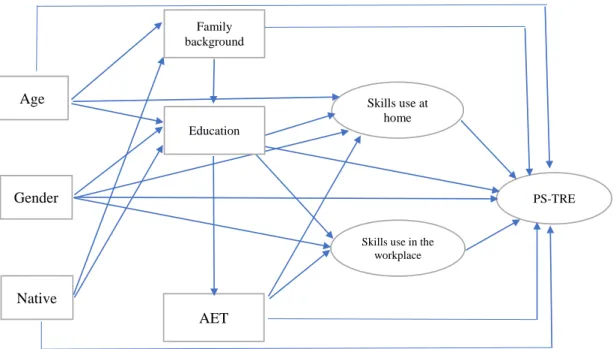
The main objective of this paper is to analyse the presence of PS-TRE skills in adults between 25 and 65 years old in Europe. Specifically, it explores the factors that are related to higher PS-TRE proficiency score. Given the absence of available models that analyse this issue, we started from research published by Scandurra and Calero (2017), in which the authors propose a structural equation model (SEM). Their work uses data from OECD’s PIAAC to analyze socio-personal and educational variables that could influence adults' literacy level (Figure 2). Their sample included all OECD countries except Australia, Cyprus and Russia because of the unavailability of data. The construction of their model was based on research by Desjardins (2003) on literacy proficiency. In Scandurra and Calero’s model, educational level of the father (Family background) influences the respondent’s educational level (Education). Due to the intergenerational transmission of education, both play an important role in the configuration of adult skills and skill practices. Also, the uses of skills at home and in the workplace were found to have a relevant effect on literacy scores. The authors also controlled for covariates such as Age, Gender and being born in the country (Native). These had an effect on the educational level (negative in the case of age), on the use of skills, and on literacy.
Figure 2. Path diagram, visual representation of Scandurra & Calero (2017) model
Source: Own elaboration from Scandurra & Calero (2017)
*Observed variables are represented as squares and latent variables as ellipses
In our own analyses, we use a modified version of this model. Regarding the choice of variables, first, the literature shows that Age is related inversely proportional to the levels of the three skills
Gender
Native
Education Family background Skills use at home Skills use in the workplace LiteracyAge
measured in the PIAAC survey (literacy, numeracy and PS-TRE) (Desjardins & Warnke 2012; Calero et al. 2016), and, specially, on PS-TRE (Hämäläinen et al. 2015). This is due to biological reasons, such as aging and cognitive decline, and because of older adults’ restricted access to education when they were young (Scandurra & Calero 2017). In relation to Gender, although in the PIAAC survey, men obtained higher scores in the three direct skills measurements (literacy, numeracy and PS-TRE, OECD, 2016), evidences have indicated that, after controlling for age and other social characteristics, the gender gap has a weakened influence on skills attainment
(Scandurra & Calero 2017; Christl & Köppl-Turyna 2017). However, given the traditionally unequal access to education by adult women, especially in the workplace, the gender variable is commonly used to test its influence on educational level, and the level of foundational skills, such as literacy, numeracy or PS-TRE, being critical for training and workplace success (Christl & Köppl-Turyna 2017). Continuing with the personal characteristics, being Native or migrant is also highlighted as an important variable within the literature. Differences in the educational systems of the country of origin and the country of destination, and the fact that the immigrant population often starts from a socioeconomic situation generally more precarious than that of natives, might put them in an unfavourable position (Isphording 2014; Marks 2006).
In relation to the educational variables, the Educational Level or highest level of qualification obtained in the past (measured by ISCED levels) has been used in this model as one of the variables that, hypothetically, contributes most to the skill indices (at home and in the workplace) and the level PS-TRE proficiency. Both in relation to the generic development of skills (Kerckhoff 2001, Carbonaro 2007) and improved socio-economic destinations (Hanushek et al., 2013), but also in relation to the specific development of PS-TRE skills (Hämäläinen, De Wever, Nissinen & Cincinnato 2017; XXXXXX 2017), educational attainment is usually considered as a fundamental explanatory variable. Family Background, measured through the "Father's highest level of education" strongly influences this factor. According to Bukodi and Goldthorpe (2012), this variable helps explain a wider set of relevant aspects, such as educational level, socioeconomic background, social and cultural capital, etc. As such, it is relevant to be used in PIAAC analyses, as the dataset does not include alternative measures such as the International Socio-Economic Index, ISEI. Family capital and the intergenerational transmission of education have been traditionally discussed as one of the main factors for explaining educational success, both because of the better access to resources, and because of schooling decisions taken by the family (Jerrim & Macmillan 2015; Breen & Karlson 2014).
Finally, the Skills in Use indices, both at home and in the workplace, have been considered in our models, both as predictors of PS-TRE, but also as dependent variables of the previous individual and educational factors. The constructs Skills used at home and Skills used in the workplace were already computed and defined in the PIAAC survey, integrating data from the variables use of writing skills, use of reading skills, use of numeracy skills and use of ICT skills respectively. The index on skills used in the workplace also included the use of task discretion at work. Information on these variables was presented through the use of ordinal scales ranging from 1-5, where 1 represents the "lowest to 20%", 2 the "20-40%", 3 the "40-60%", 4 the "60-80%" and 5 the "80-100%”. According to Collins and Evans (2007) or Flyvberg (2001), individuals tend to practice their skills on daily basis. This practice, or its absence, leads them to improve their levels of competences, being the best way to gain further proficiency. A variable that often appears in analytical models of skills attainment is employment. In this study, it has not been considered, because it did not feature as a significant contributor to previous models (Hämäläinen, De Wever, Nissinen & Cincinnato 2017, XXXXXX 2017, Scandurra & Calero 2017) and being in
employment is in fact covered by the variable Skills in the workplace. We did run a separate model that included employment, but a significant effect has not been found.
However, in our hypothetical model we have taken into account a variable that did not appear in the study by Scandurra and Calero (2017), which is participation in non-formal education activities (AET - Adult Education Training). The introduction of this variable in the model is based on the observation that participation in adult education seems to be a determinant in the acquisition of PS-TRE. Several authors came to this conclusion based on analyses conducted using PIAAC data (Hämäläinen, De Wever, Nissinen & Cincinnato 2017; Hämäläinen, De Wever, Malin, &
Cincinnato 2015). This relationship was also found in previous work by one of the authors of this paper (XXXXXX 2017; XXXXXX 2018).
Considering all these factors, our hypothesized model is described graphically in Figure 3. In this model, Family background, Education and AET have been considered as observed or endogenous variables (variables directly measured in the PIAAC survey and represented in the figure as squares) for avoiding redundancies of using more than one indicator. On the other hand, the same relationships between variables proposed by Scandurra and Calero (2017) have been hypothesized, but with adding in the potential relationship between Age and the use of Skills at home as stated by Ballestero (2002). When testing this assumption1, Age did not show a clear relationship with the
use of Skills at work. We therefore decided to eliminate this causal relationship with the aim to arrive at a stronger model. As it has been aforementioned, the AET variable has been included using the PIAAC variable Participation in non-formal education activities in the last 12 months, known to be largely predicted by educational level, and predicting skills use and PS-TRE
proficiency levels. The observed variable Participation in formal education activities in the last 12 months was not included because the percentage of adults in the sample that answered yes to this question was very low, and when it was included in the model, it was not found to be significant. As in Scandurra and Calero’s model (2017) Skills use at home, Skills use in the workplace and PS-TRE were defined as endogenous or latent variables, composed by the observed variables specified in Table 1 and represented as ellipses in the graphical model (Figure 3).
Figure 3. Path diagram, visual representation of our PS-TRE model.
Source: Own processing
*Observed variables are represented as squares and latent variables as ellipses
1 To avoid an excessively long and complex paper, the different models tested from the initial
model by Scadurra & Calero have not been included. The criteria for defining the final model have been based only on significant relations among the variables (p<0.001), with the aim to get a stronger and more optimal model.
Gender
Native
Skills use at home
Skills use in the workplace PS-TRE Age Education Family background AET
Method
Instrument
Our analysis is based on data from the first (2013) and the second (2016) rounds of the PIAAC’s Survey of Adult Skills which measures adults’ proficiency in key information-processing skills, and how these adults use these skills in different environments such as at home or in the workplace (OECD, 2016). The third round has not been taken into account as data have not been released yet. So far, the survey has been conducted in 40 countries. Respondents were between 16 and 65 years old. According to the OECD, cognitive skills are necessary to enable individuals to participate successfully in society and to contribute to a productive economy. Apart from literacy and numeracy skills, PS-TRE skills were evaluated through adults’ performances on different tasks. Ten plausible values (PV) were calculated as a result. These PV are a statistical means to replicate a probable score distribution that summarizes how well each respondent answered a small subset of the assessment items; and, how well other respondents from a similar background performed on the rest of the assessment item pool. Each individual case in the PIAAC dataset has a set of ten PVs for each proficiency domain (literacy, numeracy, problem solving in technology-rich environments), and all ten PVs must be used together to estimate proficiency (OECD, 2012). This then leads to a more reliable and unbiased estimate of respondents’ skills proficiency. The final PS-TRE scores range from 0 to 500. Level <1 comprises values of score 240 or below; level 1 from 241-290; level 2, 291-340; and level 3, 341-500.
The PIAAC questionnaire also includes questions about socio-demographic and socio-economic variables such as age, sex, country of origin, educational level, or employment and salary situation, among others, that allow the characterization of the sample. In addition to other relevant issues informing our further understanding of adult skills, for example social and linguistic history, the use of different skills both at home and in the workplace, and the participation in educational activities, were also included as variables in PIAAC.
Sample
In the two first rounds of the PIAAC survey, around 250,000 adults have been evaluated, representing the total population between 16 and 65 years of OECD member countries (OECD 2016). For the present analysis, we decided to work with European countries only. However, those countries that either had not collected some of the core variables of interest (such as PS-TRE), or that measured concepts differently, were excluded from the analysis. Finally, the countries included in our sample are Belgium, Czech Republic, Denmark, Finland, Ireland, Netherlands, Norway, Poland, Slovak Republic, Sweden and United Kingdom. Among the countries that composed the sample, we selected individuals aged 25-65, in accordance to the European way of describing this group as the working age population. Finally, cases with missing data on the model variables were excluded to make the sample more robust for the modelling process.
The final sample has been n = 20,034 (see APPENDIX for sample features), distributed equitably in terms of country of residence, age group (mean age 42.6, with a standard deviation of 10.8), and gender. In terms of educational level, there is an overrepresentation of people with higher
education (54.6 of individuals with ISCED 5 level). This is due to the fact that we are using a selective sample, excluding respondents with missing values on the skills measured. However, we used the same criteria for inclusion and thus obtained a similar sample bias as our model of reference (Scandurra & Calero 2017). Not including missing data with the aim to get a stronger model led to the focus on individuals in employment at the time of data collection, as those with missing data on “Skills used in the workplace” were excluded. Similar to our model of reference, Scandurra and Calero (2017), we did not apply sampling weights and thus conducted analyses based on the unweighted number of respondents. The distribution between natives (92.8) and non-natives (7.2) is representative of European population distribution (6.9% according to Eurostat, 2017). Regarding family background, low-level educated father represents more than a third of the sample (36.6), but with the largest group consists of respondents with medium-level of paternal education (40.7). Two thirds of the participants in our analyses have undertaken non-formal education activities in the last year. Information on the use of skills at home and in the workplace,
derived from original variables in the PIAAC dataset, was presented in quintiles (lower than 20% of use, 20-40%, 40-60%, 60%-80% and over 80%). More than the 50% of the sample uses falls into the two highest levels (60%-80% and over 80%), indicating a stronger than average use of skills among the selected sample compared to all respondents in the dataset. More detailed results are shown in APPENDIX (Table 5). Finally, the mean of all the plausible values for PS-TRE in our sample is 293.29 (level 2).
Selection of Variables
From the 1,329 variables included in the PIAAC survey, we have selected a number of observed and latent variables shown in Table 1, in order to test our hypothetical model presented above. The types of the variables (dichotomous, ordinal and continuous) have been selected following our model of reference.
Table 1. Variables used in the model
Latent variables Observed variables Type
Description Label Description Label
Gender (male/female) Gender Dychotomus
Age Age Ordinal
Born in country Native Dychotomus Highest level of education Education Ordinal Father’s highest level of
education Family Ordinal Participation in non-formal
educational activities in the
last 12 months AET Dychotomus
Use of Skills at Home Skills Home
Use of writing skills at
home WRITH Ordinal
Use of reading skills at
home READH Ordinal
Use of numeracy skills at
home NUMH Ordinal
Use of ICT skills at home ICTH Ordinal Use of Skills in the
workplace Skills Work
Use of writing skills at
work WRITW Ordinal
Use of reading skills at
work READW Ordinal
Use of numeracy skills at
work NUMW Ordinal
Use of ICT skills at work ICTW Ordinal Use of task discretion at
work TASKW Ordinal
PS-TRE proficiency PS-TRE Plausible value PS-TRE 1 PV1 Continuous Plausible value PS-TRE 2 PV2 Continuous Plausible value PS-TRE 3 PV3 Continuous Plausible value PS-TRE 4 PV4 Continuous Plausible value PS-TRE 5 PV5 Continuous Plausible value PS-TRE 6 PV6 Continuous Plausible value PS-TRE 7 PV7 Continuous Plausible value PS-TRE 8 PV8 Continuous Plausible value PS-TRE 9 PV9 Continuous Plausible value PS-TRE 10 PV10 Continuous Source: OECD, 2016, Own processing
For its selection we have revised the existing literature (explained above in Variables that are Related to the Acquisition of PS-TRE. Hypothetical Model epigraph) proposing 5 components of skills acquisition, using the following observed variables: education (Highest level of education), family background (Father’s highest level of education), AET (participation in non-formal educational activities in the last Twelve months); and the latent variables: Use of Skills at Home (using the four items: reading, writing, numeracy and ICT), and Use of Skills in the workplace
(using the five items reading, writing, numeracy, ICT and task discretion – as explained above, we added this variable taking into account its relevance for PS-TRE score). The level of skills use was used based on the skill use scales computed by the OECD, as explained above. Finally, the latent construct of PS-TRE comprises the 10 plausible values of PS-TRE. Similar to the original model by Scandurra and Calero (2017), we controlled for the following observed variables: age, gender and being native-born (or not).
Analysis
To test the proposed hypothetical model, resulting from the theoretical review on the factors that are potentially related to the acquisition of PS-TRE skills, an analysis through SEM has been conducted. The choice to use this technique, and following Byrne (2010), was taken for a number of reasons: first, because of the lack of research that applies SEM to the field of adult education which limits the field’s understanding of complex relationships between variables; second, due to the advantages that SEM has over conventional linear regressions. In this sense, SEM allows to use several dependent variables in a same model, to construct latent variables (more reliable than the observed ones, by including measurement errors, allowing the combination of almost all kinds of items). SEM also produces multiple goodness-of-fit measures that allow checking if our model fits the data.
To carry out this analysis, we used the IBM-SPSS extension AMOS (version 22). A two-step modelling has been performed to, on the one hand, describe the contribution of each observed variable to its corresponding latent variable (see results section, Table 3), and then to analyse the proposed structural model, including both observed variables and latent variables (see results section, Figure 4, and Table 4). This full structural equation model is used to test hypothetical patterns of a causal structure linking several variables onto the construct (Byrne 2010). This technique has a confirmatory nature to test a model derived from theoretical revision, such as the one proposed in this paper. As explained above, the inclusion of variables defining the final model has been based on a previous model predicting literacy proficiency by Scandurra and Calero (2017). In order to get a stronger and more optimal model, only those relations among variables that were found to be significant (p<0.001) were included in the final model.
The selected estimator was a Maximum Likelihood Estimator (MLE). This type of estimator is recommended when the analysis incorporates variables measured in different ways (Byrne, 2010), such as dichotomous, ordinal and scale level variables in our case. It has specifically been recommended within the literature on applying SEM using AMOS (Pérez, Medrano & Sánchez Rosas 2013; Byrne 2010).
Below, we will report our results. First, the goodness-of-fit of our model is tested using RMSEA; CFI; TLI; NFI and GFI as indicators, as recommended by Schlermelleh-Engel et al. (2003), Vandenberg (2006) and Byrne (2010) (see table 2). These authors suggest not using chi square/d.f. indicator for large samples. In reporting the coefficients of our final model (see tables 3 and 4), we have included both unstandardized and standardized regression weights as produced by AMOS. Although the literature recommends using standardized coefficients to facilitate the interpretation and comparison of results, unstandardized regression weights within AMOS outputs provide additional information about standard errors, critical residues, and the significance of each variable. We have also calculated the indirect effects on endogenous variables to check the mediating effects of the variables on PS-TRE level, as recommended by Pérez, Medrano and Sánchez Rosas (2013). Within the results section below (table 4), and as discussed above, we will only focus on significant relationships. The aim of this paper has not been to make comparisons between the different European countries within the sample. Their participant features were more or less equivalent after the depuration of the cases. However, we have replicated our analysis for each individual country, obtaining similar results, which further validates our model.
Results
Regarding the evaluation of the goodness-of-fit of our model, the analyzed indicators (RMSEA, CFI, TLI, NFI, GFI; similarly used in our model of reference by Scandurra and Calero 2017), demonstrate that the matrix derived from the data and those from the conceptual model (Figure 3) do not have significant differences. As such, it can be considered as an optimal model.
Table 2. Goodness-of-fit indicators for the proposed model
Index Value Limit criteria Interpretation
RMSEA .05 < .80 Fits CFI .96 > .93 Fits TLI .96 > .90 Fits NFI .96 >.90 Fits GFI .95 >.90 Fits Own processing
In our measurement model (the first step in the modelling process), all observed variables were significant in their loads onto the latent variables (p<0.001; critical residues, Est./S.E.>1.96). Both for skills used at home and skills used at work, the strongest contribution was made by the variable ICT use (.761 and .676 respectively in their standardized regression weights).
Table 3. Measurement model
Estimate S.E. Est/S.E. P
Regression weights WRITW<-Skills_Work 1.000 READW<-Skills_Work 1.044 .021 49.164 *** NUMW<-Skills_Work 1.298 .027 48.260 *** ICTW<-Skills_Work 1.754 .033 53.473 *** TASKW<-Skills_Work .563 .020 27.703 *** WRITH<-Skills_Home 1.000 READH<-Skills_Home .950 .016 59.918 *** NUMH<-Skills_Home 1.084 .019 57.642 *** ICTH<-Skills_Home 1.147 .019 61.290 *** PVPSL1<-PSTRE 1.000 PVPSL2<-PSTRE 1.005 .005 215.868 *** PVPSL3<-PSTRE 1.005 .005 216.356 *** PVPSL4<-PSTRE .990 .005 214.561 *** PVPSL5<-PSTRE .994 .005 214.878 *** PVPSL6<-PSTRE 1.012 .005 216.931 *** PVPSL7<-PSTRE 1.003 .005 214.813 *** PVPSL8<-PSTRE .990 .005 212.738 *** PVPSL9<-PSTRE 1.003 .005 215.397 *** PVPSL10<-PSTRE 1.003 .005 215.287 ***
Standardized regression weights
WRITW<-Skills_Work .481 READW<-Skills_Work .552 NUMW<-Skills_Work .533 ICTW<-Skills_Work .761 TASKW<-Skills_Work .246 WRITH<-Skills_Home .580 READH<-Skills_Home .639 NUMH<-Skills_Home .593 ICTH<-Skills_Home .676 PVPSL1<-PSTRE .909 PVPSL2<-PSTRE .910 PVPSL3<-PSTRE .911 PVPSL4<-PSTRE .908 PVPSL5<-PSTRE .909 PVPSL6<-PSTRE .912 PVPSL7<-PSTRE .908 PVPSL8<-PSTRE .905 PVPSL9<-PSTRE .909 PVPSL10<-PSTRE .909
Source: OECD, 2016. Own processing
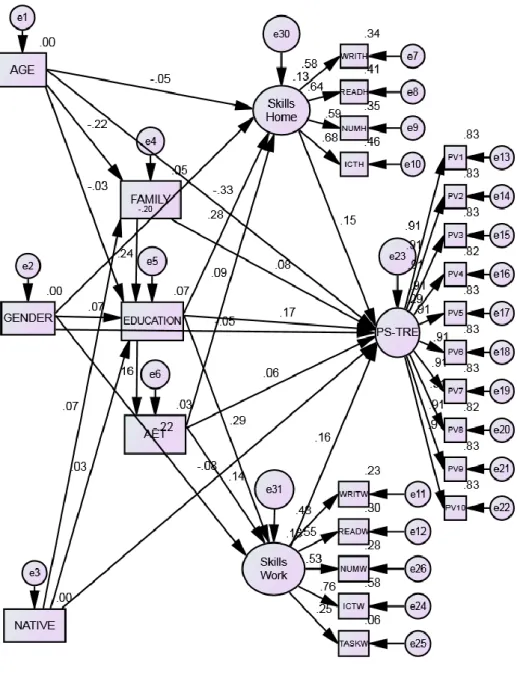
The second step of our analyses is being represented in the structural model shown in Figure 4, together with its values specified in Table 4. Turning first to the standardized estimates for the structural parameter paths, it is clear that all of these estimates are significant (p <0.001; critical residuals, Est/SE>1.96). For facilitating comparisons across different types of variables
(dichotomous, ordinal and continuous measured in different ways), we have used standardized parameters both in Table 4 and in Figure 4, which should be interpreted as percentage change in the standard deviation of the endogamous variable (dependent factor) for every one single point change in the standard deviation of the exogenous variable (independent factor).
Results demonstrate that age is the strongest factor affecting the PS-TRE score, (standardized coefficient -.326), therefore, the older adults are, the lower their PS-TRE score. Factors such as educational level (.170), the use of skills at work (.164) and at home (.148) (especially, as we have explained above, the use of ICT skills), as well as the family background (.080), seem to be decisive when it comes to obtaining higher scores in PS-TRE. Origin and gender seem to be characteristics that can affect PS-TRE score. Both being not native and female indicators are related with a lower coefficient in this skill. Finally, introducing the AET variable is also relevant, assuming a standardized coefficient of .057.
It is also interesting to check the influence of these socio-personal and educational variables on the indices of use of skills at home and at work. In this case, as an explanatory variable, educational level is the strongest predictor (coefficient of .293 for skills at work and .283 for skills at home), followed by gender, where being a woman again means a lower score on both indices. However, age does not seem to be as relevant as having participated in non-formal educational activities during the last 12 months in relation to skills used at home. While age has a coefficient of -.052 in its weight to skills used at home, AET coefficients are .141 in relation to predicting of the use of skills at work and .091 for the use of skills at home.
We have also verified the relevance of the intergenerational transmission of education. We can see from the model that the coefficient of family background on educational level is .237, higher than other aspects such as age, gender or being immigrant. On the other hand, as expected, being older is also related to having a father with a lower educational level (-.216). Finally, the aforementioned Matthew Effect is also noted, given that one’s educational level is a strong predictor of
participation in educational activities (standardized coefficient of .163).
Finally, we have calculated the indirect effects to check whether the intermediation of the used variables was relevant for the PS-TRE score. Analysing the standardized coefficients of this mediating effect, we can appreciate that the variables that are more relevant in this sense are the skills used at home and at work, attenuating the effects of gender (-.030 and -.036 respectively) and age (-.008 on skills at home) on the PS-TRE score (see Table 4 Indirect effects on PS-TRE). This relevant role of intermediation of the use of skills on the PS-TRE score is also clearly shown in the case of respondents’ educational level (.042 skills at home; .048 skills at work), and their participation in AET (.013 skills at home; .026 skills at work). Another variable that seems to mediate is educational level. For example, the positive relation with family background increases the PS-TRE score (.040), reduces the relevance of age in this skill (-.005), but also serves as an important mediator for women to score better in PS-TRE (.012, versus -.049 without the mediating effect of the educational level). Finally, participation in non-formal education activities has a certain mediating role, both between the effect of the educational level in the PS-TRE (.009), as well as in relation to gender and educational level (.001).
Figure 4. Visual representation of the model. Standardized estimates and estimates of error variance parameters (e)2
Source: OECD, 2016. Own processing
2 error (e) is an unobserved variable. Whereas traditional multivariate procedures are incapable of
either assessing or correcting for measurement error, SEM provides explicit estimates of these error variance parameters, avoiding inaccuracies of other traditional methods (Byrne, 2010, p. 24)
Table 4. PS-TRE model results
Estimate S.E. Est/S.E. P
Regression weights FATHERED<-AGE -.015 .000 -31.413 *** FATHERED<-BORN .219 .020 10.860 *** EDUCATION<-FAMILY 1.058 .031 33.839 *** EDUCATION<-AGE -.010 .002 -4.466 *** EDUCATION<-GENDER .478 .046 10.370 *** EDUCATION<-BORN .437 .089 4.885 *** NFE<-EDUCATION .021 .001 23.310 *** Skills_Home<-GENDER -.286 .012 -24.223 *** Skills_Work<-GENDER -.243 .009 -25.658 *** Skills_Home<-AET .147 .013 11.226 *** Skills_Work<-AET .177 .010 17.165 *** Skills_Home<-EDUCATION .060 .002 32.626 *** Skills_Work<-EDUCATION .048 .001 32.167 *** Skills_Home<-AGE -.003 .001 -6.593 *** PSTRE<-Skills_Work 10.360 .530 19.538 *** PSTRE<-Skills_Home 7.240 .395 18.338 *** PSTRE<-AGE -1.061 .021 -51.461 *** PSTRE<-GENDER -3.424 .459 -7.453 *** PSTRE<-BORN -11.114 .826 -13.453 *** PSTRE<-FAMILY 3.711 .297 12.503 *** PSTRE<-EDUCATION 1.757 .075 23.565 *** PSTRE<-AET 4.470 .501 8.922 ***
Standardized regression weights
FATHERED<-AGE -.216 FATHERED<-BORN .075 EDUCATION<-FATHERED .237 EDUCATION<-AGE -.031 EDUCATION<-GENDER .071 EDUCATION<-BORN .033 AET<-EDUCATION .163 Skills_Home<-GENDER -.200 Skills_Work<-GENDER -.219 Skills_Home<-AET .091 Skills_Work<-AET .141 Skills_Home<-EDUCATION .283 Skills_Work<-EDUCATION .293 Skills_Home<-AGE -.052 PSTRE<-Skills_Work .164 PSTRE<-Skills_Home .148 PSTRE<-AGE -.326 PSTRE<-GENDER -.049 PSTRE<-BORN -.082 PSTRE<-FATHERED .080 PSTRE<-EDUCATION .170 PSTRE<-AET .057
Indirect effects on PS-TRE
Estimate S.E. Est/S.E. P PSTRE<-AGE -.048 PSTRE<-FATHERED .065 PSTRE<-GENDER -.046 PSTRE<-EDUCATION .105 PSTRE<-NFE .037 PSETRE<-SKILLSH<-AGE -.008 PSE-TRE<-FATHERED<-AGE -.017 PSTRE<-ED<-AGE -.005 PSTRE<-ED<-FATHERED<-AGE -.009 PSTRE<-SKILLSH<-GENDER -.030 PSTRE<-SKILLSW<-GENDER -.036 PSTRE<-ED<-GENDER .012 PSTRE<-AET<-ED<-GENDER .001 PSTRE<-SKILLSH<-ED<-GENDER -.002 PSTRE<-SKILLSW<-ED<-GENDER .003 PSTRE<-FATHERED<-BORN .006 PSTRE<-ED<-BORN .006 PSTRE<-SKILLSH<-ED<-BORN .001 PSTRE<-SKILLSW<-ED<-BORN .002 PSTRE<-ED<-FATHERED .040 PSTRE<-SKILLSH<-ED<-FATHERED .005 PSTRE<-SKILLSW<-ED<-FATHERED .011 PSTRE<-AET<-ED .009 PSTRE<-SKILLSH<-ED .042 PSTRE<-SKILLSW<-ED .048 PSTRE<-SKILLSH<-AET<-ED .002 PSTRE<-SKILLSW<-AET<-ED .004 PSTRE<-SKILLSH<-AET .013 PSTRE<-SKILLSW<-AET .023
Source: OECD, 2016. Own processing
Reference category of gender (male), for born (native) and AET (no)
Discussion
The rapidly changing labour markets and social environments of recent years have made it necessary for people to develop high levels of skills, especially the so-called 21st Century skills (P21-Partnership for 21st Century Learning 2017; Care, Griffin & Wilson 2018, Griffin, McGaw & Care 2012). Among these skills, PS-TRE is highly relevant, especially since ICT has permeated all kinds of activities (Vanek 2017; Harteis & Billett 2013). However, as discussed in the earlier parts of our paper, factors such as age, gender, belonging to immigrant or ethnic minorities, as well as having low levels of education can negatively influence decreased opportunities for skills development, favouring Social Darwinism in the new Information Society. This inevitably leads to consequent risks of social exclusion and marginalization of certain social groups (Compaine 2001, Van Greunen & Steyn 2015). Previous research has already demonstrated that the development of skills strongly relates to people socio-economic status (Cunha, Heckman & Schennach 2010; Cunha & Heckman 2007; Bowles, Gintis & Osborne 2001; Hanushek 2015). That is why social research, still in an embryonic status on this topic of PS-TRE (Hämäläinen et al. 2017), must analyse what factors promote or hinder the development of these skills, with the aim of achieving a more inclusive society in which there is access to these 21st Century skills for all.
In the study presented in this paper, we have analysed the factors that are related to the
achievement of a higher PS-TRE proficiency score, with the aim of acting as a knowledge base to further strengthen the debate in relation to the development of the PS-TRE for all. The use of SEM allowed us to simulate a predictive model exploring the complex relationships between variables, instead of only testing them as separate independent variables in a multiple linear regression analysis. This has given us the chance to look into direct as well as indirect relationships between PS-TRE proficiency and the other variables. For example, while participation in AET was found to be a relevant predictor of a higher PS-TRE score, participation in itself could also be predicted by adults’ educational attainment, hence adding an indirect effect on top of the direct one we found between educational level and PS-TRE score.
In order to assist our research procedures, the previous literature has been taken as a starting point, specifically the model proposed by Scandurra and Calero (2017) who analysed Literacy and Numeracy competencies using data from PIAAC, inspired by Desjardins’ (2003) work on literacy achievement. Given the relevance of participation in adult education in previous research on problem-solving (Hämäläinen, et al. 2017; 2015; XXXXXX 2017; XXXXXX 2018), we decided to include this variables into our model (measured in this case as non-formal education activities in the last 12 months), at the same level as the respondents’ educational level and their family background.
The results of our model on PS-TRE corroborate some of the issues highlighted by Scandurra and Calero (2017) in relation to Literacy and Numeracy. This includes similar effects of educational level on the skills measured (.188 in the previous model, and .170 in our model). This effect was also found in other previous studies such as those by Kerckhoff (2001), Carbonaro (2007) or Hämäläinen, et al. (2017). As hypothesized in the previous model on literacy, we also found a prediction from adults’ family background onto their own educational level. The importance of educational level is, as in the study by Scandurra and Calero (2017), even more relevant in relation to the use of skills at home and at work, with a standardized coefficient of .283 and .293
respectively. Thus, both variables in relation to the use of skills have a decisive relation to the PS-TRE score, especially the use of ICT skills. These variables were found to be stronger predictors of PS-TRE proficiency levels than other variables such as family background or being an immigrant. Evidence on the effects of the use of skills in relation to generic competencies scores were also found by Collins and Evans (2007) or Flyvberg (2001).
However, in our study, age was found to be a stronger predictor of PS-TRE scores, (-.326), compared to similar analyses based on PIAAC data in previous research. Scandurra and Calero did not focus on PS-TRE but on Literacy (-.032) and Numeracy (-.011). As such, our finding in relation to age corroborates the previous literature warning about the risk of exclusion of older people in a technological world (Desjardins & Warnke 2012; Calero et al. 2016, Hämäläinen et al. 2015). However, negative predictors such as “age” (being older) or gender (“female”), can be mediated through the development of skills at home and at work, educational level and
participation in AET. These findings were also discussed in previous similar studies (Scandurra & Calero 2017; Christl & Köppl-Turyna 2017). These findings further underline the importance of education, either theoretical/academic (educational level, AET), or practical (AET, skills in use). This line of thought has been confirmed in the literature (Holford and Mohorcic-Spolar 2012; XXXXXX 2017; Vanek 2017; Harteis & Billett 2013) and further highlights the value of
education as a fundamental strategy to achieve equitable access to the development of the different competences.
In spite of the relevance given by different national and supranational organizations, such as the OECD, to the development of high level skills in a knowledge-based economy, the truth is that the so-called "new literacies" (or the 21st Century skills, including PS-TRE) have received attention within compulsory levels of schooling, but are not typically referred to in relation to the adult population. This causes a lack of alignment for adults with the current demands of the labour market, or economic, cultural and social environments. This is especially true for the most vulnerable groups in society.
Levels of initial educational, use of skills at home and in the workplace and participation in AET predicted, both directly and through intermediation, respondents’ levels of PS-TRE proficiency. Therefore, translating the main findings of this study into a set of recommendations for policy and practice, it is clear that providing everyone with equal access to education should be a core priority. Adults who did not receive the opportunity to achieve high levels of education could profit from participation in adult education. So do migrants whose foreign qualifications might not have been validated in the context of the host country. Widening access to adult education among older adults might also further guarantee their skills are being updated on a regular basis. More incentives for women to participate in work-related training and obtain a more satisfying work-life balance could also help the development of their skills. As family background remains a relevant predictor of adults’ educational attainment, it is also important to keep on investing in the education and development of children growing up in the most deprived families in Europe. This will hopefully help to reduce the attainment gap between the richest and the poorest teenagers, as, for example, visible in PISA data.
To finalise, recommendations for future research are being discussed as well. The limitations of the study are found in the absence of a reflection on the structural characteristics of both Europe in general, and of the countries that make up the sample in particular. Having started from the seminal proposal by Desjardins (2003) and its subsequent assumption as a model by Scandurra and Calero (2017), both core underpinnings of our study, justify this absence. Additionally, the chosen sample can be considered slightly biased after its depuration. However, our approach and results have been aligned with previous studies. Due to these limitations, future research could be carried out taking into account national samples and their structural characteristics. Additionally, data from subsequent OECD PIAAC rounds could be included too.
References
Akcaoglu, M., & Koehler, M. J. (2014). Cognitive outcomes from the Game-Design and Learning (GDL) after-school program. Computers & Education, 75, 72–81.
Ballestero, F. (2002). La brecha digital. El riesgo de exclusión en la Sociedad de la Información (Fundación Retevisión)
XXXXXX XXXXXX
Bocconi, S., Chioccariello, A., Dettori, G., Ferrari, A., Engelhardt, K. (2016). Developing computational thinking in compulsory education – Implications for policy and practice; EUR 28295 EN; doi: 10.2791/792158
Bowles, S., Gintis, H. & Osborne, M. (2001). The Determinants of Earnings: A Behavioral Approach. Journal of Economic Literature, 39(4), 1137- 1176.
Breen, R. & Karlson, K. B. (2014). Education and social mobility: New analytical approaches, European Sociological Review, 30(1), 107–118.
Bukodi, E. & Goldthorpe, J. H. (2012). Decomposing “social origins”: The effects of parents’ class, status, and education on the educational attainment of their children, European Sociological Review, 29(5), 1024–1039.
Byrne, B. (2010). Structural Equation Modeling with AMOS (London, Routledge)
Calero, J., Murillo Huertas, I. & Raymond Bara, J. L. (2016). Education, age and skills: An analysis using the PIAAC survey. Working paper 2016/03 (Barcelona, IEB)
Carbonaro, W. (2007). The effects of education and cognitive skill on earnings: How much do occupations and jobs matter? Research in Social Stratification and Mobility, 25(1), 57–71 Care, E. (2018). Twenty-First Century Skills: From Theory to Action. In E. Care, G. Griffin & M. Wilson, M. (Eds). Assessment and Teaching of 21st Century Skills (New York, Springer) Care, E., Griffin, G., & Wilson, M. (Eds) (2018). Assessment and Teaching of 21st Century Skills (New York, Springer)
Castells, M. (2002). The Information Age: Economy, Society and Culture (Oxford, Blackwell Publishing)
Christl, M. & Köppl-Turyna, M. (2017). Gender wage gap and the role of skills: evidence from PIAAC dataset, GLO Discussion Paper, 63
Collins, H. & Evans, R. (2007). Rethinking expertise (Chicago, University of Chicago Press) Compaine, B. (2001). Digital Divide. The MIT Press (Cambridge, Massachussets)
Csapó, B., & Funke, J. (Eds.). (2017). The nature of problem solving. Using research to inspire 21st century learning. (Paris, OECD Publishing).
Cunha, F., Heckman, J. & Schennach, S. (2010). Estimating the Technology of Cognitive and Noncognitive Skill Formation. Econometrica, Econometric Society, 78(3), 883-931.
Cunha, F. & Heckman, J. (2007). The technology of skill formation. American Economic Review, 97(2), 31-47.
Desjardins, R. (2003) Determinants of literacy proficiency: A lifelong–lifewide learning perspective. International Journal of Educational Research, 39, 205–245.
Desjardins, R. & Warnke, A. J. (2012). Ageing and skills. A review and analysis of skill gain and skill loss over the lifespan and over time (Paris, OECD)
Eurostat (2017). Population data. Available at: http://ec.europa.eu/eurostat/web/products-datasets/-/migr_pop3ctb
Flyvberg, B. (2001) Making social science matter. Why social inquiry fails and how it can succeed again (Cambridge, Cambridge University Press)
Goos, M. (2013), How the world of work is changing: a review of the evidence, ILO Research Paper, 1-54. Available at:
www.ilo.org/public/english/dialogue/actemp/downloads/events/2013/symp/how_worldofwork_cha nging.pdf
Griffin, P., McGaw, B. & Care, E. (Eds.). (2012). Assessment and teaching of 21st Century Skills (Dordrecht, Springer)
Desjardins, R. & Warnke, A. J. (2012) Ageing and skills. A review and analysis of skill gain and skill loss over the lifespan and over time (Paris, OECD)
Habermas, J. (1987). Teoría de la acción comunicativa. Vol. I. Racionalidad de la acción y racionalización social. Vol. II. Crítica de la razón funcionalista. (Madrid, Taurus)
Hämäläinen, R., De Wever, B., Malin, A. & Cincinnato, S. (2015). Education and working life: VET adults’ problem-solving skills in technology-rich environments. Computers & Education, 88, 38-47.
Hämäläinen, R., De Wever, B., Nissinen, K., Cincinnato, S. (2017). Understanding adults’ strong problem-solving skills based on PIAAC, Journal of Workplace Learning, 29(7/8), 537-553. doi: 10.1108/JWL-05-2016-0032
Hanushek, E.A. (2015). Returns to Skills around the World: Evidence from PIAAC. European Economic Review, 73, 103-130.
Harris, K. (2015). Integrating digital literacy into English language instruction: Issue brief. Available at: https://goo.gl/XWpyWG
Harteis, C. & Billett, S. (2013). Intuitive expertise: theories and empirical evidence. Educational Research Review, 9, 145-157
Holford, J. & Spolar, V. A. M. (2012). Neoliberal and inclusive themes in European lifelong learning policy. In S. Riddell, S., J. Markowitsch, J. & E. Weedon, E. (eds) Lifelong learning in Europe: equity and efficiency in the balance (Bristol, Policy Press).
XXXXXX XXXXXX
Isphording, I. E. (2014). Disadvantages of linguistic origin – Evidence from immigrant literacy scores, Economics Letters, 123(2), 236–239.
Jacobson, E. (2012). Adult basic education in the age of new literacies. New Literacies and Digital Epistemologies, 42.
Jerrim, J. & Macmillan, L. (2015). Income inequality, intergenerational mobility, and the Great Gatsby curve: Is education the key? Social Forces, 94(2), 1–29.
Kerckhoff, A. C. (2001). Education and social stratification processes in comparative perspective, Sociology of Education, 74, 3–18.
Marks, G. N. (2006). Accounting for immigrant non-immigrant differences in reading and mathematics in twenty countries, Ethnic and Racial Studies, 28(3), 925–946.
Newman, A., Rosbash, T., & Sarkisian, L. (2015). Learning for life: the opportunity for technology to transform adult education. Tyton Partners. Available at:
http://tytonpartners.com/tyton-wp/wp-content/uploads/2015/03/Learning-for-Life_The-Oppty-for-Tech-to-Transform-Adult-Education_March-20151.pdf
OECD. (2009). PIAAC problem solving in technology-rich environments: a conceptual framework. Available at: https://goo.gl/drJRML
OECD (2012), Literacy, Numeracy and Problem Solving in Technology-Rich Environments: Framework for the OECD Survey of Adult Skills, OECD Publishing, Paris.
doi:10.1787/9789264128859-en
OECD. (2013). OECD skills outlook 2013: First results from the survey of adult skills. OECD Publishing. Available at: https://goo.gl/3BtmvS
P21-Partnership for 21st Century Learning (2017). P21's Framework for 21st Century Learning. Available at: https://goo.gl/Y58DGn
Pérez, E., Medrano, L.A. & Sánchez Rosas, J. (2013). El Path Analysis: conceptos básicos y ejemplos de aplicación. Revista Argentina de Ciencias del Comportamiento, 5(1), 52-66.
Rampey, B. D., Finnegan, R., Goodman, M., Mohadjer, L., Krenzke, T., Hogan, J. & Provasnik, S. (2016). Skills of U.S. unemployed, young, and older adults in sharper focus: Results from the Program for the International Assessment of Adult Competencies (PIAAC) 2012/2014: First Look (NCES 2016-039) (Washington DC, American Institutes for Research)
Reder, S. (2015). Digital inclusion and digital literacy in the United States: a portrait from PIAAC’s Survey of Adult Skills (Washington DC: American Institutes for Research)
Scandurra, R. & Calero, J. (2017). Modelling adult skills in OECD countries. British Educational Research Journal, 43(4), 781–804
Schermelleh-Engel, K., Moosbrugger, H., & Müller, H. (2003). Evaluating the Fit of Structural Equation Models: Tests of Significance and Descriptive Goodnessof-Fit Measures, Methods of Psychological Research Online, 8(2), 23-74.
Trawick, A.R. (2017). Using the PIAAC Literacy Framework to Guide Instruction: An Introduction for Adult Educators (Washington, DC, PIAAC).
Tynjälä, P. (2013). Toward a 3-P model of workplace learning: a literature review. Vocations and Learning: Studies in Vocational and Professional Education, 6(1), 11-36.
Tynjälä, P., Häkkinen, P. & Hämäläinen, R. (2014). TEL@work - towards integration of theory and practice, British Journal of Educational Technology, 45(6), 990-1000.
Vanek, J. (2017). Using the PIAAC Framework for Problem Solving in Technology-Rich Environments to Guide Instruction: An Introduction for Adult Educators. (PIAAC, Washington, DC)
Van Greunen, D. & Steyn, J. (2015). ICTs for Inclusive Communities in Developing Societies (London: Cambridge Scholars Publishing)
Vandenberg, R. J. (2006). Statistical and Methodological Myths and Urban Legend, Organizational Research Methods, 9(2), 194-201.
Voskoglou, M. G., & Buckley, S. (2012). Problem solving and computational thinking in a learning environment. Egyptian Computer Science Journal (ECS), 36(4).
Wing, J. (2014). Computational thinking benefits society. Social issues in computing. Available at:
http://socialissues.cs.toronto.edu/2014/01/computational-thinking
Yadav, A., Good, J., Voogt, J., Fisser, P. (2017). Computational Thinking as an Emerging Competence Domain. In Mulder, M. (Ed.) Competence-based Vocational and Professional Education (Switzerland, Springer)
APPENDIX
Table 5. PIAAC Sample features
Frecuency Percentage Country Belgium 1603 8.0 Czech Republic 1579 7.9 Denmark 3049 15.2 Finland 2450 12.2 Ireland 1470 7.3 Netherlands 1997 10 Norway 2289 11.4 Poland 1151 5.7 Slovak Republic 1115 5.6 Sweden 1969 9.8 United Kingdom 1362 6.8 Gender Male 10299 51.4 Female 9735 48.6
Education No formal qualification or below ISCED 1 54 0.3
ISCED 1 73 0.4 ISCED 2 671 3.3 ISCED 3 1163 39.2 ISCED 4 1039 5.2 ISCED 5 10955 54.6 ISCED 6 430 2.1
Born in country Yes 18591 92.8
No 1443 7.2
Father Education ISCED 1-2 7336 36.6
ISCED 3- 4 8152 40.7
ISCED 5-6 4546 22.7
Non formal education Did not participate 5341 26.7
Participated 14693 73.3
Use of ICT skills at home Lowest to 20% 1370 6,8
More than 20% to 40% 3434 17,1
More than 40% to 60% 5036 25,1
More than 60% to 80% 5473 27,3
More than 80% 4721 23,6
Use of ICT skills at work Lowest to 20% 1962 9,8
More than 20% to 40% 3889 19,4
More than 40% to 60% 4829 24,1
More than 60% to 80% 4866 24,3
More than 80% 4488 22,4
Use of numeracy skills at
home Lowest to 20% 2549 12,7
More than 20% to 40% 3659 18,3
More than 60% to 80% 5212 26
More than 80% 4037 20,2
Use of numeracy skills at
work Lowest to 20% 2633 13,1
More than 20% to 40% 3268 16,3
More than 40% to 60% 4447 22,2
More than 60% to 80% 4689 23,4
More than 80% 4997 24,9
Use of reading skills at
home Lowest to 20% 423 2,1
More than 20% to 40% 2528 12,6
More than 40% to 60% 5313 26,5
More than 60% to 80% 6374 31,8
More than 80% 5396 26,9
Use of reading skils at
work Lowest to 20% 302 1,5
More than 20% to 40% 2199 11
More than 40% to 60% 4659 23,3
More than 60% to 80% 6421 32,1
More than 80% 6453 32,2
Use of task discretion at
work Lowest to 20% 1536 7,7
More than 20% to 40% 3058 15,3
More than 40% to 60% 4188 20,9
More than 60% to 80% 5273 26,3
More than 80% 5979 29,8
Use of writing skills at
home Lowest to 20% 1967 9,8
More than 20% to 40% 2996 15
More than 40% to 60% 6165 30,8
More than 60% to 80% 4732 23,6
More than 80% 4174 20,8
Use of writing skills at
work Lowest to 20% 971 4,8 More than 20% to 40% 3135 15,6 More than 40% to 60% 5724 28,6 More than 60% to 80% 5454 27,2 More than 80% 4750 23,7 Base n.= 20,034