Underlying Effect of Customer Satisfaction on Repurchase
Intentions: Mediating role of Trust and Commitment
Muhammad Sohaib1* Muhammad Ahmad Ur Rehman2 Umair Akram3
1. School of Economics and Management, Beijing University of Posts and Telecommunications, No 10, Xitucheng Road, Haidian District, Beijing, PRC 100876, China
2. Textile Management, National Textile University Sheikhupura Road, Faisalabad 37610, Pakistan 3. School of Economics and Management, Beijing University of Posts and Telecommunications, No 10,
Xitucheng Road, Haidian District, Beijing, PRC 100876, China
Abstract
Pakistani banking industry rivalry becomes more intense with the development of this sector. This study aims to examine the relationship between customers satisfaction and repurchase intentions through the prologue of trust and commitment as mediators in the banking industry of Pakistan. 225 customers of banks was included in the analysis with 87% response rate. Results showed positive relationship between satisfaction and repurchase intentions, trust and repurchase intentions, trust and commitment. Satisfaction positively enhances the trust subsequently trust fosters the commitment and this increase the repurchase intentions of customer. Commitment and trust both are act as mediators between customers satisfaction and repurchase intentions. These findings have strategic implications for increasing customers repurchase intentions in banking industry of Pakistan.
Keywords: Satisfaction, Trust, Commitment, Repurchase intentions
1. Introduction
In dynamic environment new trends, technologies and regulations are creating intense competition in banking industry. Pakistan banking business is flourishing and competition among rivals becomes more intense. Scheduled banks stocks are growing from Pak Rs 725.4 Millions to Pak Rs 1031.3 Millions in Fiscal year 2012 and Fiscal year 2013 respectively (SBP, 2013). According to the State Bank of Pakistan, increase in reserves of Pakistani banks enhancing rivalry among them. More banks are approaching to keep their market share by retaining the existing customers. The existing and new entrants are tried to getting customers from their rivals by providing better services. So, banks are more conscious to retain the existing customers because new customer’s attraction required much efforts and finance then existing customers. The existing customers can be retained by providing satisfaction, creating trust and commitment with service providing bank.
Repurchase intentions is growing as most important issue and need to figure out those factors which directly or indirectly influences the intentions of customers. To investigate the repurchase intentions, satisfaction, trust and commitment numerous studies were conducted by scholars (Eriksson & Vaghult, 2000; Gundlach, Achrol, & Mentzer, 1995; McDougall & Levesque, 2000; Moorman, Deshpande, & Zaltman, 1993).
In aggressive environment importance of customer satisfaction cannot be ignored. Organizations are competing with rivals by increasing customer’s satisfaction and making them loyal. The measurement of customer satisfaction shows positive influence on the customer loyalty and negative influence on the switching intentions (Arokiasamy, 2008).
Organizations are trying to enhance their profitability by increasing satisfaction of customers (Anderson, Fornell, & Lehmann, 1994). Customer satisfaction plays important role to build trust and commitment (Giese & Cote, 2000). Customer’s retention is a major concern for the organizations and they want to know about those factors that influences the customer retention. Trust and commitment are key drivers to develop a long term relationship, which ultimately affects the customer behavioural intentions for relationship continuity with service provider (Gounaris, 2005).
Trust depends on the interactional relationship quality which is perceived by the customers and exchange partners. This develops their belief on each other and minimizes the future uncertainty. Moreover, commitment is desirable state to maintain a long term relationship with exchange partners. Sometimes committed customers are willing to take more risk by investing in the uncertain exchanges. Because trust on exchange partners create more value for committed customers (Moorman, Zaltman, & Deshpande, 1992).
The constructs of satisfaction, trust, commitment and repurchase behaviours are empirically and theoretically different from each other (Geyskens, Steenkamp, & Kumar, 1999). Satisfaction develop trust and ultimately
commitment grows in long term relationship between customer and service provider (Garbarino & Johnson, 1999; Geyskens et al., 1999; Morgan & Hunt, 1994; Spake, Beatty, Brockman, & Crutchfield, 2003).
The core objective of this study is to empirically investigate the role of satisfaction in customers repurchase intentions within the context of Pakistani banking industry. To investigate satisfaction and trust, trust and commitment as on mediator between satisfaction and repurchase intentions.
2. Background of the Study
2.1 Satisfaction
The satisfaction is explained as overall performance of services or products that meet the customer’s expectations. As well, the extent to which customers felt pleasure due to transferring ability of customer’s expectations and desires into pleasure (Hellier et al., 2003). Consumer satisfaction definition conceptually derived from the previous literature and this comprises on the following components (i) consumer satisfaction affects the response rate which consists of emotional state and cognitive process (ii) response intensity depends on the particular expectations and purchase experience (iii) response rate also varies according to the particular situation and time (Giese & Cote, 2000; McDougall & Levesque, 2000). Customer satisfaction performs a key mediating role in low relational customers construct, also influence on the future intentions (Garbarino & Johnson, 1999).
Customer satisfaction includes perceived value and service quality elements (core quality and relational quality), which significantly affects the future intentions. Core quality (basic) and relational quality (the way of delivery) affects the customer satisfaction but these are less important derivers than perceived value (McDougall & Levesque, 2000). Consumers measure the different products performance as instrumental performance (physical) and expressive performance (Psychological). Expressive outcomes affect the satisfaction level but not contributing in dissatisfaction. The unsatisfactory experiences related to the expressive outcomes. Whereas, features of different products varies also this creates impact on the expressive and instrumental outcomes (Maddox, 1981).
Satisfaction is positively related with the trust (Pavlou, 2003). Further satisfaction positively influences and enhances the customer’s commitment with suppliers (Meyer, Stanley, Herscovitch, & Topolnytsky, 2002). Many studies indicated that satisfaction also plays important role in customers repurchase intentions (Rauyruen & Miller, 2007; Tsai, Huang, Jaw, & Chen, 2006; Anderson & Sullivan, 1993; Jones, Mothersbaugh, & Beatty, 2003; Fullerton, 2005; Durvasula, Lysonski, Mehta, & Tang, 2004). Although, relationship among customers satisfaction and repurchase are varies due to the three reasons. First, satisfied customers have different repurchase intentions due to diverse characteristics. Second reason is biased response rate of customers. Third includes nonlinear relationship among satisfaction and repurchase intentions (Mittal & Kamakura, 2001). Satisfaction play its role to make customer loyal and enhance firm’s profitability. Satisfied customers have different levels of satisfaction which affect the repurchase intentions of satisfied customers at individual level (Jin & Su, 2009). The association between satisfaction and repurchase behaviour (frequency of visits, monetary value) is considerably moderates by relationship interaction (Seiders, Voss, Grewal, & Godfrey, 2005).
The relationship between Customer satisfaction and behavioural intentions is investigated in previous studies and results explain positive association between them (Mittal & Kamakura, 2001; Anderson & Sullivan, 1993). The outcomes of satisfied and dissatisfied customers are different, which associated differently with repurchase intentions (Oliver, 1993). Satisfied customers positively and significantly affects the customer loyalty intentions (Rust & Zahorik, 1993). Further they are more likely to repurchase and they continue their relationship with service provider rather than dissatisfied customers (Tsai & Huang, 2007).
2.2 Trust
Trust is defined as exchange partners are willing to rely on each other and one of them has confidence on exchange partner. The construct of this definition splits’ into two parts these are psychological part (confidence) and sociological part (willingness). Trust is higher when exchange partners has less knowledge about each other and trust is less when exchange partners has much knowledge about exchange partners. Interpersonal characteristics of exchange partners play a major role to affect the trust (Moorman et al., 1993). Further trust and distrust have different dimensions which explain the individual positive or negative belief in organization (Kramer, 1999).
Trust of consumers in services relationship is based on two dimension cognitive trust and affective trust. Satisfaction with previous interactions are strongly affects the cognitive trust. Furthermore, cognitive trust strongly affects the sales performance and affective trust significantly influence on the future intentions (Johnson & Grayson, 2005). Trust has two way directions between user and provider of research (Moorman et al., 1992). Mutual perceived trustworthiness directly and indirectly affects the outcomes. Trust is based on interactions with each other over time that build trustworthiness and mutual trust (Smith & Barclay, 1997).
2.3 Commitment
Commitment defined as exchange partners has confidence on each other and desire to maintain valuable long- term relationships (Moorman et al., 1992). Commitment performs as central role to success is helpful to develop long-term profitable relationships with the existing customers (Morgan & Hunt, 1994). Commitment plays a mediating role between the construct of attitudes and future intentions of customers. Furthermore, commitment predicts future intentions of customers when relationship among exchange partners is high (Garbarino & Johnson, 1999). Trust affects the relationships and commitment performs to develop long-term relationships. Moreover, commitment can predict the future intentions of professional service customers (Rosenbaum, Massiah, & Jackson, 2006). Commitment plays very important role to build strong relationships among the exchange partners. Further committed partners can develop social norms and more opportunities can be created for less committed partners. Social norms play significant role to develop reliable and long term commitment (Gundlach et al., 1995).
The committed buyer’s purchase more and more from sellers in this way selling firms generate more profit by strengthens their relationship with buyers (Stanko, Bonner, & Calantone, 2007). Committed customers are not only remain loyal with existing service provider also they increase share by repurchasing (Lacey, 2007). Although, only affective commitment significantly affects the buyers loyalty but normative and calculative commitment has no significant results on loyalty. (Cater & Zabkar, 2009; Stanko et al., 2007).
2.4 Repurchase Intentions
Marketing past practices focus on the selling concept and not consider the retention of customers. But recent practices consider existing customers due to intense rivalry and high cost involved for new customer attraction (Hallowell 1996). Customers are considered as mode of success through which organizations are attaining maximum profit and share of market (Hafeez & Muhammad, 2012). Business relationships mainly depend upon the customer retention. Importantly, relationship development affect the customer retention through relationship satisfaction. Further relationship satisfaction positively influence on the customer retention (Eriksson & Vaghult, 2000).
Repurchase intentions based on several factors which are determined by the preceding purchase and personal decision making process. Repurchase decision making theory (TRD) explored that satisfaction and commitment are significantly contributing to the repurchase decision making process of customers (Han & Ryu, 2012). While, attitudinal antecedent’s of behaviour like subjective norm, past behaviour (Recency, frequency, monetary) and perceived behaviour significantly affects the intentions which moderates the buying intentions (DeCanniere, DePelsmacker, & Geuens, 2009).
2.5 Trust influence customer commitment
According to commitment-trust theory trust plays a central role in successful relationship. Trust is created by belief and confidence of one partner on another exchange partner (Morgan & Hunt, 1994; Andrus & Martin, 2001). Trust plays very important role to build the relationship among exchange partners as Spekman (1988) considered it to be base for deliberate exchange relationships. Because trust provides high value to exchange partners and they desire to remain committed with them (Hrebiniak 1974).
Trust is outcome of perceived value and exchange experience, also this creates the medium term relationships. Sometimes professional service customers taking trust for granted which cannot predict the future behavioural intentions (Rosenbaum et al., 2006). The relationship between service provider and consumer depends upon the trust on each other. This study was conducted to meet the gap between consumer and service provider. The trust related to satisfaction and commitment has influence on the relationship quality. It is important to identify those uncertainty factors which affect the trust. Whereas, contributing factors to build trust are not enough without
customer satisfaction and commitment for implementation of strategic relationship marketing. Trust only builds when customers and service providers understand the importance of each other (Fam, Foscht, & Collins, 2004). Importantly, Moorman et al., (1992) explored the trust as major element which significantly affects the customer’s commitment with service providers. Trust positively affects the affective commitment and negatively affects the calculative commitment. Furthermore, affective commitment positively affects the customer intention and calculative commitment has negative influence on the customer intentions (Gounaris, 2005).
2.6 Trust and commitment as mediating constructs
According to the trust-commitment theory trust and commitment both are taken as mediators. Trust is antecedent of the commitment and customers did not become committed unless trust is already developed. This theory also explains that trust and commitment both are persuades the future intentions of the customers (Morgan & Hunt, 1994). Trust influences the relationships and commitment performs to develop long-term relationships (Rosenbaum et al., 2006). The trust have been fosters due to customer satisfaction (Zineldin & Jonsson, 2000) Committed customers are not only remain loyal with existing service provider also they increase share by repurchasing (Lacey, 2007). Commitment plays a mediating role between the construct of attitudes and future intentions of customers. Furthermore, commitment predicts future intentions of customers when relationship among exchange partners is high (Garbarino & Johnson, 1999).
H1: There is a relationship between satisfaction and trust.
H2: There is relationship between satisfaction and commitment
H3: There is a relationship between trust and repurchase intentions.
H4: There is a relationship between commitment and repurchase intentions.
H5: There is a relationship between trust and commitment.
H6: Trust mediates the relationship between satisfaction and commitment.
H7: Commitment mediates the relationship between trust and repurchase intentions.
Figure 1. Research Model
3. Methodology
Banking industry of Pakistan was selected for the study. The reasons to select this sector for surveys are following: Banking industry is much organized than other sectors because information regarding sector is conveniently available. Specifically, banking is growing sector in Pakistan more charming growth rate cause for more intense competition. So, customer’s retention is becomes burning issue, which is investigated by exploring the customer repurchase intentions.
The sample size of the study was 225 respondents. The Hair et al., (1986) stated that minimum number of observations must be 10 against each variable. Specifically, data were collected from the customers of banking sector in Faisalabad Pakistan. All well popular banks customers were taken for true representation of sample. The primary data were collected from the customers of different banks through personally administrated questionnaires. For this purpose non-probability sampling type convenience sampling method is used and 300 research questionnaires were distributed within normal banking hours to the conveniently available customers in different banks. Respondents were requested to complete the questionnaire by considering their bank. As a result, 260 questionnaires were returned out of which 35 questionnaires were not included in the analysis of data due to incomplete information. The 225 usable questionnaires were included for the analysis of data. The response rate was 87%.
4. Measures
A comprehensive questionnaire was developed for the research. Trust and commitment were measured by five and seven items consecutively on seven point likert scale. Measures of trust and commitment were adapted from the Morgan & Hunt (1994). The one item of trust is negatively worded as “In our relationship, my bank cannot
Trust
Commitment
Repurchase
Intentions
Satisfaction
be trusted at times”. This item of trust is reverse coded for accuracy of results. Rating scale measures the items against the following anchors like “1= strongly disagree” and “7= strongly agree”. While, satisfaction was measured by three items on seven point likert scale with anchors like, “1= Very Low” and “7= Very High”, which are adopted from Oliver (1980). The item of satisfaction was like, “The relationship that I have with my bank is something I am very committed to.”
Repurchase intentions was measured with the help of four items on seven point likert scale, which were adopted from the Garbarino & Johnson (1999). The rating scale consists on the following anchors like, “1= strongly disagree” and “7= strongly agree”. The repurchase intentions measuring item is as, “I plan to maintain the relationship with my bank.”
5. Results
The total usable responses were 225 out of which 160 (71%) males and 65 (29%) female’s. The survey participants were mostly fall into 26-30 year’s age contained 34%. Those individuals who have master qualification and they contributed to survey were 58% percent. 25% customers of survey were graduate. The income group Pak Rs 0-30 thousand contained 46% of survey participants. 53% of respondents have less than five year experience with their bank. 24% bank customers experience were within six to ten years.
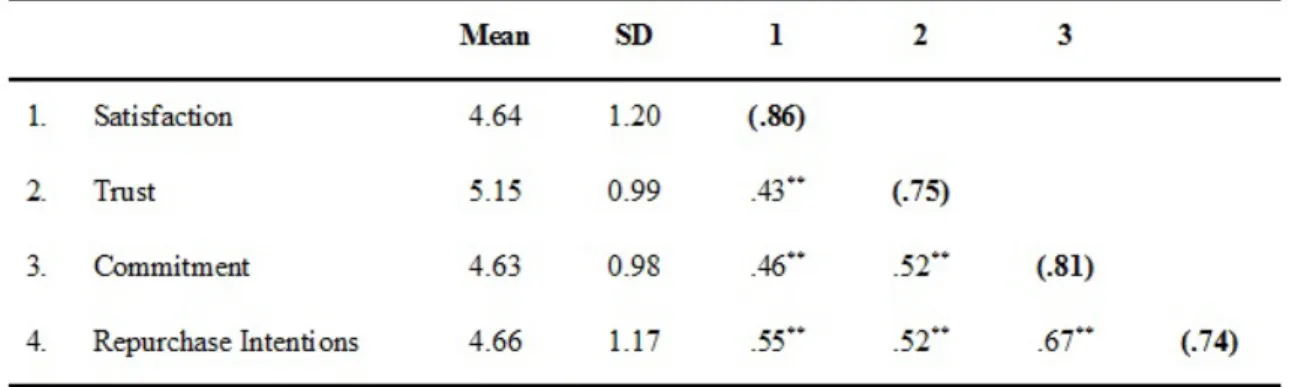
The scale reliabilities of variables, descriptive statistics and correlation between the variables are explained in Table 1. The satisfaction consists upon 3 items. The Cronbach’s Alpha value for satisfaction is .86, trust is .76, and commitment is .82. All items of individual variables were satisfying the minimum criteria of reliability as .70 Alpha’s value explained by the Nunnally (2010) and according to Hair et al., (1986) minimum acceptance value of reliability must be .60. The satisfaction, trust, commitment and repurchase intentions associations were figure out by Pearson correlation method. The correlation value between the satisfaction and trust was .43 (P< 0.01). The correlation value .46 (P< 0.01) represents that there was considerable relationships between trust and commitment. The correlation value .52 (P< 0.01) represents that both variables had positive relationships between them. The association among repurchase intentions and satisfaction, trust, commitment were significant and positive.
Table 1: Scale reliabilities, Descriptive statistics and correlation
Regression analysis was performed to analyze the influence of predictor’s variables on the dependent variables. Both linear and multiple regression models were used to determine the outcomes of the variables. All variables multicollinearity and auto-correlation were analyzed with the variance inflation factor (VIF) and Durbin-Watson. The maximum value of VIF was 1.51, and Durbin-Watson test maximum value was 2. So, these values indicated that there was no problem of multicollinearity and auto-correlation.
The Table 2 gives the detail about five linear regression models (Models 1, 2, 3, 4 and 5) results. This explains that predictor variables were significant or insignificant for the prediction of dependent variables (i.e., Trust, Commitment, and Repurchase Intentions). In model 1, Hypothesis 1 result reveals that satisfaction had positive and significant relationship with trust (β = .382, P< .05). The predictor satisfaction coefficient of determination (R2 = .185) explains the 19% explained variation of trust. In model 2, Hypothesis 2 result explains that
satisfaction had positive and significant relationship with commitment (β = .450, P< .05). The predictor satisfaction coefficient of determination (R2 = .219) explains the 22% explained variation of commitment. In model 3, Hypothesis 3 result figure out that trust had positive and significant relationship with repurchase intentions (β = .570, P< .05). The predictor trust coefficient of determination (R2 = .269) explains the 27% explained variation of repurchase intentions. In model 4, Hypothesis 4 result describes that commitment had positive and significant relationship with repurchase intentions (β = .673, P< .05). The predictor commitment coefficient of determination (R2 = .439) explains the 44% explained variation of repurchase intentions. In model 5, Hypothesis 5 result illustrates that trust had positive and significant relationship with commitment (β = .629, P< .05). The predictor trust coefficient of determination (R2 = .338) explains the 34% explained variation of commitment. So, proposed Hypothesis (i.e., H1, H2, H3, H4, and H5) were accepted.
Table 2: Linear regression
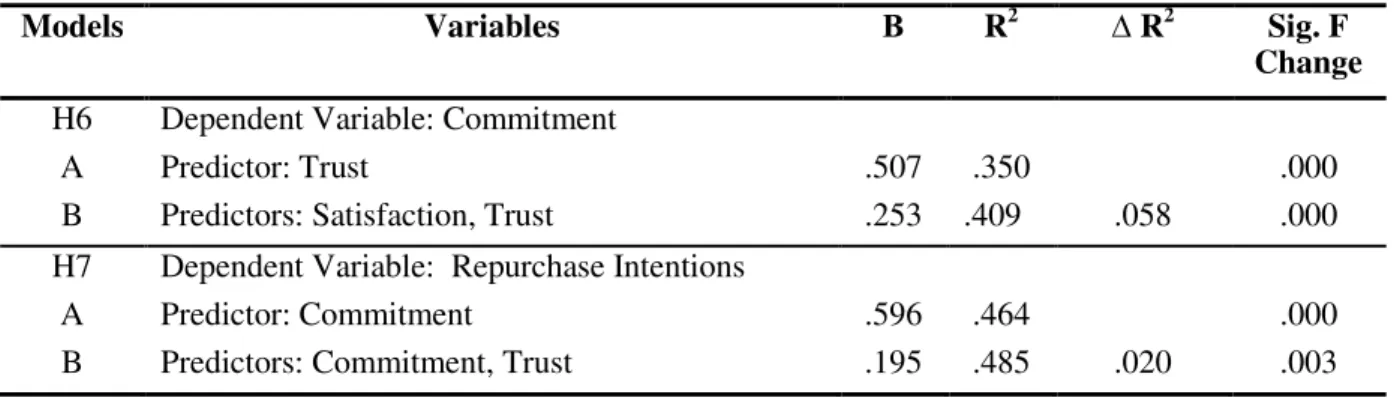
The Table 3 explains the mediation results with two multiple regression models (Models 6.a, 6.b, 7.a, 7.b). All models were formed according to the Baron & Kenny (1986) approach. In first model of 6.a, outcome describes that trust as independent variable significantly and positively influences the commitment (β = .507, P< .05). Further trust explains 35% variation of the commitment (R2 = .350). In second model of 6.b, trust plus satisfaction (predictors), result explains that satisfaction significantly and positively affects the commitment (β = .253, P< .05). The ∆R2 = .058, R2 = .409, figure out that satisfaction as a predictor cause only 5.8% improvement in coefficient of determination of commitment. In first model of 7.a, outcome describes that commitment as independent variable significantly and positively influences the commitment (β = .596, P< .05). More commitment explains 46.4% variation of the repurchase intentions (R2 = .464). In second model 7.b, commitment plus trust (predictors), result explains that trust significantly and positively affects the repurchase intentions (β = .195, P< .05). The ∆R2 = .020, R2 = .485, figure out that trust as a predictor cause only 2% improvement in coefficient of determination of repurchase intentions. The results of both proposed hypothesis for mediation (i.e., H6, H7) explained that trust and commitment as mediator were not fully mediate and they partially mediate the relationship between satisfaction and commitment, trust and repurchase intentions respectively. So, Hypothesis 6 and Hypothesis 7 were partially supported.
Table 3: Multiple regression
Models
Variables
Β
R
2∆
R
2Sig. F
Change
H6
Dependent Variable: Commitment
A
Predictor: Trust
.507
.350
.000
B
Predictors: Satisfaction, Trust
.253
.409
.058
.000
H7
Dependent Variable: Repurchase Intentions
A
Predictor: Commitment
.596
.464
.000
6. Discussion
This study was two main objectives, one was to find out the mediating effect of trust among the customers satisfaction and commitment, second was to figure out the role of commitment as mediator among trust and repurchase intentions.
According to the Baron & Kenny (1986) approach for two mediators seven models were formed. The Hypothesis 1 results show that satisfaction has positive and significant relationship with trust. The Hypothesis 2 consequence was illustrating that satisfaction significantly and positively influences the commitment of the customers. The Hypothesis 5 figures out that trust radically and positively persuade the commitment. Further Hypothesis 6 results described that trust positively but partially mediate the relationship among satisfaction and commitment. The proposed Hypothesis 1, Hypothesis 2 and Hypothesis 5 all are significant. But Hypothesis 6 results shows that trust and satisfaction as predictors have also significant relationship with commitment and change in coefficient of determination is near to zero (∆R2 = .058). So, trust partially mediates the satisfaction and commitment relationship.
The second objective of the study was to find out mediating effect of the commitment among trust and repurchase intentions. In Hypothesis 4, commitment significantly and positively influences the repurchase intentions. The Hypothesis 3 results revealed that trust has significant and positive relationship with repurchase intentions of bank customers. More in Hypothesis 7, commitment partially mediate the relationship among trust and repurchase intentions of bank customers. The proposed hypotheses Hypothesis 4 and Hypothesis 3 all are significant. The Hypothesis 7 results represents that commitment and trust as predictors have also significant relationship with repurchase intentions and change in coefficient of determination is near to zero (∆R2 = .020). So, commitment partially mediated the relationship among trust and repurchase intentions of bank customers. This study results are empirically supported with the previous studies. Many findings figure out that satisfaction positively affects the trust (DeRuyter & Wetzels, 2000; Garbarino & Johnson, 1999; Johnson & Grayson, 2005; Miyamoto & Rexha, 2004; Nijssen, Singh, Sirdeshmukh, & Holzmueller, 2003; Roman & Ruiz, 2005; Wiertz, DeRuyter, Keen, & Streukens, 2004). Further satisfaction positively influence and enhances the customer’s commitment (Meyer et al., 2002; Brown, Barry, Dacin, & Gunst, 2005). Trust is precursor of the commitment and this reflects long term relationships (Geyskens, Steenkamp, Scheer, & Kumar, 1996; Morgan & Hunt, 1994). It also positively influences the customers repurchase intentions that increases the sales performance (Johnson & Grayson, 2005). According to the repurchase decision making theory committed customers are significantly contributing to the repurchase decision making process (Han & Ryu, 2012). Moreover, committed customers are becomes loyal customers and they repeat purchase with the service provider (Lacey, 2007). Specifically, trust and commitment plays the role of mediation among variables (Saleh, Ali, & Quazi, 2013). The empirical outcome of study finds that both trust and commitment partially mediates the relationship among satisfaction and loyalty. The results suggested that these variables are precursor of the satisfaction-loyalty relationship and mediates the relationship with different intensity (Chen, 2012).
7. Managerial Implications
This study highlights the impact of customer satisfaction on repurchase intentions and role of trust and commitment as mediators. The empirical results and concepts provide value to the bank managers for the retention of existing customers. To achieve customer repurchase intentions satisfaction is considered as most important factor. More importantly, this study fosters the bank customer’s satisfaction that can be achieved through customer’s perception about service providers, perceived experiences and expectations. Once customers developed their trust on bank then this fosters commitment and committed customers repurchase from service providers. The commitment and trust as mediators were evident for this study. This advocates that managers must have to consider the other factors which can influence on the customer satisfaction relationship with repurchase intentions. Bank managers should consider the mediation effect of trust and commitment in order to improve the customers repurchase intentions.
Bank managers need to increase the trust of customers by providing services according to their needs and wants. This automatically increases the customer’s commitment with the service provider. Moreover, committed customers become loyal and they repurchase from the current service providers over the number of times. Managers must have to provide the superior value by customizing the individual customers. This increases the customer satisfaction, trust and commitment that ultimately enhances the bank customers repurchase intentions.
8. Limitations and Future Directions
Despite, the significant contribution of study results in practical implications and literature of service marketing. This study has some specific limitations that cannot be ignored. Specifically, limitations are emerging from the selection of sample and its measurement techniques. Firstly, the exploratory research is conducted to investigate the key issues and variables instead of longitudinal study to figure out the behavioural intentions of customers at different time of repurchase. Secondly, for the collection of data convenience sampling technique is used. Through this method data were collected from conveniently available customers of banks. So, these bank customers are mostly job holders, post graduates and graduates. Thirdly, this study did not categorize the customers of banks into retail, commercial, and corporate clients. Fourthly, the collected data were personalized in nature this means customers of different banks vary in nature and they might have biased response.
In services sector other than banks the theoretical framework of satisfaction, trust, commitment and repurchase intentions (dependent variable) must be replicated in insurance and airline industry. Further the outcomes should be compare and contrast with each other to know facts about variation in repurchase intentions of customers over the different industries. Specifically, in banking industry corporate, commercial and retail banking clients repurchase intentions would be compared with each other.
Additionally, repurchase intentions is the element of behavioural intentions of customers. The recommend intentions of customers are also the dimension of behavioural intentions. Both dimensions of behavioural intentions would be included in theoretical framework as dependent variables. Further involvement and perceived value can be taken as mediator among satisfaction and repurchase intentions of customers. Finally, future studies can also include dissatisfied customers to know about significant differences or similarity among the groups (i.e., Satisfied and Dissatisfied customers). Managers on these bases cope with variations among groups by developing different marketing strategies for satisfied and dissatisfied customers.
References
Anderson, E. W., & Sullivan, M. W. (1993). The antecedents and consequences of customer satisfaction for firms. Marketing Science, 12(2), 125-143.
Anderson, E. W., Fornell, C., & Lehmann, D. R. (1994). Customer satisfaction, market share, and profitability: findings from Sweden. The Journal of Marketing, 58(3), 53-66.
Andrus, D. M., & Martin, D. (2001). The development and management of a department of marketing advisory council. Journal of Marketing Education, 23(3), 216-227.
Arokiasamy, A. R. A. (2008). The impact of customer satisfaction on customer loyalty and intentions to switch in the banking sector in malaysia. The Journal of Commerce 5(1), 14-21.
Baron, R. M., & Kenny, D. A. (1986). The moderator–mediator variable distinction in social psychological research: Conceptual, strategic, and statistical considerations. Journal of Personality and Social Psychology, 51(6), 1173.
Brown, T. J., Barry, T. E., Dacin, P. A., & Gunst, R. F. (2005). Spreading the word: Investigating antecedents of consumers’ positive word-of-mouth intentions and behaviors in a retailing context. Journal of the Academy of Marketing Science, 33(2), 123-138.
Cater, B., & Zabkar, V. (2009). Antecedents and consequences of commitment in marketing research services: The client's perspective. Industrial Marketing Management, 38(7), 785-797.
Chen, S. C. (2012). The customer satisfaction–loyalty relation in an interactive e-service setting: The mediators. Journal of Retailing and Consumer Services, 19(2), 202-210.
Das, T. K., & Teng, B. S. (1998). Between trust and control: developing confidence in partner cooperation in alliances. Academy of Management Review, 23(3), 491-512.
De Cannière, M. H., De Pelsmacker, P., & Geuens, M. (2009). Relationship quality and the theory of planned behavior models of behavioral intentions and purchase behavior. Journal of Business Research, 62(1), 82-92. De Ruyter, K., & Wetzels, M. G. (2000). The impact of perceived listening behavior in voice-to-voice service encounters. Journal of Service Research, 2(3), 276-284.
Durvasula, S., Lysonski, S., Mehta, S. C., & Tang, B. P. (2004). Forging relationships with services: the antecedents that have an impact on behavioural outcomes in the life insurance industry. Journal of Financial Services Marketing, 8(4), 314-326.
Eriksson, K., & Vaghult, A. L. (2000). Customer retention, purchasing behavior and relationship substance in professional services. Industrial Marketing Management, 29(4), 363-372.
Fam, K. S., Foscht, T., & Collins, R. D. (2004). Trust and the online relationship-an exploratory study from New Zealand. Tourism Management, 25(2), 195-207.
Fullerton, G. (2005). The service quality–loyalty relationship in retail services: does commitment matter? Journal of Retailing and Consumer Services, 12(2), 99-111.
Garbarino, E., & Johnson, M. S. (1999). The different roles of satisfaction, trust, and commitment in customer relationships. The Journal of Marketing, 63(2), 70-87.
Geyskens, I., Steenkamp, J. B. E., Scheer, L. K., & Kumar, N. (1996). The effects of trust and interdependence on relationship commitment: a trans-Atlantic study. International Journal of Research in Marketing, 13(4), 303-317.
Geyskens, I., Steenkamp, J. B., & Kumar, N. (1999). A meta-analysis of satisfaction in marketing channel relationships. Journal of Marketing Research, 36(2), 223-238.
Giese, J. L., & Cote, J. A. (2000). Defining consumer satisfaction. Academy of Marketing Science Review, 1(1), 1-22.
Gounaris, S. P. (2005). Trust and commitment influences on customer retention: insights from business-to-business services. Journal of Business Research, 58(2), 126-140.
Gundlach, G. T., et al. (1995). The structure of commitment in exchange. The Journal of Marketing, 59(1), 78-92.
Hafeez, S., & Muhammad, B. (2012). The Impact of Service Quality, Customer Satisfaction and Loyalty Programs on Customer’s Loyalty: Evidence from Banking Sector of Pakistan. International Journal of Business and Social Science, 3(16), 200-209.
Hair Jr, J. F., et al. (1986). Multivariate data analysis with readings, Macmillan Publishing Co., Inc.
Hallowell, R. (1996). The relationships of customer satisfaction, customer loyalty, and profitability: an empirical study. International Journal of Service Industry Management, 7(4), 27-42.
Han, H., & Ryu, K. (2012). The theory of repurchase decision-making (TRD): Identifying the critical factors in the post-purchase decision-making process. International Journal of Hospitality Management, 31(3), 786-797. Hellier, P. K., Geursen, G. M., Carr, R. A., & Rickard, J. A. (2003). Customer repurchase intention: a general structural equation model. European Journal of Marketing, 37(11/12), 1762-1800.
Hrebiniak, L. G. (1974). Effects of job level and participation on employee attitudes and perceptions of influence. Academy of Management Journal, 17(4), 649-662.
Hume, M., Mort, G. S., & Winzar, H. (2007). Exploring repurchase intention in a performing arts context: who comes? and why do they come back?. International Journal of Nonprofit and Voluntary Sector Marketing, 12(2), 135-148.
Jin, Y., & Su, M. (2009). Recommendation and repurchase intention thresholds: A joint heterogeneity response estimation. International Journal of Research in Marketing, 26(3), 245-255.
Johnson, D., & Grayson, K. (2005). Cognitive and affective trust in service relationships. Journal of Business Research, 58(4), 500-507.
Jones, M. A., Mothersbaugh, D. L., & Beatty, S. E. (2003). The effects of locational convenience on customer repurchase intentions across service types. Journal of Services Marketing, 17(7), 701-712.
Kramer, R. M. (1999). Trust and distrust in organizations: Emerging perspectives, enduring questions. Annual Review of psychology, 50(1), 569-598.
Lacey, R. (2007). Relationship drivers of customer commitment. The Journal of Marketing Theory and Practice, 15(4), 315-333.
Maddox, R. N. (1981). Two-factor theory and consumer satisfaction: replication and extension. Journal of Consumer Research, 8(1), 97-102.
McDougall, G. H., & Levesque, T. (2000). Customer satisfaction with services: putting perceived value into the equation. Journal of Services Marketing, 14(5), 392-410.
Meyer, J. P., Stanley, D. J., Herscovitch, L., & Topolnytsky, L. (2002). Affective, continuance, and normative commitment to the organization: A meta-analysis of antecedents, correlates, and consequences. Journal of Vocational Behavior, 61(1), 20-52.
Mittal, V., & Kamakura, W. A. (2001). Satisfaction, repurchase intent, and repurchase behavior: investigating the moderating effect of customer characteristics. Journal of Marketing Research, 38(1), 131-142.
Miyamoto, T., & Rexha, N. (2004). Determinants of three facets of customer trust: A marketing model of Japanese buyer–supplier relationship. Journal of Business Research, 57(3), 312-319.
Moorman, C., Zaltman, G., & Deshpande, R. (1992). Relationships between providers and users of market research: The dynamics of trust. Journal of Marketing Research, 29(3), 314-328.
Moorman, C., Deshpande, R., & Zaltman, G. (1993). Factors affecting trust in market research relationships. The Journal of Marketing, 57(1), 81-101.
Morgan, R. M., & Hunt, S. D. (1994). The commitment-trust theory of relationship marketing. The Journal of Marketing, 58(3), 20-38.
Nijssen, E., Singh, J., Sirdeshmukh, D., & Holzmüeller, H. (2003). Investigating industry context effects in consumer-firm relationships: preliminary results from a dispositional approach. Journal of the Academy of Marketing Science, 31(1), 46-60.
Nunnally, J. C. (2010). Psychometric Theory 3E, Tata McGraw-Hill Education.
Oliver, R. L. (1980). A cognitive model of the antecedents and consequences of satisfaction decisions. Journal of Marketing Research, 17(4), 460-469.
Oliver, R. L. (1993). Cognitive, affective, and attribute bases of the satisfaction response. Journal of Consumer Research, 20(3), 418-430.
Paulssen, M., & Birk, M. M. (2007). Satisfaction and repurchase behavior in a business-to-business setting: Investigating the moderating effect of manufacturer, company and demographic characteristics. Industrial Marketing Management, 36(7), 983-997.
Pavlou, P. A. (2003). Consumer acceptance of electronic commerce: integrating trust and risk with the technology acceptance model. International Journal of Electronic Commerce, 7(3), 101-134.
Rauyruen, P., & Miller, K. E. (2007). Relationship quality as a predictor of B2B customer loyalty. Journal of Business Research, 60(1), 21-31.
Roman, S., & Ruiz, S. (2005). Relationship outcomes of perceived ethical sales behavior: the customer's perspective. Journal of Business Research, 58(4), 439-445.
Rosenbaum, M. S., Massiah, C., & Jackson Jr, D. W. (2006). An investigation of trust, satisfaction, and commitment on repurchase intentions in professional services. Services Marketing Quarterly, 27(3), 115-135. Rust, R. T., & Zahorik, A. J. (1993). Customer satisfaction, customer retention, and market share. Journal of Retailing, 69(2), 193-215.
Saleh, M. A., Ali, M. Y., & Quazi, A. (2013). A comparative study of consumer and B2B goods importers’ trust and commitment: Evidence from an Asian developing country. Australasian Marketing Journal (AMJ), 21(2), 126-136.
Sbp. (2013, December 20). Annual Reports. Retrieved from http://sbp.org.pk/reports/arFY13/ Anul-index-eng-13.html
Seiders, K., Voss, G. B., Grewal, D., & Godfrey, A. L. (2005). Do satisfied customers buy more? Examining moderating influences in a retailing context. Journal of Marketing, 69(4), 26-43.
Smith, J. B., & Barclay, D. W. (1997). The effects of organizational differences and trust on the effectiveness of selling partner relationships. The Journal of Marketing, 61(1), 3-21.
Spake, D. F., Beatty, S. E., Brockman, B. K., & Crutchfield, T. N. (2003). Consumer comfort in service relationships measurement and importance. Journal of Service Research, 5(4), 316-332.
Spekman, R. E. (1988). Strategic supplier selection: understanding long-term buyer relationships. Business Horizons, 31(4), 75-81.
Stanko, M. A., Bonner, J. M., & Calantone, R. J. (2007). Building commitment in buyer–seller relationships: A tie strength perspective. Industrial Marketing Management, 36(8), 1094-1103.
Tsai, H. T., Huang, H. C., Jaw, Y. L., & Chen, W. K. (2006). Why on‐line customers remain with a particular e‐ retailer: An integrative model and empirical evidence. Psychology & Marketing, 23(5), 447-464.
Tsai, H. T., & Huang, H. C. (2007). Determinants of e-repurchase intentions: An integrative model of quadruple retention drivers. Information & Management, 44(3), 231-239.
Wiertz, C., De Ruyter, K., Keen, C., & Streukens, S. (2004). Cooperating for service excellence in multichannel service systems: an empirical assessment. Journal of Business Research, 57(4), 424-436.
Zineldin, M., & Jonsson, P. (2000). An examination of the main factors affecting trust/commitment in supplier-dealer relationships: an empirical study of the Swedish wood industry. The TQM Magazine, 12(4), 245-266.