
Rethinking Technology, ICTs and Development:
Why It Is Time To Consider ICT4D 3.0
∗Anna Bon
International Office VU University Amsterdam
De Boelelaan 1105, 1081 HV Amsterdam, The Netherlands
[email protected]
Hans Akkermans
Network Institute VU University Amsterdam
De Boelelaan 1081, 1081 HV Amsterdam, The Netherlands
[email protected]
ABSTRACT
In the past decade, ICT and Development has become a notable field, in terms of both relevance and size. It is char-acterized by a wide diversity of research studies from a range of disciplines, a plethora of ICT technological development projects in many countries, and different (also conflicting) methodological approaches regarding theory as well as prac-tice. This typifies a young and vibrant field. Despite all these commendable research activities, the field still lacks a broader coherent and shared underlying theoretical frame-work and methodology that is the signature of mature scien-tific fields. This paper investigates this fundamental issue. First, we propose that complexity theory offers a fruitful conceptualization and framework to understand how ICTs work in a development context, and we detail this based on available general literature as well as our own ICT4D research in Africa. Second, we explore practical implica-tions of this approach, leading to a different participatory approach labelled ICT4D 3.0.
Categories and Subject Descriptors
1 [Method, Meta Review, Theory]: Sociotechnical Sys-tems, Information Science; 2 [Qualitative Research Meth-ods]: Participatory, Action Research—Interdisciplinarity, Practice
General Terms
Theory
Keywords
ICT4D 3.0, Complex Adaptive Systems, self-organized agents, technological innovation
∗W4RA Working Papers 2014/12/15 - WP1 This paper presents the results of an ongoing research project in ICT4D; The Network Institute, VU University Amsterdam - version 0.5
1.
INTRODUCTION
It is a general assumption that ICTs are beneficial for devel-opment. This is a (pretty) easy assumption that — however — should in our view not be taken for granted. Even if true, it underspecifies how ICTs are to be developed and employed in development contexts and for whose interests. There has been a strong trend (that is still continuing) that ICT4D is basically a simple replication of so-called ‘west-ern’ technology and knowledge in a development context. If so, objectives and methodologies are exogenously defined, and there is effectively no dialogue where real end-users and supposed beneficiaries can express their own priorities. On the other hand, there is a growing awareness amongst policy makers, practitioners and researchers that ICT4D should move beyond the traditional technology-centric think-ing towards more participation [1, 2, 3, 4]. Many reported failures in ICT4D projects, the lack of sustainability and the mismatch between implemented technologies and their utility, have unleashed a call for contextualization of efforts, for more participation and for more rigorous monitoring and evaluation e.g. [2, 1, 5, 6].
Often, ICT4D is just framed as a tool to increase Gross Domestic Product (GDP) and thus to support private sector involvement1, in line with contemporary politics, targeting economic growth asthe solution to global poverty.
Such a (neoliberal) political attitude to ICT4D is however also heavily criticized for being first and foremost in the self-interest of the rich and privileged, enabling them to retain positions of economic, social and political power, instead of really focusing on poor and marginalized communities [2]. Here a strong bias is present in a cultural-specific view of economics, namely neoliberal capitalism [3], for producing and favouring specific discourses, seemingly free of contra-dictions such as: offering new markets for ICT vendors while helping the poor [7], despite contradictory realities of devel-opment [8] and its linear conceptualization of impacts [9].
At the implementation and practitioner level, ICT4D actions still commonly apply simple one-way instrumental methods for planning, roll-out, scaling up and impact evaluation [10,
1Cf. the WSIS 2005 agenda:
7, 11, 12]. The financial dependency of ICT4D projects on donor organizations often dictates practitioners to use lin-ear, process-oriented methods [11]. An example of ICT4D as a linear input-process-output model is presented by Heeks & Molla [5], who link ICT4D resources and processes in time, relating outputs to behaviour changes, outcomes to costs and benefits and impacts to broader development goals, as a waterfall-type planning model [13]. This (assumed but un-warranted) linearity and sequential thinking, as a prototypi-cal exemplar for the international development aid sector, is fundamentally criticized by Ben Ramalingam in his impor-tant bookAid at the Edge of Chaos[14]. Focused on current NGO practices, it criticizes the prescriptions to practition-ers to use blueprint approaches and mechanistic frameworks, instead of allowing them to use adaptive, open-ended, sys-temic approaches.
In our view, the conceptualization of ICT4D, evolving in a way different from mainstream western technologies, as an emerging technological innovation process with local as well as global features, and serving locally defined value priori-ties, is still missing in the ICT4D debate.
In ICT4D, the linear conceptualisation of the implementa-tion process, assuming that results are predictable, and that outcomes can be easily measured against externally pre-defined indicators, leads to centrally controlled replications of mainstream western technologies, without the notion of localadaptation or trueinnovation.
We note, however, that the pitfalls of such a linear approach should already be well-known from ICT practices in the
western world: the linear waterfall model was introduced in the 1960s to centrally plan and control large-scale software development projects [15]. Soon, in contrast, the waterfall model was held responsible for high rates of failure in large-scale ICT projects, due to lack of user involvement and in-put, to incomplete and changing requirements and to incom-plete or changing specifications [16, 17]. As a response, new methods were introduced [18, 19, 20, 21], including cyclic, prototyping, adaptive and iterative methodologies, referred to now asagile development methods [22, 23], user-centric spaces of innovation such as living labs [24, 25] and self-organizing software development teams such asScrum [26].
Adaptationto context and end-user involvement are central to these methods, which are currently widely used in western countries [27, 28, 29, 30, 31]. Given these historical techno-logical developments and hard-won lessons learned, one has to wonder what they may tell us about ICT4D.
In this paper we thus propose an alternative approach, in which ICT4D is theoretically seen as a complex adaptive system (CAS). The ‘beneficiaries’ (BTW, a misnomer in its own right) are self-organized agents, interacting locally to solve real-world problems in their own specific context. The action is centred in a space of dialogue, where new knowledge is constructed, using iterative, collaborative and adaptive methods. This approach, labelled ICT4D 3.0, has impor-tant, theoretical as well as practical, implications for prob-lem definition, impprob-lementation, scaling-up and evaluation of ICTD outcomes.
1.1
An actionable alternative approach
In this paper we argue that technological innovation - and therefore ICT4D - is an open-ended process, which cannot be centrally controlled. To avoid a mismatch between the action and its actual meaning, ICT4D is conceptualized as a complex adaptive system, in which the beneficiaries are self-organized agents (or actors), cooperating to solve a real-world problem in their specific context. The centre of the action is a space of dialogue, where requirements are elicited and new knowledge is created. Meaningful, adaptive arte-facts are socially and technically constructed, using iterative, collaborative methods. The power of the social networks and the mechanisms of diffusion are leveraged, allowing end-users and beneficiaries to select the best solutions, re-invent, adapt and scale up to serve local needs.
Our approach is informed by extensive field research in rural areas of Burkina Faso and Mali, in the period 2009 - 2014, and was co-developed with local domain experts - small-holder farmers from small rural communities, local radio stations, local agriculture experts. The approach has impli-cations, not only for the problem definition and the action, but also for strategies of scaling and impact evaluation. In this paper we propose complexity theory as a framework to understand how ICTs can work in a development con-text. Section 2 introduces complex adaptive systems and their properties as a theoretical framework. We detail this based on existing literature of complex adaptive systems in a development context and examples from our own ICT4D research in Africa. In section 3 we give the practical implica-tion of our approach for the problem definiimplica-tion, implemen-tation and scaling. In the conclusions section we summarize the contributions of the ICT4D 3.0 approach for research, policy and action.
2.
COMPLEXITY SCIENCE
Systems such as ant colonies, human brains, cities, devel-oping embryos, rural communities, immune systems, living organisms, and many other systems in nature, all have in common that they canchangeandreorganize themselves to
adapt to problems posed by their surroundings [32]. This capacity to adapt and even anticipate to change, makes these systems robust and resilient to changing conditions in their environment [32, 33, 34, 35]. Systems like these evolve over time, in response to events and changes in their surroundings, and follow a unique, evolutionary path with-out a final goal [36]. This makes them a moving target, continuously evolving, in search of sub-optimal conditions, but never reaching an equilibrium state [32]. These systems, which are of great interest to mankind, share certain char-acteristics, for which they are classified ascomplex adaptive systems [32].
To understand this class of systems which, according to com-plexity scientist John H. Holland exhibit complexities that
block broadly based attempts at comprehension[32], complex-ity science emerged in the 1980s and 1990s as a broad in-terdisciplinary scientific endeavour. Complexity science was soon applied in many different domains and disciplines such as biology, chemistry, computer science, economics, physics, and social sciences [37]. In contrast to deterministic systems such as construction models of bridges, airplane design, and artefacts in e.g. civil engineering, which can be calculated
using classic, equation-based mathematics, complex adap-tive systems have, to date, defied accurate simulation by computers [32].
Complex adaptive systems are by many referred to as non-linear systems, but since non-non-linearity is ubiquitous and these systems are only a subset of the vast class of non-linear dynamical systems, as mathematician Stanislaw Ulam observed, “to speak of non-linear science is like calling zool-ogy the study of non-elephant animals ”[38]. According to anthropologist Stephen Lansing “the biggest surprise in com-plexity science was that comcom-plexity lurks within extremely simple systems, and that complex global patterns with new properties can emerge from local interactions”[38].
Complexity science is applied in different domains and disci-plines, therefore different nomenclatures are used and terms may have different meanings for different research communi-ties, as complexity scientist Murray Gell-Mann remarked “a scientist would rather use someone else’s toothbrush than another scientist ’s terminology”[36]. According to Simon Levin it is easy to find books that discuss, with varying de-grees of specificity, ecosystems, the biosphere, economies, organisms, or brains as complex adaptive systems, however, it is much harder to find a formal definition, as if investiga-tors fear that by defining a complex adaptive system, they will somehow limit a concept that is meant to apply to ev-erything [33]. Still, as we will describe in the following para-graphs, despite the lack of formal definitions in complexity theory, a common kernel and a number of key-characteristics can be extracted from these systems [33, 32].
2.1
Complex adaptive systems
Complex adaptive systems consist of large numbers of het-erogeneous components - also referred to as agents - who interact with each other and with their environment [37, 38] [39]. Agents operate and interact in distributed ways ac-cording to their own interaction rules – also referred to as internal models orschemata [36, 32]. The agents have cer-tain properties or attributes for which they can be grouped together, or categorized.
The interactions between the agents occur in the absence of a central controlling mechanism [37, 39]. Emerging patterns, which are typical for complex adaptive systems, result from aggregated behaviour of agents, amplified or dampened by feedback loops [33, 39]. Heterogeneity or diversity of agents is mentioned as one of the key characteristics by several complexity scholars, as well as aggregated behaviour, non-linearity and flows of information. [40, 33, 34].
As observed in the nature around us, where small systems such as organisms can be part of local ecosystems, which in turn can be part of larger ecosystems, complex adaptive systems exist at various scales, and can be embedded in one another. In human networks this can be observed, e.g. as small groups or social networks aggregate into larger groups or organizations [39, 41, 42].
Numerical computer simulations can be used to study emerg-ing complexity from agents, behavemerg-ing and interactemerg-ing based on simple properties and internal rules. These are simplified models, compared to systems in nature, but clearly they
il-lustrate how simple behaviour can lead to complexity when the number of agents increase, and how small, externally induced fluctuations can have large impact on the system [37]. Numerical models are used to study emerging prop-erties, evolution of complexity and to observe different out-puts, based on variable input data. These numerical models are mainly “black box”experiments, because these computer programs, as John Holland wrote ‘can solve complex prob-lems, which even their creators cannot understand ’[43]. For better understanding and thought experiments conceptual models can be used, to visualize concepts, properties, rela-tions, dynamic interactions and emerging patterns in com-plex adaptive systems [37].
2.2
Self-organizing systems
Spontaneous self-organization can occur under certain con-ditions in complex adaptive systems, as observed in physical, chemical and biological systems, and in social systems such as knowledge networks and other forms of human organiza-tion [39]. For self-organizaorganiza-tion to occur, a system must be open and receptive to external influences and random fluc-tuations; meanwhile, different constituent agents must be able to mutually influence each other, or perform some sort of self-referencing, causingrecursive processes and feedback loops [42]. These conditions, which exist in self-organized systems, are also observed in diffusion networks [44] and
knowledge networks [39].
2.3
Diffusion networks
Diffusion networks bear resemblance to complex adaptive systems, and consist of agents who interact in distributed ways [45]. Diffusion is defined as a process in social net-works, in which a new idea or innovation iscommunicated
through certainchannels overtime, among the members of a social system [45, 44]. In diffusion networks the rate of adoption of an innovation varies depending on various prop-erties of the system: the attributes of the innovation, such as its relative advantage to the adopter, and its compatibil-ity to values and needs [44]; the properties of the network, i.e. the agents (nodes) and their communication channels (edges) [44, 39]. Communication between social agents who share various traits (e.g. gender, age, profession, language) is effective in the decision to adopt or reject an innovation. Hence,strong network linksare effective for the diffusion of an innovation [44, 39]. However, weak links in a network, i.e. communication between dissimilar agents can also be effective, for the spread of new information in a network [46, 47]. Therefore, the degree of proximity amongst inter-acting agents in the system i.e. the level of homophily or
heterophily influences adoption rate of innovations [44].
Diffusion of an innovation travels through a social network over time, until it eventually reaches acritical massof adopters, after which diffusion will propagate in a self-sustaining way [44], as a self-organizing, emerging pattern. The diffusion rate can be accelerated by thecontagion effect, when indi-viduals base their choice on what they expect others will do. An amplified effect of contagion occurs in case the innovation is aninteractive communication technologye.g. a networked computer, a fax, a (mobile) phone, email, or social network applications such as e.g. Facebook, LinkedIn or Whatsapp. When the number of interactive communication agents in a social system is still below a critical number, advantage
for the individual user is limited, as there are only few peo-ple, to communicate with. The benefits increase with each additional adoption, for future adopters, as well as for ear-lier adopters. This causes reciprocal interdependence [44], as a feedback loop, amplifying the effect progressively, espe-cially after acritical massis reached. The critical mass may also represent a social threshold, beyond which the norms of the social system will encourage individual members to adopt the innovation [48, 44]. The concept ofcritical mass
also shows up in other (complex adaptive) systems such as epidemiology, fashion, survival, and extinction of species, language systems and political movements [49].
2.4
Knowledge networks
Knowledge networks are communication networks where in-teracting agents exchange knowledge. Knowledge networks exist at various scales, from small organizations with only a few agents, to global size. The World Wide Web can be conceptualized as the largest knowledge network in human history. Agents in a knowledge network may be humans or aggregates, such as groups and organizations, and may also include non-human agents such as computers, software, robots, mobile communication devices, ideas, concepts etc. [39, 42]. We defineknowledgeas the body of data and infor-mation that people bring to bear to practical use in action, in order to carry out tasks and create new information [50].
Knowledgecan only be understood, according to Lesp´erance within a network of other knowledge concepts [51]. Knowl-edge in a network can be diffused, as to increase the level of knowledge among all agents. Alternatively, collective knowl-edge can remain in certain nodes, leaving agents possess rela-tively unique, non-redundant knowledge. The latter configu-ration will enable a network to accomplish work collectively, through collaboration and division of tasks [39]. An impor-tant characteristic of knowledge networks is their fluidity, in terms of both agents and linkages: people join or leave a knowledge network on the basis of tasks to be accomplished, and their levels of interests, resources, and commitments [39]. Knowledge networks can be conceptualized as complex systems, and communication and knowledge networks are likely to self-organize [39, 42].
2.5
Complexity and ICT4D
In the sections above we have briefly introduced complex adaptive systems. In the following sections we explain how complexity theory offers a new conceptualization of ICT for development as a networked, open-ended, adaptive, socio-technical system – not centrally controlled – in which large-scale patterns can emerge as a consequence of many dis-tributed interactions, and innovations emerge over time, as a consequence of continuous knowledge sharing, reinvention, and selection. It is their dynamic nature, and adaptability to change, which offers opportunities to influence the sys-tems through adapted management [32]. In the next para-graphs we will show how the diffusion of mobile telephony has evolved as a large-scale complex adaptive system.
2.5.1
The mobile revolution in Africa
To present date, the fastest, and probably one of the most successful technological innovations that swept the African continent has been mobile telephony. In Africa, 69 out of 100 people have a cellular subscription in 2014 where this
Figure 1: Diffusion rate of mobile telephony in Africa, Source: International Telecommunication Union
was 4 out of 100 inhabitants in 2002. 2. The adoption rate of mobile telephony in Africa, as shown in Figure 1, displays an incomplete S-curve, in line with Everett Rogers’famous dif-fusion of innovation model [44]. The current adoption rate, and that of the past two years, show that diffusion is still ongoing. Rogers model predicts that the adoption rate will slow down in a few years, when adoption will approximate its maximum.
Interestingly, mobile telephony was not introduced as an ICT4D tool. In the early 2000s, the leading policy papers such as UNDP Human Development Report 2001 and World Summit for the Information Society (See e.g. WSIS 2004)
3, etc.) marginally mentioned mobile telephony as a tool for
development, and focussed on computers and the internet as the envisaged technology for development, since a similar technological evolution was expected as in Europe and the US. Only in the mid-2000s, mobile telephony was observed as a large-scale phenomenon, and its impact became visible, it drew attention of researchers, policy makers and donor organizations e.g. [52, 53, 54, 55, 56]. It supported the existing opinion that ICT4D should be left to free markets and the private sector.
Which attributes of mobile telephony associo-technical in-novation [44] explain its wide adoption in developing coun-tries? Firstly, there is therelative advantage of mobile tele-phony, as perceived by adopters, communication over dis-tance – and costs saving – especially for those who were pre-viously deprived from any electronic communication device. Secondly, there iscompatibility with existing oral traditions and communication habits, – not text but voice-based; its affordability, especially the prepaid cards, suitable for peo-ple with no steady income [53]. Thirdly, its simplicity to use and learn. Fourthly, its triability [44], or the degree to which
2Source ITU
http://www.itu.int/en/ITU-D/Statistics/Pages/default.aspx
3e.g.
it can be experimented before acquiring, ensured through community phones, public phone boxes and phone sharing in families, a practice which is widely reported for devel-oping regions [53]. Finally, its usefulness isobservable, and contagious, as people carry the phone along, often as a sta-tus object [53]. Mobile phones were not designed specifically for the development context, but appeared very appropriate , in all their simplicity and affordability.
Several effects helped to accelerate the diffusion of mobiles. Mobiles are interactive communication technologies, that become valuable for adopters, when numbers start to in-crease. Additionally, an innovation which improves nication, while at the same time benefiting from commu-nication for its diffusion, creates a self-amplifying feedback loop [44, 39, 42].
Various stories and studies report new or enhanced practices and emerging trade through mobile telephony: e.g. fishing villages in India [54], crop markets in Uganda [55], grain markets in Niger, [52] have demonstrated the abilities of the mobile platform to improve livelihoods of people in un-derprivileged communities. In her book “Mobile Phones, the New Talking Drums of Everyday Africa ”[53] Mirjam de Bruin et al. illustrate with personal stories, how technology is (re-)shaping social realities in African societies and soci-ety and technology are interdependent and are evolving in a dialectic process of cultural and social appropriation [53].
Resuming, mobile telephony became a new communication channel for emerging economic, social and knowledge net-works, connecting both existing and emerging new social structures. Moreover, mobile telephone, – despite, or maybe because of its limited functionality – became the first large-scale communication network connecting developing regions and people locally and globally, with the potential to en-able new forms of collaborations and networking. This is how Africans and their societies are shaping and reinvent-ing the technologies of communication, in a socio-technical, adaptive, and open-ended process.
2.5.2
Mobile money
The second large technological innovation in Africa was mo-bile money. As an African innovation, momo-bile money transfer was introduced in Kenya in 2007 by the local mobile oper-ator Safaricom [57]. The system, named M-Pesa – pesa is the Swahili word for money – registered 1.1 million users in the first eight months after its inception, while an amount of US$ 87 million was transferred over the system [57]. By September 2009, 8.5 million Kenyans had registered to use the service [57]. In 2013 this was 17 million, two-thirds of Kenya’s adult population4. M-pesa allows to deposit money on a cell phone, and to transfer it to other users of the ser-vice. It allows to cash it back to currency from a network of agents, airtime resellers and retail outlets acting as banking agents. Users are charged a small fee for each transfer. M-Pesa has become a banking service for millions of people in Africa who never used bank account before. Soon after the success of M-Pesa in Kenya, new mobile payment systems popped up in many other countries in African countries,
of-4See
http://www.economist.com/blogs/economist-explains/2013/05/economist-explains-18
fered by other mobile operators such as Orange, Vodafone, Airtel, MTN.
The fast diffusion of mobile payment systems, followed the mobile revolution, and shows similar properties in line with the classical diffusion model [44]. The advantages as per-ceived by its users were: (i) the ability to store and transfer money at distance – e.g. remittances [58], (ii) the perceived compatibility with existing values and payment habits, (iii) its simplicity to learn and operate, its triability and observ-ability using interpersonal communication channels [44]. As the case with mobile telephony, the innovation shows emerging patterns in society. According to Mbiti and Weil ‘only a decade ago, family members in different parts of Kenya had a very limited scope of communicating with rel-atives from distant parts of the country, and faced difficulties in sending and receiving remittances. Now, in many cases, appeals for assistance and the availability of resources can be communicated, and money can be transferred almost in-stantaneously ’. Plyler et al. argue that M-Pesa has enabled small businesses to expand and grow and increased the cir-culation of money in small communities [58], as emerging patterns, embedded in existing or new, emerging patterns of self-organization.
The diffusion of mobile payment could only have occurred after the mobile revolution, as it needs a critical mass of mobile users to become useful as a true payment service. Mobile telephony, mobile payment systems and other new mobile services can be seen as acluster of innovations [44]. The diffusion of M-pesa may have an accelerating effect on mobile telephony diffusion, as more people will dislike to share their phone including their mobile account (i.e. their savings) with others, in the way the mobile phone is often shared in communities and large families.
Apart from its success on the demand-side, diffusion of mo-bile telephony and momo-bile payment systems in low-income markets represent an enormous grow market at the supply side [59]. For the mobile operators the prepaid mobile of-ferings reduced financial risks and the burden of sales and billing tasks, leaving distribution to the local entrepreneurs and street vendors. The roll-out of infrastructure was phased, allowing the supplier to scale investments in network infras-tructure according to the growing demand.
2.5.3
Expanding markets
From the business perspective mobile telephony was the tool that increased economic activity and greatly benefited the private sector. The business success of mobile telephony sup-ported the neoliberal-capitalist discourse of exploiting ofthe fortune at the bottom of the pyramid, as a new market seg-ment for western multinational firms [56]. The market op-portunities in low-income regions were explained by neolib-eral development economists [60] referring to Adam Smith’s
Invisible Hand, described in his book “The Wealth of Na-tions”[61], – in fact the earliest (1776) discussion of complex adaptive systems in a social context [37] – and referred to by free-market thinkers [62] as an example of win-win situa-tion ofbenefits for the private sector, while helping the poor
e.g. [7]. Notwithstanding the benefits of mobile in develop-ing regions, and the need for emergdevelop-ing local eco-systems to
make new technologies sustainable, examples of market fail-ures make clear that the roll-out of public infrastructfail-ures for development cannot be left exclusively to the self-interest of the international private sector [60].
In the previous two examples of successful diffusion of tech-nological innovations in a development context it becomes clear from the spread of these innovations that (i) the need for improved communication existed previous to the inno-vation (ii) the innoinno-vation has improved and increased com-munication leading to new or improved networks and infor-mation transfer. This is promising for further improvements in communication and networking. The properties of these innovations in terms of advantage, compatibility etc. teach us how to design new technologies; the theory of diffusion, knowledge networks and self-organization teach us that the existing social structures are key to the adoption of an in-novation. In the next section we present an example from a self-organized socio-ecological system, that might benefit from improved communication and technological innovation.
2.6
Complexity in rural development
Sendzimir et al. [63] studied a case of rural communities in the Maradi and Zinder regions in Niger, who were vulner-able to food shortages, but managed to apply agro-forestry systems, also known as regreening, to improve food secu-rity. This extensive study of self-organized systems in Niger shows how development actions can be braided into local systems, contributing to positive feedback loops and ampli-fying effects.
Farmers, herders, NGOs, and governmental institutions in-teracted with each other in distributed ways, over a period of 25 years. Sendzimir et al. [63] studied the resilience of the social-ecological system and showed that the large-scale
regreening was a multi-actor system, without central coor-dination, where distributed actions by development organi-zations and local communities caused an emerging pattern of large-scale regreening. [63]. A similar reforestation trend is described for the Central Plateau in Burkina Faso, where farmers-innovators introduced simple manual soil and water conservation techniques. These innovations were soon ap-propriated and enhanced by others, applied in neighbouring communities, and picked up and diffused by local NGOs, causing a considerable agro-environmental transformation in the region. [64, 65]. An effect of all localized interac-tions is more resilience of the socio-ecological system to cli-matological change and food shortages [63, 64]. The case of regreening can be conceptualized as a complex adaptive system, where several groups of self-organized agents inter-acted autonomously at different levels, periods and scales and initiated a reforestation trend, as a large-scale emerging pattern.
As shown in the study of Sendzimir et al. [63] and other studies [66, 34, 14], the dynamic nature of complex adaptive asks for anadaptiveapproach, in contrast to traditional ac-tions in the development realm. A real-world problem solv-ing attitude can therefore be applied – common from the engineering sciences – using adaptive project management, to build technologies for rural communities in the Sahel, and support local self-organized actions.
3.
PRACTICAL IMPLICATIONS FOR ICT4D
In this section we describe an example of a research project that was set up to help improve communication for regreen-ing, in a context as described in the previous paragraph.
3.1
An open-ended ICT4D research project
Several field trips were organized from 2009 to 2012 to the Central Plateau of Burkina Faso and the regions around S´egou, Tominian, Bankass, Bandiagara in Mali, and regions near Tamale and Bolgatanga, in northern Ghana, involving a heterogeneous, multidisciplinary team.
The group consisted of (i) rural development researchers who supported the localregreening activities since the 1980s [64], (ii) local NGO staff experienced in rural development (iii) ICT-professionals, web-developers, requirement engineers, information analysts, (iv) communication and media special-ists (v) local community radio journalspecial-ists, (vi) small farmers and herders from the region.
The common goal was to improve information and knowl-edge sharing in these regions, to facilitate dissemination of
regreening practices, and improve sales of local agricultural products. Any technological solution should support the pri-orities of the local communities, in casu improving resilience to food shortages through regreening and improved commu-nication.
The conditions for communication were challenging: there no internet in these regions; many farmers were not able to read and write, and the languages spoken were Mor´e, Bambara and Bomu. The infrastructure available for infor-mation and communication amongst the rural population was local community radio and simple speech-based mobile phone. New technological solution should make use of lo-cal resources. There was no budget to implement expensive infrastructures.
It was clear that mainstream technologies like PCs, internet-based or sms-internet-based services would not fit the local context, so new technologies had to be developed, adapted to the rural conditions. To ensure useful solutions, development of new technologies should be done in collaboration with the prospective end-users.
The end-users did not have a technical background. Sim-ilarly, the ICT professionals and web-developers were un-familiar with the local context and conditions. The input from end-users as local domain experts was indispensable for a common understanding, to define the problems, and elicit requirements.
The local farmers and representatives from the local com-munities were participants in the team. They were invited to join the team through personal contacts, and common ac-quaintances. The farmers did not receive payments to par-ticipate in the research, and parpar-ticipated through interest in the expected outcomes. The local participants assisted in the definition of the problems and the design, by telling user stories, attending demonstrations, participating in test sessions and discussing possible solutions. They brought in their knowledge about the local languages and other local topics. They helped to verify the functionalities and validate
Figure 2: Collaborative workshop in Gourcy, Burk-ina Faso, January 2014
Figure 3: Groups of interacting agents in ICT4D socio-technical system
the outcomes.
The dialogue proved essential to design and build solutions. Figure 2 shows a collaborative workshop in Gourcy, Burk-ina Faso were the team, including farmers and ICT experts are jointly eliciting requirements for a voice-based market information system.
In our CAS model the ICT4D research team is conceptual-ized as a heterogeneous group ofagents, interacting within the existing rural complex adaptive system. Technologies are built from the mixture of ideas, viewpoints and prac-tices, about farming, herding, seeding, pruning, bee-keeping, honey producing, and ICT, speech technologies, software engineering, radio broadcasting, etc. The CAS model for ICT4D is elaborated in the following sections.
3.1.1
Interactions
Like in complex adaptive systems, who are characterized by numerous interactions of agents, who exchange information, we discern different agents and groups interacting contin-uously with each other. In our research project in West-Africa, we started zooming in to the level of individuals. In-teractions should bridge the physical and cultural distances between ICT developers and local end-users. In software
engineering this is common practice and a critical success factor [22].
Interactions in our study in West-Africa were pro-actively organized, through a space of dialogue, where agents from the different backgrounds meet. To do this systematically, we borrowed elements from different theoretical frameworks, as shown in the following paragraphs.
Ba, the workshop as field of meaning creation.
We bor-rowed the concept of ba, from a Japanese epistemological tradition, as the space where different agent groups meet and work together [67]. Ba is a conceptualfield of mean-ing creation, where innovative artefacts and their uses are constructed and social learning occurs through interaction, observation, dialogue, and internalization [68]. Thedialogueis the interactive process where newmeaning is articulated and made available for individual and collaborative action [68].
In our study the space of dialogue orfield of meaning cre-ation is operational through localworkshops. To adapt the Japanese concept ofbato the African context, we introduced the Bambara conceptKuma Blonwhich meansHouse of the Spoken Word.
To put ba or Kuma Blon in practice, the team organized thirty-two workshops in the period between 2009 and 2014, in south-east Mali, Burkina Faso, and northern Ghana. Apart from the workshops, field visits were made to farmers in small rural communities,5, assisted by local NGOs. Building a new community takes time, especially with mem-bers from various cultural backgrounds, speaking different languages. The encounters in the period 2009-2014, were important for team building amongst European and African ICT developers, researchers, agriculture experts and farm-ers, farmer-innovators and community radio journalists, all engaged in the action. 6
Research methods.
The project was set up as open-ended, real-world problem solving, interdisciplinary research. We applied elements from action research, living labs and Ag-ile software development, because these methods allow re-searchers to participate in theaction.Action research is known for its purpose tochangeor influ-ence a real life problem, in which researchers actively par-ticipate and interact - not as mere observers - in the action [69]. Action research is useful for its reflective and flexible research design, aimed attruecollaboration, and oriented at experimentation and learning in a real life setting [70, 69]. Living labs find their origin in technology and engineering, as real-life experimentation and validation environments for technological innovation [24, 25, 71]. Living lab methods
5The small villages we visited and held focus group
dis-cussion were Konobougou, Mali, Ranawa in Burkina Faso, Yameriga and Tongo-Beo in Northern Ghana
6See Deliverable D1.1 Use case and Requirements analysis
are characterised by early involvement of users, in a realistic setting. We met prospective users in real life, and observed and asked them to perform certain tasks, to elicit informa-tion for system design, that would be difficult to obtain in an interview or talk.
Because of their adaptive, experimental and user-centric ap-proach,Agile software development methods were used [22, 23]: roadshow, scrum self-organizing teams of developers, and iterative development methods were used throughout the research period.
Roadshows.
Theroadshow, is one of theAgilemethods for software development. Theroadshow is defined as a demon-stration of software to end-users and other stakeholders to obtain their feedback on the direction of the project [72]. In our research the roadshow consisted of a series of demon-strations and brainstorm workshops in different places dur-ing our road trips through Mali, Burkina Faso and northern Ghana. The roadshow as applied in our West-African case, was organized according to a special format [22, 23], using combination of focus group discussions, brainstorming, and observation. It was meant to generate new ideas, collect use cases from the end-users and elicit requirements as a first step for the design of technological solutions.Roadshows were organized in different cities, towns and ru-ral villages, 7. During the road shows demonstrations of mobile, voice-based ICT solutions, adaptive to this rural context, were shown to the prospective end-users, – farm-ers, local radio journalists and NGO-staff – to trigger the imagination. An account of a roadshow workshops – a typ-icalKuma Blon – is given in the following paragraph.
Organizing a roadshow in Mali.
The first series of road-show meetings took place in Mali in January 2011, in Ban-diagara, a small town in the south-east of Mali, in Hotel Togona, on Monday 17 January 2011. There were 14 partici-pants, representatives from community radios: Radio S´egou, Radio Moutian, ORTM Mopti, Radio Seno Bankass, Radio Baguire, and seven farmers from Bankass, Tominian, Soun-galobougou, Gongon, and Yawakanda (Mali). From the de-velopers team eight people were present: requirements engi-neers, information analyst, web developers, voice-technologist, sustainable land management, communication and media expert. Some people had multiple roles. Below an exam-ple of a typicalKuma Blonworkshop is given.Demo sessions to trigger ideas.
The chair person from the NGO8 introduced the research project 9 to the work-shop participants. A demo by a web developer showed the possibilities of recording a voice message and retrieving it from the computer. A speech technologist demonstrated a7Bamako, S´egou, Konobougou, San, Tominian,
Bandia-gara in Mali; Ouagadougou, Gourcy, Ouahigouya, Ranawa, Kaya in Burkina Faso and Tamale, Bolgatanga, Yameriga in northern Ghana
8Sahel Eco, Mali
9Web Alliance for Regreening in Africa and EU-funded
VOICES research project
voice message recorded from a mobile phone to the computer and subsequently broadcast on the radio, to give an idea of the integration of voice-mobile telephony-radio in an off-line setting (there was no internet available). An agricultural ex-pert from India gave a presentation on Farmer Helpline, an ICT4D project in rural India, where exchange of knowledge amongst farmers is enabled through an expert network and a knowledge system.
Brainstorm with local end-users.
After the introduction by the local NGO’s chair woman and other demonstrations by web developers and ICT4D-experts, a vibrant discussion starts with the farmers and radio journalists. This is trans-lated semi-simultaneously from English to French to Bam-bara and vice-versa. From the discussions we learn that there is enthusiasm amongst farmers and radio people for innovative voice services which can be accessible through mobile phone. Unlike the national farmer umbrella organi-zations in Bamako, who had been very critical about farmer engagement in the process of problem definition, these par-ticipants (farmers and radio people) can imagine useful ap-plication of voice services. They mention voice services inte-grated with radio, voice directory services, that can identify experts on certain subject (e.g. agriculture), voice messag-ing services, question & answer services, updated price in-formation about agriculture market products etc. In time of vaccination of the herds, (an activity which engages many farmers and herders), vaccination events can be easily orga-nized using voice services, says herder Idrissu Sangue. Voice-based information about health (e.g. for pregnant women, how to treat malaria etc.) is also useful. One participant mentions what could be named a Voice Forum, a voice-based system where people can leave messages and react on each other’s messages, on a certain topic, within a group or com-munity.The ideas from the Kuma Blon brainstorm sessions, were noted down as the first stage of use case and requirement analysis, as described in the following sections.
Living lab example.
Living Labs are user-centric co-creation methods, were ideas for new technological solutions are gen-erated by developers and users, and solutions are tested in real live, by users in heir own context.The following fragment describes the user involvement in the design and deployment of a voice-based communication system. The idea for this system was generated during a
Kuma Blonworkshop in 2011 by staff from local NGO Sahel Eco. A prototype was built after this idea and tested in a real live environment in Mali, by prospective end-users: two NGO-staff members and five farmers from a small rural community near Tominian. The prototype was improved according to their feedback. The system is still in use, at the time of writing, November 2014.
The original situation was sketched by NGO Sahel Eco staff member Amadou Tangara, who frequently organized meet-ings for farmers aboutregreening. Tangara had difficulty in inviting farmers, because they do not use email. Moreover, the farmers speak different languages: some French, others
local languages Bambara or Bomu. To organize an event, Tangara had to make 25 different phone calls. This took him too much time.
In the envisaged situation, a registered number of farmers receive an automated spoken voice message on the phone, informing time and place of an event or meeting. Farmers are addressed in their own language. They can phone back and retrieve the voice message again at a later time. The message is (optionally) issued in several languages.
A first prototype of this system was built in July 2012. Dur-ing a field trip in November 2012 staff member Amadou Tan-gara from Sahel Eco tested the system in real live, how to record a voice message in three languages, using a web inter-face; how to enter a list of invitees and their phone numbers; how to issue a voice message through the web interface. The invitees on the list receive a phone call with the message. The two prototype interfaces, mobile phone and web, were tested in a real life setting in Mali. First in S´egou by amadou Tangara, next in San, by colleague NGO-staff member Drisa Gana and next day with five farmers in Tominian. The farmers tested the voice-based mobile interface, and evalu-ated how to use the DTMF on their mobiles, (DTMF is e.g. press 1 for yes, 2 for no etc). They tested to see if they could understand and navigate the voice-menu, if they could hear and understand a voice message which is pre-recorded. They tested the quality of the audio, and gave feedback on several aspects of usability. All feedback was used to fine-tune the system for the second cycle of iterative development. The above example shows how an idea for a new technology is co-developed through interaction and brainstorm by users and developers. The idea for a voice-based event-organizing system was generated collectively and selected as use case. It was modelled using formal modelling languages, designed and built as a voice-based technology in support of rural communities in Mali. The ICT team observed and inter-acted with the users and discovered the specific functional and non-functional requirements, necessary to improve and make the system useful for this context.
During the first sessions, the users had difficulty in selecting their preferred language from the voice-menu, by pressing on a certain key (press 1 for French etc.). They also found difficulties in navigating a voice menu with more than three options to choose from. 10 The living lab approach, applied here in a Kuma Blon-type of interaction, appeared to be appropriate method to build solutions for this context.
Scrum.
Scrum is also one of the interactiveAgile methods [22]. Scrum consists of self-organized teams, who discuss on a regular basis, encouraging each other to be creative, share information and work iteratively towards the best solution.10A full description of the use case and
require-ments analysis for this project can be found at http://w4ra.org/publications/voices/
Organizing Scrum at distance.
ICT systems are usually not developed by a team. Therefore a good communication mechanism is needed. We applied scrum to discuss plan-ning, design and systems according to progressive insights [26]. The members of the team remained the same through-out the project period, both at the African and the Euro-pean sides. Stability in the team as well as frequent face-to-face meetings ensured optimal design. The total scrumteam consisted of people with different backgrounds, either in ICT, or in local context. The language gap with the real end-users in Mali and Burkina Faso was bridged by trans-lators who spoke French and local African languages Mor´e, Bomu, Bambara. During the periods in between field visits, the team in Amsterdam, Toulouse, London, Bamako and Mopti (Mali) held two-weekly skype meetings. To facilitate communication about architectural design, a modelling lan-guage with graphical syntax was used: Unified Modelling Language (UML2.0). Also informal models, cartoons, sce-narios and short films were used to communicate. A semi-formal model of the shea butter and honey service is given in Figure 4.
Requirements analysis.
In software development, a require-ment is defined, according to Bourque et al. [73] as a prop-erty is exhibited to solve some real world problem. Re-quirements analysis is an early stage in building an under-standing of the problem to be solved. It is a social activity and it needs a good relationship between the developers and the users see also [31]. Requirements are social constructs, created in the dialogue between requirement engineers and users. Requirements engineers mediate between the domain of the software users (and other stakeholders) and the tech-nical world of the software engineer. A number of techniques were used in our requirements elicitation, the principal ones being:Interviews, Eliciting requirements in the most traditional
way; Observation, Immersing yourself in the environment and observing how users interact with their software and with each other;Facilitated meetings, a group of people can bring more insight into their software requirements than an individual. Group can brainstorm and refine ideas, which may be difficult to bring to the surface using interviews;
Scenarios Providing context to the elicitation of user re-quirements. They allow the software engineer to provide a framework for questions about user tasks by permittingwhat if and how is this done questions to be asked; Conceptual modelling, Modelling of a real-world problem is key to soft-ware requirements. This can be done using formal models or semi-formal sketches;Prototypes, Providing users with a context within which they can better understand what in-formation they need to provide. There is a wide range of prototyping techniques, from paper mock-ups of screen de-signs to beta-test versions of software products, and a strong overlap of their use for requirements elicitation and the use of prototypes for requirements validation.
Iterative, cyclic development.
InAgiledevelopment meth-ods, software is constructed iteratively throughout the de-sign and implementation phases [16]. Iterations are nec-essary to discard errors and refine and improve thesolu-Figure 4: A semi-formal communication model of the shea-butter and honey service
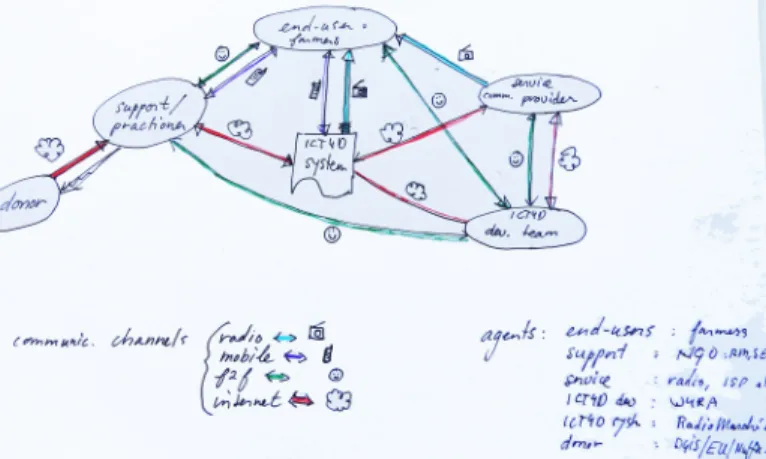
Figure 5: Field sketch book of agents, roles, values and operational goals
tion during cycles of design, testing, redesign, testing, re-design, and deployment. The end-users play an important role in the development cycles, giving feedback, to improve the design. The results of one cycle determine the content of the next development-test cycle. By employing an iterative methodology rather than deploying a single end-application at once, we ensure that we understand the local require-ments, and build solutions fit for the context.
In the above sections we showed how interactions amongst different agent groups can generate novel solutions. Next we will discuss the alignment of operational goals.
3.1.2
Agents and their internal models in ICT4D
As discussed in the previous sections, complex adaptive sys-tems are composed of agents – ants, molecules, living organ-isms, cells, humans, organizations, computers, or a mixture of them, depending on the type of system –, interacting in distributed ways, linking and organizing themselves accord-ing to certainrulesorinternal models [32, 36]. These rulescan be simply interpreted as what the agents do, or what they want or under which conditions they interact. In the case of humans, an internal model is driven or influenced by many factors, including values, context, traditions, what others do etc. [39, 44].
In our pilot in West-Africa, agents are represented by the following groups: (i) innovative farmers (ii) rural communi-ties, (iii) NGOs who support the communities in their efforts
to regreen their fields, (iv) the multi-disciplinary group of ICT4D developers and researchers and (v) community radio stations.
In our model agents are grouped by operational goals. The
rules or internal models are reflected in operational goals, preferences, or intrinsic motivation to communicate and par-ticipate in the action. The operational goal of farmers can be to sell more local products such as sheabutter or honey, or to increase the number of trees on their fields. The NGO can have as a goal to support the regreening activities, by organizing group meetings with farmers. The ICT4D team can have as an operational goal to develop an information service and an adaptive methodology to support the NGO and the farmers. The local radio station may have as a goal to increase the number of informative programs, while earning from paid broadcasts.
Operational goals yield information for the design of adap-tive, innovative technologies, as shown in the next para-graphs. In Figure 5 a field note is shown, presenting different agent groups in the pilot, with their roles and operational goals. In Figure 6 a simple conceptual model is shown, with the agents, their communication channels, roles and values.
Operational goals in a shea butter and honey
trad-ing service.
An important aspect of regreening, according to NGO Sahel Eco, is the development of new local value chains, through which the farmers start to sell tree prod-ucts. By increasing sales of typical tree products such as shea butter and honey, a larger number of farmers will start to see the benefits of growing trees as crop producing plants, according to Sahel Eco, who tries to promote regreening amongst local communities. Setting up a new value chain is difficult, given the lack of a communication infrastructure, and the lack commercial channels. We were asked to sup-port the value-chain creating activities of Sahel Eco, as they explained us the following user story:An agricultural extension worker (from the local NGO Sa-hel Eco) collects weekly information about offerings of shea butter and honey from small producers in 19 villages near Tominian. He receives the following information: the prod-uct name, the quantity offered, the price per unity, and the farmer’s phone number. He collects the data in an Excel sheet on his laptop. The Excel file is sent by email from to three community radio stations: Radio ORTM S´egou, Ra-dio Koutiala, RaRa-dio ORTM Mopti). A hard copy of the information is brought by motorcycle to Radio Mountian in Tominian, because they do not have an internet connection. The radios broadcast the information, including the phone numbers of the producers. Potential customers either phone the radio station or the producer directly.
The key idea for a service based on this use case is a system that collects and stores the offerings in a data base, having a voice-based interface to access the offerings as a spoken message in various local languages. The offerings can be broadcast on the radio. This system will make the work of the extension worker and the radio station easier and more efficient. Meanwhile, the NGO can monitor the sales process by accessing the log files of the offerings in the system, and
Figure 6: Model of agents, roles, and communication channels
easily create statistics of the quantities of products that were offered. The voice-based service that was built according to this use case was nick-namedRadioMarch´e.The system was built as an automation of a semi-paperbased legacy system and was perfectly aligned with the operational goals of the farmers to advertise their products on the radio, and accord-ing to the radio stations, who are paid for the broadcasts. The NGO who has set up the paper-based system pilot, to support sales of agro-forestry products is also served by the system.
Agents Operational goals
Producers from Tominian Sell honey and shea butter Potential buyers Buy at best price
Radio stations Broadcast offerings
Sahel Eco Process info from producers Donor agency Fund pilot project
By grouping agents based on operational goals, it is possi-ble to design solutions that may ber eused by people with similar goals. Operational goals are related to sustainabil-ity. This was discussed with the stakeholders during the workshops. The following paragraph describes a discussion about sustainability of ICT4D systems, during a Kuma Blon workshop in Mali, in January 2011.
Sustainability discussed with end-users.
The sustainabil-ity of services and possible business models is discussed with prospective end-users. The participants in the workshop – farmers, a herder, NGO-staff members – express their ideas about business cases, necessary to make people pay for the voice services. The participants reaffirm that most people will be prepared to pay for a (mobile) service if it saves them e.g. travel time, or provides them with information about market prices. People would like to exchange information without having to travel around or having to make multi-ple phone calls. The participants propose that payments should be integrated in the billing system of the phone (mo-bile money was not yet available in Mali in 2011 at the time of this workshop).Operational goals, as we will see in the next sections, are
the drivers of action in a CAS, the aggregation of which can lead to emerging patters. Operational goals relate to another property of complex adaptive systems, which isselection.
3.1.3
Selection
Natural selection is a biological process in the evolution of species. The concept was first introduced by Charles Darwin [74] in 1859 to explain the existence of adapted organisms and biological traits which we perceive in nature. Selection
is an essential feature of all complex adaptive systems, as an autonomous process that uses the outcomes of local interac-tions toselectforreplication orenhancement[34]. Selection
is one of the fundamental characteristics of a complex adap-tive system, because it leads toadaptation. Aggregation and amplification of effects through positive feedback loops can result in emergence of certain large-scale patterns [33]. In social systemsselection can be seen as the learning capacity of a group or organization [37]. Selection is important to discard errors or anticipate to failure, improving the system [32]. Selectionis defined by Murray Gell-Mann [36] as a dy-namic process of continuously updating information which is stored and kept in basic rules, customs, myths, laws, in-stitutions, depending on the type of complex system. To build meaningful technologies in a development context,
selection is an essential mechanism. Selection takes place at various scales and at different points in time: during design and development, when only a limited number of people is involved; during implementation and deployment, as larger numbers are involved. Finally, during diffusion and scaling-up, selection by its users defines the success of an innovation. Selection mechanisms are used at the start of the design process, shortly after the collective brainstorming, in which many new ideas are generated in thespace of dialogue, dur-ing the road show or field visit. Selection in this stage is necessary to reduce the number of ideas, and discard the less interesting or useful. In our case of ICT4D in West-Africa, selection mechanisms are applied, (i) as an iterative learning capacity of the group, and (ii) for the elicitation of requirements and tacit knowledge and selection of the most suitable use cases. Design choices, hence selection, are based on jointly defined criteria, as from the initial phase.
Who selects what?.
In our ICT4D approach, the problem definition comes from the local users, however,selection of the ideas and use cases to be developed into a new ICT solution, is a joint decision. Therefore the prospective end-users, other stakeholders and the developers team have a say in the selection, and in setting the priorities. The end-users select what is useful and meaningful in their work and con-text. The ICT developers select what is affordable, in terms of time to develop, expenses, complexity of design and use, adaptability in the local context, transferability to different contexts, promising in terms of diffusion of innovation.Mutual analysis of contexts.
At the start, the ICT4D re-searchers and developers had to learn about the local text, and its constraints. The unavailability of internet con-nections, the modesty of financial resources, the wide-spread availability of voice-based mobile phone, and the inability offarmers to read and write and speak French, represented constraints for technological solutions. This resulted in se-lection of a certain type of technologies, infrastructure (radio and GSM-based) and modality (voice). Selection could be seen as the first collective learning process of the team. This learning and selection took place during workshops and field visits in Burkina Faso in September 2009 and February 2010. Conversely, the farmers, local radio journalists and local NGO staff learned about new context as well. Through demonstrations and talks, they learnt about the possibili-ties of using, e.g. voice-based systems that combine mobile phone and community radio. This exchange of knowledge re-sulted in a merger of ideas, aimed at creation of new, mean-ingful solutions.
Selection of long list of use cases.
The next step is to jointly select interesting cases that could be made efficient through improved communication or information sharing or access. This done through brainstorming extensively with all team members. In our case, creatively generating ideas was not difficult, because of the heterogeneous composition of the team. The road shows and field visits, as described in the previous sections, resulted in many creative ideas, from which a long list of sixteen use cases could be selected, as shown in Table 1.Selection of best use cases.
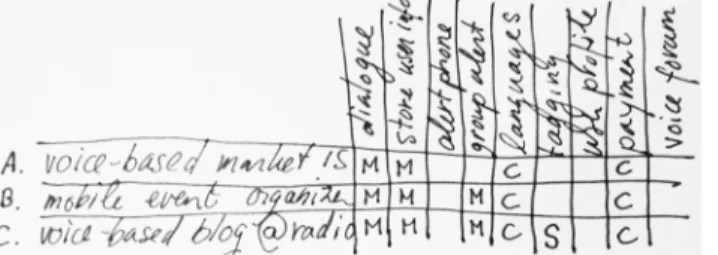
From list of use cases, a se-lection has to be made, which one to develop first, next, postpone or discard. A priority list was made, based on criteria selected by developers and users: (i) usefulness by e.g. increased efficiency of a certain task or improved com-munication, (ii) adaptability to the local context, (iii) fea-sibility in terms of cost of use, (iv) complexity of use, (v) generalizability and transferability of the solution to other regions, (vi) the ease and cost of technological development and maintenance, (vii) the potential to make local business out of the service. Usefulness for the user against ease of building it technically are the most important criteria. In Figure 7 three use cases are compared, based on require-ments, using the MoSCoW method to prioritize (Must have, Should have, Could have, Won’t have) [73].Figure 8, modified after Hartman et al. [75] plots user need against ease of development per use case. From this figure it becomes clear which use cases rank high in ease and utility. In a commercial setting, where an ICT system is commis-sioned by a customer, i.e. paying organization, the diagram gives is sufficient information to make a good selection. In an innovation project, however, as this ICT4D context other criteria are important as well. It is important to choose a system that can be reused in similar contexts. Criteria such as adaptability, generalizability and local technical support on the longer run have to be taken into account as well. Out of sixteen use cases we selected a legacy, paper-based system based on priorities from local stakeholders, and fea-sibility and ease of technical development.
A voice-based market information system was built accord-ingly, nicknamed RadioMarch´e. The system was deployed,
Figure 7: Three use cases evaluated against several requirements
validated and tested by local users, and taken in production as a pilot, in 2012 in the region of Tominian, to support sales of local tree-based products for farmers in 19 small villages [?]. The increase of efficiency for the users (Sahel Eco and Radio Stations), and the relative advantage for the benefi-ciaries of the system (the farmers near Tominian), as well as relative ease of technical development, compared to other systems, supported the decision.
The second best use case was the event organizer, as de-scribed in section 2.2, where one can use a web interface to issue fifty simultaneous voice-based phone messages in dif-ferent languages. The system, built accordingly, was nick-named Tabale, after the Bambara word for the village drum, that is beaten to gather villagers for an important meeting.
Selection of key requirements for the Tabalé use case.
For the user story described in the previous paragraph, the following key requirements were selected. To make sure that the users and developers have a shared understanding of the requirements, they are discussed using mock-ups, story boards and prototypes as illustrative communication tools. The requirements elicitation process has to prevent building useless artefacts. The following requirements were collected:Functional requirements
Web interface for Sahel Eco
add, update, delete users and user profiles user profiles include name, phone, language system allows to record voice as audio system allows to create events event has date, time, associated audio multiple languages are allowed message can be sent to multiple users prompt in multiple languages French, Bomu, Bambara support
Non-functional requirements
prompt should speak malian french dialect voice prompt should sound familiar
3.1.4
Adaptation
The ability to adapt to changing conditions in the environ-ment, makes a system robust and resilient on the longer run. In our research the adaptivity of ICT solutions proved im-portant for its immediate deployment, and for scaling up and diffusion to other regions and users with comparable conditions.
Nr. Use case title Main stakeholders
1 m-Milk ordering and delivery service of Tominian Milk producers and NGO 2 m-Tree protection alert service Sahel Eco Farmers and NGO 3 mobile-web Event organizer for vaccination of herds Farmers
4 m-Farmer-expert directory service Farmer organization 5 NGO info-line about legal issues in several languages Sahel Eco
6 Leave announcement or select your favourite song Radio
7 Shea butter and honey trading service Radio and Sahel Eco 8 Access radio programs and announcements on your phone Radio
9 Gourcy seed producers seed certification service Farmer organization 10 Radio questions and answers about agricultural issues Radio
11 m-collective purchase organizing service Local buyers
12 m-GIS regreening service Sahel Eco
13 m-Farmer social network Sahel Eco
14 mobile-web regional market system Farmer organization 15 Sahel Eco portal to Regreening and access to m-services Sahel Eco
16 m-event organizer for re-greening events Sahel Eco, farmers
Table 1: Long list of use cases Source: [71]
Figure 8: Adapted from Hartman et al. 2000
In our ICT4D project, adaptivity was built in the design from the start. Adaptation and reinvention can occur at three stages: (i) at the level of the end-user, who reinvents new, alternative, innovative ways to use a technological arte-fact, which was not intended in its design. (ii) at the level of ICT developers it is possible – and encouraged – to re-use the software, which is made available as open-source, and in-vent, redesign and deploy it in other contexts for other users an purposes. (iii) at the level of organizations, researchers and practitioners, the methodologies presented in this paper, can be used and adapted for design of user-centric services, adaptive for any other (development) context.
The example in the next section shows how solutions can be re-used after adaptation to other contexts.
Adaptation of market information system.
The voice-based market information system RadioMarch´e was fully adaptive to the local needs and context, distributing voice-based information on the local products: shea nuts, shea butter, honey, and local nuts. At the moment of writing this paper, farmers in Burkina Faso have requested an adapted version of RadioMarch´e for the context in the Yatenga re-gion, in the Central Plateau. The language here is different:Mor´e, and the products are also different.The RadioMarch´e system was built in a modular way, as to be adapted, reused and maybe even reinvented for a different context. The soft-ware is made available as Open Source and can be re-used and adapted. The name of the adapted RadioMarch ˜Al’ sys-tem in Burkina Faso isRaas Kibaya, which means market information in Mor´e language.
reinvention.
Reinvention is often observed during diffusion of innovations [44], as adaptation by its users. An example of reinvention by local users of the systems built during our research project is described below.The case of messaging system Tabale reinvented.
Amadou Tangara, staff member of NGO Sahel Eco, was one of the key-users of the systems built here for this local context. Tangara helped to define the use cases and select the re-quirements, and gave regular feed-back on usefulness. One of Tangara’s suggestions was to merge the functionalities of both systems. As the development was not further priori-tised as soon as Tangara wished, he started to use Tabale to send group voice-based phone messages to honey producers to aggregate group sales on behalf of the farmers. The Ta-bale system was not originally built with this purpose, but it appeared to be flexible en generic to be used for other purposes.3.1.5
Emergence
Aggregation of interactions in a CAS may lead to emerging patterns, which are not discernible at the levels of individ-ual agents. Feedback loops are the internal processes that can amplify or annihilate certain effects in a CAS. Feedback loops can occur e.g. when operational goals of many different agents become aligned and start to amplify each other. In our ICT4D project we have perceived certain feedback loops, despite the scale in which we operated. Improved commu-nication amongst farmers, NGO-staff, local radio journal-ists and ICT4D researchers led to improved communication. This in turn increased communication amongst a wider


![Table 1: Long list of use cases Source: [71]](https://thumb-us.123doks.com/thumbv2/123dok_us/1855500.2769815/13.918.187.744.18.279/table-long-list-use-cases-source.webp)