ADMINISTRATION
AND
SCORING
MANUAL
Manual Prepared By
Jill S. Fischer, Ph.D.
Amy J. Jak, M.A.
Judith E. Kniker, M.A.
Richard A. Rudick, M.D.
Mellen Center for MS Treatment and Research
Cleveland Clinic Foundation
Cleveland, Ohio
Gary Cutter, Ph.D.
AMC Cancer Research Center
Denver, Colorado
ADMINISTRATION
AND
SCORING
MANUAL
R e v i s e d , O c t o b e r 2 0 0 1M U LT I P L E S C L E R O S I S
F U N C T I O N A L C O M P O S I T E
( M S F C )
ACKNOWLEDGMENTS
The MS Functional Composite (MSFC) was developed by the National MS Society’s Clinical Outcomes Assessment Task Force, chaired by Richard Rudick, MD. The work of the Task Force was supported by an unrestricted grant to the National MS Society from Berlex Pharmaceuticals. Members of the Task Force included: Jack Antel, MD; Christian Confavreux, MD; Gary Cutter, PhD; George Ellison, MD; Jill Fischer, PhD; Fred Lublin, MD; Aaron Miller, MD; John Petkau, PhD; Stephen Rao, PhD; Stephen Reingold, PhD; Karl Syndulko, PhD; Alan Thompson, MD; Joy Wallenberg, MD; Brian Weinshenker, MD; and Ernest Willoughby, MD.
Biogen, Inc. provided support for preparation of this manual and supported its publication.
Copyright© 2001, National Multiple Sclerosis Society
C O N T E N T S
Introduction 1
General Instructions 3
Instructions for the Timed 25-Foot Walk 6
Questions About the Timed 25-Foot Walk 8
Instructions for the 9-Hole Peg Test 10
Questions About the 9-Hole Peg Test 12
Instructions for the Paced Auditory Serial Addition Test 14 Questions About the Paced Auditory Serial Addition Test 17
Examining Technician Self-Assessment Test 19
Examining Technician Self-Assessment Test Answers 23 Forms for the Multiple Sclerosis Functional Composite 27 Scoring Instructions for the Multiple Sclerosis Functional Composite 33
References 41
T
his Manual was developed for two purposes: 1) to provide instructions necessary for standardized, quality-controlled administration and scoring of a three-part compos-ite clinical measure, the Multiple Sclerosis Functional Composcompos-ite (MSFC), which was recommended by the Task Force on Clinical Outcomes Assessment of the National Multiple Sclerosis Society; and 2) to provide background and instructions for creating standardized scores from the individual components.Disease-modifying medications for MS have been evaluated historically using rating scales of physical disability, such as the Expanded Disability Status Scale (EDSS) (1), or clinical measures of disease activity, such as the number of relapses. In February 1994 a meeting titled “Outcomes Assessment in Multiple Sclerosis Clinical Trials” was held in Charleston, SC. Traditional clinical rating scales were critically evaluated, and their lim-itations were identified. A meeting summary has been published by Whitaker et al. (2). Participants in the Charleston meeting recommended development of a new clinical out-come measure for MS clinical trials that met several criteria: 1) it should be multidimen-sional to reflect the varied clinical expression of MS across patients and over time; 2) the dimensions should change relatively independently over time; 3) one component should be a measure of cognitive function (2).
As a result of this meeting, the National Multiple Sclerosis Society’s Advisory Committee on Clinical Trials of New Agents in Multiple Sclerosis appointed a Task Force on Clinical Outcomes Assessment in 1994. The Task Force was charged with reviewing existing clinical outcome measures and recommending an optimal approach to clinical outcome assessment in future MS trials. The Task Force recommended that an optimal MS clinical outcome measure should be multidimensional in order to reflect the principal ways MS affects an individual —leg function and ambulation; arm and hand function; cognitive function; visual function; sensory function; and bowel, bladder, and sexual function. Additional characteristics of an optimal clinical outcome measure included applicability across the range of disease severity; strong psychometric proper-ties; sensitivity to, and ability to predict, clinical change due to MS; ability to detect treatment effects in clinical trials; practicality of administration; and acceptability to patients. These criteria and guidelines for developing improved measures were published in detail (3).
Two key components of the guidelines were: 1) an exploration of quantitative func-tional measures as components of a composite outcome measure; and 2) specifications for a meta-analysis of primary and secondary outcome assessments in existing MS clin-ical data sets to provide an objective basis for development of a multidimensional com-ponent outcome assessment. A subgroup of the Clinical Outcomes Assessment Task Force analyzed placebo group data from 14 major clinical trials and natural history stud-ies completed within the last decade (4). Measures that were present at multiple time points in at least two data sets were evaluated in terms of their reliability, construct validity (i.e., correlation with the expected clinical dimensions), sensitivity to change over time, and criterion validity (i.e., correlation of change with concurrent change on the EDSS within the same time frame and future change on the EDSS in the following year). Ultimately, measures of three clinical dimensions (leg function/ambulation;
INTRODUCTION
arm/hand function; and cognitive function) met criteria for inclusion in a composite outcome measure. Three variables were recommended as primary measures in a Multiple Sclerosis Functional Composite (MSFC):1) Timed 25-Foot walk; 2) 9-Hole Peg Test (9-HPT); and 3) Paced Auditory Serial Addition Test (PASAT-3” version) (5,6).
Although components of the MSFC have been administered in a number of recent clinical trials, they have typically been administered by different study personnel, who vary in their experience and training in administering quantitative measures of perfor-mance. Ideally, a single examining technician should administer all three MSFC compo-nents following standardized procedures. This manual provides general instructions about the administration of quantitative functional measures to MS patients, and detailed instructions for administering each of the primary MSFC components. A self-assessment questionnaire is also provided so that examiners can assess their knowledge of key aspects of MSFC administration and scoring. Excellent reliability (both intra-rater and inter-rater) has been achieved when examining technicians are thoroughly trained in MSFC procedures (i.e., participate in a formal training session, practicing each of the measures at least five times prior to administering them to study patients) and strictly adhere to the instructions in this manual.
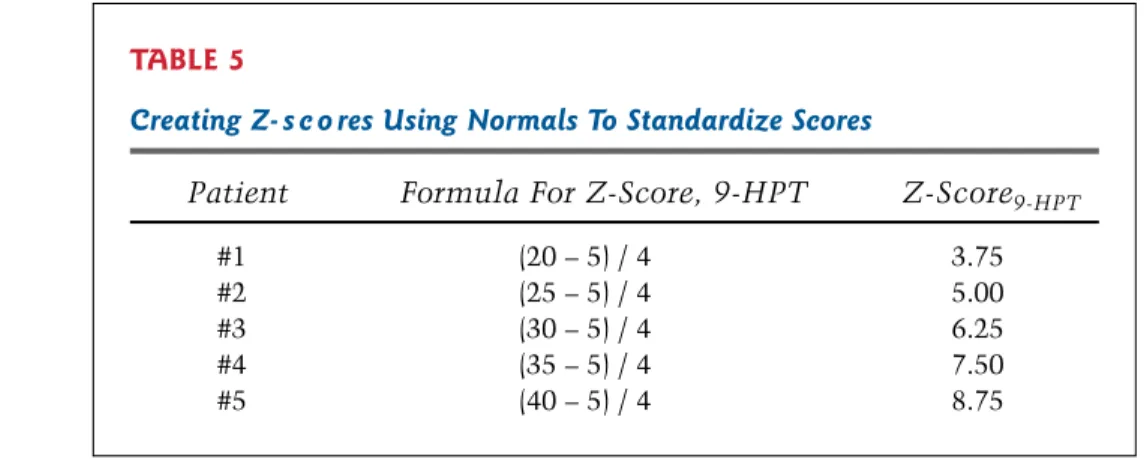
The manual also contains information on scoring methodology that can be used to create a single standardized score for each patient at each test session. Since the three variables are different in what they actually measure (time for the 9HPT and 25-Foot Timed Walk, but number of correct answers for the PASAT-3), it was necessary to iden-tify a sensible way to use variables that inherently measure dimensions on different scales; that is, to define a common metric for these variables, and a Z-score was select-ed for this purpose. Thus, the results from each of these three tests are transformselect-ed into Z-scores and averaged to yield a composite score for each patient at each time point.
M
any of those who will be administering the MSFC may not have had extensive experience with MS patients or with standardized testing procedures. The follow-ing instructions are provided to ensure that the MSFC is administered in a standardized in a manner, regardless of the examining technician’s prior experience.STANDARDIZING MSFC ADMINISTRATION
The MSFC should be administered as close to the beginning of a study visit as possible, but definitely before the patient does a distance walk. MSFC components should be administered in the following order:
1. Trial 1, Timed 25-Foot Walk 2. Trial 2, Timed 25-Foot Walk 3. Trial 1, Dominant Hand, 9-HPT 4. Trial 2, Dominant Hand, 9-HPT 5. Trial 1, Non-Dominant Hand, 9-HPT 6. Trial 2, Non-Dominant Hand, 9-HPT 7. PASAT-3’’
Note:Some neuropsychologists also recommend completing the PASAT- 2’’, which is administered at a faster rate, to provide additional information about informtion pro-cessing speed. This can be added as an option after the PASAT 3’’. Instructions for the PASAT 2’’ are included in this manual, although only the PASAT-3’’ is currently recom-mended for inclusion in the MSFC.
An individual component of the MSFC should be discontinued only if the patient meets the discontinue criteria for that component. Other components should still be administered.
Instructions for each component measure should be given exactly as they appear in the manual. Translations of the instructions to be read to patients are available in some languages (French, German, Dutch, Greek, and Hebrew). As patients gain more experi-ence with the tasks, many may want to skip the instructions or the PASAT practice tri-als. To ensure standardized administration, full instructions should be given for each task, and at least one practice trial should always be given for each section of the PASAT.
GENERAL
ADMINISTRATION AND SCORING MANUAL FOR THE MSFC – REVISED OCT. 2001
TESTING ENVIRONMENT
Every effort should be made to use the same testing room and the same designated area for the Timed 25-Foot Walk at every visit. It is essential that the potential for external distractions be kept to a minimum. All necessary materials (see p. 5) should be assem-bled prior to the patient’s arrival. If the space designated for the Timed 25-Foot Walk is a public hallway, complete privacy may be impossible; however, every attempt should be made to keep the patient’s path clear of obstacles (human or inanimate). No one other than the examiner and the patient should be in the testing room during 9-HPT and PASAT. Unplug the phones (or turn off their ringers), and turn off beepers (or switch to nonaudible notification). Establish some way to indicate to others that testing is in progress and you are not to be disturbed (e.g., a sign on the door stating “TESTING IN PROGRESS—DO NOT DISTURB”).
ESTABLISHING RAPPORT
The examining technician should be thoroughly familiar with all of the measures prior to their administration so that s/he can focus only on establishing rapport, observing the patient’s behavior, and recording the patient’s times and responses. The MSFC can be challenging for patients, so it is important to establish good rapport early on. Introduce yourself to the patient the first time you meet him or her and ask the patient how he or she prefers to be addressed. You may want to say something like, “Hello, my name is Jane Doe, I’m a nurse here at the center and the examining technician for the study. Please call me Jane. How do you prefer to be addressed?” Query to find out if s/he prefers Mr., Mrs., Dr., first name, or a nickname. Make eye contact with the patient and speak in a friendly, yet professional, manner.
Offer to answer any questions the patient may have about the measures. Patients may ask things such as, “What will I be doing today?” or “How long will this take?” You may tell the patient things such as, “I’ll be testing your upper and lower extremity func-tion as well as cognitive funcfunc-tion,” or, “You’ll be doing three tasks today, which will take about 20 minutes to complete.”
RECORDING RESPONSES
Use a clipboard as your writing surface and hold it in such a way that the patient cannot see what you are writing. Please write legibly. Any deviation from the standard instruc-tions due to examiner error or external interferences should be noted in the appropriate section of each Record Form. In general, any circumstances that may have affected the patient’s performance should be recorded.
PROVIDING FEEDBACK TO THE PATIENT ABOUT HIS/HER PERFORMANCE
Do not provide the patient with test answers and do not indicate whether answers are correct or incorrect (either verbally or nonverbally, except on practice items. Do not give the patient direct feedback about his/her performances on any of the measures, i.e., the times on the Timed 25-Foot Walk or 9-HPT or the patient’s total correct on PASAT. If the patient asks, “How did I do?,” or something to that effect, give general encourage-ment and/or feedback such as, “You gave great effort today,” or, “I thought things ran very smoothly today.” If the patient appears distressed upon the completion of a task, it may be helpful to say something similar to, “I can see that this test was very difficult for you. It can be a very challenging task and I appreciate how you gave your full effort.” It is important that you make all reasonable attempts to maintain the physical and emo-tional comfort of the patients as they complete the measures. At the completion of the visit be sure to thank the patient for his/her participation.
GENERAL INSTRUCTIONS
MATERIALS REQUIRED FOR THE MSFC
Clipboard, pens, stopwatch, cassette tape or CD player, PASAT stimulus tape, 9-HPT appa-ratus, Dycem (to stabilize the 9-HPT apparatus), clearly marked 25-foot line, Case Record Forms.
The 9-HPT apparatus is available through several vendors. For example, the Rolyan 9-Hole Peg Test is a one-piece molded plastic model that is distributed by Smith & Nephew, Inc. (Rehabilitation Division); One Quality Drive; PO Box 1005; Gemantown, WI 53022-8205; Phone: (800) 558-8633; FAX: (800) 545-7758. WARNING:Although the 9-HPT apparatus itself is well-constructed, the stop-watches provided with the 9-HPT by Smith & Nephew have been very unreli-able in our experience. Consequently, we recommend obtaining a more reliunreli-able stopwatch through a sports store, psychological test publisher, or other vendor. Dycem is recommended to anchor the 9-HPT apparatus and can be ordered through several suppliers of occupational therapy materials. For example, a 10” x 14” Dycem activity pad suitable for this purpose is available through Sammons Preston, Inc.; 4 Sammons Court; Bolingbrook, IL60440; Phone: (800) 323-5547; FAX: (800) 547-4333.
PASAT audiocassette tapes or CDs are available through: Stephen Rao, Ph. D. ; Section of Neuropsychology; MCW Clinic at Froedtert; 9200 W. Wisconsin Avenue; Milwaukee, WI 53226; e-mail: [email protected]. WARNING: Audiotapes stretch after 75 to 100 administrations, so timing of stimulus presentation should be checked and tapes replaced periodically.
TIMED 25-FOOT WALK
DESCRIPTION
The Timed 25-Foot Walk is a quantitative measure of lower extremity function. It is the first component of the MSFC administered at each visit. The patient is directed to one end of a clearly marked 25-foot course and is instructed to walk 25 feet as quickly as possible, but safely. The task is immediately administered again by having the patient walk back the same distance. Patients may use assistive devices when doing this task. In clinical trials, it is recommended that the treating neurologist select the appropriate assistive device for each patient.
MATERIALS NEEDED
Stopwatch, clipboard, Timed 25-Foot Walk Record Form, marked 25-foot distance in an unobstructed hallway, assistive device (if needed)
TIME LIMIT PER TRIAL
3 minutes (180 seconds) per trial.
DISCONTINUE RULES
1. If the patient cannot complete Trial 2 of the Timed Walk after a 5-minute rest period. 2. If the patient cannot complete a trial in 3 minutes.
ADMINISTRATION
Administration of the Timed 25-Foot Walk is demonstrated on the Training CD-ROM.
Trial 1
Make sure that the stopwatch is set to 0:00. For the Timed 25-Foot Walk, the subject should be directed to one end of a clearly marked 25-foot course (clearly defined on the floor or on the wall) and instructed to stand just behind the starting line. Point out where the 25-foot course ends, then instruct the patient as follows: “I’d like you to walk 25
I N S T R U C T I O N S F O R T E S T I N G
feet as quickly as possible, but safely. Do not slow down until after you’ve passed the fin-ish line. Ready? Go.”
Begin timing when the lead foot is lifted and crosses the starting line. The examiner should walk along with the patient as he/she completes the task. Stop timing when the lead foot crosses the finish line. The examiner should then record the subject’s walk time to within 0.1 second, rounding as needed. Round up to the next tenth if hundredth’s place is > = .05, round down if hundredth’s place is <.05 (e.g., 32.45" would round to 32.5" but 32.44" would round to 32.4"). Once the time is recorded, be sure to reset the stopwatch.
Trial 2
After completing the first timed walk, position the patient just behind the line where s/he is now standing, repeat the same instructions, and have the patient complete the walk again.
Assistive Devices
In clinical trials and other serial studies, the goal is to use the same assistive device at each study visit. The treating neurologist should select an assistive device at the beginning of the study for each patient who needs one, keeping in mind that the patient may deteriorate modestly over the course of a trial. In general, patients should use their customary assis-tive device(s), NOT the least assistance possible to complete the test. For patients with sig-nificant gait impairment, the treating neurologist should have the patient use a rolling walker even if this is not the patient’s customary device. In general, non-wheeled walkers should not be used. If a patient does use an assistive device, this should be noted on the Record Form.
Completing the Record Form
Record any circumstances that you believe may have affected the patient’s performance. These are factors that may have affected the trial but were not severe enough to necessi-tate repetition of the trial. Examples include, but are not limited to, the following:
The patient had a cold or reports not feeling well. The patient tripped but did not fall.
If a situation arises that necessitates the repetition of a trial, indicate the reason a trial had to be repeated on the Record Form. Examples of reasons to repeat a trial include, but are not limited to, the following:
The patient fell during the walk.
Examiner forgot to start or stop stopwatch.
Examiner forgot to reset stopwatch in between trials.
The patient stopped to talk to someone while walking, or another person/thing some-how interfered with walk.
Record only the times for the two successfully completed trials of the Timed 25-Foot Walk. If the patient could not complete one or both of the trials of the Timed 25-Foot Walk, record this in the appropriate section of the Record Form. For example, if the patient’s dis-ease has progressed and/or physical limitations prohibit him or her from completing the trial, you should indicate “Unable to complete trial due to physical limitations”, and record any specifics that you can observe (i.e., patient in a wheelchair now and unable to walk, etc.). If the patient did not complete a trial for any other reason, specify this as well (e.g., patient fell and was too fatigued to complete another trial; patient refused to complete trial).
Q U E S T I O N S A B O U T T H E
TIMED 25-FOOT WALK
Q. Does it matter what kind of shoes the patient wears?
A. As long as the style of the shoe is consistent for each patient from visit to visit, it does not matter what kind of shoes are worn. Encourage the patient to wear comfortable shoes and discourage patients from wearing, for example, high-heeled shoes one visit and run-ning shoes the next.
Q. Is the patient allowed to pause while walking the 25-foot distance?
A. The patient should be encouraged to walk at a steady pace, one that he or she can sus-tain for 25 feet. However, pauses are allowed as long as the patient can complete the walk within the 3-minute time limit.
Q. Is the patient allowed to run?
A. No. The patient is to walk quickly but should not run.
Q. Is the patient allowed to wear an AFO (ankle-foot orthosis) during the Timed 25-Foot Walk?
A. If the patient typically wears an AFO and wears it every time the Timed 25-Foot Walk is performed, the patient may wear his/her AFO. Be sure to record this on the Record Form.
Q. What should I do if the patient wants to use the wall as support while walking? A. The patient is only allowed to use customary assistive devices while walking (e.g.,
crutch, cane, wheeled walker, rollator) and therefore is not allowed to use a wall for con-tinued support during the Timed 25-Foot Walk.
Q. What should I do if the patient asks to lean on me for support while walking?
A. This also is not allowed. Only customary assistive devices should be used if the patient needs extra support while walking.
Q. How many times is the patient allowed to touch the wall or my arm momentarily for support during the walk?
A. The patient is allowed to touch the wall or your arm a maximum of two times. If he or she touches the wall/your arm more than twice, repeat the trial, emphasizing to the patient that he or she is to walk using only the support of an assistive device. If the patient does not use an assistive device, notify the study coordinator that the patient may need to be reevaluated for use of an assistive device.
QUESTIONS ABOUT THE TIMED 25-FOOT WALK
Q. What’s the difference between a cane and a crutch?
A. A crutch extends under the axilla or supports the upper arm whereas the patient mere-ly holds onto a cane.
Q. What should I do if the patient drops his or her cane (or other assistive device) while walking?
A. Restart the trial and record the reason on the source document form.
Q. Non-wheeled walkers are not allowed. What should I do if this is the assistive device the patient typically uses?
A. Supply the patient with an accepted assistive device to use for the study visits. If it is a device unfamiliar to the patient, time should be allowed to practice with the device before the Timed 25-Foot Walk is administered.
Q. It is standard practice at my site to use a guard belt during tasks such as the Timed 25-Foot Walk. Is that O.K. for this study?
A. If this is standard practice for your site and all patients will consistently wear the guard belt for all trials of the Timed 25-Foot Walk for every visit, then this is acceptable. The device should neither assist nor encumber the patient.
Q. Is it O.K. if the patient carries his/her purse or coat while he/she is walking?
A. The patient should walk unencumbered. Patients should not be carrying any of their belongings during the Timed 25-Foot Walk. Furthermore, coats, purses, etc. should not be draped over wheeled walkers or rollators while the patient is completing the Timed 25-Foot Walk.
Q. What should I do if the patient falls while s/he is walking?
A. If the patient has not injured him/herself and is able to continue, start the trial over, reading the full instructions again. Emphasize that the patient should walk as quickly as possible, but safely.Record that the trial was repeated on the Record Form.
Q. The patient keeps falling during the walk. How many attempted trials are permitted before I should discontinue and indicate that the patient was unable to complete the trial?
A. Two. If the patient cannot successfully complete one trial of the Timed 25-Foot Walk in two consecutive attempts, discontinue the trial. Be sure to indicate this on the source document form.
Q. What should I do if I forgot to reset the stopwatch between trials?
A. If the stopwatch was not reset to 0:00, the trial will have to be repeated. On the Timed 25-Foot Walk Record Form, note that the trial was repeated and why.
DESCRIPTION
The 9-HPT is a quantitative measure of upper extremity (arm and hand) function. Its use with MS patients was first reported by Goodkin, Hertsgaard, & Seminary in 1988 (7), and it has seen increasing use in MS clinical trials and clinical practice during the last decade. The 9-HPT is the second component of the MSFC to be administered. Both the dominant and non-dominant hands are tested twice (two consecutive trials of the dom-inant hand, followed immediately by two consecutive trials of the non-domdom-inant hand). It is important that the 9-HPT be administered on a solid table (not a rolling hospital bedside table) and that the 9-HPT apparatus be anchored (e.g., with Dycem).
MATERIALS NEEDED
9-HPT Apparatus, Dycem, stopwatch, clipboard, 9-HPT Record Form
TIME LIMIT PER TRIAL
5 minutes (300 seconds)
DISCONTINUE RULES
1. If the patient cannot complete one trial of the 9-HPT in 5 minutes.
2. If the patient cannot complete a trial with his or her dominant hand within 5 min-utes, move on to the trials with the non-dominant hand.
3. If the patient cannot complete a trial with his or her non-dominant hand, move on to the PASAT.
ADMINISTRATION
Administration of the 9-hpt is demonstrated on the Training CD-ROM. Dominant Hand—Trial 1
Make sure that the stopwatch is set to “0:00.” Introduce this section by saying, “Now, we’re going to be measuring your arm and hand function.” If this is the first visit, ask, “Are you right- or left-handed?” Make a note of the dominant hand for subsequent instructions. Place the 9-HPT apparatus on the table directly in front of the patient. Arrange the apparatus so that the side with the pegs is in front of the hand being tested and the side with the empty pegboard is in front of the hand not being tested. Secure with Dycem.
Read the following instructions to the patient: “On this test, I want you to pick up
I N S T R U C T I O N S F O R T H E
INSTRUCTIONS FOR THE 9-HOLE PEG TEST
the pegs one at a time, using one hand only, and put them into the holes as quickly as you can in any order until all the holes are filled. Then, without pausing, remove the pegs one at a time and return them to the container as quickly as you can. We’ll have you do this two (2) times with each hand. We’ll start with your [DOMINANT] hand. You can hold the peg board steady with your [NON-DOMINANT] hand. If a peg falls onto the table, please retrieve it and continue with the task. If a peg falls on the floor, keep working on the task and I will retrieve it for you. See how fast you can put all of the pegs in and take them out again. Are you ready? Begin.”
Start timing as soon as the patient touches the first peg, and stop timing when the last peg hits the container. If a peg drops on the floor, the examiner may retrieve it and put it back in the peg box. However, if a peg drops onto the table, allow the patient to retrieve it.
Record the patient’s time under “Dominant hand—Trial 1.” If the subject stops after having put all the pegs into the holes, prompt the subject to remove them as well by say-ing, “And now remove them all.” If the subject begins to remove more than one peg at a time, correct him/her by saying, “Pick up one peg at a time.”
Dominant Hand—Trial 2
After the first trial with the dominant hand, say, “Good. Now, I’d like you to do the same thing again, once again using your [DOMINANT] hand. See how fast you can put all of the pegs in and take them out again. Ready? Begin.” Again, start timing as soon as the patient touches the first peg, and stop timing when the last peg hits the contain-er. Record the patient’s time under “Dominant hand—Trial 2.”
Non-Dominant Hand—Trials 1 and 2
After the second trial with the dominant hand, rotate the apparatus 180 degrees such that the side with the pegs is now in front of the non-dominant hand and the empty peg-board is in front of the dominant hand. Then say, “OK. Now I’d like you to switch and use your [NON-DOMINANT] hand. This time, you can use your [DOMINANT] hand to stabilize the peg board. Ready? Begin.” Administer, time, and record the two non-dominant hand trials following the procedures described above for non-dominant hand trials.
Completing the Record Form
Record any circumstances that you believe may have affected the patient’s performance. These are factors that may have affected the trial, but were not severe enough to neces-sitate repetition of the trial. Examples include (but are not limited to) the following:
• The patient dropped a peg • The patient has a cold
• The patient forgot eyeglasses and had difficulty seeing pegs • The patient talked during the task
If a trial is repeated, indicate this and specify the reason it had to be repeated. Examples of reasons to repeat a trial include the following:
• The patient knocked entire apparatus on the floor • The examiner forgot to start or stop stopwatch
• The examiner forgot to reset the stopwatch in between trials
Record only the times for the two successfully completed trials for each hand on the 9-HPT. If the patient could not complete one or both of the trials for either hand of the 9-HPT, record this in the appropriate section of the Record Form. If the patient’s dis-ease has progressed and/or physical limitations prohibit him or her from completing the trial, the examiner should mark “Unable to complete trial due to physical limitations,” and then record any specifics that can be observed (e.g., patient unable to use right hand, patient could not complete within time limit, etc.). If the patient did not complete a trial for any other reason, describe the specific circumstances (e.g., patient refused).
Q U E S T I O N S A B O U T T H E
9-HOLE PEG TEST
Q. Is the patient allowed to take a break between the Timed Walk and the 9- HPT? A. Yes, but the patient is only allowed to rest a maximum of 5 minutes after the Timed
Walk before starting the 9-HPT.
Q. How should I determine the dominant hand if the patient indicates that he or she uses both hands?
A. The dominant hand is the hand with which the patient writes (or did write) the majori-ty of the time.
Q. What should I do if the patient talks during the 9-HPT?
A. Discourage the patient from talking as he or she completes the 9-HPT. You may quick-ly prompt the patient to remain quiet while the trial is in progress. Then, in between tri-als, emphasize to the patient that his or her concentration should be centered on the 9-HPT and that s/he should wait until the test is over to talk with you.
Q. What should I do if a patient attempts to use both hands to complete a trial of the 9-HPT?
A. Prompt the patient to use only one hand (dominant or non-dominant accordingly). If the patient continues to use both hands, start the trial over, emphasizing to the patient that s/he is to use only the one hand being tested.
Q. What should I do if the patient takes out two pegs at a time?
A. Prompt the patient with, “Pick up one peg at a time.” If the patient responds to the prompt, and subsequently takes only one peg at a time, continue with the trial. If the patient continues to take out two pegs at a time, start the trial over, emphasizing to the patient that he/she must only pick up the pegs one at a time. Record the reason for the repeated trial on the Record Form.
Q. What should I do if the patient takes more than two pegs at a time or even a whole handful of pegs at once?
A. If the patient takes more than two pegs at a time, start the trial over, emphasizing that he/she must pick up only one peg at a time. Record the reason for the repeated trial on the Record Form.
Q. What should I do if the patient knocks a peg out of a hole once it has already been placed?
QUESTIONS ABOUT THE 9-HOLE PEG TEST
A. If a peg comes out of a hole and falls onto the table, let the patient retrieve it. If the peg comes out of a hole and falls onto the floor, you should retrieve it and place it in the con-tainer.
Q. What should I do if the patient knocks the whole 9-HPT apparatus on the floor? A. Stop the trial. Reassemble the apparatus, repeat the instructions, and start the trial over.
Encourage the patient to hold the pegboard steady with the hand he/she is not using, if possible. Note the incident in the appropriate section of the Record Form.
Q. What should I do if the patient cannot complete the 9-HPT with one hand?
A. If this happens on the enrollment visit (Day 1), the patient will not be able to enroll in the study. If this occurs once the patient is already enrolled in the study, indicate this in the appropriate section of the Record Form. Administer the 9-HPT at every visit, even if the patient was unable to complete it the visit before; the patient may be able to com-plete the test at subsequent visits.
Q. Is the patient allowed to rest in between trials of the 9HPT?
A. No. The patient should progress directly from trial to trial, pausing only while you read the instructions for each subsequent trial.
Q. What should I do if I forgot to reset the stopwatch in between trials?
A. If the stopwatch was not reset to 0:00 at the beginning of the trial, that trial will have to be repeated. Note on the Record Form which trial(s) was repeated and why.
Q. What should I do if I forgot to turn the 9-HPT apparatus when switching to the non-dominant hand?
A. Start the trial over and note the reason for the repeated trial on the Record Form. Q. What should I do if I realize the 9-HPT kit is missing pegs?
A. A supply of extra pegs can be ordered through the vendor. It is the examining technician’s responsibility to make sure that all equipment is complete and in good working order prior to a study visit.
I N S T R U C T I O N S F O R T H E
PACED AUDITORY
SERIAL ADDITION TEST
DESCRIPTION
The Paced Auditory Serial Addition Test (PASAT) is a measure of cognitive function that specifically assesses auditory information processing speed and flexibility, as well as calcu-lation ability. It was initially developed by Gronwall in 1977 (1) to monitor the recovery of patients who had sustained mild head injuries. Stimulus presentation rates were adapted for use with MS patients by Rao and colleagues in 1989 (2), and the measure has been widely used in MS studies during the last decade. The PASAT is presented on audiocassette tape or compact disc (CD) to control the rate of stimulus presentation. Single digits are presented either every 3’’ (or every 2” for the optional 2” PASAT) and the patient must add each new digit to the one immediately prior to it. The test score is the number of correct sums given (out of 60 possible) in each trial. To minimize familiarity with stimulus items in clinical tri-als and other serial studies, two alternate forms have been developed; the order of these should be counterbalanced across testing sessions. The PASAT is the last measure of the MSFC that is administered at each visit.
MATERIALS NEEDED
An audiocassette tape or CD player, audiocassette tape or CD with PASAT stimuli, clip-board and PASAT Record Forms to administer the test. Note:audiocassette tapes stretch after 50-75 presentations and should be replaced with new tapes.
DISCONTINUE RULES
1. If the patient does not get at least two answers correct (consecutive or not) on any one of the three 3’’ practice sequences.
2. If the patient does not get at least one answer correct on PASAT-3’’ test, do not administer the 2’’ test. This patient is considered unable to perform the test.
ADMINISTRATION
Administration of the PASAT is demonstrated on the Training CD-ROM.
Verify that you have the correct Record Form and audiocassette/CD (Form A or B) before you start reading the instructions for the 3’’ Practice Trial to the patient.
INSTRUCTIONS FOR THE PACED AUDITORY SERIAL ADDITION TEST
PASAT-3'' Practice Trials
For PASAT-3” (stimuli every 3’’) say, “On this tape (or CD) you are going to hear a series of single digit numbers that will be presented at the rate of one every 3 seconds. Listen for the first two numbers, add them up, and tell me your answer. When you hear the next number, add it to the one you heard on the tape right before it. Continue to add the next number to each preceding one. Remember, you are not being asked to give me a running total, but rather the sum of the last two numbers that were spoken on the tape (or CD).”
Write the numbers 5, 7, 3, and 2 from left to right on a sheet of paper. Then give the following instruction: “For example, if the first two numbers are ‘5’ and ‘7,’ you would say ‘12.’ If the next number is ‘3’ you would say ”(pause for an answer from patient). If the patient gives a running total (i.e., “15”) or a number other than “10,” pro-vide the correct number and explain the task again before going on. “Then if the next number is ‘2’ you would say ”(pause for an answer from patient). If the patient fails to say “5,” provide the answer and proceed to the practice items.
Then say, “This is a challenging task. If you lose your place, just jump right back in — listen for two numbers in a row and add them up and keep going. There are some practice items at the beginning of the tape (or CD). Let’s try these first.” Play the sample items, stopping the tape after the last practice item. After three consecutive “no respons-es,” prompt him/her to resume by saying, “Jump back in with the next two numbers you hear.” You should always administer at least onepractice trial before administering the actual test. Proceed to the PASAT-3” test if the patient gets two or more answers correct (consecutive or not). Repeat the practice items, if necessary, until the subject gets two or more answers correct.
Administer the practice sequence a maximum of three times. Record answers in the space provided on the PASAT Practice Form. If the patient gets at leasts 2 answers correct (consecutive or not) on any of the practice sequences proceed to administer the 3''PASAT test.
PASAT- 3 ' '
Once it is clear that the patient possesses sufficient understanding of the task, begin PASAT 3” test. Before starting PASAT 3”, remind him/her: “Remember, if you get lost, just jump back in because I can’t stop the test once it has begun.” Discourage talking and oral calculations during the test; only the patient’s answers should be spoken out loud. The patient may need prompting to continue the test if she/he gets lost. After five consecutive ‘no responses,’ redirect the patient quickly by saying, “Jump back in,”but do not stop the tape.
Note: Some neuropsychologists also recommend completing the PASAT 2'' to pro-vide additional information about cognitive function. This can be added as an option after the PASAT 3''. Instructions for the PASAT 2'' follow, although only the PASAT 3'' is currently recommended for inclusion in the MSFC.
PASAT-2'' Practice Trials (optional)
Before Part 2 (stimuli every 2”) say, “There is a second part to this test, identical to the first, except that the numbers will come a little faster, one every 2 seconds. Let’s try some practice items.” Emphasize that the patient’s task is the same, but that it is impor-tant to try to get his/her answer out as quickly as possible so as to hear the next number spoken on the tape. On every visit, at least one 2’’ practice trial must be administered before administering the 2’’ test. Allow up to threepractice trials.
PASAT-2'' (optional)
After the practice items, proceed directly with the 2’’ administration. If the patient com-pleted the 3’’ PASAT, the 2’’ version is to be administered regardless of the patient’s per-formance on the 2’’ practice items.
ADMINISTRATION AND SCORING MANUAL FOR THE MSFC – REVISED OCT. 2001
Completing the PASAT Record Form
Circle all correct answers. Write in any incorrect responses in the space provided. Place a dash when no response is given. If the patient corrects him/herself after giving a response, count the amended answer as the response. The amendedresponse is the one that will be used in determining total correct, regardless of whether it was the correct or incorrect response. Slash through the old response and write in ‘SC’ with a circle around it to indi-cate that the patient self-corrected.
Each section of the PASAT has a maximum of 60 correct answers (i.e. 61 digits are presented for each part). Count the total number correct (number of circled answers) for PASAT-3’’ and record on the PASAT Record Form. Repeat the same scoring procedure for PASAT-2’’. (Additional scores can also be computed to examine patterns of responses on the PASAT, but these are beyond the scope of this manual.)
Finally, record any circumstances that you believe may have affected the patient’s performance. These are factors that may have affected the trial, but were not severe enough to necessitate repetition of the trial. Examples include, but are not limited to, the following:
• Subtle noises outside of the testing room • Patient reports frustration or mild distress
• Patient talked during test (other than to give answers)
If a trial must be repeated, indicate this and specify the reason why the trial had to be repeated. Examples of reasons to repeat a trial include, but are not limited to, the following: • Test interrupted (e.g. someone walked into the room or other major disturbance) • Examiner error, such as starting the tape in the wrong place or using the wrong
form.
Record only totals for the successfully completedPASAT-3’’ and PASAT-2’’. If the patient is unable to perform the PASAT (i.e., cannot get at least two correct on any 3’’ practice and at least one correct on the test portion), the examiner should indi-cate “Unable to complete due to cognitive limitations” and record any specific observa-tions. If the patient did not complete a trial for any other reason, record the reasons for this as well (e.g., patient refused to complete test, examiner forgot to administer PASAT-2’’, etc.).
Q U E S T I O N S A B O U T T H E
PACED AUDITORY SERIAL
ADDITION TEST
Q. Can I operate the tape player/CD player on batteries when administering the PASAT? A. No. You should always run the tape player/CD player on electric power to ensure that
the rate of stimulus presentation is standardized.
Q. What should I do if the patient does not respond at all on the PASAT practice?
A. If the patient has not made a response to any of the first five stimulus items, stop the practice trial and explain the task again. Remind the patient to state his/her answers aloud. Do not count the five “no responses” as one of the three practice trials. (This sit-uation is likely to occur only on the patient’s first visit, when the patient is not familiar with the task. )
Q. If the patient has performed well on the PASAT in past visits, do I still have to admin-ister the PASAT practice sequence?
A. Yes. At least one practice trial for both the 3’’ and 2’’ PASAT must be administered at every study visit. Failure to administer the practice trial will invalidate the data. Q. What should I do if the patient refuses to do the PASAT practice sequence?
A. The PASAT practice is an important part of the PASAT and of the overall MSFC. The practice sequence is not optional and should not be presented as such. Explain to the patient that he or she must be given at least one 3’’ and optionally, the 2’’ practice every study visit to maintain consistency. Emphasize the benefits that the practice trial will have on preparing him/her for the task.
Q. Am I allowed to provide the patient with helpful strategies for the PASAT?
A. No. You are allowed to give the patient only the standard instructions. Further explana-tions are allowed if the patient is having difficulty understanding the test, but these should be general instructions, not specific strategies to improve the patient’s score. Q. Is the patient allowed to perform the calculations out loud, for example, to say “3 + 9
is 12’’, etc.?
A. All calculations are to be done silently. Indicate to the patient that oral calculations could interfere with his or her performance. Discourage the patient from talking, except to provide his or her answer. Watch for this behavior during practice trials and correct it before proceeding to the actual test.
Q. Is the patient allowed to “write” on the table with his or her finger during the PASAT? A. No. Observe the patient during the practice trials for this behavior. Instruct the patient that all calculations are to be done in his or her head and that “writing down” the num-bers is not permitted.
Q. Is the patient allowed to count on his or her fingers?
A. No. Again, if this behavior is exhibited by the patient during the practice, explain that is not allowed and that all calculations must be done in the patient’s head.
Q. I had already started the PASAT test and the patient asked to start over. Is this OK? A. No. As the instructions indicate, once the PASAT test has begun, you cannot stop it even
if the patient requests to do so. The only reasons that you would stop the PASAT test would be because of a major external disturbance, equipment failure/malfunction, or something of this nature.
Q. What should I do if the patient refuses to do the PASAT?
A. The PASAT is a primary component of the MS Functional Composite. If a patient is
unwilling to complete the PASAT, s/he may need to reconsider participation in the study.
Q. Is the patient allowed to rest in between the PASAT 3’’and the PASAT 2’’?
A. No. You should proceed directly from the end of the PASAT 3’’ test into the optional two second sequence (i.e., 2’’ instructions, 2’’ practice, then 2’’ test).
E X A M I N I N G T E C H N I C I A N
SELF-ASSESSMENT
E
xamining technicians are encouraged to be thoroughly familiar with all of the MSFC components prior to administering these to a patient during a study visit. You should be able to answer each of the following questions without referring to the manual.I. GENERAL OVERVIEW
1. Please number the following to indicate the correct sequence of tests (1–8): ____ PASAT-3’’
____ 9-HPT (Dominant hand)—Trial 1 ____ PASAT-2’’
____ Timed 25-Foot Walk—Trial 1
____ 9-HPT (Non-dominant hand)—Trial 2 ____ 9-HPT (Dominant hand)—Trial 2 ____ Timed 25-Foot Walk—Trial 2
____ 9-HPT (Non-dominant hand)—Trial 1
2. Why is it important to eliminate distractions during these tests? ________________ _________________________________________________________________________________ 3. Can the instructions for any of the tests be eliminated if the patient indicates that
s/he remembers what to do? Yes _____ No _____
4. Should the patient be allowed to converse with the examiner while performing any of the MSFC tests?
ADMINISTRATION AND SCORING MANUAL FOR THE MSFC – REVISED OCT. 2001
II. TIMED 25-FOOT WALK
1. Who should determine whether the patient will use an assistive device for this test? ____________________________________________________________________________ _________________________________________________________________________________ 2. When is the stopwatch started for this test? ____________________________________
_________________________________________________________________________________ 3. Is a patient allowed to use a wall or other support other than the assistive device
designated for that patient? Yes _____ No _____
4. When is the stopwatch stopped for this test? _____________________________________ _________________________________________________________________________________ 5. What should the examining technician do before Trial 2? _______________________
_________________________________________________________________________________ 6. What should the examining technician do if s/he realizes midway through testing
that the stopwatch was not reset appropriately? _________________________________ _________________________________________________________________________________ 7. What should the examining technician do if there is an external distraction during
testing that affects the time the subject needs to complete this test?
_________________________________________________________________________________ 8. For how long is the patient allowed to rest between trials of the Timed 25- Foot
Walk? _________________________________________________________________________ _________________________________________________________________________________ III. NINE-HOLE PEG TEST (9-HPT)
1. What equipment is required for this test? ________________________________________ _________________________________________________________________________________ 2. How is the 9-HPT board positioned in front of the subject?
_________________________________________________________________________________ _________________________________________________________________________________ 3. When is the stopwatch started for this test? _____________________________________ _________________________________________________________________________________
EXAMINING TECHNICIAN SELF-ASSESSMENT TEST
4. What should the examining technician do before starting the next trial?
_________________________________________________________________________________ 5. When is the position of the 9-HPT apparatus changed? __________________________
_________________________________________________________________________________ 6. What should the examining technician do if a peg falls on the table?
_____________________________________________________________________________ 7. What should the examining technician do if a peg falls on the floor?
_________________________________________________________________________________ 8. What should the examining technician do if the patient pauses prior to removing
the pegs from the pegboard? ____________________________________________________ _________________________________________________________________________________ 9. What should the examining technician do if the patient tries to pick up more than
one peg at a time? ______________________________________________________________ _________________________________________________________________________________ 10. When is the stopwatch stopped for this test? ____________________________________
________________________________________________________________________________ 11. What should the examining technician do if during testing s/he realizes that the
stopwatch was not set appropriately? ___________________________________________ _________________________________________________________________________________ 12. What should the examining technician do if there is an external distraction during
testing that affects the time the subject needs to complete the 9-HPT?
_________________________________________________________________________________ 13. For how long is the patient allowed to rest between trials on the 9-HPT?
_________________________________________________________________________________
IV. PASAT
1. What equipment is needed for the PASAT? ______________________________________ _________________________________________________________________________________ 2. Who is responsible for ensuring that the correct PASAT form is used?
_________________________________________________________________________________ _________________________________________________________________________________ _________________________________________________________________________________
ADMINISTRATION AND SCORING MANUAL FOR THE MSFC – REVISED OCT. 2001
3. Should the tape/CD player be operated on batteries for the PASAT? Yes _____ No _____
4. What is the minimumnumber of practice trials given before the PASAT-3’’ or PASAT-2’’? _____________________________________________________________________ _________________________________________________________________________________ 5. What is the maximumnumber of practice trials given before the PASAT-3’’ or
PASAT-2’’?
_________________________________________________________________________________ _________________________________________________________________________________ 6. Which three conditions warrant stopping the practice trials prior to completion?
_________________________________________________________________________________ _________________________________________________________________________________ _________________________________________________________________________________ 7. What is the correct way to record the patient’s responses on the PASAT Record
Form?
Correct answers: ______________________________________________________________ Incorrect Answers: ____________________________________________________________ No Responses: ________________________________________________________________ Amended Responses: ___________________________________________________________ 8. What should the examining technician do if the patient indicates s/he wants to
start the test over? _____________________________________________________ 9. What is the minimum number of correct PASAT-3’’ responses the patient must
have during the randomization visit in order to be eligible for the study?
_________________________________________________________________________________ 10. For how long is the patient allowed to rest between the 3’’ and the
PASAT-2’’?
E X A M I N I N G T E C H N I C I A N
SELF-ASSESSMENT TEST
ANSWERS
I. GENERAL OVERVIEW
1. Please number the following to indicate the correct sequence of tests (1–8): _____7 PASAT-3’’
_____3 9-HPT (Dominant hand)—Trial 1 _____8 PASAT-2’’
_____1 Timed 25-Foot Walk—Trial 1
_____6 9-HPT (Non-dominant hand)—Trial 2 _____4 9-HPT (Dominant hand)—Trial 2 _____2 Timed 25-Foot Walk—Trial 2
_____5 9-HPT (Non-dominant hand)—Trial 1
2. Why is it important to eliminate distractions during these tests?
To provide patients with the optimal testing environment; to minimize variability in testing conditions from one study visit to the next.
3. Can the instructions for any of the tests be eliminated if the patient indicates that s/he remembers what to?
Yes _____ No _____X
4. Should the patient be allowed to converse with the examiner while performing any of the MSFC tests?
ADMINISTRATION AND SCORING MANUAL FOR THE MSFC – REVISED OCT. 2001
II. TIMED 25-FOOT WALK
1. Who determines whether or not the patient will use an assistive device for this test throughout the course of the study?
The treating physician (at the initial visit, and at a subsequent visit if a change is required).
2. When is the stopwatch started for this test?
When the patient’s front foot crosses the starting line.
3. Is a patient allowed to use a wall or other support other than the assistive device assigned by the treating physician?
Yes _____ No _____X
4. When is the stopwatch stopped for this test? When the patient’s front foot crosses the finish line. 5. What should the examining technician do before Trial 2?
Record the time (in seconds), then reset the stopwatch.
6. What should the examining technician do if s/he realizes midway through testing that the stopwatch was not reset appropriately?
Start the trial over and note the reason the trial was repeated on the Timed 25-Foot Walk Record Form.
7. What should the examining technician do if there is an external distraction during testing that affects the time the subject needs to complete this test?
Start the trial over and note the circumstances on the Timed 25-Foot Walk Record Form.
8. For how long is the patient allowed to rest between trials of the Timed 25- Foot Walk?
The patient is allowed to rest a maximum of 5 minutes between Trial 1 and Trial 2 of the Timed 25-Foot Walk.
III. NINE-HOLE PEG TEST (9HPT)
1. What equipment is required for this test?
You will need the 9-HPT apparatus, Dycem, a stopwatch, a clipboard, the 9-HPT Record Form, and a pen.
2. How is the 9-HPT board positioned in front of the subject?
The apparatus is placed securely on the Dycem, with the apparatus set up horizontally in front of the patients, with the peg container in front of the hand being tested.
EXAMINING TECHNICIAN SELF-ASSESSMENT ANSWERS
3. When is the stopwatch started for this test? When the patient touches the first peg.
4. What should the examining technician do before starting the next trial? Record the time (in seconds), then reset the stopwatch.
5. When is the position of the 9-HPT apparatus changed?
After completing Trial 2 with the dominant hand but before beginning Trial 1 with the non-dominant hand.
6. What should the examining technician do if a peg falls on the table? Let the patient retrieve it (you may prompt him/her to do so if needed). 7. What should the examining technician do if a peg falls on the floor?
The technician should retrieve it.
8. What should the examining technician do if the patient pauses prior to removing the pegs from the pegboard?
Prompt the patient with “And now remove them all.”
9. What should the examining technician do if the patient tries to pick up more than one peg at a time?
Prompt the patient with, “Pick up one peg at a time.” If the patient contin-ues to take two pegs at a time or more than two pegs, start the trial over, noting the circumstance on the 9-HPT Record Form.
10. When is the stopwatch stopped for this test? When the last peg hits the container.
11. What should the examining technician do if during testing s/he realizes that the stopwatch was not set appropriately?
Start the trial over and note the circumstance on the 9-HPT Record Form.
12. What should the examining technician do if there is an external distraction during testing that affects the time the subject needs to complete the 9HPT?
Start the trial over and note the circumstance on the 9-HPT Record Form. 13. For how long is the patient allowed to rest between trials of the 9-HPT?
The patient is not allowed to rest between trials of the 9-HPT.
IV. PASAT
1. What equipment is needed for the PASAT?
You will need the cassette tape/CD player, PASAT tape/CD, PASAT Record Form, a clipboard and a pen.
ADMINISTRATION AND SCORING MANUAL FOR THE MSFC – REVISED OCT. 2001
2. Who is responsible for ensuring that the correct PASAT form is used? The study coordinator should provide the examining technician with the PASAT form specified for that patient for that study visit. The examining technician should double check that the correct form has been pulled prior the patient’s arrival.
3. Can the tape/CD player be operated on batteries for the PASAT? Yes _____ No _____X
4. What is the minimum number of practice trials given before the PASAT-3’’ or PASAT-2’’?
One. At least one practice trial must be given before each section of the PASAT.
5. What is the maximum number of practice trials given before the PASAT-3’’ or PASAT-2’’?
Three
6. Which three conditions warrant stopping the practice trials prior to completion? 1) If the patient gives a running total.
2) If the patient adds the current digit to the digit two items prior to it. 3) If the patient does not respond to any of the first three stimulus digits. 7. What is the correct way to record the patient’s responses on the PASAT Record
Form?
Correct answers: Circle the correct answer.
Incorrect Answers: Write in the patient’s incorrect response on the lines provided. No Responses: Place a dash.
Amended responses: Slash through the old response and write in ‘SC’ with a circle around it to indicate that the patient self-corrected.
8. What should the examining technician do if the patient indicates s/he wants to start the test over?
This is not permitted. Once the trial is started, it cannot be repeated even if the patient requests it. Encourage the patient to jump back in.
9. What is the minimum number of correct PASAT-3’’ responses the patient must have during the randomization visit in order to be eligible for the study?
One
10. For how long is the patient allowed to rest between PASAT-3’’ and PASAT- 2’’? The patient is not allowed to rest between the PASAT- 3’’and PASAT- 2’’.
RECORD FORMS FOR THE
MULTIPLE SCLEROSIS FUNCTIONAL COMPOSITE
LOWER EXTREMITY FUNCTION: TIMED 25-FOOT WALK
Subject ID Number Day Month Year
Visit Date:
TIMED 25-FOOT WALK
Unilateral Assistance Cane Crutch
Bilateral Assistance Cane Crutch Walker/Rollator Did patient wear an AFO?
Was assistive device used?
Assistive device used (mark one):
Yes No
Yes No
Trial 1
Time for 25-Foot Walk seconds
For a complete trial, record any circumstances that affected the patient’s performance:
If trial was not completed (mark one): Specify: Unable to complete trial due to physical limitations ➠
Other ➠
Trial 2
Time for 25-Foot Walk seconds
For a complete trial, record any circumstances that affected the patient’s performance:
If trial was not completed (mark one): Specify: Unable to complete trial due to physical limitations ➠
Other ➠
Did it take more than two attempts to get two successful trials? Yes No If yes, please specify reasons(s) for more than two attempted trials:
Subject Initials
RECORD FORMS FOR THE
ADMINISTRATION AND SCORING MANUAL FOR THE MSFC – REVISED OCT. 2001
UPPER EXTREMITY FUNCTION: NINE-HOLE PEG TEST (9-HPT)
Subject ID Number Day Month Year
Visit Date: Subject Initials
9-HOLE PEG TEST
DOMINANT HAND Trial 1
NON-DOMINANT HAND Trial 1
Trial 2 Trial 2
DOMINANT HAND (Check one):
For a complete trial, record any circumstances that affected the patient’s performance:
If trial was not completed (mark one): Unable to complete trial due Specify: to physical limitations ➠
Other ➠
Did it take more than two attempts to get two sucessful trials? Yes No
If Yes, please specify reason(s) for more than two attempted trials:
Did it take more than two attempts to get two sucessful trials? Yes No
If Yes, please specify reason(s) for more than two attempted trials:
seconds
For a complete trial, record any circumstances that affected the patient’s performance:
If trial was not completed (mark one): Unable to complete trial due Specify: to physical limitations ➠
Other ➠
seconds
For a complete trial, record any circumstances that affected the patient’s performance:
If trial was not completed (mark one): Unable to complete trial due Specify: to physical limitations ➠
Other ➠
seconds
For a complete trial, record any circumstances that affected the patient’s performance:
If trial was not completed (mark one): Unable to complete trial due Specify: to physical limitations ➠
Other ➠
seconds
Right Left
FORMS FOR THE MULTIPLE SCLEROSIS FUNCTIONAL COMPOSITE
9 + 1
3
5
2
6
4
9
7
1
4
10 —— 4 —— 8 —— 7 —— 8 —— 10 —— 13 —— 16 —— 8 —— 5 ——
PASAT Practice Items
RATE #1
(3 sec.)
PASAT Practice Items
RATE #2
(2 sec.)
9 + 1
3
5
2
6
4
9
7
1
4
10 —— 4 —— 8 —— 7 —— 8 —— 10 —— 13 —— 16 —— 8 —— 5 ——
9 + 1
3
5
2
6
4
9
7
1
4
10 —— 4 —— 8 —— 7 —— 8 —— 10 —— 13 —— 16 —— 8 —— 5 ——
3 + 8
2
7
9
1
8
5
2
6
4
11 —— 10 —— 9 —— 16 —— 10 —— 9 —— 13 —— 7 —— 8 —— 10 ——
3 + 8
2
7
9
1
8
5
2
6
4
11 —— 10 —— 9 —— 16 —— 10 —— 9 —— 13 —— 7 —— 8 —— 10 ——
3 + 8
2
7
9
1
8
5
2
6
4
11 —— 10 —— 9 —— 16 —— 10 —— 9 —— 13 —— 7 —— 8 —— 10 ——
COGNITIVE FUNCTION: PASAT - PRACTICE ITEMS
Subject ID Number Day Month Year
Visit Date: Subject Initials
ADMINISTRATION AND SCORING MANUAL FOR THE MSFC – REVISED OCT. 2001
1 + 4
8
1
5
1
3
7
2
6
9
5 —— 12 —— 9 —— 6 —— 6 —— 4—— 10—— 9—— 8 —— 15——
4
7
3
5
3
6
8
2
5
1
13—— 11—— 10—— 8—— 8—— 9—— 14—— 10—— 7—— 6——
5
4
6
3
8
1
7
4
9
3
6—— 9—— 10—— 9—— 11—— 9—— 8—— 11—— 13—— 12——
7
2
6
9
5
2
4
8
3
1
10—— 9—— 8—— 15—— 14—— 7—— 6—— 12—— 11—— 4——
8
5
7
1
8
2
4
9
7
9
9—— 13—— 12—— 8—— 9—— 10—— 6—— 13—— 16—— 16——
3
1
5
7
4
8
1
3
8
2
12—— 4—— 6—— 12—— 11—— 12—— 9—— 4—— 11—— 10——
Total Correct (raw) = ________
Percent Correct = ________
RATE #1
(3 sec)
4 + 3
7
2
5
1
8
6
9
1
7
7—— 10—— 9 —— 7—— 6 —— 9—— 14—— 15—— 10—— 8——
9
4
6
3
5
8
1
6
2
7
16—— 13—— 10—— 9—— 8—— 13—— 9—— 7—— 8 —— 9——
5
9
4
5
2
6
4
8
3
5
12—— 14—— 13—— 9—— 7—— 8—— 10—— 12—— 11—— 8——
9
7
4
2
8
5
2
1
6
4
14—— 16—— 11—— 6—— 10—— 13—— 7—— 3—— 7—— 10——
7
3
5
9
6
4
5
3
9
4
11—— 10—— 8—— 14—— 15—— 10—— 9—— 8—— 12—— 13——
1
8
3
1
6
8
5
4
2
6
5—— 9—— 11—— 4—— 7—— 14—— 13—— 9—— 6—— 8——
Total Correct (raw) = ________
Percent Correct = ________
RATE #2
(2 sec)
COGNITIVE FUNCTION: PASAT - FORM A
Subject ID Number Day Month Year
Visit Date: Subject Initials
FORMS FOR THE MULTIPLE SCLEROSIS FUNCTIONAL COMPOSITE
2 + 7
5
8
2
9
6
4
1
3
6
9—— 12 —— 13—— 10—— 11—— 15—— 10—— 5—— 4—— 9——
3
6
2
8
4
9
1
6
7
2
9—— 9—— 8—— 10—— 12—— 13—— 10—— 7—— 13—— 9——
4
1
5
7
3
9
7
2
6
8
6—— 5—— 6—— 12—— 10—— 12—— 16—— 9—— 8—— 14——
4
2
5
8
5
9
3
7
1
4
12—— 6—— 7—— 13—— 13—— 14—— 12—— 10—— 8—— 5——
2
4
3
6
1
7
3
8
3
9
6—— 6—— 7—— 9—— 7—— 8—— 10—— 11—— 11—— 12——
1
3
5
2
6
4
9
7
1
4
10—— 4—— 8—— 7—— 8—— 10—— 13—— 16—— 8—— 5——
Total Correct (raw) = ________
Percent Correct = ________
RATE #1
(3 sec)
7 + 8
6
3
7
5
9
1
2
6
8
15—— 14—— 9 —— 10—— 12—— 14—— 10—— 3—— 8—— 14——
3
6
2
5
9
7
1
8
3
6
11—— 9—— 8—— 7—— 14—— 16—— 8—— 9—— 11—— 9——
7
4
2
5
3
8
6
2
3
7
13—— 11—— 6—— 7—— 8—— 11—— 14—— 8—— 5—— 10——
3
5
2
8
5
3
7
4
1
5
10—— 8—— 7—— 10—— 13—— 8—— 10—— 11—— 5—— 6——
2
4
1
6
3
9
7
1
8
4
7—— 6—— 5—— 7—— 9—— 12—— 16—— 8—— 9—— 12——
6
2
5
8
1
9
7
2
8
3
10—— 8—— 7—— 13—— 9—— 10—— 16—— 9—— 10—— 11——
Total Correct (raw) = ________
Percent Correct = ________
RATE #2
(2 sec)
COGNITIVE FUNCTION: PASAT - FORM B
Subject ID Number Day Month Year
Visit Date: Subject Initials